

History and Development of the Convair CV-240 Airliner Program
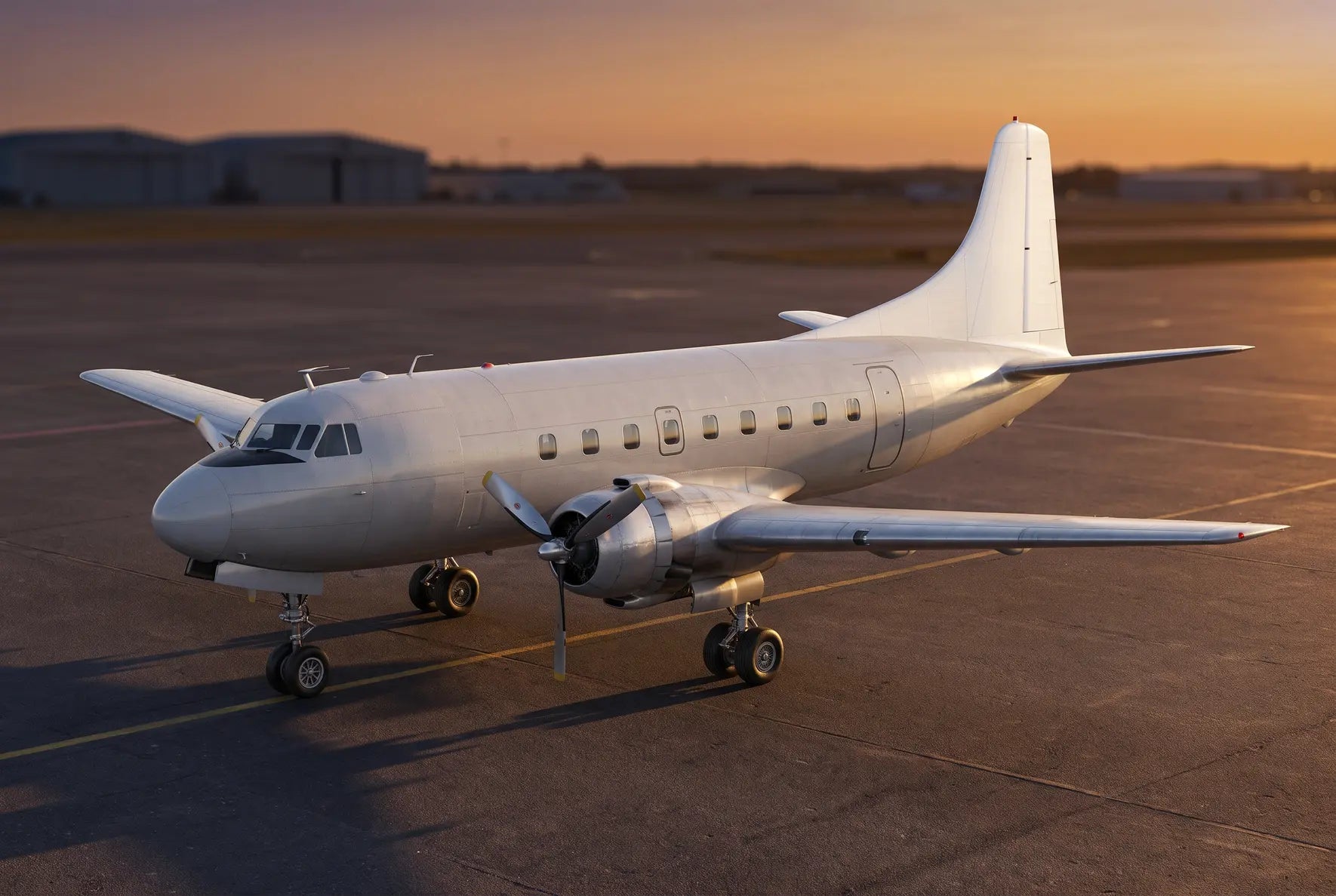
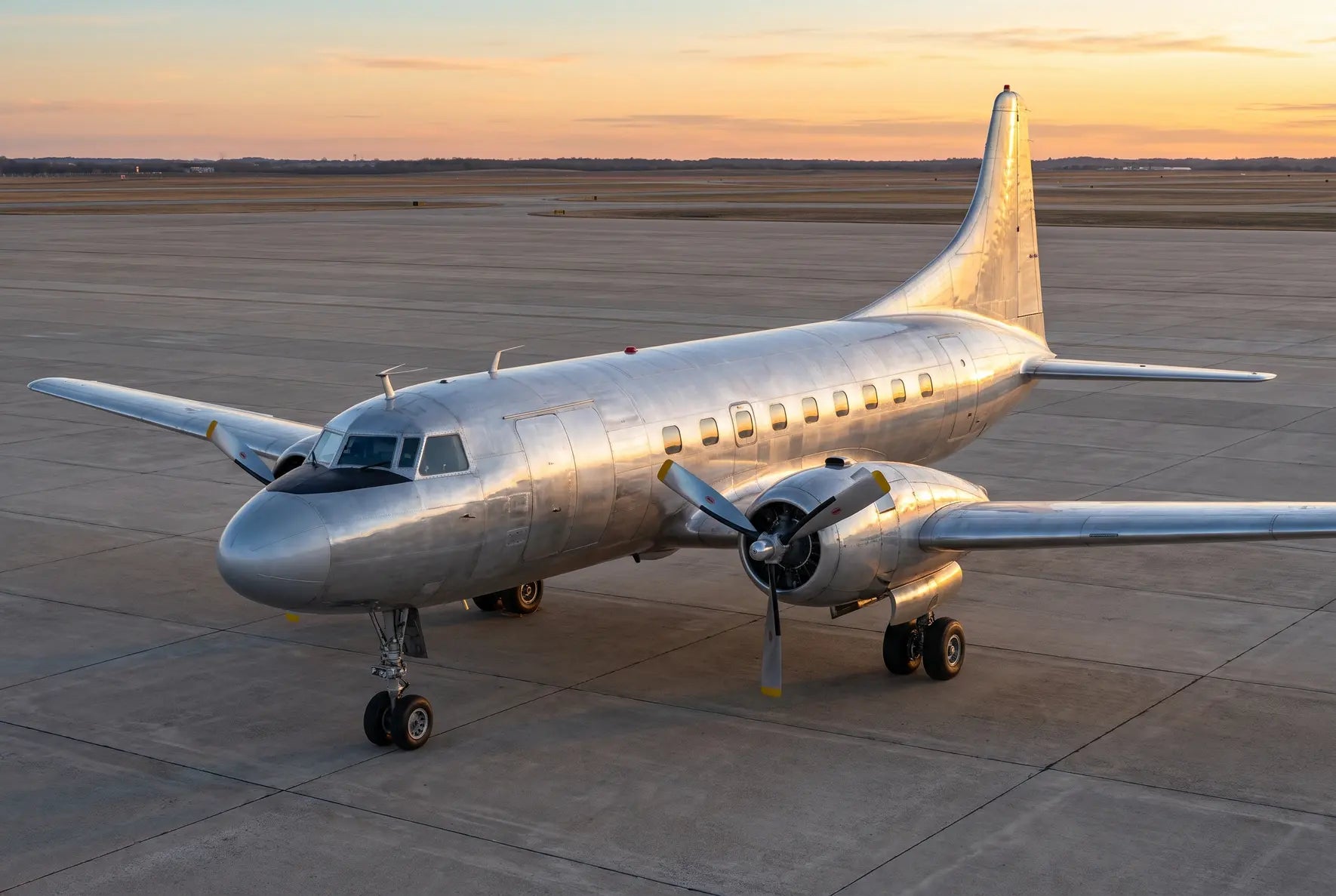
The Convair CV-240 was conceived in the years immediately after the Second World War, when American carriers were searching for a modern successor to the ubiquitous but unpressurized Douglas DC-3. The type was designed and built by Consolidated Vultee Aircraft Corporation, the company universally known as Convair. The result was a pressurized, twin-engine short- to medium-range transport that helped define the postwar regional airliner and earned the marketing name Convairliner. A useful overview of the wider piston-Convair family is maintained by the Convair 240 family reference.
The program traces directly to a specification issued by American Airlines in 1945, which called for a pressurized twin-engine airliner seating around 40 passengers for local and short-haul routes. Convair first answered with the Model 110, an unpressurized design carrying roughly 30 passengers. Although the Model 110 flew, it did not fully satisfy American's requirements for cabin pressurization and capacity, so Convair undertook a substantial redesign. The fuselage was lengthened to accommodate 40 seats as standard and the cabin was pressurized, producing what became the definitive Model 240.
The chronological milestones of the program are well documented:
- 1945: American Airlines initiates the design requirement that shapes the aircraft.
- 16 March 1947: First flight of the CV-240 prototype (registration NX90849) at San Diego, as recorded by the Smithsonian National Air and Space Museum.
- February 1948: First delivery to American Airlines, indicating type certification around this time.
- 1 June 1948: Entry into revenue service with American Airlines.
Power came from two Pratt & Whitney R-2800 Double Wasp 18-cylinder air-cooled radial engines, typically the R-2800-CA18 variant. Sources place normal output at about 2,100 hp per engine, with up to 2,400 hp available for takeoff on installations fitted with water-methanol injection. The pressurized cabin, tricycle landing gear and built-in air stairs gave the type a clear operational edge over the DC-3, allowing higher cruising altitudes and improved passenger comfort. Typical performance included a cruise speed near 451 km/h (280 mph) and a baseline range around 1,930 km (about 1,200 miles). Readers interested in later pressurized twins may also find our coverage of the Boeing 747-100SR a useful contrast in how manufacturers tailored aircraft to specific route demands.
What Sets the CV-240 Apart From the CV-340 and CV-440
The CV-240 is the foundational member of the piston-Convair family, and the later CV-340 and CV-440 were progressively enlarged and refined developments of it rather than clean-sheet designs. All three share the same low-wing layout and the same basic R-2800 powerplant, but the later variants introduced a longer fuselage, greater wingspan and higher passenger capacity. The CV-440, marketed as the Metropolitan, added more aerodynamic engine cowlings and noise-reduction refinements. In short, the CV-240 offered the original 40-seat pressurized configuration, while its successors traded that baseline for more capacity, range and improved economics.
The following points summarise the key identifiers that distinguish the CV-240 in its original form:
- Engines: Two Pratt & Whitney R-2800-CA18 Double Wasp radials, roughly 2,100 hp normal.
- Cabin: First pressurized commercial twin-engine airliner, standard 40-seat layout (configurations from about 32 to 44 passengers).
- Fuselage: Baseline 240 length, stretched from the Model 110 but shorter than the CV-340/CV-440.
- Systems: Tricycle landing gear with integrated forward and ventral air stairs.
- Production: CV-240 series built from 1947 to about 1954; the 240 series (including military derivatives such as the T-29 trainer and C-131) totalled several hundred airframes, per Airliners.net production data.
The transition from the Model 110 to the definitive Model 240 illustrates how a launch customer's insistence on pressurization reshaped an entire program. Rather than a modest modification, American Airlines' demand for a pressurized 40-seat cabin drove a redesign extensive enough to create a new model, one that established the design language carried forward into every later piston Convairliner.

A Convair CV-440 Metropolitan aircraft from Scandinavian Airlines System (SAS) is captured in flight above a scenic landscape, showcasing its sleek design and the airline's branding. The aerial view includes a coastline and a mountainous region.
Convair CV-240 Technical Specifications, Systems and Engines
The Convair CV-240 was conceived in the late 1940s as a pressurised, twin-engine short-to-medium range airliner intended to replace the unpressurised Douglas DC-3 on regional and feeder routes. Its design balanced a comfortable, cabin-altitude-controlled interior for around 40 passengers against the runway performance and reliability demanded by post-war domestic networks. The result was a rugged, tricycle-gear aircraft that offered airline passengers a faster, higher and smoother ride than the piston twins it succeeded, while retaining relatively modest field-length requirements.
Technically, the CV-240 traded outright range for payload flexibility and dependable climb performance from two powerful radial engines. Its low-wing, all-metal construction and integral airstair made it well suited to airfields with limited ground infrastructure, a philosophy of self-sufficiency later echoed in larger and more modern types across the industry, including freighters such as the Boeing 747-400ERF.
- Wingspan: 91 ft 9 in (27.97 m), per Smithsonian National Air and Space Museum data.
- Length: 74 ft 8 in (22.76 m).
- Height: 26 ft 11 in (8.82 m).
- Wing area: 817 ft² (75.9 m²).
- Empty weight (OEW): approximately 25,445 lb (11,542 kg).
- Maximum gross weight (MTOW): approximately 42,500 lb (19,280 kg).
- Passenger capacity: 40 in a pressurised cabin, with a flight crew of two to three.
- Maximum speed: around 315 mph (274 kt, 507 km/h).
- Cruise speed: roughly 280 mph (244 kt, 451 km/h) at maximum cruise; lower normal cruise settings are also documented.
- Range: about 1,200 mi (1,930 km) baseline, extending toward 1,800 mi (2,900 km) with favourable payload, as noted by Aeropedia.
- Service ceiling: commonly listed at 16,000 ft (4,880 m), with higher figures cited for some later configurations.
- Initial rate of climb: about 1,520 ft/min (463 m/min).
- Engines: two Pratt & Whitney R-2800 Double Wasp 18-cylinder radials in the 2,100 to 2,400 hp class.
Systems and Handling-Relevant Technology
As a piston-era airliner, the CV-240 relied on conventional mechanically and hydraulically actuated flight controls rather than modern automation. Pressurisation and cabin conditioning were among its defining features, allowing operation at altitudes that improved passenger comfort and weather avoidance compared with earlier types. Braking used hydraulic wheel brakes on the tricycle undercarriage, and engine management depended on carburetted radial control, propeller governors and, on higher-rated variants, water-methanol injection to provide brief additional power for take-off, as described by the South Australian Aviation Museum.
Performance computation in this era was manual, using published charts for weight, temperature and pressure altitude, so pilots calculated take-off and landing distances against tabulated data rather than onboard performance systems. Health monitoring likewise depended on cockpit instrumentation and scheduled maintenance rather than electronic diagnostics.
Published figures for the CV-240 vary because operators specified different engine sub-types, cabin densities and weights, and because quoted numbers may reflect baseline certification values, maximum-payload conditions or optimised in-service settings. Range in particular depends heavily on payload and reserves, while cruise speed and ceiling shift with atmospheric assumptions and engine rating. Individual values should therefore be read as representative rather than absolute, and the SKYbrary CV-240 family entry is a useful cross-reference.
The Pratt & Whitney R-2800 Double Wasp
The CV-240 was powered by two Pratt & Whitney R-2800 Double Wasp engines, an 18-cylinder, two-row, air-cooled radial displacing roughly 2,800 cubic inches, hence its designation. Built by Pratt & Whitney, then a division of United Aircraft Corporation, the R-2800 was one of the most significant high-power piston engines of World War II and the early post-war period. On the CV-240, sub-variants such as the R-2800-CA3 and CA18 delivered a normal rating near 2,100 hp with up to 2,400 hp available for take-off, often assisted by water-methanol injection.
The engine's reputation for reliability at high output made it a natural choice for a demanding airline application. The same R-2800 family famously powered iconic wartime fighters including the Republic P-47 Thunderbolt and the Grumman F6F Hellcat, and it went on to serve numerous other military and civil designs of the period. Its combination of durability and readily available power gave the CV-240 the dependable climb and cruise performance that made it a successful transitional airliner between the DC-3 generation and the turboprop and jet aircraft that followed.
Convair CV-240 vs CV-340 vs CV-440 vs Douglas DC-3: Specifications Comparison
Scroll horizontally to see more →
| Parameter | Convair CV-240 | Convair CV-340 | Convair CV-440 | Douglas DC-3 |
|---|---|---|---|---|
| Entry into service | 1948 | 1952 | 1956 | 1936 |
| Engines | 2 × Pratt & Whitney R-2800 Double Wasp radial | 2 × Pratt & Whitney R-2800 Double Wasp radial | 2 × Pratt & Whitney R-2800 Double Wasp radial | 2 × Pratt & Whitney R-1830 Twin Wasp radial |
| Length | 22.8 m | 24.0 m | 24.1 m | 19.7 m |
| Wingspan | 28.0 m | 32.2 m | 32.2 m | 28.9 m |
| Height | 8.2 m | 8.3 m | 8.4 m | 5.2 m |
| Typical seating and layout (short description + approximate passengers) | Single-class: 40 passengers | Single-class: 44–48 passengers | Single-class: 48–52 passengers | Single-class: 21–32 passengers |
| MTOW | 19.3 t | 20.9 t | 21.6 t | 11.4 t |
| Range | 1,565 nm | 935 nm | 1,677 nm | 1,500 nm |
| Cruise speed | 0.37 Mach | 0.39 Mach | 0.40 Mach | 0.30 Mach |
| Service ceiling | 24,900 ft | 25,000 ft | 24,900 ft | 23,200 ft |
| Program note | Pressurized short-haul replacement for the Douglas DC-3, baseline member of the Convair 240 family. | Stretched, higher-capacity development of the CV-240 optimized for longer regional routes. | Further refined, modernized variant of the Convair piston airliners, offering improved comfort and performance. | Iconic unpressurized pre-war airliner that the Convair CV-240 family was designed to supersede on short-haul services. |
Scroll horizontally to see more →
This table compares key specs across the Convair CV-240 family and the Douglas DC-3, showing how the pressurized Convairs modernized short-haul travel. The CV-340/440 are longer and have wider wings than the CV-240, bringing higher seating and MTOW. All Convairs use R-2800 engines and cruise faster than the DC-3, while the CV-440 offers the longest range and highest typical capacity.
Convair CV-240 Routes, Missions and Airlines Around the World
The Convair CV-240 was designed as a pressurized, twin-engine piston airliner for short- and medium-haul work, powered by two Pratt & Whitney R-2800 Double Wasp radial engines. Introduced in 1948 as a modern replacement for the Douglas DC-3, it cruised at roughly 280 mph (450 km/h, about 240 kt) with a range of approximately 1,040 to 1,560 nmi (1,930 to 2,895 km) depending on fuel and payload. In practice, most sectors flown were far shorter, in the regional band of roughly 300 to 1,000 km, allowing airlines to schedule several short legs per day.
The type suited high-frequency feeder and point-to-point networks, connecting secondary and regional airports to larger trunk hubs. Its pressurized cabin let crews cruise higher and smoother than unpressurized rivals, improving comfort on business and medium-density domestic services. The main operational challenge for operators was economics: piston twins carried high maintenance demands on complex radial engines, and their 40-seat capacity limited unit revenue as jet and turboprop equipment arrived in the late 1950s and 1960s. Similar short-haul roles later passed to developments such as the stretched Convair 340, and to pilots flying regional networks like those documented in this overview of Alaska Airlines operations.
Where the Convair CV-240 operates
The CV-240 saw service across four broad regions. In North & South America, it flew dense domestic trunk-feeder schedules and regional city pairs. In Europe, national carriers used it on short- to medium-haul network routes between capitals and regional cities. In Asia, it served domestic and regional passenger routes, while in Africa it supported domestic and regional flying. Across all regions the missions were consistent: short sectors, multiple daily rotations, and feeder connectivity rather than long-haul service.
- Europe: KLM operated the type from 1948 to 1960 on European medium-haul passenger services; Swissair and Sabena flew short- to medium-haul network routes; LOT Polish Airlines used it on European passenger services, and Condor Flugdienst employed it in charter and tourist work.
- North & South America: American Airlines was the launch customer with about 75 aircraft on high-frequency domestic U.S. routes as a DC-3 replacement; Western Airlines, Continental Airlines and Pan American World Airways flew short- to medium-haul domestic and regional services; FAMA operated it on Argentine domestic and regional routes.
- Asia: Garuda Indonesia used the type on domestic and regional passenger routes across the Indonesian archipelago.
- Africa: Ethiopian Airlines operated the CV-240 on domestic and regional African routes.
Typical seating and cabin layouts
The standard CV-240 cabin seated 40 passengers, with some operators fitting up to 44 seats depending on pitch and configuration. Network carriers such as American Airlines often used the aircraft in comfortable domestic layouts that emphasized the pressurized cabin as a selling point over the DC-3, while leisure and charter users like Condor Flugdienst favored denser all-economy seating to maximize capacity on tourist sectors. Flight crews typically comprised three cockpit crew plus one cabin attendant. Because factory documentation did not fix a single universal class split, arrangements varied by operator; detailed figures on capacity and configuration are collected in the Convair 240 family reference and in preserved-aircraft records such as those held by the Smithsonian National Air and Space Museum.
In this video, learn how the Convair 240, ordered in 1946 by American Airlines chief C. R. Smith, was a pressurised twin-engine aircraft that did everything right, yet still ended up getting dumped.
Convair CV-240 Safety Record and How Safe Is It Today
The Convair CV-240 entered service with American Airlines in 1948 as one of the first pressurised twin-engine airliners, conceived as a modern successor to the Douglas DC-3. About 571 Convair 240s were built, with the wider CV-240/340/440 family exceeding a thousand aircraft. Placed against decades of service across trunk carriers, regional operators, charters and later cargo work, the type earned a strong early reputation: historical accounts note that the first 100 aircraft flew more than 840,000 hours before the first fatal accident in 1952, among the best records of any transport of its era. Over its long life roughly 78 Convair 240s were lost in accidents, a figure that reflects an ageing piston fleet migrating into secondary and freight roles rather than any fundamental design flaw. Many events clustered in the approach, landing and climb phases, consistent with piston-transport operations before modern warning systems. Independent databases such as the Aviation Safety Network catalogue these occurrences in detail.
Notable accidents and what changed afterwards
- American Airlines Flight 723 (1953, Albany, New York): a CV-240 descended below its approach profile and struck obstructions during an instrument approach, a controlled-flight-into-terrain event. Accidents of this type across the industry drove tighter approach minima, better instrument training and, eventually, terrain-warning technology.
- American Airlines Flight 476 (1955, near Forney, Missouri): an engine failure produced an in-flight fire and structural damage. The investigation reinforced the importance of engine maintenance discipline, fire protection and inspection of radial-engine powerplants.
- Sabena CV-240-12 (1953, Kelsterbach, near Frankfurt): loss of power on both engines shortly after takeoff, attributed to lead deposits fouling the spark plugs, with flap retraction at low speed as a contributory factor. The case highlighted engine handling, fuel and ignition maintenance, and stabilised departure procedures.
- Convair 240 charter (1977, near Gillsburg, Mississippi): the U.S. National Transportation Safety Board found fuel exhaustion and dual engine power loss, citing crew inattention to fuel status and inadequate planning. It remains a widely cited lesson in fuel management and flight planning.
How safe is the Convair CV-240?
Judged against its very high traffic volume in the 1950s and 1960s, the CV-240 was a sound and comparatively safe aircraft for its generation. Its pressurised structure, proven Pratt & Whitney R-2800 radial engines and retractable tricycle landing gear were advanced features that improved comfort and ground handling over earlier taildraggers. Most serious accidents traced back to operational, weather or maintenance factors rather than the airframe itself, and later hull losses often involved high-time aircraft in operations with less standardised oversight. Modern aviation safety rests on rigorous design certification, standard operating procedures, recurrent training and independent regulatory supervision, principles reflected in how airlines maintain professional crews today, as explored in our overview of BA CityFlyer pilot conditions. Aggregated statistics from the International Civil Aviation Organization and other bodies consistently confirm that, across generations of aircraft, commercial aviation remains one of the safest modes of transport.
01 What kind of routes and range was the Convair CV-240 designed for?
The Convair CV-240 was designed as a short- to medium-haul airliner, typically flying sectors of around 500 to 1,200 miles between regional and major cities. Its practical range in airline service was roughly 1,200 to 1,900 km depending on fuel load, payload, and weather, making it well suited to dense domestic networks. Airlines used it for multi-stop routes and feeder services into larger hubs rather than long intercontinental flights. This mission profile positioned the CV-240 as a modern replacement for the Douglas DC-3 on similar distances, but with faster speeds and pressurization.
02 What is the cabin experience like on a Convair CV-240?
The Convair CV-240 cabin is pressurized and air-conditioned, offering a more comfortable environment than earlier unpressurized piston airliners of its era. It typically seats about 40 passengers in a single-aisle layout, with relatively generous seat width but limited overhead storage compared with modern jets. Noise levels in the cabin are higher than in modern turbofan aircraft, especially near the engines and propellers, but conversation is still possible without headsets. The aircraft’s lower cruising altitude compared with jet airliners can give more pronounced sensations of turbulence, though its robust structure and wing design handle such conditions well.
03 Which airlines have operated the Convair CV-240 and on what kinds of routes?
The Convair CV-240 was operated by a range of U.S. and international carriers, including American Airlines, KLM, Lufthansa and others in the late 1940s and 1950s. These airlines used the type mainly on domestic and regional European or trans-border routes, such as multi-leg services between major cities and smaller regional airports. The aircraft was also popular as a corporate and charter transport once retired from frontline airline duties, often flying tailored business or group travel itineraries. Today, surviving CV-240s are largely found in museums or occasional heritage and special operations rather than scheduled airline service.
04 How does the Convair CV-240 perform compared with similar aircraft of its era?
Powered by two Pratt & Whitney R-2800 Double Wasp radial engines of around 2,100–2,400 hp each, the Convair CV-240 cruises at roughly 430–450 km/h, faster than the Douglas DC-3 it was intended to replace. Its pressurized cabin, tricycle landing gear, and integrated air stairs made it more modern and efficient in ground handling and passenger comfort than many contemporaries. In terms of fuel efficiency, it reflects typical piston-engined economics of the era, with higher specific fuel consumption than later turboprop successors like the Convair 580 but acceptable for short- to medium-range routes. Overall, it offered a good balance of speed, payload, and reliability for regional airline operations of the mid-20th century.
05 What is known about the safety record and design features of the Convair CV-240?
The Convair CV-240 family accumulated a long service history across airlines and military operators, with a safety record typical of piston airliners of its time. Its design includes a strong low-wing structure, dual-engine redundancy, and a pressurized fuselage, all contributing to predictable handling and structural resilience. Safety performance in service depended heavily on operator maintenance standards, crew training, and the operational environment, as with other aircraft of the period. While accidents did occur over the decades, they were generally in line with the risk profile of similar piston-powered transports, rather than indicating a specific systemic design flaw.
06 As a passenger, is there anything practical to know when flying on a Convair CV-240?
On a Convair CV-240, seats located farther from the engines and propellers, typically nearer the middle of the cabin, tend to be slightly quieter and may feel smoother. Window size is modest by modern standards but still offers good outside visibility, which many enthusiasts appreciate on approach and climb-out. The aircraft’s lower typical cruising altitude can make clouds and weather more visible, and turbulence may be felt more distinctly than on large jets, though within normal comfort levels for most travellers. Boarding is usually via built-in air stairs rather than jet bridges, giving a more direct, classic aviation experience when entering and exiting the aircraft.