

History and Development of the Britten-Norman BN-2A Mk III Trislander
The Britten-Norman BN-2A Mk III Trislander is a three-engined regional utility aircraft developed from the successful twin-engined BN-2 Islander. It was created to carry more passengers and payload over short feeder and inter-island routes while keeping the rugged short take-off and landing (STOL) qualities that defined its predecessor.
The manufacturer and the Islander family
Britten-Norman was founded on the Isle of Wight by aircraft designers John Britten and Desmond Norman. The company built its reputation on simple, robust utility aircraft, most notably the BN-2 Islander, a twin-engined STOL type conceived in the early-to-mid 1960s for short, rough airstrips. The Islander first flew in 1965 and became a commercial success, with more than 1,250 built over five decades. That success, combined with operators wanting greater capacity on the same demanding routes, provided the basis for a stretched, higher-capacity derivative. More detail on the type is available from SKYbrary and authoritative aviation references.
Why the Trislander was developed
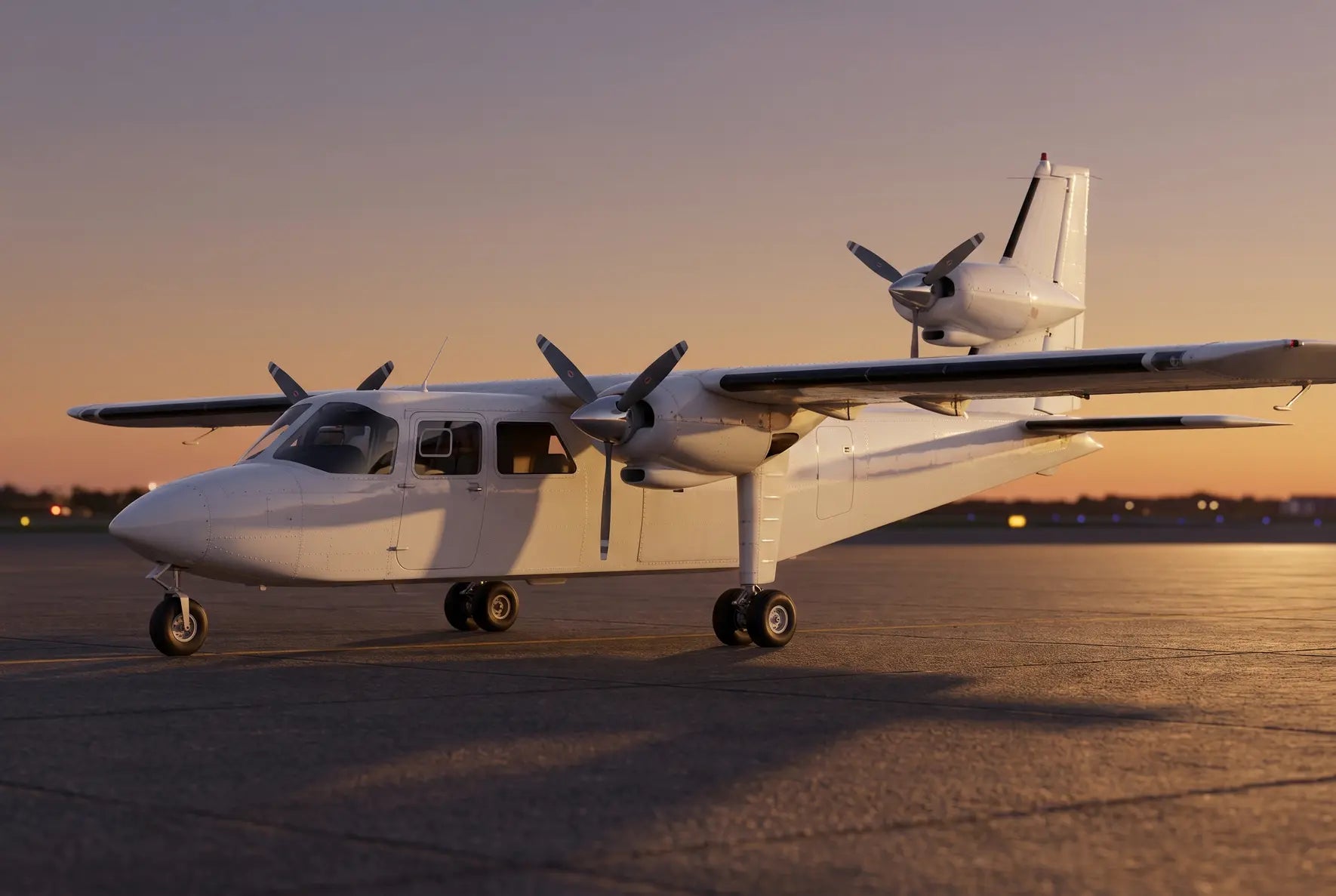
By the late 1960s, Britten-Norman identified demand for an aircraft offering greater seating and payload than the Islander but with similar rough-field capability. Rather than design an entirely new airframe, the engineers stretched the Islander fuselage, strengthened the fixed tricycle landing gear and structure, and added a third Lycoming engine on the fuselage centreline atop an extended fin. This third engine increased power for higher gross weights, improved take-off performance from short strips, and added engine-out redundancy on routes over water. The same philosophy of practical regional types links it to later turboprop feederliners such as the ATR 42-300.
Prototype, certification and entry into service
The prototype was converted from an existing Islander airframe and initially designated the Islander Mk.3. It made its first flight on 11 September 1970 at Bembridge, Isle of Wight, flying to the Farnborough Air Show the same day. Britten-Norman obtained type certification on 14 May 1971, with deliveries beginning in June 1971 and revenue service starting in July 1971 with launch customer Aurigny Air Services of Guernsey. Aurigny became the largest operator, flying up to 15 Trislanders. Production ran from 1970 to 1982, with about 73 aircraft delivered. Most were built at Bembridge on the Isle of Wight, though later ownership saw some assembly phases involving Belgium and Romania before UK certification.
What distinguishes the BN-2A Mk III variant
Compared with the twin-engined BN-2 Islander, the Trislander is a stretched, heavier, three-engined development. It carries up to 18 passengers against the Islander's typical 9 to 10, uses a third tail-mounted engine for extra power and redundancy, and has a strengthened structure and landing gear to handle a higher maximum take-off weight of around 10,000 lb. Within the Mk III line, several sub-variants were produced: the Mk III-1 short-nose first production version; the Mk III-2 with a lengthened nose for extra baggage and a higher operating weight; the Mk III-3 certified for the United States; and the Mk III-4, a Mk III-2 fitted with rocket-assisted take-off (RATO) for extremely demanding strips.
The following points summarise the key variant identifiers:
- Engines: 3 × Avco Lycoming O-540-E4C5 piston engines, 260 hp each, the third mounted atop the fin
- Capacity: up to 18 passengers, normally one pilot
- Maximum take-off weight: approximately 10,000 lb (4,536 kg)
- Performance: cruise around 135 to 151 kt, range about 1,000 mi (1,600 km), service ceiling near 13,150 ft
- Field performance: short take-off distance with operation from unprepared surfaces
- Sub-variants: Mk III-1, Mk III-2, Mk III-3 and the RATO-equipped Mk III-4
In essence, the Trislander preserved the rugged simplicity and field performance of the Islander while offering greater capacity, making it a practical solution for regional and island operators through the 1970s and beyond.

A Trislander aircraft operated by Aurigny Air Services is captured in mid-flight. The plane, notable for its distinctive yellow tail, bears the registration G-FTSE and promotional livery.
Technical Specifications, Systems and Powerplant of the BN-2A Mk III Trislander
The Britten-Norman BN-2A Mk III Trislander is a three-engined, high-wing, fixed-gear piston utility transport developed from the BN-2 Islander. Its mission was straightforward: move up to 17 passengers efficiently over short regional and inter-island sectors, from short or unprepared strips, while keeping acquisition and operating costs low. To achieve this, Britten-Norman stretched and strengthened the Islander fuselage and added a third Lycoming O-540 engine mounted high on an elongated tail fin, raising capacity and payload without redesigning the wing for heavier nacelles.
The design trade-offs are typical of a rugged commuter type. Fixed tricycle gear and a strut-braced high wing reduce complexity and tolerate rough surfaces, at the cost of cruise efficiency, while the centreline tail engine improves engine-out symmetry and lowers foreign-object-damage risk. Range, payload and field performance are therefore closely linked: heavier loads shorten range and lengthen takeoff runs.
- Wingspan: 53 ft 0 in (16.15 m)
- Length: 49 ft 3 in (15.01 m)
- Height: 14 ft 2 in (4.32 m)
- Wing area: 337 ft² (31.3 m²)
- Empty weight: approx. 5,842 lb (2,650 kg)
- MTOW: commonly published as 10,000 lb (4,536 kg); certain Mark III configurations are limited by the UK CAA Type Certificate Data Sheet to 9,350 lb (4,241 kg)
- Passengers: up to 17 (certified), with a total of 18 persons on board per the type certificate
- Range: approx. 870 nmi (1,000 statute mi, 1,600 km), depending on reserves and power setting
- Cruise speed: about 135 kt (155 mph) at 13,000 ft, 59% power
- Service ceiling: approx. 13,160 ft (4,010 m)
- Engines: 3 × Lycoming O-540-E4C5, 260 hp (194 kW) each, total 780 hp
- Fuel: roughly 185 US gal (700 L) in the traditional spec; main plus tip tanks give about 196 US gal total, with somewhat less usable per the TCDS
- Takeoff to 50 ft / landing from 50 ft: approx. 1,950 ft (590 m) and 1,445 ft (440 m) in book figures
Systems and handling-relevant technology
True to Britten-Norman's minimal-systems philosophy, the Trislander uses conventional manual flight controls with cable and pushrod runs, without powered or hydraulic boost, which suits an aircraft of this weight class and keeps maintenance simple. Braking is provided by conventional wheel brakes on the strengthened main gear; low approach speeds keep braking demands modest, and there is no complex anti-skid system. Each of the three air-cooled, six-cylinder engines drives a constant-speed propeller, with carburetted induction and pilot-managed mixture and power. The SKYbrary technical summary reflects the original baseline avionics as those of a 1970s light commuter: VHF COM/NAV, transponder and basic navigation aids, with more advanced equipment typically added by operators. The simplicity of these systems is part of what makes the type attractive on demanding short sectors, a context discussed in our overview of regional and short-haul operating conditions.
Published performance figures vary because they depend on operator options, cabin density, actual weights, fuel state, and atmospheric and runway assumptions. For example, some sources cite shorter STOL takeoff and landing distances near 393 m and 259 m at reduced weight with optimal technique, while conservative book figures assume near-MTOW operations. Certification documents from EASA's Type Certificate Data Sheet also note operating-altitude limits for specific sub-models that differ from the aerodynamic service ceiling. Numbers should therefore be read with their stated basis rather than as absolutes.
The Lycoming O-540 engine and its lineage
The Trislander is powered by three Lycoming O-540-E4C5 units, each a normally aspirated, carburetted, 540-cubic-inch (8.9 L) flat-six rated at 260 hp. The wider O-540 family was developed by Avco Lycoming as a higher-power evolution of its four-cylinder designs, aimed at mid-size general aviation and commuter aircraft in the roughly 235 to 350 hp class. It spans normally aspirated (O-540), fuel-injected (IO-540) and turbocharged (TIO-540) sub-variants, with the suffix codes denoting accessory and mounting configuration. In service since the late 1950s and 1960s, the O-540 series is among the most widely used six-cylinder piston engines in its class, found in types such as the Piper PA-32 Cherokee Six and Saratoga, the PA-28-235 family, and various Rockwell Commander, agricultural and utility aircraft. Selecting a proven, well-supported off-the-shelf powerplant was consistent with Britten-Norman's goal of low-cost, easily maintained operations, and the propellers fitted were typically Hartzell two-bladed constant-speed units.
BN-2A Mk III Trislander vs BN-2 Islander vs DHC-6 Twin Otter 300 vs Short 330-200 Specifications
Scroll horizontally to see more →
| Parameter | Britten-Norman BN-2A Mk III Trislander | Britten-Norman BN-2 Islander | DHC-6 Twin Otter Series 300 | Short 330-200 |
|---|---|---|---|---|
| Entry into service | 1971 | 1969 | 1970 | 1976 |
| Engines | 3 × Lycoming O-540-E4C5 piston engines | 2 × Lycoming O-540 or TIO-540 piston engines | 2 × Pratt & Whitney Canada PT6A turboprops | 2 × Pratt & Whitney Canada PT6A-45R turboprops |
| Length | 15.01 m | 10.86 m | 15.77 m | 21.35 m |
| Wingspan | 16.15 m | 14.02 m | 19.81 m | 22.76 m |
| Height | 4.32 m | 4.22 m | 5.94 m | 7.44 m |
| Typical seating and layout (short description + approximate passengers) | Single-class: 14–17 passengers | Single-class: 8–9 passengers | Single-class: 15–19 passengers | Single-class commuter: 30–36 passengers |
| MTOW | 4.54 t | 2.99 t | 5.67 t | 11.84 t |
| Range | 870 nm | 620 nm | 770 nm | 700 nm |
| Cruise speed | 0.24 Mach | 0.22 Mach | 0.30 Mach | 0.33 Mach |
| Service ceiling | 14,600 ft | 13,000 ft | 25,000 ft | 20,000 ft |
| Program note | Stretched three-engined development of the Islander, optimised for very short-haul regional routes from short and rough airstrips. | Baseline twin-engined utility commuter from which the Trislander was developed, focused on rugged short-field operations with smaller loads. | Rival STOL regional commuter offering higher performance and turboprop efficiency for similar short-haul missions. | Larger high-capacity commuter airliner providing a step up in seats for regional airlines on short sectors from modest airfields. |
Scroll horizontally to see more →
The table compares key specs of four short-haul/STOL commuter aircraft. The Trislander is a three-piston stretch of the Islander, adding seats (14–17 vs 8–9) and range (870 vs 620 nm) with higher MTOW. The Twin Otter’s PT6A turboprops deliver higher cruise (0.30 Mach) and a much higher ceiling (25,000 ft). The Short 330 is the largest, with 30–36 seats and the highest MTOW (11.84 t) but similar range.
Trislander Operations and Airlines: Routes, Missions and Operators Worldwide
The Britten-Norman BN-2A Mk III Trislander was conceived as a feederliner: a slow but rugged three-engined commuter built for very short sectors rather than speed. Most flights lasted between roughly 10 and 40 minutes, and the aircraft was rarely flown anywhere near its published 1,000 mi (1,600 km, 870 nmi) maximum range. Operators valued it for short-field performance, simple piston maintenance and the ability to carry up to 17 passengers on routes that could not support larger turboprops.
Daily utilisation followed a high-frequency, short-turnaround pattern. A single airframe typically flew many short legs from morning to evening, with brief ground times between sectors. Aurigny, the Guernsey-based launch operator, ran the type from July 1971 for more than four decades, making it the clearest example of sustained inter-island shuttle work in the Channel Islands.
Operationally, the Trislander suited point-to-point networks linking small communities to a regional gateway, rather than hub-and-spoke systems built around major hubs. It thrived at secondary and regional airfields with short or restricted runways. The main challenges for operators were its modest cruise speed of around 135-165 kt, a noisy and unpressurised cabin limited to about 10,000 ft, and, in later years, scarcity of spare parts and a shrinking pool of trained crews.
Where the Trislander Operates
Use of the type concentrated in four broad regions. In Europe, missions centred on Channel Islands and Scottish island links, flown by small scheduled carriers. Across the Americas, work focused on Caribbean island-hopping and short feeder hops in northern South America. In Asia and Oceania the aircraft served regional island routes, while in Africa it appeared with a handful of national and regional carriers on thin domestic sectors.
In each market the common thread was the same: short, frequent legs into airfields where demand and runway length ruled out larger equipment. For background on how small regional carriers structure such niche operations, see this overview of a boutique airline business model.
- Europe: Aurigny (Guernsey) was the launch customer and world's largest operator, flying Channel Islands services such as Guernsey-Alderney and Alderney-Southampton; Blue Islands (Jersey), Loganair and Lydd Air in the United Kingdom also operated the type on regional and island links.
- North & South America: LIAT (Antigua and Barbuda) and Anguilla Air Services used it for Caribbean island-hopping, while Roraima Airways and other carriers in Guyana flew short domestic feeder sectors.
- Asia: regional operators in Oceania, including Great Barrier Airlines (now Barrier Air) of New Zealand, used the type on short island routes such as services to Great Barrier Island.
- Africa: the Trislander was operated on thin regional sectors by carriers including Sierra Leone Airways.
Typical Seating Layouts
The cabin uses a narrow 1+1 arrangement with no central aisle, boarding through multiple side doors: three on the starboard side and two on the port side, so passengers enter the door nearest their row. Per the EASA type-certificate data sheet for the BN-2A Mk III-1, the aircraft is certified for one pilot and up to 17 passengers, a maximum of 18 persons on board.
In practice, network and scheduled operators usually installed 14 to 16 seats, with the rear cabin sometimes given over to luggage on baggage-heavy island runs, as noted in published Trislander specifications. Charter and leisure use followed similar ranges, trading a row or two of seats for cargo flexibility. There is no business or premium configuration: every seat is a single, all-economy commuter seat, which kept the aircraft simple and well matched to its short-sector mission.
In this video, step into the cockpit of Unity Airlines LITTLE TRISTAR, a Trislander BN-2A Mk III-2, for a full-flight AirClips view as pilots showcase rare aircraft operations and in-flight perspectives.
Safety Record of the Britten-Norman BN-2A Mk III Trislander: How Safe Is It?
The Britten-Norman BN-2A Mk III Trislander served from 1971 until production ended in 1982, with a comparatively small worldwide fleet of only a few dozen airframes. Because so few were built and many flew with small island and charter operators in remote regions, exposure data such as total flight hours and cycles is not centrally published, which makes precise statistical comparison with larger airliners difficult. The recorded accident history, catalogued by the Aviation Safety Network, includes both fatal and non-fatal events spanning several decades and continents, yet shows no single recurring catastrophic design flaw. The type developed a reputation as a robust short-haul commuter, most visibly with Aurigny Air Services, which operated up to roughly 15 aircraft on Channel Islands routes under UK Civil Aviation Authority oversight until retiring them in 2015.
Notable accidents and what changed afterwards
- 1980, Tumut, Australia (cargo flight, VH-EGU): An en-route loss of control was attributed to airframe and carburettor ice accumulation during a cold-front crossing, with two fatalities. The event reinforced icing-avoidance procedures and more conservative dispatch decisions for non-de-iced piston commuters, a generic hazard rather than a type-specific defect.
- 1977, Lanseria, South Africa (Southern Aviation): The aircraft struck the ground attempting a stall turn during an air display, sustaining major damage but with no fatalities. The primary factor was an aerobatic-style manoeuvre outside the type's intended envelope, prompting renewed emphasis on display authorisations and operating limitations rather than design change.
- 2009, Great Barrier Island, New Zealand (Great Barrier Airlines): The starboard propeller separated in flight and struck the fuselage, forcing an emergency landing with injuries but no deaths. Investigators identified undetected corrosion and fatigue of the propeller flange, leading to enhanced inspection and maintenance requirements for propeller hubs and mounting hardware.
These cases reflect distinct causes, icing, operational decision-making and maintenance-related component failure, rather than a common structural weakness, and most are documented in official reports linked through recognised safety databases.
How safe is the Trislander?
Judged against its traffic volume, the Trislander's safety profile is broadly consistent with other 1970s-era piston commuter aircraft operating in demanding environments. Its design philosophy favoured simplicity and resilience: three Lycoming piston engines for redundancy beyond a conventional twin, a non-pressurised cabin suited to lower-altitude sectors, and strengthened fixed landing gear. The certified design evolved accordingly, with the EASA Type-Certificate Data Sheet specifically referencing strengthened main undercarriage modifications. Safety in service therefore depends heavily on disciplined standard operating procedures, rigorous maintenance and continued airworthiness oversight by authorities such as the UK CAA and EASA, which issue and enforce airworthiness directives. The same dependence on maintenance culture and crew standards is evident across the wider piston-commuter community, including remote-route operators profiled in this overview of Everts Air operations. When properly maintained and flown within its limits, the type shows no evidence of being unusually hazardous as a design. For broader context, statistics compiled by organisations such as the International Civil Aviation Organization consistently confirm that, across aircraft types and eras, aviation remains one of the safest modes of transport.
01 What kind of routes and missions is the Britten-Norman BN-2A Mk III Trislander typically used for?
The Britten-Norman BN-2A Mk III Trislander is primarily used on short-haul regional routes, especially inter-island services and connections to remote communities. Its short take-off and landing performance allows it to operate from very short or semi-prepared airstrips, making it suitable for islands, rural regions, and coastal airfields. With a range of around 1,000 miles (about 1,600 km) in standard configuration, it comfortably covers typical sectors of 30 minutes to two hours. Historically it has been used for high-frequency shuttle flights, small-package cargo, and mixed passenger–freight operations where reliability and payload matter more than speed.
02 What is the passenger experience like inside a Britten-Norman BN-2A Mk III Trislander?
The Britten-Norman BN-2A Mk III Trislander has a narrow fuselage derived from the smaller Islander, with a single “wall-to-wall” seating layout and no central aisle, so boarding is via side doors rather than walking down the cabin. Most cabins are fitted for around 14–16 passengers, and luggage may be stored at the rear or in external compartments, so space can feel snug but practical for short flights. Noise levels are higher than on modern turboprops because of the three piston engines, so headsets or earplugs are often appreciated. The large windows and low cruising altitude, however, provide excellent views, which many passengers find to be the highlight of the trip.
03 Which airlines have operated the Britten-Norman BN-2A Mk III Trislander and on what types of routes?
The Britten-Norman BN-2A Mk III Trislander has been used mainly by small regional and island airlines rather than large carriers. Notable operators included airlines in the Channel Islands, the UK, the Caribbean, and other island chains, often using the type on very short routes of 15–45 minutes between nearby islands or between islands and the mainland. Typical examples include sectors comparable to London–Brussels in distance or mainland UK to the northern Channel Islands. As the aircraft is no longer in production and the fleet is aging, only a few examples remain in active commercial service, usually in niche regional roles.
04 How does the performance and role of the Britten-Norman BN-2A Mk III Trislander compare to similar regional aircraft?
The Britten-Norman BN-2A Mk III Trislander is slower than many modern turboprops, with a typical cruise of about 135–150 knots, but it excels in payload and short-field performance for its size. Its three Lycoming O-540 engines, each rated at around 260 hp, provide strong climb and redundancy, supporting safe operation from short, rough, or sloped runways where some faster aircraft cannot operate. Compared with similar 15–19 seat regional types, the Trislander usually offers lower operating costs and excellent low-speed handling at the expense of cruise speed and cabin refinement. This makes it more of a rugged utility airliner than a high-comfort commuter aircraft.
05 What is known about the safety record and design features of the Britten-Norman BN-2A Mk III Trislander?
The Britten-Norman BN-2A Mk III Trislander was designed as a robust utility type with a simple fixed landing gear, strong airframe, and three-engine configuration for added power and redundancy. The third engine mounted on the fin is a distinctive feature and provides extra thrust and improved climb performance, particularly valuable in hot-and-high or short-field conditions. Like many older regional aircraft, its safety record largely reflects the demanding environments it serves and the standards of individual operators rather than a single inherent design issue. Today the type is well documented in certification data and operating manuals, and remaining aircraft are operated under modern regulatory oversight and maintenance regimes.
06 As a passenger, are there any practical tips for flying on a Britten-Norman BN-2A Mk III Trislander?
On the Britten-Norman BN-2A Mk III Trislander, passengers who prefer a smoother ride may wish to sit near the wing or close to the aircraft’s center of gravity, typically mid-cabin, as very forward or aft seats can feel more motion on short sectors. The cabin is relatively noisy due to piston engines and propellers close to the fuselage, so bringing earplugs or using airline-provided hearing protection can enhance comfort. Hand luggage space is limited, so compact bags are most practical and heavier items are usually placed in dedicated baggage areas. Because the aircraft flies low and often over scenic areas, choosing a window seat can offer excellent views, especially on clear days over island or coastal routes.