

Boeing 727-100C: History, Development, and What Makes This Convertible Variant Unique
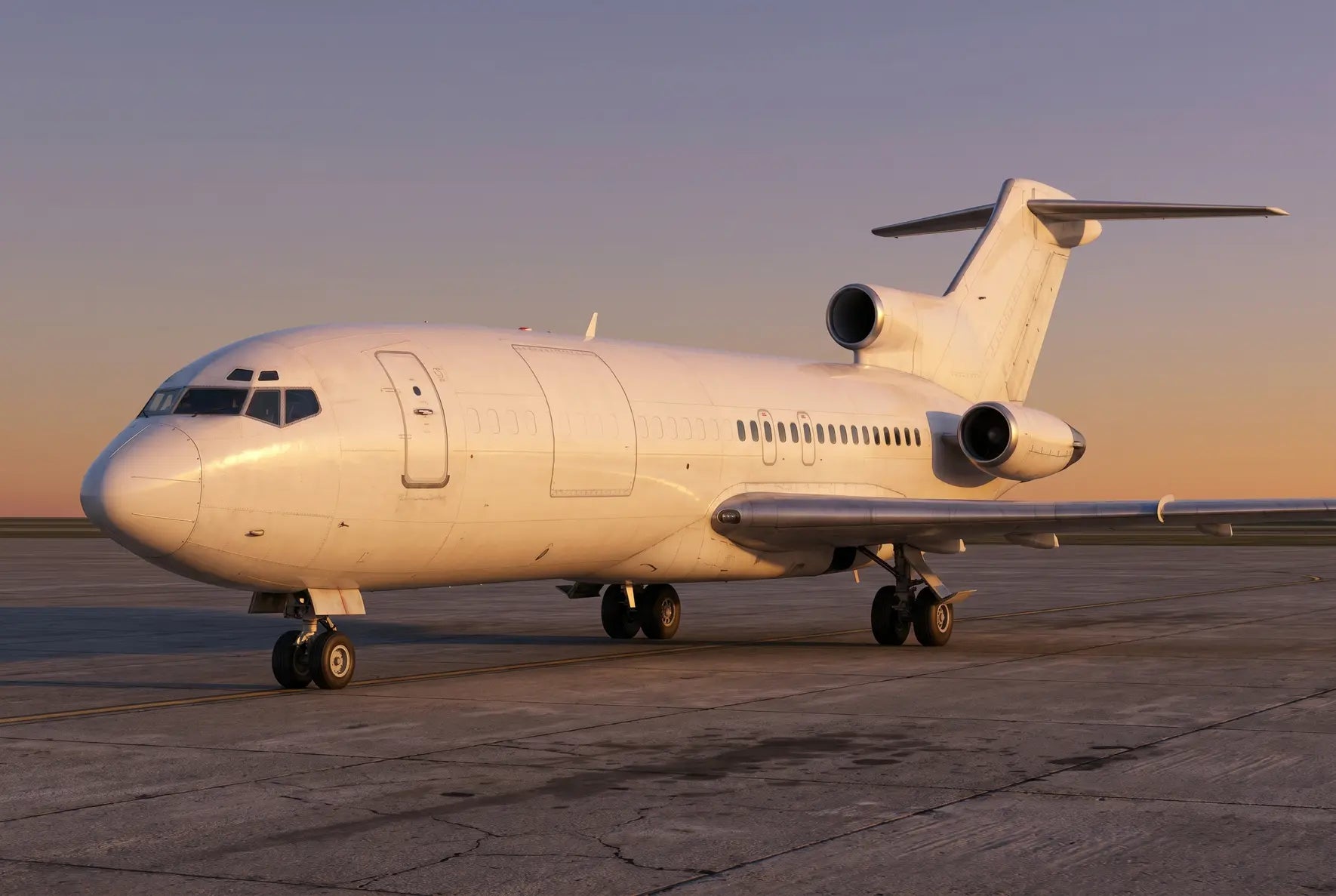
The Boeing 727 family was conceived in the late 1950s to fill a gap in the commercial jet market: a short-to-medium-range airliner capable of operating from shorter runways and smaller airports that the larger Boeing 707 and Douglas DC-8 could not efficiently serve. Boeing formally launched the 727 program on December 5, 1960, backed by launch orders from Eastern Air Lines and United Air Lines, each committing to 40 aircraft. The trijet configuration, with three Pratt & Whitney JT8D engines mounted at the rear fuselage, gave the aircraft the performance flexibility airlines demanded for a wide range of domestic and regional routes.
The first 727-100 prototype (registration N7001U) rolled out on November 27, 1962, at Boeing's Renton facility near Seattle, Washington. Its maiden flight followed on February 9, 1963, from Paine Field in Everett. The FAA granted type certification under Type Certificate A3WE on December 24, 1963, and Eastern Air Lines inaugurated commercial 727 service on February 1, 1964, flying the Miami-Washington-Philadelphia route.
As the standard passenger 727-100 proved its worth, airlines quickly identified demand for a version that could switch between passenger and freight operations. Boeing responded by developing the Boeing 727-100C (the "C" standing for "Convertible"), a factory-built variant structurally modified to carry main-deck cargo, passengers, or a combination of both. The 727C and 727-100C designations received FAA approval on January 13, 1966, as additions to the existing 727 type certificate. Deliveries of the Boeing 727-100C began shortly after certification, with early operators including Northwest Airlines, United Airlines, and Lufthansa. Boeing produced approximately 58 727-100C airframes out of a total of roughly 572 aircraft in the entire 727-100 series. Production of the short-body 727-100 line, including the convertible variant, ended in October 1972, as demand shifted toward the stretched Boeing 727-200 and 727-200 Advanced.
Like other members of the 727-100 family, the Boeing 727-100C was manufactured by Boeing Commercial Airplanes at its Renton, Washington plant. The aircraft was powered by three Pratt & Whitney JT8D low-bypass turbofan engines, with early deliveries commonly fitted with the JT8D-1, JT8D-7, or JT8D-9 variants, each producing around 14,000 to 14,500 lbf of thrust. These powerplants were the same family used across the broader 727 fleet, ensuring commonality in maintenance and pilot training. With a maximum takeoff weight of approximately 76,700 kg (169,000 lb), the 727-100C offered a range of around 2,250 to 2,300 nautical miles, depending on payload configuration.
What Distinguishes the Boeing 727-100C from Other 727-100 Variants
The defining feature of the Boeing 727-100C is its dual-role capability. Unlike the standard 727-100 passenger aircraft, which had no large side cargo door and a cabin floor rated only for passenger loads, the 727-100C introduced two critical structural changes: a large main-deck cargo door on the forward left fuselage (approximately 3.4 m wide by 2.0 m high), and a reinforced cabin floor with strengthened floor beams capable of supporting palletised freight. The cargo door was sized for compatibility with standard Boeing 707-320C pallets, allowing operators to use existing ground handling equipment and containers. In all-cargo configuration, the main deck could accommodate up to 8 pallets with a maximum payload of approximately 18,600 kg (41,000 lb). In a mixed combi layout, the aircraft carried around 52 passengers alongside 4 cargo pallets. When operated as a pure passenger aircraft, the 727-100C seated up to 94 passengers in a mixed-class arrangement.
A closely related sub-variant, the 727-100QC (Quick Change), shared the same cargo door and reinforced floor but added modular, palletised seating and pre-wired interior modules that enabled conversion between passenger and freight roles in approximately 30 minutes. The standard 727-100C, while fully convertible, required a longer turnaround time for reconfiguration and was better suited to operators with seasonal or longer-term shifts between passenger and cargo demand. For a comparison with another aircraft designed around operational flexibility, see the overview of the Antonov An-148, a regional jet built to serve challenging airfield conditions.
Key identifiers of the Boeing 727-100C compared to other 727-100 sub-variants include:
- Engines: 3 x Pratt & Whitney JT8D series (commonly JT8D-1, -7, or -9), same as the standard 727-100
- Main-deck cargo door: large forward left door (~3.4 m x 2.0 m), absent on the standard passenger 727-100
- Reinforced floor: strengthened floor beams and cargo tie-down fittings for palletised freight
- Cabin configurations: all-passenger (up to 94 pax), combi (52 pax + 4 pallets), or all-cargo (8 pallets)
- Maximum payload (all-cargo): approximately 18,600 kg (41,000 lb)
- MTOW: approximately 76,700 kg (169,000 lb)
- Pallet compatibility: standard Boeing 707-320C pallets
Over time, many 727-100C airframes transitioned from their original airline operators to dedicated cargo carriers in Latin America, Africa, and the Middle East, where their rugged design and cargo flexibility proved especially valuable on routes with limited infrastructure. The convertible concept pioneered by the Boeing 727-100C influenced subsequent Boeing designs, reinforcing the commercial logic of building aircraft that could adapt to shifting market demands between passenger and freight operations.

A Boeing 727 aircraft of Iberia, Spain's national airline, flies above the clouds under a clear blue sky. The plane features the airline's classic red and orange livery.
Boeing 727-100C Technical Specifications, Systems and Engine Overview
The Boeing 727-100C was the convertible passenger-freight variant of the original 727-100, designed to switch between all-passenger, all-cargo, or mixed configurations using the same airframe. Its defining structural change was a large main deck cargo door on the left forward fuselage, paired with a reinforced cargo floor capable of handling standard palletized freight. When operating as a passenger aircraft, the 727-100C was essentially identical in performance to the standard 727-100; in freighter mode, it offered a main deck payload of up to 18,600 kg (40,900 lb). The FAA approved the type under Type Certificate A3WE on 13 January 1966, covering the 727C and 727-100C alongside the baseline 727-100.
From a design standpoint, the 727-100C inherited the same rear-mounted trijet layout, T-tail, and triple-slotted flap system that gave the entire 727 family its reputation for excellent short-field performance. The convertible mission introduced a trade-off: the reinforced cargo floor and main deck door added structural weight compared to the pure passenger variant, slightly increasing operating empty weight while keeping the same maximum takeoff weight options. This meant that, in passenger configuration, range and payload margins were marginally reduced compared to a standard 727-100, while in freighter configuration, the aircraft could carry substantial cargo loads over short-to-medium-haul routes.
- Overall length: 40.59 m (133 ft 2 in)
- Wingspan: 32.92 m (108 ft 0 in)
- Height: 10.36 m (34 ft 0 in)
- Wing area: approximately 153 m² (1,650 sq ft)
- Main deck cargo door: approximately 3.4 m x 3.4 m (134 in x 134 in), left forward fuselage, outward-opening
- Main deck cargo volume: 99.7 m³; lower holds add approximately 25 m³
- Maximum payload (all-cargo): 18,600 kg (40,900 lb)
- Typical MTOW: 76,700 kg (169,000 lb)
- Fuel capacity: 29,100 litres (7,680 US gal)
- Typical range (passenger configuration): approximately 2,250 nmi (4,170 km); less at maximum freight payload
- Maximum cruise speed: approximately Mach 0.81 (518 kt / 960 km/h)
- MMO: Mach 0.90
- Service ceiling: 42,000 ft
- Engines: 3 x Pratt & Whitney JT8D low-bypass turbofans (14,000 to 14,500 lbf depending on variant installed)
- Takeoff field length (MTOW, sea level, ISA): approximately 2,500 m (8,200 ft)
- Landing distance (MLW, sea level, ISA): approximately 1,600 m (5,250 ft)
Systems, Flight Controls and Handling Technology
The 727-100C used the same fully powered hydraulic flight control architecture as every early 727. Three independent 3,000 psi hydraulic systems, designated A, B, and Standby, provided redundancy for all primary flight controls. The inboard and outboard ailerons, elevators, and dual-segment rudder were normally powered simultaneously by Systems A and B. If one system failed, full control authority was maintained on the remaining system. In the unlikely event of both A and B failing, ailerons and elevators reverted to manual cable control, while the lower rudder could be driven by the Standby system. Artificial feel was provided through dual feel computers fed by pitot pressure and stabilizer position, ensuring consistent control forces across the speed range.
The horizontal stabilizer was electrically trimmed via a jackscrew actuator, controlled by thumb switches on the yokes, an autopilot input, or manual trim wheels. Trailing-edge and leading-edge high-lift devices were hydraulically driven, with an alternate flap system using the standby hydraulic pump. Flap asymmetry protection automatically stopped drive motion if differential extension was detected. Two independent yaw damper systems, one for the upper and one for the lower rudder segment, suppressed Dutch roll, a characteristic consideration of the swept-wing design. Anti-skid braking used wheel-speed sensors on the main gear to modulate hydraulic brake pressure and prevent wheel lock-up, particularly important during heavy-weight freighter landings on shorter runways. The avionics suite was a standard 1960s analog flight deck with dual flight directors, a coupled autopilot for ILS approaches, HSI with VOR/localizer course selection, and a stall warning computer driving a stick shaker activated by angle-of-attack sensing. Like all modern freighter conversions, the 727-100C concept influenced later convertible and quick-change designs, a lineage that extends to aircraft such as the Boeing 737-800BCF.
Published performance figures for the 727-100C can vary significantly depending on the installed engine variant, operator-selected weights, cabin density in passenger mode, atmospheric conditions (temperature and pressure altitude), and runway surface state. The takeoff and landing distances noted above assume sea level, ISA conditions, dry runway, and no wind. Operators planning missions at high-altitude or hot airports, or on contaminated runways, must consult the FAA-approved Airplane Flight Manual performance charts for the specific airframe serial number and engine configuration. Range figures likewise depend on payload, reserve fuel policy, and cruise altitude; the commonly cited 2,250 nmi applies to a typical two-class passenger layout and should not be treated as an absolute value.
Pratt & Whitney JT8D: The Engine Behind the 727-100C
Every Boeing 727-100C was powered by three Pratt & Whitney JT8D low-bypass turbofan engines, a powerplant family that became one of the most commercially successful in aviation history. The JT8D was a dual-spool design derived from the earlier J52 turbojet, featuring a single-stage fan, a six-stage low-pressure compressor, a seven-stage high-pressure compressor, a can-annular combustion section, a single-stage HP turbine, and a three-stage LP turbine. Its bypass ratio of roughly 1:1 was modest by later standards but represented a significant advance in fuel efficiency and noise over pure turbojets of the era.
The FAA Type Certificate for the 727-100C approved several JT8D variants. The most common engines fitted to 727-100C aircraft in service were the JT8D-1 and JT8D-7, each rated at 14,000 lbf (62.3 kN) of takeoff thrust, and the JT8D-9, rated at 14,500 lbf (64.5 kN). Higher-thrust models such as the JT8D-11 (15,000 lbf), JT8D-15, and JT8D-17 (up to 17,400 lbf) were also approved under A3WE, though these were more commonly associated with the later 727-200 series.
The JT8D first flew on the Boeing 727 prototype in February 1963 and entered commercial service in 1964. Pratt & Whitney reports that more than 14,750 JT8D engines were produced, accumulating hundreds of millions of flight hours before production ended around 2001. Beyond the 727, the standard JT8D family powered the Boeing 737-100 and 737-200, the McDonnell Douglas DC-9 series, the Sud Aviation Caravelle (re-engined variants), and the Dassault Mercure. A military derivative, the Volvo RM8, served as the afterburning powerplant of the Saab 37 Viggen fighter. The later JT8D-200 series, with thrust ratings from 18,500 to 21,700 lbf and a higher bypass ratio, became the exclusive engine for the McDonnell Douglas MD-80 family. The JT8D's combination of robust design, relatively simple construction using solid turbine blades, and broad operator base made it a cornerstone of narrow-body jet operations for over four decades.
Boeing 727-100C vs 727-100 vs 727-200Adv vs Douglas DC-9-30 Specifications Comparison
Scroll horizontally to see more →
| Parameter | Boeing 727-100C | Boeing 727-100 | Boeing 727-200Adv | Douglas DC-9-30 |
|---|---|---|---|---|
| Entry into service | 1967 | 1964 | 1967 | 1967 |
| Engines | 3 × Pratt & Whitney JT8D turbofans | 3 × Pratt & Whitney JT8D turbofans | 3 × Pratt & Whitney JT8D turbofans | 2 × Pratt & Whitney JT8D turbofans |
| Length | 40.59 m | 40.59 m | 46.69 m | 36.37 m |
| Wingspan | 32.92 m | 32.92 m | 32.92 m | 28.47 m |
| Height | 10.44 m | 10.44 m | 10.44 m | 8.22 m |
| Typical seating and layout (short description + approximate passengers) | Convertible combi/cargo-passenger: 52 passengers | Passenger narrow-body: 106–131 passengers | Stretched passenger narrow-body: 134–189 passengers | Short/medium-haul narrow-body: 80–115 passengers |
| MTOW | 76 t | 77 t | 95 t | 44 t |
| Range | 4,170 nm | 2,250 nm | 2,550 nm | 1,700 nm |
| Cruise speed | 0.81 Mach | 0.81 Mach | 0.81 Mach | 0.76 Mach |
| Service ceiling | 37,000 ft | 37,000 ft | 37,000 ft | 37,000 ft |
| Program note | Convertible -100 variant with strengthened floor and cargo door for mixed passenger/freight service. | Baseline short-fuselage 727 passenger model and original high-capacity short-haul trijet. | Stretched 727 family member with higher seating capacity and improved payload economics. | Two-engine DC-9 benchmark from the same era, representing a smaller conventional narrow-body competitor. |
Scroll horizontally to see more →
The table compares key specs and roles of the Boeing 727 family and the Douglas DC-9-30. All 727 variants share three JT8D engines and similar cruise (Mach 0.81) and ceiling (37,000 ft), but the 727-200Adv is longer, heavier (95 t MTOW) and seats up to 189. The 727-100C trades passenger capacity (52) for a combi cargo floor and has the longest listed range (4,170 nm). The DC-9-30 is smaller, twin-engine, and lighter (44 t MTOW) with shorter range and slower cruise.
Boeing 727-100C Operations: Airlines, Typical Routes and Missions Worldwide
The Boeing 727-100C was the convertible variant of the original short-body 727, designed from the outset to switch between passenger, mixed (combi), and all-cargo configurations. Fitted with a large forward main-deck cargo door measuring approximately 2.18 x 3.40 metres and a reinforced cabin floor, this variant gave operators the flexibility to run daytime passenger schedules and overnight freight services with the same airframe. Reconfiguration between layouts could be completed in roughly 30 minutes on the Quick Change (QC) sub-variant, and only slightly longer on the standard 727-100C.
Typical missions fell in the short-to-medium-haul bracket, with sector lengths generally between 300 and 1,200 nautical miles (approximately 550 to 2,200 km), translating to flights of one to three hours. With a published range of around 2,250 nmi (4,170 km) in passenger configuration and three Pratt & Whitney JT8D engines, the aircraft could cover most domestic trunk routes and intra-regional international services. In cargo mode, practical economic range was often shorter, around 1,000 to 1,800 nmi, due to the fuel-payload trade-off at higher gross weights. Daily utilisation for mainline passenger carriers commonly reached 6 to 9 block hours, spread across four to six rotations. Cargo and express operators, by contrast, concentrated flying into nighttime windows, typically accumulating 5 to 8 block hours per night on hub-and-spoke parcel networks.
The Boeing 727-100C thrived in both hub-and-spoke and point-to-point operating models. In hub-and-spoke networks, it was particularly effective for overnight express cargo, connecting spoke cities to a central sorting facility and returning before dawn. In passenger service, airlines deployed the variant on feeder routes linking secondary cities to major hubs. Point-to-point operations were common for charter and inclusive-tour flights, as well as direct freight links between non-hub city pairs. The aircraft's ability to operate from shorter runways, as described in the Boeing 727 Wikipedia entry, made it well suited to secondary and regional airports with limited infrastructure. However, as a three-engined, older-generation narrowbody, the type faced increasing challenges from rising fuel costs and tightening noise regulations. Most 727-100C aircraft were originally Stage 2 compliant, requiring expensive hushkit modifications or engine changes to meet ICAO Chapter 3 and FAA Stage 3 standards, which gradually pushed the variant out of service in noise-sensitive regions.
Where the Boeing 727-100C Operated Around the World
The Boeing 727-100C saw service across four broad regions, though the majority of deliveries went to carriers in North America and Europe. In the United States, major trunk carriers used the convertible variant on high-frequency domestic routes, switching airframes to cargo duty at night for mail and express freight. European operators valued the type for intra-continental scheduled services and charter flights to Mediterranean holiday destinations. In South America, the aircraft served both domestic trunk routes and regional international links, with the combi capability proving especially useful on routes where passenger demand was moderate but freight volumes were significant. Operators in Africa and parts of Asia generally acquired 727-100C airframes second-hand, deploying them on domestic and regional services where the type's short-field performance and cargo flexibility remained valuable assets. Airlines operating on routes connecting remote communities, much like those profiled in our feature on Air Austral, often relied on convertible narrowbodies to balance passenger and freight demand on thinner routes.
- North & South America: In the United States, Eastern Air Lines operated approximately 25 727-100C freighters alongside its large passenger 727 fleet, using them on East Coast trunk and Florida routes. United Airlines deployed a subset of its 727-100 fleet as convertible aircraft on domestic services from Chicago O'Hare, Denver and San Francisco, rotating them into overnight mail and express cargo runs. TWA used its 727-100C aircraft on trunk routes from New York, St. Louis and Kansas City, with nighttime freight conversions on the same city pairs. Northwest Orient operated convertible 727-100s on Upper Midwest and Great Lakes routes from Minneapolis/St. Paul and Detroit. Alaska Airlines was among the largest 727-100C operators, with seven aircraft, taking advantage of the convertible layout on routes to Alaskan communities where both passenger seats and main-deck freight capacity were essential. Braniff International Airways used four 727-100C aircraft on its domestic and Latin American network. In South America, Transbrasil operated six 727-100C aircraft in combi roles on Brazilian domestic routes linking São Paulo, Brasília and regional cities.
- Europe: Lufthansa operated 727-100C convertible aircraft on intra-European routes from Frankfurt and Munich, using them for passenger service by day and freight or mail at night. Sabena of Belgium flew three 727-100C aircraft on short- and medium-haul European services in mixed passenger-cargo configurations. Dan-Air in the United Kingdom operated two 727-100C aircraft, primarily on charter and inclusive-tour flights from London Gatwick to Mediterranean leisure destinations, switching to freight or combination roles during off-peak tourist seasons.
- Asia: Documented 727-100C operations in Asia were more limited. Iran Air operated early 727-100 convertible variants on domestic and regional Middle Eastern routes, with some airframes later redeployed as freighters. Several aircraft passed through Gulf-based charter and cargo operators on a lease or second-hand basis.
- Africa: South African Airways operated 727-100s, with part of the fleet featuring convertible capability on domestic routes such as Johannesburg to Durban and Port Elizabeth, as well as regional services. Various West and Central African carriers acquired ex-US and ex-European 727-100C airframes for charter, Hajj, and cargo operations.
Typical Seating Configurations on the Boeing 727-100C
Because the Boeing 727-100C was a convertible aircraft, its cabin layout depended entirely on the operator's mission. According to a 1968 Boeing general description document, the baseline all-passenger layout seated up to 128 passengers in a single-class, six-abreast (3-3) economy arrangement at a seat pitch typical of charter operations. In a standard two-class configuration, the aircraft typically carried around 106 passengers: 8 to 12 in first class (2-2 abreast, with 20-inch spacing between armrests and a 23-inch aisle) and 80 to 100 in economy (3-3 abreast). Network carriers such as United Airlines configured their 727-100s with as few as 96 seats (10 first class and 86 coach), reflecting more generous pitch, while high-density operators pushed closer to 119 to 128 seats in single-class layouts. In the combi arrangement, the forward cabin accommodated four standard cargo pallets while the aft section retained approximately 52 passenger seats in mixed-class seating. In full-cargo mode, the entire main deck accepted up to eight pallets for a maximum structural payload of around 17,000 to 18,600 kg. Further details on 727-100 cabin layouts can be found on Simple Flying's guide to Boeing 727 variants.
In this video, experience a cockpit view aboard a private Boeing 727-100 Super 27 as it departs Sacramento McClellan (MCC) and continues to Stockton (SCK) for a touch-and-go, filmed November 19, 2018.
Boeing 727-100C Safety Record: Accident History and How Safe Is It?
Across the entire Boeing 727 programme, 1,832 airframes were delivered between 1963 and 1984. Of those, 572 belonged to the short-body 727-100 family, which includes approximately 53 factory-built Boeing 727-100C convertible variants. Over more than four decades of commercial service, the 727 fleet accumulated roughly 76.6 million flights worldwide. According to the Wikipedia accident register, around 120 Boeing 727 airframes of all variants have been lost to accidents, criminal acts or other causes. For the 727-100 series specifically, the Aviation Safety Network (ASN) database records approximately 45 hull-loss events, a figure that includes cargo operations, ground-damage write-offs and deliberate acts. Many of these losses occurred during the type's later years, when older 727-100 and 727-100C airframes transitioned to freight duty with smaller operators, sometimes in regions with limited infrastructure and less regulatory oversight.
Notable Accidents and Their Legacy
Several incidents involving the 727-100 family, including the convertible 727-100C, led directly to meaningful improvements in aviation safety.
- Civil Air Transport Flight 010 (1968) - On 16 February 1968, a Boeing 727-92C (a 727-100C sub-variant) registered B-1018 crashed during an ILS approach to Taipei Songshan Airport, killing 21 of the 63 people on board plus one person on the ground. Investigators found that a senior pilot, who was not the assigned pilot-in-command, had taken the left seat without authorisation and allowed the aircraft to descend well below the glide slope. The radio altimeter warning sounded at approximately 350 feet AGL, yet corrective action came too late. The aircraft struck terrain short of the runway. This accident underscored the dangers of unauthorised cockpit role changes and weak altitude monitoring, themes that would later become central to Crew Resource Management (CRM) training programmes introduced across the industry from the late 1970s onward.
- TWA Flight 514 (1974) - On 1 December 1974, a Boeing 727-231 struck Mount Weather in Virginia during an approach to Washington Dulles, killing all 92 on board. The crew had descended below the minimum safe altitude after misinterpreting an ATC clearance. The NTSB investigation triggered sweeping changes to approach-chart design, ATC phraseology for descent clearances, and the depiction of minimum safe altitudes on instrument procedures. Together with other controlled-flight-into-terrain (CFIT) events, it accelerated the FAA mandate requiring Ground Proximity Warning Systems (GPWS) on all large turbine-powered transport aircraft under 14 CFR 121.360, a rule that directly benefited every 727 still in service.
- SAM Colombia Flight 501 (1993) - A Boeing 727-46 operating from Bogota to Medellin began its descent approximately 44 nautical miles too early and flew into mountainous terrain, killing all 132 occupants. The investigation highlighted deficiencies in terrain awareness, navigation discipline, and ATC coordination. This accident, alongside similar CFIT events in the Andes, reinforced the push for Enhanced GPWS (EGPWS) with predictive terrain-mapping capability, which later became standard on surviving 727 fleets and all new transport aircraft worldwide.
Each of these events, while tragic, produced lasting regulatory and procedural improvements that made not only the 727 but the entire global fleet safer. Stabilised-approach criteria, mandatory go-around policies, and standardised altitude callouts all trace part of their origin to lessons learned from 727-era operations.
How Safe Is the Boeing 727-100C Today?
When measured against the volume of traffic it handled, the Boeing 727 family achieved a fatal-event rate of approximately 0.50 per million flights, according to AirSafe.com. That figure is lower than contemporaries such as the Boeing 707 (around 1.0 per million flights) and broadly comparable to or slightly better than the DC-9 and DC-10. The 727-100C, as a sub-variant operating within the same regulatory framework, benefited from the same design philosophy: a rugged tri-jet airframe with triple-redundant hydraulic systems, proven Pratt & Whitney JT8D engines, and the ability to operate from shorter runways in diverse environments. Modern-generation jets like the 737NG or A320 family now achieve rates well below 0.10 per million departures, reflecting decades of incremental progress in avionics, materials and human-factors training. For anyone exploring how professional pilot careers have evolved alongside these safety gains, the transformation in standard operating procedures since the 727 era is remarkable.
Regulatory bodies such as the FAA and EASA, together with operators and manufacturers, continuously refine airworthiness directives, maintenance programmes and crew-training standards. The safety lessons drawn from the Boeing 727-100C and its variants have been embedded into the DNA of modern aviation oversight. As confirmed by Boeing's own Statistical Summary of Commercial Jet Airplane Accidents, fatal-accident rates across the global commercial fleet have declined by more than 60% over the past two decades alone. Commercial aviation remains, by a wide margin, one of the safest modes of long-distance transport available.
01 What is the Boeing 727-100C designed to do?
The Boeing 727-100C is a convertible version of the original 727-100, built to carry passengers, cargo, or a combination of both. Its key feature is the large main-deck cargo door, which lets operators switch missions more easily than on a standard passenger jet. That made it useful for airlines needing a flexible aircraft for both scheduled service and freight-heavy operations.
02 What kind of routes was the Boeing 727-100C used on?
The Boeing 727-100C was typically used on short- to medium-haul routes, where its runway performance and payload flexibility were most valuable. It could serve dense domestic routes, charter flying, and mixed passenger-freight schedules. In cargo use, it was also suited to regional and overnight freight missions that needed fast loading and unloading.
03 How did the Boeing 727-100C compare with other aircraft of its era?
Compared with twin-engine jets, the Boeing 727-100C offered strong performance from shorter runways and in hot-and-high conditions, thanks in part to its three-engine layout and rear-mounted engines. It was more versatile than many pure passenger aircraft because of its convertible cabin and freight door. The trade-off was higher fuel burn and maintenance complexity than later twinjets.
04 What is the passenger experience like on a Boeing 727-100C?
When fitted for passengers, the Boeing 727-100C usually had an older narrow-body cabin with a relatively small fuselage and less modern insulation than today’s aircraft. It was known for a louder cabin, especially near the rear-mounted engines, and for a more basic feel than newer jets. Seat comfort depended heavily on airline configuration, but window seats generally offered the best view and a classic jet experience.
05 Which airlines operated the Boeing 727-100C, and for what purpose?
The Boeing 727-100C was operated by airlines that needed flexibility between passenger and cargo work, especially during the 1960s through the 1980s. It was common with carriers that ran mixed-use schedules, charter services, and freight operations. Over time, many were converted to dedicated freighters or replaced by more efficient twin-engine aircraft.
06 What safety and design features should travelers know about the Boeing 727-100C?
The Boeing 727-100C has a T-tail and three rear-mounted engines, a design that helped with runway performance but also gave it a distinctive handling and noise profile. A well-known safety feature on the 727 family is the built-in airstair at the tail, which allowed independent boarding at airports without jet bridges. Like any older airliner, safety depends on maintenance, crew training, and operator standards, and the type’s record reflects decades of varied service rather than one single mission profile.