

History and Development of the Boeing 737 800BCF Converted Freighter Program
The Boeing 737 800BCF (Boeing Converted Freighter) emerged from a growing global demand for narrowbody freighter capacity driven by the rapid expansion of e commerce and express parcel logistics. By the mid 2010s, ageing classic freighters such as the 737 300F and 737 400SF were approaching the end of their economic service lives, while the pool of mid life 737 800 passenger aircraft offered an ideal feedstock for conversion. Boeing, leveraging decades of experience in passenger to freighter programmes across the 747, 767 and 757 families, identified the 737 Next Generation (NG) platform as the logical successor for the standard body cargo segment.
Program Launch and Key Milestones
In February 2016, Boeing officially launched the 737 800BCF programme, announcing an initial batch of conversion commitments. GE Capital Aviation Services (GECAS), the commercial aircraft leasing arm of General Electric, was named the launch customer with a significant fleet order. The first physical conversion was carried out at Boeing Shanghai Aviation Services (BSAS), a joint venture between Boeing, the Shanghai Airport Authority and China Eastern Airlines. Work on the inaugural airframe was completed ahead of schedule in approximately four months, with the aircraft finishing conversion on 15 October 2017 and a formal celebration held on 9 November 2017.
On 19 April 2018, Boeing announced the delivery of the first 737 800BCF to GECAS. The aircraft entered revenue service with West Atlantic Group, a Swedish cargo airline, marking the variant's operational debut. West Atlantic subsequently expanded its BCF fleet and became one of the programme's most prominent early operators across European freight networks.
Demand accelerated rapidly. By July 2018, GECAS had expanded its commitment to 35 firm orders. In September 2022, Boeing delivered the 100th 737 800BCF to AerCap (which had acquired GECAS in late 2021), confirming AerCap Cargo as the largest single customer. By mid 2024, Boeing had accumulated more than 280 orders and commitments from over 30 lessors and operators, with converted aircraft flying in more than 38 countries. To meet this demand, Boeing expanded its global conversion network to include STAECO in Jinan (China), GAMECO in Guangzhou (China), COOPESA in Costa Rica, KF Aerospace in Canada, and a Boeing operated facility at London Gatwick in the United Kingdom.
It is worth noting that the FAA Flight Standardization Board Report confirms the 737 800BCF is not approved for ETOPS operations, reflecting its design focus on short to medium haul cargo routes rather than extended overwater missions. For readers looking to learn more about aircraft variants and aviation topics in a broader context, the team behind Ready for Takeoff offers further resources.
What Sets the Boeing 737 800BCF Apart from Competing Conversions
The narrowbody freighter conversion market for the 737 800 platform features three main programmes: the Boeing 737 800BCF, the AEI 737 800SF by Aeronautical Engineers Inc., and the IAI 737 800BDSF by Israel Aerospace Industries. While all three transform the same passenger airframe into a cargo configuration, the Boeing programme holds a distinct advantage as the original equipment manufacturer (OEM). Boeing's access to proprietary original design data enables tighter integration of structural modifications with the baseline type certificate. According to Cirium Ascend Consultancy, the 737 800BCF accounts for roughly two thirds of all 737 800 freighter conversions, with AEI holding approximately 27% and IAI around 7%.
Boeing markets the 737 800BCF as offering 20% better fuel efficiency per tonne than classic 737 freighters, along with 29% more cargo volume and 23% greater payload. These figures are attributed to the longer fuselage, modern CFM56 7B engines and improved aerodynamics inherited from the 737 NG passenger platform. The conversion process itself includes the installation of a large main deck cargo door on the left hand side of the fuselage, structural reinforcement of the main deck floor to support palletised freight, a cargo handling system, a rigid cargo barrier, smoke detection and fire suppression systems, and the replacement of passenger windows with structural plugs.
The following summary highlights the verified variant identifiers of the Boeing 737 800BCF:
- Engines: two CFM International CFM56 7B series turbofans
- Maximum structural payload: 23,900 kg (52,800 lb)
- Maximum takeoff weight (MTOW): 79,015 kg (174,200 lb)
- Range at volume limited payload: approximately 2,000 nmi (3,750 km)
- Main deck cargo positions: 12 (eleven standard 88 × 125 in pallets plus one contoured half pallet)
- Main deck cargo door (left hand): 141 in × 86.5 in (358 cm × 220 cm) clear opening
- Wingtip configuration: blended winglets, as fitted to the donor 737 800 airframe
- Supernumerary seating: accommodation for up to four non flight crew members
- ETOPS: not approved

A Delta Air Lines Boeing 737-800 aircraft is seen in flight against a clear blue sky. The airplane is painted in the airline's distinctive livery and is captured from a side angle, highlighting its sleek design and aerodynamic features.
Boeing 737-800BCF Technical Specifications, Systems and Engine Overview
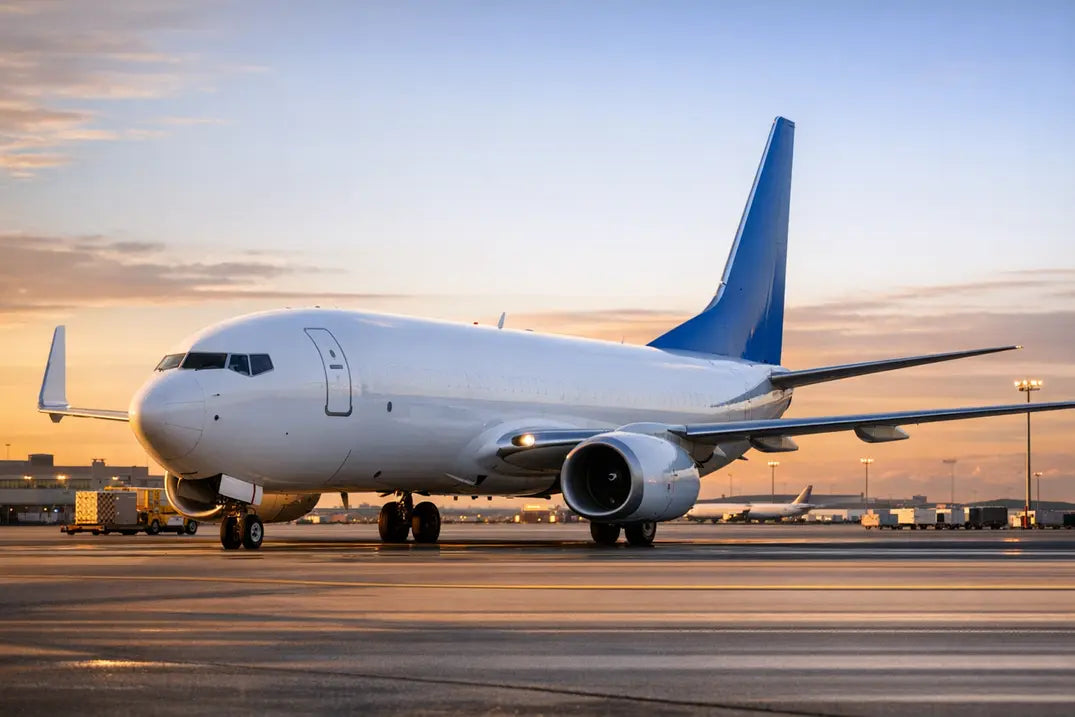
The Boeing 737-800BCF (Boeing Converted Freighter) is a narrowbody cargo aircraft derived from the passenger 737-800 airframe through an OEM certified conversion program. Launched by Boeing in February 2016 and first delivered in April 2018, the conversion centres on installing a large main deck cargo door on the left fuselage, reinforcing the cabin floor for 9g pallet loads, and reconfiguring the interior as a Class E cargo compartment. The result is a freighter capable of carrying up to 23,950 kg (52,800 lb) of revenue payload over routes up to approximately 2,000 nmi, filling a vital role in the express parcel and e commerce cargo segments.
Built on the proven 737 Next Generation platform, the 737-800BCF inherits the aerodynamic gains of the NG wing with blended winglets, a robust dual hydraulic system and a mature CFM56 powerplant. The design philosophy favours simplicity: Boeing uses original design data to keep modification count low, conversion turnaround times short (typically around four months) and operating economics competitive. Compared to older narrowbody freighters it replaces, the type offers roughly 20 percent lower fuel consumption and significantly reduced noise footprint, making it well suited to curfew restricted airports. Operators such as those transitioning from legacy Soviet era freighters like the Ilyushin Il 12 and its successors have found modern converted freighters a compelling upgrade path.
- Length: 39.5 m (129 ft 6 in)
- Wingspan: 35.79 m (117 ft 5 in) with blended winglets
- Height: 12.5 m (41 ft 2 in) at tail
- Maximum Takeoff Weight (MTOW): 79,000 kg (174,200 lb)
- Maximum Landing Weight (MLW): 66,350 kg (146,300 lb)
- Maximum Zero Fuel Weight (MZFW): 62,750 kg (138,300 lb)
- Maximum Structural Payload: 23,950 kg (52,800 lb)
- Volume Limit Payload: 20,768 kg (45,787 lb)
- Main Deck Cargo Volume: 141.5 m³ (4,997 ft³), accommodating 11 standard 88 × 125 in AAA pallets plus one AEP/AEH half pallet position
- Lower Hold Bulk Volume: 43.7 m³ (1,543 ft³)
- Main Deck Cargo Door (LH): clear opening 358 cm wide × 220 cm high (141 × 86.5 in)
- Range with Maximum Payload: approximately 1,995 nmi (3,695 km)
- Range at Volume Limit Payload: approximately 2,570 nmi (4,760 km)
- Fuel Capacity: 26,025 litres (6,875 US gal)
- Long Range Cruise Speed: Mach 0.785 (approximately 452 KTAS at cruise altitude)
- Service Ceiling: 41,000 ft
- Engines: 2 × CFM International CFM56 7B series turbofans (24,200 to 27,300 lbf per engine depending on variant)
- Noise Compliance: ICAO Chapter 4 / FAA Stage 4
- Avionics: 737NG glass cockpit with six LCD displays, dual FMC, EGPWS and TCAS II as standard
Systems, Flight Controls and Handling Technology
The 737-800BCF retains the conventional hydraulic flight control architecture of the 737NG family. Primary flight controls (ailerons, elevator and rudder) are powered by two independent hydraulic systems, designated A and B, each operating at 3,000 psi. A power transfer unit allows either system to back up the other for critical functions. The spoiler panels, used for roll augmentation, speedbrake and ground spoilers, are hydraulically actuated with mechanical reversion available on selected panels. The stabiliser trim system is electromechanical, operable from the control column switches or the manual trim wheel on the centre pedestal.
Autobrake and digital anti skid systems are standard, with carbon multidisc brakes providing consistent stopping performance across a wide weight range. The Full Authority Digital Engine Control (FADEC) manages all engine parameters automatically, including start sequencing, thrust setting and protective limiting, which simplifies crew workload during high density cargo operations. Performance computation is handled through the FMC, which calculates takeoff and landing speeds based on entered weights, temperature, pressure altitude and runway condition. Maintenance data is captured by the onboard maintenance computer and can be downloaded for trend monitoring, supporting operators in planning engine and airframe maintenance intervals efficiently.
Published performance figures for the 737-800BCF should always be interpreted in context. Range, payload and field length numbers quoted by Boeing assume specific weight, temperature, altitude and runway conditions. In practice, operator configured weights, cabin density (pallet versus bulk loading), ambient temperature, airport elevation, runway slope and wind component all influence actual performance. Figures such as takeoff field length (approximately 2,400 to 2,800 m at MTOW under ISA conditions at sea level) and landing distance vary accordingly, and operators generate tailored performance data for each departure using approved software.
CFM56 7B Engines: History, Variants and Applications
The 737-800BCF is powered exclusively by the CFM International CFM56 7B family of high bypass turbofan engines. CFM International, a 50/50 joint venture between GE Aerospace and Safran Aircraft Engines, developed the CFM56 7B specifically for the Boeing 737 Next Generation series. The engine entered airline service in 1997 aboard the 737 700 with Southwest Airlines and quickly became the dominant powerplant for the entire 737NG family.
Three main thrust rated variants are available for the 737-800 airframe: the CFM56 7B24 rated at 107.6 kN (24,200 lbf), the CFM56 7B26 at 117 kN (26,300 lbf) and the CFM56 7B27 at 121.4 kN (27,300 lbf) for high gross weight operations. All share the same core architecture: a 61 inch diameter single stage fan, a three stage low pressure compressor, a nine stage high pressure compressor, a single annular combustor, a single stage high pressure turbine and a four stage low pressure turbine. The bypass ratio is approximately 5.1:1 and the overall pressure ratio is around 32:1. Dry weight is approximately 2,370 kg (5,216 lb) per engine.
In 2007, Boeing and CFM introduced the Tech Insertion upgrade package, which improved high pressure turbine durability and reduced fuel burn by about one percent. This was followed in 2015 by the CFM56 7BE (Enhanced) variant, offering a further two percent improvement in fuel efficiency, two percent lower emissions and up to four percent lower maintenance costs compared to earlier production standards. All variants are fully interchangeable on wing.
The broader CFM56 family, with thrust ratings spanning 18,500 to 32,000 lbf, has accumulated more than one billion flight hours across over 600 operators worldwide and maintains a dispatch reliability rate above 99.9 percent. Beyond the 737NG, CFM56 variants power the Airbus A320ceo family (CFM56 5B), the Airbus A340 200/300 (CFM56 5C), and military platforms such as the KC 135 Stratotanker (CFM56 2). This broad installed base ensures a deep global support network of spare parts, MRO providers and technical expertise, which directly benefits 737-800BCF operators seeking predictable engine maintenance costs and high aircraft availability.
Boeing 737-800BCF vs 737-800 vs 737-900ER vs 737-700 Specifications
Scroll horizontally to see more →
| Parameter | Boeing 737-800BCF | Boeing 737-800 | Boeing 737-900ER | Boeing 737-700 |
|---|---|---|---|---|
| Entry into service | 2009 | 1998 | 2007 | 1998 |
| Engines | 2 × CFM56-7B | 2 × CFM56-7B | 2 × CFM56-7B | 2 × CFM56-7B |
| Length | 39.5 m | 39.5 m | 42.1 m | 33.6 m |
| Wingspan | 35.8 m | 35.8 m | 35.8 m | 35.8 m |
| Height | 12.5 m | 12.5 m | 12.5 m | 12.5 m |
| Typical seating and layout | Freighter: 23 t payload | 2-class: 162–189 passengers | 2-class: 180–215 passengers | 2-class: 126–149 passengers |
| MTOW | 79 t | 79 t | 85.1 t | 70 t |
| Range | 2,570 nm | 3,060 nm | 3,310 nm | 3,010 nm |
| Cruise speed | 0.78 Mach | 0.78 Mach | 0.78 Mach | 0.78 Mach |
| Service ceiling | 41,000 ft | 41,000 ft | 41,000 ft | 41,000 ft |
| Program note | Converted freighter with 23 t payload capacity for medium-haul cargo | Standard passenger baseline of NG family | Stretched high-capacity passenger variant with extended range | Short-fuselage baseline passenger variant for high-density routes |
Scroll horizontally to see more →
The table compares key specifications across four Boeing 737 variants, highlighting size, payload/passenger capacity, weights, and performance. The 737-900ER is the longest (42.1 m) and has the highest MTOW (85.1 t) and range (3,310 nm) for higher-capacity routes. The 737-700 is shortest (33.6 m) with lower MTOW (70 t). The 737-800BCF matches the 737-800 dimensions and MTOW (79 t) but trades range (2,570 nm) for a 23 t cargo payload.
Boeing 737-800BCF Operations: Typical Missions, Routes and Airlines Worldwide
The Boeing 737-800BCF is designed primarily for express cargo, e-commerce parcels and general freight on domestic and short to medium haul routes. With a maximum structural payload of 23.9 tonnes and a range of approximately 2,000 nautical miles (3,700 km) at full load, the type fits comfortably into overnight parcel networks and regional cargo schedules. When flying at volume limited payload (around 20.8 tonnes), range extends to roughly 2,570 nautical miles (4,760 km), opening transcontinental segments such as Miami to Calgary or Frankfurt to Riyadh. According to Boeing's official brochure, the aircraft offers 20% better fuel efficiency per tonne compared with older narrowbody freighters it typically replaces.
Most operators integrate the Boeing 737-800BCF into hub and spoke cargo networks, feeding major sorting centres during night time windows and returning before dawn. Typical daily utilisation for express freight operators falls in the 10 to 14 flight hour range, with multiple short cycles between a central hub and regional spokes. The type is equally suited to secondary airports thanks to its moderate runway requirements and commonality with the passenger 737NG fleet, which simplifies crew training, spare parts logistics and ground handling. Point to point operations are less common but remain viable for medium haul direct routes serving e-commerce fulfilment centres.
Operational challenges for 737-800BCF operators include the inherent payload versus range trade off on longer sectors, competition from widebody freighters on denser routes, and the need to coordinate conversion slots at approved maintenance facilities. With conversion demand rising sharply, turnaround times at MRO providers can create fleet planning bottlenecks. Crews transitioning from passenger 737NG operations may also need additional training on cargo loading procedures, dangerous goods handling and emergency management during freight flights, where there are no cabin crew to assist.
Where the Boeing 737-800BCF Operates Around the World
According to a Cirium Ascend Consultancy analysis, the 737 800 freighter family is in service with more than 60 operators across 38 countries. Adoption is particularly strong in Europe and Asia, where e-commerce volumes have driven rapid fleet growth, while North and South America are expanding steadily through integrator contracts and airline cargo divisions. In Africa, the type remains less prevalent, though the continent represents a growing market for narrowbody freighter capacity as express logistics networks develop.
- Europe: ASL Airlines (with subsidiaries in Ireland, Belgium and France) is the largest European operator, with a fleet that has grown beyond 11 aircraft and commitments for up to 40 total units. These aircraft serve an express freight and ACMI network covering more than 100 airports across the continent. West Atlantic, based in Sweden, was the first airline worldwide to take delivery of the type in April 2018 and now operates multiple 737-800BCF airframes on mail and parcel routes across the United Kingdom and Europe, flying for integrators and postal operators.
- North and South America: In the United States, 7 AIR Cargo operates the Boeing 737-800BCF on scheduled cargo services from Miami International Airport to destinations including Guatemala City, Managua, San José and San Juan, with plans to double its fleet. In Brazil, GOL Linhas Aéreas has committed to converting up to 12 aircraft to support e-commerce logistics for Mercado Livre, linking São Paulo with cities such as Manaus and Cuiabá. Modern Logistics, also in Brazil, operates at least two units. Aerolíneas Argentinas and Copa Airlines in Panama have also been reported as operators of the type in Latin America.
- Asia: China is the single largest market for the converted freighter. SF Airlines and YTO Cargo Airlines, the air arms of China's leading express delivery companies, form the backbone of regional demand. K-Mile Asia in Thailand, a joint venture with ASL Aviation Holdings, deploys the type on intra-Asian express routes. SpiceXpress, the cargo division of India's SpiceJet, has taken delivery of converted freighters to expand domestic and regional freight capacity across South Asia.
- Africa: No major dedicated operators of the Boeing 737-800BCF have been widely confirmed on the continent as of early 2026, although ASL Aviation Holdings has partnerships in the region and overall narrowbody freighter demand in Africa is expected to increase as e-commerce infrastructure matures.
Cargo Configuration and Cabin Layout of the Boeing 737-800BCF
Because the Boeing 737-800BCF is a pure freighter conversion, there is no passenger cabin. The entire main deck is reconfigured to accept up to 12 pallet positions (11 standard 88 × 125 inch pallets plus one smaller contoured pallet), providing approximately 141.5 cubic metres (5,000 cubic feet) of main deck volume. The lower hold adds around 43.7 cubic metres (1,540 cubic feet) of bulk cargo space. A large cargo door measuring 86 × 140 inches is installed on the forward left fuselage. Forward of the main deck, a small galley area accommodates up to four supernumerary seats for non operating crew or cargo handlers, a standard feature described in Boeing's freighter family overview. Unlike passenger variants, where layout differences arise between network and leisure carriers, configuration variation on the 737-800BCF is minimal. Operators may choose between all pallet, all container or mixed loading arrangements depending on the cargo mix, but the structural layout and door position remain consistent across the fleet.
In this video, watch cargo and regional jets in bright sunlight as Cargo Air’s Enter Air Hybrid Boeing 737-800BCF LZ-CGC departs for MXP, plus Marathon Airlines Embraer E175STD SX-ASK from BFS and a DHL arrival.
Boeing 737-800BCF Safety Record: How Safe Is This Converted Freighter?
The Boeing 737-800BCF (Boeing Converted Freighter) shares its airframe, structure and core systems with the passenger Boeing 737-800, the most produced variant within the 737 Next Generation (NG) family. With more than 7,100 737NG aircraft delivered since the late 1990s and thousands still flying daily around the world, the platform has accumulated tens of millions of flight cycles and hours. According to data compiled by AirSafe.com, the 737-600/700/800/900 family records a fatal accident rate of roughly 0.07 per million flights, making it one of the safest narrowbody types ever produced. The 737-800BCF conversion programme was launched in 2016, with the first redelivery in 2017. By mid 2024 approximately 250 units had been converted and were operating with around 62 cargo carriers across 38 countries, according to Cirium Ascend Consultancy. No hull loss or fatal accident specifically involving a 737-800BCF has been recorded in major aviation safety databases to date.
Because the BCF retains the same type certificate, flight controls, avionics and structural design as its passenger counterpart, its safety profile is best understood by examining the broader 737-800 accident history. Over nearly three decades of service, the 737-800 has been involved in a small number of fatal accidents relative to its enormous fleet size and global utilisation. Each event prompted targeted improvements in design, training or regulation.
Notable 737-800 Accidents and Lessons Learned
Turkish Airlines Flight 1951 (2009) — On 25 February 2009, a 737-800 crashed 1.5 kilometres short of Runway 18R at Amsterdam Schiphol during approach. The Dutch Safety Board investigation determined that a faulty left radio altimeter transmitted an erroneous reading of minus 8 feet, causing the autothrottle to enter its landing flare mode prematurely and reduce engine thrust to idle. The resulting speed decay led to an aerodynamic stall at low altitude. Nine of the 135 occupants lost their lives. Key outcomes included Boeing modifications to the 737NG autothrottle logic to incorporate dual altimeter cross checking, enhanced crew training on unreliable airspeed and altitude scenarios, and stricter go around policies for unstabilised approaches.
Air India Express Flight 1344 (2020) — On 7 August 2020, a 737-800 overran the tabletop runway at Kozhikode (Calicut), India, in heavy rain and a tailwind. The aircraft broke apart after dropping into a valley beyond the runway end. Eighteen of 190 occupants were killed. The investigation highlighted an unstabilised approach and the decision to continue landing despite adverse conditions. The event reinforced the importance of stabilised approach criteria and prompted Indian authorities to review runway safety area requirements at tabletop airports.
China Eastern Airlines Flight 5735 (2022) — On 21 March 2022, a 737-800 entered a near vertical dive during cruise and crashed in Guangxi province, killing all 132 people on board. As of early 2026 the Civil Aviation Administration of China (CAAC) has not published a final report, citing ongoing investigation. Preliminary findings ruled out weather, airworthiness and crew qualification issues. The Aviation Safety Network record notes that both flight recorders were recovered and analysed, but the definitive cause remains officially undetermined.
Jeju Air Flight 2216 (2024) — On 29 December 2024, a 737-800 belly landed at Muan International Airport in South Korea after a confirmed bird strike that disabled one engine. Investigators found that the remaining engine was inadvertently shut down in the cockpit, leaving the aircraft without thrust. The jet overran the runway and struck a concrete localiser structure, resulting in 179 fatalities among 181 occupants. South Korean authorities have since begun removing non frangible structures at the ends of runways at multiple domestic airports, and a cross party parliamentary investigation was launched to examine bird hazard management and airport infrastructure standards.
How Safe Is the Boeing 737-800BCF?
When assessed in context, the 737-800 platform's accident rate is remarkably low relative to its traffic volume. A fatal accident rate of approximately 0.07 per million departures means that, statistically, an event occurs only once in many millions of flights. The aircraft benefits from a mature design philosophy refined over successive 737 generations, redundant flight control systems, and comprehensive regulatory oversight from the FAA and EASA. Operators worldwide follow rigorous standard operating procedures covering stabilised approaches, go around criteria and automation management, all of which have been strengthened by the lessons detailed above.
The 737-800BCF adds a large cargo door, a reinforced floor and a cargo handling system during conversion, but its flight deck, engines and primary structure remain unchanged. Every converted airframe undergoes extensive inspection and operational readiness checks before returning to service. Boeing reports that the conversion has been certified under a Supplemental Type Certificate approved by the FAA, and each aircraft must meet current airworthiness standards before it may operate commercially.
According to Boeing’s own Statistical Summary of Commercial Jet Airplane Accidents, the industry has achieved a 65 percent reduction in the fatal accident rate over the past two decades, even as global air traffic has grown substantially. The 737-800BCF, operating within this improving safety landscape and subject to continuous airworthiness directives from regulators, remains a reliable platform for cargo operations. Aviation, whether passenger or freight, continues to be one of the safest modes of transport available.
01 What is the Boeing 737-800BCF designed for?
The Boeing 737-800BCF is a factory-authorized freighter conversion of the passenger 737-800, optimized for cargo transport. It offers over 5,000 cubic feet of main deck cargo space with 11 standard pallets and one half-pallet, plus additional lower lobe compartments for bulk cargo. Operators use it for efficient medium-haul freight routes up to about 2,000 nautical miles.
02 What is the range and payload capacity of the Boeing 737-800BCF?
The Boeing 737-800BCF has a maximum structural payload of around 23 tons and a design range of 1,995 nautical miles with that load, extending to 2,570 nautical miles with volume-limited payload. It carries up to 23,950 kg of revenue payload, making it suitable for routes like Miami to Lima or Hong Kong regional flights. Fuel capacity is 26,025 liters, supporting versatile cargo missions.
03 How fuel efficient is the Boeing 737-800BCF compared to older freighters?
The Boeing 737-800BCF is 20 percent more fuel efficient per tonne than 737 Classic freighters like the 737-300SF. Powered by two CFM56-7B engines producing 24,000 to 27,000 lbf thrust each, it achieves speeds up to Mach 0.789. This efficiency comes from Next Generation 737 improvements, reducing operating costs on cargo routes.
04 Which airlines operate the Boeing 737-800BCF and on what routes?
Cargo carriers like Atlas Air, DHL, and various freight operators use the Boeing 737-800BCF for regional and medium-haul networks. Common routes include transcontinental hops such as Miami to Calgary, Frankfurt to Middle East destinations, or intra-Asia flights from Hong Kong. Its range supports high-frequency cargo services without needing long-haul capability.
05 What are the key performance specs of the Boeing 737-800BCF?
The Boeing 737-800BCF has a maximum takeoff weight of 79,000 kg and cruises at Mach 0.789 with a range versatility for payloads up to 23 tons. It features high commonality with passenger 737NG models, easing pilot transitions and maintenance. Cargo volume totals about 6,000 cubic feet, with main deck at 141.5 cubic meters.
06 How does the Boeing 737-800BCF ensure safety and reliability?
The Boeing 737-800BCF shares the proven Next Generation 737 flight deck and systems, including glass cockpit and performance enhancements like improved takeoff slats. It benefits from the 737 family's extensive safety record and common maintenance with passenger variants. Design features support short runways and reliable operations for cargo missions worldwide.