

Boeing 707-320 Intercontinental: History, Development and What Set It Apart
The Boeing 707 family emerged in the 1950s as the product that would define the commercial jet age. Boeing had invested its own capital in the Model 367-80 prototype, which flew for the first time on 15 July 1954. That demonstrator led directly to the production 707-120, which made its maiden flight on 20 December 1957 and entered scheduled transatlantic service with Pan American World Airways on 26 October 1958. The 707-120 proved the viability of jet travel, but its range and payload were not sufficient for every intercontinental route. Airlines needed an aircraft that could fly nonstop across the Atlantic and Pacific with a full passenger load, and Boeing responded with the Boeing 707-320 Intercontinental.
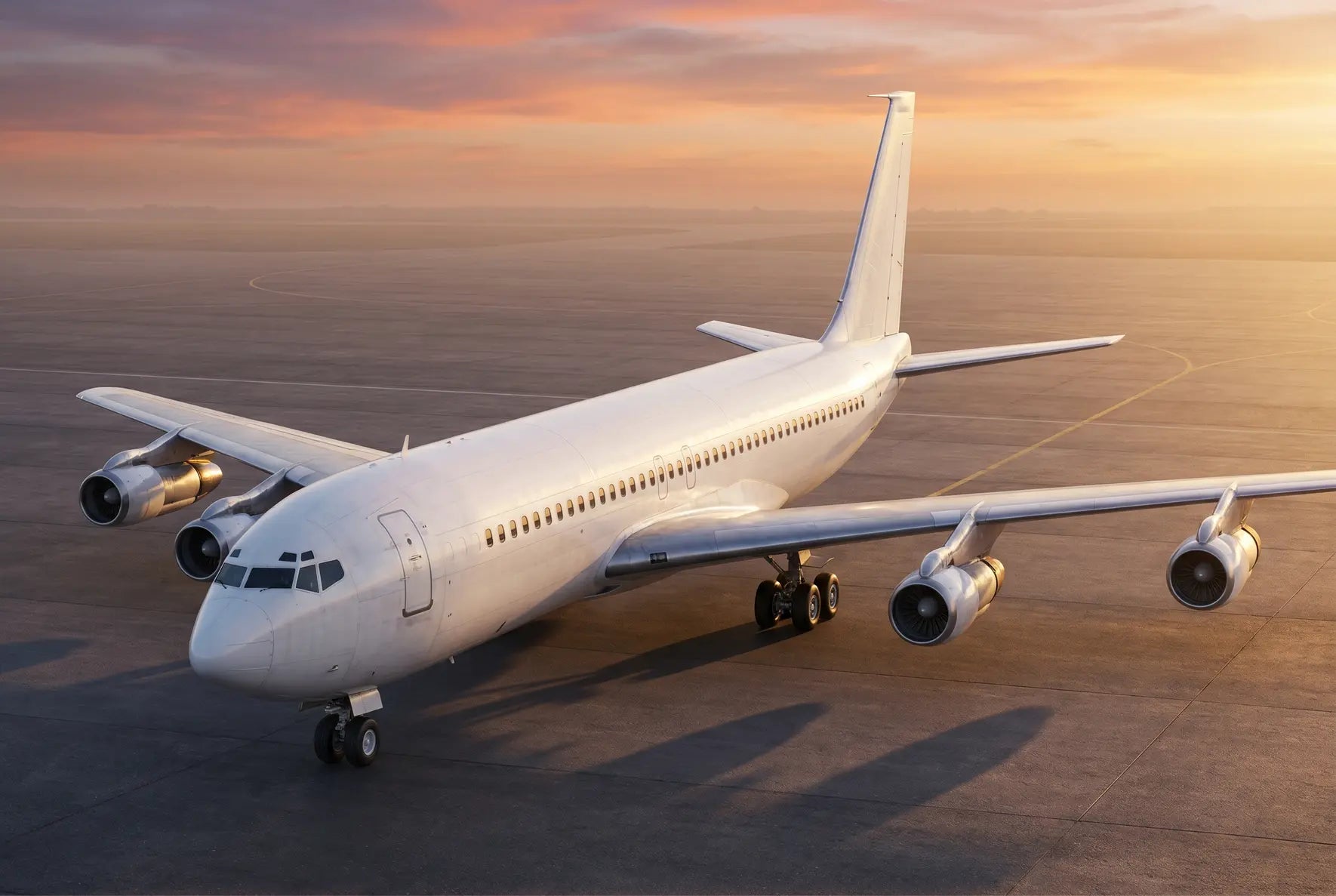
Boeing, headquartered in Seattle, Washington, designed the 707-320 as a stretched, longer-winged derivative of the 707-120 optimised for true long-haul operations. The variant featured an approximately 80-inch (2.03 m) fuselage plug forward of the wing, plus extensions to the vertical fin and horizontal stabiliser, bringing the overall length to 152 ft 11 in (46.61 m) compared with 145 ft 1 in for the 707-120. The wingspan grew from 130 ft 10 in to 145 ft 9 in (44.42 m), a gain of nearly 15 feet, which substantially increased internal fuel volume and aerodynamic efficiency. A ventral fin beneath the rear fuselage improved directional stability at high speeds and high angles of attack, compensating for the longer airframe.
The Boeing 707-320 Intercontinental completed its first flight on 11 January 1959. It was powered by four Pratt & Whitney JT4A turbojet engines, initially in JT4A-3 or JT4A-5 variants producing around 15,800 lbf (70.3 kN) of thrust each. Many airframes were later delivered with, or upgraded to, the JT4A-11 rated at approximately 17,500 lbf (77.8 kN). The type received its FAA type certification later that year, and Pan American World Airways, the launch customer, began scheduled 707-320 Intercontinental services in August 1959. In the same year, the variant was used on the first scheduled round-the-world jet service. On 23 February 1960, a 707-320 set a distance record by covering the route from Seattle to Cairo. A total of 69 turbojet-powered 707-320 airframes were delivered through January 1963, all produced at Boeing's Renton, Washington facility, where 707 family assembly ran from 1956 to 1979.
The Boeing 707-320 arrived at a pivotal moment in aviation history. While Western carriers raced to adopt jets such as the 707 and the Douglas DC-8, Aeroflot was operating Soviet-built types like the Tupolev Tu-114 on competing long-haul international routes. The 707-320 gave airlines such as Pan Am, Air France and others the nonstop transatlantic and transpacific capability that helped establish the Western jet network as the global standard.
What Distinguishes the Boeing 707-320 from Other 707 Variants
The Boeing 707-320 sits between the shorter-range 707-120 and the later turbofan-powered 707-320B in the family hierarchy. Compared with the 707-120, the 707-320 offered roughly 2,600 km (1,600 mi) more range thanks to its larger wing, greater fuel capacity and higher maximum take-off weight of up to 312,000 lb (141,700 kg). Typical range in a two-class passenger configuration was around 3,915 nmi (7,250 km), sufficient for most transatlantic and many transpacific sectors with a fuel stop. The 707-420 shared the same Intercontinental airframe but was powered by Rolls-Royce Conway turbofan engines instead of the Pratt & Whitney JT4A turbojets, and was ordered primarily by European carriers such as BOAC.
The subsequent 707-320B, introduced in 1962, retained the stretched fuselage but replaced the JT4A turbojets with Pratt & Whitney JT3D low-bypass turbofans, delivering lower fuel consumption, reduced noise and a significant range increase to approximately 5,000 nmi. The 707-320B also received aerodynamic wing refinements. The final evolution, the 707-320C, added a large cargo door and three-section leading-edge flaps while eliminating the ventral fin, creating a convertible passenger-freighter that became the most-produced member of the Intercontinental family.
Key identifiers that distinguish the original turbojet Boeing 707-320 Intercontinental from its siblings:
- Engines: Four Pratt & Whitney JT4A turbojets (JT4A-3, JT4A-5 or JT4A-11), producing 15,800 to 17,500 lbf each
- Wingspan: 145 ft 9 in (44.42 m), extended by nearly 15 ft over the 707-120
- Overall length: 152 ft 11 in (46.61 m), with an 80-inch fuselage plug ahead of the wing
- Maximum take-off weight: Up to 312,000 lb (141,700 kg)
- Typical range (two-class): Approximately 3,915 nmi (7,250 km)
- Ventral fin: Fixed under-fuselage fin for directional stability, later removed on the 707-320C
- Seating capacity: Up to 189 passengers in a single-class layout
- Production: 69 turbojet 707-320 airframes delivered (1959 to January 1963)

A Pan American World Airways Boeing 707-321B aircraft is captured in flight against a clear sky. The airplane displays the iconic Pan Am logo on its tail fin.
Boeing 707-320 Technical Specifications, Systems, and Engine Options
The Boeing 707-320, marketed as the Intercontinental, was designed from the outset for long-range, transatlantic and transpacific operations. Compared with the shorter-range 707-120, it featured a stretched fuselage, a substantially redesigned wing with greater span and area, and more powerful engines. These changes shifted the design balance firmly toward intercontinental range at higher gross weights, while retaining the proven fuselage cross-section and cockpit philosophy of the 707 family. The larger wing improved lift-to-drag ratio and high-altitude cruise performance, and Boeing added a taller vertical stabilizer and a prominent ventral fin beneath the tail to ensure adequate directional stability at low speeds and high angles of attack.
The 707-320 represented a significant step beyond the domestic 707-120, enabling airlines such as Pan American to operate nonstop services across the Atlantic with full passenger loads. Its design trade-offs prioritised range and payload capacity over short-field performance, making it best suited to major international airports with long runways. The aircraft shared its era and mission profile with competitors like the Douglas DC-8-30, which used the same JT4A engine family.
- Length: 152 ft 11 in (46.61 m)
- Wingspan: 145 ft 9 in (44.42 m)
- Height: approximately 42 ft 0 in (12.8 m)
- Maximum takeoff weight (MTOW): approximately 316,000 lb (143,300 kg)
- Typical passenger capacity: 141 passengers in two-class configuration, up to 189 in high-density layout
- Range: approximately 3,750 nmi (6,940 km) with 141 passengers in two classes, per Boeing published data
- Cruise speed: Mach 0.82 to 0.84 (approximately 504 kn / 933 km/h)
- Maximum operating Mach number (Mmo): Mach 0.90
- Service ceiling: approximately 39,000 to 42,000 ft, depending on weight and configuration
- Engines: 4 x Pratt & Whitney JT4A turbojet (JT4A-3, JT4A-5, or JT4A-11, depending on sub-variant)
- Thrust per engine (JT4A-11): approximately 17,500 lbf (77.8 kN)
- Fuel capacity: approximately 23,855 US gallons (90,300 litres)
- Wing structure: all-metal, two-spar, fail-safe design with Fowler flaps, split fillet flaps, and leading-edge flaps
- Avionics baseline: analog electromechanical instruments, dual VHF COM/NAV, HF radio for oceanic operations, ADF, DME, VOR/ILS, weather radar, and analog autopilot with flight director
Systems, Flight Controls, and Handling Technology
Like all 707 variants, the 707-320 relied on conventional, mechanically signalled, hydraulically powered flight controls with no fly-by-wire architecture. The pilot's control column, wheel, and rudder pedals connect via cables, bellcranks, and pushrods to hydraulic actuators at the control surfaces. Pitch control is provided by dual elevators and a trimmable horizontal stabilizer for large trim changes. Roll authority comes from a dual aileron system: outer ailerons operate at low speeds and are mechanically locked out at higher Mach numbers to prevent over-sensitivity and wing-twist issues, while inner ailerons remain active across the full speed range. Upper-wing spoiler panels augment roll control and double as speed brakes in flight and ground spoilers after touchdown. Yaw control is handled by a single hydraulic rudder. This architecture, while dated by modern standards, was robust and well-proven across the 707 family. The flight control philosophy of the 707-320 was nearly identical to that found on other contemporary types such as the BAC One-Eleven 500, which also used hydraulically powered, mechanically signalled controls.
The autopilot and flight director system was fully analog, providing command bars on the attitude director indicator (ADI) for pitch and roll guidance. The autopilot could couple to VOR and ILS for heading hold, VOR tracking, and ILS-coupled approaches, but full autoland capability was not standard. The braking system used hydraulic multi-disc brakes on the main landing gear with an analog anti-skid system that modulated brake pressure based on individual wheel speed to prevent tyre lockup. Engine control was entirely hydromechanical: throttle levers in the cockpit commanded fuel control units on each engine via mechanical linkage, with no digital engine management (FADEC) of any kind.
Published performance figures for the 707-320 vary depending on operator-selected options, cabin density, actual operating weights, atmospheric conditions, and runway surface state. Range figures, for example, depend heavily on passenger count, cargo load, reserve fuel policy, and wind assumptions. MTOW options could differ between airlines, and field-length data are sensitive to temperature, altitude, and runway condition. For these reasons, any single number should be understood as representative rather than absolute, and specific operator or regulatory documentation should always be consulted for dispatch or planning purposes.
Engines: Pratt & Whitney JT4A and the Transition to JT3D
The original Boeing 707-320 was powered by four Pratt & Whitney JT4A turbojet engines, the civil designation of the military Pratt & Whitney J75. Developed as a larger, more powerful successor to the J57, the J75 was first announced in 1954 and first ran in 1955, with civil certification as the JT4A following in March 1957. It was a two-spool axial-flow turbojet with an overall pressure ratio of approximately 12.5:1, airflow of about 256 lb/s, and a dry weight in the region of 5,100 lb (2,313 kg). On the 707-320, the most common variant was the JT4A-11, rated at approximately 17,500 lbf (77.8 kN) of takeoff thrust per engine. A notable operational advantage over the earlier JT3C turbojets of the 707-120 was that the JT4A did not require water injection at takeoff.
Beyond the 707-320, the JT4A/J75 family saw wide military use. The Convair F-106 Delta Dart and Republic F-105 Thunderchief were among the primary military users, while early versions of the Lockheed U-2 also used J75 variants. On the civil side, the Douglas DC-8-20 and DC-8-30 shared the JT4A powerplant with the 707-320. Pratt & Whitney later adapted the J75 core into the FT4 industrial and marine gas turbine, which was produced in large numbers (over 1,000 units) for ship propulsion and power generation.
The JT4A's tenure on the 707-320 was relatively short, as the rapid development of turbofan technology soon rendered pure turbojet power uncompetitive on fuel consumption and noise. Boeing introduced the 707-320B in the early 1960s, re-engined with four Pratt & Whitney JT3D low-bypass turbofans (typically JT3D-3B or JT3D-7, rated at approximately 18,000 to 19,000 lbf). The JT3D, created by adding a front fan stage to the proven J57/JT3C core, achieved a bypass ratio of roughly 1.4:1, resulting in specific fuel consumption reductions on the order of 10 to 15 percent compared with the JT4A. This improvement extended the 707-320B's range to approximately 5,000 nmi (9,300 km) with a two-class load, while also reducing noise levels substantially. The JT3D went on to power a wide range of aircraft, including the Boeing 707-120B, Douglas DC-8-50 series, and several military derivatives such as early E-3 Sentry AWACS aircraft.
Boeing 707-320 vs DC-8-62 vs VC10 vs Boeing 720: Specifications Comparison
Scroll horizontally to see more →
| Parameter | Boeing 707-320 | Douglas DC-8-62 | Vickers VC10 | Boeing 720 |
|---|---|---|---|---|
| Entry into service | 1960 | 1967 | 1964 | 1961 |
| Engines | 4 × Pratt & Whitney JT4A-11 | 4 × Pratt & Whitney JT3D-3B | 4 × Rolls-Royce Conway RCo.42 | 4 × Pratt & Whitney JT3C-7 |
| Length | 46.61 m | 48.01 m | 48.38 m | 41.68 m |
| Wingspan | 43.41 m | 45.18 m | 44.55 m | 39.88 m |
| Height | 12.70 m | 12.93 m | 12.04 m | 12.04 m |
| Typical seating and layout (short description + approximate passengers) | 3-class: 165–189 passengers | 3-class: 150–189 passengers | 3-class: 135–151 passengers | 2-class: 116–149 passengers |
| MTOW | 142 t | 151 t | 151 t | 107 t |
| Range | 3,900–4,600 nm | 5,200 nm | 5,000 nm | 4,000 nm |
| Cruise speed | 0.81 Mach | 0.82 Mach | 0.86 Mach | 0.82 Mach |
| Service ceiling | 42,000 ft | 41,000 ft | 43,000 ft | 41,000 ft |
| Program note | Original Boeing intercontinental jetliner variant for long-haul routes, offering increased capacity and range over earlier 707s. | Stretched long-range DC-8 derivative positioned for similar intercontinental missions as the 707-320. | British long-range jet designed for “hot and high” and long-thin routes, competing in the same era and market segment. | Shorter-range, lighter 707-family derivative optimized for medium-haul routes from shorter runways. |
Scroll horizontally to see more →
The table compares key specs of four early jetliners: Boeing 707-320, Douglas DC-8-62, Vickers VC10, and Boeing 720. The DC-8-62 leads in range (5,200 nm) with the highest MTOW (151 t, tied with VC10) and the longest airframe. The VC10 is fastest at Mach 0.86 and has the highest ceiling (43,000 ft). The 720 is the lightest (107 t), shorter-range, and seats fewer, reflecting its medium-haul role.
Boeing 707-320 Operations: Routes, Airlines and Missions Worldwide
The Boeing 707-320, marketed as the "Intercontinental," was designed for long-haul transoceanic and intercontinental missions. Powered initially by four Pratt & Whitney JT4A turbojets (later replaced by JT3D turbofans on the 707-320B), the aircraft offered a range of approximately 3,750 nmi (6,940 km) with 141 passengers in a two-class layout, according to Boeing production records. Typical stage lengths ranged from 2,000 to 3,500 nmi, covering sectors such as New York to London (around 3,000 nmi, approximately 7 hours of flight) or multi-stop intercontinental itineraries linking Europe with Africa, the Middle East and Asia through intermediate stops at cities like Rome, Cairo or Karachi.
In daily operation, airlines typically achieved 8 to 12 flight hours per aircraft per day when deployed on intensive long-haul schedules. The aircraft excelled within hub-and-spoke networks built around major international airports such as London Heathrow, New York JFK, Paris Orly and Frankfurt. Flag carriers used the 707-320 on prestige "spoke" routes radiating from these hubs, while multi-stop through-services (for example, London to Singapore via Rome, Beirut and Karachi) were common. Some high-profile city pairs, such as New York to Paris, operated as point-to-point flagship sectors, though they remained embedded within broader hub-based networks.
Operators faced several challenges. The 707-320 required long runways of approximately 3,200 m for maximum-weight departures, restricting its use to well-equipped airports. Early JT4A turbojet variants were fuel-thirsty and noisy, and from the 1970s onward, tightening noise regulations at major airports forced many operators to fit hush-kits or retire the type from frontline passenger service. The four-crew cockpit (captain, first officer, flight engineer and navigator on early long-haul operations) also raised crew costs compared with later two-crew aircraft. As widebody jets such as the Boeing 747 and DC-10 entered service, many 707-320s shifted to secondary routes, charter work, cargo operations or were transferred to airlines in developing regions. The Soviet-era Tupolev Tu-154 filled a broadly comparable role on medium- and long-haul routes behind the Iron Curtain during the same period.
Where the Boeing 707-320 Operated Around the World
The Boeing 707-320 served airlines across all four broad aviation regions. In Europe, flag carriers deployed it on transatlantic prestige routes and connections to former colonies in Africa and Asia, while charter airlines used it on high-density seasonal services to the Mediterranean and the Caribbean. In North America and South America, the type was the backbone of intercontinental jet travel, linking US and Canadian gateways with Europe and Asia, and connecting South American capitals with Europe and North America. Across Asia and the Middle East, national carriers relied on the 707-320 for their first nonstop or one-stop links to Europe and North America. In Africa, flag carriers initially used the type for intercontinental passenger flights, and as newer jets arrived, many airframes transitioned to cargo duties, remaining in service well into the 21st century with freight operators.
- Europe: Air France operated the 707-320 on transatlantic routes from Paris to New York and services to Africa and Asia. Lufthansa was a significant operator with about 11 707-320B aircraft linking Frankfurt to New York, Chicago and Los Angeles. BOAC (later British Airways) used the type as its main long-haul jet on routes from London to North America, the Caribbean, Africa and Asia. Aer Lingus flew Dublin and Shannon to New York, while charter carriers such as Condor and Dan-Air operated high-density flights from Northern Europe to Mediterranean holiday destinations.
- North & South America: Pan American World Airways was the launch customer, introducing the 707-320 on transatlantic service from New York to London in 1959 and later on transpacific routes to Tokyo and Hong Kong. Trans World Airlines connected New York and St. Louis with Europe and the Middle East. Northwest Orient built its North Pacific network around the type, linking Seattle with Tokyo and Manila, as documented by the Northwest Airlines History Center. In South America, VARIG operated from Rio de Janeiro and Sao Paulo to New York and Europe, Aerolineas Argentinas connected Buenos Aires with Madrid, Rome and Paris, and Avianca linked Bogota with New York, Miami and European destinations.
- Asia: Pakistan International Airlines was one of the largest global 707 operators, with up to 37 airframes connecting Karachi and Lahore to London, New York and the Far East. Air India used the type on routes from Mumbai and Delhi to London, New York and Australia. Cathay Pacific operated from Hong Kong to Japan, Southeast Asia, Australia and Europe. El Al flew from Tel Aviv to Europe, North America and Africa, while Iran Air connected Tehran with Europe and Asia. Saha Airlines of Iran was the last commercial 707 passenger operator, ending scheduled flights in 2013.
- Africa: South African Airways was a major operator, flying from Johannesburg to Europe and North America, often via intermediate African or island stops. Ethiopian Airlines used the 707-320 from Addis Ababa to Europe, the Middle East and other African capitals. EgyptAir operated from Cairo to Europe, Africa and Asia. Air Afrique linked West and Central African capitals with Paris and other European hubs. Many 707-320s were later acquired by African cargo operators such as DAS Air Cargo for intra-African and Europe-Africa freight services.
Typical Seating Layouts on the Boeing 707-320
The Boeing 707-320 featured a single-aisle cabin approximately 3.55 m wide, configured in a standard 6-abreast (3-3) layout throughout the economy section. Boeing's baseline two-class configuration seated approximately 141 passengers: around 18 in first class (arranged 2-2 abreast with greater pitch) and 123 in economy at a pitch of about 34 inches (86.4 cm), as detailed in specialist performance data.
Network flag carriers such as Pan Am, BOAC and Air France typically stayed close to this 141-seat two-class baseline for intercontinental service, sometimes including a small forward lounge or bar area in first class. Charter and leisure operators, by contrast, adopted high-density all-economy layouts with up to 181 seats at 34-inch pitch on the original 707-320, approaching the exit-limited maximum of 189 passengers. Later 707-320B and 707-320C variants, fitted with additional exits, could accommodate up to 219 passengers in maximum-density all-economy configurations, though such layouts were uncommon and typically reserved for short- to medium-haul charter flights. Northwest Orient adopted a distinctive layout on its 707-320B fleet, combining a standard passenger cabin with a large forward main-deck cargo compartment spanning 37 feet along the left side of the cabin, enabling the airline to carry approximately five tons of cargo alongside a full passenger load.
In this video, discover why the Boeing 707 became a commercial aviation breakthrough, examining the design choices, performance advantages, and market timing that helped it succeed where other early jets fell short.
Boeing 707-320 Safety Record: How Safe Was the Intercontinental?
The Boeing 707-320, also known as the Intercontinental, entered airline service in 1959 and remained operational with various carriers for over four decades. Boeing produced 865 civil 707s across all variants, and the 707-320 series, including the -320B and -320C sub-variants, represented the largest share of that production total. According to the Aviation Safety Network, the entire Boeing 707 family was involved in approximately 175 hull-loss accidents throughout its service life. As of 2019, records indicate 261 aviation occurrences and 174 hull-loss accidents with a total of 3,039 fatalities across all 707 variants. These figures must be weighed against millions of flight hours accumulated over decades of intensive long-haul operations worldwide, during an era when cockpit technology, air traffic control procedures, and safety standards were considerably less advanced than they are today.
Notable Accidents Involving the Boeing 707-320 Series
Several high-profile accidents involving 707-320 variants led directly to lasting improvements in aviation safety.
BOAC Flight 911 (1966) involved a Boeing 707-436, a -320 variant operated by British Overseas Airways Corporation. On 5 March 1966, the aircraft broke apart in flight after encountering extreme clear-air turbulence in the lee of Mount Fuji, Japan, killing all 124 people on board. The investigation found that mountain-wave rotor turbulence generated aerodynamic loads beyond the airframe's design limits. Boeing subsequently increased the height of the vertical fin and added a ventral fin to 707 aircraft. The accident also prompted expanded operational guidance on avoiding mountain-wave turbulence and reinforced the importance of meteorological awareness in route planning.
Varig Flight 820 (1973) was a Boeing 707-345C (-320C) on a scheduled service from Rio de Janeiro to Paris. On 11 July 1973, a fire started in a rear lavatory, most likely from a discarded cigarette igniting paper towels in the waste bin. Toxic smoke rapidly filled the cabin, and although the crew managed an emergency landing in a field near Orly Airport, 123 of the 134 occupants died from smoke inhalation. The French BEA investigation triggered landmark cabin safety reforms, including mandatory smoke detectors in aircraft lavatories, fire-resistant waste bins with automatic extinguishers, and stricter flammability standards for cabin materials. These changes have since prevented countless in-flight fires across the global fleet.
Agadir disaster (1975) involved a Boeing 707-3D3C operated by Alia Royal Jordanian on a Hajj charter flight. On 3 August 1975, the aircraft struck mountainous terrain during a night approach near Agadir, Morocco, killing all 188 people on board. The accident was classified as controlled flight into terrain (CFIT), caused by premature descent below safe altitude in instrument meteorological conditions. This disaster, along with similar CFIT events of the era, added considerable weight to the movement for mandatory Ground Proximity Warning Systems (GPWS) on transport aircraft. The FAA mandated GPWS for U.S.-registered airliners in the mid-1970s, and ICAO later recommended global adoption, eventually leading to today's Enhanced GPWS (EGPWS) and Terrain Awareness and Warning System (TAWS) requirements.
How Safe Is the Boeing 707-320?
The Boeing 707-320's accident history reflects the realities of first-generation jet operations rather than an inherent design flaw. When hull-loss figures are measured against the total number of flights, cycles, and years of service, the 707-320 series performed broadly in line with other early jet airliners such as the Douglas DC-8. Many of its recorded accidents occurred during a period with limited terrain-awareness technology, less sophisticated cockpit instrumentation, and evolving crew resource management practices. The lessons learned from 707 incidents have been instrumental in shaping the modern safety framework documented in Boeing's own statistical reviews, contributing to design improvements, enhanced standard operating procedures, and stricter regulatory oversight that benefit every aircraft flying today. Modern pilot working conditions and training standards across airlines worldwide owe much to the procedural reforms pioneered after early jet-age accidents. Commercial aviation remains, by a wide margin, one of the safest modes of transport, with fatal accident rates declining steadily decade after decade.
01 What was the typical range and mission profile of the Boeing 707-320?
The Boeing 707-320 was designed as a long-range jet airliner capable of crossing oceans on routes such as North America–Europe, North America–South America, and Europe–Asia with one hop. Depending on variant and configuration, its range was roughly 4,000–5,000 nautical miles, making it suitable for true intercontinental services. Airlines commonly used it on flagship long-haul routes where speed and jet comfort were key selling points. Shorter regional segments were usually only part of multi-leg journeys linking major global hubs.
02 What was the passenger experience like on a Boeing 707-320?
Cabins on the Boeing 707-320 were typically arranged in a 3-3 economy layout, with a 2-2 or 2-3 configuration in premium cabins, and seat pitch that was often more generous than on many modern narrowbodies. The cabin was known for being relatively noisy, especially near the engines and behind the wings, due to early-generation turbojet and low-bypass turbofan technology. Overhead bins were smaller and lighting more basic than on today’s widebody aircraft, giving the cabin a more compact, vintage feel. Passengers who preferred a quieter ride usually chose seats forward of the wing and away from the engines.
03 Which airlines operated the Boeing 707-320 and on what kinds of routes?
The Boeing 707-320 family was used by many major airlines, including Pan Am, TWA, BOAC/British Airways, Lufthansa, Air France, Qantas, El Al, and others on their primary long-haul networks. It was a workhorse on transatlantic and transpacific services, as well as long routes connecting Europe with Africa, the Middle East, and Asia. Some carriers later shifted the type to secondary long-haul or high-demand regional routes as more modern widebodies like the Boeing 747 and DC-10 entered service. Over time, many airframes were converted to freighters or special-mission aircraft once they left frontline passenger service.
04 How does the performance and fuel efficiency of the Boeing 707-320 compare with later airliners?
The Boeing 707-320 delivered excellent performance for its era, with high cruise speeds around Mach 0.80–0.82 and strong climb capability for long overwater flights. However, its early-generation engines burned significantly more fuel per seat than later widebodies such as the Boeing 767, 777, or Airbus A330. Noise and emissions standards also became more stringent, making it harder for classic 707s to operate in many regions without engine hushkits or other modifications. Modern twin-engine jets can carry more passengers farther with less fuel and lower operating costs, which is a key reason the 707-320 was phased out of commercial service.
05 What is the safety record and notable design features of the Boeing 707-320?
The Boeing 707-320 has a safety record typical of early long-range jets, with some well-documented accidents, many of which reflected the evolving understanding of high-speed jet operations and navigation at the time rather than a single design flaw. Important design features included a swept-wing layout, four wing-mounted engines, hydraulic-powered flight controls, and advanced (for its era) navigation and autopilot systems. The aircraft introduced many airlines and crews to routine high-altitude, long-distance jet flying, influencing training standards and procedures that later benefitted newer types. As with most legacy jets, remaining 707-320 airframes in specialized roles are maintained under strict regulatory oversight and updated operational practices.
06 Can passengers still fly on a Boeing 707-320 today, and what should they know about the ride?
Regular scheduled passenger flights on the Boeing 707-320 have effectively disappeared, with most remaining aircraft used for cargo, military, or governmental missions or preserved in museums. On the rare occasions when a 707-320 is used for special passenger flights, travellers can expect higher cabin noise levels, smaller overhead storage, and a more classic interior layout compared with modern widebodies. The ride characteristics are generally stable at cruise, though the relatively narrow fuselage and older wing design can make turbulence feel a bit more pronounced than on today’s large twin-aisle jets. Seat choices forward of the wings and away from engines and galleys typically offer the quietest and most comfortable experience on this vintage aircraft.