

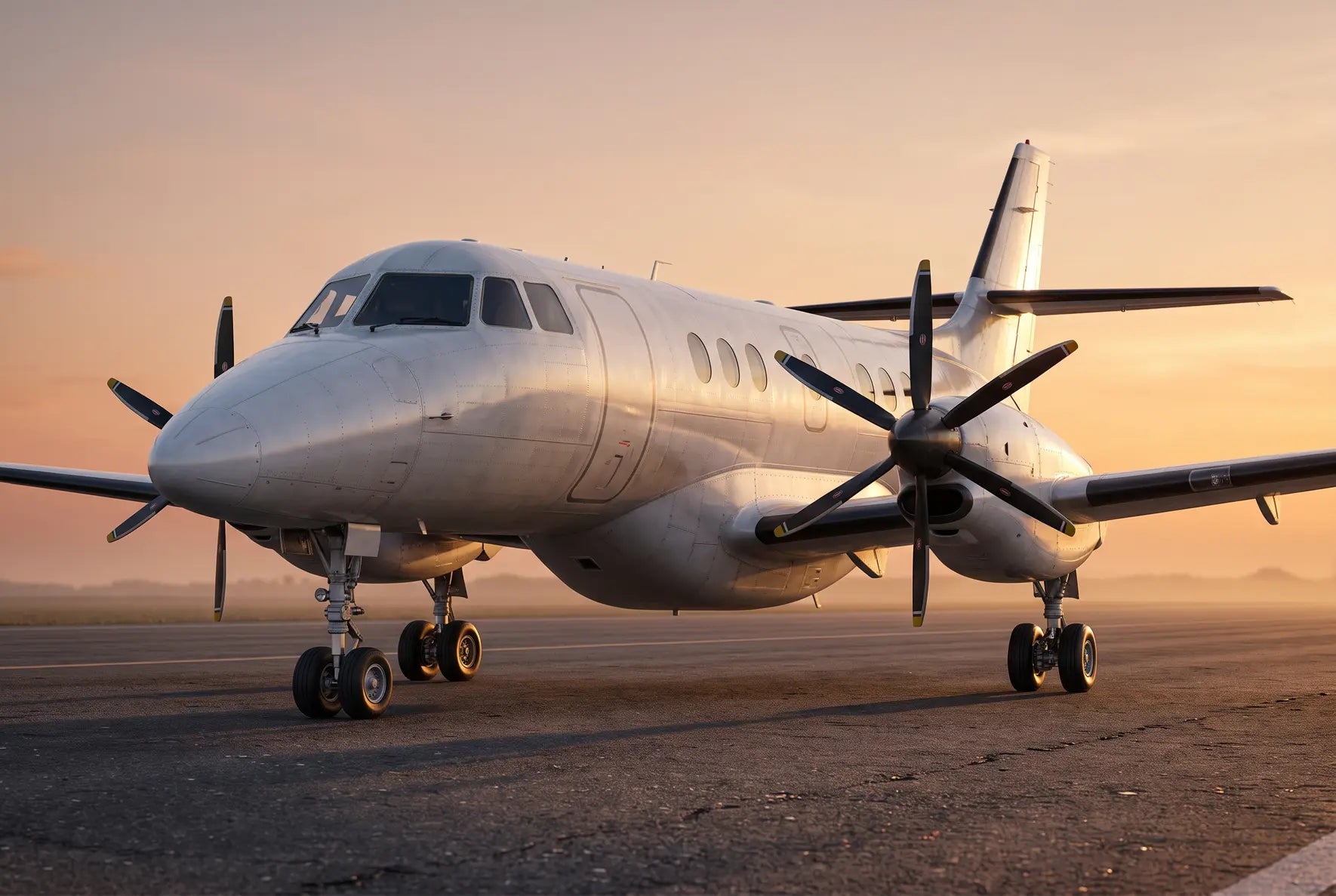
BAe Jetstream 41: History, Development and Variant Highlights
The BAe Jetstream 41 (marketed as the Jetstream 4100, and widely known as the J41) was British Aerospace's attempt to move up-market from the successful 18/19-seat Jetstream 31/32 into the fiercely contested 29-seat commuter segment. By the late 1980s regional carriers, particularly in the United States, wanted larger feederliners with better economics per seat, and BAe responded by stretching and modernising its existing Jetstream family rather than starting from a clean sheet.
The programme was officially launched in May 1989, backed early on by market interest from major US regional operators. The prototype was rolled out on 27 March 1991, and the aircraft made its first flight from Prestwick on 25 September 1991. European airworthiness certification and delivery followed quickly: the first aircraft was delivered to Manx Airlines on 25 November 1992, marking entry into service in late 1992. US certification of the Jetstream 4100 followed in 1993. The type holds the EASA Type Certificate EASA.A.189 for the Jetstream 4100 Series.
Production did not last long. In May 1997, BAe announced it would end Jetstream 41 manufacturing, by which point about 100 aircraft had been delivered; the total number built is recorded as 104, with the final airframe completed in early 1998. The type nonetheless remained in regional service worldwide for decades, with operators such as Eastern Airways retaining sizeable fleets.
What sets the Jetstream 41 apart from the 31/32
Although it shares its lineage and general appearance with the smaller Jetstream 31/32, the J41 is effectively a redesigned aircraft rather than a simple fuselage plug. The fuselage was stretched to seat 29 passengers in the familiar 2+1 layout, and the wing was reworked into a new one-piece structure repositioned lower on the fuselage, allowing a flat cabin floor. Power came from the more capable Garrett/AlliedSignal TPE331-14 series turboprops rated at roughly 1,650 shp each, driving five-blade propellers, and the flight deck adopted a modern Honeywell digital EFIS suite in place of the older analogue instrumentation. These changes gave the variant greater payload, range and cabin comfort than its predecessors, while meeting newer European and US certification standards. Prospective crews often encounter type-specific selection and assessment stages during airline hiring, including standardised screening such as the DLR pilot tests used by several airlines.
The following points summarise the key variant identifiers that distinguish the Jetstream 41 within the family:
- Engines: two Garrett/AlliedSignal/Honeywell TPE331-14GR/HR turboprops, approximately 1,650 shp each, with five-blade propellers.
- Capacity: 29 passengers in a 2+1 cabin, plus two flight crew and one cabin crew member.
- Dimensions: length about 19.25 m (63 ft 2 in) and wingspan about 18.29 m (60 ft 5 in), reflecting the stretched fuselage and new one-piece low wing.
- Weights and performance: maximum take-off weight of 24,000 lb (10,886 kg), typical cruise around 285-290 kt.
- Avionics: Honeywell digital EFIS flight deck, a clear generational step over the 31/32.
The programme was not without difficulty. Later industry commentary judged the J41 as a stretch that arguably pushed the original Jetstream design close to its practical limits, with the powerplant installation viewed as marginal against the larger airframe's increased weight and systems demands. Commercial pressures in the crowded 30-seat turboprop market, alongside the rise of regional jets, ultimately contributed to the early 1997 production shutdown. Even so, the Jetstream 41 established a solid reputation for reliability in short-haul feeder operations, and detailed operational data remains documented by SKYbrary for reference by pilots and engineers.

A blue and white Eastern Airways Jetstream 41 aircraft is captured mid-flight against a clear sky. The plane's landing gear is deployed, indicating it is either approaching for landing or recently taken off.
BAe Jetstream 41: Technical Specifications and Systems Highlights
The BAe Jetstream 41 was conceived as a stretched, EFIS-equipped development of the earlier Jetstream 31, designed for the 29-seat regional turboprop market. Its mission priorities were short-sector economics, good runway performance from regional airfields, and a passenger cabin sized to bridge the gap between small commuters and larger regional jets. As a family derivative it inherits the Jetstream lineage's fuselage cross-section philosophy and handling character, while adding a longer fuselage, a redesigned wing with the engines mounted lower and further outboard, and a modern glass flight deck. These choices reflect the usual regional turboprop trade-off: prioritising payload and field performance over outright range and cruise speed.
Compared with a small regional jet such as the Embraer ERJ 140, the Jetstream 41 accepted lower cruise speed in exchange for turboprop fuel efficiency on short sectors, making it well suited to thin, frequent regional routes.
- Length: about 19.25 m (63 ft 2 in).
- Wingspan: about 18.29 m (60 ft 5 in).
- Height: about 5.74 m (18 ft 10 in).
- Passenger capacity: 29 in standard airliner configuration, with two flight crew and one cabin crew.
- MTOW: 24,000 lb (about 10,886 kg).
- Maximum landing weight: 23,300 lb (about 10,569 kg).
- Operating empty weight: reported between roughly 14,144 lb (basic empty) and 14,988 lb (typical operating empty for the passenger version), depending on definition.
- Cruise speed: around 285 kt in normal cruise, with SKYbrary quoting about 290 kt TAS.
- Service ceiling: 26,000 ft (about 7,600 m).
- Range: quoted variously from about 1,000 nm to 1,490 nm depending on payload and reporting basis.
- Engines: two Garrett/AlliedSignal (now Honeywell) TPE331-14 turboprops rated at 1,500 shp (pre-modification) or 1,650 shp (post-modification).
- Propellers: five-blade constant-speed units.
- Avionics baseline: a four-tube EFIS glass cockpit with a Honeywell digital flight director, weather radar, TCAS, EGPWS and dual AHRS.
Systems and handling-relevant technology
The Jetstream 41 introduced a modern EFIS flight deck in place of the earlier Jetstream's more traditional instrumentation, giving crews integrated primary flight and navigation displays alongside a digital flight director. Engine management uses the well-proven TPE331 architecture, in which the engine and constant-speed propeller are governed together, and each engine drives a five-blade propeller for improved noise and thrust characteristics. Braking is supported by an anti-skid system to help maintain directional control and consistent stopping performance on shorter or contaminated runways. Ground-proximity and traffic-alerting systems (EGPWS and TCAS) provide the safety envelope expected of a regional airliner of its generation.
Published performance numbers for the type vary between sources, and this is normal rather than contradictory. Differences arise from operator-specific cabin density and interior weights, the exact MTOW and payload assumed, whether "range" is quoted with maximum payload or maximum fuel, and the atmospheric and runway-condition assumptions behind takeoff and landing distances. For that reason figures such as range (roughly 1,000 to 1,490 nm) and cruise speed (about 285 to 290 kt) are best read together with their stated basis rather than as absolute values.
The Garrett TPE331 engine family
The Jetstream 41 is powered by the TPE331-14 GR/HR engine, a member of the Garrett TPE331 turboprop family. The engine was originally developed by Garrett AiResearch, then marketed under AlliedSignal branding, and today is supported by Honeywell following successive corporate mergers, so the same core engine appears under three names across its service life. The TPE331 is a single-shaft turboprop, an architecture that links the compressor, turbine and propeller gearbox on one spool for a responsive, mechanically direct powerplant. On the Jetstream 41 it delivers 1,500 shp on earlier examples and 1,650 shp after modification, as documented in the EASA type certificate data for the Jetstream 4100 series.
The TPE331 became one of the most widely produced regional and utility turboprops, with millions of operating hours across its variants. Beyond the Jetstream 41, the family has powered aircraft such as the Dornier 228, the Embraer EMB 110 Bandeirante, and the Fairchild Metroliner series, giving the engine a broad maintenance and support base that benefited regional operators of the type.
BAe Jetstream 41 vs ATR 42-300 vs Saab 340B vs Dash 8-100: Key Specifications Comparison
Scroll horizontally to see more →
| Parameter | BAe Jetstream 41 | ATR 42-300 | Saab 340B | de Havilland Canada Dash 8-100 |
|---|---|---|---|---|
| Entry into service | 1992 | 1985 | 1989 | 1984 |
| Engines | 2 × AlliedSignal TPE331-14GR/HR turboprop | 2 × Pratt & Whitney Canada PW120 turboprop | 2 × General Electric CT7-9B turboprop | 2 × Pratt & Whitney Canada PW120 turboprop |
| Length | 19.25 m | 22.67 m | 19.79 m | 22.25 m |
| Wingspan | 18.29 m | 24.57 m | 21.44 m | 25.89 m |
| Height | 5.74 m | 7.59 m | 7.52 m | 7.49 m |
| Typical seating and layout (short description + approximate passengers) | Commuter turboprop: 29 passengers | Regional turboprop: 42–50 passengers | Regional turboprop: 30–34 passengers | Regional turboprop: 37–39 passengers |
| MTOW | 10.89 t | 16.85 t | 13.61 t | 16.33 t |
| Range | 774 nm | 780 nm | 920 nm | 1,100 nm |
| Cruise speed | 0.44 Mach | 0.40 Mach | 0.44 Mach | 0.42 Mach |
| Service ceiling | 26,000 ft | 25,000 ft | 25,000 ft | 25,000 ft |
| Program note | Stretched Jetstream family commuter designed for 29-seat regional airline service. | Early ATR baseline turboprop offering higher capacity and stronger economics on short regional routes. | Compact twin-turboprop commuter optimized for lower-density regional operations. | Early Dash 8 baseline turboprop positioned for short-haul regional connectivity and rugged airport performance. |
Scroll horizontally to see more →
The table compares four early regional turboprops across size, capacity, and performance. The Jetstream 41 is the smallest and lightest at 10.89 t MTOW with 29 seats, while the ATR 42-300 and Dash 8-100 carry more passengers (roughly 37–50) and have larger wingspans. Range varies most: Dash 8-100 leads at 1,100 nm, Saab 340B follows at 920 nm, with Jetstream 41 and ATR 42 near 775–780 nm. Cruise speeds are similar around Mach 0.40–0.44 and ceilings are 25,000–26,000 ft.
BAe Jetstream 41 Operations: Typical Routes, Missions and Airlines Worldwide
The BAe Jetstream 41 was conceived as a 29-seat pressurised commuter and feeder turboprop, competing directly with the Embraer EMB-120 Brasilia, Saab 340 and Dornier 328. Its mission profile is defined by short regional sectors: most operators fly it on legs of roughly 100-300 nm (about 30-90 minutes airborne), with occasional routes reaching 400-500 nm where geography demands. The practical commercial range is around 774 nm with 29 passengers and IFR reserves, and a service ceiling near 25,000-26,000 ft. On short legs the aircraft typically cruises at 18,000-24,000 ft at about 268-285 kt.
Daily utilisation follows the classic regional turboprop pattern of multiple short segments. A 30-seat type of this class commonly operates 5-8 sectors per day, with block times around 0.8-1.0 hour on a 150 nm leg and total daily flight time frequently in the 5-8 hour range. Short-field performance (take-off around 1,500 m, landing near 1,320 m per the SKYbrary type record) lets it serve regional and secondary airports with modest runways.
Operational Environments
Two network models dominate. The first is hub-and-spoke feeding, connecting smaller cities to mainline hubs under major-carrier brands. The second is regional point-to-point, linking secondary cities directly where no dominant hub exists. With only 29 seats, the type is too small for dense trunk routes but well matched to thin spokes. The main operational challenge is unit cost: like most 30-seat turboprops, seat-mile economics are less favourable than larger regional jets, which has gradually pushed the type out of many fleets and left a small active population worldwide.
Where the Jetstream 41 Operates
The aircraft has served across four broad regions. In Europe, it flew mainly as a UK regional workhorse and hub feeder, both independently and under major-carrier franchises. In North and South America, it appeared in United States feeder liveries and on thin Colombian and Brazilian domestic routes. In Asia, several carriers used it on short domestic sectors between secondary cities and provincial capitals. In Africa, regional operators deployed it on point-to-point links between secondary centres and as feeders into national hubs.
- Europe: Eastern Airways (United Kingdom) remains the largest operator, using the type on short domestic and near-European sectors between secondary airports such as Aberdeen, Humberside and Sumburgh. Manx Airlines operated it in British Airways franchise colours as a hub feeder into Manchester and London. Several other UK franchisees flew it on domestic and short intra-European legs.
- North & South America: United Express operated Jetstream 41s in the United States as regional feeders into United hubs on typical 100-300 nm sectors. In South America, regional carriers in Colombia and Brazil used the aircraft on thin domestic routes, mixing point-to-point service with hub feeding.
- Asia: several regional carriers operated the type on short domestic sectors, generally well below its maximum range and often into airports with limited infrastructure.
- Africa: regional operators, notably in South Africa, used the aircraft on thin domestic and near-regional routes, connecting secondary cities and industrial centres and feeding larger national hubs.
Typical Seating Layouts
The EASA type certificate for the Jetstream 4100 series sets a maximum of 30 passenger seats, but almost every airline configures the cabin for 29 passengers in a single class, with two pilots and one flight attendant. The cabin uses a three-abreast, 2-1 layout across a single aisle, with a forward passenger door, a rear service door and two overwing emergency exits. Cabin length is roughly 9.5 m, width around 1.85 m and height about 1.7 m.
Because the type is essentially a commuter aircraft, seat-map variation between operators is minimal: both network feeders and independent regionals typically retain the standard 29-seat single-class arrangement, prioritising rapid turnarounds over premium cabins. Crew rostering on such short, high-frequency regional rotations is demanding, a reality familiar to pilots across the low-cost and regional sector, as discussed in this overview of Ryanair pilot working conditions. Manufacturer and heritage documentation from BAE Systems confirms the 29-seat commuter/feeder design intent that continues to shape how the aircraft is deployed today.
In this video, watch an Eastern Airways BAe Jetstream 41 as it lands at Birmingham Airport (BHX) and later departs, featuring clear views of the aircraft during approach, touchdown, taxi, and takeoff.
BAe Jetstream 41 Safety Record: How Safe Is This Turboprop?
The BAe Jetstream 41 (also designated Jetstream 4100) is a 29-seat regional turboprop that entered service in 1992, when it received its European airworthiness certificate under the UK Civil Aviation Authority on 23 November 1992, with the first aircraft delivered to Manx Airlines. Production ended in May 1997, by which point 100 aircraft had been delivered and 104 airframes built in total. Set against this relatively small fleet and roughly three decades of commuter operations worldwide, the type has accumulated only a limited number of hull losses and fatal accidents. Most serious events recorded in the Aviation Safety Network database relate to crew decision-making, approach and landing handling, or specific component failures, rather than any fundamental flaw in the airframe's design.
Notable accidents and what changed afterwards
A small number of occurrences illustrate the type's operational risk profile and the lessons drawn from them.
- South African Airlink (Airlink) Flight 8911, Durban, 2009. Shortly after take-off from Durban, an engine suffered a catastrophic failure of the second-stage turbine seal plate. The official investigation found that the crew misidentified the affected engine and shut down the serviceable one, attributing this to a breakdown in crew resource management (CRM) and a deviation from standard operating procedures. The forced landing resulted in one fatality. The recommendations focused on strengthened CRM training, disciplined engine-failure diagnosis and cross-checking, and revised engine maintenance and inspection practices, rather than airframe redesign.
- Sky Express, Rhodes, Greece, 2015. A landing accident that caused substantial damage but no fatalities. The Greek investigation examined approach technique and handling in the prevailing conditions and issued recommendations on stabilised-approach criteria, go-around decision-making and operator training.
Additional events in the ASN record involve regional and charter carriers, typically runway excursions, hard landings or overruns associated with weather, runway state or approach handling. As with most regional turboprops, these point to operational and human-factor causes addressed through procedures, training and maintenance oversight rather than type-certificate changes. Investigation bodies such as the UK Air Accidents Investigation Branch and the US NTSB publish the primary reports underpinning these entries.
How safe is the BAe Jetstream 41?
Judged against its exposure, the Jetstream 41 has a modest accident count for a type that has operated short regional sectors, which involve frequent take-offs and landings, across many carriers since 1992. Its safety rests on a conventional, proven design philosophy, twin AlliedSignal/Honeywell TPE331 turboprops with engine-out handling in mind, and on the disciplined application of standard operating procedures backed by ongoing regulatory oversight. The recurring theme in its record is that outcomes depend heavily on crew training, CRM and procedural compliance, which is precisely why operators and regulators have concentrated corrective action there. The wider working environment for crews, from rostering to fatigue management, also shapes operational safety, as discussed in this overview of pilot working conditions. Viewed in context, and consistent with aggregated IATA and ICAO data showing commercial accident rates on the order of only a few events per million departures, the Jetstream 41 reflects the broader reality that aviation remains one of the safest modes of transport.
01 What kind of routes and range is the BAe Jetstream 41 typically used for?
The BAe Jetstream 41 is a regional commuter turboprop designed for short to medium sectors, typically up to about 700–800 nautical miles in day-to-day service. Its maximum range is quoted around 740–770 nautical miles in many operator and charter configurations, which suits routes of roughly 1.5 to 2.5 hours. Airlines and charter operators commonly use the Jetstream 41 on feeder services linking smaller regional airports to major hubs, as well as point-to-point routes where jet aircraft would be uneconomical. This mission profile makes it well suited to markets with moderate passenger demand but frequent service needs.
02 How is the cabin layout and comfort on the BAe Jetstream 41 for passengers?
The BAe Jetstream 41 cabin is relatively narrow but well proportioned for a 29–30 seat commuter aircraft, with a width of about 6 ft 1 in, height around 5 ft 10 in, and a cabin length just over 31 ft. Seats are usually arranged in a 1–2 layout, giving many passengers a single seat on one side and two-seat pairs on the other, which can feel more spacious than a typical 3–3 jet cabin. Most configurations include a small galley and a lavatory, and the aircraft is pressurized and air-conditioned for comfort. Depending on the operator, there are also VIP and executive layouts with fewer seats and more space per passenger, often used in charter and corporate roles.
03 Is the BAe Jetstream 41 noisy, and what is the overall passenger experience like?
As a twin turboprop, the BAe Jetstream 41 produces more propeller noise than larger jets, but the design deliberately moved the engines further from the fuselage compared with the earlier Jetstream 31, which reduces cabin noise. Some aircraft were fitted with optional active noise suppression systems, further improving the sound levels and comfort. Passengers can expect noticeable engine and propeller noise during take-off and climb, with a quieter experience in cruise, especially toward the rear of the cabin. For many travellers, the trade-off is acceptable given the short sector lengths and the convenience of serving smaller airports.
04 Which airlines operate the BAe Jetstream 41 and on what kinds of routes?
The BAe Jetstream 41 has been widely used by regional and commuter carriers, including United Express in the past and Eastern Airways in the UK, which remains one of the largest current operators. These airlines typically deploy the Jetstream 41 on domestic and near-neighbour international routes where passenger demand is modest but reliable frequency is required, such as connecting secondary cities to major hubs or serving remote communities. Many aircraft have also transitioned into charter, corporate, and specialized roles, using flexible seating configurations from 10-seat VIP to 16-seat executive layouts. This mix of operators reflects the aircraft’s versatility across both scheduled and on-demand regional operations.
05 How does the BAe Jetstream 41 perform compared with similar regional turboprops?
The BAe Jetstream 41 is powered by two Garrett/AlliedSignal TPE331-14 turboprop engines of around 1,500–1,650 shaft horsepower each, giving it a typical cruise speed near 270–285 knots and a service ceiling around 25,000–26,000 feet. Performance focuses on short-field capability, with typical landing distances around 800–1,000 meters, which allows operation from smaller regional airports with limited runway length. It sits in a niche between smaller 19-seat aircraft and larger 30–50 seat turboprops, offering roughly 29–30 seats and good economics on thinner routes where bigger aircraft would be difficult to fill. Its fuel burn and speed are competitive for its class, making it a practical choice for short regional sectors rather than longer, high-speed trunk routes.
06 What should travellers know about safety, turbulence behaviour, and seat choice on the BAe Jetstream 41?
The BAe Jetstream 41 was certified as a modern commuter airliner, featuring an electronic flight instrument system cockpit and standard safety equipment such as terrain awareness and traffic alert systems on many aircraft, and it has been widely used in commercial service with a conventional safety profile for its class. As a relatively small turboprop with low-mounted wings, it can feel turbulence more than large jets, but its robust structure and wing design are intended for regional weather conditions, and crews can often choose altitudes around 20,000–25,000 feet to avoid the worst bumps. For comfort, passengers who are sensitive to noise or vibration may prefer seats toward the rear, further from the engines and propellers, while forward seats can offer a slightly smoother ride in turbulence. Window views are generally good throughout, with the 1–2 seating layout providing many single-seat options that frequent flyers often appreciate.