

BAe 146-100: History and Development of the Quiet Regional Jet
The BAe 146-100 was the baseline, shortest-fuselage member of the British Aerospace 146 family, a four-engined regional jet designed to bring quiet, short-field jet operations to airports that previously relied on turboprops. Its origins trace back to the Hawker Siddeley HS.146 concept, launched in August 1973 as a 70-seat regional jet intended to fill the gap between turboprop airliners such as the HS.748 and Fokker F27 and small jets like the BAC One-Eleven and the Boeing 737. The goal was an aircraft that could operate economically from short, less-equipped airfields while offering the comfort and speed of a jet.
The HS.146 began as a private venture, but spiralling inflation and difficult economic conditions led Hawker Siddeley to stop work in October 1974. The project was effectively shelved until UK aerospace consolidation created British Aerospace, which absorbed Hawker Siddeley and relaunched the program in 1978 as the British Aerospace 146. The renewed effort centred on a quiet "Whisperjet" with low fuel consumption and excellent short-field performance, suited to noise-sensitive city airports. The initial family comprised two variants: the shorter 146-100 and the stretched 146-200.
Key program and variant milestones include:
- August 1973: HS.146 70-seat regional jet concept announced.
- October 1974: original HS.146 development halted on economic grounds.
- 1978: program relaunched by British Aerospace as the BAe 146.
- Mid-1981: first order placed by LAPA (Líneas Aéreas Privadas Argentinas).
- 3 September 1981: first flight of the BAe 146-100.
- 8 February 1983: UK Civil Aviation Authority Certificate of Airworthiness granted.
- March 1983: delivery to launch customer Dan-Air.
- May 1983: entry into revenue service with Dan-Air.
The manufacturer story spans two names. Hawker Siddeley Aviation originated the design and conducted early 1970s work, while British Aerospace took the project through certification and production. Production of the 146 family ran from 1983 into the early 2000s, and including the later Avro RJ derivatives totalled 387 aircraft, making it the most successful British civil jet airliner program. Enthusiasts who enjoy the era of multi-engine British and Anglo-American jetliners may also appreciate the contrast with earlier long-haul designs such as the Boeing 707-420.
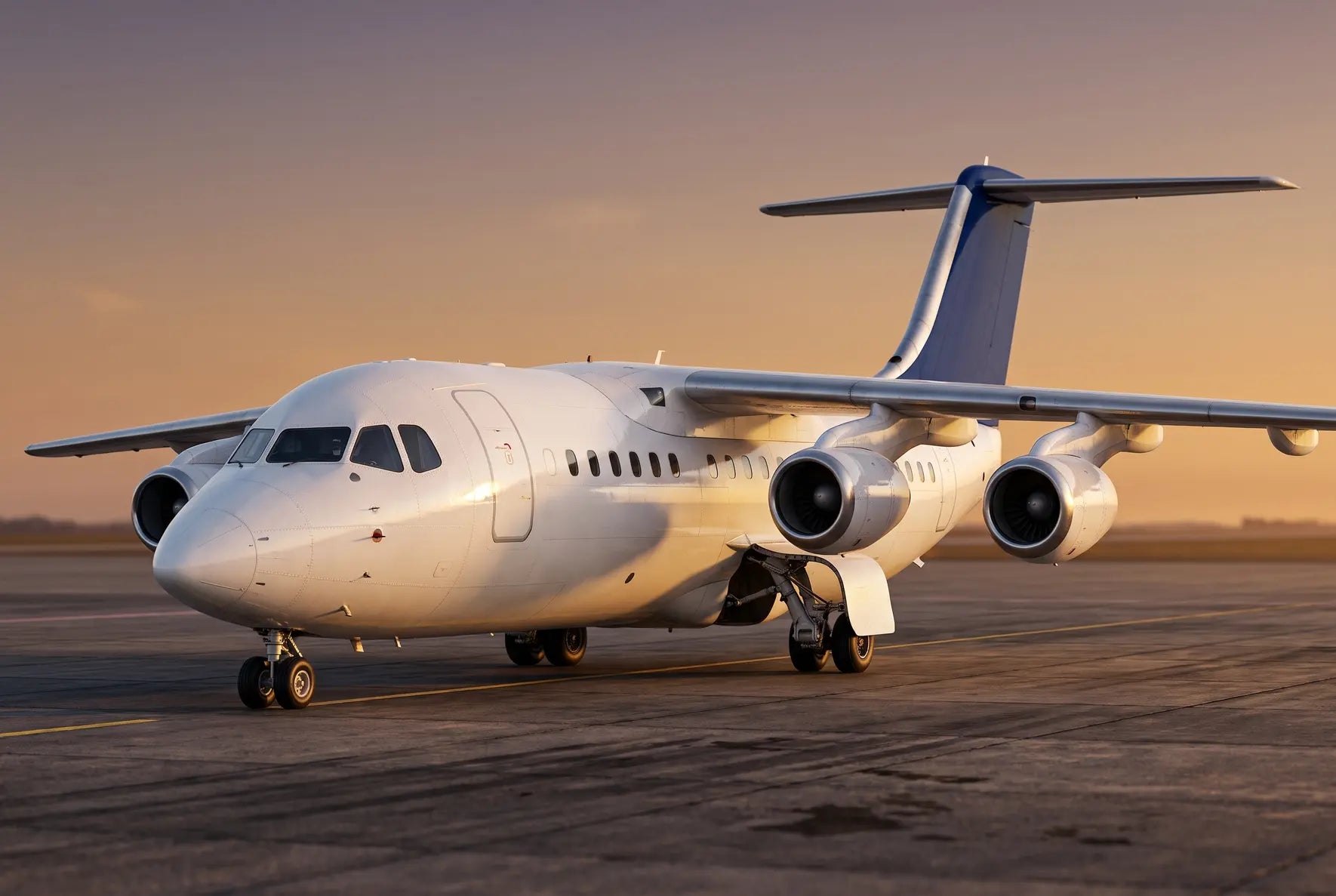
Technically, the 146-100 is defined by a high monoplane wing, a T-tail, and four Avco/Textron Lycoming ALF 502 turbofans mounted on short pylons beneath the wing. A distinctive large split airbrake in the tail provided strong deceleration, allowing the design to omit thrust reversers, while large flaps and spoilers supported short take-off and landing and steep-approach operations into airports such as London City. The quiet ALF 502 installation earned the type its "Whisperjet" reputation.
What sets the BAe 146-100 apart
Within the family, the 146-100 is the shortest and lightest member. The later 146-200 introduced a stretched fuselage and higher weights for greater seating, and the 146-300 stretched the airframe further to offer the highest passenger capacity. All three share the high-wing, T-tail, four-engine layout and short-field capability, but the 146-100 was optimised as a compact, low-capacity regional jet. The variant later evolved into the Avro RJ70, which introduced FADEC-equipped LF507 engines and digital avionics, distinguishing the modernised aircraft from the original 146-100.
The following points summarise the main variant identifiers for the BAe 146-100:
- Engines: four Textron Lycoming ALF 502R-5 turbofans (approximately 29.8-31 kN / 6,970 lbf each), with earlier ALF 502R-3 fits.
- Length: about 93 ft 10 in (28.6 m), the shortest in the family.
- Wingspan: about 86 ft (26.2 m).
- Maximum take-off weight: approximately 84,000 lb (38,102 kg).
- Cruise speed: about 477 mph (767 km/h).
- Range: roughly 1,864 miles (3,000 km).
- Capacity: typically 70 to 112 passengers depending on cabin layout.
- Unique systems: large split tail airbrake replacing thrust reversers, oversized flaps and spoilers, and a notably quiet noise profile.
In terms of program history, the most significant disruption was the 1974 economic halt and the four-year gap before the 1978 relaunch, which involved reassessment and refinement of the design under British Aerospace. The later move to the Avro RJ series in the early 1990s, with new engines and modern avionics, represents the other major evolution from the original 146-100 baseline.

The image features the logo of the Avro RJ, highlighting the bold black letters 'AVRO' above, with 'RJ' in striking red below, against a contrasting black and white background.
BAe 146-100 Technical Specifications, Systems and Engines
The BAe 146-100 was conceived as the shortest member of British Aerospace's quiet, four-engine regional jet family, optimised for short-field operations into noise-sensitive and city-centre airports. Its design priorities were excellent runway performance, very low noise and the ability to operate without ground support equipment, thanks to a high-mounted wing, a built-in airstair and four high-bypass geared turbofans. The trade-off was modest range and a relatively low service ceiling compared with twin-engine narrowbodies, in exchange for short-field access and quiet, smooth operation. As the baseline variant, it shares its fuselage cross-section, T-tail and wing architecture with the later -200, -300 and Avro RJ developments.
The aircraft typically seated around 70 passengers in a single-class layout, making it well suited to thin, frequency-driven regional routes. For travellers comparing regional types, the high-wing turbofan layout contrasts with modern turboprops such as the ATR 42-600, which favours fuel efficiency over jet speed and comfort.
Specifications that matter
- Wingspan: 26.34 m (86 ft 5 in)
- Length: 26.16 m (85 ft 10 in)
- Height: 8.61 m (28 ft 3 in)
- Engines: four Textron Lycoming ALF 502R-5 high-bypass geared turbofans
- Thrust class: approximately 6,970 lbf (about 31 kN) per engine
- MTOW: 38,102 kg (84,000 lb)
- OEW: 23,300 kg (51,368 lb)
- MLW: 35,153 kg (77,500 lb)
- Range: roughly 2,174 km (1,173 nm) on the published seating/range table, varying with payload assumptions
- Cruise speed: around M0.72 (published data also cites about 300 kt IAS)
- Service ceiling: 31,000 ft
- Fuel capacity: approximately 11,728 L
- Typical seating: about 70 passengers, single class
Systems and handling-relevant technology
The BAe 146-100 uses conventional, hydraulically powered flight controls rather than fly-by-wire, with the four-engine layout providing benign engine-out handling and useful redundancy. A defining feature is the large airbrake at the tailcone, which lets the aircraft fly steep, well-controlled approaches into short runways without spool-down delays from the engines. Combined with effective anti-skid braking and full-span trailing-edge flaps, this gives the type its characteristic short landing performance. The baseline BAe 146-100 was fitted with analogue avionics; the later Avro RJ family introduced digital avionics and FADEC-controlled engines, so those features are not baseline to this variant.
Published performance figures should be read with care. Range, field length and payload values depend heavily on operator-specific options, cabin density, selected weight variants, atmospheric conditions and runway state, so quoted numbers represent particular reference cases rather than absolute limits. Independent type data, such as that compiled by SKYbrary, often shows representative family figures that may differ slightly from subtype-specific certified data.
Engines: the Lycoming ALF 502 family
The BAe 146-100 is powered by four Avco Lycoming ALF 502R-5 turbofans, with some early aircraft referencing the lower-rated ALF 502R-3 (about 6,700 lbf). The ALF 502 is a twin-spool, high-bypass geared turbofan: a reduction gearbox keeps the fan tip speed subsonic, which is central to the aircraft's reputation as a very quiet "Whisperjet". Its gas-generator core was derived from Lycoming's T55 turboshaft, the engine that powers the CH-47 Chinook helicopter, adapted with a new fan and low-pressure turbine for fixed-wing use.
Corporate ownership of the programme passed from Avco Lycoming to Textron Lycoming, and later into AlliedSignal and then Honeywell. Beyond the BAe 146, the ALF 502 family found use on the early Canadair CL-600 Challenger business jet, while a military derivative powered the Northrop A-9A prototype and NASA's Quiet Short-Haul Research Aircraft. The engine's direct descendant, the Honeywell LF 507, was a higher-thrust, FADEC-equipped development used on the later Avro RJ70, RJ85 and RJ100, which were essentially re-engined and updated BAe 146 airframes.
BAe 146 Variants and Avro RJ85 Specifications Comparison
Scroll horizontally to see more →
| Parameter | BAe 146-100 | BAe 146-200 | BAe 146-300 | Avro RJ85 |
|---|---|---|---|---|
| Entry into service | 1983 | 1983 | 1988 | 1993 |
| Engines | 4 × Textron Lycoming ALF 502R turbofans | 4 × Textron Lycoming ALF 502R turbofans | 4 × Textron Lycoming ALF 502R-5 turbofans | 4 × Honeywell LF 507-1F turbofans |
| Length | 26.20 m | 28.55 m | 30.99 m | 28.76 m |
| Wingspan | 26.21 m | 26.21 m | 26.21 m | 26.34 m |
| Height | 8.61 m | 8.61 m | 8.59 m | 8.61 m |
| Typical seating and layout (short description + approximate passengers) | Single-class: 70–82 passengers | Single-class: 85–100 passengers | Single-class: 100–112 passengers | Single-class: 85–100 passengers |
| MTOW | 34 t | 38 t | 44 t | 40 t |
| Range | 2,090 nm | 1,970 nm | 1,800 nm | 1,700 nm |
| Cruise speed | 0.70 Mach | 0.70 Mach | 0.70 Mach | 0.74 Mach |
| Service ceiling | 35,000 ft | 35,000 ft | 35,000 ft | 35,000 ft |
| Program note | Original short-fuselage BAe 146 variant optimised for regional routes from short runways. | Stretched BAe 146 development offering more capacity on short- to medium-haul services. | Longest BAe 146 version aimed at high-density regional markets while retaining short-field performance. | Updated Avro RJ family member replacing BAe 146-200 with modernised systems and improved economics. |
Scroll horizontally to see more →
The table compares key specs across the BAe 146-100/-200/-300 and the Avro RJ85. It shows the family’s growth in length and capacity from about 70–82 seats on the -100 to 100–112 on the -300, alongside higher MTOW (34 t to 44 t). In contrast, range generally decreases as size increases (2,090 nm to 1,800 nm), while the RJ85 updates the -200 with LF 507 engines and a higher cruise speed (Mach 0.74 vs 0.70).
BAe 146-100 Operations and Airlines: Routes, Missions and Fleets
The BAe 146-100 was conceived as a short-haul, high-frequency regional jet. In airline service it typically flew sectors of 200 to 600 nautical miles (370 to 1,110 km), with most scheduled legs lasting between 1 and 2 hours of block time. Practical airline range fell in the 970 to 1,170 nautical mile (1,800 to 2,170 km) band depending on payload, while lighter, low-density configurations could reach roughly 1,500 to 1,800 nautical miles. Cruise was flown at about Mach 0.70 (around 410 knots true airspeed) with a service ceiling near 31,000 ft, according to Skybrary.
Daily utilisation followed a classic regional pattern of roughly 6 to 9 block hours and 4 to 8 legs per day, exploiting the type's robust, four-engine design. Its operating niche was defined by short-field and noise performance: large Fowler flaps, generous spoilers and a split tail airbrake allowed steep approaches without thrust reversers. This made it the smallest and most field-capable member of the family, well suited to constrained airports such as London City, Bern, Lugano and the high-altitude strip at Paro in Bhutan. The aircraft's quiet Lycoming ALF 502 turbofans earned it the Whisperjet nickname and access to curfew-restricted city airports. Operators used it both as a hub-and-spoke feederliner and on thin point-to-point city pairs, though four engines and ageing systems made maintenance costs higher than for twin-jet competitors.
Where the BAe 146-100 operates
Built in modest numbers, the original short-fuselage variant saw its widest use across Europe, where carriers deployed it on regional feeder and city-centre routes into noise-sensitive airfields. In North & South America the type appeared on West Coast and regional short-haul work and, in South America, on thin high-elevation sectors, although many American carriers favoured the larger -200. Across Asia it served short domestic and challenging-airfield routes, most famously into Bhutan, while in Africa it handled regional sectors from secondary airports with limited runway length.
- Europe: Dan-Air London was the launch customer, flying its first revenue service Gatwick to Bern in May 1983. Air UK, Jersey European, Manx Airlines, British Airways, SAS, Alitalia Express and Turkish Airlines used the variant on short intra-European feeder and city routes, while the Royal Air Force operated three as Queen's Flight VIP transports from 1986. Details are catalogued by Planespotters.
- North & South America: the pure -100 was scarce here, with most regional and West Coast work performed by the larger -200 flown by PSA, AirCal and Air Wisconsin. In South America, Star Peru and TAM Empresa Publica of Bolivia operated -100s on thin, often high-altitude sectors from secondary fields.
- Asia: Druk Air of Bhutan selected the smallest variant for its short, high-elevation runway at Paro, exploiting the type's hot-and-high and STOL strengths, while SkyJet Airlines in the Philippines flew it on regional short-haul services.
- Africa: BAe 146 family aircraft served regional Southern and East African routes from carriers such as Airlink and Air Botswana, valued for short-field capability into runway-limited airports, though documentation often groups all variants together.
Typical seating and cabin layouts
The 146-100 used a flexible five- or six-abreast cabin. In one-class regional layouts it typically carried 70 to 85 passengers, with five-abreast (3-2) seating offering around 70 seats and six-abreast high-density fits reaching the low 90s. Network carriers commonly fitted two-class cabins, placing a small forward business section at 32 to 34 inch pitch ahead of economy at 30 to 32 inch pitch, yielding totals nearer 60 to 75 seats. Leisure and charter operators favoured single-class, higher-density layouts to maximise revenue, trading comfort for capacity. Because it targeted premium short-haul and demanding airfields, many -100 operators chose moderate density to preserve performance margins. General manufacturer and family data are summarised on Wikipedia, and the type's regional role can be compared with newer turboprops such as the Xian MA700.
In this video, discover why BAe 146 and Avro RJ Whisperjet airliners still fly in Canada, what makes them unique, and how these distinctive jets continue operating as other fleets retire.
BAe 146-100 Safety Record and How Safe Is This Regional Jet?
The BAe 146-100 is the smallest member of British Aerospace's quiet, four-engine regional jet family, with only 35 of the series 100 built and first deliveries from 1983. Because accident databases usually aggregate the whole BAe 146/Avro RJ family, the type's record is best understood at family level: according to published accident summaries, the BAe 146/Avro RJ has been involved in roughly 14 hull-loss accidents over several decades of intensive short-haul service across European, North American and Australian operators. For a type designed for high-cycle operations into noise-sensitive and short-field airports such as London City, that figure reflects a generally solid safety profile relative to the very large number of flights and landing cycles flown since the early 1980s. The four-engine layout adds redundancy after an engine failure, while the large airbrake and spoilers support stabilised steep approaches into constrained aerodromes.
Notable accidents and what changed afterwards
- PauknAir Flight 4101 (1998, BAe 146-100, EC-GEO): the aircraft struck terrain on approach to Melilla, Spain, in poor visibility, a controlled-flight-into-terrain (CFIT) scenario with 38 fatalities. The accident, documented in the Aviation Safety Network type database, reflected the era's wider push toward enhanced terrain awareness systems, stabilised-approach criteria and crew resource management.
- China Northwest Airlines Flight 2119 (1993, BAe 146-300, B-2716): the closest sub-variant suffered a fatal takeoff accident at Yinchuan linked to takeoff configuration and handling issues. Events of this kind reinforced industry emphasis on configuration checks, checklist discipline and rotation training.
- Engine turbine failure (2000, BAe 146-100, VH-NJR, Canberra): a rejected takeoff followed first-stage turbine blade separation from fatigue cracking. The ATSB investigation found a relevant manufacturer service bulletin had not been incorporated, reinforcing the need for rigorous tracking and compliance with engine service bulletins in operator maintenance programmes.
The BAe 146 is also recognised for cabin air quality ("fume") events tied to its bleed-air pressurisation system, which prompted revised maintenance procedures and improved reporting of contamination occurrences.
How safe is the BAe 146-100 today?
When the small number of serious occurrences is weighed against the very high volume of cycles flown by the family over four decades, the BAe 146-100 sits within the expected safety range for a mature regional jet. Its safety rests less on any single feature than on layered defences: a redundant four-engine design, effective high-lift and braking devices for steep, stabilised approaches, standard operating procedures, and oversight by regulators such as the UK Civil Aviation Authority. Crew standards remain central, and the demands placed on flight crews across operators large and small are explored further in our look at pilot working conditions at Atlas Air. Independent statistics, including those compiled by ICAO, consistently confirm that commercial aviation remains one of the safest modes of transport.
01 What typical routes and ranges is the BAe 146-100 used for?
The BAe 146-100 is designed primarily for short-haul regional routes, typically flying sectors of 500 to 1,500 kilometres between major hubs and smaller city airports. Its range with maximum payload is around 2,100–2,200 km, which makes it suitable for dense shuttle services, domestic flights, and short international hops. Operators have commonly used it on routes where runway length, terrain, or noise restrictions limit larger jets. This mission profile positions the BAe 146-100 as a feeder aircraft linking secondary airports to larger network hubs.
02 How is the cabin layout and comfort on the BAe 146-100 for passengers?
The BAe 146-100 typically seats around 70 passengers in a single-class layout, with a five-abreast configuration (2–3 across) and an economy seat pitch of roughly 79 cm, offering moderate legroom for a regional jet. The cabin is relatively narrow but has a good height, giving most passengers enough headroom and a comfortable sense of space on short flights. Overhead bins are adequate for standard carry-on bags, and the cabin length of about 15.4 metres keeps boarding and disembarkation quick. Seating comfort varies by airline, but on typical one- to two-hour sectors the aircraft generally offers a pleasant experience.
03 Is the BAe 146-100 a quiet or noisy aircraft from a passenger perspective?
The BAe 146-100 was marketed as the “Whisperjet” and is considered quieter than many older-generation regional jets, particularly during approach and landing. Its four small turbofan engines and advanced flap and airbrake configuration allow reduced use of reverse thrust, helping lower noise around airports and in the cabin. Passengers usually notice engine noise most during take-off, but once in cruise the cabin sound level is moderate and acceptable for normal conversation. These low-noise characteristics made the BAe 146-100 popular at airports with strict noise regulations and in densely populated urban areas.
04 How does the BAe 146-100 perform compared with similar regional jets?
The BAe 146-100 offers strong short-field performance, with take-off distances of about 3,600–3,900 feet and landing distances around 4,000 feet, making it well suited to airports with short or constrained runways. Its cruise speed of roughly 750 km/h is comparable to many regional jets, although some newer types may be slightly faster and more fuel efficient. Where it stands out is its combination of four engines, high wing, and large flaps and spoilers, which provide good climb performance and reliable handling into challenging airports. In modern operations it is not the most economical option, but its unique performance profile keeps it valuable for niche missions and special operations.
05 What is the safety record and notable design features of the BAe 146-100?
The BAe 146 family, including the -100, has a generally solid safety record for a regional jet designed in the late 20th century, with relatively few major accidents compared with the large number of flights operated. The aircraft features a high wing and T-tail, four redundant turbofan engines, and large flaps, spoilers, and a distinctive tail-mounted air brake that reduce reliance on reverse thrust and improve control during landing. Its quiet operation and short take-off and landing capabilities were central design goals, supporting safe use at smaller, often more demanding airports. As with any type, safety performance also depends heavily on operator maintenance standards and crew training.
06 As a traveller, what should be known about flying on a BAe 146-100 (seat choice, turbulence, windows)?
On the BAe 146-100, seats over or just ahead of the wing often provide a smoother ride in turbulence, as the wing’s position helps dampen motion compared with seats in the very front or rear. Window spacing is fairly regular, but alignment can vary by row, so passengers who value a good view may prefer seats slightly forward of the wing, away from the engines and structural components. Because the engines are mounted on the rear part of the high wing, cabin vibration is usually modest and the noise level is comfortable for most travellers. For short regional flights, the aircraft offers a practical, stable experience, especially for those who choose seats near the wing or in the central portion of the cabin.