

ATR 72-600: History, Development and What Sets This Variant Apart
The ATR 72-600 is the current production standard of the ATR 72 family, a twin-engine turboprop regional airliner that has served short-haul routes worldwide since the late 1980s. To understand how the -600 came to be, it is necessary to trace the origins of the ATR partnership and the evolution of the ATR 72 through its successive variants.
Origins of ATR and the ATR 72 Family
ATR, which stands for Avions de Transport Regional in French and Aerei di Trasporto Regionale in Italian, was established on 4 November 1981 when French manufacturer Aerospatiale and Italian manufacturer Aeritalia signed a cooperation agreement in Paris. The joint venture was created specifically to develop a modern turboprop airliner for regional routes. Aerospatiale later became part of Airbus, while Aeritalia evolved into Leonardo, meaning ATR today operates as a 50/50 partnership between Airbus and Leonardo.
The first product of this collaboration was the ATR 42, a 42- to 50-seat turboprop that entered service in 1985. Encouraged by market demand for a higher-capacity variant, ATR developed the ATR 72 by stretching the fuselage by 4.5 metres, increasing the wingspan, fitting more powerful engines, and adding roughly 10% more fuel capacity. The ATR 72 prototype completed its maiden flight on 27 October 1988. The type received airworthiness certification from the French DGAC on 25 September 1989, and Finnair introduced the aircraft into commercial service on 27 October 1989.
Over the following decades, ATR introduced several improved sub-variants. The ATR 72-200, powered by Pratt & Whitney Canada PW124B engines, was the original production version. The ATR 72-210 replaced those with PW127 engines for improved hot-and-high performance. The ATR 72-500 (formally designated ATR 72-212A) arrived in the late 1990s with six-blade propellers, PW127F engines, and incremental cabin and systems improvements. Each generation retained the same fundamental airframe architecture while refining performance, efficiency, and passenger comfort.
Launch and Development of the ATR 72-600
ATR launched the -600 program in October 2007, covering both the ATR 42-600 and ATR 72-600 simultaneously. The goal was to deliver a comprehensive modernisation of the flight deck, engines, and cabin while retaining the proven ATR 72-212A airframe. Rather than a clean-sheet redesign, the ATR 72-600 was developed as a significantly upgraded derivative of the ATR 72-500.
The first ATR 72-600 was powered on in December 2008 and began its flight trials campaign on 24 July 2009. The ATR 72-600 received EASA certification in May 2011, clearing the way for commercial operations. ATR delivered the first two ATR 72-600s to launch customer Royal Air Maroc at a ceremony in Toulouse in August 2011, marking the variant's entry into service. By the time of that first delivery, ATR had already recorded orders for approximately 180 aircraft in the -600 series.
Since then, the ATR 72-600 has become the dominant variant in ATR's order book and is operated by airlines across every inhabited continent. In November 2025, Transport Canada certified both the ATR 42-600 and ATR 72-600, enabling Canadian carriers to operate the type for the first time.
What Differentiates the ATR 72-600 from Earlier Variants
The most significant upgrade in the ATR 72-600 compared with its predecessor, the ATR 72-500, is the completely redesigned flight deck. The -600 introduced the Thales TopDeck glass cockpit, often referred to as the Suite 600 avionics. This system replaced the older displays with five large LCD screens, a modern flight management system, and an upgraded autopilot and flight director, along with RNP (Required Navigation Performance) capability. The result is improved situational awareness, reduced pilot workload, and enhanced dispatch reliability.
On the propulsion side, the ATR 72-600 is equipped with two Pratt & Whitney Canada PW127M turboprop engines, each rated at 2,475 SHP for take-off, with an automatic power reserve (APR) rating of 2,750 SHP on one engine in case of the other engine failing. These engines drive Hamilton Standard 568F six-blade propellers with a diameter of 3.93 metres. Compared with the PW127F fitted to the ATR 72-500, the PW127M provides a notable power boost for take-off, improving performance in hot-and-high conditions.
The cabin was also refreshed with lighter seats, larger overhead bins, and improved interior design. Standard seating is 72 passengers at a 29-inch pitch, although EASA approved a high-density layout of up to 78 seats in 2015. Maximum take-off weight increased to 23,000 kg in the optional configuration, up from the ATR 72-500's typical 22,000 kg, giving operators greater payload-range flexibility.
The following list summarises the key variant identifiers of the ATR 72-600 (ICAO code: AT76):
- Type certificate designation: ATR 72-212A (with -600 equipment fit)
- Engines: 2x Pratt & Whitney Canada PW127M (2,475 SHP take-off; 2,750 SHP APR)
- Propellers: Hamilton Standard 568F, six-blade, 3.93 m diameter
- Avionics: Thales TopDeck glass cockpit (Suite 600) with five LCD displays and RNP capability
- Typical seating: 72 passengers (up to 78 in high-density layout)
- MTOW: 22,800 kg (basic) / 23,000 kg (optional)
- Max cruise speed: 275 KTAS (510 km/h)
- Range at max passengers: approximately 758 NM

The image shows a FlyFireFly ATR 72-212A aircraft in flight. The plane is painted in a distinctive red and white livery with the airline's logo and web address on the fuselage.
ATR 72-600 Technical Specifications, Systems and Engine Overview
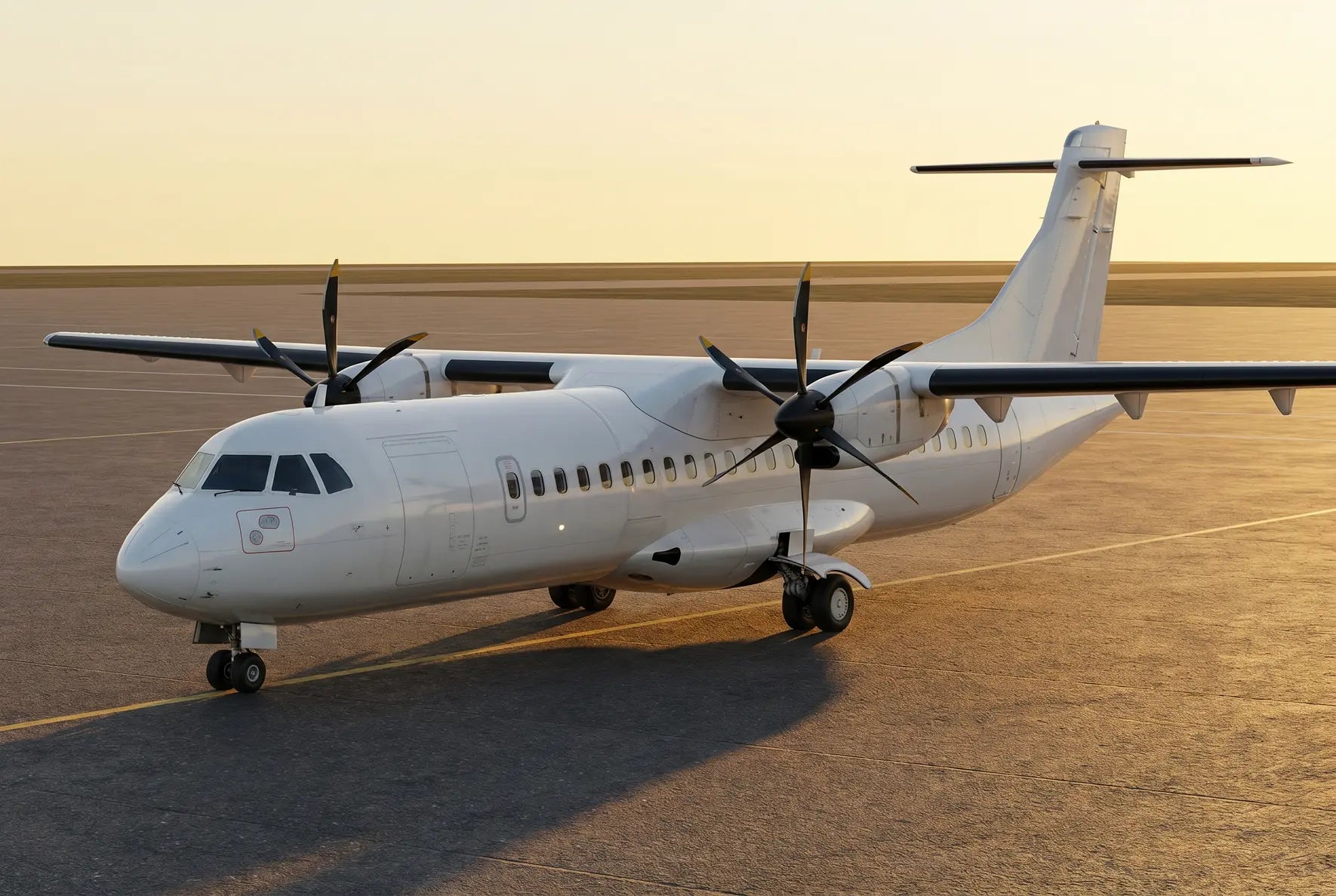
The ATR 72-600 is the latest production variant of the ATR 72 family, a high-wing, twin-engine turboprop built by the Franco-Italian consortium ATR (Avions de Transport Régional). It is designed for short-haul regional routes, typically connecting communities and secondary airports where runways are shorter and traffic volumes do not justify jet equipment. The airframe retains the proven high-wing, T-tail layout shared across the ATR family, prioritising low operating costs, short-field capability and fuel efficiency over high cruise speed.
Core design trade-offs reflect the regional mission: a relatively modest cruise speed of around 275 KTAS is accepted in exchange for turboprop fuel economy, which ATR claims yields roughly 45% lower fuel burn than comparable regional jets. The 72-600 inherits the structural and aerodynamic platform of earlier ATR 72 variants but upgrades the cockpit to a Thales glass avionics suite and standardises the Pratt & Whitney Canada PW127M engine paired with six-blade composite propellers. These changes improve dispatch reliability, situational awareness and operational flexibility for a wide range of regional airline operators.
- Length: 27.17 m (89 ft 2 in)
- Wingspan: 27.05 m (88 ft 9 in)
- Height: 7.65 m (25 ft 1 in)
- Typical seating: 70–72 passengers at 29–30 in pitch; up to 78 in high-density layout
- MTOW: 22,800 kg (basic) / 23,000 kg (optional)
- Maximum landing weight (MLW): 22,350 kg
- Maximum zero fuel weight (MZFW): 20,800 kg (basic) / 21,000 kg (optional)
- Typical OEW: approximately 13,450 kg (in-service)
- Maximum fuel capacity: 5,000 kg
- Range (max passengers): approximately 740–758 NM (manufacturer figures, standard reserves)
- Maximum cruise speed: 275 KTAS (at 95% MTOW, ISA, optimum FL)
- Service ceiling: 25,000 ft (FL250)
- Takeoff field length: approximately 1,280–1,315 m (MTOW, ISA, sea level)
- Landing field length: 915 m (MLW, sea level, EASA Air Ops)
- Engines: 2 × Pratt & Whitney Canada PW127M, 2,475 SHP takeoff rating per engine
- Propellers: Hamilton Standard (Collins Aerospace) 568F, 6-blade, 3.93 m diameter
- Avionics: Thales integrated modular avionics (IMA) glass cockpit with five LCD displays and FMS
- Noise certification: ICAO Annex 16, Chapter 4 compliant
Systems, Flight Controls and Onboard Technology
The ATR 72-600 uses conventional mechanical primary flight controls: ailerons, elevators and rudder are actuated through cables and pushrods, not fly-by-wire. Spoilers and flaps are hydraulically powered by the blue hydraulic system. An automatic flight control system (AFCS) with a dual-channel digital autopilot and flight director is layered on top, supporting precision approaches up to CAT II ILS. The Thales avionics suite introduced an AFDX (Avionics Full Duplex Switched Ethernet) backbone, making the ATR 72-600 one of the first regional turboprops to adopt this digital bus architecture. Five wide-format LCD screens present primary flight, navigation, and engine/systems data in a clean, consolidated layout.
Braking is handled by a hydraulic multi-disc wheel brake system with an electronic anti-skid controller to prevent wheel lock-up during rejected takeoffs and landings. The engines are managed by a dual-channel Full Authority Digital Engine Control (FADEC), which automates power management, torque and temperature limiting, and propeller coordination. This FADEC also supports the Automatic Takeoff Power Control System (ATPCS) and auto-feather logic for one-engine-inoperative scenarios. Performance computation for takeoff and landing is typically handled through FMS functions and ATR-endorsed Electronic Flight Bag (EFB) applications rather than a standalone hardware performance computer. In 2020, ATR and Thales certified the Standard 3 avionics upgrade, which added synthetic vision, RNP-AR 0.3/0.3 approach capability and enhanced low-speed protections.
It is worth noting that published ATR 72-600 performance figures should be interpreted with care. Takeoff and landing distances vary depending on operator-selected MTOW options, airfield elevation, temperature, runway condition (dry versus wet), and cabin configuration. Range figures assume standard fuel reserves and maximum passenger load at a given seating density; different operators may achieve different results depending on actual OEW, payload, wind conditions and altitude. Figures in manufacturer brochures represent ideal or reference conditions and do not replace performance calculations specific to each operation.
Engines: The Pratt & Whitney Canada PW127M
The ATR 72-600 is powered by two Pratt & Whitney Canada PW127M turboprop engines. Each delivers 2,475 SHP at takeoff, with automatic reserve power of 2,750 SHP available on a single engine in the event of the other engine failing. Maximum continuous power is rated at 2,500 SHP, max climb at 2,192 SHP and max cruise at 2,132 SHP. The PW127M is a derivative of the earlier PW127F and PW127E engines that powered the ATR 72-500 and ATR 42-500, respectively, and offers approximately 5% more power than the PW127F for improved hot-and-high performance.
The PW127M belongs to the PW100 turboprop family, a series of engines in the 1,800 to 5,000 SHP range that Pratt & Whitney Canada has produced since the mid-1980s. The PW100 family uses a distinctive three-shaft, free-turbine architecture with two centrifugal compressors (each driven by its own turbine stage) and a separate two-stage power turbine driving a front-mounted reduction gearbox. This layout provides strong part-power efficiency and robust surge margins across a wide operating envelope. The broader PW100 family has powered aircraft including the de Havilland Canada Dash 8 series, Fokker 50, Embraer EMB-120 Brasilia and BAe ATP, accumulating over 100 million operating hours worldwide. The PW127M specifically, however, has been documented exclusively on ATR 42/72 series aircraft.
In 2021, Pratt & Whitney Canada launched the PW127XT engine series as the successor to the PW127M on ATR -600 aircraft. The XT variant incorporates redesigned compressors, a new high-pressure turbine module and an improved oil system, delivering approximately 3% lower fuel burn, up to 40% more time on wing (targeting 20,000 hours between overhauls) and around 20% lower direct maintenance costs. ATR 72-600 deliveries have been transitioning to the PW127XT-N, while the PW127M remains in widespread service across the existing fleet. Both engine variants drive six-blade Hamilton Standard 568F composite propellers (now supported under the Collins Aerospace brand following corporate mergers) with a diameter of 3.93 m, optimised for low noise and efficient thrust at regional turboprop speeds.
ATR 72-600 vs ATR 42-600 vs Dash 8-400 vs Embraer E175: Regional Aircraft Comparison
Scroll horizontally to see more →
| Parameter | ATR 72-600 | ATR 42-600 | De Havilland Canada Dash 8-400 | Embraer E175 |
|---|---|---|---|---|
| Entry into service | 2011 | 2012 | 2000 | 2005 |
| Engines | 2 × Pratt & Whitney Canada PW127M/N turboprops | 2 × Pratt & Whitney Canada PW127M turboprops | 2 × Pratt & Whitney Canada PW150A turboprops | 2 × General Electric CF34-8E turbofans |
| Length | 27.17 m | 22.67 m | 32.83 m | 31.68 m |
| Wingspan | 27.05 m | 24.57 m | 28.42 m | 26.00 m |
| Height | 7.65 m | 7.59 m | 8.30 m | 9.85 m |
| Typical seating and layout (short description + approximate passengers) | Single-class: 68–78 passengers | Single-class: 40–50 passengers | Single-class: 70–78 passengers | 2-class: 70–88 passengers |
| MTOW | 23 t | 18.6 t | 29.3 t | 40.3 t |
| Range | 825 nm | 800 nm | 1,100 nm | 2,200 nm |
| Cruise speed | 0.45 Mach | 0.44 Mach | 0.50 Mach | 0.78 Mach |
| Service ceiling | 25,000 ft | 25,000 ft | 27,000 ft | 41,000 ft |
| Program note | Stretched member of ATR’s -600 turboprop family, optimized for high-efficiency short-haul regional routes with up to 78 seats. | Baseline -600 ATR turboprop, offering similar technology to the ATR 72-600 in a smaller, lower-capacity airframe for thinner routes. | Competing high-performance regional turboprop with higher speed and payload, widely used on busy short sectors and challenging airfields. | Regional jet alternative with higher speed and range, positioned above large turboprops for longer and premium regional markets. |
Scroll horizontally to see more →
The table compares four regional aircraft on size, seating, performance, and program role. The ATR 72-600 and Dash 8-400 offer similar 70–78 seat capacity, but the Dash 8-400 is longer, heavier, faster (0.50 Mach), and has more range (1,100 nm). The smaller ATR 42-600 targets 40–50 seats with similar ceiling. The E175 stands apart as a jet, with much higher speed (0.78 Mach), ceiling (41,000 ft), and range (2,200 nm) but higher MTOW.
ATR 72-600 Operations: Typical Routes, Missions and Airlines Worldwide
The ATR 72-600 is built for short-haul regional missions where turboprop economics outperform jet alternatives. Most operators fly sectors averaging 45 to 50 minutes of block time, covering roughly 200 to 300 nautical miles per leg. According to Aviation Week, average annual utilisation for the ATR 72 fleet sits close to 2,100 flight hours, which translates to approximately six to seven sectors per day with turnaround times of around 25 to 35 minutes at regional airports. This high-cycle rhythm is central to how the aircraft generates revenue on thin routes that would be uneconomical for regional jets.
The aircraft thrives in hub-and-spoke networks, feeding passengers from secondary cities into mainline hubs where they connect to narrowbody or widebody services such as those operated by the Airbus A321LR. It is equally effective in point-to-point regional links between smaller cities, island-hopping archipelago routes and remote-access services where short or unpaved runways limit jet operations. The manufacturer quotes a maximum range of approximately 740 nautical miles with a full passenger load and emphasises the type's ability to operate from runways as short as around 1,000 metres, making it a versatile platform across diverse geographies and climates.
Operators do face specific challenges. Cruise speed of approximately 275 knots true airspeed is roughly 40 percent slower than a comparable regional jet, which makes the type less competitive on sectors above 350 nautical miles and more sensitive to strong headwinds. In icing conditions, strict operational procedures apply, including mandatory speed additives and configuration changes, which can limit payload or force altitude deviations. Hot-and-high airports may impose weight restrictions on warm afternoons due to reduced engine performance. Passenger perception can also be a factor: the cabin is narrower and noisier than a jet, and some travellers associate turboprops with older technology, pushing airlines to invest in communication and branding around fuel efficiency and environmental credentials.
Where the ATR 72-600 Operates Around the World
With more than 500 units delivered since its introduction, the ATR 72-600 is the most widely ordered variant of the ATR 72 family. It serves airlines on every inhabited continent, from the cold-weather domestic networks of northern Europe to the tropical island chains of Asia and the Pacific. In North and South America, the type supports both Caribbean island-hopping and essential-service routes in remote Canadian provinces. Across Africa and the Middle East, it connects underserved communities to national capitals and provides inter-island links in the Indian Ocean.
The following overview highlights key operators and the way they deploy the aircraft in each broad region.
- Europe – Regional connectivity drives most ATR 72-600 operations here. Air Corsica links the island of Corsica with mainland France on sectors of around 40 to 60 minutes. Binter Canarias connects the Canary Islands with inter-island shuttle services. Air Nostrum, operating as Iberia Regional, feeds Madrid and other Spanish hubs from smaller domestic airports. Braathens Regional Airlines operates domestic Swedish routes, while Loganair serves Scottish and UK regional airports, including remote island communities. Emerald Airlines, flying under the Aer Lingus Regional brand, covers Ireland-to-UK routes. TAP Express (operated by Portugalia) uses the type on domestic Portuguese services from Lisbon and Porto, and Air Serbia connects Belgrade with nearby Balkan destinations.
- North and South America – In the Caribbean, Air Caraibes operates ATR 72-600s between Guadeloupe, Martinique and neighbouring islands, and InterCaribbean Airways connects destinations across the eastern Caribbean. In Canada, Rise Air became the country's first ATR 72-600 operator in early 2025, deploying the aircraft on essential-service routes across Saskatchewan. In Central and South America, EasyFly in Colombia uses the type for domestic regional services, and SATENA connects remote Colombian communities on government-backed routes.
- Asia – This region represents the largest market for the ATR 72-600. Wings Air, part of the Lion Air Group in Indonesia, is one of the biggest ATR operators in the world, running an extensive domestic network across the archipelago. IndiGo deploys a significant fleet on Tier 2 and Tier 3 city routes across India under the UDAN regional connectivity scheme. Bangkok Airways in Thailand uses the aircraft to serve leisure destinations like Koh Samui and Sukhothai. AirSWIFT in the Philippines connects Manila to resort airports such as El Nido on very short runways. In the Pacific, Air New Zealand operates one of the largest ATR 72-600 fleets for domestic services linking Auckland, Wellington and regional centres, while Air Tahiti and Air Caledonie rely on the type for inter-island services across French Polynesia and New Caledonia respectively.
- Africa – The ATR 72-600 fills a critical connectivity role across the continent. Air Senegal operates domestic and regional West African routes from Dakar. Air Algerie uses a fleet of ATR 72-600s on domestic services linking Algiers with secondary Algerian cities. Air Botswana deploys the type on domestic and cross-border routes in southern Africa. Afrijet in Gabon connects regional capitals in Central Africa, and Air Mauritius flies inter-island services in the Indian Ocean, notably between Mauritius and Rodrigues.
Typical Seating Configurations on the ATR 72-600
The ATR 72-600 cabin features a single-aisle layout with four-abreast seating in a 2-2 configuration. According to ATR's official specifications, the aircraft can seat up to 78 passengers in a high-density layout at 28-inch pitch, while a standard configuration accommodates 72 passengers at approximately 29 to 30 inches of pitch.
In practice, the seat count varies by operator strategy. Network carriers aiming for passenger comfort often choose 68 to 72 seats with 30 to 31 inches of pitch. Air New Zealand, for example, fits 68 economy seats at 30-inch pitch. Loganair and Emerald Airlines (Aer Lingus Regional) both configure 72 seats with pitch ranging from 29 to 31 inches. At the other end of the spectrum, high-density operators like IndiGo maximise capacity with 78 economy seats at 28-inch pitch to minimise cost per seat on busy domestic routes. ATR also offers a combi layout seating around 44 passengers alongside additional cargo volume, which suits operators that need to carry freight alongside passengers on remote routes. Seat width across configurations is typically around 18 inches, with modest recline of approximately three inches, consistent with short-haul regional service.
In this short video, you will get a clear introduction to ATR aircraft electrical systems, covering key components and basic operation to help you better understand related ATR technical training videos.
ATR 72-600 Safety Record: Accident History and How Safe Is This Turboprop?
The ATR 72-600 has been in commercial service since 2011 and is the current-production variant of the ATR 72 family, a twin-engine turboprop that first flew passengers in 1989. As of late 2025, more than 775 ATR 72s of all sub-types were in active airline service worldwide, with the -600 accounting for the majority of the fleet. Over its operational life, the ATR 72 family has accumulated tens of millions of flight hours across demanding regional networks on every continent. The Aviation Safety Network ATR 72-600 occurrence database records a small number of hull-loss accidents specifically involving the -600 variant. When viewed against the total volume of departures performed by this type, the overall safety record is broadly comparable to other modern Western-built regional aircraft.
Notable Accidents and Incidents Involving the ATR 72-600
Two fatal accidents stand out in the ATR 72-600's operational history. Understanding these events and the industry responses they triggered is essential for a balanced assessment of the type's safety.
- Lao Airlines Flight QV301 (October 2013) - An ATR 72-600 (registration RDPL-34233) crashed into the Mekong River while on approach to Pakse Airport in Laos during severe weather linked to the remnants of Typhoon Nari. All 49 occupants were killed. The official investigation, summarised on SKYbrary, determined that the probable cause was a sudden deterioration in weather combined with the flight crew's failure to execute the published instrument approach and missed-approach procedure, resulting in controlled flight into terrain (CFIT). Contributing factors included descent below published minima, an incorrect altitude pre-selected in the autopilot panel, possible somatogravic illusions and limited crew coordination during the go-around. Following the accident, Lao Airlines was required to strengthen training on instrument approaches, missed-approach procedures, ATR 72-600 automation management and human-factors awareness, including spatial disorientation.
- TransAsia Airways Flight GE235 (February 2015) - An ATR 72-600 operating out of Taipei Songshan Airport experienced an engine malfunction shortly after take-off. The crew inadvertently shut down the remaining operative engine instead of the malfunctioning one, resulting in a total loss of thrust. The aircraft stalled, struck a bridge and crashed into the Keelung River. Of the 58 people on board, 43 lost their lives. Taiwan's Aviation Safety Council attributed the accident to critical errors in engine-failure management, inadequate crew resource management (CRM) and training deficiencies. The fallout was significant: Taiwan's Civil Aviation Administration ordered immediate proficiency checks and re-qualification for all TransAsia ATR pilots, tightened simulator training requirements for engine-failure scenarios and increased surveillance of regional operators. TransAsia Airways ultimately ceased operations in 2016.
Earlier variants of the ATR 72 were also involved in notable events that shaped the type's safety evolution. The 1994 crash of American Eagle Flight 4184, an ATR 72-200, near Roselawn, Indiana, was caused by ice accretion beyond the de-icing boot coverage and led to sweeping changes across the turboprop industry. The FAA issued 18 Airworthiness Directives covering 29 turboprop types, mandating extended de-icing boots, higher minimum speeds in icing, restrictions on autopilot use in icing conditions and comprehensive crew training on ice recognition. These measures significantly improved safety for the entire ATR family and for turboprops in general.
How Safe Is the ATR 72-600 Today?
Measured against traffic volume, the ATR 72-600 compares favourably with other modern regional aircraft. According to data published on the ATR Safety portal, the ATR-600 series records a fatal accident rate of approximately 0.13 per million departures, which is roughly four times lower than the average for the large turboprop market as a whole. For context, the ICAO State of Global Aviation Safety Report 2025 places the worldwide commercial accident rate at around 1.87 accidents per million departures for 2023, a figure that encompasses all severity levels and aircraft categories. The dominant accident categories for the ATR fleet remain loss of control in-flight (LOC-I) and controlled flight into terrain (CFIT), both of which are actively targeted through improved standard operating procedures, enhanced pilot training and better cockpit automation.
The ATR 72-600 benefits from a modern glass cockpit, updated avionics and a design philosophy refined over more than three decades of continuous production. Regulatory oversight from EASA, the FAA and national authorities ensures that airworthiness directives, mandatory service bulletins and operational limitations are applied across the global fleet. Operators are required to implement safety management systems (SMS) and participate in flight data monitoring programmes. Like the Boeing 777-200ER in the widebody jet segment, the ATR 72-600 reflects a mature design that has been progressively improved through lessons learned from real-world operations. Aviation, including regional turboprop flying, remains one of the safest modes of mass transport available, and the ATR 72-600's record supports that broader conclusion.
01 What typical routes and flight lengths does the ATR 72-600 operate on?
The ATR 72-600 is mainly used on short regional routes, typically flying sectors of about 200 to 500 nautical miles, which usually means flight times of 45 minutes to around 1.5 hours. Airlines often use it to connect smaller cities with nearby hubs, to serve island-hopping routes, or to operate into airports with short runways where larger jets cannot land as efficiently.
02 How comfortable is the ATR 72-600 cabin for passengers?
The ATR 72-600 usually seats around 68 to 78 passengers in a single-class layout, with a 2-2 seating configuration and no middle seats. The modern “-600” cabin has improved lighting, larger overhead bins compared with earlier ATR models, and updated seats, but it is generally noisier and feels more “regional” than larger jet airliners. Comfort can vary by airline, depending on seat pitch and interior choices, but for flights under an hour the experience is typically considered practical and adequate.
03 How noisy is the ATR 72-600, and where is the best place to sit?
As a turboprop, the ATR 72-600 is noticeably noisier than most jet aircraft, especially near the propellers over the wing. Passengers looking for a quieter ride usually prefer seats toward the front of the cabin, ahead of the wings, where propeller and airflow noise are less intense. Seats over the wing can feel a bit more vibration, while seats at the very back may experience more engine and airflow noise during climb and descent.
04 How does the ATR 72-600 compare with regional jets in performance and fuel efficiency?
At typical regional cruise speeds and distances, the ATR 72-600 is designed to be more fuel efficient than many comparable regional jets, especially on sectors under about 400–500 nautical miles. It cruises slower than jets, so flight times can be slightly longer, but the lower fuel burn and ability to operate from shorter runways make it well suited to thin or challenging regional routes. Airlines often choose the ATR 72-600 when passenger demand is moderate and operating costs and runway performance are more important than maximum speed.
05 Which airlines commonly use the ATR 72-600 and on what kinds of routes?
The ATR 72-600 is widely used by regional and low-cost carriers in Europe, Asia-Pacific, and other regions, including airlines that specialize in serving smaller communities and island destinations. It is frequently seen on domestic routes within countries such as France, Italy, Indonesia, and the Philippines, as well as on short international hops between nearby countries. Many operators use it as a feeder aircraft, carrying passengers from smaller airports to larger hubs where they can connect to medium- and long-haul flights.
06 Is the ATR 72-600 a safe aircraft, and how does it handle turbulence?
The ATR 72-600 is certified to modern safety standards and incorporates updated avionics, flight deck systems, and structural improvements over earlier versions of the ATR 72. Safety outcomes depend on operator training, maintenance, and procedures, but the type itself is widely used and supported by the manufacturer. In turbulence, the aircraft can feel more “lively” than a larger jet because of its lighter weight and high-wing turboprop design, yet it is engineered to withstand the same kinds of loads and is operated within strict speed and altitude limits to keep the ride within safe margins.