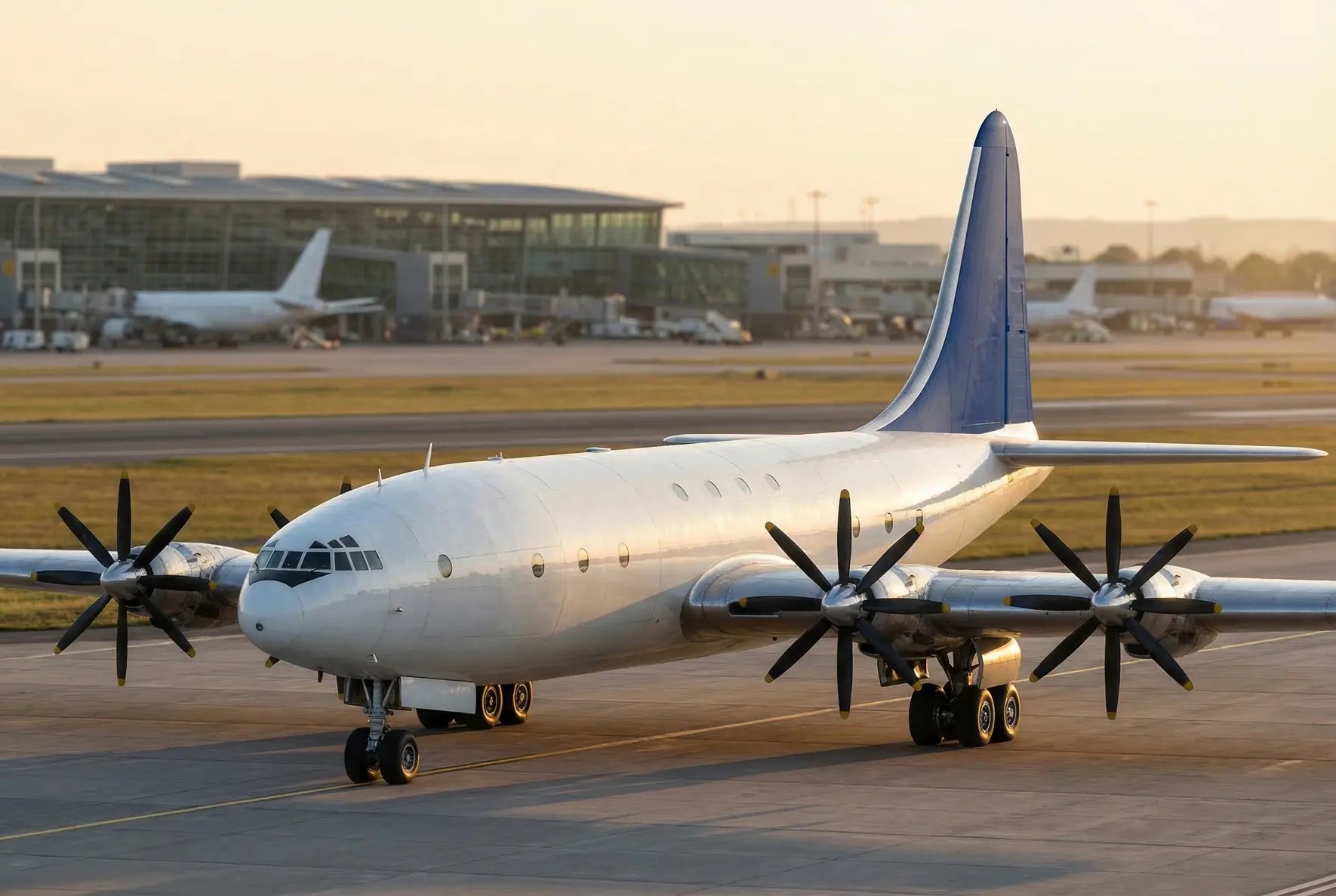
Bristol Brabazon: History, Development, and the Rise and Fall of a Giant
The Bristol Brabazon remains one of the most ambitious and ultimately ill fated airliner programmes in British aviation history. Born from wartime planning and post war optimism, this colossal transatlantic aircraft pushed the boundaries of what was technically possible in the late 1940s, yet never carried a single fare paying passenger.
Origins: The Brabazon Committee and the Type I Requirement
In December 1942, while World War II still raged, the British government formed the Brabazon Committee, chaired by Lord Brabazon of Tara (John Moore Brabazon), a former Minister of Aircraft Production. The committee was tasked with defining Britain's post war civil aviation needs and ensuring the nation would not fall behind the United States in commercial air transport. By February 1943, it had published recommendations for several aircraft types. The Type I specification called for a large, luxurious, propeller driven airliner capable of flying nonstop from London to New York, carrying around 100 passengers in a standard of comfort comparable to first class ocean liner travel.
The Bristol Aeroplane Company, based at Filton near Bristol, was already experienced in large aircraft design and had studied very large bomber configurations as early as 1937. These studies projected a 100 passenger transatlantic capability. When the Air Ministry issued a heavy bomber requirement in 1942 specifying a 15 ton payload, Bristol updated its designs using Centaurus engines. This work positioned Bristol ideally to respond to the Type I requirement, and the company received a contract for two prototypes of the Bristol Type 167, along with an option for 10 production models.
Design and Construction: Pushing Boundaries at Filton
Prototype construction began in October 1945, shortly after V J Day. The design team, led by Leslie G. Frise, incorporated several groundbreaking features. The Bristol Brabazon was the first aircraft to be outfitted with 100 percent powered flying controls and also the first to feature electric engine controls. The pressurised and air conditioned cabin sat within a fuselage approximately 25 feet (7.6 m) in diameter, offering unprecedented space for passengers. With a wingspan of 230 feet (70 m), wider than even the later Boeing 747, the aircraft required an enormous runway at Filton. The village of Charlton was relocated to make way for runway extensions.
Powering the Mk.I were eight Bristol Centaurus 18 cylinder radial piston engines, each capable of producing 2,650 horsepower. These were mounted in pairs within four inboard wing nacelles, driving contra rotating propellers through combining gearboxes. The wings were so thick that a person six feet tall could stand upright inside them for maintenance access.
First Flight and Public Debut
The Mk.I prototype, registered G AGPW, was rolled out for engine runs in December 1948. After taxi tests on 3 September 1949 revealed a nosewheel steering issue (resolved by disabling the system), the Bristol Brabazon made its maiden flight on 4 September 1949 from Filton Aerodrome. Piloted by A. J. "Bill" Pegg with co pilot Walter Gibb and an eight member crew, the 26 minute flight reached 3,000 feet at 160 mph before approximately 10,000 spectators. The aircraft was displayed at the Farnborough Airshow in September 1949, returned to Farnborough in 1950, demonstrated at London Heathrow, and appeared at the Paris Air Show in 1951.
Brabazon Mk.I vs. Mk.II: What Set Each Variant Apart
Bristol planned two distinct variants of the Type 167, each targeting different performance envelopes. The Brabazon Mk.I served as the baseline prototype powered by piston engines, while the Brabazon Mk.II was intended to replace the Centaurus radials with eight Bristol Coupled Proteus turboprops arranged in four paired units. The Mk.II promised a significantly higher cruise speed of approximately 330 mph (530 km/h) compared to the Mk.I's 250 mph (400 km/h), along with improved ceiling and an empty weight reduction of roughly 10,000 lb (4,540 kg). The Mk.II retained the Mk.I's wing thickness but featured a modified leading edge to accommodate the slimmer Proteus engines. Early Mk.II concepts explored pusher propeller configurations before settling on a tractor layout.
Key variant identifiers for the Bristol Brabazon programme include:
- Brabazon Mk.I: Eight Bristol Centaurus piston engines (2,650 hp each), coupled in pairs; maximum speed 300 mph; cruise speed 250 mph at 25,000 ft; range 5,500 miles; maximum takeoff weight 290,000 lb (131,542 kg); 100 percent powered flying controls and electric engine controls.
- Brabazon Mk.II (unfinished): Eight Bristol Coupled Proteus turboprops in four paired units; projected cruise speed 330 mph; estimated 10,000 lb lighter empty weight; modified wing leading edge for turboprop nacelles.
- Common features: 230 ft wingspan; 177 ft length; pressurised, air conditioned cabin; 100 passenger capacity in luxury configuration; crew of 6 to 12.
Cancellation and Legacy
Despite its technical achievements, the Bristol Brabazon faced mounting problems. Development delays eroded airline interest, and British Overseas Airways Corporation (BOAC) never placed an order. The total programme cost reached approximately £6 million, with an additional £2 million required to complete the Mk.II. Development of the Proteus turboprops suffered from overweight, underpowered, and fatigue related issues. In February 1952, the government halted Mk.II construction. The Mk.I made its final flight on 20 September 1952 after 164 flights totalling just 382 hours. In October 1953, both prototypes were broken up and sold for scrap for £10,000. Today, surviving remnants can be found at the BAE Systems Heritage collection and the M Shed museum in Bristol.
While the Bristol Brabazon never entered service, its technological innovations contributed to subsequent Bristol developments, particularly the Bristol Britannia turboprop airliner (the Brabazon Committee's Type III recommendation), which went on to set payload records into the 1970s. The lessons learned from this programme, from powered flight controls to large scale pressurised fuselage construction, influenced a generation of British aircraft design. For those preparing for careers in this fascinating industry, resources such as mock interview preparation tools can help aspiring aviation professionals articulate their knowledge of these landmark programmes with confidence.

The image depicts the Brabazon Mk.1 prototype aircraft parked on an airfield in front of a large hangar. The aircraft, bearing the registration G-AGPW, is shown in a side profile, highlighting its sleek design.
Bristol Brabazon Technical Specifications, Systems Innovations and Performance Data
The Bristol Type 167 Brabazon was conceived as a luxury transatlantic airliner capable of flying nonstop from London to New York. Everything about its engineering reflected that ambition: an enormous airframe sized for ocean crossings, eight powerful radial engines arranged in coupled pairs, and a fuselage wide enough for first class comfort at a time when most airliners still resembled converted bombers. The design prioritised range and passenger space over speed or operating economy, resulting in an aircraft that pushed British aeronautical engineering to new limits in the late 1940s.
With a maximum takeoff weight of 290,000 lb (131,542 kg) and a wingspan of 230 ft (70.1 m), the Brabazon was larger than any land based airliner of its era. Its thick, multi cellular wing housed fuel, engine nacelles and the paired drivetrain assemblies. The circular cross section fuselage measured 25 ft (7.6 m) in diameter, enabling six abreast seating in its standard 100 passenger luxury configuration. Like the heavy freighters that would come decades later, such as the Boeing 777F, the Brabazon demonstrated how sheer structural scale can be harnessed for long range capability.
- Wingspan: 230 ft (70.1 m)
- Overall length: 177 ft (54 m)
- Height: 50 ft (15.2 m)
- Maximum takeoff weight (MTOW): 290,000 lb (131,542 kg)
- Empty weight: approximately 145,100 lb (65,816 kg)
- Fuel capacity: 13,650 imperial gallons (62,054 litres)
- Engines: 8 × Bristol Centaurus 20 sleeve valve radials, each rated at 2,650 hp (1,976 kW), driving four sets of contra rotating propellers
- Maximum speed: 300 mph (483 km/h) at 25,000 ft
- Cruise speed: 250 mph (402 km/h) at 25,000 ft
- Range: 5,500 statute miles (8,851 km) with maximum fuel
- Service ceiling: 25,000 ft (7,620 m)
- Passenger capacity: 100 (luxury layout) or up to 341 (theoretical high density)
- Wing area: 5,317 sq ft (494 m²)
- Crew: 6 to 12
Flight Controls, Systems and Technical Innovations
The Brabazon was the first aircraft to feature 100 percent powered flying controls. All primary surfaces, including ailerons, elevators, rudder and flaps, were actuated by high pressure hydraulic servos, eliminating manual reversion entirely. This was a landmark innovation; the sheer size of the control surfaces on an airframe with a 230 ft wingspan made unassisted manual control impractical. The total weight of the hydraulic servo actuators was approximately 136.5 kg.
Another notable feature was the purpose built gust alleviation system. A sensing probe mounted on the nose exterior detected turbulence, triggering servo responses that reduced wing bending loads and improved ride comfort. This system was planned for further automation on the proposed Mark II variant. The Brabazon also introduced electric engine controls, allowing remote throttle and propeller management from the flight deck, another first for civil aviation at the time.
Published performance figures for the Brabazon should be understood in the context of a prototype programme. Only one airframe (the Mk I) ever flew, completing its maiden flight on 4 September 1949. Performance data such as range and fuel burn were based on manufacturer calculations and limited flight testing rather than extended airline operations. Differences in quoted figures across historical sources often stem from whether values reflect design targets, measured flight test results, or projected operational capabilities. Atmospheric assumptions, loading configurations and the distinction between gross and net range also account for variations in published numbers.
The Bristol Centaurus: Powerplant of the Brabazon Mk I
The Bristol Centaurus was the final and most powerful engine in the Bristol Engine Company's celebrated line of sleeve valve radials. Launched in 1937 and first type tested in 1938, it was an 18 cylinder, two row, air cooled radial with a displacement of 3,272 cu in (53.6 litres). The sleeve valve design delivered smooth, quiet operation and excellent specific power output. Each cylinder produced roughly 147 hp, giving a total output of up to 2,650 hp (1,976 kW) at 2,700 rpm in the variants fitted to the Brabazon. Fuel was a 100/130 octane petrol mix, and supercharging came from a single stage, two speed centrifugal unit.
In the Brabazon, the eight Centaurus 20 engines were mounted in pairs within slim wing nacelles, each pair driving a set of 16 ft diameter contra rotating propellers through combining gearboxes. This twin engine per nacelle layout was unusual and mechanically complex, but it reduced aerodynamic drag compared to eight separate nacelle installations.
Beyond the Brabazon, the Centaurus powered several important military and civilian aircraft. It served in the Hawker Tempest II, the Hawker Sea Fury (one of the fastest production piston engine fighters ever built), the Blackburn Firebrand torpedo fighter, and the postwar Airspeed Ambassador airliner. Production was initially delayed during World War II because the smaller Bristol Hercules was prioritised for the war effort, but by the end of the conflict approximately 2,500 Centaurus units had been built.
For the unbuilt Brabazon Mark II, Bristol planned to replace the Centaurus radials with eight Bristol Proteus turboprop engines arranged in coupled pairs. The Proteus, Bristol's first mass produced gas turbine, offered around 4,000 shp per unit and would have raised cruise speed to approximately 330 mph while saving an estimated 4,540 kg of empty weight. However, the entire Brabazon programme was cancelled in 1953 before the Mk II was completed. The Proteus subsequently found service on the Bristol Britannia airliner, where it proved its long range turboprop credentials on transatlantic routes.
Bristol Brabazon vs Comet 1 vs Constellation L-1049 vs DC-7C Specifications Comparison
Scroll horizontally to see more
| Parameter | Bristol Brabazon | de Havilland DH.106 Comet 1 | Lockheed Constellation L-1049 | Douglas DC-7C |
|---|---|---|---|---|
| Entry into service | 1949 | 1952 | 1951 | 1956 |
| Engines | 8 × Bristol Centaurus 20 | 4 × de Havilland Ghost | 4 × Wright R-3350 | 4 × Wright R-3350 |
| Length | 54.0 m | 28.6 m | 35.4 m | 43.5 m |
| Wingspan | 70.1 m | 35.1 m | 38.6 m | 43.2 m |
| Height | 15.2 m | 8.5 m | 7.4 m | 8.1 m |
| Typical seating and layout | 2-class: 100 passengers | 2-class: 44–52 passengers | 3-class: 62–95 passengers | 3-class: 80–105 passengers |
| MTOW | 132 t | 54 t | 79 t | 82 t |
| Range | 4,750 nm | 1,500 nm | 4,480 nm | 5,600 nm |
| Cruise speed | 0.41 Mach | 0.82 Mach | 0.53 Mach | 0.54 Mach |
| Service ceiling | 31,000 ft | 42,000 ft | 25,000 ft | 25,000 ft |
| Program note | Super-large experimental transatlantic piston airliner prototype; never entered service | First commercial jet airliner; smaller, faster, shorter range pioneer | Advanced long-range piston airliner for transatlantic routes | Final long-range development of DC-7 series for nonstop US coast-to-coast |
Scroll horizontally to see more
The table compares four early long-haul airliners across size, powerplants, capacity, and performance. Brabazon is the largest and heaviest with eight piston engines and 100 seats, yet it is slow (0.41 Mach) and never entered service. Comet 1 is far smaller but much faster (0.82 Mach) with higher ceiling. DC-7C offers the longest range (5,600 nm), edging the Constellation.
Bristol Brabazon Intended Routes, Missions and Airlines: Why It Never Flew
The Bristol Brabazon was conceived as a long range transatlantic airliner, built to carry up to 100 passengers in exceptional luxury between Europe and North America. However, the aircraft never entered commercial airline service. Only one prototype, registered G-AGPW, was completed and flown between 4 September 1949 and 1953. A second airframe, the Mk.II intended to use Bristol Proteus turboprop engines, was never finished. The project was officially cancelled on 17 July 1953 by the British Minister of Supply, and both airframes were scrapped at Filton.
The primary intended mission was nonstop service on the London to New York route, a distance of approximately 5,500 km (3,400 miles). With a design range of 8,800 km and a cruising speed of around 402 km/h (250 mph) at 7,620 m (25,000 ft), the Bristol Brabazon could theoretically have completed a westbound Atlantic crossing in roughly 12 to 14 hours, depending on headwinds. This was significantly faster than the four to five day ocean liner crossing the aircraft was designed to replace, yet substantially slower than the new generation of jet airliners already on the horizon, such as the de Havilland Comet.
From an operational standpoint, the Bristol Brabazon posed serious challenges. Its maximum takeoff weight of 131,542 kg (290,000 lb) and 70 m (230 ft) wingspan demanded exceptionally long and wide runways. The runway at Filton had to be extended from 610 m to 2,440 m specifically for the prototype. Very few airports in the late 1940s and early 1950s could have accommodated it. The aircraft's eight Bristol Centaurus piston engines, driving four pairs of counter rotating propellers, required complex maintenance. Its cost per seat mile was projected to be far higher than contemporary or forthcoming competitors, largely because the lavish cabin layout accommodated only 100 passengers in an airframe large enough for over 300. Daily utilisation would have been limited by the long turnaround times such a complex aircraft would have required, further undermining its economics.
The Bristol Brabazon project emerged from the Brabazon Committee, established in December 1942 to define British post war civil aviation needs. The Type I specification called for a large, long range airliner for transatlantic service. Bristol Aeroplane Company received a contract for two prototypes, but the programme struggled throughout to attract a launch customer.
Airlines and Regional Interest in the Bristol Brabazon
No airline ever placed a firm order for the Bristol Brabazon. The aircraft was demonstrated at public events including the 1950 Farnborough Airshow and the 1951 Paris Air Show, but failed to generate commercial commitments. BOAC (British Overseas Airways Corporation), the state owned long haul carrier and the most likely operator, was consulted during the design phase and contributed to cabin layout recommendations, including the cinema, cocktail bar and lounge areas. However, BOAC ultimately judged the aircraft too slow, too expensive to operate, and increasingly obsolete compared to emerging turboprop and jet powered designs. BEA (British European Airways) briefly explored the idea of using the prototype for high density holiday charter flights between London and Nice with a 180 seat configuration, but this never progressed beyond informal discussions.
Because the Bristol Brabazon never reached production, there is no record of regional airline operations or deployment across global markets. Its intended role was strictly transatlantic, linking major hubs in Europe (primarily London Heathrow or Filton) with destinations in North America (primarily New York). There were no known expressions of interest from carriers in Asia, Africa, or South America. The aircraft's enormous size and infrastructure requirements would have further limited its potential to established major airports with suitably long runways.
- Europe: BOAC was the primary intended operator for transatlantic routes from London. BEA informally considered using the prototype for Mediterranean holiday flights. No continental European carrier expressed documented interest.
- North & South America: New York was the primary planned destination. No North American or South American airline is recorded as having considered the Bristol Brabazon for its fleet.
- Asia: No documented interest from any Asian carrier. The aircraft's range could theoretically have supported segments of routes to the region, but no such plans were developed.
- Africa: No African carrier expressed interest. While British Empire and Commonwealth route networks existed, the Brabazon's transatlantic focus and operating costs precluded African operations.
Cabin Layout and Seating of the Bristol Brabazon
The Bristol Brabazon's cabin was designed to replicate the experience of an ocean liner in the sky. The 25 foot (7.6 m) diameter circular fuselage, the widest of any airliner of its era, was subdivided into six forward cabins, each seating three to six passengers. Amenities included a 37 seat cinema, a dining room seating 38 passengers around individual tables positioned over the wing spar, a cocktail bar, a lounge, and a promenade area. For overnight transatlantic crossings, 52 sleeping berths were planned. The cabin was fully pressurised and air conditioned, a rarity for aircraft of this size at the time. Crew requirements for pilot fitness and endurance on such long flights underline the importance of aeronautical medicine in the development of long range aviation.
The standard day configuration seated 100 passengers in a 3+3 abreast arrangement with a generous seat pitch of 81 cm, providing approximately 1.96 m² per passenger. An alternative high density layout of 341 passengers in 9 abreast seating was studied but was never the design intent. The entire concept was single class, reflecting a pre war philosophy that prioritised comfort for wealthy travellers over operating economics. This approach was already being overtaken by the late 1940s, as airlines increasingly demanded higher capacity, multi class configurations to maximise revenue. The lessons of the Brabazon's cabin philosophy informed the development of later Bristol aircraft programmes, including the commercially successful Bristol Britannia turboprop airliner.
In this video, discover the Bristol Brabazon, a giant airliner so ambitious it even included a movie theater. Learn how this remarkable aircraft was designed and why it became an aviation legend.
Bristol Brabazon Safety Record: How Safe Was This Giant Airliner?
The Bristol Brabazon occupies a unique position in any discussion of aircraft safety. Only a single prototype, registered G‑AGPW, was ever completed and flown. The Bristol Type 167 Brabazon never entered commercial service, carried no fare‑paying passengers, and accumulated roughly 382 flight hours across approximately 164 sorties between its maiden flight on 4 September 1949 and its final flight on 20 September 1952. No accidents, incidents, or structural failures were recorded during that entire flight‑test programme. The aircraft was grounded and scrapped in 1953 for economic and strategic reasons rather than for any safety‑related concern. A second airframe, intended as the turboprop‑powered Mk II, was partially built but never completed, so its safety profile cannot be assessed.
Because the Brabazon fleet consisted of just one airframe and zero revenue flights, conventional safety metrics such as hull‑loss rates per million departures or fatal‑accident rates per flight hour simply do not apply. Any evaluation of how safe the Bristol Brabazon was must therefore rest on the engineering choices embedded in the design, the results of its test programme, and the broader legacy those innovations left for later aircraft types.
Flight Test Programme and Notable Events
Chief Test Pilot A.J. "Bill" Pegg and co‑pilot Walter Gibb performed the first flight from Filton Aerodrome. The sortie lasted approximately 25 minutes and reached 3,000 feet and 160 mph, using only a fraction of the extended 2,440‑metre (8,000‑foot) runway that had been specially prepared for the aircraft. In the months that followed, the prototype was demonstrated publicly at the Farnborough Air Show in 1949 (static display) and 1950 (flying display), and it also operated from London Heathrow during handling evaluations.
Throughout the entire test campaign, no emergency landings, engine‑out events, or structural anomalies were publicly reported by the Bristol Aeroplane Company or the Ministry of Supply, which oversaw the programme. The absence of incidents is notable given the aircraft's sheer scale: a 230‑foot wingspan, a maximum take‑off weight of approximately 131 tonnes, and eight coupled Bristol Centaurus piston engines driving four sets of contra‑rotating propellers. Managing an aircraft of that size with the technology available in the late 1940s posed genuine engineering challenges, yet the test record remained clean.
It is worth noting that the programme was cancelled by the British government in July 1953 primarily because of escalating costs (estimated at £12–18 million for the prototype alone), the lack of airline orders, and the rapid advance of turboprop and turbojet technology, not because of any safety deficiency.
How Safe Was the Bristol Brabazon?
Without commercial operations to generate statistical data, the safety of the Bristol Brabazon is best judged by its design philosophy and technological contributions. The Brabazon was the first aircraft fitted with 100 per cent powered flying controls, using hydraulic power units on all primary flight surfaces. This innovation drastically reduced pilot workload and set a precedent that became standard on virtually every large transport aircraft built since. It also incorporated a pioneering gust‑alleviation system, which used a nose‑mounted sensor probe and servos to counteract turbulence‑induced wing bending, an early ancestor of the active load‑alleviation systems found in modern airliners such as the Boeing 787.
The aircraft's pressurised, air‑conditioned fuselage and electric engine controls were further markers of a design intent focused on passenger comfort and crew situational awareness. Many of these features were later refined and adopted by the Fokker F27 generation of turboprop airliners and beyond, demonstrating how lessons learned on one programme can propagate across the industry.
Regulatory oversight of the Brabazon programme was handled by the Ministry of Supply and informed by the recommendations of the Brabazon Committee, which had set the design specifications in 1943. While the Committee focused on performance and capacity rather than explicit safety regulations, the rigorous flight‑test standards applied by Bristol engineers contributed to a culture of systematic testing that would later underpin the airworthiness certification processes managed by authorities such as the UK Civil Aviation Authority.
In summary, the Bristol Brabazon cannot be assessed through the usual lens of accident statistics because it never served the travelling public. What can be said with confidence is that its sole prototype completed nearly 400 hours of flight testing without a recorded safety event, and its engineering innovations, particularly fully powered flying controls and gust alleviation, contributed meaningfully to the safety standards now embedded in modern aviation. As global data from organisations such as the International Civil Aviation Organization (ICAO) consistently show, commercial aviation remains one of the safest modes of transport, a status built in part on the pioneering work of programmes like the Brabazon.
01 What was the intended mission profile and range of the Bristol Brabazon?
The Bristol Brabazon was designed primarily for transatlantic routes, offering a range of up to 5,500 miles to connect Europe with North America. It targeted long-haul luxury travel with capacity for 100 passengers over such distances. A second prototype planned turboprop engines for improved efficiency on these missions.
02 How was the cabin laid out in the Bristol Brabazon for passenger comfort?
The cabin accommodated 100 passengers in spacious luxury with large seating areas, a cinema, dining hall, and full sleeping berths. It featured a pressurized and air-conditioned environment for comfort on long flights. Seat pitch was around 81 cm in a 3+3 configuration across 16.7 rows.
03 Did any airlines operate the Bristol Brabazon, and on what routes?
04 How did the Bristol Brabazon's performance compare to similar aircraft?
With a maximum speed of 300 mph and cruise of 250 mph, the Brabazon was slower than emerging jet airliners but had a massive 230-foot wingspan larger than the Boeing 747's. Powered by eight Bristol Centaurus radial engines totaling over 21,000 hp, it prioritized luxury over speed and efficiency. A planned Mk II with turboprops aimed to boost power by 66 percent.
05 What safety and design features defined the Bristol Brabazon?
The Bristol Brabazon pioneered 100 percent powered flying controls, electric engine controls, and high-pressure hydraulics for precise handling of its 290,000-pound MTOW. Its stressed-skin construction used varying alloy gauges to minimize weight, and reversible-pitch propellers aided braking. No accidents occurred during its limited test flights.
06 What would the passenger experience have been like on the Bristol Brabazon?
Passengers would have enjoyed hotel-like amenities including dining, cinema, and sleeping berths in a quiet, pressurized cabin with air conditioning. Large windows and a stable design from thick wings promised smooth transatlantic flights despite the low 750 ft/min climb rate. Noise from eight radial engines was managed through wing-embedded placement and cooling inlets.