

Airbus A330-800: Program History, Development Path and Variant Origins
The Airbus A330-800 is the shorter-fuselage, longer-range member of the A330neo (new engine option) family. It was designed as the direct successor to the highly successful Airbus A330-200, retaining its fuselage length while integrating next-generation engines, a redesigned wing and modernised cabin systems. Conceived to extend the commercial life of the A330 platform against newer widebodies such as the Boeing 787, the A330-800 targets airlines operating long, thin routes where capacity requirements are moderate but range performance is critical.
The origins of the programme trace back to early 2014, when Airbus granted internal authority to offer a re-engined A330 to prospective customers. On 14 July 2014, during the Farnborough Airshow, Airbus formally launched the A330neo programme comprising two variants: the A330-800 (based on the A330-200) and the A330-900 (based on the A330-300). Both variants were announced with the Rolls-Royce Trent 7000 as the exclusive powerplant, promising approximately 14% lower fuel burn per seat compared with the A330ceo (current engine option) family.
Development proceeded with the larger A330-900 leading the flight-test campaign. The A330-900 completed its maiden flight on 19 October 2017 and received EASA type certification on 26 September 2018, entering service with TAP Air Portugal in December 2018. Much of the systems, engine and operational certification work carried out on the A330-900 was common to the A330-800, which streamlined the smaller variant's path to approval.
The first A330-800 development aircraft, MSN 1888, completed its maiden flight on 6 November 2018 from Toulouse-Blagnac, lasting 4 hours and 4 minutes. The subsequent flight-test programme accumulated approximately 370 flight-test hours across 132 flights, validating the airframe, engines and systems ahead of certification.
On 13 February 2020, the A330-800 received a joint type certificate from EASA and the FAA, including initial ETOPS 180-minute approval. Extended ETOPS certification beyond 180 minutes followed on 2 April 2020, opening the door to transoceanic operations over the most direct routing.
Kuwait Airways, the launch customer, took delivery of the first two A330-800 aircraft on 29 October 2020. The type entered commercial service on 20 November 2020 on a Kuwait-to-Dubai route. Uganda Airlines received its first A330-800 on 21 December 2020, deploying the aircraft on long-haul services from Entebbe to London and Dubai. Air Greenland followed, taking delivery of a single A330-800 named Tuukkaq on 6 December 2022, which entered service on 19 December 2022 between Greenland and Denmark as a replacement for its older A330-200.
Commercially, the A330-800 has attracted significantly fewer orders than its larger sibling. As of April 2026, the A330neo family had accumulated 489 orders, of which only around 12 were for the A330-800, with eight delivered and a small backlog remaining. The limited uptake is attributed to several factors: a plentiful supply of relatively young second-hand A330-200s, airline preference for the higher-capacity A330-900, and intense competition from the Boeing 787. Operating an airline fleet that includes widebody aircraft like the A330-800 demands skilled flight crews; understanding how pilot working conditions vary across carriers helps illustrate the human dimension behind long-haul operations.
What Differentiates the Airbus A330-800 from the A330-900 and the A330-200
Within the A330neo family, the A330-800 and A330-900 share the same Rolls-Royce Trent 7000 engines, the same 64-metre wingspan with composite sharklets, common cockpit systems and the Airspace cabin concept. The key distinction is the fuselage: the A330-800 measures 58.82 metres in length (identical to the A330-200), while the A330-900 stretches to 63.66 metres. This gives the A330-800 a typical three-class capacity of around 257 passengers versus approximately 287 for the A330-900. In return, the shorter fuselage and lower structural weight grant the A330-800 a range of up to 8,150 nautical miles, roughly 800 to 1,000 nm more than the A330-900, along with improved short-field performance.
Compared with the legacy A330-200 it replaces, the A330-800 offers a fundamentally different propulsion and aerodynamic package. The Trent 7000 delivers roughly double the bypass ratio of the older Trent 700, CF6-80E1 or PW4000 engines available on the A330-200. The redesigned A330neo wing features increased span and composite sharklet wingtip devices, reducing drag and improving cruise efficiency. The Airspace cabin, adapted from the A350, provides larger overhead bins, full LED mood lighting, improved acoustic insulation and redesigned sidewalls for greater perceived space. The initial certified MTOW stood at 242 tonnes, with higher-weight options reaching approximately 251 tonnes to unlock the full 8,150 nm range.
The following list summarises the verified identifiers of the Airbus A330-800:
- Manufacturer designation: A330-841
- Engine: 2 x Rolls-Royce Trent 7000 (approximately 72,000 lbf thrust per engine)
- Wingtip device: Composite sharklets, wingspan 64 m
- Fuselage length: 58.82 m (same as A330-200)
- Typical seating: ~257 passengers (three-class)
- Range: Up to 8,150 nm (high-MTOW variant)
- MTOW options: 242 t (initial) / ~251 t (extended)
- ETOPS: Certified beyond 180 minutes
- Cabin concept: Airspace by Airbus (LED lighting, larger bins, improved acoustics)

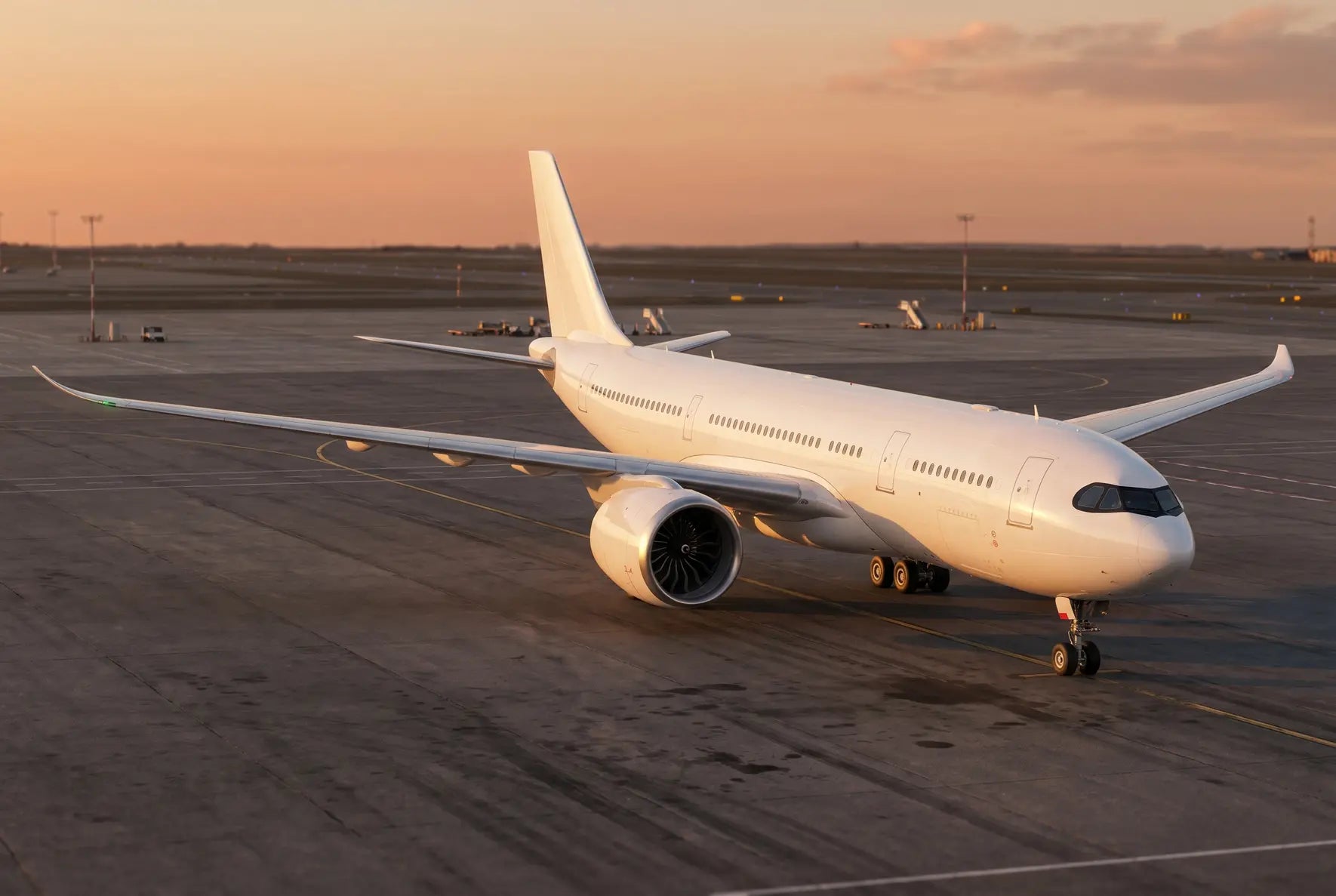
The image shows an Airbus A330neo aircraft in flight against a clear blue sky. This modern airplane features sleek design and advanced aerodynamics, underscoring its role in aviation innovation.
Airbus A330-800 Technical Specifications, Systems and Engine Overview
The Airbus A330-800 is the shorter-fuselage, longer-range member of the A330neo family, based on the proven A330-200 airframe but re-engineered with new-generation Rolls-Royce Trent 7000 engines, a redesigned wing featuring A350-derived sharklet wingtip devices, and upgraded avionics. Its primary mission is to serve long and ultra-long-haul routes at lower seat counts, giving operators widebody economics on thinner city pairs where a larger aircraft would not fill reliably.
The design philosophy behind the A330-800 prioritises range and fuel efficiency over maximum passenger volume. By keeping the same fuel capacity as the longer A330-900 in a shorter fuselage, Airbus achieves a manufacturer-quoted range of up to 8,100 nm (15,000 km) with 257 passengers in a typical three-class layout. The aircraft inherits the A330 family's twin-aisle, twin-engine configuration and the well-established fly-by-wire flight control system common across the Airbus widebody range.
- Overall length: 58.82 m (193 ft)
- Wingspan (geometric): 64.00 m (210 ft), with A350-style composite sharklet wingtip devices
- Height: 17.39 m (57 ft 1 in)
- Fuselage width (external): 5.64 m (222 in)
- Maximum cabin width: 5.26 m (207 in)
- Wing area: approximately 372 m²
- Maximum take-off weight (MTOW): 251 tonnes
- Maximum landing weight (MLW): 186 tonnes
- Maximum zero-fuel weight (MZFW): 176 tonnes
- Operating empty weight (OEW): approximately 130,185 kg
- Maximum fuel capacity: approximately 139,090 litres
- Range: up to 8,100 nm / 15,000 km (manufacturer figure, typical three-class, 257 passengers)
- Typical cruise Mach: M 0.82
- Maximum operating Mach (Mmo): M 0.86
- Service ceiling: approximately 41,500 ft (12,634 m)
- Engines: 2 x Rolls-Royce Trent 7000-72, approximately 72,000 lbf (324 kN) thrust each
- Seating: 220-260 in typical two/three-class; up to 406 in maximum single-class configuration
- Lower-deck cargo: 8 pallets or 27 LD3 containers
- Cockpit: two-crew glass flight deck with LCD displays and Airbus fly-by-wire sidestick controls
Systems Architecture and Handling Technology
The A330-800 retains the mature Airbus fly-by-wire (FBW) architecture introduced on the original A330/A340 family, with electronic flight-control computers commanding hydraulically actuated control surfaces. The system operates in normal, alternate and direct law, providing flight envelope protection including angle-of-attack limiting, bank-angle protection and overspeed prevention. Pilots interact through sidestick controllers in a flight-path-stable, load-factor-demand mode. FBW control laws on the neo were updated to account for the aerodynamic changes from the new wing and higher MTOW, but the philosophy and handling characteristics remain consistent with earlier A330 variants and the wider Airbus family.
Braking uses multi-disc carbon brakes managed by a brake and steering control unit (BSCU) that integrates anti-skid, autobrake and brake-temperature monitoring. Engine control is fully managed by a dual-channel FADEC (full-authority digital engine control), handling fuel flow, variable geometry scheduling, start sequencing and thrust-limit protection. The modernised avionics suite includes an upgraded flight management system (FMS) with fuel and route optimisation capabilities aligned with A350-era standards, along with ECAM (Electronic Centralised Aircraft Monitoring) for centralised systems management. Airlines operating other Airbus fly-by-wire widebodies benefit from strong cross-crew qualification synergies, as the A330-800 shares common procedures and cockpit logic with the A330-900, A350 and other FBW types.
Published performance figures for the A330-800 should always be read in context. Values such as range, take-off field length and payload capability vary depending on operator-selected options including cabin density, maximum weight variant, auxiliary fuel tanks and specific equipment. Atmospheric assumptions (ISA versus hot-and-high conditions), runway surface state and required reserve policies all influence real-world numbers. Airbus's headline 8,100 nm range, for example, is quoted for a specific passenger count and typical configuration; operators flying denser cabins or carrying more cargo will see shorter ranges, while lighter loads could extend it.
Rolls-Royce Trent 7000: The Exclusive Powerplant
The A330-800 is powered exclusively by two Rolls-Royce Trent 7000 high-bypass turbofan engines, with no alternative engine option available. The Trent 7000 was developed specifically for the A330neo programme and represents the latest evolution of the Trent family, a lineage that began with the Trent 700 for the original A330 in the early 1990s. Rolls-Royce designed the Trent 7000 by combining the proven three-shaft architecture of the Trent family with advanced core technology derived from the Trent XWB (which powers the Airbus A350).
Key specifications of the Trent 7000 include a fan diameter of 112 inches (2.85 m) using hollow titanium fan blades, a bypass ratio of approximately 10:1, and an overall pressure ratio of around 50:1. Certified thrust is in the region of 72,000 lbf (324 kN) per engine. The three-shaft layout features a single-stage fan, an 8-stage intermediate-pressure compressor, a 6-stage high-pressure compressor, a single annular combustor, and turbine stages consisting of 1 HP, 1 IP and 6 LP stages. This architecture allows each spool to rotate at its optimum speed, contributing to high thermodynamic efficiency.
Compared to the Trent 700 it replaces, the Trent 7000 roughly doubles the bypass ratio (from about 5:1 to 10:1), which is a major driver of the claimed 25% reduction in fuel burn when combined with the neo's aerodynamic improvements. Rolls-Royce states that the Trent 7000 and airframe changes together deliver approximately 14% better fuel burn per seat versus previous-generation A330s. The engine is also rated at around 6 dB quieter than its predecessor. The Trent 7000 is exclusive to the A330neo family and does not power any other aircraft type, though it shares core technology with the Trent 1000 (Boeing 787) and Trent XWB (Airbus A350). Rolls-Royce has introduced durability improvements including a re-engineered high-pressure turbine blade that doubles blade life and increases time on wing, with further hot-section enhancements in development targeting up to 30% additional time-on-wing improvement.
Airbus A330neo vs Boeing 787-9 vs Airbus A350-900 Specifications Comparison
Scroll horizontally to see more →
| Parameter | Airbus A330-800 | Airbus A330-900 | Boeing 787-9 | Airbus A350-900 |
|---|---|---|---|---|
| Entry into service | 2020 | 2018 | 2014 | 2015 |
| Engines | 2 × Rolls-Royce Trent 7000-72 | 2 × Rolls-Royce Trent 7000-72 | 2 × Rolls-Royce Trent 1000 or GEnx-1B | 2 × Rolls-Royce Trent XWB-84 |
| Length | 58.82 m | 63.66 m | 62.81 m | 66.80 m |
| Wingspan | 64.00 m | 64.00 m | 60.12 m | 64.75 m |
| Height | 17.92 m | 16.79 m | 17.02 m | 17.05 m |
| Typical seating and layout (short description + approximate passengers) | 3-class: 257–271 passengers | 3-class: 260–300 passengers | 2-class: 280–300 passengers | 3-class: 300–350 passengers |
| MTOW | 251 t | 251 t | 254 t | 280 t |
| Range | 8,100 nm | 7,350 nm | 7,635 nm | 8,100 nm |
| Cruise speed | 0.82 Mach | 0.82 Mach | 0.85 Mach | 0.85 Mach |
| Service ceiling | 41,000 ft | 41,000 ft | 43,000 ft | 43,000 ft |
| Program note | Smaller, long-range A330neo variant optimized for lower-demand long-haul routes with very high range. | Stretched A330neo variant focused on higher-capacity medium- to long-haul markets with strong seat-mile costs. | Composite-fuselage twin-engine wide-body positioned as a highly efficient long-haul competitor in the same size class. | New-generation Airbus composite wide-body offering higher capacity and range as a step up from the A330neo family. |
Scroll horizontally to see more →
The table compares key specs of the A330-800 and A330-900 against the Boeing 787-9 and Airbus A350-900. The A330-800 matches the A350-900 for top range at 8,100 nm but carries fewer passengers, while the A330-900 trades range for higher capacity. The 787-9 cruises faster (Mach 0.85) and has a higher ceiling (43,000 ft) than the A330neos, and the A350-900 is the heaviest with the highest MTOW at 280 t.
Airbus A330-800 Operations: Airlines, Typical Routes and Missions Worldwide
The Airbus A330-800 is designed for medium- to ultra-long-haul missions on routes where passenger demand does not justify a larger widebody such as the A350 or Boeing 787-9. With a maximum range of 8,100 nautical miles (15,000 km) carrying around 257 passengers in a typical three-class layout, this variant can cover sectors lasting anywhere from five to roughly 17 hours. Airbus positions it as the lowest operating-cost widebody in its category, making it appealing for carriers that need intercontinental reach without the higher seat count of the A330-900 or A350.
In practice, operators tend to schedule the Airbus A330-800 on long-haul legs of approximately 5 to 12 block hours, with the aircraft technically capable of missions up to 17 hours. Daily utilisation patterns for long-haul widebodies of this class typically fall in the range of 8 to 11 block hours per day, depending on network design and turnaround times. Because the global fleet remains very small, most operators fly the type on a limited number of high-value routes rather than rotating it across a broad network.
The Airbus A330-800 fits both hub-and-spoke and point-to-point models, though current operators mainly use it to link a primary or secondary hub to distant destinations where frequency and range outweigh the need for high capacity. Its airport compatibility is largely similar to earlier A330 variants, which means it can serve most gates and taxiways already configured for the A330 family without infrastructure changes.
Operators face several challenges. The very small worldwide fleet limits variant-specific economies of scale in spare-parts pooling and residual values. Competition from long-range narrowbodies such as the A321XLR on thinner routes, and from larger widebodies on denser sectors, narrows the commercial niche. Industry analysts note that few airlines are ordering the type despite its advanced technology, which can affect financing terms and lease-market liquidity.
Where the Airbus A330-800 Operates
As of 2025, the Airbus A330-800 is flown by a very limited number of scheduled carriers. In Europe, the type appears primarily through Air Greenland, which uses a single aircraft to connect Greenland with Denmark. In the Middle East, Kuwait Airways is the largest operator, deploying four aircraft on intercontinental routes to Europe and Asia. In Africa, Uganda Airlines operates two aircraft from Entebbe to long-haul destinations in Europe, the Middle East and Asia. No scheduled carrier in North America, South America or the broader Asia-Pacific region currently operates the Airbus A330-800, and no US airline has selected this variant. One additional aircraft is in VIP or governmental service with an undisclosed private customer.
- Europe: Air Greenland is the sole European-linked operator, using one Airbus A330-800 delivered in December 2022 on its core transatlantic route between Nuuk or Kangerlussuaq and Copenhagen, a sector of roughly 1,800 to 2,000 nautical miles. The aircraft replaced an older A330-200 and also covers seasonal charter flights to holiday destinations in southern Europe. Its long range provides critical fuel-reserve margins for operations in the challenging Arctic environment. Pilots interested in how European carriers structure their operations can explore Austrian Airlines pilot conditions for a closer look at a major European network airline.
- Middle East: Kuwait Airways is the world's largest Airbus A330-800 operator with four aircraft, all delivered between October 2020 and September 2022. The airline deploys them from Kuwait City (KWI) on medium- and long-haul routes to Europe (London Heathrow, Frankfurt, Paris Charles de Gaulle, Rome Fiumicino, Istanbul) and selected destinations in South Asia and Southeast Asia such as Dhaka, Islamabad and Colombo. Typical sector lengths range from about 5 to 10 hours.
- Africa: Uganda Airlines operates two Airbus A330-800 aircraft, delivered in December 2020 and January 2021, from its hub at Entebbe (EBB). These serve long-haul routes to London Heathrow, Dubai, Guangzhou and Mumbai, with sector lengths generally between 6 and 9 hours. The aircraft enabled the carrier to launch its first intercontinental services.
- North & South America and Asia-Pacific: No scheduled airline in these regions currently operates the Airbus A330-800. The type's niche positioning and the availability of alternatives such as the Boeing 787 and Airbus A330-900 have limited its adoption beyond the operators listed above.
Typical Seating Configurations on the Airbus A330-800
Airbus quotes a typical three-class capacity of 257 to 271 seats and a maximum single-class capacity of 406 seats for the Airbus A330-800. In practice, current operators configure the cabin to suit their specific long-haul missions, and layouts vary significantly between network and leisure-oriented carriers.
Kuwait Airways fits 235 seats in a two-class layout: 32 lie-flat business-class seats in a 1-2-1 all-aisle-access arrangement, and 203 economy seats in the standard 2-4-2 configuration. This relatively low-density setup prioritises passenger comfort on overnight intercontinental flights. Detailed seat maps are available on AeroLOPA's Kuwait Airways A330-800 page.
Air Greenland takes a higher-density, leisure-oriented approach with 305 seats in two classes: 42 premium-economy seats and 263 economy seats. There is no traditional lie-flat business cabin, reflecting the carrier's focus on transatlantic leisure and visiting-friends-and-relatives traffic between Greenland and Denmark. The Air Greenland A330-800 seat map on AeroLOPA provides a full breakdown.
Uganda Airlines is understood to operate a three-class configuration in the 250- to 260-seat range, including a lie-flat business class, premium economy and economy, consistent with its long-haul missions to Europe, the Middle East and Asia. Exact seat counts should be confirmed directly with the airline, as detailed public seat-map data for this operator is limited.
Across all configurations, the Airbus A330-800 retains the A330 family's standard eight-abreast (2-4-2) economy cross-section with 18-inch-wide seats as the Airbus baseline. Business-class products on this type generally feature direct aisle access and full-flat beds with a bed length of approximately 2.0 metres, while economy pitch on long-haul services typically falls in the 31- to 32-inch range.
In this video, discover why airlines have largely avoided the Airbus A330-800, Airbus’s worst-selling aircraft. Learn what factors led to just 12 deliveries and what that means for the jet’s future.
Airbus A330-800 Safety Record: How Safe Is This Widebody Aircraft?
The Airbus A330-800 has recorded zero hull losses, zero fatal accidents and no serious incidents since its first delivery to Kuwait Airways in October 2020. With roughly eight aircraft in airline and VIP service operated by Kuwait Airways, Uganda Airlines and Air Greenland, the global A330-800 fleet remains small compared with the larger A330-900. Cirium data shows approximately 4,600 A330-800 flights were scheduled for 2025 alone, and the type continues to build operational experience on medium- and long-haul routes without a single safety-significant event recorded in the Aviation Safety Network database.
The broader A330 programme, which includes the older A330-200 and A330-300 (collectively known as the A330ceo), provides deeper statistical context. Across all variants the A330 family has accumulated more than 70 million flight hours since the mid-1990s, according to Airbus A330 Facts and Figures (April 2025). While the older variants have been involved in a limited number of hull-loss events over three decades of operations, each incident triggered measurable improvements in design, training and regulation that directly benefit the neo generation.
Key A330 Family Incidents and Their Safety Legacy
Because the A330-800 itself has no accident history, the most relevant safety lessons come from earlier A330ceo variants. The following events shaped the engineering and operational standards the A330-800 inherits today.
- Air France Flight 447 (A330-200, 2009) - En route from Rio de Janeiro to Paris, temporary pitot-tube icing at cruise altitude caused unreliable airspeed readings, autopilot disconnection and reversion to alternate law. The flight crew did not recognise the resulting high-altitude aerodynamic stall, and the aircraft was lost over the Atlantic with 228 fatalities. The BEA investigation prompted replacement of older Thales pitot probes across A330 and A340 fleets, redesigned flight-director logic for unreliable-airspeed scenarios, and a global push for improved upset-prevention and recovery training (UPRT). Airbus also enhanced crew guidance on flight-law reversion so pilots clearly understand which protections remain active in alternate law.
- Qantas Flight 72 (A330-300, 2008) - Over Western Australia a faulty Air Data Inertial Reference Unit (ADIRU) produced erroneous angle-of-attack spikes, causing two sudden uncommanded nose-down pitch movements at cruise. The crew recovered and diverted safely, though 119 occupants sustained injuries. This serious incident led to ADIRU software and hardware modifications, improved cross-checking logic between redundant data sources, and updated abnormal-procedure checklists for all A330 operators.
- Air Transat Flight 236 (A330-200, 2001) - A fuel-line chafing issue caused by improper maintenance led to a fuel leak and eventual dual engine flameout over the Atlantic. The crew glided the aircraft roughly 65 nautical miles to a successful deadstick landing at Lajes in the Azores with no fatalities among the 293 occupants. The event reinforced fuel-system inspection protocols, maintenance documentation standards and fuel-imbalance monitoring procedures.
Each of these events contributed to the regulatory framework and engineering baseline inherited by the A330neo programme. The A330-800 benefits from pitot probes with improved icing resistance, refined ADIRU redundancy logic, updated fly-by-wire control laws and strengthened training requirements that did not exist when the earlier variants first entered service.
How Safe Is the Airbus A330-800?
By any measurable standard, the Airbus A330-800 ranks among the safest commercial aircraft currently in production. Its fly-by-wire flight control system provides envelope protection including alpha-floor, bank-angle and load-factor limits, while the exclusively fitted Rolls-Royce Trent 7000 engines have demonstrated dispatch reliability above 99.9 percent across the A330neo family. The aircraft also carries advanced safety systems such as the Runway Overrun Prevention System (ROPS) and enhanced TCAS integration, both derived from the A350 programme.
From a regulatory standpoint, the A330-800 holds EASA type certification with ETOPS approval beyond 180 minutes, granted in April 2020. This extended-range clearance requires demonstration of exceptional engine and systems reliability before an aircraft is permitted to fly routes far from diversion airports. Airbus further integrates its Skywise big-data platform for predictive maintenance across the A330neo fleet, allowing operators to identify potential issues before they become operational events.
When accident rates are measured against traffic volume, the A330 family's record compares favourably with industry-wide statistics published by ICAO and IATA. The neo variants, including the A330-800, benefit from lessons learned over more than 70 million A330 flight hours combined with the latest engine technology and avionics. For aspiring pilots interested in building a career on Airbus widebody types, programmes such as the Avion Express Cadet Program offer a structured pathway that often leads to type ratings on larger Airbus aircraft. Commercial aviation remains statistically one of the safest modes of transport, and the A330-800, with its clean operational record, modern design philosophy and rigorous regulatory oversight, reflects that standard.
01 What kind of routes and range is the Airbus A330-800 typically used for?
The Airbus A330-800 is designed for long‑haul routes, with a range of roughly 15,000 km, making it suitable for nonstop flights of 15–17 hours depending on airline configuration and payload. Airlines use it on “thin” long‑haul routes where passenger demand is moderate but nonstop service is still needed, such as secondary city pairs between Europe, the Middle East, Africa, and Asia. Its long range also makes it well suited for connecting smaller hubs to distant destinations without a stopover. Because the fleet is small, it often appears on specific flagship long‑range routes rather than high‑frequency trunk routes.
02 How is the cabin on the Airbus A330-800 set up, and what is the passenger experience like?
Most Airbus A330-800 operators use a two‑class layout with economy in a 2‑4‑2 configuration, which gives many window and aisle seats and generally avoids the middle seat blocks of larger 3‑4‑3 widebodies. The cabin benefits from new-generation lighting, improved air systems, and quieter Rolls‑Royce Trent 7000 engines compared with older A330 variants. Passengers can usually expect modern in‑seat entertainment, USB and power outlets, and relatively low cabin noise on long flights. Exact seat pitch, recline, and amenities vary by airline, so checking the specific carrier’s seat map and reviews is useful before choosing a seat.
03 Which airlines operate the Airbus A330-800 and on what kinds of routes?
The Airbus A330-800 is a niche variant with only a few operators, most notably Kuwait Airways and Uganda Airlines, along with a small number of government and VIP operators. Kuwait Airways uses the A330-800 on long‑haul routes linking Kuwait to destinations in Europe and Asia, where long range is required but demand does not justify a larger widebody. Uganda Airlines employs the type on intercontinental routes such as Entebbe to the Middle East and Europe, opening nonstop links from its hub. Because the global fleet is small, spotting an Airbus A330-800 is still relatively rare compared with other widebodies.
04 How does the Airbus A330-800 compare to similar aircraft in performance and fuel efficiency?
The Airbus A330-800 is part of the A330neo family and uses new Rolls‑Royce Trent 7000 engines, optimized aerodynamics, and sharklet-equipped wings to reduce fuel burn compared with older A330ceo models. Its range is competitive with aircraft like the Boeing 787-8, but the A330-800 typically carries fewer passengers than the larger A330-900 while offering similar long‑haul performance. For airlines, it fills a role where high efficiency is needed on long routes with moderate demand rather than maximum capacity. This makes it attractive for niche long‑haul missions but less popular overall than its larger A330-900 sibling and rival 787 variants.
05 What is known about the safety and design features of the Airbus A330-800?
The Airbus A330-800 shares its core airframe and systems heritage with the well‑established A330 family, which has accumulated millions of flight hours worldwide. It incorporates updated avionics, modern flight management systems, and structural improvements introduced with the A330neo program. Safety design follows current certification standards, including advanced flight control protections, redundant systems, and modern cockpit ergonomics similar to other recent Airbus models. The global in‑service A330-800 fleet is small, and there have been no major safety incidents specific to this variant as of its early years in service.
06 As a passenger, is there anything practical to know when flying on an Airbus A330-800?
On the Airbus A330-800, many travellers prefer window or aisle seats in the 2‑4‑2 economy layout, as this limits the number of middle seats and can make long flights more comfortable. Over‑wing seats may have slightly restricted views, while seats near galleys or lavatories can experience more foot traffic and noise. The A330 family generally handles turbulence smoothly thanks to its wide wings and modern flight controls, though experience always depends on weather conditions. Because cabin features are airline‑specific, checking that particular carrier’s seat chart and recent passenger feedback is helpful when choosing a seat on an A330-800 flight.