Vickers Viscount 800: History, Development and What Set This Variant Apart
The Vickers Viscount programme traces its origins to the Brabazon Committee, established by the British government in 1943 to plan post-war civil aviation. Among its recommendations was a requirement for a short to medium range turboprop airliner for European routes. Vickers-Armstrongs, based at Weybridge in Surrey, took up the challenge under chief designer Rex Pierson, and the result was one of the most commercially successful British airliners ever built.
The initial design, designated Type 630, was a 32 seat aircraft powered by four Rolls-Royce Dart turboprop engines. Its prototype, registered G-AHRF, completed its maiden flight on 16 July 1948, making it the world's first turboprop airliner to fly. Although the Type 630 proved the concept, airlines wanted greater capacity. Vickers responded with the enlarged Type 700, which stretched the fuselage to seat between 40 and 53 passengers and introduced more powerful Dart variants. The first production Type 701 flew in August 1952, and British European Airways (BEA) inaugurated full passenger service on 18 April 1953. The smooth, quiet ride of the Dart turboprops and the large oval cabin windows generated strong demand from carriers worldwide, prompting Vickers to develop a higher capacity derivative.
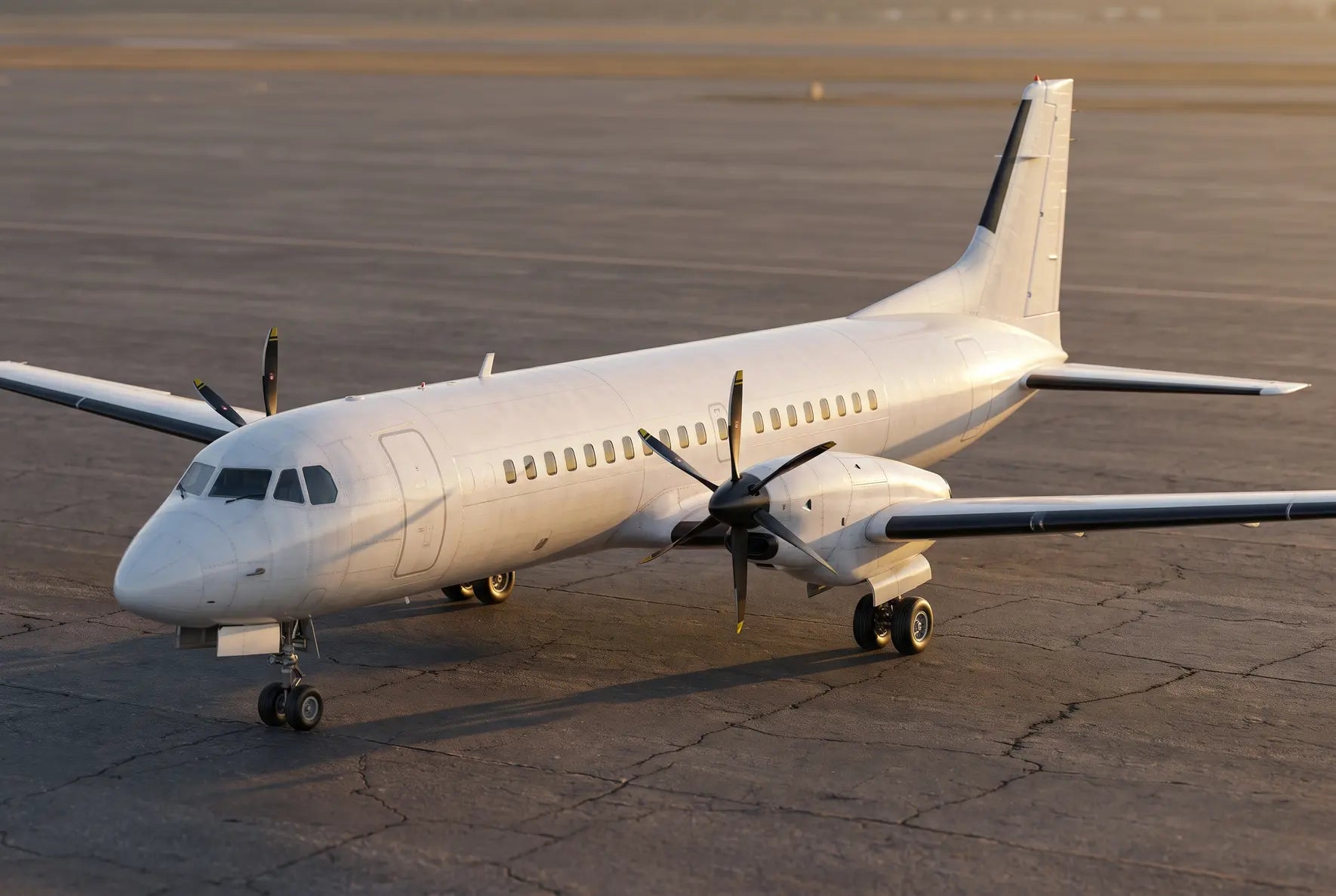
The Vickers Viscount 800 series was conceived to address airline requests for more seats and improved payload on short to medium haul routes. Vickers stretched the fuselage by 3 ft 10 in (1.17 m), increasing overall length from 81 ft 10 in on the Type 700 to 85 ft 8 in (26.11 m) on the Type 800. This allowed seating for 53 to 65 passengers depending on the interior configuration. The wingspan remained unchanged at 93 ft 8.5 in (28.56 m). Production was carried out at Vickers factories at Hurn, near Bournemouth, and at Weybridge. The first production aircraft of the 800 series was the Type 802, built for BEA, which was delivered in February 1957. Power came from four Rolls-Royce Dart RDa.6 Mk 510 engines, each producing approximately 1,535 ehp. BEA ordered 24 Type 802 aircraft, and further customers quickly followed: KLM ordered 9 units of the Type 803, Aer Lingus took delivery of 6 Type 808 aircraft, and Trans-Australia Airlines (TAA) and Ansett-ANA introduced the type on Australian domestic routes. In total, approximately 72 aircraft of the base 800 series (Types 802 through 808) were completed.
The success of the Viscount 800 led Vickers to develop the Type 810 sub-series, which first flew on 23 December 1957. The 810 retained the same stretched fuselage but introduced the more powerful Rolls-Royce Dart RDa.7 Mk 525 engine, rated at 1,990 ehp. This provided significantly improved performance in hot and high conditions, as well as better climb rates and higher maximum takeoff weight of 72,500 lb (32,885 kg). Continental Airlines became one of the first operators of the Type 812, taking delivery from May 1958, while Brazil's VASP received Type 827 aircraft from October 1958 and Japan's All Nippon Airways introduced the Type 828 from July 1961. When production of all Viscount variants ended in 1964, a total of 445 aircraft had been built across all series, making it the best selling British airliner of its era. Many airlines around the world, from North America to Asia and Australasia, operated the type for decades. For readers interested in the evolution of airline operations, this overview of Air Transat illustrates how charter and scheduled carriers have continued to shape the passenger experience long after the turboprop age.
What Distinguishes the Vickers Viscount 800 from Other Variants
The Vickers Viscount 800 sat between the shorter Type 700 and the higher performance Type 810 in the Viscount family. Compared with the Type 700, the 800 featured a longer fuselage with an additional pair of cabin windows on each side forward of the propellers, a detail that makes it visually identifiable. The 800 retained the Type 700 wing but offered meaningfully more cabin volume and a higher maximum seating capacity. Relative to the Type 810, the base 800 used less powerful Dart 510 engines rather than the Dart 525, resulting in lower takeoff weights and reduced hot and high performance, but it was well suited to the temperate European and Australian route networks where it operated most heavily. The Type 806, ordered by BEA, was a notable 800 sub-variant that used the Dart Mk 520 engine before some were later re-engined with Dart 510 units.
Key identifiers and features of the Vickers Viscount 800 series include:
- Engines: Four Rolls-Royce Dart RDa.6 Mk 510 turboprops (approximately 1,535 ehp each); Dart Mk 520 on the Type 806
- Fuselage length: 85 ft 8 in (26.11 m), stretched 3 ft 10 in over the Type 700
- Wingspan: 93 ft 8.5 in (28.56 m), unchanged from the Type 700
- Typical seating: 53 to 65 passengers in various layouts
- Visual identifier: Extra pair of oval cabin windows forward of the propeller line on each side
- Production sub-types: Types 802, 803, 804, 805, 806, 807, and 808, each corresponding to a specific airline customer
A vintage aircraft from Alidair Scotland is parked on the tarmac at an airport. The airplane is white with yellow and blue accents and is marked with the registration G-ARIR.
Vickers Viscount 800 Technical Specifications, Systems and Engine Overview
The Vickers Viscount 800 was a stretched, more powerful evolution of the original Viscount 700 series, designed to carry more passengers over short to medium haul routes while retaining the smooth, low vibration ride that made the type famous. The fuselage was lengthened by approximately 1.17 m (3 ft 10 in) compared to the 700, granting meaningful extra cabin volume and raising typical seating to around 65 passengers in a mixed class layout. With four upgraded Rolls Royce Dart turboprops and a higher maximum takeoff weight, the 800 balanced increased payload against modest improvements in range, a trade off common in stretched variants of the era.
The aircraft inherited the Viscount family's low wing, pressurised fuselage and elliptical cabin cross section. Pressurisation was a key selling point when the Viscount entered service, offering passengers comfort at higher altitudes where turboprops operate most efficiently. A total of 67 Type 800 airframes were built, with deliveries beginning in early 1957. For anyone preparing for airline interviews, the Viscount 800 is a landmark aircraft worth understanding as the world's first commercially successful turboprop airliner.
- Length: 26.11 m (85 ft 8 in)
- Wingspan: 28.55 m (93 ft 8 in)
- Height: 8.15 m (26 ft 9 in)
- Wing area: 89.5 m² (963 sq ft)
- Fuselage diameter: 3.05 m (10.01 ft)
- Maximum takeoff weight (MTOW): 30,617 kg (67,500 lb)
- Operating empty weight (OEW): approximately 18,722 kg (41,276 lb)
- Maximum payload: approximately 6,804 kg (15,000 lb)
- Typical passenger capacity: up to 65 (varies by operator configuration)
- Engines: four Rolls Royce Dart RDa.7/1 Mk 525 turboprops, rated at approximately 1,990 ehp each
- Maximum cruising speed: approximately 564 km/h (304 kt) at 6,100 m (20,000 ft)
- Service ceiling: 7,600 m (25,000 ft)
- Range (max payload): approximately 2,052 km (1,108 nm)
- Range (max fuel): approximately 2,172 km (1,173 nm)
- Rate of climb at MTOW: approximately 503 m/min (1,650 ft/min)
- Fuel capacity: approximately 7,382 litres (1,950 US gallons)
- Crew: two pilots plus cabin crew
Systems, Flight Controls and Handling
The Viscount 800 used conventional manual flight controls with cable and pulley linkages for ailerons, elevators and rudder, supplemented by hydraulic servo boost to reduce stick forces at higher speeds. There was no fly by wire, no yaw damper and no stability augmentation system in the standard configuration. Flaps were trailing edge units operated by a dedicated cockpit lever; the aircraft did not feature spoilers or other advanced lift dumping devices. Avionics were fully analogue, reflecting 1950s standards: basic flight instruments, VHF radio navigation aids and no weather radar or flight management system as standard.
Braking relied on conventional hydraulic wheel brakes actuated by toe pedals on the rudder bar. No anti skid or autobrake system was fitted. Reverse thrust was available through propeller reversal, controlled via the throttle levers. The cabin pressurisation system drew bleed air from the Dart engines, allowing comfortable operation at the type's typical cruise altitudes around 20,000 ft. The Viscount's handling was widely praised by crews: BAE Systems Heritage notes the aircraft's reputation for smooth, stable flight with responsive controls, an attribute that helped sell the type to airlines worldwide.
Published performance figures for the Viscount 800 can vary between sources depending on specific operator configuration, cabin density, actual operating weight, atmospheric conditions (ISA or otherwise) and runway surface state. The MTOW, range and climb data listed above are representative of a typical Dart Mk 525 powered 800 series aircraft. Operators sometimes configured heavier or lighter cabins, affecting payload range calculations. When comparing figures, it is important to note whether values represent manufacturer brochure data, certification limits or airline operational performance.
Rolls Royce Dart: The Engine Behind the Viscount 800
The Viscount 800 was powered by four Rolls Royce Dart turboprops, specifically the RDa.7/1 Mk 525 variant, each producing approximately 1,990 equivalent horsepower (ehp). The Dart was a pioneering engine: design work began in 1945 at Rolls Royce in Derby, the first run took place in July 1946, and a flight test followed in October 1947 aboard a modified Avro Lancaster testbed. The engine featured a two stage centrifugal compressor, seven straight through combustion chambers and a multi stage axial turbine. Its architecture proved remarkably reliable and adaptable.
The Dart Mk 525 fitted to the Viscount 800 represented a significant step up from the earlier RDa.3 variants (approximately 1,480 ehp) used in the Viscount 700. Rolls Royce achieved the power increase through enlarged compressor impellers and revised turbine staging. Some later Viscount sub variants received the Dart Mk 529 (RDa.7/2), rated at approximately 2,100 ehp, for improved hot and high performance. Water methanol injection was also available on certain marks for takeoff power augmentation.
Beyond the Viscount, the Dart engine family powered a wide range of aircraft. The Fokker F27 Friendship, the Hawker Siddeley HS.748 (and its military Andover derivative), the Japanese NAMC YS 11 and the French Breguet 1050 Alizé maritime patrol aircraft all relied on Dart variants. Over 7,100 Dart engines were produced before production ended in 1987, making it one of the most successful turboprop powerplants in aviation history. Its combination of moderate weight, proven reliability and straightforward maintenance helped keep operating costs low for Viscount operators around the world.
Vickers Viscount 800 vs Viscount 700 vs Viscount 810 vs Lockheed L-188 Electra Specifications
Scroll horizontally to see more
| Parameter | Vickers Viscount 800 | Vickers Viscount 700 | Vickers Viscount 810 | Lockheed L-188 Electra |
|---|---|---|---|---|
| Entry into service | 1957 | 1953 | 1958 | 1959 |
| Engines | 4 × Rolls-Royce Dart 510 | 4 × Rolls-Royce Dart 506 | 4 × Rolls-Royce Dart 525 | 4 × Allison 501-D13 |
| Length | 26.1 m | 24.0 m | 26.1 m | 30.5 m |
| Wingspan | 28.6 m | 28.6 m | 28.6 m | 30.3 m |
| Height | 8.2 m | 8.3 m | 8.2 m | 10.3 m |
| Typical seating and layout | 2-class: 57–65 passengers | 2-class: 44–53 passengers | 2-class: 67–74 passengers | 2-class: 75–98 passengers |
| MTOW | 32 t | 29 t | 33 t | 52 t |
| Range | 1,200 nm | 1,000 nm | 1,380 nm | 2,600 nm |
| Cruise speed | 0.50 Mach | 0.49 Mach | 0.51 Mach | 0.54 Mach |
| Service ceiling | 25,000 ft | 25,000 ft | 25,000 ft | 29,000 ft |
| Program note | Stretched development of the 700 series with increased capacity for medium-range routes | Original production series, first turboprop airliner in service | Upgraded 800 with more powerful engines for better performance and range | US turboprop competitor with higher capacity and speed for short/medium haul |
Scroll horizontally to see more
The table compares key specs across Viscount 700/800/810 variants and the Lockheed L-188 Electra. The Viscount family shares a 28.6 m wingspan and 25,000 ft ceiling, but capacity grows from 44–53 (700) to 67–74 (810) with higher MTOW and range. The Electra is larger and heavier (52 t), carries more passengers, flies faster, and offers far greater range (2,600 nm) and a higher ceiling.
Vickers Viscount 800: Typical Routes, Missions and Airlines Around the World
The Vickers Viscount 800 was designed for short to medium haul regional services. With a maximum range of approximately 2,220 km (1,380 miles) and a cruising speed of around 563 km/h (350 mph), it was ideally suited for sectors lasting between 1.5 and 3 hours. The stretched fuselage, extended by 1.17 m (3 ft 10 in) over the Series 700, enabled operators to carry between 53 and 75 passengers depending on configuration, making it an efficient workhorse for high frequency domestic and intra-continental routes.
Operators typically deployed the Vickers Viscount 800 on hub and spoke networks connecting major cities to regional centres, as well as on point to point services linking secondary airports. The aircraft's Rolls Royce Dart turboprop engines offered relatively low operating costs and quick turnaround times, allowing airlines to schedule multiple daily rotations. Airlines such as British European Airways (BEA) in the United Kingdom and Trans Australia Airlines (TAA) in Australia achieved high daily utilisation rates by operating several short sectors per day on busy domestic corridors.
Operational challenges for the Vickers Viscount 800 included performance limitations in hot and high conditions, given a maximum takeoff weight of approximately 29,260 to 32,886 kg (64,500 to 72,500 lb) depending on the sub variant. As jet airliners entered service in the late 1950s and 1960s, the type gradually lost competitiveness on longer routes. Some operators addressed evolving freight needs by fitting larger rectangular cargo doors, a feature introduced with the 800 series. Production ended in 1964 after a total of 445 Viscounts of all variants had been built, as documented by BAE Systems Heritage.
Where the Vickers Viscount 800 Operated
The Vickers Viscount 800 saw service across four broad regions, making it one of the most widely operated turboprop airliners in aviation history. In Europe, it formed the backbone of several national carriers' short haul fleets, linking capitals and regional cities. In North America, it became the first turboprop airliner purchased in large numbers by major US and Canadian airlines. Africa saw the type on trunk routes connecting key cities in southern and central regions. In Asia and Oceania, the Viscount 800 served domestic networks in countries such as Japan, India, and Australia, where it proved especially popular on inter-city corridors.
According to Wikipedia's comprehensive operator list, more than 570 owners and operators were involved with the Viscount programme worldwide, underlining the global reach of this pioneering aircraft.
- Europe: British European Airways (BEA) was the launch customer and largest European operator, using the Viscount 800 extensively on UK domestic and European routes from 1957 until the early 1980s, when the fleet transitioned to successor British Airways. Aer Lingus operated the type on Irish domestic and cross channel services. Austrian Airlines used Viscounts on regional European routes. British Midland operated 29 Viscounts, including 800 series variants (models 813, 815, and 831), primarily on UK domestic services between 1967 and 1988. British Air Ferries acquired 18 ex British Airways Viscounts in the early 1980s, becoming one of the world's largest operators and deploying them on charter, leasing and oil industry support flights. Other European operators included Alitalia and several independent British charter airlines such as British Eagle and Alidair.
- North & South America: Capital Airlines in the United States was one of the largest Viscount operators worldwide, acquiring 60 aircraft and deploying them on busy eastern US corridors, accumulating over 350,000 flight hours by 1958. Trans Canada Air Lines (later Air Canada) built a fleet of 51 Viscounts, the largest in North America, for domestic Canadian services. Continental Airlines, United Airlines, and Northeast Airlines also operated the type on US domestic routes. The Viscount 800 did not see widespread adoption in South America, though some aircraft were resold to operators in the region later in their service lives. For insights into how different airlines structured their international operations during this era, see this overview of Corsair International.
- Asia: All Nippon Airways in Japan operated Viscounts on domestic routes. Indian Airlines used the type on its extensive domestic network across India. The government of Iran operated at least one Viscount 800 series airframe in VIP configuration. Arkia Airlines in Israel used the aircraft for regional services. Pakistan International Airlines also operated the Viscount on domestic and regional routes.
- Africa: Central African Airways operated Viscounts on trunk routes connecting cities such as Salisbury (now Harare) and Johannesburg from 1956. Air Rhodesia, its successor, continued regional services. Ghana Airways and South African Airways also operated the type. In Oceania, Trans Australia Airlines (TAA) and Ansett ANA were major operators on Australia's domestic trunk routes, with 28 Viscounts registered in the country over the years according to Aeropedia. The Royal Australian Air Force (RAAF) also operated two Viscount 816 aircraft in VIP transport configuration.
Typical Seating Configurations of the Vickers Viscount 800
The Vickers Viscount 800 featured a pressurised circular cross section fuselage with a single aisle. The standard cabin layout used a 2+2 abreast seating arrangement, offering generous space by the standards of the 1950s and 1960s. The aircraft was renowned for its large oval panoramic windows, which provided excellent visibility for passengers.
Typical seating capacity ranged from 53 to 65 passengers in standard airline configurations, though high density layouts could accommodate up to 75 seats by adopting a tighter 2+3 arrangement. BEA typically configured its Viscount 802 with around 65 seats in an all economy layout. Trans Australia Airlines and Ansett ANA used similar configurations on their Australian domestic services. Some corporate and VIP operators fitted far fewer seats with luxury furnishings, including tables and executive style seating.
Interior seating and flight deck configurations were tailored to each customer's specifications, with each variant receiving a unique Vickers Type number reflecting those choices. A detailed seat map of the British Airways Viscount 802 layout is available on AeroLOPA, illustrating the 2+2 abreast arrangement and cabin dimensions that characterised this classic turboprop airliner.
This video explores the Vickers Viscount in Jetflx Classic Airlines, following Henry Tenby on a nostalgic journey through 1950s and 1960s airline history, highlighting the aircraft’s era, travel and memories.
Vickers Viscount 800 Safety Record: How Safe Was This Turboprop?
The Vickers Viscount 800 belongs to a family of 445 turboprop airliners built between 1948 and 1964 by Vickers-Armstrongs at Weybridge and Hurn in the United Kingdom. The type entered revenue service in 1953 and remained in commercial operation for nearly five decades, with the last examples flying cargo missions in Africa into the early 2000s. Across all Viscount variants, over 150 accidents and incidents have been documented, including 144 hull losses. These figures must be read in proportion: the fleet accumulated millions of flight hours over roughly half a century, operating on every inhabited continent and in widely varying regulatory environments. Many losses occurred in regions where infrastructure, navigation aids and oversight standards were still developing, and a significant share involved non 800 series airframes. The 800 series, with its strengthened structure and uprated Rolls Royce Dart engines, represented a meaningful step forward from the earlier Type 700 production run of 287 aircraft.
Notable Accidents Involving Viscount 800 Series Variants
Aer Lingus Flight 712 (24 March 1968) – A Vickers 803 Viscount, registration EI-AOM, departed Cork for London Heathrow and crashed into the sea near Tuskar Rock off the coast of County Wexford, Ireland. All 61 occupants were killed. The original 1970 investigation could not establish a definitive cause. A subsequent review in 2001 suggested a possible structural or flutter event in the tail assembly, but no single explanation was confirmed. The tragedy prompted renewed focus on underwater wreckage recovery procedures and highlighted the need for better flight data recording on older turboprop types.
MacRobertson Miller Airlines Flight 1750 (31 December 1968) – A Vickers 720C Viscount, VH-RMQ, broke apart in flight south of Port Hedland in Western Australia, killing all 26 on board. The Australian investigation report identified fatigue failure of the starboard inner main spar lower boom, attributed to a manufacturing defect during bush insertion. This finding led to the immediate grounding of all Australian Viscounts and a worldwide reduction of the retirement life for the affected spar booms from 11,000 to 7,000 flights, reinforcing the importance of structural life monitoring across the global fleet.
BEA Viscount 802 at Nutts Corner, Belfast (23 October 1957) – Vickers 802 G-AOJA crashed during a go around at Nutts Corner Airport in poor visibility, killing all seven people on board. The inquiry could not determine a single cause but noted potential issues with unlit approach lighting and foreign object contamination in the flight controls. The resulting recommendations strengthened tool control procedures during maintenance and tightened airport lighting verification requirements at UK aerodromes.
How Safe Is the Vickers Viscount 800?
Assessing the safety of the Vickers Viscount 800 requires historical context. The aircraft entered service at a time when turbine powered commercial aviation was in its infancy, and many of the regulatory frameworks, cockpit resource management practices and maintenance programmes taken for granted today did not yet exist. A large portion of the recorded hull losses across the broader Viscount family occurred in the 1950s and 1960s, an era when worldwide accident rates for all airliner types were substantially higher than modern benchmarks tracked by organisations such as the International Civil Aviation Organization (ICAO).
The Viscount 800 benefited from several design strengths. Its four Rolls Royce Dart turboprop engines proved exceptionally reliable and offered a significant safety margin over piston powered contemporaries. The pressurised fuselage and large oval windows, while distinctive, were engineered within the structural knowledge of the period. Over the decades, mandatory service bulletins, airworthiness directives and fleet wide spar inspections progressively addressed fatigue concerns. Operators that adhered to manufacturer and regulatory guidance typically achieved solid dispatch reliability.
By the standards of its generation, the Viscount 800 compiled a service record broadly comparable to other first generation turboprops. For readers interested in how later regional aircraft evolved from these early designs, a useful comparison can be found in the profile of the Antonov An 158, a modern short haul jet that illustrates how airframe technology and safety engineering have advanced. Today, aviation remains statistically one of the safest modes of long distance transport, a status built in part on lessons learned from pioneering types like the Vickers Viscount.
01 What was the typical range and mission profile of the Vickers Viscount 800?
The Vickers Viscount 800 had a range of about 1,380 miles (2,220 km) with maximum payload, suited for medium-range routes like Chicago to New York or intra-regional flights in Europe and Australia. It cruised at around 350 mph (566 km/h) at 20,000-25,000 feet, powered by four Rolls-Royce Dart turboprops. Operators used it mainly for 1-3 hour flights carrying 65-75 passengers.
02 How was the cabin layout and passenger experience on the Vickers Viscount 800?
The Vickers Viscount 800 featured a pressurized cabin with large elliptical windows (19 by 26 inches) for panoramic views, low vibration, and quieter operation than piston-engine aircraft. It typically seated 65-75 passengers in a single-class layout with extended fuselage for more space. Passengers appreciated the smooth ride and comfort on medium-haul trips.
03 Which airlines operated the Vickers Viscount 800 and on what routes?
Airlines like British European Airways, Capitol Airlines in the US, Trans Australia Airlines, and Ansett in Australia flew the Vickers Viscount 800. They used it on regional and medium-distance routes, such as UK domestic flights, US East Coast hops, and Australian interstate services. It served until the 1980s in some regions before jets took over.
04 How did the Vickers Viscount 800 perform compared to similar aircraft?
The Vickers Viscount 800 offered better fuel efficiency and lower operating costs than piston airliners like the Douglas DC-6, with Rolls-Royce Dart engines enabling speeds up to 352 mph and a service ceiling of 25,000 feet. It carried more passengers than earlier Viscount models due to its lengthened fuselage. Compared to early jets, it excelled in short-to-medium sectors under 1,400 miles.
05 What was the safety record and key design features of the Vickers Viscount 800?
06 What practical details should travelers know about flying on the Vickers Viscount 800?
Seats were in a 2-2 configuration with good window views from the large elliptical panes, ideal for sightseeing. It handled turbulence smoothly due to turboprop stability at lower altitudes. Cabin noise was low for the era, and the pressurized interior maintained comfort up to 25,000 feet.