History and Development of the Tupolev Tu-334 Regional Jet Program
The Tupolev Tu-334 was conceived as a domestically built short- to medium-range regional jet intended to replace ageing Soviet-era types, principally the Tu-134 and, in some configurations, the Yak-42. The aircraft borrowed heavily from the larger Tu-204 family, reusing much of its design logic to keep development costs and risk under control while delivering a modern airframe in the 100-seat class. The program was formally launched in 1986, with an early plan calling for a first flight in 1991 and entry into service around 1995.
Post-Soviet industrial disruption and chronic funding shortages pushed those dates back substantially. The prototype was rolled out in August 1995, but the maiden flight did not take place until 8 February 1999 from Zhukovsky. Russian type certification followed only in December 2003 (reported as 30 December 2003). Despite this milestone, the Tu-334 never entered regular airline service, and no firm commercial orders materialised.
Industrial responsibility rested with Tupolev, while production planning involved several plants, including KAPO in Kazan and Aviant in Kiev, with later discussion of RSK MiG as a potential participant. The broader rationale was as much about sustaining Russian and post-Soviet aerospace manufacturing capacity as it was about replacing a single aircraft type. Readers interested in how rear-engined airliners of this era were positioned commercially may also find context in our coverage of the Lockheed L-1011-250.
What Distinguishes the Tu-334-100 From Its Sub-Variants
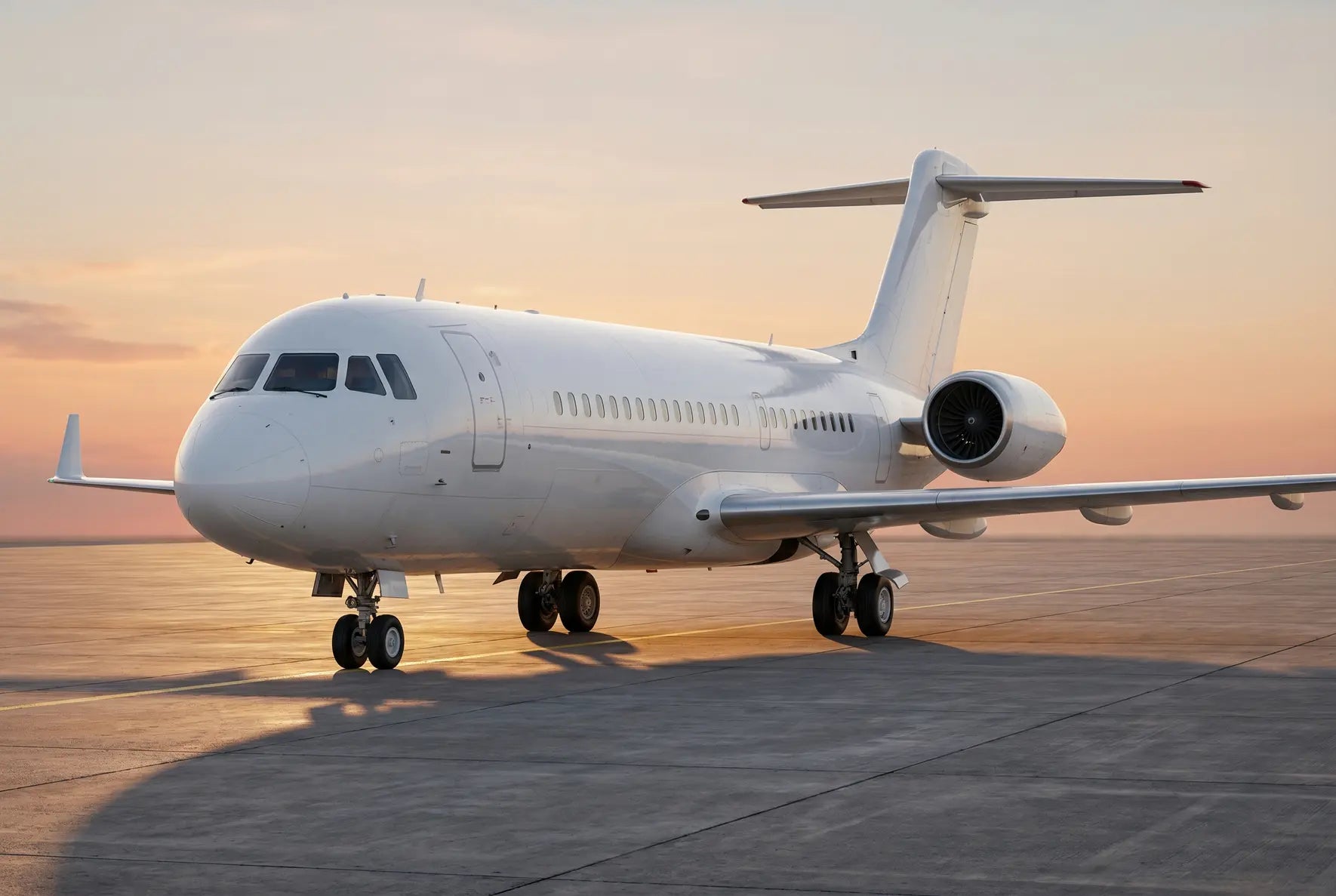
The principal production version was the Tu-334-100, the baseline ~100-seat model powered by two Ivchenko-Progress D-436T1 turbofans. A stretched, higher-capacity Tu-334-200 was proposed as a distinct variant with a higher price point, but it remained on paper. In practice, the difference between the sub-variants was mainly capacity and market positioning rather than a fundamentally different airframe concept. The Tu-334 used a rear-engined, low/mid-wing layout with a T-tail, a circular-section semi-monocoque fuselage shortened from the Tu-204, an essentially identical flight deck, and short-stroke landing gear designed to lower the sill height and ease baggage handling. The avionics fit was reported to draw on Rockwell Collins systems, reflecting a Western-style cockpit approach.
The following variant identifiers summarise the features most often used to distinguish the standard Tu-334-100:
- Engines: two Progress / Ivchenko-Progress D-436T1 turbofans.
- Configuration: rear-mounted twinjet with T-tail, fuselage shortened from the Tu-204.
- Capacity: approximately 102 seats in standard layout.
- Range: around 1,700 nautical miles (about 3,148 km).
- Weights and dimensions: maximum take-off weight near 47,900 kg, wingspan about 29.77 m.
- Avionics: Rockwell Collins-based suite with a flight deck shared with the Tu-204.
The program is best remembered for repeated schedule slips and an inability to convert certification into sales. According to aerospace analysis of the program, the Tu-334 was effectively cancelled around 2009 during Russian aerospace consolidation, as resources shifted to newer designs such as the Sukhoi Superjet 100 and the Antonov An-148. Quoted 2003 prices placed the Tu-334-100 at roughly US$16-18 million and the Tu-334-200 at about US$20 million, but with no committed customers and growing competition, the regional jet never achieved a viable production run.

A Tupolev Tu-334 aircraft is parked on an airport tarmac, with the passenger steps lowered. People are observing the plane, highlighting its features.
Tupolev Tu-334 Technical Specifications, Systems and Engines
The Tupolev Tu-334-100 was conceived in the 1990s as a short- to medium-range regional jet intended to replace ageing Soviet narrowbodies on routes of up to roughly 3,000 km. It uses a rear-mounted twin-engine layout with a T-tail and inherits cockpit philosophy and several systems from the larger Tu-204/214 family, balancing seating capacity against runway performance and operating economy. The design favoured a conventional, robust airframe able to operate from less developed regional airfields rather than maximum range.
Most published figures refer to the baseline -100; later proposals such as the -100D, -120 and -200 differed mainly in weights, fuel, wingspan and engine choice. The data below reflects the Tu-334-100 unless otherwise noted, drawn from specialist technical references such as flugzeuginfo and AeroCorner.
- Wingspan: 29.77 m (97 ft 8 in)
- Length: 31.26 m (102 ft 7 in)
- Height: 9.38 m (30 ft 9 in)
- Wing area: 83.2 m²
- Fuselage diameter: 3.8 m
- MTOW: 47,900 kg (about 105,600 lb)
- Empty weight: approximately 38,360 kg
- Maximum payload: around 9,000 kg
- Fuel capacity: about 10,100 kg (roughly 11,900 L)
- Passengers: up to 102 single-class, or 72 to 74 in a two-class layout
- Cruise speed: about 820 km/h (443 kt)
- Range with design payload: about 3,150 km (1,700 NM)
- Service ceiling: 11,100 m (36,417 ft)
- Engines: two Ivchenko-Progress D-436T1 turbofans, about 73.5 kN (16,500 lbf) each
Systems and handling-relevant technology
The Tu-334 pairs modern digital avionics with conventional flight controls. The flight deck uses an EFIS glass cockpit with multifunction displays for flight, navigation and engine data, supported by a flight management system and a digital automatic flight control system providing autopilot, flight director and approach guidance. Primary surfaces (ailerons, elevators and rudder) are hydraulically actuated rather than fly-by-wire, while leading-edge slats and double-slotted trailing-edge flaps deliver the lift needed for shorter regional runways.
Engine handling is managed through the D-436's FADEC, which integrates with the autothrottle for precise thrust management and interlocks the thrust reversers against inadvertent deployment. Wheel braking uses hydraulic brakes with an anti-skid system, and the FADEC also supports digital engine indication and health monitoring. These automation features reduce crew workload, which is particularly valuable when operating into demanding or rapidly changing conditions; for context on how crews prepare for such situations, see this overview of flying in extreme weather.
Published performance figures should be read with care. Numbers vary with operator options, cabin density, selected takeoff and landing weights, atmospheric assumptions (temperature and altitude) and runway condition. Because the Tu-334 never reached mass production, certified landing field length tables and full performance charts are not widely available in open English-language sources, so quoted values are best treated as representative rather than absolute.
The Progress D-436 engines
The baseline Tu-334-100 is powered by two Ivchenko-Progress (ZMKB) D-436T1 three-shaft high-bypass turbofans, with the D-436-148 also specified as an option. The engine family is designed by Ivchenko-Progress in Zaporizhzhia, Ukraine, and produced by Motor Sich, with some variants involving Russian industrial partners such as UMPO and NPC Salyut. The D-436 is a derivative of the earlier D-36, a three-shaft engine first run in 1971 and quoted with a bypass ratio of about 6.3:1, which powered the Yakovlev Yak-42 and the Antonov An-72 and An-74. Background on this lineage is documented in references covering the Lotarev D-36.
The D-436 variants typically produce takeoff thrust in the 6,400 to 6,830 kgf class (roughly 63 to 67 kN), with the modernized D-436-148 using FADEC for improved fuel efficiency and engine health monitoring, a reported dry weight near 1,400 kg, and a length of about 4,034 mm. Beyond the Tu-334, the family powers the Antonov An-148 and An-158 regional jets with the D-436-148, and the Beriev Be-200 amphibious aircraft with the corrosion-tolerant D-436TP. Technical details on the engine are summarised by sources such as RedStar.
Tupolev Tu-334 vs CRJ900 vs Embraer 190 vs Sukhoi Superjet 100-95 Specifications
Scroll horizontally to see more →
| Parameter | Tupolev Tu-334 | Bombardier CRJ900 | Embraer 190 | Sukhoi Superjet 100-95 |
|---|---|---|---|---|
| Entry into service | N/A | 2003 | 2005 | 2011 |
| Engines | 2 × Ivchenko-Progress D-436T1 | 2 × General Electric CF34-8C5 | 2 × General Electric CF34-10E | 2 × PowerJet SaM146 |
| Length | 31.3 m | 36.4 m | 36.2 m | 29.9 m |
| Wingspan | 29.8 m | 24.9 m | 28.7 m | 27.8 m |
| Height | 9.4 m | 7.5 m | 10.6 m | 10.3 m |
| Typical seating and layout (short description + approximate passengers) | 2-class: 72–80 passengers | 2-class: 76–90 passengers | 2-class: 96–114 passengers | 2-class: 87–98 passengers |
| MTOW | 47.9 t | 38.3 t | 51.8 t | 45.9 t |
| Range | 1,700 nm | 1,550 nm | 2,450 nm | 2,100 nm |
| Cruise speed | 0.78 Mach | 0.78 Mach | 0.78 Mach | 0.78 Mach |
| Service ceiling | 36,400 ft | 41,000 ft | 41,000 ft | 40,000 ft |
| Program note | Unrealised Russian rear‑engined regional jet derived from Tu‑204 technology, aimed at the 70–100 seat short‑haul market. | Stretched member of the CRJ family, optimised as a high‑frequency regional jet for airlines needing around 80–90 seats. | Baseline member of Embraer’s E-Jet family, targeting mainline comfort and range in the 100-seat regional segment. | Modern Russian regional jet competitor in the same size/range class, featuring wing‑mounted engines and Western avionics/engines. |
Scroll horizontally to see more →
The table compares key specs of the unrealised Tupolev Tu-334 with three in-service regional jets: CRJ900, Embraer 190 and Superjet 100-95. All cruise at Mach 0.78, but the E190 stands out for range (2,450 nm) and higher MTOW (51.8 t) with larger typical seating (96–114). The CRJ900 is longer yet has the smallest wingspan and lowest MTOW (38.3 t), while the Superjet offers mid-range performance (2,100 nm).
Tupolev Tu-334 Operations, Routes and Airlines Worldwide
The Tupolev Tu-334 was conceived as a short- to medium-range regional jet, intended to replace the ageing Tu-134 and Yak-42 fleets across the former Soviet Union. With a design range of roughly 3,150 km (about 1,700 nautical miles) and a cruise speed near 820 km/h, it was tailored to sectors of one to three hours, the kind of domestic and near-international routes typical of Russian and CIS networks. The aircraft used two rear-mounted Ivchenko-Progress D-436T1 turbofans of about 73.6 kN thrust each, a T-tail layout and a fuselage cross-section shared with the larger Tu-204.
In practice, the type never reached scheduled service. Only two flying prototypes were built. Russian type certification was achieved in 2003, but serial production was never launched, so there is no real-world daily utilisation pattern to report. The aircraft's role remained limited to flight testing and airshow demonstrations rather than revenue operations.
Intended operational environment
Had it entered service, the Tu-334 would have suited point-to-point and hub-and-spoke domestic operations from major Russian hubs to secondary and regional airports. Its rear-engine, T-tail configuration offered ground clearance and compatibility with less developed airfields, an advantage in many regions with modest infrastructure. The main operational challenge was economic: the airframe was relatively heavy and less fuel-efficient than newer competitors, and it relied largely on legacy Tu-204 structures rather than a clean-sheet optimisation for the 100-seat market.
Where the aircraft operates
Because the programme was cancelled before production, the Tu-334 has no genuine global operator base. Its commercial ambitions were focused almost entirely on one continent. Across Europe, specifically the Russian Federation and other CIS states, the type was marketed to carriers seeking to retire Soviet-era jets. Interest was occasionally reported in parts of Asia and the wider Middle East, while North & South America and Africa were never realistic markets and saw no orders or operations. The picture below reflects expressions of interest and letters of intent rather than confirmed service, since no airline ever flew the type commercially.
- Europe (Russia/CIS): The primary target market. Aeroflot and various Russian regional carriers were envisaged as core customers replacing Tu-134 and Yak-42 equipment. By December 2006, several carriers had reportedly requested the type and others had signed letters of intent, but none progressed to delivery.
- North & South America: No airlines ordered or operated the Tu-334. The aircraft was not certified to Western standards for these markets, and no sales campaigns succeeded there.
- Asia: Reports mention provisional interest from operators in countries such as Iran and Syria, attracted by a low-cost 100-seat jet, but no firm orders materialised and no aircraft were delivered.
- Africa: There is no documented operator or order. The continent did not feature in the programme's realised sales activity.
Typical seating
The standard Tu-334-100 offered a circular 3.8 m fuselage with 3-3 economy seating. A high-density single-class cabin accommodated up to 102 passengers at a 32-inch (81 cm) pitch, while a two-class layout seated roughly 72 to 74 passengers in a mixed business and economy arrangement. Network operators would typically have favoured the two-class configuration for domestic trunk routes, whereas higher-density single-class layouts suited leisure and charter missions. Detailed specifications for these planned layouts are documented in the Jane's All the World's Aircraft entry and summarised in technical references such as Flugzeuginfo. Ultimately, state support shifted to the Sukhoi Superjet 100 and the Antonov An-158, leaving the Tu-334 a certified but unbuilt design rather than an operational airliner.
This video explores why the Tupolev Tu-334, a Russian short-to-medium range airliner, failed to gain traction. Learn the key challenges, setbacks, and factors that led to its downfall.
Tupolev Tu-334 Safety Record and How Safe Is It in Service
Assessing the safety record of the Tupolev Tu-334 requires an honest acknowledgement of context: this regional jet never reached series production or scheduled commercial service. Only a small number of airframes were completed, with roughly three flying prototypes plus additional examples reserved for static and fatigue testing, according to Forecast International. The aircraft first flew on 8 February 1999 and received a Russian type certificate on 30 December 2003, yet no airline ever took delivery. Because the fleet remained limited to manufacturer test and demonstration roles, the type accumulated only a modest number of flights and cycles compared with airliners that entered widespread airline operations. This means there is no large body of in-service data, and any statistical safety rate must be read with that limited exposure in mind.
Documented accidents and serious incidents
Unlike high-volume airliners, the Tu-334 has no documented history of fatal accidents, hull losses or major serious incidents recorded in the principal aviation references, including the type overview maintained on Wikipedia and the technical entry held by Jane's. Test flights from Zhukovsky were reported to show generally stable handling and acceptable performance. The following points summarise the situation:
- No recorded hull losses: The prototype fleet completed its flight-test programme without a documented catastrophic event, so there were no accident-driven design changes specific to the type.
- Programme cancellation, not safety failure: The decision to halt the Tu-334 followed the consolidation of Russian manufacturers under United Aircraft Corporation and a strategic shift toward the Sukhoi Superjet 100, driven by funding, politics and competition rather than any safety shortfall.
- Limited operational exposure: With no airline service, the absence of recorded incidents reflects very low flight-hour accumulation rather than proven long-term reliability.
How safe is the Tupolev Tu-334?
Because the Tu-334 never carried fare-paying passengers in scheduled service, a meaningful accident rate relative to traffic volume cannot be calculated in the way it can for mature airliners. What can be assessed is its design philosophy. The aircraft borrowed a shortened Tupolev Tu-204 fuselage and flight deck for family commonality, used rear-mounted Progress D-436T1 turbofans and a T-tail to reduce foreign-object damage and runway-spray ingestion on poorly equipped airfields, and was engineered for a 60,000-hour structural life. A modern avionics suite was intended to improve situational awareness over the older Tu-134 it was meant to replace. These choices reflect mainstream regional-jet safety thinking, though without airline standard operating procedures, sustained regulatory oversight and accumulated service data, the type's real-world safety can only be inferred, not demonstrated. For broader context on how robust commercial aviation safety has become, readers can consult the annual analyses published by the International Civil Aviation Organization (ICAO) and the International Air Transport Association (IATA). Those who enjoy comparing how different airframes are engineered and operated may also find value in our overview of the Boeing 747-200C. Across the industry as a whole, the layered combination of certification standards, crew training, maintenance programmes and oversight is the reason commercial aviation remains one of the safest modes of transport available today.
01 Did the Tupolev Tu-334 ever enter regular airline service?
The Tupolev Tu-334 did not enter regular commercial airline service. Only a small number of prototypes and demonstrator aircraft were built and flown for testing, certification work, and airshow appearances. Although several airlines expressed preliminary interest in the 100-seat regional jet, no firm orders were finalized, and no aircraft were delivered to airlines for scheduled passenger operations. The project was eventually set aside in favor of newer regional jet programs within Russia’s consolidated aviation industry.
02 What kind of routes was the Tupolev Tu-334 designed to fly?
The Tupolev Tu-334 was designed for short- to medium-haul routes of roughly 2,000–3,000 km, mainly within domestic and regional networks. It targeted sectors similar to those flown by the older Tu-134, such as trunk routes between major Russian cities and busy regional connections where demand was around 70–120 passengers per flight. In mission profile it was aimed at frequent, relatively short segments with quick turnarounds rather than long-haul operations. This placed it in the same general role as Western regional jets and small narrowbodies of the 100-seat class.
03 How many passengers could the Tupolev Tu-334 carry and what was the cabin like?
The standard Tupolev Tu-334-100 was designed for around 72–102 passengers, with a single-aisle cabin in a 3–3 seating layout similar to many narrowbody jets. Typical layouts included all-economy configurations at about 32-inch seat pitch or mixed-class cabins with a small forward business or first-class section and the rest in economy. Cabin width was comparable to the Tu-204, giving a familiar six-abreast feel but not as spacious as widebodies or some newer-generation single-aisles. The rear-mounted engines were expected to reduce engine noise in the forward cabin compared to older Soviet designs with louder powerplants.
04 What is the range and performance of the Tupolev Tu-334 compared to similar aircraft?
The Tupolev Tu-334 was planned with a range of roughly 3,000–3,150 km, cruising at about 820 km/h, which placed it in line with many 100-seat regional and small narrowbody jets of its era. Its performance was optimized for regional sectors rather than maximum range, so it was competitive on typical domestic routes but less suited to very long segments. In concept, the Tu-334 would have competed with aircraft such as the Fokker 100, early Embraer regional jets, and small Airbus or Boeing variants, though it never reached the operational maturity or fleet scale of those types. Stretch variants were proposed to carry up to approximately 126 passengers with similar mission profiles.
05 What are some notable design features of the Tupolev Tu-334?
The Tupolev Tu-334 used a low-wing design with two turbofan engines mounted at the rear of the fuselage and a T-tail, a layout chosen to improve runway debris protection and reduce cabin noise. It borrowed heavily from the Tu-204 family, including a similar fuselage cross-section and a scaled-down wing, which helped with systems commonality and reduced development effort. The type was intended to feature modern avionics and a two- or three-person cockpit, with some variants planned to use Western engines and systems. These design choices were meant to modernize Russia’s regional jet offering while easing maintenance and crew transition for operators already familiar with Tupolev aircraft.
06 If the Tupolev Tu-334 had entered service, what kind of passenger experience could travellers expect?
Passengers on a Tupolev Tu-334 would likely have experienced a familiar narrowbody environment, with a single aisle, 3–3 seating, and seat pitch similar to other regional jets of its time. The rear-mounted engines would have made the forward cabin relatively quieter during cruise compared to older rear-engined types with less advanced noise treatment, though seats near the tail would experience more engine noise and vibration. Window alignment and seat comfort would depend on the specific airline configuration, but the cabin was designed to accommodate standard overhead bins and modern interior fittings. Overall, the experience would have been comparable to many 100-seat regional jets rather than a large long-haul aircraft.