Tupolev Tu-154: History, Development, and Evolution of the Soviet Trijet
The Tupolev Tu-154 is the most successful jet airliner ever produced in the Soviet Union. Developed to modernise Aeroflot's medium range fleet, this three engine narrow body aircraft served as the backbone of Soviet and post Soviet civil aviation for nearly five decades. Its story begins in the early 1960s, when the need to replace an ageing generation of airliners became urgent.
Origins and Program Launch
By the early 1960s, Aeroflot operated a mix of first generation jets and turboprops on domestic routes, primarily the Tupolev Tu-104, the Ilyushin Il-18, and the Antonov An-10. These types were becoming obsolete: the Tu-104 was fuel hungry and noisy, while the turboprops lacked the speed demanded by a growing network spanning the vast Soviet territory. In 1963, the Soviet Ministry of Aviation Industry launched a formal requirement for a modern medium range airliner capable of carrying up to 160 passengers over distances of 2,850 to 4,000 km at cruising speeds near 900 km/h. Crucially, the new aircraft had to operate from short, poorly surfaced Class B runways as short as 2,600 m, a reflection of the underdeveloped airport infrastructure across the USSR.
Two design bureaus competed for the contract. The Ilyushin bureau proposed the Il-72, a scaled down derivative of its Il-62 long range airliner featuring manual flight controls and a simpler autopilot. The Tupolev bureau, designated OKB-156 and led by chief designer Andrei Tupolev, countered with a more ambitious proposal. Under project lead Sergey Yeger, who began directing the programme in 1964, the Tupolev team designed a trijet with advanced triplex hydraulic flight controls, a triplicated autopilot, and high lift wing devices developed in collaboration with the TsAGI aerodynamics institute. These features gave the Tu-154 decisive advantages, and the Tupolev design was selected for development.
Prototype, First Flight, and Entry into Service
The hand built prototype was rolled out of Tupolev's factory in central Moscow in mid 1968, then disassembled and transported by road to Zhukovsky airfield southeast of the capital. The maiden flight took place on 4 October 1968. The aircraft made its international public debut at the 1969 Paris Air Show at Le Bourget. Testing proved longer than expected: the Tu-154 had to comply with new Soviet airworthiness standards (NLG), and approximately ten pre production airframes were used in an extended flight test programme.
Series production began in 1970 at the Kuibyshev Aviation Plant (later renamed Aviakor, in the city now known as Samara). Trial freight and mail services started in May 1971, and full passenger operations with Aeroflot commenced on 9 February 1972. The type quickly became the workhorse of the Soviet domestic network, much as the Boeing 727 served airlines in the West. Over its entire production run, which lasted until the final airframe was delivered to the Russian Defence Ministry on 19 February 2013, a total of approximately 1,025 Tu-154s were built across all variants.
Major Variants and Incremental Upgrades
The Tu-154 evolved through a series of progressively improved sub variants, each addressing operational shortcomings discovered in service.
The baseline Tu-154 entered service in 1972 powered by three Kuznetsov NK-8-2 turbofan engines. It could seat up to 164 passengers and had a maximum takeoff weight (MTOW) of approximately 90 tonnes. Early operations revealed wing fatigue cracking after several thousand flight hours, a problem that prompted structural redesign in subsequent models.
The Tu-154A, introduced in April 1974, received uprated NK-8-2U engines with higher thrust, an automated wing high lift and stabiliser trim system, and a raised MTOW of around 94 to 96 tonnes. About 111 examples were built before the next major upgrade. The Tu-154B, entering service from 1975, addressed the wing fatigue issue with a strengthened wing structure, added an extra fuel tank, and introduced rear fuselage emergency exits. MTOW climbed to 98 tonnes and high density seating reached 180 passengers. The B series was further refined through the Tu-154B-1 and Tu-154B-2 sub variants (both from 1978), which incorporated improved fuel systems, upgraded air conditioning, modernised electrics, and landing gear refinements. The B-2 in particular became a common and reliable workhorse.
The most significant evolution came with the Tu-154M, which first flew in 1982 and entered Aeroflot service in 1984. This variant replaced the NK-8-2U engines with three quieter and more fuel efficient Aviadvigatel (Soloviev) D-30KU-154 turbofans. Hourly fuel consumption dropped from roughly 6,500 kg to about 5,500 kg, a saving of approximately 15%. The rear fuselage was extensively redesigned, and aerodynamic improvements included a reworked wing leading edge and modified flap and spoiler systems. The flight crew was reduced from five members to three thanks to updated avionics, including a new inertial navigation system. The Tu-154M became the most produced sub variant, representing over 70% of all Tu-154s built. Its improved economics and lower noise levels kept it in airline service well into the 21st century, with Alrosa Airlines operating the last commercial Tu-154 passenger flight on 28 October 2020 between Mirny and Novosibirsk in Siberia.
Among earlier trijet airliners that preceded the Tu-154 in concept, the Lockheed L-649 Constellation serves as a reminder of how postwar piston powered designs drove the demand for faster, jet powered successors across both Western and Soviet aviation.
What Sets the Tu-154 Apart from Comparable Types
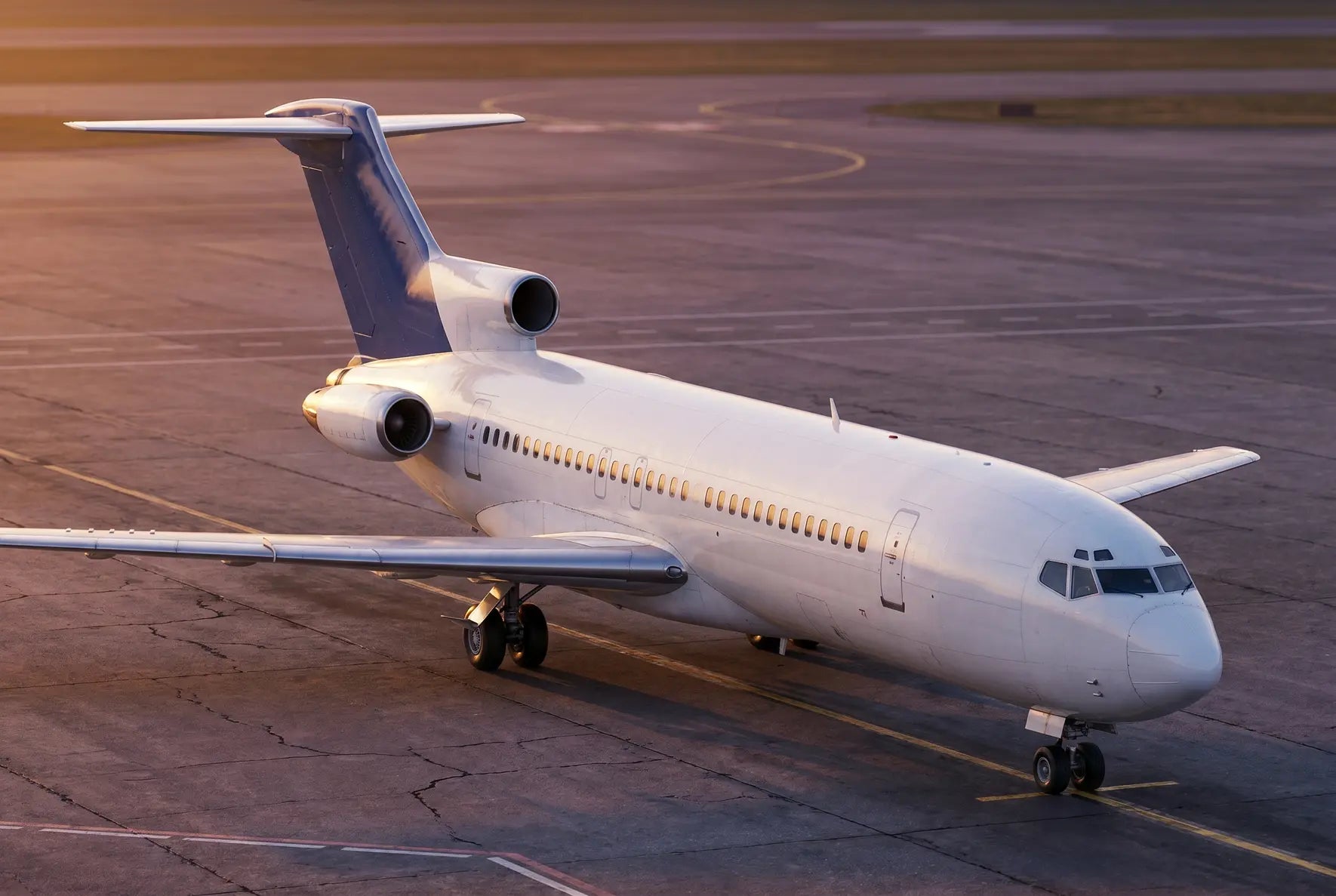
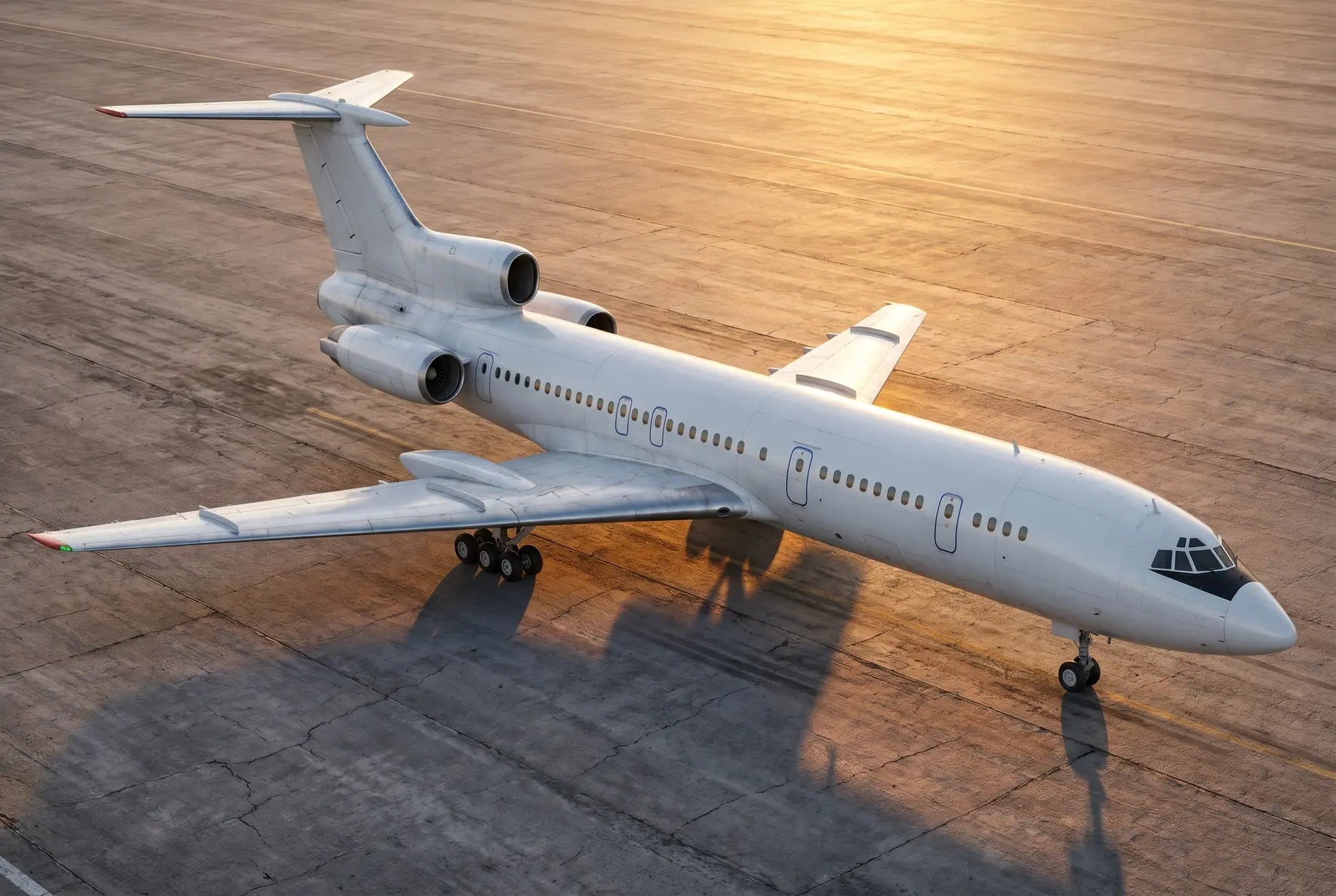
The Tu-154 was specifically engineered for operating conditions that no Western trijet ever had to face: extreme cold, unpaved runways, and enormous distances with minimal ground infrastructure. Its six wheel main landing gear bogies with oversized low pressure tyres allowed operations from gravel strips, and its robust airframe was originally rated for a 45,000 hour service life (18,000 cycles), later extended to 80,000 hours with structural upgrades. Unlike the Boeing 727, which shared the rear mounted trijet layout, the Tu-154 carried its own auxiliary power unit and ground start capability, essential for airports lacking external power and air start equipment.
Key variant identifiers that distinguish Tu-154 sub types at a glance include:
- Engines: NK-8-2 (baseline), NK-8-2U (Tu-154A/B series), D-30KU-154 (Tu-154M)
- MTOW: approximately 90 t (baseline), 98 t (Tu-154B), up to 104 t (Tu-154M)
- Hourly fuel burn: approximately 6,500 kg/h (B series) versus 5,500 kg/h (M)
- Flight crew: five (Tu-154 through B-2) versus three (Tu-154M)
- Thrust reversers: clamshell type on D-30KU-154 engines (Tu-154M only), a visible external identifier
- Centre engine intake: enlarged with a distinctive dorsal hump on the Tu-154M

The image shows a Tupolev Tu-154M aircraft in flight, operated by Iran Air Tours. The airplane is depicted against a clear blue sky, highlighting its sleek design and distinctive livery.
Tupolev Tu-154 Technical Specifications, Systems, and Engine Overview
The Tupolev Tu-154 was designed as a medium range trijet airliner capable of operating from poorly maintained, short, and unpaved runways across the vast Soviet route network. Its three rear mounted engine configuration, combined with a clean swept wing (35 degrees of sweep), gave it strong climb performance and good runway adaptability. The aircraft was engineered for self sufficiency at remote airfields, with integrated airstairs and an auxiliary power unit, reducing dependence on ground infrastructure. Compared to Western contemporaries like the Boeing 727, the Tu-154 traded fuel efficiency for ruggedness and the ability to operate in extreme temperatures, from Arctic cold to Central Asian heat.
Across its production life (1968 to 2013), the Tu-154 evolved through several major variants, each improving payload, range, or fuel economy. The early Tu-154 and Tu-154A used Kuznetsov NK-8 engines, while the definitive Tu-154M introduced Soloviev D-30KU-154 turbofans that reduced fuel consumption by roughly 28%, making the type more viable for continued operations well into the 2000s. Approximately 1,026 airframes were built in total at the Aviakor plant in Samara.
- Overall length: 47.9 m (157.2 ft)
- Wingspan: 37.55 m (123.2 ft)
- Height: 11.40 m (37.4 ft)
- Wing area: 201.5 m²
- Typical seating: 164 to 180 passengers (single class, six abreast)
- Maximum takeoff weight (MTOW): 100,000 to 104,000 kg depending on variant
- Operating empty weight (Tu-154M): approximately 53,000 kg
- Maximum landing weight: 78,000 to 80,000 kg
- Fuel capacity (Tu-154M): 49,700 litres (approximately 39,750 kg of Jet A)
- Range with full passenger load (Tu-154M): approximately 5,280 km (2,850 nm)
- Maximum cruise speed: 950 km/h (513 kt)
- Service ceiling: 11,100 to 12,300 m (36,400 to 40,350 ft)
- Takeoff field length: approximately 2,300 m
- Engines (Tu-154M): 3 × Soloviev (Aviadvigatel) D-30KU-154 turbofans, each rated at 104 kN (23,380 lbf) takeoff thrust
- Crew: 3 to 4 (two pilots, flight engineer, and optional navigator)
Systems, Flight Controls, and Handling
The Tu-154 features a triplex fully hydraulic flight control system operating the elevators, ailerons, rudder, and spoilers through three independent hydraulic channels. There is no fly by wire; pilot inputs via conventional dual yoke control columns drive hydraulic actuators directly. A PA-56 stability augmentation system (SAS) dampens oscillations and improves handling, making the aircraft more manageable during manual flight. High lift devices include double slotted flaps and leading edge slats, while four section spoilers ahead of the flaps serve as flight spoilers, airbrakes, and lift dumpers that deploy automatically on touchdown.
Later variants, especially the Tu-154M, incorporate a triple autopilot system supporting automatic ILS approaches to ICAO Category II minima, along with an autothrottle active primarily on final approach. The upgraded Tu-154M-100, produced from 1998, added Western avionics including a Flight Management Computer, GPS, EGPWS, and TCAS. Standard equipment across all variants includes GROZA weather radar and MSRP-64 flight data recorders. Operators in various national airlines adapted their cockpit procedures to the aircraft's demanding but rewarding handling characteristics.
Published performance figures for the Tu-154 vary considerably depending on the operator's chosen cabin configuration, passenger load, fuel reserves, ambient temperature, airport elevation, and runway surface conditions. Quoted range values, for instance, can shift by several hundred kilometres when comparing a maximum payload scenario to a reduced load with extra fuel. Takeoff field lengths are especially sensitive to temperature and altitude. For this reason, any single performance number should be interpreted with its specific context rather than treated as an absolute figure.
Engines: From Kuznetsov NK-8 to Soloviev D-30KU-154
The original Tu-154 and Tu-154A were powered by three Kuznetsov NK-8-2 turbofans, each producing approximately 93.2 kN (21,000 lbf) of takeoff thrust. The NK-8 was a low bypass turbofan (bypass ratio of roughly 1.0) developed by the Kuznetsov Design Bureau (OKB-276) in the 1960s. It featured a two shaft design with a two stage fan, a nine stage axial compressor, and a three stage turbine. The NK-8-2U variant used on the Tu-154B series produced slightly higher thrust at 103 kN (23,150 lbf). Derivatives of the NK-8 family also powered the Ilyushin Il-62, the first Soviet long range jet airliner. Over 2,500 NK-8-2 units were manufactured.
The Tu-154M, introduced in 1984, switched to the Soloviev D-30KU-154 turbofan, developed by the Perm Design Bureau (now Aviadvigatel). Each D-30KU-154 produces approximately 104 to 112.8 kN (23,380 to 25,350 lbf) of takeoff thrust, with a notably higher bypass ratio of 2.5 compared to the NK-8's 1.0. This jump in bypass ratio, combined with improved compressor efficiency and a higher overall pressure ratio of 17.1, delivered the roughly 28% reduction in specific fuel consumption that was critical to extending the Tu-154's economic viability. The D-30KU-154 features a three stage low pressure compressor, 11 stage high pressure compressor, cannular combustion chambers, a two stage HP turbine, and a four stage LP turbine. Dry weight is approximately 2,300 kg, rising to about 2,650 kg with the thrust reverser installed. The broader D-30KU engine family also powered the Ilyushin Il-62M, while the related D-30KP variant was used on the Ilyushin Il-76 military transport. More than 1,500 D-30KU series engines were produced, with later third series models achieving assigned service lives of up to 15,000 hours by reducing turbine inlet temperatures by 20 K.
Tu-154 Variants vs Il-62M Specifications Comparison
Scroll horizontally to see more
| Parameter | Tupolev Tu-154 | Tu-154M | Tu-154B | Ilyushin Il-62M |
|---|---|---|---|---|
| Entry into service | 1972 | 1984 | 1975 | 1973 |
| Engines | 3 × Kuznetsov NK-8-2 | 3 × Aviadvigatel D-30KU | 3 × Kuznetsov NK-8-2U | 4 × Soloviev D-30KU |
| Length | 47.9 m | 47.9 m | 48.0 m | 53.1 m |
| Wingspan | 37.6 m | 37.6 m | 37.5 m | 43.2 m |
| Height | 11.4 m | 11.4 m | 11.4 m | 12.6 m |
| Typical seating and layout | 2-class: 164 passengers | 2-class: 180 passengers | 2-class: 164–180 passengers | 3-class: 195 passengers |
| MTOW | 100 t | 100 t | 100 t | 170 t |
| Range | 2,800 nm | 3,900 nm | 2,650 nm | 5,500 nm |
| Cruise speed | 0.80 Mach | 0.80 Mach | 0.80 Mach | 0.84 Mach |
| Service ceiling | 39,000 ft | 39,000 ft | 40,000 ft | 39,000 ft |
| Program note | Original baseline trijet medium-range Soviet narrowbody airliner | Modernized variant with improved engines, range and reliability | Improved baseline with higher MTOW and better hot/high performance | Four-engine long-range widebody, Soviet counterpart to Boeing 707 |
Scroll horizontally to see more
The table compares core specs of the Tupolev Tu-154 and its Tu-154M and Tu-154B variants against the Ilyushin Il-62M. Tu-154 models are similar in size and MTOW (100 t) but differ in engines and range, with the Tu-154M extending reach to 3,900 nm. The Il-62M is larger, much heavier (170 t), carries more passengers in 3-class, and flies farthest at 5,500 nm with four engines.
Tupolev Tu-154 Operations: Typical Routes, Missions and Airlines Worldwide
The Tupolev Tu-154 was designed as a medium haul workhorse, engineered to replace the Tu-104 and Ilyushin Il-18 on domestic and international routes across the Soviet Union and its allied states. With a cruising speed of approximately 900 km/h and a range of up to 5,280 km in the Tu-154M variant, it was optimised for sectors typically lasting between two and four hours, covering distances of 1,500 to 3,500 km. According to its production history, over 1,000 airframes were built between 1968 and 2013, making it one of the most produced Soviet airliners ever.
At its peak in the early 1990s, Aeroflot Tu-154s averaged around 1,850 flight hours per year per aircraft, which translates to roughly five hours of daily utilisation. The type served predominantly in hub and spoke networks radiating from Moscow Sheremetyevo and Domodedovo airports, linking the capital to cities across Siberia, Central Asia, the Caucasus and Eastern Europe. A key design feature was the ability to operate from unpaved, gravel and poorly maintained runways in remote regions of the USSR, thanks to reinforced landing gear, low pressure tyres and a robust airframe. This made the Tu-154 indispensable in locations where Western jets could not be deployed.
Operators faced several challenges over the decades. The three rear mounted Kuznetsov NK-8 or Soloviev D-30KU engines were notably fuel hungry compared to Western contemporaries such as the Boeing 727 or other trijets of that era. Noise regulations introduced in Europe from the late 1990s progressively restricted the type from Western airports. Ageing fleets and increasing maintenance costs accelerated retirements, with Aeroflot completing its final Tu-154 service in 2009 and Alrosa Airlines operating the last scheduled passenger flight on 28 October 2020 from Mirny to Novosibirsk.
Where the Tupolev Tu-154 Operates and Historically Operated
The Tupolev Tu-154 was overwhelmingly a type associated with Europe and Asia, specifically the former Soviet bloc. In Europe, it was the standard equipment for national carriers of Warsaw Pact countries, serving dense domestic and intra-European networks. In Asia, the aircraft dominated Russian domestic trunk routes and found significant use in China, Iran and Central Asian republics. Its presence in the Americas was limited to Cuba, and there were no confirmed sustained commercial operators on the African continent, although some Eastern European airlines flew Tu-154s on routes to African destinations.
As of the 2020s, Air Koryo of North Korea remains the only airline believed to still have the type nominally in its fleet, though utilisation is extremely low.
- Europe: The largest concentration of Tu-154 operators outside of Russia was in Eastern and Southeastern Europe. Balkan Bulgarian Airlines was the lead export customer, ultimately operating 22 aircraft on domestic and European routes from Sofia. LOT Polish Airlines used the type on domestic and Eastern European routes from Warsaw. Malév Hungarian Airlines operated the aircraft on regional flights from Budapest until the airline ceased operations in 2012. CSA Czechoslovak Airlines deployed it on short and medium haul European services from Prague. Other European operators included Hemus Air, BH Air, Air Via and Bulgarian Air Charter in Bulgaria, as well as B&H Airlines in Bosnia and Herzegovina and Slovak Airlines. In Russia itself, carriers such as S7 Airlines, Ural Airlines, Pulkovo Aviation Enterprise, KrasAir and UTair all operated significant Tu-154 fleets on domestic services.
- North & South America: The only confirmed operator in the Americas was Cubana de Aviación, Cuba's national airline, which used the Tu-154 on domestic Caribbean and limited regional routes from Havana. No airlines in continental North America or South America are known to have operated the type in scheduled service.
- Asia: Aeroflot was by far the dominant operator, carrying half of all Soviet air passengers by 1990, many of them aboard the Tu-154. Across the former Soviet republics, Uzbekistan Airways flew the type until retiring it in December 2010 in favour of the Airbus A320. Azerbaijan Airlines, Belavia and carriers in Tajikistan and Turkmenistan also used the aircraft on regional networks. In China, the type was operated by CAAC Airlines, China Northwest Airlines, China Southwest Airlines, Sichuan Airlines, China Xinjiang Airlines and Air Great Wall on domestic routes, before all Chinese Tu-154s were retired by 2002 following safety concerns. In Iran, several carriers including Mahan Air, Caspian Airlines, Iran Air Tours, Kish Air and Taban Air operated the Tu-154M on domestic and Middle Eastern routes. Air Koryo in North Korea remains the last known active operator.
- Africa: No African based airline is confirmed to have operated the Tupolev Tu-154 in regular scheduled service. Some Eastern European carriers, notably Balkan Bulgarian Airlines, flew their Tu-154 fleets to African destinations including Angola, Nigeria and Zimbabwe, but these were operations by European registered aircraft rather than African operators.
Typical Seating Configurations on the Tupolev Tu-154
The Tupolev Tu-154 features a narrow body fuselage with a cabin width of 3.58 m, arranged in a standard six abreast (3+3) single aisle layout. Across its production life, the manufacturer offered up to 15 different interior configurations, giving operators considerable flexibility. In high density all economy layouts, the Tu-154B could accommodate up to 180 passengers, while the Tu-154M typically seated 164 in a single class arrangement. Two class configurations, with a small forward business or first class section, generally reduced total capacity to around 128 seats.
Aeroflot, the principal operator, favoured high density domestic layouts seating between 158 and 169 passengers in economy on its Tu-154B-1 fleet, while export versions such as the Tu-154B-2 were often configured at 174 to 180 seats for short haul routes. On international services, mixed class layouts of 144 to 152 seats were more common. The Tu-154M, the most advanced production variant, was frequently arranged with 164 economy seats as standard or 128 in a comfortable two class format. Government and VIP variants sometimes seated as few as 36 to 72 passengers. Compared to Western narrowbodies, the Tu-154 cabin had a lower ceiling and more limited overhead luggage space, features that reflected the era and philosophy of its design.
This video explores the Tupolev Tu-154, a three-engine Soviet passenger aircraft developed by the Tupolev design bureau in the late 1960s, and explains why it became one of the most popular airliners of its era.
Tupolev Tu-154 Safety Record: Accident History and How Safe Is It?
The Tupolev Tu-154 entered service in 1972 and remained in production until 2013, with approximately 1,025 airframes built across all variants. Over more than four decades of operation, the type was involved in 110 accidents, including 73 hull losses, resulting in a total of 2,911 fatalities according to the Aviation Safety Network database. That hull loss figure represents roughly 7% of total production, a rate that reflects both the era in which the aircraft was designed and the operational environments in which it flew. The Tu-154 served primarily within the Soviet Union and its successor states, where maintenance standards, air traffic control infrastructure and crew training programmes differed significantly from Western norms during much of its career. A fair assessment of the aircraft's safety record must account for these systemic factors, which were often more influential than the airframe design itself.
Notable Accidents and Their Impact on Safety
Aeroflot Flight 3352 (11 October 1984, Omsk): A Tu-154B-1 collided with maintenance vehicles on the runway during landing at Omsk Airport, killing 174 of the 179 people on board and 4 ground workers. The primary cause was an air traffic controller who had fallen asleep, allowing vehicles onto an active runway without notifying the flight crew. The accident exposed critical weaknesses in Soviet runway safety management and ATC oversight. Controllers involved were prosecuted, and the disaster prompted reviews of vehicle clearance procedures and runway incursion prevention protocols across Soviet airports.
Aeroflot Flight 5143 (10 July 1985, Uchkuduk, Uzbekistan): A Tu-154B-2 stalled and crashed during cruise flight, killing all 200 occupants. This remains the deadliest accident involving the Tu-154 and was, at the time, the worst disaster in Soviet aviation history. Contributing factors included crew fatigue, improper altitude selection and inadequate speed monitoring. The tragedy led Soviet aviation authorities to introduce stricter crew duty time limitations and reinforced the importance of fatigue management, issues that the global aviation community continued to address in subsequent decades.
Polish Air Force Tu-154M (10 April 2010, Smolensk, Russia): A Tu-154M carrying the President of Poland and 95 other passengers and crew members crashed during approach to Smolensk North airfield in dense fog. All 96 people on board were killed. The investigation found that the crew descended below the minimum descent altitude without visual contact, ignored terrain awareness warnings and failed to execute a timely go around. The accident highlighted deficiencies in crew resource management, approach discipline and training within the operating unit. It prompted a broad reassessment of VIP flight operations procedures in Poland and intensified international discussion about cockpit authority gradients.
Russian Defence Ministry Tu-154B-2 (25 December 2016, Sochi): A Tu-154B-2 operated by the Russian Air Force crashed into the Black Sea shortly after takeoff from Sochi, killing all 92 occupants, including 64 members of the Alexandrov Ensemble. Investigators attributed the crash to the pilot's spatial disorientation during the initial climb, compounded by fatigue and stress. The disaster was the last major accident involving the type and contributed to the near complete withdrawal of Tu-154s from Russian military and civilian service.
How Safe Is the Tupolev Tu-154?
When evaluating the safety of the Tu-154, context is essential. A significant proportion of its accidents occurred during the Soviet and early post Soviet periods, when regulatory frameworks, maintenance practices and pilot training standards were evolving and often fell short of the benchmarks set by Western regulators such as the FAA or EASA. Research published in academic analyses of Tu-154 accidents notes that the aircraft's survival rate in fatal events averaged around 31%, and that human and operational factors dominated over pure design flaws. The Tu-154's three engine configuration provided a degree of powerplant redundancy, and the Tu-154M variant introduced improved Soloviev D-30KU-154 engines with better fuel efficiency and reliability.
Compared to its closest Western contemporary, the Airbus A310-300 and the Boeing 727, the Tu-154 had a broadly similar hull loss percentage relative to production numbers, but it operated in environments with less mature safety infrastructure. The global jet hull loss rate has fallen dramatically over the decades, reaching 0.10 per million flight cycles for modern generation aircraft according to Airbus accident statistics. By any modern standard, the Tu-154's record would be considered poor, but it is more accurately understood as a product of its time and operating context rather than a fundamentally unsafe design.
With the type now almost entirely retired from service, its legacy serves as a reminder of how far aviation safety has progressed. Lessons drawn from Tu-154 accidents have contributed to improvements in crew training, ATC procedures, runway safety and cockpit automation worldwide. Aviation remains, statistically, one of the safest modes of transport, and the industry's capacity to learn from past events is central to that achievement.
01 What is the typical range and mission profile of the Tupolev Tu-154?
The Tupolev Tu-154 has a maximum range of about 6,600 km with full payload, making it suitable for medium- to long-haul flights. It was commonly used on routes like Moscow to Central Asia, Europe, and domestic Soviet Union flights up to 4,000-5,000 km. Mission profiles focused on high-capacity passenger transport in challenging weather conditions due to its powerful engines.
02 What was the cabin layout and passenger experience like on the Tupolev Tu-154?
The Tu-154 typically seated 164 to 180 passengers in a three-class layout or up to 190 in high-density economy. Cabins featured relatively spacious seating with overhead bins, but noise levels were higher than modern jets due to its three Kuznetsov NK-8 engines. Passengers noted decent legroom in standard configuration but experienced more vibration during takeoff and landing.
03 Which airlines operated the Tupolev Tu-154 and on what routes?
Aeroflot was the primary operator, using it extensively on domestic Russian routes and to former Soviet states. Other airlines like Uzbekistan Airways, Air Moldova, and Czech Airlines flew it on regional international flights within Europe and Asia. By 2020, most fleets were retired, with limited operations in Russia and North Korea on shorter domestic legs.
04 How does the Tupolev Tu-154's performance compare to similar aircraft?
The Tu-154 cruised at Mach 0.84 with a takeoff weight around 100 tons, outperforming the Boeing 727 in range but lagging behind the Boeing 737 in fuel efficiency. Its three-engine design provided good hot-and-high performance for airports like those in Central Asia. Compared to the Il-62, it offered shorter takeoff runs and better short-field capabilities.
05 What is the safety record of the Tupolev Tu-154?
The Tu-154 had over 1,000 built with around 60 hull-loss accidents from 1972 to 2019, yielding a hull-loss rate of about 1.3 per million flights, higher than Western contemporaries like the Boeing 727. Key design features included a reinforced fuselage for rough runways and reverse thrust for short landings. Later variants like the Tu-154M improved avionics and safety with better navigation systems.
06 What should passengers know about flying on a Tupolev Tu-154, like seat choice or turbulence?
Economy seats in rows 11-25 offered average pitch of 31-32 inches; rows near wings provided smoothest turbulence ride. Windows were smaller but offered good views; choose port side for northern routes. The aircraft handled turbulence steadily due to its swept wings, though older interiors meant bring noise-canceling headphones for engine sound.