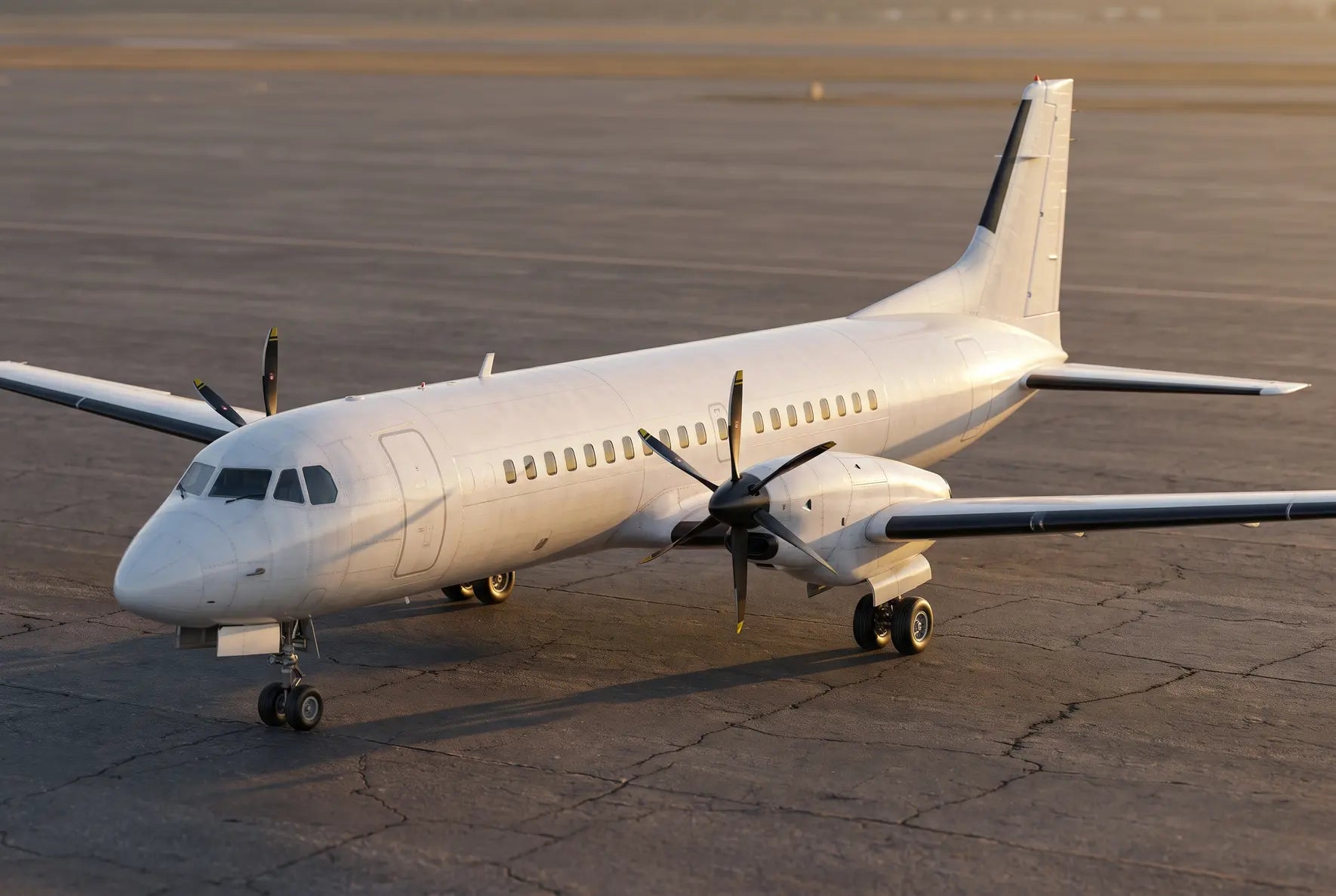



Beechcraft 1900C: History, Development and What Sets This Variant Apart
The Beechcraft 1900C belongs to one of the most successful 19 seat commuter turboprop families ever produced in the United States. Its story is rooted in decades of twin engine development at Beech Aircraft Corporation, founded by Walter Beech in Wichita, Kansas, in 1932. From the legendary Model 17 Staggerwing to the pressurised Super King Air family, Beechcraft steadily refined its expertise in turboprop design and cabin pressurisation, eventually culminating in a dedicated regional airliner programme aimed squarely at the booming commuter market of the early 1980s.
The design lineage of the 1900 traces back to the 1949 Model 50 Twin Bonanza, a five seat utility aircraft that evolved through the Queen Air and King Air series. By the late 1970s, Beechcraft recognised an opportunity to stretch and adapt its proven Super King Air 200 (B200) platform into a purpose built 19 passenger commuter airliner. The resulting aircraft, designated the Beechcraft 1900, retained the B200's wing spar and general structural philosophy while featuring a longer fuselage, a T tail configuration, new wing panels, and two Pratt & Whitney Canada PT6A 65B turboprop engines, each flat rated at 1,100 shaft horsepower and driving four bladed Hartzell composite propellers.
The prototype completed its maiden flight on 3 September 1982. Certification by the Federal Aviation Administration (FAA) under Type Certificate Data Sheet A24CE followed on 22 November 1983, granted under Special Federal Aviation Regulation (SFAR) 41C for commuter category operations. The aircraft entered revenue service in February 1984, quickly finding favour among regional commuter carriers across North America.
Only three examples of the baseline Beechcraft 1900 were built. This initial configuration featured dual airstair doors (one forward, one aft) for passenger boarding. Beechcraft rapidly determined that a single front airstair door paired with an enlarged rear cargo door would be far more practical for airline operations, and this revised layout defined the Beechcraft 1900C, the first true production variant. Early 1900C airframes, carrying UB serial number prefixes, were otherwise structurally similar to the original three aircraft. A total of 74 UB series aircraft were manufactured before a significant upgrade was introduced: the adoption of a wet wing fuel system. In this configuration, entire sections of the wing are sealed to serve as integral fuel tanks, replacing the earlier bladder type tanks and meaningfully increasing usable fuel capacity and range. These later production 1900C airframes carry UC serial number prefixes, and 174 UC series aircraft were built. The wet wing improvement made the Beechcraft 1900C a more versatile platform for longer regional routes.
A corporate transport version known as the Beechcraft 1900C ExecLiner was also offered, featuring an executive cabin interior rather than the standard commuter layout. The first ExecLiner was delivered in 1985. Additionally, six military variants designated UD were manufactured for the United States armed forces, serving under the military designation C 12J. In total, approximately 254 Beechcraft 1900C airframes (74 UB, 174 UC, and 6 UD) were produced before the programme transitioned to the substantially redesigned 1900D in 1991.
For aspiring pilots preparing for interviews at regional operators that still fly legacy turboprops like the 1900 family, structured mock interview practice can be a valuable step in building confidence and technical fluency.
What Distinguishes the Beechcraft 1900C from Other 1900 Variants
The Beechcraft 1900C occupies a distinct position between the three baseline 1900 airframes and the later, much redesigned 1900D introduced in 1991. While the original 1900 and the 1900C share the same engines, wing, and fuselage cross section, the 1900C's revised door arrangement (single forward airstair plus enlarged aft cargo door) became the operational standard. The subsequent wet wing (UC) sub variant further extended range without external modifications. In contrast, the 1900D represented a far more ambitious update: a taller, stand up cabin achieved through a deeper fuselage cross section, winglets for improved aerodynamic efficiency, more powerful PT6A 67D engines rated at 1,279 shaft horsepower, a full Electronic Flight Instrument System (EFIS) cockpit, and larger doors. These changes addressed the 1900C's most noted limitation, its low cabin height, which required taller passengers to stoop while moving through the aisle.
Key identifiers that distinguish the Beechcraft 1900C from other members of the family include:
- Engines: two Pratt & Whitney Canada PT6A 65B turboprops, each producing 1,100 shp
- Propellers: four bladed Hartzell constant speed composite propellers
- Door layout: single forward airstair door with enlarged rear cargo door (replacing the dual airstair doors of the baseline 1900)
- Fuel system: bladder tanks on early UB airframes; integral wet wing tanks on later UC airframes (approximately 4,495 lb usable fuel on UC models)
- Serial number prefixes: UB (early production), UC (wet wing production), UD (military C 12J variants)
- Maximum takeoff weight: 17,120 lb (7,764 kg)
- Cabin: standard low profile cross section, seating up to 19 passengers in a 1+1 configuration; no stand up headroom (a limitation resolved in the 1900D)
- FAA certification basis: SFAR 41C, Type Certificate Data Sheet A24CE
Production of the entire Beechcraft 1900 family ended in October 2002 after a total of 695 aircraft had been built across all variants. By that time, the manufacturer had transitioned through corporate ownership changes, from Beech Aircraft Corporation to Raytheon Aircraft and eventually to what became Hawker Beechcraft (now part of Textron Aviation). Despite the end of production, many Beechcraft 1900C airframes remain active worldwide in commuter, cargo, and special mission roles, a testament to the durability and versatility of the design.

A Beechcraft 1900D aircraft operated by Eagle Airways, part of Air New Zealand Link, is shown in mid-flight against a clear blue sky. The plane features the distinctive Air New Zealand logo on its tail.
Beechcraft 1900C Technical Specifications, Systems and Engine Overview
The Beechcraft 1900C was designed as a rugged, pressurised commuter and regional cargo turboprop capable of operating from short runways with up to 19 passengers. Derived from the Beechcraft 1900 family, itself an evolution of the proven King Air platform, the 1900C introduced a "wet wing" fuel system (from serial number UC onward) that significantly increased range without external tanks. The design philosophy prioritised reliability and field performance over speed, balancing payload capacity with the ability to serve smaller regional airports. Its unpressurised baggage compartment aft of the cabin and twin airstair doors gave operators flexibility for both passenger and mixed cargo configurations.
Compared to the original 1900, the C variant offered greater fuel capacity, improved anti ice protection, and a higher useful load. While it retained the same low ceiling fuselage (passengers cannot stand upright in the aisle), this trade off kept structural weight down and preserved short field performance. The later 1900D would address the cabin height limitation, but the 1900C remains valued as a freight and utility platform, particularly in remote and austere operating environments.
- Powerplant: 2 × Pratt & Whitney Canada PT6A‑65B turboprops, each flat rated at 1,100 shp (820 kW)
- Propellers: Hartzell four bladed constant speed, full feathering
- Length: 57 ft 8 in (17.62 m)
- Wingspan: 57 ft 9 in (17.64 m)
- Height: 15 ft 5 in (4.72 m)
- Maximum Takeoff Weight (MTOW): 16,600 lb (7,530 kg); up to 17,600 lb (7,983 kg) with optional kit
- Empty Weight: approximately 8,992 lb (varies by configuration)
- Fuel Capacity: approximately 665 to 675 US gallons (2,525 litres / ~4,484 lb of Jet A)
- Maximum Cruise Speed: approximately 248 KTAS (460 km/h)
- Service Ceiling: 25,000 ft
- Range (full passengers): approximately 1,200 nm (2,220 km); up to ~1,350 nm (2,500 km) at reduced payload
- Takeoff Distance (over 50 ft obstacle): approximately 2,673 ft
- Landing Distance (over 50 ft obstacle): approximately 2,680 ft
- Rate of Climb: approximately 3,000 ft/min (both engines); approximately 800 ft/min (single engine)
- Pressurisation Differential: 4.8 ± 0.1 psi (sea level cabin up to 11,000 ft; 9,000 ft cabin altitude at FL250)
- Seating: up to 19 passengers plus 2 crew
Systems, Flight Controls and Handling
The Beechcraft 1900C uses a conventional cable operated flight control system for ailerons, elevators, and rudder, with dual push pull yokes and interconnected rudder pedals. There is no hydraulic boost or fly by wire architecture; control feel is direct and mechanical, which many pilots appreciate for its predictability at low speeds and during short field operations. Flaps are electrically actuated via a motor driven gearbox and jackscrew mechanism, deploying four single slotted surfaces. The T tail configuration places the horizontal stabiliser in cleaner airflow above the propeller wash, improving elevator authority and widening the allowable centre of gravity range. Stabilons (small auxiliary surfaces on the aft fuselage) and vortex generators further enhance pitch and directional stability, particularly at low speed and high angles of attack.
The pressurisation system uses engine bleed air routed through outflow valves governed by a pressurisation controller. A three position cabin switch (DUMP, PRESS, TEST) allows the crew to manage cabin altitude. The outflow valves override the controller to maintain the maximum differential of 4.8 psi. Ice protection includes pneumatic de ice boots on wing and tail leading edges and engine inlet anti ice using bleed air. The electrical system is a 28V DC architecture supplied by engine driven generators. Pilots transitioning from King Air variants will find the cockpit layout and systems philosophy familiar, though operators planning to fly the 1900C commercially should be aware that a valid Class 1 medical certificate is required for airline transport operations.
Published performance figures for the 1900C can vary meaningfully between sources. Differences typically arise from operator installed options (cargo conversions, auxiliary equipment), selected cabin density, actual operating empty weight, atmospheric assumptions (ISA versus ISA+15°C), airport elevation, and runway surface condition. MTOW may also differ depending on whether the optional gross weight increase kit is installed (16,600 lb baseline versus 17,600 lb). Fuel burn and range figures are especially sensitive to cruise altitude, power setting, and passenger/cargo load. Any performance number should therefore be understood in context rather than taken as an absolute guarantee.
Pratt & Whitney Canada PT6A‑65B Engines
The Beechcraft 1900C is powered by a pair of Pratt & Whitney Canada PT6A‑65B turboprop engines. The PT6A family, developed by P&WC (now part of RTX Corporation), is one of the most successful turboprop engine programmes in aviation history. The original PT6A‑6 was certified in 1963 at 550 shp, and the family has since grown to cover the 580 to 1,940 shp range. By the mid 2010s, more than 51,000 PT6 engines had been produced, accumulating over 400 million flight hours, with an in flight shutdown rate of approximately one per 651,126 hours.
The PT6A‑65B belongs to the "large" PT6A group (A‑64 through A‑68). It uses a free turbine, reverse flow design: intake air passes through a five stage compressor (four axial stages plus one centrifugal impeller), enters an annular reverse flow combustion chamber, and drives a single stage gas generator turbine. Exhaust gases then power a two stage free power turbine, which transmits torque through a two stage planetary reduction gearbox to the propeller shaft. Each PT6A‑65B is flat rated at 1,100 shp on the 1900C, with a published time between overhaul (TBO) of approximately 6,000 hours. Engine control is hydromechanical, and propeller governing uses engine oil pressure with centrifugal counterweights and feathering springs.
The later Beechcraft 1900D replaced the PT6A‑65B with the more powerful PT6A‑67D rated at 1,279 shp (954 kW), reflecting the increased weight and aerodynamic demands of the stand up cabin fuselage. Outside the Beechcraft 1900 family, variants of the PT6A‑65 series have been installed on agricultural aircraft such as the Ayres Turbo Thrush, and the military C‑12J variant of the 1900C also relies on the PT6A‑65B. The engine's modular construction, broad spare parts availability, and extensive global maintenance network have made it a cornerstone of regional and utility aviation for over six decades.
Beechcraft 1900C vs 1900D vs EMB 120 vs ATR 42-500 Specifications Comparison
Scroll horizontally to see more →
| Parameter | Beechcraft 1900C | Beechcraft 1900D | Embraer EMB 120 Brasilia | ATR 42-500 |
|---|---|---|---|---|
| Entry into service | 1985 | 1991 | 1985 | 1996 |
| Engines | 2 × P&W PT6A-65B | 2 × P&W PT6A-67D | 2 × P&W PW118 | 2 × P&W PW127E |
| Length | 17.6 m | 17.7 m | 20.0 m | 22.7 m |
| Wingspan | 17.7 m | 17.7 m | 20.0 m | 24.6 m |
| Height | 4.7 m | 4.6 m | 6.5 m | 7.1 m |
| Typical seating and layout | Single class: 19 passengers | Single class: 19 passengers | Single class: 30 passengers | 2-class: 42-48 passengers |
| MTOW | 7.8 t | 7.7 t | 11.6 t | 18.6 t |
| Range | 1,350 nm | 1,280 nm | 1,750 nm | 1,600 nm |
| Cruise speed | 0.27 Mach | 0.29 Mach | 0.30 Mach | 0.32 Mach |
| Service ceiling | 25,000 ft | 30,000 ft | 30,000 ft | 31,000 ft |
| Program note | Baseline 19-seat regional turboprop for short commuter routes | Improved successor with taller tail and better hot/high performance | Direct competitor with higher capacity for regional routes | Larger, modern regional turboprop with higher speed/capacity |
Scroll horizontally to see more →
The table compares key specs of the Beechcraft 1900C/1900D, Embraer EMB 120 Brasilia, and ATR 42-500. The 1900s are 19-seat commuters with the lowest MTOW (~7.7–7.8 t) and shorter range (1,280–1,350 nm), while the EMB 120 carries 30 and offers the longest range (1,750 nm). The larger ATR 42-500 seats 42–48, has the highest MTOW (18.6 t), and the fastest cruise (0.32 Mach).
Beechcraft 1900C Operations: Typical Routes, Missions and Airlines Worldwide
The Beechcraft 1900C was designed from the outset as a high utilisation commuter workhorse. Powered by two Pratt & Whitney Canada PT6A turboprops, it carries up to 19 passengers on short haul sectors typically ranging from 100 to 400 nautical miles (185 to 740 km), which translates into block times of roughly 45 to 90 minutes at a cruise speed near 250 knots. In demanding commuter schedules, an airframe can log between 2,000 and 3,000 flight hours per year, completing three to six sectors per day with rapid turnarounds made possible by its airstair door and compact cabin. That level of productivity made the type a favourite of Essential Air Service (EAS) carriers in the United States and of charter operators in remote regions worldwide.
The operational environments where the Beechcraft 1900C thrives are defined by short or unpaved runways and thin passenger demand. With takeoff distances often under 4,000 feet (1,200 m), the aircraft accesses airfields that are beyond the capability of most regional jets. It excels in hub and spoke networks, feeding traffic from secondary and tertiary airports into major hubs such as Denver, Albuquerque or Johannesburg. Point to point services in mountainous, coastal or island geography also represent a core mission. Operators face some recurring challenges: the cabin height of roughly 4 ft 9 in (1.45 m) limits passenger comfort on longer legs, and the two pilot requirement under airline regulations increases crew costs relative to single pilot cargo platforms. Maintenance of the pressurisation system and propeller assemblies on airframes with high cycle counts also demands careful planning, especially in hot and high altitude environments.
Where the Beechcraft 1900C Operates Around the World
North America has always been the dominant market for the Beechcraft 1900C. The type became the backbone of Essential Air Service contracts in the United States and of regional feeder networks in Canada, linking isolated communities in the Rockies, the Arctic and the British Columbia coast to major hubs. In Africa, the aircraft found a second life with charter and contract operators serving the mining, oil and humanitarian sectors across West Africa and Southern Africa, where short runways and demanding conditions match its design strengths. Europe saw more limited adoption, primarily with Scandinavian and French charter carriers, while in the Asia Pacific region a small number of aircraft served island and domestic charter markets in countries such as Indonesia and Papua New Guinea. In South America and the Caribbean, a handful of operators used the type for inter island shuttle services. As of July 2018, a total of 114 Beechcraft 1900C airframes and 192 1900Ds remained in airline service: 207 in the Americas, 63 in Africa, 25 in Europe and 11 in Asia Pacific and the Middle East combined. The type competes in the same regional turboprop segment as aircraft like the Embraer EMB 120 Brasilia, which seats 30 passengers and targets slightly longer stage lengths.
- North & South America: Mesa Airlines introduced the Beechcraft 1900C in late 1985, operating it from its Albuquerque hub to high altitude destinations across New Mexico, Colorado and Texas, building up to 45 daily departures serving 17 cities before transitioning to the 1900D. Great Lakes Airlines inherited much of that fleet and deployed it on EAS routes across the Midwest and Rocky Mountain states out of Denver until ceasing operations in 2018. Gulfstream International Airlines operated seven leased Beechcraft 1900C aircraft on scheduled services from Fort Lauderdale to the Bahamas and Puerto Rico. Colgan Air and Air Midwest used the type as feeders for major carriers under the USAir Express and US Airways Express banners respectively. In Canada, Pacific Coastal Airlines continues to fly the Beechcraft 1900C on scheduled routes from Vancouver along the British Columbia coast, while Central Mountain Air and Exploits Valley Air Services served communities in Alberta and Newfoundland. Cargo specialist Ameriflight also operates the type on freight runs across the United States.
- Africa: Sahel Aviation Service, based in Bamako, Mali, is one of the largest charter operators of the Beechcraft 1900 in West Africa, flying a fleet of up to nine aircraft on mining support, humanitarian and passenger charter missions. CemAir in South Africa operates the type on scheduled domestic routes from Johannesburg to cities such as Mthatha and Kimberley. Other operators on the continent include Bluebird Aviation in Kenya and Global Aviation in Mauritania, both focused on charter and contract flying.
- Europe: With only 25 airframes recorded in service across the continent as of 2018, the Beechcraft 1900C occupies a niche in Europe. Jonair in Sweden operates the type on charter, medevac and ad hoc cargo missions from Stockholm Bromma, while French operator Regourd Aviation, which also holds subsidiaries in Africa, has included the 1900 series in its regional charter and lease portfolio.
- Asia & Oceania: EastIndo in Indonesia has been listed as a civilian operator of the Beechcraft 1900. In Papua New Guinea, domestic charter carrier Air Sanga added a Beechcraft 1900 to serve highland and island routes from Port Moresby. In Pakistan, JS Air historically operated the Beechcraft 1900C on charter flights until 2010.
Typical Seating Configurations on the Beechcraft 1900C
The standard cabin layout of the Beechcraft 1900C seats 19 passengers in a single class, single aisle arrangement. Rows of individual seats face forward on each side of a narrow centre aisle, reflecting the aircraft's commuter mission. Seat pitch typically falls between 29 and 30 inches, with a modest recline of 2 to 3 inches. Cabin dimensions are approximately 25.3 ft (7.7 m) long, 4.6 ft (1.37 m) wide and 4.9 ft (1.5 m) high, which means passengers cannot stand upright, a well known trade off of the C model that the later 1900D variant addressed with a deeper fuselage.
Commuter airlines such as Pacific Coastal Airlines and Jonair retain the full 19 seat configuration to maximise revenue on short sectors. Seat maps published by Pacific Coastal Airlines show a straightforward layout with no galley and no lavatory, keeping turnaround times to a minimum. Charter and VIP operators sometimes reduce the seat count to 12 or fewer, installing wider seats, sidewall tables and an aft lavatory for executive missions. Cargo and mixed use operators can remove seats entirely to create freight volume of up to 122 cubic feet, a flexibility that keeps the Beechcraft 1900C relevant for operators such as Ameriflight and Sahel Aviation Service that need to switch rapidly between passenger and cargo roles.
In this video, fly aboard a Beech 1900C with Pacific Coastal Airlines on a regional route from Victoria to Vancouver, showcasing operations within British Columbia and offering a look at this Canadian carrier.
Beechcraft 1900C Safety Record: Incident History and How Safe Is It?
The Beechcraft 1900C entered commercial service in the mid 1980s and remained in production until 1991, with a total of 207 airframes delivered. Over four decades of operations, the type has accumulated hundreds of thousands of flight hours in demanding environments ranging from Alaskan bush routes to tropical cargo networks. When evaluating the aircraft's safety record, it is important to consider the operational context: the Beechcraft 1900C has often served on short, high frequency sectors in regions with challenging terrain, variable weather and limited ground infrastructure. These conditions are statistically associated with higher accident exposure regardless of airframe type.
A 1990s academic study cited by Aviation Week & Space Technology placed the Beechcraft 1900 series accident rate at approximately 0.01 per 100,000 flight hours, a figure that was considered favourable among commuter category turboprops at the time. The Aviation Safety Network database lists several dozen occurrences for the combined Beechcraft 1900 fleet (1900, 1900C and 1900D), including hull losses and serious incidents. The majority of those events have been attributed to operational and human factors rather than inherent design deficiencies.
Notable Accidents and Safety Lessons
Several significant events involving the Beechcraft 1900C and closely related variants led to tangible improvements in regulation, training and maintenance procedures.
- Ryan Air Service Flight 103 (1987): On 23 November 1987, a Beechcraft 1900C (N401RA) operating a scheduled passenger flight crashed short of runway 03 at Homer Airport, Alaska, killing 18 of the 21 occupants. The NTSB report AAR 88/11 identified improper cargo loading as the probable cause: approximately 600 pounds of excess freight shifted the centre of gravity well beyond the aft limit, leading to loss of pitch control during flap extension on approach. Contributing factors included crew failure to verify weight and balance documentation and icing conditions. The investigation prompted the FAA to reinforce cargo loading supervision requirements and weight and balance verification procedures for Part 135 commuter operators.
- Air Midwest Flight 5481 (2003): Although this accident involved a Beechcraft 1900D, the lessons apply directly to the 1900C family. On 8 January 2003, the aircraft (N233YV) stalled immediately after takeoff from Charlotte Douglas International Airport and crashed into a hangar, killing all 21 people on board. The NTSB report AAR 04/01 determined two concurrent causes: elevator control cables had been incorrectly rigged during maintenance, limiting pitch authority, and the aircraft was loaded above its maximum allowable weight with an aft centre of gravity because the operator relied on outdated average passenger weights. This accident triggered sweeping changes: the FAA revised standard passenger weight assumptions upward, mandated tighter maintenance quality assurance programmes and required improved oversight of outsourced maintenance organisations.
- Ameriflight N31704 (2020): On 8 May 2020, a Beechcraft 1900C operating a Part 135 cargo flight at San Antonio International Airport suffered a main landing gear collapse on touchdown. No fatalities occurred. The investigation found that the failure resulted from a non conforming aluminium alloy component in the gear assembly, highlighting the importance of parts traceability and material conformity in ageing fleets.
Across these events, a consistent theme emerges: the most critical risk factors have been related to weight and balance management, maintenance quality and crew decision making rather than to structural or aerodynamic shortcomings of the airframe itself. Each accident led to regulatory and procedural improvements that benefited the broader commuter aviation community.
How Safe Is the Beechcraft 1900C Today?
The Beechcraft 1900C was certified under FAA Part 23 commuter category requirements, which mandate structural fail safe design, system redundancy and comprehensive emergency provisions. The airframe features a pressurised fuselage, a T tail configuration for enhanced stability, wing mounted tailets and stabilons that reduce stall speed, and three dedicated emergency exit hatches in addition to the main airstair door. Power is provided by two Pratt & Whitney Canada PT6A turboprop engines, one of the most produced and field proven powerplants in aviation history, renowned for reliability and ease of maintenance.
Operators flying the Beechcraft 1900C today are subject to rigorous oversight, including FAA or equivalent national authority approved maintenance programmes, mandatory compliance with Airworthiness Directives, and crew training syllabi that emphasise CRM (Crew Resource Management), weight and balance verification and icing awareness. For anyone considering a career path in commercial aviation, understanding how regulatory frameworks and standard operating procedures protect passengers is fundamental. Aspiring pilots can explore structured training routes such as the Avion Express cadet programme, which illustrates how modern airline recruitment integrates safety culture from day one.
According to the IATA Annual Safety Report, commercial aviation as a whole continues to record historically low accident rates, with turboprop operations improving steadily as fleet modernisation, enhanced training standards and data driven safety management systems take effect. While the Beechcraft 1900C is an older design and some airframes have accumulated significant hours, continued airworthiness depends on disciplined maintenance and regulatory compliance rather than calendar age alone. When operated within its certified limits and maintained according to manufacturer and regulatory standards, the Beechcraft 1900C remains a capable and dependable regional turboprop. Aviation, across all categories, continues to be one of the safest modes of transport available.
01 What is the typical range and cruise speed of the Beechcraft 1900C?
The Beechcraft 1900C cruises at approximately 240-248 knots (460 km/h) and offers a best range of around 1,399 nautical miles with optimal fuel management. With full fuel tanks and a full passenger load, the practical range is typically 550-1,200 nautical miles depending on payload and conditions, making it well-suited for short to medium-range regional routes.
02 How many passengers can the Beechcraft 1900C carry and what is the cabin experience like?
The Beechcraft 1900C seats up to 19-20 passengers in a single-deck configuration with a cabin length of 7.7 meters and a height of approximately 1.45 meters. The cabin is not a stand-up cabin in the standard 1900C model, though passengers benefit from a pressurized cabin rated to 25,000 feet, which helps reduce turbulence effects and ear pressure changes during flight.
03 How does the Beechcraft 1900C perform on short and unprepared airstrips?
The Beechcraft 1900C can take off and land on relatively short airstrips, requiring approximately 2,673 feet for takeoff over a 50-foot obstacle and 2,680 feet for landing. The aircraft is certified to operate on grass, dirt, and gravel runways, making it particularly valuable for regional and remote operations where conventional paved infrastructure may not be available.
04 What engines power the Beechcraft 1900C and how fuel-efficient is it?
The Beechcraft 1900C is powered by two Pratt & Whitney PT6A-65B turboprop engines, each producing 1,100 shaft horsepower, and burns approximately 109 gallons per hour during cruise. The turboprop configuration makes it notably more fuel-efficient than comparable jet aircraft for shorter regional routes, contributing to lower operating costs and environmental efficiency.
05 Is the Beechcraft 1900C still in service and what operators use it?
Although the Beechcraft 1900C is no longer in production, it remains a robust workhorse in regional and cargo operations worldwide. The aircraft serves regional airlines, cargo operators, corporate charter services, and government operators including military variants like the C-12J, demonstrating its continued utility and reliability across diverse mission profiles.
06 What safety features and modern avionics does the Beechcraft 1900C have?
The Beechcraft 1900C features a pressurized cabin, weather radar, and the ability to handle icing conditions, making it suitable for various weather scenarios. Modern variants and upgraded aircraft are equipped with Electronic Flight Instrument Systems (EFIS) and can be outfitted with contemporary avionics, though original aircraft feature glass cockpit options that enhance situational awareness and operational safety.