


Lockheed L-649 Constellation: History, Development, and What Set It Apart
The Lockheed L-649 Constellation occupies a pivotal place in post-war commercial aviation. It was the first variant in the Constellation family designed from the outset as a civilian airliner, distinguishing it from the earlier L-049, which was essentially a conversion of the wartime C-69 military transport. To understand how the L-649 came to be, it helps to look at the origins of the entire Constellation program and the remarkable cast of characters behind it.
Origins of the Constellation Program
The Constellation story began in 1939, when Howard Hughes, the industrialist who controlled Trans World Airlines (TWA), approached Lockheed with a bold request: design a pressurized, long-range airliner capable of flying coast to coast nonstop across the United States. Working in secrecy, Lockheed engineer Clarence "Kelly" Johnson and his team at the company's Burbank, California facility developed a four-engine aircraft with a distinctive triple-tail empennage and a dolphin-shaped pressurized fuselage. The result was an airplane that represented a generational leap from earlier propeller airliners such as the Ford Trimotor, which had defined the previous era of commercial flight with limited range, low speed, and unpressurized cabins.
World War II intervened before the Constellation could enter airline service. The prototype, designated XC-69, made its maiden flight on January 9, 1943, and the U.S. Army Air Forces requisitioned all production as C-69 military transports. After the war ended, surplus C-69s were converted into the L-049 Constellation and delivered to airlines including TWA, which inaugurated scheduled service in February 1946. However, the L-049 was not a clean-sheet civilian design; it inherited the structural and systems compromises of its military origins.
Why the L-649 Was Created
The L-049's entry into airline service was marred by serious reliability issues with the Wright R-3350 radial engines, which were prone to overheating and in-flight fires. A series of incidents in 1946, including a Pan American L-049 that lost an engine in flight over Connecticut on June 18 and a fatal TWA training flight crash near Reading, Pennsylvania, on July 11, led to a temporary grounding of the entire Constellation fleet. Lockheed responded with engineering improvements to fire detection, nacelle fireproofing, and engine cooling systems. These lessons fed directly into the design of the L-649, which was conceived as a strengthened, more capable, and more reliable civilian Constellation.
The L-649 retained the same overall dimensions and fuselage cross-section as the L-049, but incorporated reinforced wing and fuselage structures, upgraded Wright R-3350-749C18BD-1 Duplex Cyclone engines rated at 2,500 hp each (compared to the 2,200 hp of the L-049's powerplants), and a higher maximum takeoff weight of 94,000 lb (42,638 kg). These changes translated into improved payload, better hot-and-high performance, and greater operational reliability.
The L-649 completed its first flight on October 19, 1946, and received its Civil Aeronautics Administration (CAA) type certificate in March 1947. The first delivery went to Eastern Air Lines in May 1947, making the L-649 the first Constellation variant to enter commercial service as a purpose-built airliner rather than a military surplus conversion.
Production and Operators
Production of the L-649 was limited. Lockheed built 14 standard L-649s and 6 L-649As (a sub-variant with a further strengthened structure), for a total of 20 airframes. The primary customers were Eastern Air Lines and Chicago and Southern Air Lines. The modest production run reflected the rapid pace of development within the Constellation family: Lockheed was already offering the L-749, an extended-range derivative, which attracted the majority of airline orders. Most surviving L-649s were eventually upgraded to L-749A standards with the addition of wing fuel tanks and further structural improvements.
What Differentiates the L-649 from the L-049 and L-749
The L-649 sat between two closely related variants. Compared to the L-049, it offered more powerful engines, a stronger airframe, higher gross weight, and improved engine reliability. Compared to the L-749, the L-649 was essentially the same aircraft but without the additional 1,130 gallons (4,278 liters) of fuel capacity in the outer wing sections that gave the L-749 true transatlantic range. This made the L-649 well suited to domestic trunk routes in the United States, while the L-749 was preferred by carriers operating long overwater sectors such as Pan American and Air France.
Key variant identifiers for the Lockheed L-649 Constellation include:
- Engines: Four Wright R-3350-749C18BD-1 Duplex Cyclone 18-cylinder radials, 2,500 hp each
- Maximum takeoff weight: 94,000 lb (42,638 kg)
- Passenger capacity: 60 to 81 depending on cabin configuration
- Wingspan: 123 ft (37.49 m); Length: 95 ft 3 in (29.03 m)
- Total production: 20 (14 L-649 and 6 L-649A)
- Primary operators: Eastern Air Lines, Chicago and Southern Air Lines
- Distinguishing feature vs. L-749: No additional outer wing fuel tanks; shorter range
Though its production numbers were small and its service life in original form was brief, the L-649 represented a critical step in the evolution of the Lockheed Constellation family, bridging the gap between wartime adaptations and the purpose-built long-range airliners that followed.

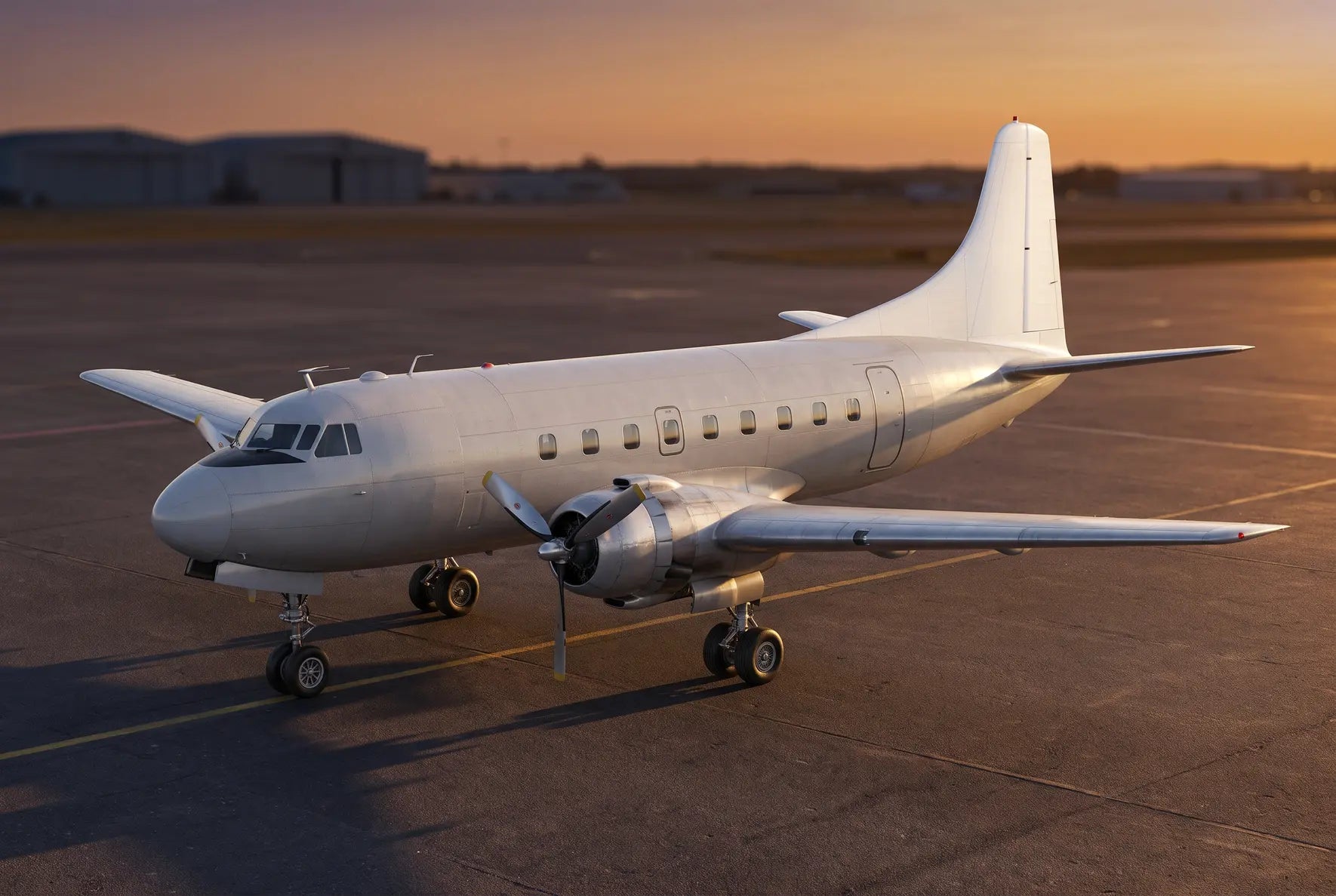
A vintage Eastern Air Lines L-649 Constellation airplane is parked on an airstrip, captured against a backdrop of distant mountains under a clear sky.
Lockheed L-649 Constellation: Technical Specifications, Systems and Engine Overview
The Lockheed L-649 Constellation represented the first purpose built civilian variant of the Constellation family, moving beyond the wartime L-049/C-69 conversions. Designed to carry between 48 and 81 passengers on medium to long range domestic and transatlantic routes, the L-649 addressed key shortcomings of its predecessor, notably engine overheating and limited payload. The airframe retained the iconic triple tail and dolphin shaped pressurised fuselage of the L-049 Constellation, but Lockheed strengthened the structure and introduced more powerful Wright engines to support a higher maximum takeoff weight and improved hot and high field performance.
Trade offs centred on range versus payload. With full fuel the L-649 could cover nearly 4,000 statute miles, but at maximum payload that figure dropped to around 2,290 miles. The subsequent L-749 variant added roughly 1,130 US gallons of wing fuel to extend range further, which is why many operators ultimately preferred the newer model. For those exploring the broader Constellation lineage, the aircraft type directory at Ready for Takeoff provides additional context on the family and its place in aviation history.
- Wingspan: 123 ft (37.49 m)
- Overall length: 95 ft 3 in (29.03 m)
- Height: 23 ft 8 in (7.21 m)
- Wing area: 1,650 sq ft (153.3 sq m); airfoil root NACA 23018, tip NACA 4412
- Empty weight: approximately 55,000 lb (24,948 kg)
- Maximum takeoff weight (MTOW): 94,000 lb (42,638 kg)
- Maximum payload: 39,000 lb (17,690 kg)
- Typical passenger capacity: 48 to 81, depending on cabin configuration (commonly 55 in mixed class layouts)
- Maximum speed: 325 mph (523 km/h; 282 kn)
- Cruise speed: approximately 272 mph (438 km/h; 236 kn)
- Range (maximum fuel): 3,995 statute miles (6,429 km; 3,472 nmi)
- Range (maximum payload): 2,290 statute miles (3,685 km; 1,990 nmi)
- Service ceiling: 24,442 ft (7,450 m)
- Engines: 4 × Wright R-3350-749C18BD-1 Duplex Cyclone, 2,500 hp (1,864 kW) each at takeoff
- Propellers: 3 bladed Hamilton Standard constant speed, fully feathering
- Crew: 5 (two pilots, flight engineer, two cabin crew)
Systems, Flight Controls and Handling Technology
The L-649 used hydraulically boosted flight controls, a configuration inherited from the L-049 that reduced pilot workload during long sectors. Large Fowler flaps along the trailing edge of the wing provided the additional lift needed for acceptable approach speeds at the type's high operating weights, while the fully feathering and reversible pitch Hamilton Standard propellers contributed to shorter landing rolls and improved single engine handling. The aircraft featured electric de-icing on wing and tail leading edges, cabin pressurisation that allowed comfortable cruise above most weather, and a flight engineer station dedicated to monitoring engine parameters, fuel management and electrical systems.
Braking relied on conventional hydraulic wheel brakes without anti skid automation; stopping distances therefore depended heavily on pilot technique and runway surface conditions. Performance computation was carried out manually using charts and tables adjusted for temperature, pressure altitude and aircraft weight. There were no flight management computers or autothrottle systems; engine power was set by the flight engineer using manifold pressure gauges and RPM indicators.
Published performance figures for the L-649 can vary noticeably between sources. Differences in operator configured cabin density (51 to 81 seats), selected fuel load, actual takeoff weight, atmospheric conditions (temperature and pressure altitude), and runway surface state all influence real world numbers. Manufacturer range figures typically assume standard day conditions and optimum cruise altitude, so operators in hotter climates or at higher elevation airports would have experienced reduced payload or range compared to published values.
Wright R-3350 Duplex Cyclone: The L-649's Powerplant
The L-649 was powered by four Wright R-3350 Duplex Cyclone radial engines in the 749C18BD-1 variant, each rated at 2,500 horsepower for takeoff (five minute limit at 2,800 RPM) and 2,100 hp for normal continuous operation at 2,400 RPM. This was a significant step up from the 2,200 hp R-3350 variants fitted to the earlier L-049 and the wartime Boeing B-29 Superfortress, and it addressed chronic overheating problems through redesigned nacelles and an enlarged oil system with 9 additional US gallons of capacity per engine.
Developed by Wright Aeronautical, a division of Curtiss Wright, the R-3350 first ran in May 1937 as an 18 cylinder, twin row, supercharged, air cooled radial displacing nearly 3,350 cubic inches (54.9 litres). Early production was plagued by reliability issues, particularly fuel and air mixture distribution in the carburetted supercharger, problems that were gradually resolved through wartime B-29 service and post war refinements including direct fuel injection. According to the National Museum of the United States Air Force, the R-3350 became one of the most powerful radial piston engines ever mass produced in the United States, with total production exceeding 50,000 units across military and commercial variants.
Beyond the Constellation family, the R-3350 powered a wide range of aircraft. Military types included the Boeing B-29 and B-50 Superfortress, the Douglas A-1 Skyraider, and the Lockheed P-2 Neptune maritime patrol aircraft. In the commercial world, later turbo compound derivatives of the R-3350 (which recovered additional power from exhaust driven turbines) went on to power the Douglas DC-7 series and the Lockheed L-1049 Super Constellation, representing the final generation of piston powered airliners before the jet age took hold.
Lockheed Constellation Family Specifications Comparison (L-649 to L-1649)
Scroll horizontally to see more
| Parameter | Lockheed L-649 Constellation | Lockheed L-749 Constellation | Lockheed L-1049 Super Constellation | Lockheed L-1649 Starliner |
|---|---|---|---|---|
| Entry into service | 1947 | 1947 | 1951 | 1958 |
| Engines | 4 × Wright R-3350-749C18BD | 4 × Wright R-3350 | 4 × Wright R-3350 | 4 × Pratt & Whitney R-2800 |
| Length | 29.0 m | 29.7 m | 34.0 m | 35.8 m |
| Wingspan | 37.5 m | 37.5 m | 38.0 m | 47.5 m |
| Height | 7.2 m | 6.8 m | 7.6 m | 8.5 m |
| Typical seating and layout | 2-class: 60–81 passengers | 2-class: 60–81 passengers | 3-class: 62–95 passengers | 3-class: 75–110 passengers |
| MTOW | 43 t | 50 t | 62 t | 84 t |
| Range | 3,500 nm | 4,350 nm | 4,400 nm | 5,280 nm |
| Cruise speed | 0.37 Mach | 0.38 Mach | 0.45 Mach | 0.48 Mach |
| Service ceiling | 24,000 ft | 25,000 ft | 25,000 ft | 25,000 ft |
| Program note | First civilian Constellation with improved engines | Extended range version with more fuel capacity | Stretched fuselage, higher capacity and power | Final evolution with new wings and turboprops planned |
Scroll horizontally to see more
The table compares four Lockheed Constellation variants, showing a steady evolution in size and capability. From the L-649 to the L-1649, length grows from 29.0 m to 35.8 m and MTOW nearly doubles from 43 t to 84 t. Range improves from 3,500 nm to 5,280 nm, while cruise speed rises from Mach 0.37 to 0.48. Seating capacity also increases, reflecting the L-1049 stretch and the L-1649’s long-range focus.
Lockheed L-649 Constellation: Airlines, Routes and Operational Missions Worldwide
The Lockheed L-649 Constellation was the first true civilian variant of the Constellation family, entering service in May 1947. Designed to carry between 48 and 81 passengers depending on cabin configuration, this four engine airliner was built primarily for medium to long haul domestic services in North America. Only 22 airframes were produced (16 L-649 and 6 L-649A), making it one of the rarest Constellation variants. Powered by four Wright R-3350-749C18BD-1 engines producing 2,500 hp each, the aircraft cruised at approximately 300 mph (483 km/h) and offered a maximum range of 3,995 miles (6,429 km) with full fuel, or 2,290 miles (3,685 km) with maximum payload.
Typical missions for the L-649 Constellation involved domestic trunk routes within the eastern United States, with flight durations generally spanning 3 to 5 hours on segments of around 800 to 1,500 miles. The aircraft operated primarily in a point to point network model, connecting major urban centres in the Northeast with vacation destinations in Florida and the Caribbean. Eastern Air Lines, the principal operator, ran high frequency schedules from hubs such as New York, Boston and Washington, D.C. to Miami, sometimes offering departures as frequently as every 30 minutes during peak travel seasons. This saturation strategy demanded robust daily utilisation, although the relatively small fleet size of 14 aircraft limited total capacity.
Operators faced several challenges with the L-649 Constellation. The Wright R-3350 radial engines, while improved over those fitted to the earlier L-049, still required careful thermal management. Cabin noise from the four piston engines remained significant despite augmented insulation using fiberglass and non inflammable cloth. Furthermore, the limited production run of just 22 units meant spare parts logistics could be demanding. Many L-649 airframes were eventually upgraded to the longer range L-749A standard, reflecting how quickly the variant was superseded by improved models in the fast evolving postwar aviation market. For passengers flying aboard propeller driven aircraft of this era, comfort strategies were essential, and many of those principles remain relevant for enhancing the flight experience today.
Where the Lockheed L-649 Constellation Operated
The operational footprint of the Lockheed L-649 Constellation was concentrated almost entirely in the Americas. Eastern Air Lines, under the leadership of Eddie Rickenbacker, deployed its 14 L-649 aircraft along the densely travelled eastern seaboard corridor of the United States, linking industrial cities in the Northeast with leisure destinations in the South. Chicago and Southern Air Lines (C&S), the other primary operator, used six L-649A variants on its Valley Level Route connecting Chicago, Memphis and New Orleans, and extended international services to the Caribbean and South America, reaching Havana, Kingston, Port au Prince, Ciudad Trujillo, Aruba, Curaçao and Caracas. Trans World Airlines (TWA) is also recorded as having operated one L-649, though it primarily focused on the later L-749 for its transatlantic ambitions.
Unlike the more widely produced L-749 and L-1049 Super Constellation, which saw extensive service in Europe, Asia and Africa with airlines such as Air France, KLM and Qantas, the L-649 did not achieve significant international distribution. Its limited production meant that no European, Asian or African carriers are confirmed to have operated this specific variant as original customers.
- North & South America: Eastern Air Lines was the dominant operator, flying the L-649 on high frequency trunk routes between New York, Boston, Washington, D.C. and Miami. Chicago and Southern Air Lines operated six L-649A aircraft on domestic routes from Chicago to New Orleans and on international services to Havana (Cuba), Kingston (Jamaica), and Caracas (Venezuela). Trans World Airlines briefly operated one L-649 before transitioning to the L-749 for its long haul network. After C&S merged with Delta Air Lines in 1953, several of these aircraft were transferred out of the fleet.
- Europe: No confirmed European airline operators of the L-649 variant have been documented. European carriers such as Air France, KLM and BOAC operated later Constellation models, particularly the L-749 and L-1049, which offered the transatlantic range required for their networks.
- Asia: No confirmed Asian airline operators of the L-649 have been identified. Asian carriers that later used Constellation variants, such as Air India, opted for the longer range L-749 and L-1049 models suited to intercontinental routes.
- Africa: No confirmed African airline operators of the L-649 have been documented. African operators of Constellation types, including South African Airways, used later variants with greater range capability for routes connecting the continent to Europe.
Typical Seating Configurations of the Lockheed L-649 Constellation
Lockheed offered ten different cabin layouts for the L-649 Constellation, providing airlines with considerable flexibility. Standard seating ranged from 48 passengers in a spacious, luxury oriented configuration up to a maximum of 81 in a higher density arrangement. The cabin featured a 2+2 abreast seating layout within the distinctive triple tail fuselage, measuring approximately 95 feet 3 inches (29.03 m) in length.
Eastern Air Lines configured its L-649 fleet for its premium Gold Plate service, emphasising passenger comfort with features such as retractable overhead sleeping berths, modernised air conditioning and reclining seats. A typical Eastern layout seated approximately 55 passengers, reflecting the airline's focus on a luxury travel proposition on its competitive Northeast to Florida corridor. Chicago and Southern Air Lines similarly used the L-649A on its premium services, though specific seat counts for C&S have not been widely documented. Unlike modern airlines, strict multi class cabin divisions were not standard practice in this era; instead, operators chose between all first class luxury configurations or modestly denser single class layouts. Detailed cabin diagrams and historical specifications for the Constellation family can be found through resources at the Smithsonian National Air and Space Museum.
In this video, discover the Lockheed Constellation, the iconic Connie airliner, featuring four 18-cylinder Wright R-3350 radial engines, with a focus on C69 649 749A L-1049 and Eastern Airlines Speedpak Postal (1947).
Lockheed L-649 Constellation Safety Record: How Safe Was This Classic Airliner?
The Lockheed L-649 Constellation entered commercial service in 1947 as one of the first pressurised airliners purpose built for postwar airline operations. Only 20 airframes were produced (14 L-649 and 6 L-649A), all delivered to Eastern Air Lines and Chicago and Southern Air Lines. The small fleet size and relatively brief operational window before most aircraft were upgraded to L-749A standard mean that the L-649's accident history is limited in volume compared with later, more numerous Constellation variants. According to the Aviation Safety Network database, only two recorded accidents involved the L-649 specifically, both occurring in early 1948 while the type was still accumulating its first operational hours. Of the 856 Constellations built across all variants, the broader family experienced a considerably higher number of incidents over three decades of worldwide service, but the L-649 sub variant contributed just one hull loss and a single fatality to that tally.
Notable Accidents Involving the Lockheed L-649 Constellation
Two significant events shaped the early safety narrative of the L-649 Constellation:
- Eastern Air Lines Flight 604, 21 January 1948 (Boston Logan Airport) – During landing in heavy snowfall, the L-649 registered NC111A lost directional control on the runway. The right main gear and nose gear collapsed, and the aircraft slid off the runway onto its right wing. All 25 occupants survived without injury, but the airframe was destroyed and written off. The Civil Aeronautics Board determined the probable cause to be loss of directional control due to excessive snow accumulation, with a contributing factor being inadequate runway condition assessment. The event reinforced the importance of rigorous winter operations procedures and accurate runway surface reporting, principles that remain central to cold weather airport management today.
- Eastern Air Lines Flight 611, 7 February 1948 (offshore Georgia) – While cruising approximately 155 miles off Brunswick, Georgia, the No. 3 propeller on L-649 NC112A suffered a blade separation. A portion of the blade penetrated the fuselage on the lower right side, severing engine controls, electrical wiring and floor structure, and fatally injuring one crew member. Despite the loss of two engines, the flight crew managed to land safely at West Palm Beach. The probable cause was attributed to propeller failure linked to repetitive engine malfunctioning of the Wright R-3350 powerplant. The aircraft was repaired and eventually returned to service. This incident drew attention to the reliability challenges of the early R-3350 Duplex Cyclone engine, which was known for overheating, lubrication deficiencies and fuel mixture irregularities. Over the following years, Wright Aeronautical introduced direct fuel injection and improved cooling, significantly raising engine reliability across the entire Constellation family.
Neither event led to the grounding of the L-649 fleet, but both contributed to a growing body of operational knowledge that improved maintenance protocols, winter procedures and powerplant oversight for piston era airliners.
How Safe Was the Lockheed L-649 Constellation?
Assessing the safety of the L-649 Constellation requires historical context. The aircraft operated during an era when aviation regulation was still maturing under the Civil Aeronautics Board, and standardised practices for crew training, runway management and engine maintenance were evolving rapidly. With just 20 airframes, the L-649 experienced one hull loss and one fatality, giving it a comparatively modest accident footprint. Across the broader Constellation programme, Lockheed continually refined the design, improving engine nacelle fire protection, hydraulic redundancy and structural reinforcement with each successive variant.
By modern standards, the accident rate of any 1940s airliner would appear high, but traffic volumes, navigation technology and regulatory frameworks were fundamentally different. Today, commercial aviation benefits from decades of lessons learned from aircraft like the Constellation. Organisations such as the International Civil Aviation Organization (ICAO) have built a global safety oversight system informed by those early incidents. Airlines such as SAS Scandinavian Airlines, which operated later Constellation variants on transatlantic routes, applied the procedural improvements that the L-649 era helped pioneer. Aviation remains, statistically, one of the safest forms of long distance transport, a status achieved in part because each generation of aircraft, including the Lockheed L-649 Constellation, contributed critical safety data that shaped the industry's relentless pursuit of higher standards.
01 What is the typical range and mission profile of the Boeing 737?
The Boeing 737 has a maximum range of about 3,115 nautical miles for the 737-800 variant, making it ideal for short- to medium-haul flights of 2 to 5 hours. It commonly operates on high-frequency domestic routes and regional international services. Airlines use it for point-to-point missions to efficiently connect smaller airports with hubs.
02 How is the cabin laid out on the Boeing 737, and what is the passenger experience like?
The Boeing 737 typically features a single-aisle cabin with 6-abreast seating in economy, offering 126 to 220 seats depending on the variant and airline configuration. Passengers report average noise levels around 80-85 dB, quieter than older models due to improved engines, with decent legroom in premium economy on some carriers. Window seats provide good views, though larger windows on newer MAX variants enhance the experience.
03 Which airlines commonly operate the Boeing 737 and on what routes?
Major operators include Southwest Airlines, Ryanair, United Airlines, and American Airlines, which fly the Boeing 737 extensively. Southwest uses it for all-domestic U.S. routes under 2,000 miles, Ryanair for Europe's low-cost short-haul network, and United for North American feeders. It dominates high-density regional routes worldwide.
04 How does the Boeing 737 perform in fuel efficiency compared to similar aircraft?
The Boeing 737 MAX offers 14% better fuel efficiency than the previous generation 737 NG, thanks to CFM LEAP-1B engines and advanced aerodynamics. It competes closely with the Airbus A320neo, burning about 20% less fuel per seat than older A320s on similar missions. This efficiency supports lower operating costs on busy short-haul routes.
05 What is the safety record of the Boeing 737, and what key design features contribute?
The Boeing 737 family has a strong safety record, with the NG and MAX variants showing fatality rates below industry averages for comparable aircraft. Features like redundant flight control systems, enhanced ground proximity warning, and winglets for stability contribute to its reliability. Over 10,000 units delivered reflect rigorous certification and ongoing improvements.
06 What are good seat choices on the Boeing 737 for comfort and less turbulence?
Opt for seats in rows 1-5 or over the wing (around rows 10-15) for a smoother ride during turbulence, as the fuselage center experiences less motion. Bulkhead seats offer extra legroom but limited recline ahead, while exit rows provide space for taller passengers. Check airline seat maps for window alignments, as some Boeing 737s have slightly offset windows.