

Short 360 History and Development: From the Short 330 to the SD3-60
The Short 360 (company designation SD3-60) is a British twin-turboprop regional airliner developed by Short Brothers of Belfast, Northern Ireland. It was conceived as a larger, aerodynamically refined derivative of the earlier Short 330, itself a stretched development of the boxy SC.7 Skyvan. By the late 1970s, regional operators flying the 30-seat 330 wanted higher capacity and better economics on short feeder routes, and the Short 360 answered that demand while retaining the same rugged, high-wing, fixed-gear commuter philosophy.
The manufacturer: Short Brothers of Belfast
Founded in 1908, Short Brothers is widely regarded as the world's first production aircraft manufacturer. From its Belfast facilities the company built a distinctive line of turboprop transports, including the Skyvan, the Short 330 and the Short 360. During the closing years of 360 production, Short Brothers was acquired by Bombardier in 1989, folding the Belfast operation into a larger aerospace group. The company's turboprop lineage traces back to designs whose engineering ambition also connects to earlier all-metal airliners such as the Boeing 247, an aircraft that helped define the modern airliner concept.
Program launch, first flight and entry into service
Development of the Short 360 was announced in 1980. The prototype (registration G-ROOM) made its first flight on 1 June 1981 from Belfast and was demonstrated at the Paris Air Show within days. Type certification followed on 3 September 1981. The first production aircraft (c/n SH.3601, registration N360SA) flew on 19 August 1982, and the type entered commercial service in November 1982 with Suburban Airlines in the United States. Production ran from 1981 to 1991, with 165 airframes completed before the line closed, and no direct successor followed. A military transport derivative, the C-23 Sherpa, was built between 1984 and 1990.
What sets the Short 360 apart from the Short 330
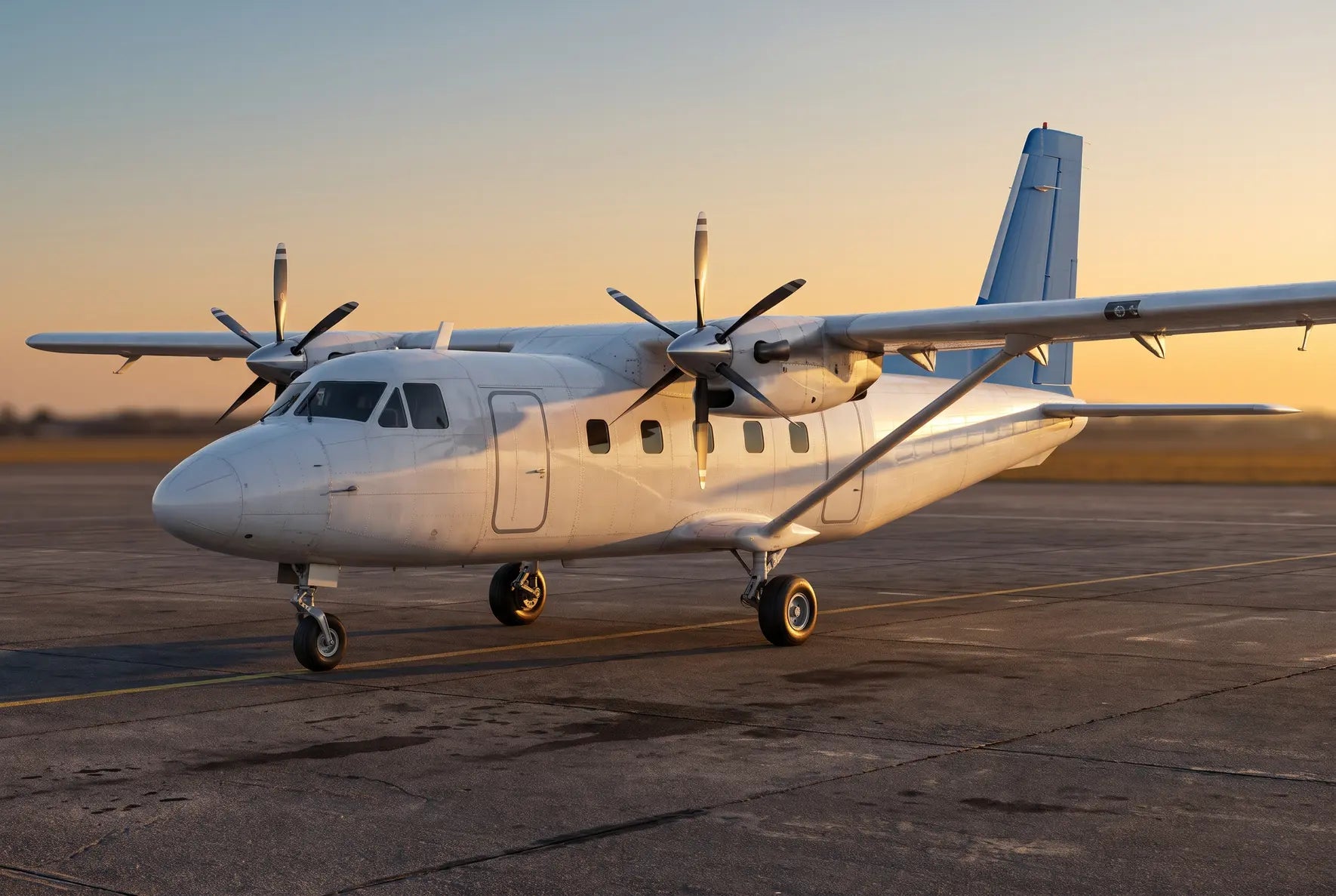
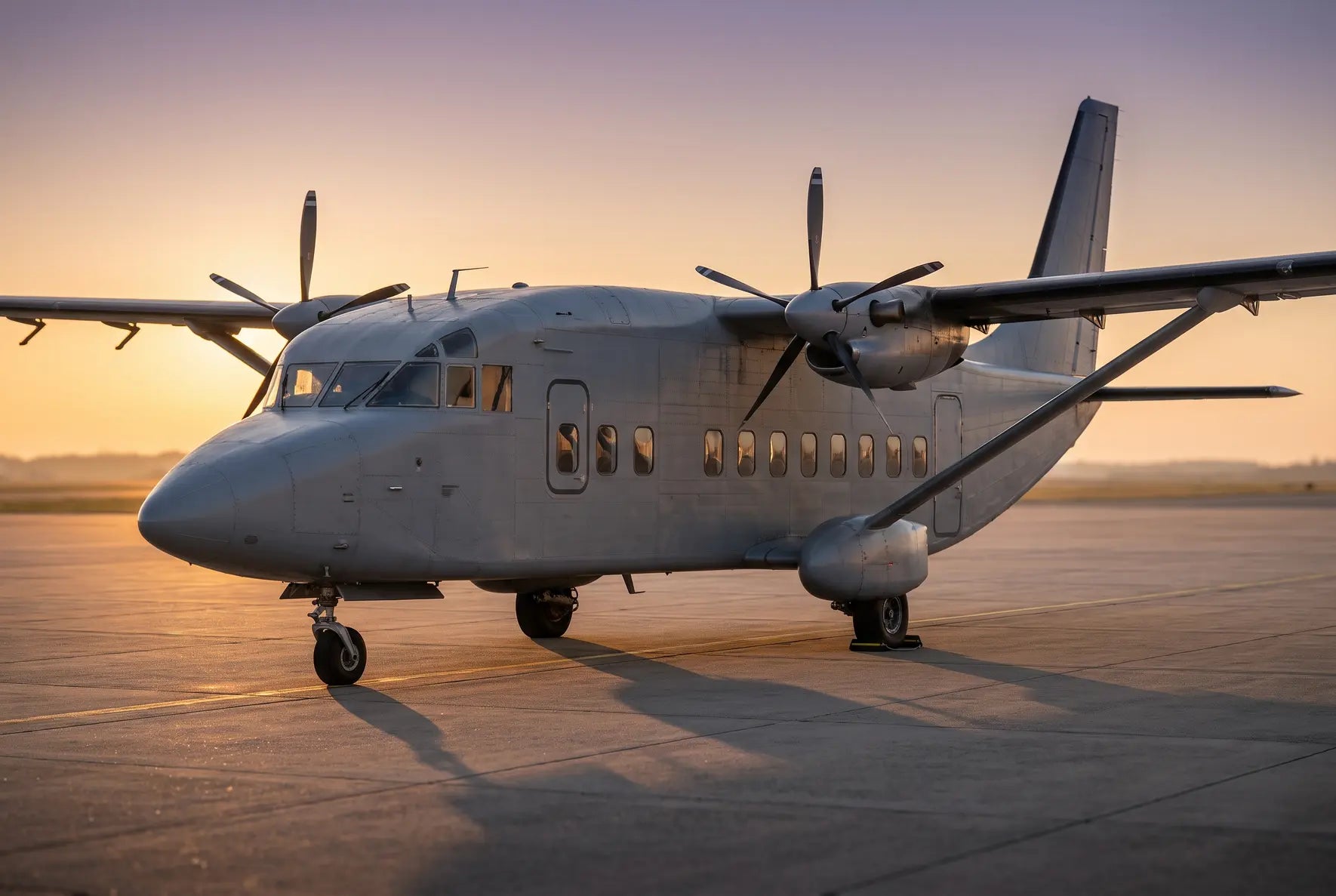
The Short 360 was a substantial reworking of the 330 rather than a simple stretch. The fuselage was lengthened to roughly 21.58 m (70 ft 10 in), adding rows of seats for a typical 36 passengers versus 30 in the 330. The most visible change was the tail: the 360 replaced the 330's twin-fin arrangement with a single tall vertical fin and revised tailplane, reducing interference drag and improving directional stability. These aerodynamic refinements produced a cleaner, faster aircraft, though the trade-off was a slightly shorter range of about 1,595 km (861 nm) compared with the 330. Power came from two Pratt & Whitney Canada PT6A turboprops (the PT6A-65R on the commuter series). Cruise speed was around 180 kt (330 km/h), with a service ceiling near 6,100 m (20,000 ft).
The 360 evolved through several civil variants: the baseline 360-100, the improved 360-200, the advanced 360-300 passenger model, and the 360-300F freighter derived from it. Key variant identifiers for the Short 360 family include:
- Engines: two Pratt & Whitney Canada PT6A turboprops (PT6A-65R class on the 360 series)
- Tail: single tall vertical fin, distinguishing it from the twin-fin Short 330
- Capacity: typically 36 passengers, up to 39 in high-density layouts
- Length: approximately 21.58 m (70 ft 10 in)
- Maximum take-off weight: around 12,292 kg (27,099 lb)
- Configuration: high wing, fixed landing gear, short-field capability
- Sub-variants: 360-100, 360-200, 360-300 and 360-300F freighter, plus the C-23 Sherpa military version
The Short 360 proved popular in North America, where 74 examples were delivered, making it the second most common feederliner in the United States behind the Metroliner. Its boxy fuselage and fixed gear limited speed relative to newer streamlined turboprops, but operators valued its robustness, low operating costs and short-field performance, which secured its role across regional airlines in the United Kingdom, the United States, Argentina and Australia.

A Pacific Coastal Airlines aircraft, specifically a Short 360-300 with registration C-GPCF, is captured mid-flight against a clear blue sky. The plane displays the airline's logo prominently on its fuselage.
Short 360 Technical Specifications, Systems and Engine Performance
The Short 360 (Short Brothers SD3-60) was designed as a rugged, low-cost regional airliner, developed directly from the earlier Short 330. Its distinctive braced high wing, square-section fuselage and twin turboprop layout reflect a clear design priority: carrying up to 36 passengers economically over short sectors from modest regional airfields, rather than chasing high cruise speeds or long range. The design deliberately favours simplicity and structural robustness over aerodynamic refinement, trading outright efficiency for low acquisition and maintenance costs, easy loading and dependable short-field operations.
Compared with its Short 330 predecessor, the 360 introduced a stretched fuselage, a single swept fin replacing the twin tail, an aerodynamically cleaner rear fuselage and uprated engines, all aimed at improving seating capacity and cruise performance while retaining the family's straightforward systems philosophy. Operators such as those documented in the history of Braathens Regional Aviation valued this class of turboprop for reliable point-to-point regional connectivity.
- Wingspan: approximately 22.8 m (74 ft 10 in), per the SKYbrary SH36 type record
- Length: around 21.6 m (70 ft 10 in)
- Height: about 7.2 m (23 ft 8 in)
- Wing area: roughly 42.1 m² (454 sq ft)
- Maximum takeoff weight (MTOW): about 12,292 kg (27,099 lb)
- Operating empty weight: approximately 7,870 kg (17,350 lb)
- Passenger capacity: 36 typical, up to 39 in high-density layouts
- Fuel capacity: around 2,182 L (576 US gal)
- Cruise speed: roughly 210–218 kt (about 390–404 km/h) at around FL100
- Service ceiling: certificated at about 20,000 ft (6,100 m)
- Range: approximately 570 NM (about 1,050 km) with a typical passenger payload and reserves, extending toward roughly 860 NM under lighter, long-range assumptions
- Engines: two Pratt & Whitney Canada PT6A-65 series turboprops, about 1,327–1,424 shp each
Systems and handling-relevant technology
The Short 360 was engineered as a straightforward commuter airliner. Its primary flight controls are conventional and mechanically actuated through cables and push-rods, using trim tabs and aerodynamic balancing rather than powered hydraulic boost or fly-by-wire automation, a choice consistent with the aircraft's emphasis on low weight and simple maintenance. Hydraulics are used principally for the retractable tricycle landing gear and wheel braking. The gear and rugged structure suit operations from short and semi-prepared regional strips.
The cockpit reflects its early-1980s origin, with analog instrumentation and IFR-capable radios; typical fitments include dual VHF communication and navigation radios, ADF, DME, transponder and a basic autopilot or flight director. Many aircraft were later retrofitted with GPS and updated avionics by operators. Engine handling relies on the mature PT6A control philosophy, giving pilots responsive, well-understood power management for regional stage lengths.
Published figures for the Short 360 vary between sources, and this is expected rather than contradictory. Range, cruise and field-length numbers depend on the specific engine sub-variant fitted, cabin seating density, actual takeoff and landing weights, and atmospheric assumptions such as temperature, elevation and runway condition. Certified performance is defined by the Aircraft Flight Manual for a given weight and set of conditions, so the values above should be read as representative planning figures rather than absolute guarantees.
Engines: the Pratt & Whitney Canada PT6A family
The Short 360 is powered by two Pratt & Whitney Canada PT6A turboprops, generally the PT6A-65R on standard aircraft and the uprated PT6A-65AR on later or higher-performance versions. The PT6A-65R is rated at around 1,327 shp, while the PT6A-65AR delivers approximately 1,424 shp per engine, giving the aircraft ample power for short-field departures at MTOW. The engines drive constant-speed, feathering and reversible propellers.
The PT6 is one of the most successful turboprop programmes in aviation history. According to the Pratt & Whitney Canada PT6 record, design work began in 1958, the engine first flew on 30 May 1961 and entered commercial service in 1964. It uses a free-turbine architecture in which a gas-generator section drives a separate power turbine connected to the propeller through a reduction gearbox, an arrangement that contributes to the engine's renowned reliability and flexibility. The wider PT6A family spans roughly 580 to 1,940 shp across its many variants.
That versatility explains why the same engine family appears on a very broad range of aircraft. Beyond the Short 330 and Short 360, PT6A variants power the Beechcraft King Air series and numerous other utility, business and commuter turboprops, making it one of the most widely produced turboprop engines ever built, with hundreds of millions of accumulated flight hours across the fleet.
Short 360 vs Short 330 vs DHC-6 Twin Otter 300 vs Embraer EMB 110 Specs Comparison
Scroll horizontally to see more →
| Parameter | Short 360 | Short 330 | de Havilland Canada DHC-6 Twin Otter Series 300 | Embraer EMB 110 Bandeirante |
|---|---|---|---|---|
| Entry into service | 1982 | 1976 | 1969 | 1973 |
| Engines | 2 × Pratt & Whitney Canada PT6A-65R turboprops | 2 × Pratt & Whitney Canada PT6A-45R turboprops | 2 × Pratt & Whitney Canada PT6A-27 turboprops | 2 × Pratt & Whitney Canada PT6A-34 turboprops |
| Length | 21.72 m | 17.69 m | 15.77 m | 15.10 m |
| Wingspan | 22.76 m | 21.69 m | 19.81 m | 15.33 m |
| Height | 7.87 m | 6.94 m | 5.94 m | 4.90 m |
| Typical seating and layout (short description + approximate passengers) | Single-class commuter: 36–39 passengers | Single-class commuter: 30–33 passengers | Single-class commuter/STOL: 19 passengers | Single-class regional: 15–21 passengers |
| MTOW | 12.9 t | 10.5 t | 5.7 t | 5.8 t |
| Range | 770 nm | 940 nm | 775 nm | 950 nm |
| Cruise speed | 0.35 Mach | 0.34 Mach | 0.30 Mach | 0.30 Mach |
| Service ceiling | 25,000 ft | 25,000 ft | 25,000 ft | 22,965 ft |
| Program note | Stretched, higher-capacity development of the Short 330 aimed at 36–39 seat regional commuter routes. | Baseline 30-seat commuter airliner that formed the foundation for the larger Short 360 family. | Versatile STOL commuter and utility aircraft widely used on short, rough-field regional routes and remote operations. | Early-generation regional turboprop designed for short-haul feeder services and utility roles in challenging environments. |
Scroll horizontally to see more →
The table compares key specifications for four regional turboprops, showing how the Short 360 is a stretched, higher-MTOW evolution of the Short 330 with more seats (36–39 vs 30–33) and larger dimensions, but slightly less range (770 vs 940 nm). The Twin Otter carries fewer passengers (19) yet matches the 360’s ceiling, while the EMB 110 offers similar range to the 330 with smaller size and a lower ceiling.
Short 360 Routes, Missions and Airlines Around the World
The Short 360 was conceived as a short-haul commuter airliner, and its operating profile reflects that role. Typical sectors run up to about 500 nautical miles (roughly 800 km), with a published maximum range near 570 nautical miles (about 1,056 km) and a cruise speed around 210 to 218 knots (390 to 404 km/h). These figures made it well suited to frequent, short stages rather than long intercity legs, and many operators used it for multiple daily rotations linking small communities to larger cities. Detailed specifications are documented by reference databases and the Aeropedia technical entry.
Operationally, the type served two main environments. In hub-and-spoke networks it acted as a feeder, carrying passengers between secondary airports and major hubs on behalf of larger carriers. In point-to-point regional networks it linked smaller destinations directly. Its short-field capability, needing roughly 1,400 m (about 4,500 ft) of runway, made it valuable at secondary and regional airports with limited infrastructure. The main operator challenges came from its modest capacity of 36 to 39 seats, which limited revenue as demand grew, and from fleet support: production ended in 1991, so ageing aircraft and parts availability increasingly favoured newer turboprops. Its reliability and low operating cost, however, kept it in cargo service long after passenger use declined.
Where the Short 360 Operates
Across Europe, North & South America, Asia and Africa, the aircraft found homes wherever regional feeder and thin-route economics mattered. In Europe, and especially the United Kingdom and Ireland, it became a backbone of regional and island connections, later shifting heavily into overnight freight work. In North & South America, it flew as a commuter feeder under major-carrier brands and, more recently, as a dedicated cargo aircraft across the Caribbean and Central America. In Asia, it served commuter and inter-island roles, while in Africa it appeared with a small number of regional operators.
- Europe: Aer Lingus, Loganair, Manx Airlines, Gill Airways, Jersey European, CityFlyer Express, Connectair and BAC Express used it for passenger commuter and feeder services, while Emerald Airways operated it extensively in cargo roles. Many of these carriers linked regional airfields to the busy hubs described in our overview of British Airways operations.
- North & South America: Suburban Airlines was the first scheduled passenger operator, followed by U.S. commuter carriers such as Command Airways, Simmons Airlines, Executive Airlines, WestAir Commuter Airlines, Atlantic Southeast Airlines and Air Midwest, many flying under American Eagle, United Express or Allegheny Commuter banners. In Canada, Time Air and Pacific Coastal Airlines flew it on regional routes. Cargo operators including Air Cargo Carriers and Skyway Enterprises keep it active in freight, while regional and Caribbean carriers such as Aeroperlas, La Costena and Tiara Air used it for passenger service.
- Asia: Deraya Air Taxi operated it in commuter and air-taxi roles, and it also appeared with carriers such as Bangkok Airways on regional services.
- Africa: Air Seychelles used it for inter-island passenger connections in the Indian Ocean region.
Typical Seating and Cabin Layouts
The cabin is unpressurised and configured for short regional hops. The most common arrangement is a single-class 36-seat layout, with a high-density option reaching 39 seats. Network and commuter operators generally favoured the standard 36-seat fit, prioritising a simple feeder cabin, while leisure and charter operators leaned toward the denser 39-seat configuration to maximise revenue on short sectors. Cargo and mixed variants remove seats to carry payloads of roughly 3.2 to 3.8 tonnes, reflecting the aircraft's square fuselage and rear-loading practicality. Cabin dimensions are about 1.85 to 1.93 m wide and 1.86 to 1.88 m high, powered by two Pratt & Whitney Canada PT6A-65R turboprops with a maximum take-off weight near 12,300 kg. Configuration details are outlined in the Airlines-Inform data sheet and the Aerocorner profile.
In this video, explore The Feederliners Short 330 and 360 in a reworked presentation, featuring updated visuals and improved pacing for a clearer look at these compact feederliner vessels.
Short 360 Safety Record: How Safe Is This Regional Turboprop?
The Short 360 (also written Shorts 360 or SD3-60) is a British twin-turboprop regional airliner that first flew in August 1982 and entered service later that year. Production ended in 1991 after 165 aircraft were delivered, and the type went on to serve commuter, feeder and cargo operators across Europe, North America, the Caribbean and beyond. Around 110 examples were still active in 1998, roughly 86 by 2006, and only a few dozen by the late 2010s. Against that modest fleet and its decades of short-haul, high-cycle operation, published records list approximately 11 hull-loss accidents for the type. Many of these occurred in demanding environments such as mountainous terrain, marginal weather or cargo operations, rather than pointing to a systemic airframe or engine defect. Detailed occurrence records can be reviewed on the Aviation Safety Network database.
Notable accidents and what changed afterwards
- Philippine Airlines Flight 443 (1987): a Short 360 struck a mountain of roughly 5,000 ft on approach to Iligan, killing all 15 on board. The event was consistent with controlled flight into terrain (CFIT) during an approach in high ground. Accidents of this profile across the industry accelerated the adoption of terrain awareness and warning systems (TAWS/EGPWS) and stricter approach and minima procedures.
- Loganair, Firth of Forth (2001): a cargo-configured Short 360 was lost shortly after take-off from Edinburgh, with both pilots fatally injured. The occurrence was investigated by the UK Air Accidents Investigation Branch, whose reports are published by the AAIB. Investigations of this kind typically reinforce engine and de-icing inspection regimes and crew handling of post-take-off malfunctions.
- Corporate Air, Billings (1997): a Short 360 suffered a left main landing-gear collapse after a landing carried out with a very high descent rate; both pilots survived. The outcome highlighted stabilised-approach criteria and touchdown technique rather than a design fault, and such events commonly feed into revised operator standard operating procedures and simulator training on energy management and go-arounds.
- Air Cargo Carriers, Oshawa (2004): a Short 360-300 was destroyed during a failed go-around attempt. Missed-approach accidents like this have driven wider emphasis on unstable-approach recognition and disciplined go-around decision-making across regional operations.
How safe is the Short 360?
Interpreting the record fairly means weighing the accident count against traffic volume and operational context. The Short 360 was engineered as a rugged, mechanically straightforward commuter aircraft, with a high wing, fixed landing gear and two proven Pratt & Whitney Canada PT6A turboprop engines. These features reduce certain failure modes, but the type's short-haul mission naturally concentrates flying in high-cycle approach and landing phases and, historically, in terrain-rich or remote airfields, which raises exposure to CFIT and landing-phase events. The available evidence does not indicate a fundamental design flaw; instead, the accident profile mirrors well-known regional-turboprop risks tied to terrain, weather and human factors, most of which modern training, SOPs and regulatory oversight are designed to mitigate. Readers interested in comparable-era Soviet regional and short-haul design philosophy can explore the Tupolev Tu-154B for contrast. When set against overall industry statistics compiled by bodies such as the International Civil Aviation Organization, it is worth remembering that commercial aviation, including well-maintained legacy turboprops operated under current standards, remains one of the safest modes of transport available.
01 What kind of routes and range is the Short 360 typically used for?
The Short 360 is a regional turboprop designed for short-haul sectors, typically up to about 500–600 nautical miles, depending on payload and configuration. It is well suited to commuter routes linking smaller cities or island communities with larger hubs, especially where runway length is limited. Airlines and charter operators often use the Short 360 for multi-leg schedules with frequent takeoffs and landings rather than long nonstop flights. Its design prioritizes reliable point-to-point connectivity over long-range cruising.
02 What is the Short 360 cabin like for passengers in terms of layout, comfort, and noise?
The Short 360 cabin is relatively tall and narrow, with a single-aisle layout and up to 36–39 seats in an all-economy configuration. The high-wing design and large rectangular windows give good outside views, but the proximity of the turboprop engines and the boxy fuselage shape mean the cabin can be noisier than more modern regional aircraft. Seating comfort is basic but practical for flights usually under one hour, with straightforward overhead storage and a simple interior. Passengers who prefer a quieter ride often choose seats closer to the front, away from the propellers.
03 Which airlines operate the Short 360 and on what types of routes?
The Short 360 is no longer produced and is now mainly flown by smaller regional and charter operators rather than major airlines. Historically, it served commuter carriers in the UK, Europe, and North America on short domestic and cross-border routes, as well as island services where short-field performance was important. Today, remaining examples are often used for niche passenger services, cargo operations, and ad hoc charters, particularly to airports with limited infrastructure. Travellers are most likely to encounter the Short 360 on specialized regional or island-hopping routes rather than mainstream trunk services.
04 How does the Short 360 perform compared with similar regional turboprop aircraft?
The Short 360 offers modest cruise speeds of around 210–218 knots, with a service ceiling of about 20,000 feet, making it slower and lower-flying than newer regional turboprops. Its strength lies in short takeoff and landing performance and robust PT6A engines, allowing operations from runways around 1,100–1,300 meters and basic airfields. Compared with sleeker designs such as the Dash 8 or ATR series, the Short 360 is less fuel-efficient per seat and less refined aerodynamically, but it is appreciated for its simple systems, rugged airframe, and versatility for mixed passenger and freight missions. This balance of performance and practicality made it popular in demanding regional environments rather than high-speed routes.
05 What is known about the Short 360 safety record and key design features affecting safety?
The Short 360 has accumulated a number of hull-loss accidents over its service life, largely reflecting intensive use on short sectors and operations into challenging regional airports. It features a high wing, sturdy landing gear, and twin Pratt & Whitney Canada PT6A turboprop engines, a widely used and well-regarded powerplant in regional aviation. The conventional tail and improved aerodynamics over the earlier Short 330 were intended to enhance handling and stability, especially in crosswinds. As with any older aircraft type, current safety depends heavily on the individual operator’s maintenance standards, crew training, and adherence to modern regulatory requirements.
06 As a passenger, what should be considered when choosing a seat on the Short 360 and how does it handle turbulence?
On the Short 360, seats forward of the wing usually experience slightly less engine and propeller noise, while seats near the wing and aft fuselage can feel vibrations more strongly. The high-wing configuration generally provides stable low-speed handling and good performance at lower altitudes, but the boxy fuselage can make turbulence feel more pronounced than on larger jets. Window views are good on most rows, so travellers who enjoy watching takeoff and landing often favor seats near the wing to see the flaps and props in action. For those sensitive to motion, a seat near the center of the cabin over the wing is usually the most comfortable choice.