

History and Development of the Short 330: Program, Design and Variant Traits
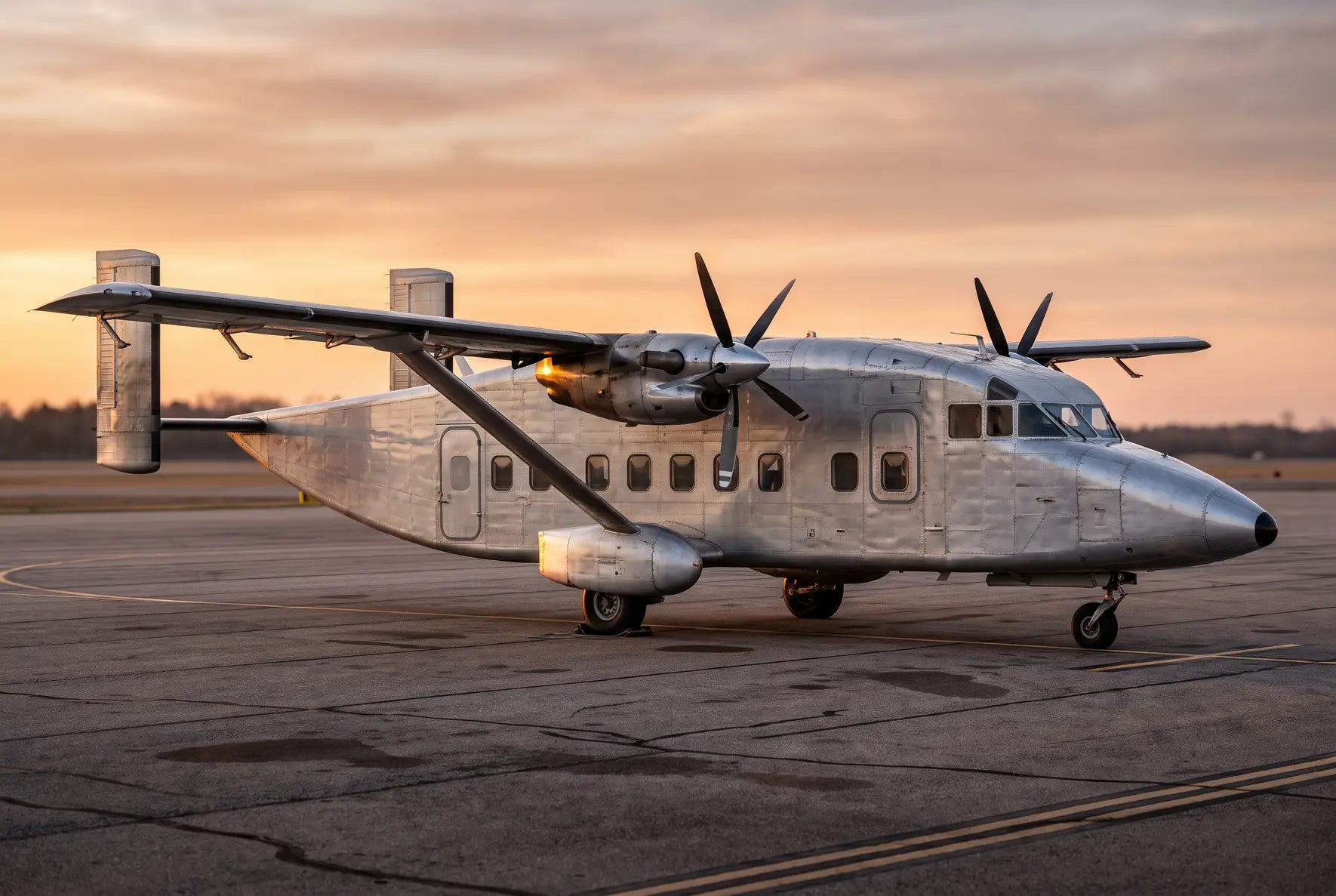
The Short 330 (company designation SD3-30) was designed by Short Brothers, the historic British manufacturer based at Belfast (Sydenham) in Northern Ireland. The company had already established a distinctive high-wing, square-section, twin-turboprop layout with its Short SC.7 Skyvan utility aircraft in the 1960s, and it drew directly on that experience to enter the emerging regional and commuter airliner market.
The commercial rationale was specific. In the early 1970s, the US Civil Aeronautics Board revised its commuter rules to allow feeder airlines to carry up to 30 passengers, and Short Brothers sized the aircraft to exploit exactly that threshold, which is reflected in the "30" of the designation. The 330 was conceived as a low-cost, low-maintenance feederliner able to replace smaller types such as the Beechcraft Model 99 and the de Havilland Canada DHC-6 Twin Otter on short scheduled routes, and it benefited from British government regional aid.
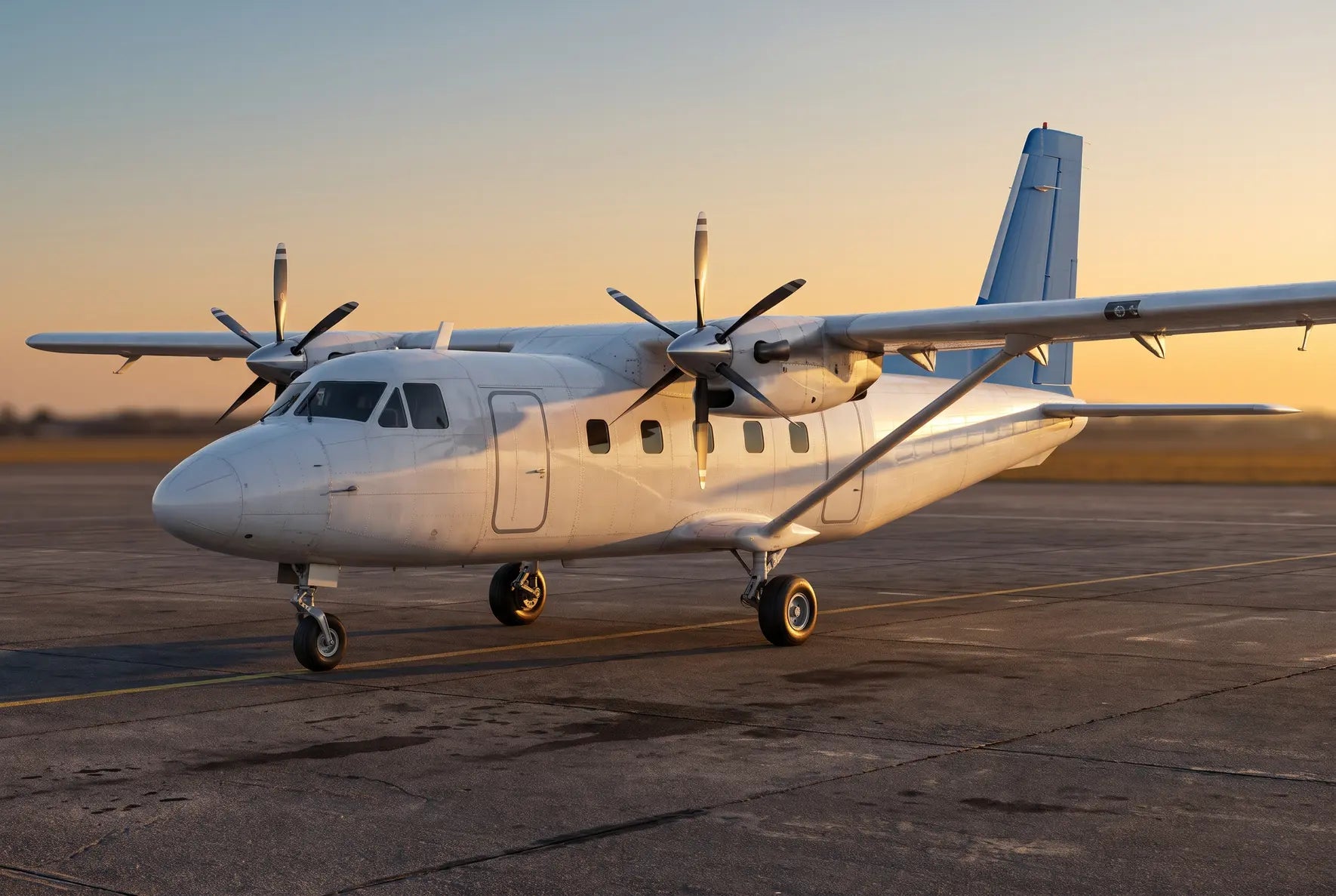
Structurally, the 330 kept the Skyvan's box-section fuselage cross-section but added a stretched fuselage, a greater wingspan and the characteristic Skyvan-style twin-fin tail with a high wing. The program advanced quickly:
- Production approval granted on 23 May 1973.
- First prototype (G-BSBH) first flight from Belfast on 22 August 1974, debuting shortly afterwards at the Farnborough Air Show.
- Second prototype (G-BDBS) flown in July 1975 for certification trials.
- FAA certification achieved on 15 December 1975.
- Entry into airline service in 1976, with Time Air of Canada among the early operators.
Production ran from 1976 to 1992, with authoritative sources placing the total built at roughly 139 to 141 aircraft across civil, freighter and military versions. Original civil certification was issued by the UK Civil Aviation Authority, with corresponding FAA acceptance for operation in US airspace. Candidates preparing for type-related interviews on turboprop feederliners can review structured guidance in this technical pilot interview resource.
What sets the Short 330 apart from its siblings
The 330 sits between the smaller Skyvan and the later, larger Short 360. Compared with the Skyvan, it offers a longer fuselage, greater span and higher cruise performance while retaining strong short-field capability. The clearest distinction from the 360 is the tail: the 330 retains a twin-fin arrangement derived from the Skyvan, whereas the 360 adopted a conventional single vertical tail, a longer fuselage and refined aerodynamics. The first Short 360 was delivered in 1982, positioning it as the successor rather than a direct equivalent. Within the 330 line itself, the initial 330-100 was followed by the improved 330-200, which introduced minor drag-reduction and systems updates for better economy while sharing the same wing, tail and powerplant family.
The principal variant identifiers for the Short 330 are summarised below.
- Powerplant: two Pratt & Whitney Canada PT6A-45R turboprops, each rated at about 1,198 shp, driving five-bladed Hartzell propellers.
- Tail configuration: distinctive twin-fin empennage (versus the single fin of the Short 360).
- Capacity: designed for up to 30 passengers, with some high-density layouts listed at around 33 seats.
- Key dimensions: length 17.69 m, wingspan 22.76 m, height 4.95 m.
- Weights: maximum take-off weight 10,387 kg and maximum payload around 3,220 kg.
- Performance: cruise near 160 knots, service ceiling 20,000 ft, and short-field take-off and landing distances of roughly 1,160 m and 1,100 m.
- Derivatives: the Sherpa and military C-23 freighters, fitted with a rear cargo ramp and PT6A-45R/B engines.

The image shows a Short 330-200 aircraft operated by MN Aviation in flight. The plane features a distinctive red and white livery with registration number N106SW visible on the fuselage.
Short 330 Technical Specifications, Systems and Engine Highlights
The Short 330 (also written Shorts 330 or SD3-30) was engineered as a rugged, short-haul commuter and utility transport. Its priorities were simple and consistent: carry around 30 passengers economically over regional stage lengths, operate reliably from modest runways, and keep maintenance straightforward for smaller carriers. The design trades outright cruise speed and altitude for payload, cabin volume and short-field capability, reflected in its distinctive braced high wing and fixed landing gear. The aircraft shares its essential airframe philosophy with the earlier Short SC.7 Skyvan and was later developed into the stretched Short 360 and the Sherpa freighter derivatives.
The consolidated data below reflects the Short 330 and the more powerful Short 330-200; where authoritative sources differ slightly, values are given as ranges. Detailed type data is documented by SKYbrary.
- Wingspan: ~22.8 m (74 ft 8 in)
- Length: ~17.7 m (58 ft)
- Height: ~5.0 m (16 ft)
- Wing area: 42.1 m² (453 sq ft)
- Cabin: ~9.1 m long, 1.93 m wide, 1.98 m high
- MTOW: ~10,380–10,390 kg (approx. 22,900 lb)
- MLW: ~10,250 kg (approx. 22,600 lb)
- OEW: ~6,680 kg (approx. 14,700 lb)
- Passengers: 30 in standard single-class layout, up to 33 in high-density; freighter/combi configurations vary
- Cruise speed: ~160–180 kt (indicative, altitude and weight dependent)
- Range: ~915 nm (~1,700 km); reduced with maximum payload
- Service ceiling: ~20,000–22,000 ft
- Engines: 2 × Pratt & Whitney Canada PT6A-45R/45B, ~1,190–1,200 shp each
- Propellers: five-blade Hartzell constant-speed units
- Fuel capacity: ~672–673 US gal (~2,546–2,550 L)
- Takeoff field length: ~1,100–1,160 m
- Landing distance: ~1,100 m
Systems and handling-relevant technology
The Short 330 uses conventional, mechanically actuated flight controls with manual reversibility, in keeping with its era and mission, giving pilots direct, predictable handling at the low speeds typical of commuter operations. Its fixed tricycle landing gear removes retraction complexity and supports operation from unpaved or lightly prepared surfaces. The high, braced wing and generous flap area contribute to the aircraft's short-field behaviour and low approach speeds. Automation is limited compared with modern regional turboprops, so accurate manual performance computation and disciplined crew coordination remain central to safe operation, a discipline reinforced through structured training pathways such as the Multi-Crew Pilot Licence (MPL). Avionics are largely operator-specific; many surviving aircraft have been upgraded to full IFR standards with dual VHF COM/NAV, dual Mode S/ADS-B transponders, a radar altimeter, ADF and a digital air data computer.
Published performance figures for the Short 330 vary because operators selected different engine ratings, cabin densities and weight configurations, and because quoted range, field length and cruise numbers depend on assumptions about payload, atmospheric conditions and runway state. Freighter conversions, auxiliary equipment and variant differences (for example the 330 versus the 330-200) further explain why sources rarely agree to the last digit. The values above should therefore be read as representative rather than absolute.
The Pratt & Whitney Canada PT6 engine
Both propellers are driven by Pratt & Whitney Canada PT6A turboprops, in the medium-power PT6A-45 series rated at roughly 1,190–1,200 shp. The PT6 is a Canadian-designed engine family conceived in 1958, first run in 1961 and introduced into service in 1964, and it has since become one of the most widely produced turboprop families in aviation history. Its architecture is a defining feature: a free-turbine layout mechanically separates the gas generator from the power turbine, while a reverse-flow air path allows a compact, easily installed nacelle package. In the PT6A-41/42/45/60 group, the engine combines a multi-stage compressor with axial and centrifugal stages, a single-stage gas generator turbine, a two-stage power turbine and a reduction gearbox driving the propeller. Beyond the Short 330, PT6 engines power aircraft as varied as the Cessna Caravan, Pilatus PC-12 and Beechcraft King Air, with rotorcraft and tiltrotor derivatives such as the PT6C extending the family further. This combination of reliability, compactness and moderate shaft horsepower made the PT6A a natural fit for the commuter role the Short 330 was built to serve.
Short 330 vs Short 360 vs Dornier 228-200 vs DHC-6 Twin Otter 400 Specifications
Scroll horizontally to see more →
| Parameter | Short 330 | Short 360 | Dornier 228-200 | de Havilland Canada DHC-6 Twin Otter Series 400 |
|---|---|---|---|---|
| Entry into service | 1975 | 1981 | 1982 | 2010 |
| Engines | 2 × Pratt & Whitney Canada PT6A-45B turboprops | 2 × Pratt & Whitney Canada PT6A-65AR turboprops | 2 × Garrett TPE331-5 turboprops | 2 × Pratt & Whitney Canada PT6A-34 turboprops |
| Length | 17.70 m | 18.69 m | 16.56 m | 15.77 m |
| Wingspan | 22.80 m | 22.80 m | 16.97 m | 19.81 m |
| Height | 5.00 m | 5.13 m | 4.86 m | 5.94 m |
| Typical seating and layout (short description + approximate passengers) | 1-class commuter cargo: 30 passengers | 1-class commuter: 36 passengers | 1-class commuter/utility: 19 passengers | 1-class commuter/STOL: 19 passengers |
| MTOW | 10 t | 12 t | 6 t | 5 t |
| Range | 915 nm | 1,300 nm | 1,200 nm | 889 nm |
| Cruise speed | 0.31 Mach | 0.35 Mach | 0.34 Mach | 0.29 Mach |
| Service ceiling | 25,000 ft | 25,000 ft | 23,000 ft | 19,000 ft |
| Program note | Baseline stretched Short Skyvan derivative for regional commuter and utility freight roles. | Further stretched, higher-capacity evolution of the Short 330 aimed at dense commuter routes and cargo work. | Comparable twin-turboprop utility regional aircraft from another manufacturer, with more conventional low-wing design and mixed passenger/cargo use. | Modern STOL twin turboprop focused on short-field commuter, utility, and remote-access missions rather than higher-density regional service. |
Scroll horizontally to see more →
The table compares four twin-turboprop regional/utility aircraft across dimensions, capacity, performance, and roles. The Short 360 is the largest and highest-capacity (36 seats) and also leads on range (1,300 nm), while the Short 330 offers 30 seats with lower MTOW and shorter range. Dornier 228 and Twin Otter carry about 19 passengers, with the 228 cruising faster and higher than the STOL-focused Twin Otter.
Short 330 Operations, Routes and Airlines Around the World
The Short 330 was conceived as a rugged 30-seat commuter aircraft optimised for high-frequency, short-sector flying into secondary and often austere airfields. Its published range reaches roughly 915 nm (1,695 km) with a full passenger load, but in practice most operators flew it on far shorter legs. Documented feederliner data show average scheduled stages of around 81 miles (about 70 nm / 130 km), with some routes as short as 55 to 60 miles. Cruising at about 160 kt and topping out near 20,000 ft, the type was built for cycle-intensive work rather than long-haul speed.
Daily utilisation typically involved multiple short sectors, often six to ten legs or more, with turnaround times scheduled between 10 and 25 minutes. This pattern suited morning and evening peaks feeding mainline hubs, with off-peak flying between smaller points and, for freighters, overnight cargo runs. The main operational challenge lies in the economics of short sectors: high cycle counts stress airframes and engines, and modern noise and efficiency expectations have pushed most passenger examples into retirement. Its strong STOL capability, with takeoff and landing distances near 1,100 m and fixed landing gear, remains its lasting advantage for remote and low-infrastructure operations. Aircraft such as this filled roles later addressed by jets like the Boeing 787-8 only at the very smallest end of the network.
Where the Short 330 operates
The type served predominantly in hub-and-spoke commuter networks, connecting small communities to regional hubs, and today survives mainly as a freighter and utility platform. Across Europe it flew regional feeder services and now supports cargo and airdrop missions. In North and South America it was a workhorse of US commuter regulation and Canadian regional aviation, with a strong second life in freight and government roles. In Asia it appears mostly in military and utility service, while across Africa it continues to move freight into some of the most remote strips in the world.
- Europe: Pegase Airdrop (United Kingdom) operates the type for cargo and airdrop missions, exploiting its short-field ability and payload of over three tonnes. British and Irish regional carriers historically used it as a 30-seat feederliner into short island and regional runways.
- North and South America: Time Air (Canada) was the launch customer, introducing the aircraft in 1976 on short-range regional routes. Numerous US commuter airlines adopted it to exploit 30-seat regulations, replacing smaller Beech 99 and DHC-6 types. Today ARNE Aviation, McNeely Charter Service and Win Aviation (United States) fly it as regional freighters, while NASA uses it as a specialised utility platform.
- Asia: The Philippine Army operates the type in a military utility role across the archipelago, and the reinforced 330-UT variant served the Royal Thai Army for short-range logistical support into forward bases and remote strips.
- Africa: Mont Gabaon Airlines (Democratic Republic of the Congo) uses the aircraft for cargo services into short, often unimproved strips, where its ruggedness and STOL performance remain valuable.
Typical seating and cabin layouts
Passenger commuter operators typically fitted the tall, box-section cabin with 30 seats in a 2+1 layout across roughly ten rows, served by a single offset aisle, with a large window at every row, overhead lockers, a galley and a lavatory. High-density configurations of up to 33 seats are documented. The cabin measures about 9.09 m long, 1.93 m wide and 1.98 m high, giving standing headroom unusual for a regional turboprop of its era, as detailed in aviation databases such as airlines-inform and technical references.
Cargo and utility operators favoured very different layouts. Combi versions carried roughly 18 passengers in a rear cabin, separated by a bulkhead from a forward freight compartment, adding around 2,200 lb of load. Pure freighters removed passenger seating entirely, while the reinforced 330-UT offered a higher maximum takeoff weight for tougher payloads. Powered by two Pratt & Whitney Canada PT6A-45R turboprops of about 1,190 hp each, with an MTOW near 10,387 kg and a maximum payload of roughly 3,220 kg, the airframe adapted easily between comfortable regional cabins and stripped-out cargo holds, as summarised in overviews from Simple Flying and SKYbrary.
In this video, The Feederliners showcase reworked Short 330 and 360 aircraft, highlighting updated visuals and details. Watch for a focused look at these classic feederliner models and their latest improvements.
Short 330 Safety Record and How Safe Is This Regional Turboprop
The Short 330 (SD3-30) holds a reasonably strong safety record for a rugged commuter and cargo turboprop. Roughly 141 airframes were built between the mid-1970s and 1992, serving as short-haul feederliners and utility freighters with regional carriers in the United States and Europe. Across decades of intensive, high-cycle operations into small and often austere airports, the type recorded three fatal civil accidents alongside a number of non-fatal hull losses. Because the Shorts 330 typically flew many short sectors per day into terrain-challenged or short-field destinations, most of its occurrences stem from operational and human factors rather than structural or systemic design deficiencies. For a chronological overview of these events, the Aviation Safety Network type record lists accidents by date, operator and location.
Notable accidents and what changed afterwards
The following cases illustrate the primary risk factors associated with the aircraft and the responses that followed.
- Olympic Aviation, 1989 (Samos, Greece): The deadliest event involving the type, a controlled flight into terrain during an approach in thick fog against high ground. Like other CFIT accidents of the era, it reinforced the wider industry move toward stabilised approaches, improved instrument procedures and broader adoption of ground proximity warning systems in commuter turboprops.
- Streamline Aviation, 2000 (Paris Charles de Gaulle): A runway incursion in which the Short 330 entered an active runway and was struck by a departing airliner, resulting in one fatality. The event fed into system-wide runway safety initiatives, including clearer taxi clearances, markings, signage and refined air traffic control procedures rather than any airframe change.
- Air Cargo Carriers Flight 1260, 2017 (Charleston, West Virginia): A cargo Short 330-200 suffered a loss of control on approach after a non-standard circling approach and an excessive descent rate. The NTSB investigation identified the crew's improper decision to fly a circling approach contrary to procedures, with the operator's lack of a formal safety and oversight program as a contributing factor. The findings prompted reinforcement of stabilised approach criteria, stricter adherence to standard operating procedures and stronger operator safety management.
Across these events, the recurring theme is procedural and organisational improvement rather than fundamental redesign. No authoritative source indicates a systemic structural or flight-control defect requiring a major modification of the airframe.
How safe is the Short 330?
Judged against its long service life and high number of daily cycles, the Short 330 has a comparatively low fatal accident rate for a regional turboprop, with the majority of hull losses being non-fatal and tied to landings, runway excursions or adverse weather. Its design philosophy, derived from the earlier SC.7 Skyvan, favours a high wing, robust landing gear, twin proven Pratt & Whitney Canada PT6A engines and low approach and stall speeds that reduce landing energy and improve controllability into short strips. Certified originally under UK Civil Aviation Authority oversight and operated under FAA and European authority rules, the type remains subject to standard airworthiness, maintenance and crew-training requirements, with accident investigations feeding back into procedures and directives when needed. Readers interested in a comparable four-engine airliner can review the Boeing 757-300 profile for context on how design and operations shape safety outcomes. As ICAO safety data consistently shows, commercial aviation as a whole remains one of the safest modes of transport, and the Short 330's record reflects that broader picture, with disciplined procedures and regulatory oversight underpinning its continued operation.
01 What kind of routes and mission profile is the Short 330 typically used for?
The Short 330 is designed as a regional commuter and utility aircraft, optimized for short-haul routes of roughly 500–900 km and sectors lasting about one hour. Its short takeoff and landing performance makes it suitable for serving smaller airports with short or rough runways, including island, remote, and feeder routes. Airlines and operators use it for point-to-point regional services, cargo feeder operations, and specialized missions such as military and utility transport. This mission profile allows the Short 330 to connect communities that might not be viable for larger jets or turboprops.
02 How comfortable is the cabin on the Short 330 for passengers?
The Short 330 typically seats around 30 passengers in a single-class layout, with a narrow but relatively tall cabin and large square windows that provide good outside views. The seating arrangement is usually two seats on one side of the aisle and one on the other, giving most passengers either a window or aisle seat without a middle seat. As a turboprop, cabin noise is noticeable, especially near the engines and propellers, but the aircraft is pressurized and can cruise at regional altitudes, improving comfort compared with unpressurized utility aircraft. Overall, the experience feels more like a rugged regional commuter than a modern jet, but it is practical and functional for short flights.
03 Which airlines and operators have used the Short 330 and on what kinds of routes?
Historically, the Short 330 has been operated by regional carriers in Europe, North America, and Asia, as well as cargo and military operators. Airlines used it mainly on short regional sectors linking secondary cities, island communities, and remote areas to larger hubs, where its short-field performance and modest capacity matched demand. Cargo operators and the military employed freighter and utility variants, such as the Short Sherpa and 330-UTT, for light freight, troop transport, and logistics support on routes to airfields with limited infrastructure. Although only a small number remain in service today, they generally continue to operate in niche regional and freight roles.
04 How does the performance and efficiency of the Short 330 compare with similar regional aircraft?
The Short 330 offers cruise speeds in the 160–180 knot range and a typical range around 900–1,000 nautical miles, which is modest but appropriate for its commuter role. Its maximum takeoff weight of just over 10,000 kg and strong turboprop engines give it good climb performance and short runways requirements of about 1,100 meters, making it competitive on STOL and rough-field operations. Compared with more modern regional turboprops, it is generally less fuel-efficient and slower, but it compensates with robust construction, simple systems, and the ability to carry around 30 passengers or significant cargo into challenging airfields. For operators prioritizing versatility and access over speed, the Short 330 has been a practical and cost-effective solution.
05 What is known about the safety record and key design features of the Short 330?
The Short 330 has a long service history dating back to the mid-1970s and has generally been regarded as a robust regional aircraft when properly maintained and operated within its performance envelope. Its twin Pratt & Whitney Canada PT6A turboprop engines are widely used and have a strong reliability record, contributing to overall safety and maintainability. The aircraft’s boxy fuselage, high wing, and sturdy landing gear are designed for frequent cycles and operations from short and sometimes unimproved runways, improving operational safety in demanding environments. Like any older aircraft type, individual safety outcomes depend on operator maintenance standards, training, and adherence to performance limitations.
06 As a passenger, what practical things are useful to know when flying on a Short 330?
Passengers can expect a small, straightforward cabin, and choosing seats away from the propeller area and near the front can slightly reduce noise and vibration. The large square windows give good visibility, so window seats are enjoyable for sightseeing on low-level regional flights, especially on scenic or island routes. The Short 330’s high wing and stable turboprop design generally handle turbulence adequately, though bumps may be more noticeable than on larger jets due to its size. Boarding and deplaning are usually quick at small airports, and the aircraft’s utilitarian layout emphasizes function and access over luxury, which suits short flights and adventure-style travel.