Boeing 757-300: History, Program Launch, and Development of the Stretched Variant
The Boeing 757 family traces its origins to the early 1970s, when Boeing began studying a successor to its best-selling trijet, the Boeing 727. Designed for short and medium routes, the 727 was the top-selling commercial jetliner of the 1960s, but airlines increasingly demanded better fuel efficiency and lower crew costs. Boeing evaluated two paths: a stretched 727 (tentatively called the 727-300) and an all-new twinjet codenamed 7N7. The twinjet concept won out, and in August 1978, Eastern Air Lines and British Airways placed launch orders for the new aircraft, officially designated the 757. Developed concurrently with the wide-body 767 to share cockpit design, avionics, and handling characteristics, the 757-200 completed its maiden flight on 19 February 1982, received FAA certification on 21 December 1982, and entered commercial service with Eastern Air Lines on 1 January 1983.
For over a decade, the 757-200 remained Boeing's only single-aisle airliner without a stretched variant. By the mid-1990s, European charter carriers were particularly interested in a higher-capacity version that could take better advantage of the 757's range, while also providing Boeing with a means to match the passenger capacity of the 767-200 at lower operating costs and to counter the Airbus A321. The stretched derivative was studied under the provisional designation 757-300X until its formal announcement.
On 2 September 1996, German leisure carrier Condor Flugdienst placed a launch order for 12 aircraft at the Farnborough Air Show, prompting Boeing to officially launch the Boeing 757-300 programme. Firm configuration was confirmed in November 1996, and major assembly began at the Renton, Washington factory on 9 August 1997. The prototype (registration N757X) rolled out on 31 May 1998 at a ceremony where Condor announced a 13th order. The aircraft completed its maiden flight on 2 August 1998, broadcast live on the internet. A rigorous 5.5-month flight test programme followed, using three aircraft that completed 356 flights and over 912 hours of flight testing. On 27 January 1999, the Boeing 757-300 received concurrent FAA certification and JAA validation with 180-minute ETOPS approval. Condor took delivery of the first production aircraft on 10 March 1999, and the type entered revenue service on 19 March 1999 on routes from Frankfurt to leisure destinations in the Mediterranean and Caribbean.
The 27-month development cycle from firm configuration to first delivery represented the fastest timeline for any Boeing derivative airliner at the time, surpassing even the 777-300's 31-month schedule. Due to development and cost concerns, Boeing chose not to implement a Next Generation 737-style advanced cockpit. Instead, the stretched variant received upgraded engines, enhanced avionics, and a completely redesigned cabin interior derived from the Next Generation 737 and 777, featuring sculptured ceiling panels, indirect lighting, larger overhead bins, and vacuum lavatories. Condor had ordered the stretched 757 to replace its McDonnell Douglas DC-10s and serve as high-density, low-cost transportation to holiday destinations such as the Canary Islands.
Despite strong operating economics, the Boeing 757-300 attracted limited orders beyond its initial customer base. Additional customers included Icelandair, Arkia Israel Airlines, American Trans Air, Continental Airlines, Northwest Airlines, and JMC Air. Boeing had targeted the variant as a potential 767-200 replacement for American Airlines and United Airlines, but neither carrier was in a financial position to commit. By November 1999, diminishing sales led Boeing to study reduced 757 production rates. In October 2003, following Continental Airlines' decision to switch remaining 757-300 orders to the 737-800, Boeing announced the end of 757 production. The final 757 (a 757-200 for Shanghai Airlines) rolled off the Renton line on 28 October 2004. Total production of the Boeing 757-300 reached just 55 aircraft, compared to 913 examples of the 757-200. Pilots who fly this aircraft type hold a common B757/767 type rating, a detail relevant to those exploring the daily life of an airline pilot and the operational flexibility such ratings provide. In February 2009, Continental Airlines became the first operator to fly the Boeing 757-300 equipped with blended winglets from Aviation Partners Boeing, improving fuel efficiency by approximately five percent.
What Makes the Boeing 757-300 Different from the 757-200
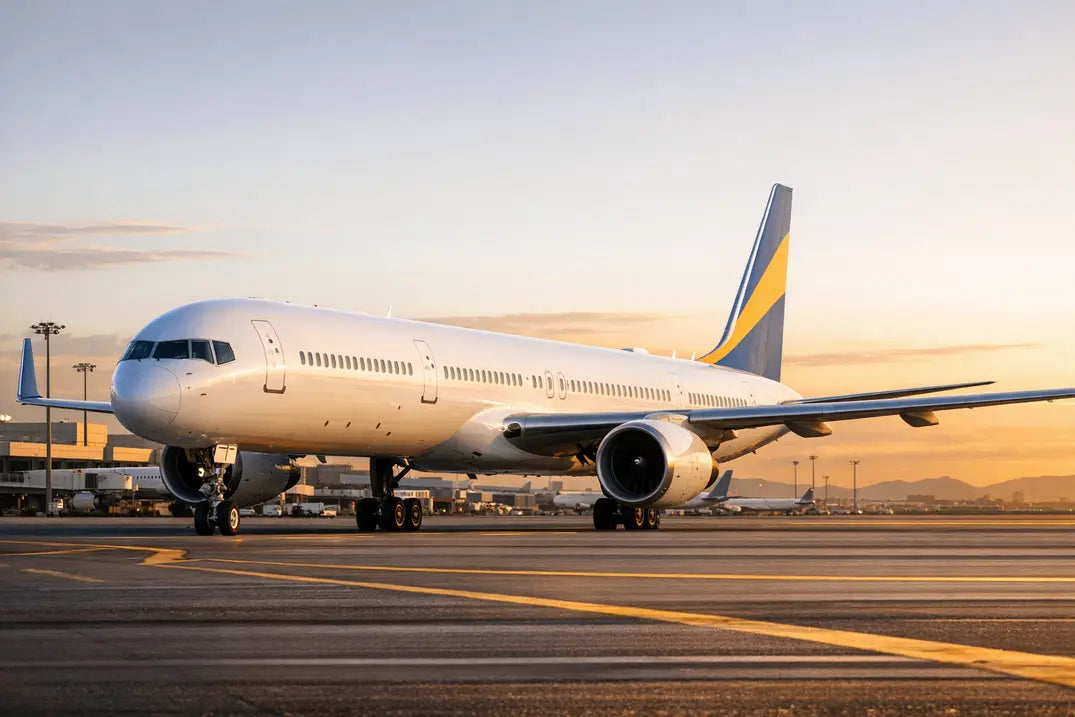
The Boeing 757-300 is the longest single-aisle twinjet ever produced. Its fuselage measures 178 ft 7 in (54.43 m), which is 23 ft 4 in (7.11 m) longer than the 757-200, achieved through a forward plug of 13 ft 4 in (4.06 m) and an aft plug of 10 ft (3.05 m). This stretch provides a 20% increase in passenger capacity and roughly 40% more lower-hold cargo volume. The variant retains the same wing, tail, cockpit, and engine options as the 757-200, but incorporates structurally reinforced wings, engine pylons, and landing gear to handle a higher maximum takeoff weight of 272,500 lb (123,600 kg). A retractable tailskid, similar to those on the 767-300 and 777, was added to protect against tail strikes during rotation and landing. Boeing also linked a pitch-attitude sensor to the spoiler deployment system: if the aircraft approaches touchdown at an excessively nose-high attitude, the three outboard spoilers on each wing are automatically held down to produce a corrective nose-down moment. Because boarding tests revealed the longer cabin could add up to eight minutes of turnaround time, Boeing and Condor jointly developed zone-based boarding procedures. Fuel capacity remains unchanged from the 757-200, which reduces maximum range to approximately 3,395 nmi (6,287 km) compared to the 757-200's 3,915 nmi (7,250 km).
Key variant identifiers that distinguish the Boeing 757-300 from the 757-200:
- Overall length: 178 ft 7 in (54.43 m) versus 155 ft 3 in (47.32 m)
- Passenger capacity: up to 289 (single class) or 243 (two class), versus up to 239 or 200
- Maximum certified capacity: 295 passengers (six standard doors, two smaller aft doors, plus overwing exits on each side)
- MTOW: 272,500 lb (123,600 kg) versus 255,000 lb (115,680 kg)
- Engine options: Rolls-Royce RB211-535E4B or Pratt & Whitney PW2043
- Retractable tailskid with body-contact indicator and modified spoiler deployment logic
- Redesigned cabin interior based on Next Generation 737/777, with larger bins and indirect lighting
- Strengthened landing gear, new wheels, 26-ply tyres, and upgraded brakes
- Blended winglets (retrofit, available from 2009 via Aviation Partners Boeing)

A Delta Air Lines Boeing 757-200, registration N713TW, is shown in midair with landing gear deployed on final approach to Boston Logan International Airport in December 2024.
Boeing 757 300 Technical Specifications, Systems and Engine Options
The Boeing 757 300 was designed as a high capacity, medium range narrowbody to serve the European charter market and offer airlines a lower cost alternative to the wide body Boeing 767 200. Its core engineering trade off is straightforward: stretch the proven 757 200 fuselage by 7.11 m (23 ft 4 in) to gain roughly 20% more seats and nearly 50% more lower hold cargo volume, while retaining the same wing, cockpit and powerplant options. Because fuel capacity is unchanged, the 757 300 trades some range for payload capacity, resulting in a published maximum range of approximately 3,395 nmi (6,288 km) compared with over 3,900 nmi for the shorter 757 200. The airframe received strengthened wings, engine pylons, landing gear and centre fuselage section, plus new wheels, 26 ply tyres, uprated brakes and a retractable tailskid to prevent tail strikes during rotation.
At 178 ft 7 in (54.43 m) in length, the 757 300 remains the longest single aisle twinjet ever produced. It shares a common type rating with the Boeing 767 family, meaning flight crews qualified on either aircraft can transition with minimal additional training. Only 55 examples were built before production ended in 2004, yet these airframes continue to serve operators on high density domestic and medium haul routes.
- Overall length: 54.43 m (178 ft 7 in)
- Wingspan: 38.05 m (124 ft 10 in); 41.0 m (134 ft 7 in) with optional Aviation Partners blended winglets
- Height: 13.6 m (44 ft 6 in)
- Wing area: 185.25 m² (1,994 sq ft); supercritical section, 25° sweep at quarter chord
- Fuselage exterior width: 3.76 m (12 ft 4 in); cabin width 3.54 m (139.3 in), six abreast economy seating
- MTOW: 123,600 kg (272,500 lb)
- Maximum landing weight (MLW): 101,610 kg (224,000 lb)
- Fuel capacity: approximately 43,490 litres (11,490 US gal), unchanged from the 757 200
- Typical two class seating: 243 passengers (12 first at 36 in pitch, 231 economy at 32 in pitch); high density single class up to 280 at 28 in pitch; maximum certified exit limit 295
- Range (manufacturer, max pax): approximately 3,395 nmi (6,288 km)
- Maximum cruise speed (Mmo): Mach 0.86; normal cruise approximately Mach 0.80 (858 km/h) at FL350
- Service ceiling: approximately 12,800 m (42,000 ft)
- Engines: two underwing turbofans; Rolls Royce RB211 535E4 B (43,100 lbf) or Pratt & Whitney PW2040/PW2043 (41,700/43,000 lbf)
- Avionics baseline: Honeywell Pegasus FMS, six Rockwell Collins CRT displays, EFIS, EICAS; three ADIRUs on the 757 300
- Noise compliance: ICAO Chapter 3 and Chapter 4 with ample margins (RB211 535E4 variant noted for 6 dB margin to Chapter 3)
Systems, Flight Controls and Handling Technology
The 757 300 retains the conventional hydraulically powered flight control architecture of the 757 family. Primary flight controls (ailerons, elevators, rudder) and secondary surfaces (spoilers, flaps, slats) are driven by three independent hydraulic systems (left, right and centre) operating at 3,000 psi. Flight control components are distributed across all three systems so that any single system can provide adequate controllability. The left and right systems are each powered by one engine driven pump and one electric motor driven pump, while the centre system uses two electric pumps. A ram air turbine (RAT) is available as a backup to power the centre system flight controls in the event of dual engine failure. A power transfer unit (PTU) can transfer hydraulic energy from the right system to the left to operate flaps, slats, landing gear and nose wheel steering if the left system loses pressure.
The flight deck uses six colour CRT displays arranged in an EFIS/EICAS configuration, a design shared with the 767 that was among the first glass cockpits in commercial aviation. On the 757 300, Boeing introduced three Air Data/Inertial Reference Units (ADIRUs), which combine the functions of the separate Air Data Computers and Inertial Reference Systems fitted to the 757 200. The Pegasus flight management system, standard on the 757 300, offers optional software for GPS, FANS and SATCOM integration, along with enhanced EICAS and improved built in test (BITE) functions. A notable airframe level feature is the carbon brake option: the 757 was the first subsonic jetliner to offer factory fitted carbon brakes (supplied by Dunlop), delivering significant weight savings over steel units.
Published performance figures for the 757 300 should be interpreted with care. Actual range, fuel burn and field length vary considerably depending on operator selected MTOW, cabin configuration and passenger count, atmospheric conditions (temperature, pressure altitude, wind), runway surface state and bleed air extraction settings. Manufacturer range values typically assume long range cruise, standard atmospheric conditions and a specific passenger count with baggage. Airlines operating in hot and high environments or with denser seating layouts will see different results from those flying lighter loads on temperate sea level routes.
Powerplant Options: Rolls Royce RB211 535E4 and Pratt & Whitney PW2000
The Boeing 757 300 was offered with two engine families: the Rolls Royce RB211 535E4 series and the Pratt & Whitney PW2000 series. The majority of 757 300 airframes were delivered with Rolls Royce engines, consistent with the overall 757 programme where the RB211 535 powered nearly 60% of all delivered aircraft.
The RB211 535E4 B, rated at 43,100 lbf takeoff thrust, was the principal engine on the 757 300. It is a three shaft, high bypass turbofan with a bypass ratio of 4.3:1 and a fan diameter of 74.1 inches. The three shaft architecture allows each spool (low pressure fan, intermediate pressure compressor and high pressure compressor) to rotate at its optimal speed, reducing the need for variable guide vanes and yielding a shorter, stiffer engine that maintains tighter compressor tip clearances over time. The RB211 535E4 was the first engine to feature wide chord fan blades, a technology that improved efficiency, reduced noise and increased resistance to foreign object damage. This engine is recognized as one of the quietest in its class, meeting ICAO Chapter 4 limits with comfortable margins. It also achieved 180 minute ETOPS approval on the 757 in 1990. Beyond the 757, the RB211 535E4 was certified on the Tupolev Tu 204 120. The broader RB211 family also powered variants of the Boeing 747 and Boeing 767, and its three spool design concept evolved directly into the Rolls Royce Trent family of engines.
The Pratt & Whitney PW2000 alternative, offered in PW2040 (41,700 lbf) and PW2043 (43,000 lbf) ratings for the 757 300, is a dual spool, axial flow turbofan with a bypass ratio of 6.0:1. It holds the distinction of being the first commercial engine certified with Full Authority Digital Engine Control (FADEC) technology in 1984, enabling precise electronic management of engine parameters including thrust setting via Engine Pressure Ratio (EPR). The PW2043 variant, launched in 1994, provides over 43,000 lbf of thrust and was intended to offer additional performance capability for the heavier 757 300, although in practice most PW2000 equipped 757 300s received the PW2040. The military derivative of the PW2000, designated F117, is the exclusive powerplant for the Boeing C 17 Globemaster III strategic airlifter, and the PW2040 also powers the C 32A (the military 757 used for U.S. government VIP transport). Both engine families are approved for 180 minute ETOPS on the 757, providing operators with full flexibility for extended overwater operations.
Comparison of Boeing 757-300 vs Similar Medium-Haul Aircraft
Scroll horizontally to see more
| Parameter | Boeing 757-300 | Boeing 757-200 | Airbus A321-200 | Boeing 767-300ER |
|---|---|---|---|---|
| Entry into service | 1999 | 1983 | 1996 | 1988 |
| Engines | 2 × PW2043 or RB211-535E4 | 2 × PW2037 or RB211-535E4 | 2 × CFM56-5B or IAE V2500 | 2 × CF6-80C2 or PW4000 |
| Length | 54.5 m | 46.7 m | 44.5 m | 54.9 m |
| Wingspan | 38.1 m | 38.1 m | 34.1 m | 47.6 m |
| Height | 13.6 m | 13.6 m | 11.8 m | 15.9 m |
| Typical seating and layout | 3-class: 240–280 passengers | 3-class: 180–220 passengers | 2-class: 185–220 passengers | 3-class: 260–290 passengers |
| MTOW | 123 t | 116 t | 93 t | 186 t |
| Range | 3,395 nm | 3,900 nm | 3,200 nm | 5,990 nm |
| Cruise speed | 0.80 Mach | 0.80 Mach | 0.80 Mach | 0.80 Mach |
| Service ceiling | 42,000 ft | 42,000 ft | 39,000 ft | 43,000 ft |
| Program note | Stretched high-capacity 757 variant for dense medium-haul routes | Baseline 757 model for efficient short/medium-haul operations | Main European narrowbody competitor with similar capacity | Widebody with twin-aisle for longer transcontinental missions |
Scroll horizontally to see more
This table compares the Boeing 757-300 with similar medium to long-haul aircraft in terms of dimensions, capacity, range, and performance. The 757-300 offers high passenger capacity and shares many features with the 757-200 but has a longer fuselage. Compared to the Airbus A321-200, it offers greater range and capacity, while the 767-300ER is larger and suited for longer routes with a higher MTOW and range.
Boeing 757-300 Operations: Typical Routes, Missions and Airlines Worldwide
The Boeing 757-300 was designed from the outset as a high-capacity, medium-range workhorse. With a maximum range of 3,395 nautical miles (6,288 km) and a maximum certified capacity of 295 passengers, the stretched variant trades some of the 757-200's range for roughly 20% more seats and nearly 50% more lower-hold cargo volume. Typical missions fall in the 2 to 6 hour flight-time bracket, covering domestic transcontinental hops in the United States, leisure routes from Northern Europe to the Mediterranean and North Africa, and selected inter-hub services. Both Delta Air Lines and United Airlines deploy their 757-300 fleets exclusively on domestic U.S. routes, linking major hubs such as Detroit, Minneapolis, Chicago O'Hare, and Denver to high-demand destinations in Florida, California, Hawaii, and Las Vegas. European leisure operators historically used the aircraft on 3 to 5 hour sectors from Germany to vacation spots in Spain, Turkey, Egypt, and the Canary Islands.
Operationally, the Boeing 757-300 fits best into hub-and-spoke networks where demand justifies a larger narrowbody but does not warrant a widebody aircraft. In the United States, Delta and United typically slot it on high-frequency trunk routes between major hubs and key spoke cities, often achieving multiple daily rotations. The type was also deployed on point-to-point leisure corridors in Europe, where charter and leisure carriers used it to shuttle holidaymakers from northern gateways to southern resorts. Its ability to operate from standard narrowbody gates and taxiways gives it a practical advantage at congested airports, although its fuselage length of 54.4 m does require a retractable tailskid to prevent tail strikes on rotation. One well-documented challenge is turnaround time: boarding the Boeing 757-300 can take up to eight minutes longer than the shorter 757-200 because of the additional rows served through a single aisle. To address this, Boeing and launch customer Condor developed zone-based boarding procedures early in the programme. The single-aisle layout also means that deplaning at high-density configurations can be time-consuming, which reduces effective daily utilisation compared to twin-aisle alternatives of similar capacity. Its close relationship with the Boeing 767-200ER, with which it shares a common type rating and numerous systems, has historically allowed operators to move crews flexibly between fleets.
Where the Boeing 757-300 Operates
North America is by far the largest theatre for the Boeing 757-300. The two remaining major operators, Delta Air Lines (16 aircraft) and United Airlines (approximately 18 to 21 aircraft), inherited their fleets through mergers with Northwest Airlines and Continental Airlines respectively. Both carriers restrict scheduled 757-300 services to domestic U.S. routes. In Europe, the type has been a fixture of the leisure and charter market since 1999, when Condor became the launch customer. Icelandair also operated the type on routes from Keflavik to high-demand European cities such as London-Heathrow. Other historical operators in Europe include Thomas Cook Airlines and JMC Air. In the Middle East, Arkia Israeli Airlines used the 757-300 on both charter flights and scheduled services to European destinations. The type has had no significant presence in Asia, Africa, or South America as a mainline scheduled aircraft, although it has occasionally appeared in those regions on ad-hoc charter or wet-lease operations. One such example is Skyline Express Airlines (Ukraine), which has operated ex-Condor 757-300s on charter flights within Europe.
- North America: Delta Air Lines operates 16 Boeing 757-300s from hubs including Detroit, Minneapolis, and Atlanta on domestic routes to Florida, California, Hawaii, and Las Vegas. United Airlines deploys its fleet primarily from Chicago O'Hare and Denver, serving Los Angeles, San Francisco, Honolulu, and Houston. Historically, Continental Airlines, Northwest Airlines, and American Trans Air also flew the variant before mergers or cessation of operations.
- Europe: Condor was the launch customer and operated up to 9 units on leisure routes from Frankfurt and Düsseldorf to the Mediterranean, Canary Islands, and North Africa. The airline retired its last 757-300 in November 2025, transitioning to an all-Airbus fleet. Icelandair used the type from Keflavik on busy routes to London and New York, and has since wound down operations in favour of the Airbus A321LR/XLR. Thomas Cook Airlines and JMC Air also operated the variant on UK-based holiday routes before those airlines ceased operations.
- Middle East: Arkia Israeli Airlines operated up to two 757-300s on charter and scheduled services from Israel to European leisure destinations such as Amsterdam and Warsaw.
- Asia, Africa, and South America: The Boeing 757-300 has had no major scheduled operators in these regions. Any appearances have been limited to one-off charters or wet-lease agreements.
Boeing 757-300 Typical Seating Configurations
Seating on the Boeing 757-300 varies significantly depending on the operator's business model. According to Boeing's Airport Planning document, the aircraft can be configured for 243 passengers in a typical dual-class arrangement or up to 279 in all-economy. The maximum exit-limit capacity is 295 passengers. In practice, U.S. network carriers favour a three-class approach: both Delta and United seat 234 passengers, split between 24 first-class seats in a 2-2 layout and 210 economy seats arranged 3-3. Delta further subdivides economy into 38 Delta Comfort+ and 172 Main Cabin seats, while United offers 54 Economy Plus and 156 standard economy seats. These configurations prioritise a domestic first-class product and extra-legroom sections that generate ancillary revenue on transcontinental flights.
Leisure and charter operators have historically used much denser layouts. Condor configured its aircraft with 275 all-economy seats, while Thomas Cook Airlines operated the densest known layout at 280 seats. Icelandair took a middle path, offering 22 Saga business-class seats alongside 203 economy seats for a total of 225. Seat pitch across all operators typically ranges from 28 to 29 inches in high-density charter configurations up to 37 inches in first class. Detailed seat maps can be found on the Delta Air Lines fleet page and on SeatMaps.com for United Airlines. The 757-300 debuted a cabin interior derived from the Next Generation 737 and 777, featuring sculptured ceiling panels, indirect lighting, and larger overhead bins, giving the stretched fuselage a more contemporary feel than earlier 757-200 cabins.
In this video, watch a Delta Air Lines Boeing 757-300 (registration N585NW) take off from Hartsfield–Jackson Atlanta International Airport, filmed from seat 19F in Comfort+ on Flight 1633 to Orlando using an iPhone 12 Pro Max.
Boeing 757 300 Safety Record: Incidents, Accidents and How Safe It Really Is
The Boeing 757 300 holds a notably clean operational safety record. With only 55 airframes produced, the stretched variant entered commercial service with Condor in March 1999 and has accumulated over two decades of revenue flying without a single hull loss or fatal accident attributed to the type. As of late 2024, roughly 45 of those 55 aircraft remained on operator registries, flown primarily by Delta Air Lines, United Airlines, Condor, and Icelandair. In that time, reported events involving the Boeing 757 300 have been limited to minor operational incidents such as turbulence encounters, technical diversions, and precautionary returns, none of which resulted in fatalities or significant structural damage. The broader Boeing 757 family, including the far more numerous 757 200, has been involved in 47 aviation occurrences and 10 hull loss accidents over more than four decades of service across 1,050 aircraft built. Those events produced a total of 575 occupant fatalities, but it is essential to note that every fatal hull loss on the 757 platform involved the 757 200 series, and several were driven by external factors such as terrorism or maintenance lapses rather than inherent design deficiencies. For anyone exploring other Boeing narrowbody variants, a look at the Boeing 737 300QC offers useful context on how safety cultures evolved across the manufacturer's single aisle lineup.
Notable 757 Family Accidents and the Lessons They Produced
Although no major accident has ever involved a Boeing 757 300, three significant events on the closely related 757 200 reshaped global aviation safety standards. Understanding them is relevant because the two variants share the same type certificate, cockpit design, and many systems.
- American Airlines Flight 965 (December 1995) — An American Airlines 757 200 operating from Miami to Cali, Colombia, struck mountainous terrain during a night approach, killing 159 of the 163 occupants. The investigation, conducted by Colombia's Aeronáutica Civil with NTSB assistance, attributed the crash to navigational and crew resource management errors, including the misuse of the Flight Management System. This controlled flight into terrain (CFIT) event became a catalyst for mandating Terrain Awareness and Warning Systems (TAWS) on all transport category aircraft, a requirement the FAA finalized in March 2000. Since TAWS became standard, the global rate of CFIT accidents has dropped dramatically.
- Birgenair Flight 301 (February 1996) — A charter Birgenair 757 200 departing Puerto Plata, Dominican Republic, crashed into the Atlantic shortly after takeoff, killing all 189 on board. Investigators determined that a pitot tube, likely blocked by a wasp nest after the aircraft sat uncovered on the ground for 20 days, produced erroneous airspeed indications that confused the crew. In response, the FAA directed that simulator training for all airline pilots must include a blocked pitot tube scenario, and Boeing modified cockpit warnings so that both pilots would be alerted when their instruments disagree. The event also prompted Europe to establish the Safety Assessment of Foreign Aircraft (SAFA) programme, which later evolved into the EU safety list.
- Aeroperú Flight 603 (October 1996) — An Aeroperú 757 200 departing Lima for Santiago crashed into the Pacific Ocean, killing all 70 on board. The cause was traced to adhesive tape left over the aircraft's static ports after routine cleaning, rendering all cockpit altitude and airspeed instruments unreliable. The NTSB subsequently recommended that conspicuous, flagged covers be used to protect static ports during maintenance, a standard that is now universal across commercial fleets worldwide.
In each of these events, the aircraft's structure and engines functioned as designed. The causal factors were external: human error in navigation, inadequate ground maintenance procedures, and insufficient cockpit alerting logic for instrument disagreements. The safety improvements that followed, including TAWS mandates, revised pilot training syllabi, and stricter maintenance protocols, benefit every Boeing 757 variant still in service today, including the 757 300.
How Safe Is the Boeing 757 300 Today?
When measured against its traffic volume and years in operation, the Boeing 757 300 stands out as one of the safest commercial aircraft variants in the current fleet. Zero hull losses across more than 25 years of service, operated by major carriers with rigorous safety oversight from the FAA and EASA, place it firmly in the top tier of safety performance for any narrowbody type. The broader 757 programme also benefits from a mature design philosophy: dual engine redundancy, a robust hydraulic architecture, and a two crew glass cockpit shared with the Boeing 767 under a common type rating, which simplifies training and reduces the risk of procedural gaps. Standard Operating Procedures for the type have been refined over four decades by dozens of operators worldwide, and regulators continue to issue Airworthiness Directives whenever inspections reveal potential concerns, such as upper fuselage fatigue checks mandated after a 2010 fuselage section loss on an older 757 200. According to the IATA 2024 Annual Safety Report, the industry wide accident rate stands at 1.13 per million flights and commercial aviation successfully transported 5 billion passengers on over 40 million flights in 2024. Aviation remains one of the safest modes of public transportation, and the Boeing 757 300's unblemished record only reinforces that conclusion for passengers who fly on this stretched narrowbody today.
01 What is the typical range of the Boeing 757-300?
The Boeing 757-300 has a maximum range of around 3,400 nautical miles (about 6,300 km), making it ideal for medium-haul routes like transcontinental flights or high-density regional services. This range supports full payloads on missions up to 3,395 nautical miles with its higher maximum takeoff weight of 272,500 pounds. Fuel efficiency remains competitive despite the stretched fuselage.
02 Which airlines operate the Boeing 757-300 and on what routes?
Delta Air Lines is a primary operator of the Boeing 757-300, using it for domestic U.S. routes such as transcontinental flights between New York and Los Angeles. Other airlines have employed it on high-density medium-haul paths in Europe and North America. Its capacity suits busy corridors where efficiency matters over ultra-long hauls.
03 How does the cabin experience feel on the Boeing 757-300?
The Boeing 757-300 accommodates up to 289 passengers in a single-aisle layout, stretched longer than the 757-200 for more seats without sacrificing narrow-body comfort. Wing-mounted engines reduce cabin noise levels effectively, and the design offers good overhead bin space. Passenger capacity emphasizes high-density configurations over extra luxury.
04 What are the performance specs of the Boeing 757-300 compared to the 757-200?
05 What is the safety record and key design features of the Boeing 757-300?
The Boeing 757-300 shares the strong safety record of the 757 family, with advanced turbofan engines and a retractable tailskid to prevent tailstrikes during its steeper rotation from the longer fuselage. It meets rigorous certification standards for maneuver loads up to 2.5g and has a design life of over 43,000 hours. No unique safety issues stand out compared to other variants.
06 What should passengers know about seats and flying on the Boeing 757-300?
Exit row and bulkhead seats offer extra legroom on the Boeing 757-300, though high-density setups mean tighter pitches around 71-74 cm; check airline maps for specifics. Large windows provide good views, and the aircraft handles turbulence steadily due to its wing design. It's best for medium flights where capacity trumps wide-body space.