

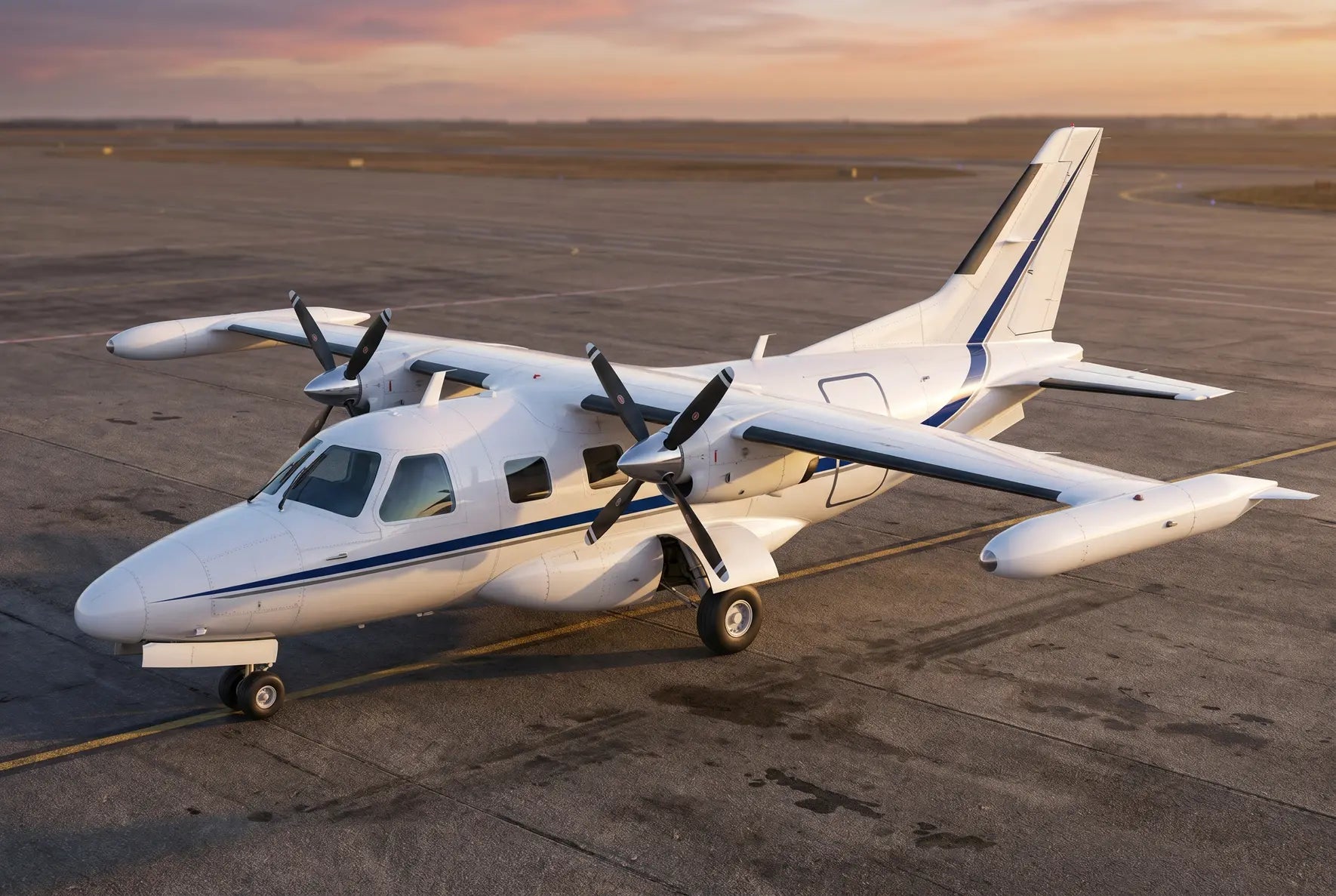
History and Development of the Mitsubishi MU-2 Turboprop Twin
The Mitsubishi MU-2 is a high-wing, twin-turboprop utility and business aircraft developed by Mitsubishi Heavy Industries (MHI) of Japan. It was the company's first post-war civil aircraft and was conceived to deliver near-jet cruise speeds, a pressurized cabin and genuine short-field capability in a compact airframe, positioning it against contemporary American and European light twins. Conceptual work began in the mid-to-late 1950s, with the formal design effort clearly underway by the late 1950s and the prototype taking shape as the MU-2A.
The MU-2A prototype made its first flight on 14 September 1963, powered by Turbomeca Astazou turboprops driving variable-pitch propellers. The type entered the corporate and utility market in 1963, and a key marketing milestone came in 1964 with a static display at the New York World's Fair, signaling MHI's intent to sell in North America. All production examples carried the MU-2B designation, and aircraft were built in Japan and later assembled at a U.S. facility in San Angelo, Texas. Early aircraft were certified by Japan's Civil Aviation Bureau and accepted by the FAA under an import type certificate; in 1976 the FAA issued a domestic type certificate to support U.S. production. Production ran from 1963 to 1986 in the United States, with the last Japanese-built airframe completed in January 1987, for a total of roughly 704 aircraft. Full configuration details, engine dash-numbers and weights are documented in the FAA Mitsubishi MU-2B program records and summarized in references such as the type history.
What sets this variant apart
Within the MU-2B family, production aircraft are commonly grouped into short-body and long-body (stretched fuselage) versions. Short-body models typically seat around five passengers and include the Solitaire series, while the stretched Marquise (MU-2B-60) adds cabin volume and seating for roughly six passengers, becoming the most refined long-body executive variant. Across the production run the MU-2 progressively adopted the Garrett TPE331 (now Honeywell) turboprop, replacing the earlier Astazou engines, alongside incremental improvements to systems, fuel capacity and weights. Defining design traits include the high wing, a short-span, high-loading wing for fast cruise, full-span double-slotted flaps for short-field work, and spoilers in place of conventional ailerons for roll control.
The following items help identify and distinguish MU-2 sub-variants:
- Engines: early Turbomeca Astazou; production aircraft use Garrett/Honeywell TPE331 turboprops.
- Body length: short-body (about 5 passengers, e.g. Solitaire) versus long-body stretched fuselage (about 6 passengers, e.g. Marquise MU-2B-60).
- Roll control: spoilers rather than ailerons, paired with full-span double-slotted flaps.
- Wing: short span and high wing loading for high cruise speed and short take-off and landing performance.
- Certification: all production models designated MU-2B with numeric suffixes (e.g. -30, -35, -36, -40, -60) indicating configuration blocks.
The MU-2 also acquired a debated U.S. safety reputation, attributed largely to its demanding handling and the gap between its performance and some operators' turboprop experience rather than a single design flaw. After investigations into uncontrolled descents in the early 1980s and icing-related accidents abroad, the FAA conducted a comprehensive evaluation and issued Special Federal Aviation Regulation No. 108 (SFAR 108) in 2008, mandating type-specific ground and flight training, annual recurrent checks and emphasis on engine-out, icing and speed-discipline procedures. Reported accident rates fell substantially afterward, reinforcing that disciplined, type-specific training is central to operating the aircraft safely. Pilots interested in the broader U.S. regional and operator landscape can read more about carrier conditions in this overview of Mesa Airlines pilot conditions.

A Mitsubishi MU-2B aircraft in flight, displaying its distinctive twin-engine turboprop design. The aircraft is captured against a clear blue sky with its landing gear extended.
Mitsubishi MU-2: Technical Specifications, Systems and Performance
The Mitsubishi MU-2 is a pressurised, high-wing twin turboprop conceived as a fast, capable utility and business aircraft. Its design priorities are speed and field performance rather than payload bulk, which is why the type cruises closer to a light jet than to most turboprops of its era while still operating from relatively short runways. The MU-2 was produced in short-body and long-body forms, later refined into the Solitaire (short fuselage) and Marquise (stretched fuselage) variants, each tuned for different range, cabin and weight trade-offs.
What sets the MU-2 apart technically is its wing. Lateral control comes from spoilers rather than ailerons, freeing the trailing edge for full-span double-slotted flaps. This arrangement gives the small, high-aspect-ratio wing a wide flap area for slow approaches while preserving roll authority, a configuration documented in detail by aviation reference sources and by the manufacturer's own Mitsubishi Heavy Industries MU-2 pages.
- Configuration: high-wing, pressurised, twin turboprop with spoiler roll control and full-span flaps
- Wingspan: approximately 10 m (short-body) to 12 m (long-body)
- Length: approximately 12 m
- Engines: two Garrett/Honeywell TPE331 turboprops (model varies by variant)
- MU-2B-60 / Marquise MTOW: about 11,575 lb
- Service ceiling: commonly 30,000 ft on later long-body variants
- Maximum cruise: roughly 300 kt (Marquise); short-body figures near 314 kt are also published
- Range: typically quoted around 1,100 nm maximum on the Marquise, depending on payload and reserves
- Fuel capacity (Marquise): about 2,700 lb
- Field performance (Marquise): balanced field length near 3,400 ft, landing distance around 4,583 ft
Systems and handling-relevant technology
The MU-2's spoiler-based roll control changes how the aircraft handles in the pattern: with no ailerons consuming wing area, the full-span flaps deliver strong low-speed lift, while spoilers also assist in descent and ground deceleration. The single-engine and asymmetric-thrust behaviour is closely tied to this layout, which is why type-specific training is mandated under an FAA Special Federal Aviation Regulation (SFAR 108) for MU-2 operations. The TPE331 is a single-shaft engine in which the propeller is geared directly to the compressor-turbine spool, giving immediate power response and integral propeller governing through the engine's fuel control and propeller pitch system. Pilots transitioning from piston twins, such as those moving up from larger types covered in our look at the Boeing 747-200C, encounter very different power-management and condition-lever procedures here.
Published performance figures for the MU-2 should be read with care. Numbers vary by specific sub-variant (for example the MU-2P, MU-2B-30 or MU-2B-60), by installed engine model, cabin density, takeoff weight, and by atmospheric and runway assumptions used in the source. A balanced field length or maximum range quoted at sea level and standard conditions will differ from real-world results at higher density altitude or heavier loads, so the values above are best treated as representative rather than absolute.
The Garrett/Honeywell TPE331 engine
Every MU-2 is powered by the Garrett AiResearch TPE331, a single-shaft turboprop first designed in 1959, first run in 1963 and certified in 1965. The programme passed through corporate succession from Garrett AiResearch to AlliedSignal and finally to Honeywell Aerospace, which markets the engine today across a power range of roughly 575 to 1,650 shaft horsepower. The MU-2 used several members of the family as the type matured, including the TPE331-25 on early MU-2B aircraft and the TPE331-10 (and -10-501M on the Solitaire) on later long-body and short-body models, as catalogued by engine reference sources.
The TPE331 has been one of the most widely installed turboprops in its class. Beyond the MU-2, it powers the Rockwell Turbo Commander series, the Fairchild Swearingen Metroliner, the Cessna 441 Conquest II, the Dornier 228, the BAe Jetstream 31/41, the CASA C-212 Aviocar, the Ayres Thrush agricultural aircraft, and the unmanned General Atomics MQ-9 Reaper. This broad fleet supports a mature parts and overhaul ecosystem, an important practical consideration for owners and operators evaluating the MU-2 today.
Mitsubishi MU-2 vs PC-12 NG vs King Air C90GTx vs Cessna 441: Specs Comparison
Scroll horizontally to see more →
| Parameter | Mitsubishi MU-2 | Pilatus PC-12 NG | Beechcraft King Air C90GTx | Cessna 441 Conquest II |
|---|---|---|---|---|
| Entry into service | 1967 | 2008 | 2010 | 1977 |
| Engines | 2 × Garrett AiResearch TPE331 turboprops | 1 × Pratt & Whitney Canada PT6A-67P turboprop | 2 × Pratt & Whitney Canada PT6A-135A turboprops | 2 × Garrett AiResearch TPE331-8 turboprops |
| Length | 12.0 m | 14.4 m | 10.8 m | 11.9 m |
| Wingspan | 11.9 m | 16.3 m | 15.3 m | 15.0 m |
| Height | 4.0 m | 4.3 m | 4.3 m | 3.7 m |
| Typical seating and layout (short description + approximate passengers) | Executive: 6–9 passengers | Executive: 6–9 passengers | Executive: 6–8 passengers | Executive: 6–9 passengers |
| MTOW | 5.25 t | 4.74 t | 4.76 t | 4.58 t |
| Range | 1,260 nm | 1,800 nm | 1,260 nm | 2,000 nm |
| Cruise speed | 0.43 Mach | 0.52 Mach | 0.41 Mach | 0.49 Mach |
| Service ceiling | 29,500 ft | 30,000 ft | 30,000 ft | 35,000 ft |
| Program note | High-performance Japanese twin turboprop aimed at fast executive and commuter operations, notable for its speed and compact airframe. | Large single-engine turboprop positioned as a versatile business and regional utility aircraft with strong range and cabin comfort. | Light twin turboprop in the King Air family targeting short-haul business, air-taxi and charter missions from shorter runways. | High-speed twin turboprop designed as a pressurized executive and corporate transport bridging piston twins and light jets in performance. |
Scroll horizontally to see more →
The table compares key specifications of four turboprops, highlighting major trade-offs in range, speed, and configuration. The MU-2 is compact and relatively heavy for its size, with twin TPE331 engines and a 1,260 nm range. PC-12 NG offers higher cruise (0.52 Mach) and longer range (1,800 nm) with a single PT6A. King Air C90GTx matches the MU-2’s range but cruises slower. Cessna 441 leads range (2,000 nm) and ceiling (35,000 ft).
Mitsubishi MU-2 Operations: Routes, Missions and Airlines Worldwide
The Mitsubishi MU-2 was conceived as a true utility twin turboprop, and the letter U in its designation literally stands for "Utility." That philosophy explains why the type spans so many roles: corporate and charter transport, light air cargo and bank-check hauling, air ambulance work, coastal patrol, search and rescue, liaison and reconnaissance, and even military training support. With cruise speeds of roughly 280–300 kt and ranges up to about 1,113–1,260 nm (2,061–2,334 km) depending on the variant, the aircraft delivers near-jet block times while keeping turboprop operating economics.
Typical sectors are short to medium. The aircraft is most often used point-to-point on legs of a few hundred nautical miles, with the reserve fuel to stretch to 800–1,100 nm non-stop when required. An AOPA operational review notes that on an 800-mile trip the MU-2 arrives roughly an hour earlier than a comparable cabin-class piston twin, burning around 200 gallons of Jet-A. Cargo and check-hauling operators tend to fly multi-leg night sequences into regional fields, while air ambulance and government missions favour fewer but longer flights. Fleet-wide, surviving aircraft still average more than 30 flight hours per month.
Operational environments and challenges
The MU-2 thrives on hub-and-spoke and point-to-point networks linking secondary and regional airports rather than major hubs. Short-field performance is a defining trait: a long-body MU-2B-60 Marquise needs roughly 2,700 ft for takeoff and a balanced field length near 3,400 ft, thanks to full-span double-slotted Fowler flaps and spoiler-based roll control. Its small, high-loading wing also gives strong icing capability, making it useful in demanding weather. The chief operational challenge is pilot discipline: the type earned a controversial early safety record, prompting the FAA to issue SFAR 108, which mandates standardised initial and recurrent training equivalent to a type rating. AOPA reports the accident rate improved significantly afterwards. Operators interested in comparable rugged regional turboprops may also review our overview of the Antonov An-26.
Where the Mitsubishi MU-2 operates
The type was built in 704 examples and exported widely, so it appears across all four broad regions. In Asia, Japan remains the heartland, where government services fly the largest organised fleet for coastal patrol, search and rescue, and liaison work. In North & South America, the United States holds the biggest surviving fleet, dominated by corporate, charter, light-cargo, check-hauling and air-ambulance roles, while Latin American operators used exported aircraft for regional utility transport. In Europe, use has centred on business and charter transport. In Africa, aircraft passed into utility, charter and survey roles, leveraging short-field performance.
- Europe: corporate and charter operators absorbed many new and used MU-2s for executive transport between regional business airports, broadly mirroring North American business-aviation use.
- North & South America: the United States Air Force uses contractor-operated MU-2s at Tyndall AFB to provide airborne targets and traffic for Air Battle Manager training, with students controlling eight MU-2 missions before progressing to fighters; numerous U.S. corporate, light-cargo and air-ambulance operators round out the fleet, while Latin American owners fly exported airframes on regional utility routes.
- Asia: the Japan Air Self-Defense Force and the Japan Coast Guard operate around forty MU-2s for search and rescue, coastline patrol and reconnaissance, alongside Japanese civil charter and ambulance use dating back to the 1960s.
- Africa: exported aircraft have served charter and utility operators, including possible survey and ambulance tasking, consistent with the type's worldwide distribution.
Typical seating and cabin layouts
The MU-2 cabin is narrow but efficient, and seating depends heavily on operator type. Network and corporate operators usually favour comfortable club or "captain's chair" layouts: short-body models such as the Solitaire seat about 4–5 passengers, while long-body variants like the MU-2B-60 Marquise offer roughly 272 cu ft of cabin and a typical six-passenger arrangement. Leisure, charter and utility operators often densify the cabin, with certified configurations reaching up to about 9–12 passengers in some setups at the expense of comfort. Air-ambulance fitments replace seats with a stretcher and attendant stations, and cargo conversions strip the interior entirely. Detailed performance and seating figures for the long-body Marquise are documented in published specifications.
In this video, Aero-TV examines the MU-2 SFAR with an expert, exploring the aircrafts airworthiness controversy and the facts behind the regulation, helping pilots and aviation fans understand the real story.
Mitsubishi MU-2 Safety Record: How Safe Is This Turboprop?
The Mitsubishi MU-2 is one of the most studied light turboprops in aviation safety circles. First flown in 1963 and built until the mid-1980s, around 704 airframes left the production line, with several hundred still flying today. Across its entire service life the type has been involved in roughly 170 accidents worldwide. Placed against decades of intensive Part 91 and Part 135 use, much of it single-pilot IFR in demanding weather, this history is significant but heavily concentrated in the years before standardized training arrived. Detailed records are catalogued by the Aviation Safety Network and the NTSB accident database, both useful for verifying figures independently.
Notable accidents and what changed afterwards
Several events shaped how the aircraft is operated and regulated today.
- South Dakota, 1993 (MU-2B-60): a state-operated aircraft lost control after a propeller blade separated in flight, attributed to fatigue in the propeller hub. The outcome was mandatory inspection and corrective action on affected propellers, a maintenance issue rather than an aerodynamic one.
- Martha's Vineyard, 2000 (MU-2B-26A): a privately operated aircraft crashed short of the runway during a low-visibility approach. The investigation focused on instrument approach execution and IFR decision-making.
- Quebec, 2016 (MU-2B-60): an aircraft was lost on approach in gusty crosswinds and poor visibility, with the inquiry centred on approach stability and crew technique, consistent with the type's historical pattern of approach and landing mishaps.
These and earlier events prompted the FAA to conduct a full safety review. Its conclusion was that the airframe was fundamentally sound and that accidents were driven mainly by inconsistent training and operation beyond pilot proficiency. The response was Special Federal Aviation Regulation 108 (SFAR 108), effective in 2008, which imposed a standardized, type-specific training, checking and currency program for every U.S.-registered MU-2. Details are published in the FAA MU-2 training and SFAR 108 resources.
How safe is the Mitsubishi MU-2?
Measured against traffic volume, the picture improved markedly after 2008. The aircraft's design philosophy explains why standardized procedures matter: it uses spoilers instead of ailerons for roll control, carries high wing loading and relies on large double-slotted flaps, giving light-jet performance but little tolerance for sloppy speed or configuration management, especially on approach, landing and go-around. Where pre-SFAR training was uneven, the regulation introduced disciplined SOPs, stabilized-approach criteria and recurrent proficiency checks, and accident frequency fell sharply afterwards. Mechanical findings in recent investigations have been rare, with attention instead on IFR decision-making, much as in other demanding operations such as the airline environments discussed in this overview of pilot conditions at Royal Jordanian. For broader context on how individual aircraft types fit into overall transport risk, the ICAO Safety Report provides authoritative global statistics. With proper type-specific training and regulatory oversight, the MU-2 operates at a risk level comparable to its peers, and aviation as a whole remains one of the safest modes of transport.
01 What kind of trips is the Mitsubishi MU-2 typically used for?
The Mitsubishi MU-2 is most often used for regional business travel, air ambulance work, cargo, special mission flights, and private owner trips. With a typical range of around 1,200–1,450 miles (about 2,000–2,300 km) depending on the variant and loading, it comfortably handles city pairs such as Dallas–Chicago, Paris–Athens, or Tokyo–Sapporo without refuelling. Its high cruise speeds of roughly 280–300 knots make it competitive with many light jets on short to medium sectors. Because it can use relatively short runways, it is well suited to secondary airports and smaller regional fields that larger airliners cannot reach.
02 What is the passenger cabin like on the Mitsubishi MU-2?
The Mitsubishi MU-2 has a pressurized cabin that typically seats 4 to 8 passengers, with some configurations accommodating up to about 10–11 in commuter layouts. The cabin is relatively narrow and not stand-up, but it offers club seating, sidewall tables on many aircraft, and good visibility through large rectangular windows. Noise levels are higher than in modern business jets but similar to many other turboprops; headsets are usually provided to reduce fatigue and improve comfort. Baggage is often split between a small internal area and an external compartment, so larger bags may be stored outside the cabin while personal items stay within reach.
03 Which airlines or operators still use the Mitsubishi MU-2 and on what types of routes?
The Mitsubishi MU-2 is no longer used by major scheduled airlines and is now found mainly in private, charter, cargo, and special-mission fleets. In North America, it is popular with small charter operators, freight companies, and air ambulance providers who fly short to medium regional routes. Some aircraft are also used by government and military agencies for liaison, training, and surveillance missions. As a result, travellers are more likely to encounter an MU-2 on an on-demand charter, medical transport, or specialist contract flight than on a regular airline schedule.
04 How does the Mitsubishi MU-2 perform compared with similar turboprop aircraft?
The Mitsubishi MU-2 is known for very strong performance, with cruise speeds around 280–300 knots and relatively high service ceilings around 29,000–33,000 feet depending on the model. This makes it faster than many comparable twin turboprops of its era and competitive in speed with some modern designs, while typically using shorter runways. Its fuel burn is efficient for the speed offered, though payload with full fuel can be modest on some variants, which leads operators to balance range against cabin load. The aircraft’s high-aspect-ratio wing with spoilers instead of conventional ailerons contributes to its distinctive handling and performance profile.
05 What should passengers know about the Mitsubishi MU-2’s safety record and design features?
Historically, the Mitsubishi MU-2 had a higher-than-average accident rate, which prompted detailed regulatory reviews and the introduction of mandatory, type-specific pilot training and maintenance standards. With these training and maintenance programs in place, the safety record has improved significantly, and regulators consider the aircraft safe when operated within its procedures. Key design features include a high wing, powerful Garrett/Honeywell TPE331 turboprop engines, and spoiler-based roll control, all of which require pilots to be specifically trained on the type. Passengers can reasonably ask operators about their MU-2 training programs and how often crews fly the aircraft, as regular experience and adherence to the training regime are important safety factors.
06 What is the passenger experience like in terms of seats, turbulence, and window views on the Mitsubishi MU-2?
Seats on the Mitsubishi MU-2 are usually arranged in a club configuration with facing pairs, giving good interaction and a business-aircraft feel, though legroom and aisle space are more limited than on larger turboprops. The high-wing design and relatively large windows give good outside views, but the wing can partially block the downward view from some seats, so window seats slightly aft of the wing root often provide the best scenery. As a small turboprop, the MU-2 can feel bumps more than a large airliner, especially at lower altitudes, but crews can often climb to smoother air thanks to the aircraft’s performance. Passengers who are sensitive to motion may prefer seats nearer the wing, where turbulence and pitch movements are usually felt a bit less than at the very rear.