

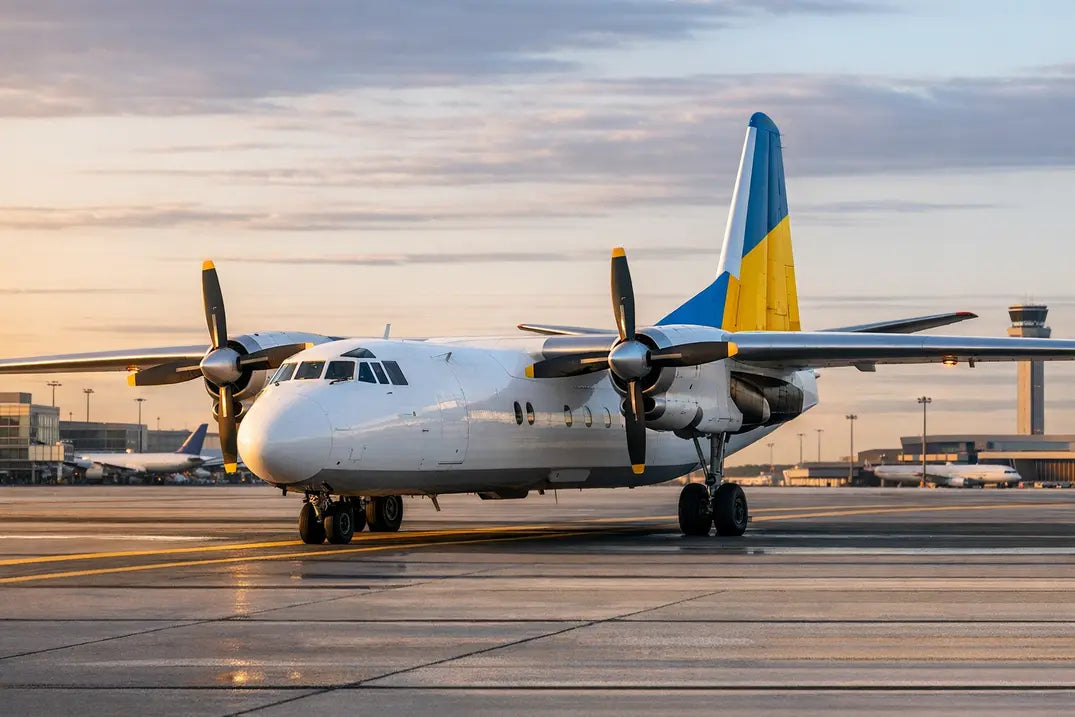
Antonov An 26: History, Development Path, and What Makes This Variant Unique
The Antonov An 26 is a twin engine turboprop transport aircraft developed by the Antonov Design Bureau in Kyiv, Ukraine (then the Soviet Union). Designed to serve both military tactical and civilian cargo roles, this versatile aircraft emerged from the need to improve upon the loading limitations of the earlier An 24 family. Since its maiden flight in 1969, the An 26 has become one of the most widely operated light transport aircraft in history, serving more than 30 countries on every inhabited continent.
Origins: From the An 24 Family to a Dedicated Cargo Transport
The Antonov Design Bureau, founded on 31 May 1946 by Oleg Antonov in Novosibirsk and relocated to Kyiv in 1952, earned a reputation for producing rugged, reliable transport aircraft suited to austere operating environments. The bureau's An 24, a short haul turboprop airliner that first flew in 1959, proved highly successful in Soviet regional aviation. However, the An 24T tactical transport derivative, while effective for supplying remote military outposts, was limited by a ventral cargo hatch that restricted the loading of vehicles and made parachute drop operations less efficient.
To address these shortcomings, the Antonov bureau began studying a new cargo focused derivative in 1966. The concept centred on replacing the belly hatch with a full rear loading ramp, a feature that would allow vehicles to be driven directly onto the cargo deck or loaded from truck bed height. In March 1968, the Soviet Ministry of Aviation Industry and the Air Force issued a joint resolution formally authorising development of the An 26 programme.
Key Milestones in the An 26 Programme
The development timeline moved quickly once the programme received official approval. The first An 26 prototype completed its maiden flight on 21 May 1969 from the Kyiv Sviatoshyn airfield, crewed by test pilot Y.N. Ketov. A second prototype followed later that year, and both aircraft appeared at the 1969 Paris Air Show at Le Bourget, marking the type's international debut. The first production example rolled off the assembly line at the Kyiv Aviation Plant on 29 August 1969.
Full series production began in 1970, and the An 26 entered operational service with the Soviet military and Aeroflot in 1972. Production continued without interruption until 1986, yielding approximately 1,398 to 1,403 aircraft (figures vary slightly between sources). Roughly 40 percent of all airframes were delivered to Soviet military units, with the remainder divided between Aeroflot and export customers. Among the first foreign operators was Poland, which received seven aircraft for the 1st Squadron, 13th Air Transport Regiment in Kraków in 1972. Subsequent deliveries reached Hungary, Romania, Czechoslovakia, Angola, Cuba, and East Germany throughout the 1970s and 1980s. For pilots and aviation professionals interested in exchanging operational knowledge about types like the An 26, dedicated aviation forums remain a valuable resource.
What Differentiates the An 26 from the An 24 and Close Sub Variants
The most significant structural change from the An 24 was the complete redesign of the rear fuselage to accommodate the cargo ramp. The fuselage was lengthened by approximately 26 centimetres aft of the wing trailing edge, and the An 24's ventral stability fins were removed, replaced by strakes flanking the base of the cargo hatch. The tailfin area and tailplane span were both increased to maintain directional stability and compensate for the aerodynamic drag introduced by the new fuselage contour.
On the powerplant side, the An 26 received uprated Ivchenko Progress AI 24VT turboprop engines, each producing 2,103 kW (2,820 ehp) and driving four bladed constant speed propellers with a diameter of 3.90 metres. A Tumansky RU 19A 300 auxiliary turbojet, producing 7.85 kN (1,760 lbf) of thrust, was housed in the starboard engine nacelle. This compact jet engine served a dual role as both an auxiliary power unit (APU) and a booster for short field or hot and high takeoffs, providing a critical capability for operations from unprepared strips.
The innovative rear ramp system could be lowered to ground level for vehicle loading or slid forward beneath the fuselage to allow cargo transfer from truck beds. Unlike the An 24T, the An 26 cargo deck could be sealed and pressurised in flight, improving operational flexibility. Maximum payload capacity reached approximately 5,500 kg, and the cabin could be rapidly reconfigured to carry up to 40 paratroopers on tip up seats or 24 stretchers in a medical evacuation layout.
The following list summarises the key variant identifiers that distinguish the baseline Antonov An 26 (NATO reporting name Curl A) from its closest relatives:
- Engines: Two AI 24VT turboprops (2,103 kW each) plus one RU 19A 300 auxiliary turbojet (7.85 kN), versus the An 24's standard AI 24A engines (1,417 kW each)
- Rear fuselage: Full width hydraulic cargo ramp replacing the An 24T's ventral hatch and double inward opening doors
- Maximum takeoff weight: 24,000 kg, compared to approximately 21,000 kg for the An 24
- Service ceiling: 7,500 m (lower than the An 24's 8,400 m due to increased gross weight)
- Range: Up to 2,550 km with maximum fuel; approximately 1,100 km with maximum payload
- Cabin versatility: Convertible cargo, paratrooper (40 troops), or medevac (24 stretchers) configurations
- Notable sub variants: An 26B (civil cargo with swingable ramps and civilianised avionics), An 26 100 (convertible passenger/cargo from 1999), An 26M Spasatel (flying hospital), An 26P (firefighting with underwing water tanks)

A Serbian Air Force Antonov An-26 military transport aircraft is seen in mid-flight against a clear blue sky, with landing gear deployed and propellers spinning.
Antonov An 26 Technical Specifications, Systems and Engine Overview
The Antonov An 26 is a twin engine turboprop transport aircraft developed by the Antonov design bureau in the Soviet Union, derived directly from the An 24 family airframe. Its core mission centres on tactical airlift: hauling cargo, troops, or medical patients into and out of short, unprepared runways in extreme climatic conditions. To achieve this, the design prioritises rough field tolerance over aerodynamic refinement, pairing a high wing with long stroke main landing gear and a rear cargo ramp that distinguishes it from its An 24 ancestor.
The airframe trades cruise efficiency for operational flexibility. A unique design feature is the inclusion of an auxiliary turbojet engine mounted inside the starboard nacelle, providing supplementary thrust on takeoff and doubling as an auxiliary power unit (APU). This asymmetric arrangement, uncommon in Western transport aircraft, gives the An 26 a distinct performance advantage at hot and high airfields. The aircraft can be rapidly reconfigured between freight, troop transport, and medical evacuation layouts, typically within 20 to 30 minutes according to published documentation.
- Wingspan: 29.20 m
- Overall length: 23.80 m
- Height: 8.58 m
- Wing area: 74.98 m²
- Maximum takeoff weight (MTOW): 24,000 kg
- Operating empty weight (OEW): approximately 15,020 kg
- Maximum payload: 5,500 kg
- Fuel capacity: 5,500 kg
- Cargo hold dimensions: 11.1 m × 2.2 m × 1.6 m (L × W × H), total volume approximately 30 m³
- Powerplant: 2 × Ivchenko Progress AI 24VT turboprops, each rated at 2,103 kW (2,820 shp), driving four blade constant speed propellers; plus 1 × Tumansky RU 19A 300 auxiliary turbojet (7.85 kN / 1,765 lbf thrust)
- Maximum speed: 540 km/h (291 kn)
- Cruise speed: approximately 435 to 440 km/h (235 to 238 kn)
- Range with maximum payload: approximately 1,100 km (594 NM)
- Range with maximum fuel: approximately 2,500 km (1,350 NM)
- Service ceiling: 7,500 m (24,600 ft)
- Takeoff field length: approximately 1,240 m (as listed by SKYbrary)
- Crew: 5 (two pilots, flight engineer, navigator, radio operator)
- Avionics baseline: Groza 26 weather radar, ILS, autopilot, flight data recorder (BUR 4 1), cockpit voice recorder
Systems, Flight Controls and Handling Technology
The An 26 uses a conventional flight control architecture with mechanical linkages and aerodynamic trim tabs, reflecting Soviet design philosophy that favoured simplicity, field repairability, and tolerance to battle damage over fly by wire sophistication. The autopilot provides basic attitude hold and heading modes, while navigation relies on traditional radio aids supplemented, on later or upgraded airframes, by area navigation units such as the KLN 90B. Some upgraded An 26B configurations incorporate a ground proximity warning system and traffic collision avoidance system, improving situational awareness to standards closer to Western expectations.
The main landing gear features twin wheel units with disc brakes and cockpit adjustable tyre pressure, a critical feature that allows crews to soften tyre footprint for soft or unpaved surfaces and firm it up for paved runways. Hydraulic actuation retracts all three gear assemblies; the nose gear is fully steerable. Each engine nacelle houses a fire extinguishing system capable of automatic activation. Engine control is managed through hydromechanical fuel control units that automatically limit torque and exhaust gas temperature (EGT), while the propellers incorporate mechanical and centrifugal pitch locks with automatic feathering capability to safeguard against asymmetric thrust events.
Published performance figures for the An 26 vary noticeably depending on the source because operators configure the aircraft differently: military variants carry additional mission equipment that raises empty weight, while payload and range numbers shift with fuel load, ambient temperature, airfield elevation, and runway surface condition. For example, range with maximum payload is commonly listed at around 1,100 km, but operators at sea level in temperate conditions may see somewhat better numbers, whereas hot and high departures reduce both payload and range. Always verify performance data against the approved flight manual for the specific serial number and configuration.
Ivchenko AI 24VT and Tumansky RU 19A 300: Engine History and Applications
The primary powerplant of the An 26 is the Ivchenko (now SE Ivchenko Progress) AI 24VT turboprop, manufactured by Motor Sich in Zaporizhia, Ukraine. Development of the AI 24 family began in the late 1950s, drawing on experience from the larger AI 20 turboprop that powered the Antonov An 12 and Ilyushin Il 18. The base AI 24, rated at 1,790 kW (2,400 shp), entered service on the An 24 in the early 1960s. Subsequent variants raised output progressively: the AI 24A reached 1,900 kW (2,550 shp), and the AI 24VT delivered 2,103 kW (2,820 shp) with water injection for improved hot weather performance. The engine is a single shaft design featuring a 10 stage axial compressor, an annular combustion chamber with eight flame tubes, and a three stage axial turbine. Dry weight is approximately 600 kg, giving a favourable power to weight ratio for its era. Over 11,750 AI 24 units were produced across all variants, powering the An 24, An 26, and An 30 reconnaissance platform.
The secondary powerplant, the Tumansky RU 19A 300 auxiliary turbojet, occupies a compartment in the starboard engine nacelle. Originally developed by the Tumansky OKB for a cancelled jet trainer project, the small turbojet was repurposed for the An 24RT and then carried over into the An 26. It produces up to 7.85 kN (1,765 lbf) of thrust and fulfils three roles: ground electrical power generation (replacing a conventional APU), bleed air for de icing, and supplementary takeoff thrust when operating from short or high altitude strips. This arrangement allows the An 26 to operate independently from ground support infrastructure, a decisive advantage for remote or austere airfields. No other widely produced transport type outside the Antonov An 24/An 26/An 30 family employs this particular turbojet booster concept. For comparison, Western tactical airlifters of similar size and era, such as the propeller driven types that preceded larger jets like the Boeing 747 300, relied solely on their main engines for all takeoff thrust.
Antonov An-26 vs An-32 vs ATR 72-600 vs BAE ATP: Key Specifications Comparison
Scroll horizontally to see more →
| Parameter | Antonov An-26 | Antonov An-32 | ATR 72-600 | BAE ATP |
|---|---|---|---|---|
| Entry into service | 1970 | 1976 | 2016 | 1988 |
| Engines | 2 × Progress AI-24VT | 2 × Progress AI-20DM | 2 × Pratt & Whitney Canada PW127M | 2 × Pratt & Whitney Canada PW125B |
| Length | 23.8 m | 23.7 m | 27.2 m | 26.0 m |
| Wingspan | 29.3 m | 29.2 m | 27.1 m | 24.9 m |
| Height | 8.6 m | 8.8 m | 7.7 m | 7.1 m |
| Typical seating and layout | Troop/cargo: 40 passengers | Troop/cargo: 39 passengers | 2-class: 68–78 passengers | 2-class: 64–72 passengers |
| MTOW | 24 t | 28.5 t | 23 t | 15.1 t |
| Range | 1,300 nm | 1,600 nm | 824 nm | 852 nm |
| Cruise speed | 0.37 Mach | 0.38 Mach | 0.38 Mach | 0.38 Mach |
| Service ceiling | 24,600 ft | 30,000 ft | 30,000 ft | 25,000 ft |
| Program note | Baseline Soviet tactical transport with rear ramp | Improved high-altitude/hot-and-high variant | Modern Western regional turboprop airliner | British regional turboprop, high-wing STOL design |
Scroll horizontally to see more →
The table compares four twin-turboprop aircraft across size, engines, payload limits and performance. The An-32 stands out with the highest MTOW (28.5 t), longest range (1,600 nm) and a 30,000 ft ceiling, improving on the An-26 baseline. ATR 72-600 and BAE ATP carry far more passengers (64–78) but have shorter ranges (824–852 nm). Speeds are similar near Mach 0.38, while the An-26 has the lowest ceiling (24,600 ft).
Antonov An-26 Typical Routes, Missions and Airlines Operating Worldwide
Designed as a rugged short to medium haul transport, the Antonov An-26 typically covers stage lengths of 600 to 1,100 km with a full payload of 5,500 kg, while ferry range extends to approximately 2,500 km with maximum fuel. At a cruise speed of around 440 km/h, individual sectors generally last between 1.5 and 3 hours. The aircraft was engineered from the outset for high cycle operations, and operators in cargo and humanitarian roles frequently schedule three to five sectors per day, depending on ground handling times and crew duty limits. Its two Ivchenko AI‑24VT turboprops, supplemented by an auxiliary RU‑19A‑300 turbojet in the right nacelle, give the type reliable performance on short, unpaved runways as short as 1,240 m, a capability that remains central to its continued service in remote regions.
The Antonov An-26 operates overwhelmingly in point to point networks rather than traditional hub and spoke systems. Most missions connect secondary or regional airports, unprepared airstrips and austere military bases that larger freighters cannot reach. Typical roles include military tactical airlift, intra‑country cargo shuttles, United Nations humanitarian logistics, medical evacuation, paradrop support and VIP government transport. Because the rear cargo ramp allows reconfiguration between freight, passenger and medevac layouts in roughly 20 to 30 minutes, a single airframe can alternate between mission types within a single day. According to SKYbrary, over 550 An‑26s remain in worldwide civil service.
Operators face several ongoing challenges. The fleet was manufactured between 1969 and 1986, so most surviving airframes have exceeded their original calendar life. Life extension programmes, notably in Russia, aim to push structural limits to 60 years, yet replacement types such as the Il‑114‑300 and the Ladoga have been repeatedly delayed. Sourcing spare parts for the AI‑24VT engines and associated systems is increasingly difficult, especially under international sanctions. The five‑person cockpit crew requirement (two pilots, flight engineer, navigator and radio operator) adds operating cost compared with modern two‑crew turboprops. Noise and emissions levels also fall short of current ICAO standards, limiting access to airports in Europe and other regulated regions.
Where the Antonov An-26 Operates Around the World
The global footprint of the Antonov An-26 reflects its Soviet‑era heritage and its unmatched ability to reach isolated destinations. In Europe, the type is now rare in commercial service but persists in military transport and government roles among several Eastern European air forces and a handful of cargo charter companies. Across Africa, the An-26 remains a workhorse for humanitarian agencies and small freight carriers linking capitals with remote airstrips, often on behalf of the United Nations. In Asia, operators in Central and South‑East Asia continue to rely on the type for regional cargo, while Chinese manufacturer Xi'an Aircraft Industrial Corporation produced the licence‑built Y‑7 derivative that extended the family's reach further. In North and South America, civilian An-26 operations have been minimal; the most notable historical user was Cubana de Aviación in Cuba, while a small number of airframes were operated by the United States military for special operations training.
- Europe: RAF‑Avia Airlines in Latvia historically operated the An-26B on civilian cargo charters across the Baltic and Mediterranean regions. Aerocom in Germany flew An-26 freighters on ad hoc European cargo routes until fleet retirement. Several Eastern European air forces, including those of Poland, Hungary, Romania and the former Czechoslovakia, used the type for military logistics from the 1970s onward. In post‑Soviet states, Motor Sich Airlines in Ukraine and Angara Airlines in Russia have operated or continue to operate the An-26 on regional passenger and cargo services linking remote Siberian and Ukrainian communities. Russian operators are currently pursuing life extension programmes to keep the type airworthy until replacement aircraft become available.
- North and South America: Civilian use in this region has been extremely limited. Cubana de Aviación operated An-26s for domestic passenger and cargo services within Cuba through the 1990s. In the United States, a small number of An-26s were flown by the 6th Special Operations Squadron between 2003 and 2007 for foreign aircraft familiarisation training, rather than commercial transport.
- Asia: Lao Airlines in Laos operated a fleet of six An-26s for domestic cargo and passenger services connecting the capital Vientiane with short provincial airstrips. Syrian Arab Airlines used six examples on domestic freight routes. Ariana Afghan Airlines and Bakhtar Afghan Airlines both operated the type for passenger services within Afghanistan during the 1980s. Silk Way Airlines in Azerbaijan has included the An-26 in its fleet for regional cargo operations in the Caucasus and Central Asia. Chinese military and civil operators flew locally assembled Y‑7 variants, extending the type's influence across the continent.
- Africa: The An-26 is arguably most active on this continent today. Air Urga, a Ukrainian operator, flies An-26 freighters on United Nations humanitarian missions in the Central African Republic, including routes such as Bangui to Ndele. Air Kasai in the Democratic Republic of the Congo uses the type for cargo runs carrying medical supplies between Kinshasa, Goma, Bunia and remote dirt strips like Lodja and Kongolo. South West Aviation and Coco Travel in South Sudan operate An-26 freighters on charter cargo and UNHCR relief flights from Juba to destinations including Wau and Maban. Serve Air Cargo also operates the type within the DRC. TAAG Angola Airlines previously used An-26s on domestic routes, and the Angolan Air Force still maintains at least one airframe. Alfa Airlines in Sudan flies government charter and cargo services, including routes from Khartoum to Talodi.
Typical Cabin Layouts and Seating Configurations
The Antonov An-26 was conceived primarily as a freighter, yet its cabin can be reconfigured to carry between 35 and 43 passengers in a single‑class layout with tip‑up seats along both sides of the fuselage. The pressurised cabin measures approximately 11.1 m long, 2.78 m wide and 1.91 m high, as documented by Airlines Inform. Military transport variants seat up to 42 paratroopers on fold‑down benches and can be converted to accept 24 stretchers plus a medical attendant for aeromedical evacuation. Some operators configured a mixed combi layout with a movable bulkhead separating a forward cargo section from 20 to 38 passenger seats in the rear. VIP government variants have been documented with just 20 to 28 seats arranged in separated compartments with enhanced furnishings.
Because the An-26 serves almost exclusively as a military or utility transport rather than a scheduled commercial airliner, there is little variation between network and leisure configurations. Operators focused on cargo typically remove all seating and use the full 50 m³ cargo hold, loading through the large rear ramp door (approximately 2.3 m × 1.7 m) that distinguishes the An-26 from its An-24 predecessor. The cabin height of just 1.91 m and the absence of overhead bins in most variants reflect its utilitarian origins. For readers interested in comparing transport aircraft layouts or exploring other aviation topics, the team at Ready for Takeoff welcomes questions from pilots, enthusiasts and travellers alike.
In this video, senior Air Urga captains guide you through a detailed Antonov An-26 walkaround, highlighting key exterior features and explaining the aircraft’s design and operational details from their firsthand experience.
Antonov An 26 Safety Record: Accident History and How Safe Is It?
The Antonov An-26 has served in both military and civilian roles since 1969, with approximately 1,400 units produced between 1969 and 1986. Over more than five decades of continuous operations across dozens of countries, the An-26 Curl has accumulated millions of flight hours in some of the most demanding environments on Earth, from unpaved airstrips in sub-Saharan Africa to Arctic supply routes in Russia. Its overall safety record must be understood in this context: many operators have flown the type under challenging conditions, including conflict zones, extreme weather, limited maintenance infrastructure and aging airframes well beyond their original design life. According to the Bureau of Aircraft Accidents Archives (BAAA), the An-26 has been involved in a significant number of hull loss events over its operational history, with a considerable proportion linked to human factors, adverse operating environments and, in recent decades, airframe age.
Notable Accidents and Lessons Learned
Several major incidents involving the Antonov An-26 illustrate recurring safety themes and the improvements that followed.
- Ukrainian Air Force, Chuhuiv (September 2020) — An An-26B on a training flight crashed on approach to Chuhuiv Air Base, killing 26 of the 27 people on board, most of them military cadets. Investigators pointed to a combination of engine failure on the right powerplant and crew errors during the subsequent single engine approach, compounded by inadequate training for asymmetric thrust scenarios. In the aftermath, Ukrainian authorities temporarily grounded their An-26 fleet, mandated enhanced engine inspections and improved simulator training for engine out procedures. The tragedy also accelerated plans to retire aging Soviet era transport aircraft from military service.
- Kamchatka Aviation Enterprise, Palana (July 2021) — An An-26B-100 carrying 28 passengers and crew crashed into a cliff approximately 10 km from Palana Airport on Russia's Pacific coast, with no survivors. The Aviation Safety Network report confirmed the cause as controlled flight into terrain (CFIT), resulting from the crew's violation of established instrument approach procedures. The pilots failed to monitor altitude and sink rate during a visual circling approach in fog and low cloud. Russia's Interstate Aviation Committee recommended reinforced altitude awareness training, stricter weather minima enforcement for remote airfields and improved crew resource management protocols.
- Sudanese Air Force, Omdurman (February 2025) — A Sudanese military An-26 crashed into a residential area shortly after takeoff from Wadi Seidna Air Base, killing all 17 occupants and 29 people on the ground. According to Aviation Safety Network data, technical problems encountered immediately after departure are believed to be the primary cause. The accident highlighted ongoing concerns about the maintenance standards of military An-26 fleets operating in conflict zones with limited access to spare parts and qualified engineering support.
- Kamchatka Aviation Enterprise, Palana (October 1989) — A Soviet Air Force An-26 crashed near Petropavlovsk-Kamchatsky during approach in poor weather, resulting in all 37 occupants losing their lives. Contributing factors included instrument approach deviations and adverse meteorological conditions. This earlier accident, along with the 2021 Palana event, underscored the persistent CFIT risk at remote Russian Far East airfields, prompting calls for terrain awareness warning system installations on turboprop transports.
Many other incidents throughout the decades have involved factors such as overloading, improperly secured cargo, operations beyond weather minima and use in active combat zones where aircraft have been struck by ground fire or missiles. Each event has contributed to incremental improvements in operating procedures, aircrew training standards and maintenance directives, though the pace and extent of implementation have varied significantly among the wide range of military and civilian operators worldwide.
How Safe Is the Antonov An 26 Today?
Assessing how safe the Antonov An-26 is requires separating the aircraft's inherent design qualities from its operational context. The An-26 was engineered from the outset as a rugged tactical transport, featuring a high wing configuration that protects engines from debris, a reinforced undercarriage capable of operating on unpaved and semi-prepared runways, and twin Ivchenko AI-24VT turboprops supplemented by an auxiliary turbojet for short field performance. As described by SKYbrary, the type is a more powerful development of the An-24 with a rear loading ramp and redesigned tail for military use. These design choices reflect a philosophy prioritising reliability and tolerance for harsh conditions.
However, many of the An-26 fleet's safety challenges are not attributable to the aircraft itself but rather to the conditions under which it operates. A substantial proportion of hull losses have occurred with operators in regions where regulatory oversight is limited, maintenance resources are scarce, and crews may lack access to modern training programmes. Pilots preparing for careers on demanding aircraft types can benefit from rigorous interview preparation resources such as those found at pilot interview question guides, which emphasise the importance of technical knowledge and situational awareness.
When comparing the An-26's accident rate to its traffic volume across more than 50 years of service in over 40 countries, the rate reflects the extreme diversity of its operating environments rather than a fundamental design deficiency. Modern Western turboprops operating under EASA or FAA oversight benefit from stricter maintenance mandates, advanced avionics, and standardised crew training, all factors that significantly lower risk. It is also worth noting that aviation as a whole remains one of the safest modes of transport, and the global industry continues to drive accident rates downward through improved technology, data sharing, and regulatory cooperation. For the An-26 specifically, safety outcomes depend heavily on operator standards, the quality of maintenance programmes, and the robustness of national regulatory frameworks under which each airframe is operated.
01 What is the typical range and cruise speed of the Antonov An-26?
The Antonov An-26 has a maximum range of approximately 2,500 km with maximum fuel, though with maximum payload the range reduces to about 1,100 km. It cruises at a speed of 440 km/h, making it suitable for short to medium-haul routes rather than long-distance operations. This performance profile makes the aircraft ideal for regional cargo and passenger transport missions.
02 How many passengers can the Antonov An-26 carry and what is the cabin like?
The An-26 can accommodate 35–43 passengers in single-class configuration, with a cabin measuring 11.10 meters in length, 2.78 meters in width, and 1.91 meters in height. The cabin is relatively compact and designed for practical utility rather than luxury, reflecting its primary role as a workhorse transport aircraft. It includes features like overhead traveling hoists and observation windows for various operational missions.
03 What is the maximum payload capacity of the Antonov An-26?
The Antonov An-26 has a maximum payload capacity of 5,500–6,500 kg depending on the variant. The aircraft features a rear loading ramp and a cargo hold measuring 1,120 x 225 x 165 centimeters with a large cargo door of 230 x 171 centimeters, facilitating easy loading of bulky and heavy items. This design allows the An-26 to operate as both a passenger and freight aircraft with minimal configuration time.
04 When was the Antonov An-26 produced and how many aircraft were built?
The Antonov An-26 was designed and produced in the Soviet Union from 1969 to 1986, with development approval signed on March 12, 1968. Over 550 An-26 aircraft have been built and remain in worldwide service across civilian and military operators. The aircraft was also license-produced in China as the Xi'an Y-7, which later evolved into the Xi'an MA60 airliner.
05 What engines power the Antonov An-26 and how efficient is it?
The An-26 is powered by two Progress AI-24VT turboprop engines, each delivering 2,820 shaft horsepower, along with an auxiliary Tumansky RU19A-300 turbojet for takeoff thrust and power generation. The aircraft has a fuel flow rate of approximately 1,000 kg per hour during cruise operations. The twin turboprops make it reliable and relatively fuel-efficient for its class, enabling operations on unpaved runways and in remote locations with minimal ground infrastructure.
06 Can the Antonov An-26 operate from unprepared airfields and what are its runway requirements?
Yes, the Antonov An-26 is specifically designed to operate from unprepared and remote locations, including unpaved runways, thanks to its long main undercarriage legs and robust construction. The aircraft requires approximately 1,240 meters for takeoff under normal conditions, allowing it to access smaller regional airports and makeshift airfields. This capability makes it invaluable for humanitarian missions, remote area logistics, and operations in developing regions with limited aviation infrastructure.