

History and Development of the McDonnell Douglas DC-10-30ER
The McDonnell Douglas DC-10-30ER was the longest-legged passenger member of the DC-10 family, built to squeeze extra range and payload out of an already capable intercontinental tri-jet. To understand why it existed, it helps to look first at the manufacturer and the aircraft family that spawned it.
Origins of the DC-10 family and McDonnell Douglas
McDonnell Douglas was formed by the 1967 merger of Douglas Aircraft and McDonnell Aircraft. The company needed a wide-body successor to the DC-8 that could serve routes where the Boeing 747 was too large. The design grew out of a losing Douglas bid in a U.S. Air Force heavy-transport competition (the contest ultimately won by the Lockheed C-5 Galaxy), then was reworked into a civil wide-body. Production began at Long Beach, California, in 1968, the first DC-10-10 flew on 29 August 1970, the FAA type certificate followed on 29 July 1971, and American Airlines opened revenue service on 5 August 1971. Further background on the type is available from the DC-10 program record.
For long intercontinental sectors, McDonnell Douglas developed the DC-10-30, which added a longer wingspan, greater fuel capacity, a two-wheel center main landing gear to carry the higher weight, and more powerful General Electric CF6-50 engines. Swissair and KLM took the first DC-10-30s in November 1972, and the variant went on to become the most numerous DC-10, with roughly 164 built through the 1980s for carriers such as Lufthansa, Swissair, VARIG, KLM and Iberia.
The extended-range DC-10-30ER
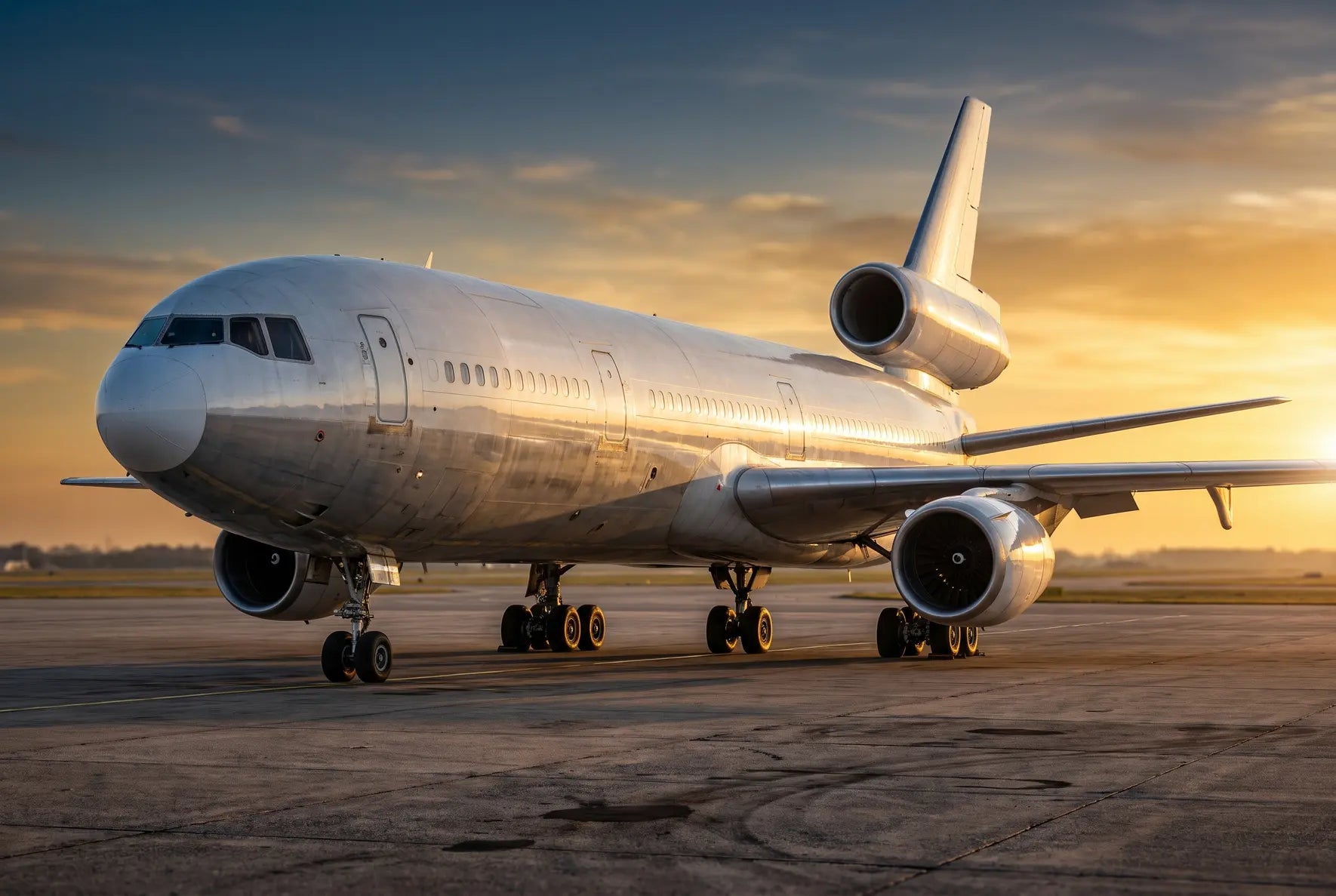
The DC-10-30ER (Extended Range) was conceived as a higher-gross-weight derivative of the DC-10-30 for the most demanding transoceanic routes. Its defining changes were an additional fuel tank installed in the rear cargo hold, an increased maximum takeoff weight, and uprated engines. According to the technical data compiled by aviation reference databases, the first DC-10-30ER was delivered to Finnair in 1981, giving the Helsinki-based carrier the reach it needed for long-haul expansion. Only a small number were produced: sources report six new-build DC-10-30ERs, with a further five standard DC-10-30s later converted to the same standard, so the type was always a niche within the broader DC-10-30 fleet.
The variant's long-range credentials fit the era in which crews and airlines were pushing wide-body operations ever farther, a theme reflected in modern European long-haul operations such as those covered in this look at Lauda Europe and pilot conditions.
What sets the DC-10-30ER apart
Compared with the standard DC-10-30, the ER kept the same long-span wing, center landing gear and CF6-50 engine family, but was re-optimised for weight and endurance. The most significant differences are the extra aft fuel tank, the higher certified takeoff weight of about 580,000 lb (263,160 kg), the more powerful General Electric CF6-50C2B engines rated at 54,000 lbf each (versus roughly 51,000 lbf on many baseline -30s), and a resulting range of around 5,730 nmi (6,600 mi / 10,620 km), roughly 700 miles more than the standard -30. The trade-off was cargo volume, since the additional tank occupied part of the lower hold. The certified configurations for the DC-10 series, including engine ratings and weight limits, are defined in the FAA type certificate documentation.
The following points summarise the main variant identifiers for the DC-10-30ER:
- Engines: three General Electric CF6-50C2B turbofans, 54,000 lbf each
- Extra fuel: additional fuel tank in the rear cargo hold
- MTOW: approximately 580,000 lb (263,160 kg), higher than the standard DC-10-30
- Range: about 5,730 nmi (6,600 mi / 10,620 km), roughly 700 mi more than the -30
- Structure/gear: shared long-span wing and center main landing gear, re-certified for higher weight
- Launch operator: Finnair, first delivery in 1981
- Production: six new-build airframes plus five conversions from DC-10-30s

A Continental Airlines McDonnell Douglas DC-10 aircraft is shown in flight. The wide-body airliner, known for its three-engine layout, is captured against a clear sky.
DC-10-30ER: Technical Specifications, Systems and Engine Highlights
The McDonnell Douglas DC-10-30ER was conceived as an extended-range development of the long-haul DC-10-30, aimed at intercontinental sectors that pushed the standard trijet beyond its comfortable range at full passenger payload. Rather than being a structurally new subtype, it is best understood as an equipment and engine sub-variant: engineers added an auxiliary fuel tank in the rear cargo hold and fitted uprated General Electric CF6-50 series engines to cope with the higher operating weights. The trade-off is characteristic of ultra-long-haul design: fuel volume is gained at the expense of some lower-deck cargo capacity, extending reach while keeping the familiar DC-10-30 airframe, wing and centreline main landing gear.
Because the ER inherits the DC-10-30 aerodynamics and dimensions, its cruise envelope, ceiling and handling remain essentially unchanged; the difference is measured in mission capability. This is the same balancing act that defines modern ultra-long-haul operations, where range, payload and runway performance must be reconciled.
Specs that matter
- Wingspan: approximately 165 ft 4 in (50.4 m), shared with the DC-10-30.
- Length: around 181 ft 7 in to 182 ft 3 in (roughly 55.3 m).
- Height: about 58 ft (roughly 17.8 m).
- MTOW: high-gross-weight class up to about 572,000 lb (259,459 kg), matching the DC-10-30 structural limit and optimised for the added fuel load.
- MLW: approximately 421,000 lb (190,964 kg) for the DC-10-30 structure.
- Baseline fuel capacity: about 36,650 US gal (138,720 L) in wing and centre-wing tanks, increased on the ER by the rear-hold auxiliary tank.
- Engines: three General Electric CF6-50B2 turbofans, in the CF6-50 thrust class of roughly 51,000 lbf each.
- Cruise speed: typically around Mach 0.82 to 0.83, with maximum cruise near Mach 0.88.
- Service ceiling: about 42,000 ft (12,800 m).
- Auxiliary tank: one additional fuel tank installed in the rear cargo hold (an auxiliary centre tank arrangement).
- Production: six aircraft built to ER standard, with five DC-10-30s converted, for eleven ER-configured airframes; first delivery to Finnair in 1981, with Swissair among early operators.
Systems and handling-relevant technology
The DC-10 uses conventional, fully powered flight controls rather than fly-by-wire: ailerons, elevators and rudder are hydraulically boosted and commanded through mechanical linkages from the cockpit. Multiple independent hydraulic systems power the primary controls, high-lift devices, landing gear and other major actuators, providing redundancy typical of wide-body transports of the era. The aircraft is equipped with anti-skid braking for wheel-speed control during landing and rejected takeoff, and standard transport-category automation including autopilot and flight-director functions. On the ER, the systems architecture is essentially that of the DC-10-30, with the notable addition of the auxiliary tank plumbing and fuel management for the extra cargo-hold cell.
Published performance figures for the type should be read with context. Numbers vary with operator options, cabin density, actual weights, reserve assumptions, and atmospheric and runway conditions. Range quoted "with passengers" depends on seating layout and payload, so ER range gains over the standard DC-10-30 are best described as meaningful improvements at a typical intercontinental payload rather than as a single absolute value.
The CF6 engine family
The General Electric CF6 is one of the most significant wide-body powerplant families in commercial aviation, described by GE as its longest-running commercial jet engine program, entering service in 1971. The early CF6-6 was derived from the military TF39 that powered the Lockheed C-5A, and was selected to power the DC-10 Series 10, gaining FAA certification in 1970. The higher-thrust CF6-50 series was launched in 1969 for longer-range aircraft, and it is the CF6-50B2 that powers the DC-10-30ER. Architecturally, the CF6 is a two-shaft, high-bypass turbofan with a single-stage fan, a 16-stage high-pressure compressor, an annular combustor, and a two-stage high-pressure plus five-stage low-pressure turbine, using modular construction to simplify overhaul. Across the family, thrust spans roughly 41,500 to 69,800 lbf, with the CF6-50 series rated in the region of 51,000 to 54,000 lbf. Beyond the DC-10, CF6 variants have powered the Airbus A300 and A310, the Boeing 747 and 767, the McDonnell Douglas KC-10 tanker and the MD-11, underlining the durability and versatility of the design.
DC-10-30ER vs DC-10-30 vs DC-10-40 vs L-1011-500: Specifications and Performance Comparison
Scroll horizontally to see more →
| Parameter | McDonnell Douglas DC-10-30ER | McDonnell Douglas DC-10-30 | McDonnell Douglas DC-10-40 | Lockheed L-1011-500 TriStar |
|---|---|---|---|---|
| Entry into service | 1981 | 1972 | 1973 | 1979 |
| Engines | 3 × General Electric CF6-50C2 | 3 × General Electric CF6-50A/C2 | 3 × Pratt & Whitney JT9D-20/59A | 3 × Rolls-Royce RB211-524B4 |
| Length | 55.35 m | 55.35 m | 55.5 m | 50.1 m |
| Wingspan | 50.39 m | 50.39 m | 50.4 m | 47.3 m |
| Height | 17.86 m | 17.86 m | 17.7 m | 16.9 m |
| Typical seating and layout (short description + approximate passengers) | 3-class: 255–270 passengers | 3-class: 255–285 passengers | 3-class: 250–270 passengers | 3-class: 230–250 passengers |
| MTOW | 259 t | 259 t | 252–259 t | 233 t |
| Range | 6,600 nm | 5,200–6,600 nm | 5,000 nm | 6,000–6,500 nm |
| Cruise speed | 0.82 Mach | 0.82 Mach | 0.83 Mach | 0.82 Mach |
| Service ceiling | 42,000 ft | 42,000 ft | 42,000 ft | 43,000 ft |
| Program note | Long-range extended-range DC-10 variant optimized for intercontinental routes, offering higher MTOW and range than earlier models. | Baseline long-range DC-10 passenger model for international services, forming the core of the family’s widebody trijet offering. | Pratt & Whitney-powered long-range DC-10 derivative aimed at specific airline customers seeking commonality with JT9D fleets. | Competing widebody long-range trijet from Lockheed, positioned as an alternative to the DC-10 on similar transoceanic and intercontinental missions. |
Scroll horizontally to see more →
The table compares four long-range widebody trijets by entry into service, engines, dimensions, capacity, MTOW, range, and cruise metrics. The DC-10-30ER matches the DC-10-30 in size but emphasizes extended range up to 6,600 nm. The DC-10-40 uses JT9D engines and similar MTOW yet shows a shorter 5,000 nm range. The L-1011-500 is smaller and lighter, with fewer seats, but offers competitive 6,000–6,500 nm range and the highest ceiling at 43,000 ft.
DC-10-30ER Operations and Airlines: Routes, Missions and Fleets
The McDonnell Douglas DC-10-30ER was built for long, thin intercontinental routes where the range of the standard -30 fell short but a Boeing 747 was too large. Only six were built new and five DC-10-30s were later converted to the ER standard, making it one of the rarest members of the family. Higher maximum takeoff weight (590,000 lb / 270 t), three General Electric CF6-50C2B engines and an extra fuel tank in the rear cargo hold gave it roughly 700 additional miles of range, for a maximum of about 6,600 mi (5,730 nmi; 10,620 km).
Typical missions were long-haul sectors of eight to eleven hours linking a home hub to distant destinations in North America, Asia or the Far East. Daily utilisation on a widebody of this era commonly reached ten to fourteen block hours, often as a single long rotation with a night layover at the outstation before returning the next day. Most operators flew it within classic hub-and-spoke networks: the aircraft concentrated long-distance traffic at a primary hub, while narrowbodies such as the DC-9, 727 and 737 fed and distributed passengers to secondary and regional airports. Point-to-point flag-carrier trunk routes were also common. The main operational challenge was economics: three engines meant higher fuel burn and maintenance cost than the twinjets (767, A330, 777) that later displaced it, and the trijet layout demanded more crew and shop time.
Where the DC-10-30ER operates
The type was concentrated in Europe and Asia, with the broader DC-10-30 family also widely present across North & South America and Africa. In Europe, Nordic and Central European flag carriers used it for ultra-long sectors from compact home markets. In Asia, it served long routes between Southeast Asia and Europe. Across North & South America and Africa, the standard -30 dominated on transatlantic and intercontinental trunk routes, with a handful of airframes upgraded toward ER-like capability.
- Europe: Finnair was the launch customer, taking its first DC-10-30ER in 1981 and flying it from Helsinki on long routes to destinations such as Bangkok, Tokyo and North America, feeding traffic through its Nordic hub. Swissair and KLM, the DC-10-30 launch customers, operated the family intensively from Zurich and Amsterdam on North American and Far East services.
- North & South America: Continental Airlines, Northwest Airlines and Canadian Airlines operated DC-10-30s on transatlantic, transpacific and long domestic trunk routes, while VARIG flew the long-range -30 from Brazil on intercontinental services.
- Asia: Thai Airways International ordered two DC-10-30ERs in 1987, configured with 243 seats for non-stop sectors of about 10,200 km from Bangkok. Japan Airlines, Korean Air and Garuda Indonesia were significant DC-10-30 operators across the region.
- Africa: Air Afrique and Nigeria Airways used the DC-10-30 on intercontinental routes linking African hubs with Europe, forming the long spokes of their networks.
Typical seating and cabin layouts
Because the ER shared the standard -30 fuselage, cabin layouts were identical to the wider family. Network flag carriers favoured two-class arrangements of roughly 240 to 255 seats; a documented configuration seated 255 passengers with 24 in first class and 231 in economy at 34-inch pitch, while Thai Airways fitted its DC-10-30ER with 243 seats. Leisure and charter operators pushed density far higher, with the airframe certified for up to about 380 passengers in a single-class, high-density layout. Detailed variant data and representative seat counts are documented by aircraftinvestigation.info and the AviaMagazine DC-10 factsheet. Cabin comfort and crew workload on these long trijet rotations remain relevant topics for aviation professionals, an area explored in this overview of airline pilot conditions.
In this video, discover why the DC-10 earned a dangerous reputation, exploring the incidents, design challenges, and aviation lessons that shaped its legacy and influenced safety changes in commercial flying.
Safety Record and How Safe Is the McDonnell Douglas DC-10-30ER?
The McDonnell Douglas DC-10-30ER was a rare extended-range development of the DC-10-30, with roughly six factory-built airframes plus several standard -30s converted to ER standard. Because so few examples flew, the variant's own accident history is best understood within the wider DC-10 family, which totalled about 386 commercial airframes and 60 KC-10 tankers across a production run that ended in 1989. Operated by carriers such as Finnair, Swissair and Thai Airways International from the early 1980s onward, DC-10-30ER aircraft accumulated large numbers of long-haul cycles over decades of intercontinental service. The DC-10 earned early scrutiny after design and maintenance issues in the 1970s, but subsequent modifications and tighter oversight produced a markedly safer aircraft in later years, and the type flew scheduled passenger services until 7 December 2013.
Major accidents and what changed afterwards
- Turkish Airlines Flight 981 (1974, DC-10-10): an improperly latched aft cargo door failed after takeoff, causing rapid decompression and loss of control. The event drove a full redesign of the cargo-door latch and locking system, cabin-floor strengthening and improved cockpit warnings. See the FAA Lessons Learned library for the certification changes that followed.
- American Airlines Flight 191 (1979, DC-10-10): an unapproved engine-and-pylon removal procedure damaged the pylon attach fittings, leading to engine separation, slat retraction and an asymmetric stall. The response included mandatory pylon inspections, a temporary grounding of U.S. DC-10s and stricter maintenance oversight, documented in the NTSB accident report.
- United Airlines Flight 232 (1989, DC-10-10): an uncontained tail-engine fan-disk failure severed all three hydraulic systems, leaving the crew to control the aircraft with differential thrust. The accident prompted stronger non-destructive inspection standards for rotating engine parts and reinforced the case for hydraulic fuses and physical separation of flight-control lines.
- Air New Zealand Flight 901 (1979, DC-10-30): a sightseeing flight struck Mount Erebus after an undisclosed change to the programmed route combined with whiteout conditions. It led to tighter control of navigation-database changes, mandatory crew briefings and greater emphasis on terrain awareness and organisational factors.
How safe is the DC-10-30ER?
Measured against the very high traffic volume the DC-10 family carried over four decades, the type's safety performance improved substantially once the early cargo-door, pylon and hydraulic vulnerabilities were addressed. The aircraft's three independent hydraulic systems, redundant structures and progressively refined maintenance and crew-resource-management procedures reflect a design philosophy that later regulators reinforced through updated certification standards and inspection regimes. The professionalism required to operate wide-bodies of this generation, discussed in the context of pilot conditions at legacy carriers such as Iberia, underlines how standard operating procedures and training underpin day-to-day safety as much as engineering does. Comprehensive per-airframe records for the DC-10-30 and -30ER can be reviewed through the Aviation Safety Network DC-10 database, while broader accident-rate context is available from ICAO safety data. Taken together, this evidence supports a clear conclusion: despite a difficult early reputation, the corrected DC-10 became a dependable long-haul aircraft, and commercial aviation remains one of the safest modes of transport.
01 What makes the McDonnell Douglas DC-10-30ER different from other DC-10 variants?
The McDonnell Douglas DC-10-30ER is a long-range, extended-range version of the DC-10 designed for intercontinental routes, with higher maximum takeoff weight and additional fuel capacity compared with the domestic Series 10 models. Airlines selected the DC-10-30 family for missions that required nonstop transatlantic or transoceanic flying while carrying around 250–300 passengers in typical two- or three-class layouts. The ER capability allowed operators to use the aircraft on demanding long-haul sectors that were beyond the reach of shorter-range DC-10 variants. This gave the DC-10-30ER a role similar to early widebody long-haul types like the L-1011 and classic 747 on many international routes.
02 What typical routes and range did airlines use the DC-10-30ER for?
The DC-10-30 family was designed as a long-haul transoceanic aircraft, with a range of roughly 6,500–6,600 nautical miles depending on configuration, making missions such as New York–Dubai feasible with reserve distance remaining. Airlines used the DC-10-30 and DC-10-30ER on intercontinental routes connecting Europe with North America, Africa, Asia, and the Middle East, as well as long-haul services from North America to Europe and Asia. Launch customers such as KLM and Swissair employed the type on high-demand international sectors where its range and payload were well matched to passenger and cargo demand. In service, the aircraft often operated overnight long-haul flights, maximizing its extended-range capability and cargo volume.
03 What is the cabin layout and passenger experience like on a DC-10-30ER?
The DC-10-30ER typically seats around 255 passengers in a three-class layout, with higher densities up to about 380 seats possible in all-economy configuration. The widebody cabin usually features 8-abreast seating in economy and 6-abreast in first or business class, giving a relatively spacious feel by the standards of its era. Operators configured the aircraft with multiple galleys and around eight enclosed lavatories, along with generous overhead bin and hold cargo space for long-haul travel. Cabin noise is higher than on newer twin-engine widebodies due to the three-engine design and age of the airframe, but many travellers appreciated the stable, heavy widebody ride on long sectors.
04 Which airlines operated the McDonnell Douglas DC-10-30ER, and on what kinds of routes?
The DC-10-30 series, including extended-range examples, was operated by major international airlines such as KLM, Swissair and others as their long-haul widebody workhorses. These aircraft were deployed on transatlantic routes like Amsterdam–North America, European hubs to African capitals, and intercontinental services to Asia and the Middle East where high capacity and robust range were required. Over time, many DC-10-30 airframes transitioned to cargo and special mission roles, including freighters and aerial firefighting platforms, reflecting the strong payload capability of the design. Passenger DC-10s have now largely left mainstream airline fleets, but the type’s route profile remains a reference for classic long-haul widebody operations.
05 How does the DC-10-30ER perform compared with similar widebody aircraft?
The DC-10-30ER combines a high maximum takeoff weight, three-engine layout and large wing to deliver long-range performance with payloads exceeding 100,000 pounds of cargo and baggage alongside passengers. Typical cruise speed is around Mach 0.82–0.84, comparable to many contemporary widebodies, with maximum cruise near Mach 0.88 and certified ceilings in the low 30,000-foot to low 40,000-foot range depending on data source. Fuel efficiency is lower than more modern twin-engine aircraft because three engines increase fuel burn and maintenance cost, but at the time the DC-10-30 was competitive with peers such as the Lockheed L-1011 and early Boeing 747 classics on long routes. Its large underfloor cargo volume and robust structure also made it attractive for conversion to freighter and special mission use after passenger retirement.
06 What should a passenger know about safety, seat choice, and ride quality on a DC-10-30ER?
The DC-10 type experienced several high-profile accidents early in its career linked to design issues such as cargo door latching, but these were addressed through modifications and regulatory action, and the aircraft went on to have a long service life with major airlines. Travellers typically find the most comfortable experience in seats forward of the wing, where engine and airflow noise are somewhat reduced and ride can feel smoother. Over the wing and near the tail, noise and vibration are more noticeable, especially given the tail-mounted third engine, though the heavy widebody structure tends to give a stable feel in cruise and during turbulence. As with any older aircraft, cabin condition and comfort depend heavily on the specific airline and interior refurbishment, so the experience can vary between operators using DC-10-30ER airframes in niche or special charter roles.