

Ford Trimotor History and Development: From Tin Goose Origins to Aviation Legacy
The Ford Trimotor, affectionately nicknamed the Tin Goose, stands as one of the most significant aircraft in early commercial aviation history. Developed by the Ford Motor Company's Aircraft Division in Dearborn, Michigan, it was among the first all metal passenger airplanes designed primarily to carry people rather than mail. Its creation reflected a broader ambition by Henry Ford to bring the same mass production principles used in automobile manufacturing to the emerging airline industry, making air travel safer, more reliable, and accessible to the public.
The origins of the Ford Trimotor trace back to engineer William B. Stout, who founded the Stout Metal Airplane Company and designed early all metal monoplanes, including the single engine 2-AT Pullman. Henry Ford acquired Stout's company in 1924, providing the capital and industrial infrastructure needed to accelerate development. Stout produced a three engine prototype designated the 3-AT in 1925, but the design performed poorly. A suspicious factory fire in January 1926 destroyed the 3-AT and the Stout factory, after which Ford's own engineering team, working largely independently of Stout, undertook a complete redesign.
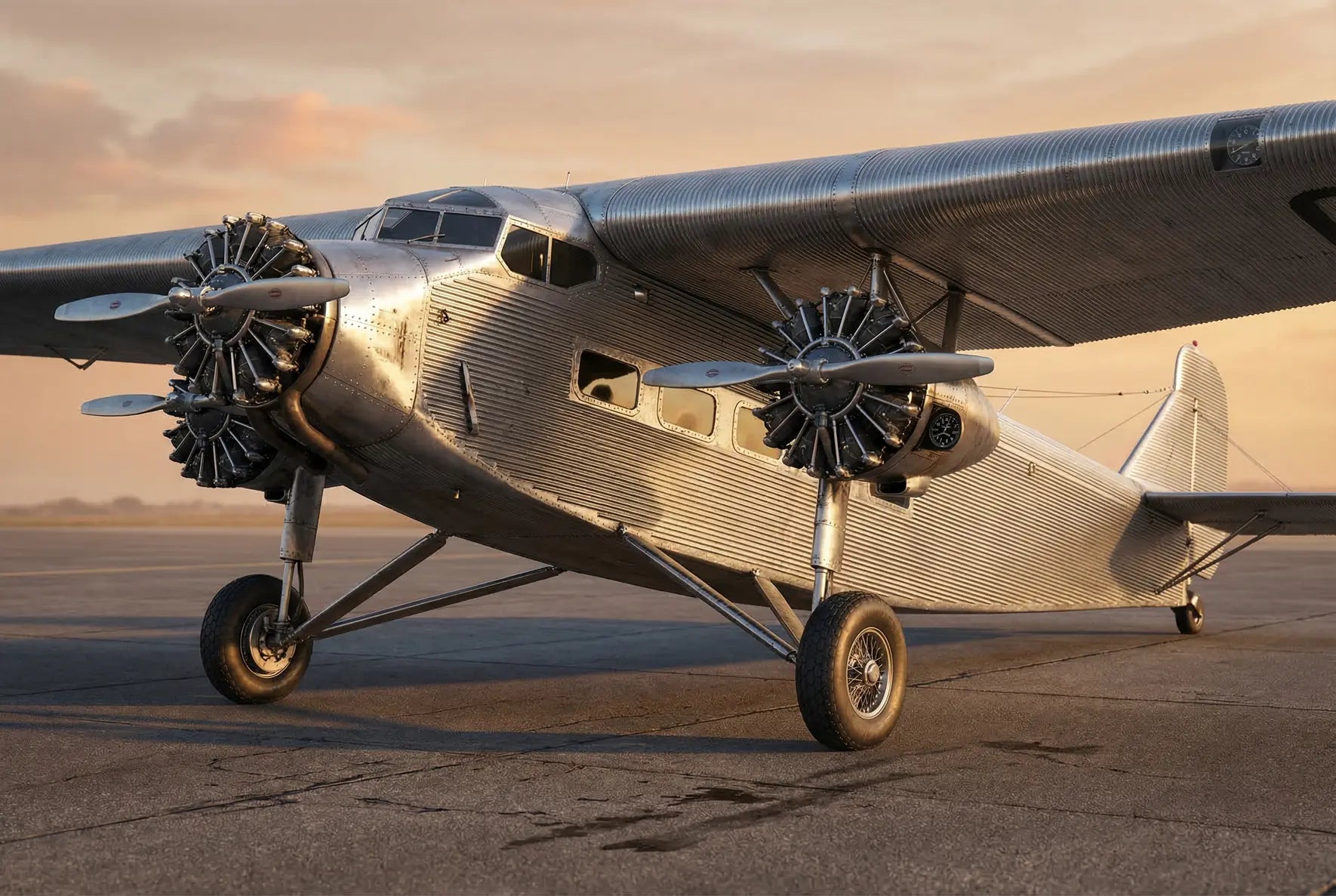
The result was the 4-AT, the first true Ford Trimotor, which made its maiden flight on June 11, 1926, piloted by test pilot Eddie Hamilton (some sources cite Rudolph "Shorty" Schroeder) from Ford Airport in Dearborn. The aircraft featured a high wing monoplane configuration, corrugated duralumin aluminum alloy skin inspired by Junkers aircraft designs, and three wing mounted radial engines. This all metal construction was a major departure from the wood and fabric biplanes of the era and gave the aircraft remarkable durability. The 4-AT entered commercial service within months, seating 8 to 12 passengers and powered by three Wright J-5 Whirlwind radial engines producing approximately 200 hp each.
Production ramped up in a new 60,000 square foot factory completed in early 1927. Ford car dealers even served as sales agents for the aircraft. Orders came from airlines and the U.S. military alike, with early customers including the U.S. Navy, Standard Oil, and emerging passenger carriers. In 1927, a Ford Trimotor completed one of the first radio beam navigation flights, from Dearborn to Wright Field in Ohio. By July 7, 1929, Transcontinental Air Transport (TAT, a precursor to TWA) inaugurated scheduled coast to coast passenger service using the Ford Trimotor, a milestone that underscored the aircraft's role in legitimizing commercial air travel in the United States. Airlines such as Pitcairn Airways, Pan American Airways, and Universal Air Lines also operated the type extensively.
The improved 5-AT variant entered production in mid 1928, incorporating suggestions from Charles Lindbergh to adopt three more powerful Pratt & Whitney R-1340 Wasp radial engines, each rated at 420 hp. The 5-AT featured a longer fuselage, an increased wingspan of approximately 77 feet 10 inches (compared to 74 feet on the 4-AT), rectangular cabin windows, and capacity for up to 17 passengers. The top speed reached approximately 150 mph, with a cruising speed around 122 mph and a range of roughly 500 to 570 miles. The 5-AT became the most produced variant, with approximately 120 units built across several sub types (5-AT-A through 5-AT-D).
Ford manufactured a total of 199 Trimotors between 1926 and 1933, when the Aircraft Division closed due to declining sales during the Great Depression and increasing competition from faster, more modern monoplanes such as the Boeing 247. Annual production peaked at 86 aircraft in 1929 but fell to just 3 units by 1932. Despite the end of production, surviving Ford Trimotors continued operating for decades, some well into the 1960s and 1970s in remote regions and scenic tour operations. Several airframes are preserved in museums today, including the Smithsonian National Air and Space Museum.
What Distinguishes the Ford Trimotor Variants
The Ford Trimotor family comprised several distinct sub variants, each reflecting incremental improvements in powerplant, airframe, and mission capability. The 4-AT series (approximately 79 built) served as the baseline production models, powered by Wright Whirlwind radials ranging from 200 to 300 hp depending on the sub type. The 4-AT-B was the main early production model with 39 units built, while the 4-AT-E introduced the more powerful Wright J-6-9 engines at 300 hp and adopted rectangular windows later standard on the 5-AT. The 5-AT series represented a significant step up in performance and capacity thanks to the switch to Pratt & Whitney Wasp engines and increased dimensions. The 5-AT-C, featuring engine cowlings and wheel fairings for improved aerodynamics, was the most numerous sub variant with 51 units produced. Less common variants included the 6-AT (floatplane configurations), the 8-AT (a single engine freighter conversion), and the 11-AT (an experimental variant fitted with Packard DR-980 diesel engines for fuel efficiency trials). Military variants were also produced, including JR-2 designations for the U.S. Navy and Marines.
The following list summarises the key identifiers that distinguish the primary Ford Trimotor variants:
- 4-AT: three Wright J-5 Whirlwind engines (200 hp each), 74 ft wingspan, 8 to 12 passenger capacity, approximately 10,130 lb gross weight
- 4-AT-E: upgraded to three Wright J-6-9 engines (300 hp each), rectangular cabin windows, 11 to 12 passengers
- 5-AT: three Pratt & Whitney R-1340 Wasp engines (420 hp each), extended wingspan of 77 ft 10 in, up to 17 passengers, top speed approximately 150 mph
- 5-AT-C: most produced sub variant (51 built), engine cowlings and wheel pants for improved aerodynamics
- 11-AT: experimental diesel engine variant with three Packard DR-980 radials (225 hp each)
- 8-AT: single engine freighter conversion of the 5-AT airframe
The Ford Trimotor's legacy as the first practical, mass produced all metal airliner remains significant. It proved that multi engine reliability and metallic construction could overcome public fear of flying and established the blueprint for future generations of commercial transport aircraft. Though modest by modern standards, the Tin Goose helped transform aviation from a daring novelty into a viable transportation system, laying groundwork that manufacturers such as Boeing and Douglas would build upon throughout the following decades.

The image shows a vintage Ford Trimotor airplane in mid-flight against a clear blue sky. The aircraft, marked with NC8407, features logos of Eastern Air Transport, highlighting its historical significance in early aviation.
Ford Trimotor Technical Specifications, Systems Design and Engine Options
The Ford Trimotor, widely known as the "Tin Goose," was a high wing, all metal monoplane designed by the Stout Metal Airplane Division of Ford Motor Company to deliver safe, reliable air transport during the late 1920s and early 1930s. Its defining engineering choice was a corrugated duralumin skin over a steel tube framework, borrowing mass production techniques from the automotive industry to deliver a rugged airframe capable of withstanding the rough conditions of early airfield operations. The trimotor configuration was itself a key design trade off: three engines provided critical redundancy, allowing the aircraft to maintain controlled flight even with one engine inoperative, at the cost of higher fuel consumption and aerodynamic drag compared to single engine designs of the era.
Produced from 1926 to 1933, the Ford Trimotor came in two major families: the 4 AT and the larger 5 AT. The 4 AT was lighter, seating up to 11 passengers, while the 5 AT expanded capacity to as many as 17 passengers with more powerful engines and a wider wingspan. Both variants used a fixed tailwheel landing gear and two bladed fixed pitch propellers. The aircraft served commercial airlines, the United States military (as the C 3 and C 4 transports), and exploration expeditions, including Richard Byrd's historic 1929 flight over the South Pole, as documented by the Smithsonian National Air and Space Museum.
- Wingspan: 74 ft 0 in (22.56 m) for 4 AT; 77 ft 10 in (23.72 m) for 5 AT
- Length: 49 ft 10 in (15.19 m) for 4 AT; 50 ft 3 in (15.32 m) for 5 AT
- Height: 11 ft 9 in (3.58 m) for 4 AT; approximately 12 ft 8 in (3.86 m) for 5 AT
- Empty weight: approximately 6,500 lb (2,948 kg) for 4 AT E; approximately 7,840 lb (3,556 kg) for 5 AT
- Maximum takeoff weight: 10,130 lb (4,595 kg) for 4 AT E; up to 13,500 lb (6,123 kg) for 5 AT
- Cruise speed: approximately 107 mph (172 km/h, 93 kn) for 4 AT E at 1,700 rpm; approximately 90 to 115 mph for 5 AT depending on configuration
- Maximum speed: 132 mph (212 km/h) for 4 AT E; 135 to 150 mph for 5 AT
- Range: approximately 570 mi (920 km, 500 nmi) for 4 AT E; approximately 550 mi (885 km) for 5 AT
- Service ceiling: 16,500 ft (5,029 m) for 4 AT E; 17,500 to 18,500 ft for 5 AT
- Rate of climb: 920 ft/min (4.7 m/s) for 4 AT E; approximately 1,100 ft/min for 5 AT
- Fuel capacity: 231 US gal (874 L) for 4 AT E
- Passenger capacity: up to 11 (4 AT); up to 17 (5 AT), plus a crew of two or three
- Wing airfoil: Göttingen 386 (root and tip)
- Wing area: approximately 835 sq ft (77.6 m²) for 5 AT
- Total production: 199 units across all variants
Flight Controls, Systems and Handling Characteristics
The Ford Trimotor used a conventional control surface arrangement: fabric covered ailerons for roll, elevators for pitch, and a rudder for yaw. There was no hydraulic boosting or autopilot system; control inputs were entirely manual, demanding significant physical effort from pilots, especially during single engine operations. The fixed pitch propellers meant that engine management was limited to throttle and mixture adjustments, with no constant speed or feathering capability.
Instrumentation was period typical, including engine gauges, airspeed indicator, altimeter, turn and bank indicator, and later models added an artificial horizon and radio navigation aids as described in FAA historical records. Braking relied on basic wheel brakes on the main gear. There was no anti skid system or advanced ground handling technology. Landing speeds as low as 57 to 64 mph allowed the Trimotor to operate from relatively short and unprepared airstrips, a practical advantage for early air routes. Takeoff ground roll for the 5 AT was approximately 1,100 ft, with a landing ground roll of about 1,200 ft.
Published performance figures for the Ford Trimotor can vary significantly depending on the specific sub variant (4 AT A through 4 AT E, 5 AT A through 5 AT D), installed engine type, aircraft weight, atmospheric conditions, and any post production modifications. Many surviving Trimotors have been re engined over the decades, further changing their operating profiles. When comparing data from museum records, type certificate documents, or aviation databases, it is important to note which variant and configuration is referenced, as even small differences in engine power or gross weight can shift cruise speed, range, and ceiling figures noticeably.
Engines: Wright Whirlwind and Pratt & Whitney Wasp Families
The Ford Trimotor was powered by two main engine families across its production life, reflecting the rapid evolution of radial engine technology during aviation's golden age. Early 4 AT models were fitted with three Wright Whirlwind radial engines, beginning with the J 4 rated at 200 hp. As the design matured, engine power increased to the J 5 (220 hp) and then the J 6 (also known as J6 9) at 300 hp. The Wright Whirlwind series, developed by Wright Aeronautical (a successor to the Wright brothers' enterprise), was one of the most important air cooled radial engines of the 1920s. The J 5 variant famously powered Charles Lindbergh's Spirit of St. Louis across the Atlantic in 1927, and also saw service on types such as the Fokker F.VII, Stearman C 3, and Lockheed Vega.
The larger 5 AT models were equipped with three Pratt & Whitney R 1340 Wasp radial engines, each producing 420 hp. The Wasp, introduced by Pratt & Whitney in 1925, represented a leap forward in power to weight ratio for air cooled radials and quickly became a standard powerplant for both civil and military aviation. The adoption of the Wasp for the 5 AT was championed by Charles Lindbergh, as noted by AOPA. Beyond the Ford Trimotor, the R 1340 powered a wide variety of aircraft including the Boeing P 26 Peashooter, de Havilland Canada DHC 3 Otter, and early Boeing Model 40 mail planes.
After production ended, many surviving Trimotors were re engined with war surplus Pratt & Whitney R 985 Wasp Junior radials rated at 450 hp each, offering improved reliability and parts availability. The R 985 also powered the Beechcraft Model 18, North American T 28 Trojan, and numerous other postwar utility aircraft. The variety of engine installations across the Trimotor fleet further contributes to the spread in published performance data. For readers interested in how early metal construction and trimotor reliability paved the way for later transport aircraft, a related overview of multi engine design philosophy can be found in our profile of the Antonov An 148.
Ford Trimotor vs Fokker F.VII vs Junkers F.13 vs Douglas DC-2: Key Specifications
Scroll horizontally to see more →
| Parameter | Ford Trimotor | Fokker F.VII | Junkers F.13 | Douglas DC-2 |
|---|---|---|---|---|
| Entry into service | 1926 | 1924 | 1920 | 1934 |
| Engines | 3 × Wright J-6-9 Whirlwind 300 hp | 3 × Armstrong Siddeley Lynx 200 hp | 1 × BMW III 185 hp | 2 × Wright Cyclone 710 hp |
| Length | 15.2 m | 14.5 m | 13.6 m | 19.0 m |
| Wingspan | 22.6 m | 18.8 m | 17.8 m | 21.8 m |
| Height | 3.6 m | 4.4 m | 4.1 m | 4.7 m |
| Typical seating and layout | Single class: 9–12 passengers | Single class: 8–12 passengers | Single class: 4–8 passengers | 2-class: 14–21 passengers |
| MTOW | 4.6 t | 4.7 t | 3.7 t | 8.4 t |
| Range | 500 nm | 780 nm | 650 nm | 1,500 nm |
| Cruise speed | 0.14 Mach | 0.15 Mach | 0.13 Mach | 0.22 Mach |
| Service ceiling | 16,500 ft | 22,000 ft | 20,000 ft | 22,100 ft |
| Program note | All-metal tri-motor airliner, reliable workhorse for early US airlines | Three-engine passenger transport, popular in Europe and colonial routes | Single-engine pioneer airliner, first mass-produced all-metal aircraft | Twin-engine airliner, advanced design winning 1934 US air race |
Scroll horizontally to see more →
The table compares four landmark early airliners across service entry, engine power, dimensions, seating, weights, and performance. The Ford Trimotor and Fokker F.VII offer similar 9–12 seat capacity and MTOW near 4.6–4.7 t, but the F.VII ranges farther (780 vs 500 nm). The Junkers F.13 is smaller and single-engine with fewer seats, while the DC-2 is larger, faster (0.22 Mach), and doubles range to 1,500 nm.
Ford Trimotor Operations, Typical Routes and Airlines Around the World
The Ford Trimotor, widely known as the "Tin Goose," was one of the first purpose built airliners to establish reliable scheduled services across the globe. Produced between 1926 and 1933, with 199 airframes delivered, this tri engine monoplane was operated by well over 100 airlines in more than 20 countries. Its corrugated aluminium construction, fixed landing gear and three radial engines made it a rugged workhorse suited to short haul point to point routes on unpaved and grass airfields that were standard during the pioneering era of commercial aviation.
Typical airline routes covered between 170 and 500 miles (270 to 800 km). With a cruise speed of approximately 90 to 110 mph (145 to 177 km/h) and a practical still air range of around 340 nautical miles with a 45 minute fuel reserve, according to the Aircraft Owners and Pilots Association (AOPA), individual flight legs typically lasted two to four hours. Longer itineraries, such as the famous coast to coast service between New York and Los Angeles inaugurated by Transcontinental Air Transport (TAT) on 7 July 1929, required multiple refuelling stops and were combined with overnight rail segments, completing the journey in roughly 48 hours. Daily utilisation was modest by modern standards, with aircraft commonly logging two to three revenue legs per day owing to the time needed for refuelling, passenger boarding on the ground and basic engine inspections between flights.
Operationally, the Ford Trimotor excelled in point to point networks linking smaller cities and secondary airfields rather than large hub complexes that did not yet exist in the late 1920s. It could use runways as short as 1,200 ft (366 m), giving operators access to remote fields and frontier strips in places such as Alaska, the Andes and the Caribbean islands. Challenges for operators were significant: the unpressurised cabin limited comfortable cruising altitudes to below roughly 10,000 ft, exposing flights to turbulence and icing; cabin noise from the three uncowled radial engines exceeded 90 dB, making in flight communication difficult; single engine performance was limited to a ceiling of about 7,100 ft, reducing safety margins over mountainous terrain; and the three engines demanded intensive maintenance, including frequent overhauls and high fuel consumption of up to 75 gallons per hour. Despite these hurdles, the type's rugged airframe and reliable multi engine layout inspired passenger confidence at a time when air travel was still a novelty. Much like the evolution of long range commercial aviation discussed in our overview of the Airbus A340 200, the Ford Trimotor represented a pivotal step in proving that air transport could be safe and commercially viable.
Where the Ford Trimotor Operated: Airlines by Region
The Ford Trimotor saw service across North America, Central and South America, Australia and to a lesser extent other regions. The majority of operators were based in the United States, where the aircraft helped transform fledgling mail carriers into scheduled passenger airlines. In Latin America, the type opened international routes linking island nations and Andean cities. According to the FAA historical record, Trimotors served in at least 20 foreign countries across several continents, though detailed records for European, Asian and African operators remain scarce in publicly available archives.
- North America: The largest concentration of operators was in the United States and Canada. Transcontinental Air Transport (TAT, predecessor to TWA) purchased ten Trimotors for the first coast to coast air rail service from New York to Los Angeles. Northwest Airlines operated five Trimotors from 1928 to 1935 on routes to Seattle, establishing it as a major trunk carrier. Stout Air Services ran six Trimotors between Detroit, Cleveland and Chicago starting in 1927, offering hot meals and limousine transfers. Maddux Air Lines, American Airlines, United Airlines and Wien Air Alaska also operated the type. Grand Canyon Airlines and Scenic Airways used Trimotors for sightseeing flights over the Grand Canyon from as early as 1928, a role one airframe fulfilled for 65 years.
- Central and South America: Pan American Airways inaugurated the first international scheduled airmail from Key West, Florida, to Havana, Cuba, on 28 October 1927, followed by passenger service in January 1928, and expanded Trimotor routes across the Caribbean, Mexico, Venezuela and the Dominican Republic. Cubana de Aviación became the first Latin American airline to fly the type from 30 October 1930. PANAGRA (Pan American Grace Airways) extended services into South America. TACA International Airlines operated Trimotors out of Honduras and Nicaragua during the 1930s and 1940s, while mining companies in Mexico used them for freight and personnel transport to remote sites.
- Asia and Oceania: Australian National Airways operated Ford Trimotors as part of the earliest scheduled air services in Australia. Limited evidence suggests the type also saw use with China based operators, though specific airline names and route details are not well documented in available sources.
- Europe and Africa: The Ford Trimotor historical record confirms that over 100 airlines worldwide flew the type, including carriers in Europe, yet no specific European or African airline operators are consistently named in publicly accessible archives. Military and government transport use in these regions is more commonly referenced than scheduled airline service.
Typical Seating and Cabin Configuration
The Ford Trimotor was produced in two principal variants that determined cabin capacity. The Smithsonian National Air and Space Museum documents that the smaller 4 AT accommodated 8 to 12 passengers, while the larger 5 AT, powered by three Pratt & Whitney Wasp radial engines of 420 hp each, could seat up to 15 passengers in standard layout or as many as 17 in high density configuration. The cabin of the 4 AT measured approximately 16 ft 3 in in length, 4 ft 6 in in width and 6 ft in height.
Seating was arranged in rows of wicker or lightweight metal chairs along each side of a narrow central aisle. Every seat was positioned beside a window, a feature that airlines marketed as a selling point. There was no formal division between cabin classes; all passengers shared the same open cabin. Operators occasionally removed seats to increase cargo volume for freight, mail or mining supply missions. Sightseeing operators such as Grand Canyon Airlines retained full passenger seating but oriented flights to maximise scenic views. Today, the surviving airworthy examples operated by the Experimental Aircraft Association (EAA) and the Liberty Aviation Museum maintain period correct cabins with roughly 8 to 10 seats for heritage flight experiences across the United States.
In this video, fly aboard a 1929 Ford Tri-Motor and learn how Henry Ford’s Model T Tin Lizzie mobilized millions of Americans from 1909 to 1926, creating a new market and shaping travel history.
Ford Trimotor Safety Record: How Safe Was the Tin Goose?
The Ford Trimotor, widely known as the "Tin Goose," earned a reputation for reliability and ruggedness during its years of active service. A total of 199 airframes were built between 1926 and 1933, comprising 79 units of the 4-AT model, 117 of the 5-AT variant, and a handful of experimental versions. These aircraft served well over 100 airlines worldwide, along with military operators, cargo carriers, and private owners. Commercial operations peaked during the late 1920s and early 1930s, though some Ford Trimotors continued flying in bush, military, and scenic roles well into the 1950s and beyond. As of today, 18 surviving examples exist and eight remain airworthy. Given that the type operated during the earliest years of commercial aviation, when cockpit instrumentation, weather forecasting, and air traffic control were still rudimentary, the Ford Trimotor's safety record must be understood in that broader context. According to the Aviation Safety Network database, the type was involved in a number of hull loss accidents over its long operational life, many of which were attributed to weather, engine failure, or the limited navigational aids available during the era.
Notable Accidents and Their Impact on Aviation Safety
Several high profile accidents involving the Ford Trimotor helped shape early aviation safety regulation in the United States and drew public attention to the risks of air travel during its infancy.
- Colonial Western Airways, March 1929 (Newark, New Jersey): A Ford 4-AT-B (NC7683) suffered a double engine failure shortly after takeoff from Newark Airport. The aircraft could not gain altitude and crashed, killing 14 of the 15 people on board. At the time, it was the deadliest air accident in the United States. The event intensified scrutiny of engine maintenance procedures and reinforced calls for stricter federal oversight of airline operations.
- Transcontinental Air Transport (TAT), September 1929 (Mount Taylor, New Mexico): A 5-AT-B known as the "City of San Francisco" (NC9649) crashed into Mount Taylor during a thunderstorm while flying from Albuquerque to Winslow, Arizona, killing all eight people on board. TAT had launched its pioneering coast to coast service only weeks earlier, combining daytime flights with overnight rail travel. The disaster caused widespread media coverage and significant financial harm to TAT, which was later absorbed into what became Trans World Airlines. The crash underscored the dangers of flying in poor weather without reliable instrument navigation and contributed to growing demands for improved weather reporting along commercial airways.
- Maddux Air Lines, January 1930 (Oceanside, California): A Ford 5-AT-C (NC9689) crashed in heavy rain and low visibility near Oceanside, killing all 16 occupants. The crew became disoriented during an emergency approach in darkness. This accident further highlighted the need for standardized instrument flight procedures and better pilot training for adverse weather conditions.
These early tragedies, combined with other incidents across the growing airline industry, played a role in the evolution of United States aviation regulation. The Air Commerce Act of 1926 had already established the Aeronautics Branch (a precursor to the modern FAA) to oversee aircraft certification, pilot licensing, and airway establishment. However, the string of fatal accidents during 1929 and 1930 accelerated the push for stronger enforcement of maintenance standards, weather reporting requirements, and air traffic rules. Although no single Ford Trimotor accident led to a named regulatory overhaul, the cumulative lessons from these events informed the progressive tightening of commercial aviation safety standards throughout the 1930s.
How Safe Was the Ford Trimotor?
For its era, the Ford Trimotor was considered one of the safest commercial aircraft available. Its tri engine configuration offered a critical layer of redundancy: if one engine failed, the aircraft could maintain controlled flight on the remaining two, a significant advantage over the single engine transports that preceded it. The all metal corrugated aluminium construction, inspired by designs pioneered by Hugo Junkers, provided superior structural durability compared to the fabric covered biplanes of the day. The Smithsonian National Air and Space Museum notes that, while noisy, the Trimotor "played a major role in convincing the public that air travel was safe and practical." Its rugged airframe allowed it to operate from unpaved airstrips, in cold weather climates with skis, and even on floats, all while maintaining a commendable service record.
It is important to note that accident rates for any aircraft type from the 1920s and 1930s cannot be meaningfully compared with modern statistics. The regulatory environment, pilot training standards, navigational technology, and air traffic management of that period bore little resemblance to the systems in place today. Modern commercial aviation benefits from redundant flight control systems, advanced weather radar, satellite navigation, and rigorous standard operating procedures, elements that simply did not exist during the Ford Trimotor's heyday. Much like the evolution seen in later aircraft such as the McDonnell Douglas MD 90, each generation of airliner builds upon lessons learned from previous types. The Ford Trimotor's contribution to that chain of progress is significant: it demonstrated that multi engine, all metal monoplanes could serve safely in regular airline service, laying the groundwork for the standards that make aviation one of the safest modes of transport in the world today.
01 What were the typical routes and range of the Ford Trimotor?
The Ford Trimotor operated on early commercial passenger and mail routes across the United States and Latin America, often covering distances up to 570-730 miles depending on the model and load. Airlines like Stout Air Lines and Pan American used it for short-haul flights between cities, relying on its ability to take off and land on rough airstrips. Mission profiles focused on reliable transport in an era before modern airports.
02 How was the cabin laid out in the Ford Trimotor, and what was the passenger experience like?
The Ford Trimotor seated 9 to 15 passengers in a single cabin with wicker or cloth seats arranged in pairs, plus a small lavatory in some variants. Noise from the three radial engines was significant due to the corrugated metal skin, but a flight attendant served meals on longer trips, offering a novel luxury. Windows provided good views, though the ride felt bumpy on unpaved fields.
03 Which airlines operated the Ford Trimotor and on what kinds of routes?
Major operators included Ford's own airline, Stout Air Lines, Pan American Airways, and Transcontinental Air Transport for U.S. domestic routes, while others flew in Canada and South America. These aircraft served short regional hops and early transcontinental segments, prized for reliability on imperfect runways. Today, heritage flights by groups like the Experimental Aircraft Association recreate those experiences on scenic tours.
04 How did the Ford Trimotor perform compared to similar aircraft of its time?
With cruise speeds of 90-115 mph and a service ceiling around 17,000-18,600 feet, the Ford Trimotor outperformed biplanes like the Travel Air due to its three engines and all-metal construction. It carried more passengers than single-engine contemporaries but consumed more fuel, prioritizing safety over efficiency. The design allowed flight in marginal weather, setting it apart in the 1920s and 1930s.
05 What is the safety record and key design features of the Ford Trimotor?
The Ford Trimotor had a strong safety record for its era, with three engines providing redundancy that prevented many single-engine failures from becoming catastrophic. Corrugated duralumin skin offered durability, and wide landing gear improved stability on rough fields. Over 200 were built with few major incidents attributed to design flaws.
06 What practical details should travelers know about flying in a Ford Trimotor?
Passengers entered via a rear door, with seats near large windows for excellent views but no assigned seating in the open cabin. The aircraft handled turbulence steadily due to its size but vibrated noticeably from engine noise and propellers. Modern rides last 30-60 minutes on calm routes, evoking early aviation without modern pressurization.