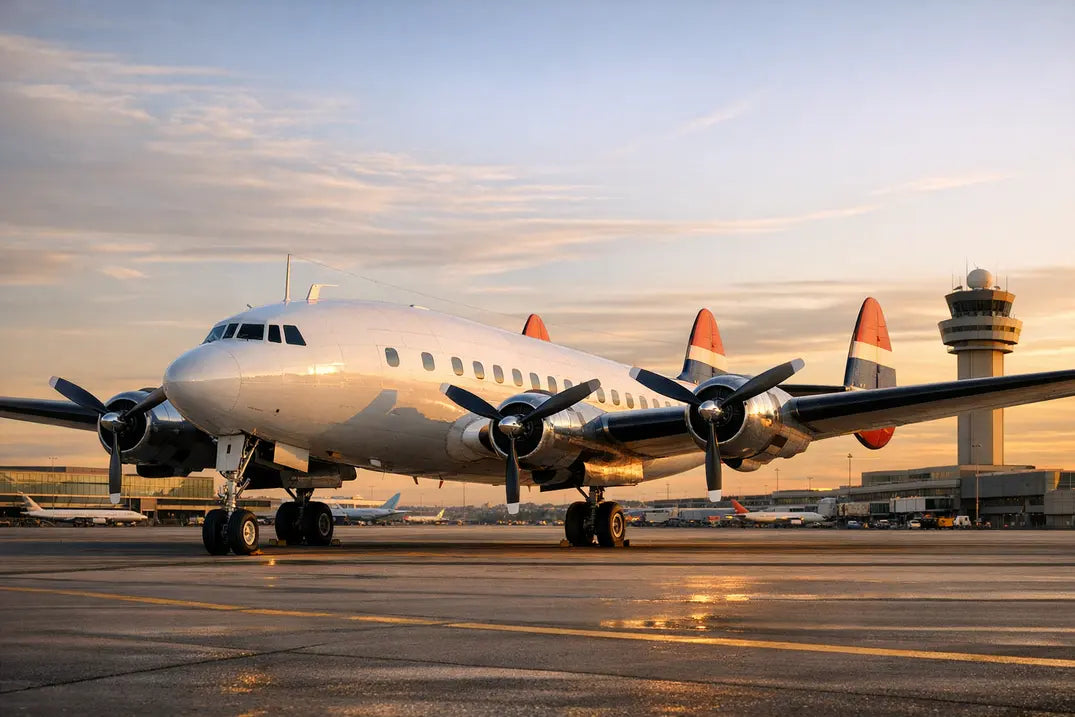
Lockheed L-049 Constellation: History, Development, and Program Origins
The Lockheed L-049 Constellation, affectionately known as the Connie, was the founding variant of one of the most celebrated propeller airliner families in aviation history. Its creation traces back to June 1939, when TWA president Jack Frye and the airline's principal shareholder, Howard Hughes, met privately with Lockheed executives at Hughes' California residence. The goal was to define an entirely new transcontinental airliner that could fly above the weather, carry passengers in a pressurised cabin, and cruise faster than any commercial aircraft then in service. Lockheed's existing L-044 Excalibur concept fell short of these ambitions, prompting chief engineer Clarence "Kelly" Johnson and his team to launch a clean sheet design that would become the L-049.
Development proceeded under extraordinary secrecy. Hughes insisted that no information reach rival airlines, and the project remained largely hidden from public view until a Wartime Production Board inspection shortly before the United States entered World War II. The design evolved rapidly: the fuselage was stretched to 95 feet 3 inches, the wingspan set at 123 feet, and four Wright R-3350 Duplex Cyclone 18 cylinder radial engines, each rated at approximately 2,200 horsepower, were selected to deliver the speed and altitude performance Hughes demanded. Hydraulic flight controls, electrically driven de-icing systems, and Hamilton Standard constant speed, reversible pitch three blade propellers rounded out a specification that was remarkably advanced for the era.
The XC-69 prototype rolled off the Lockheed Burbank, California production line in December 1942 and completed its maiden flight on 9 January 1943, piloted by Boeing test pilot Edmund T. Allen. Allen reportedly praised the aircraft's handling and noted its top speed of approximately 350 mph, which exceeded that of several contemporary military fighters. On 17 April 1944, Howard Hughes and TWA pilot Jack Frye set a transcontinental speed record by flying an early production aircraft from Burbank to Washington, D.C. in 6 hours 57 minutes at an average speed of 331 mph, dramatically publicising the Constellation's capabilities.
However, the entry of the United States into World War II reshaped the programme. The U.S. military requisitioned the entire Lockheed production line, and the L-049 airframes intended for TWA were redesignated as C-69 military transports for the Air Transport Command. An initial contract covered 202 aircraft, but wartime priorities, particularly engine allocation for the B-29 Superfortress, which shared the Wright R-3350 powerplant, meant only around 22 C-69s were delivered before hostilities ended.
With the war's conclusion, Lockheed swiftly reconverted surplus C-69 airframes to civilian L-049 standard, adding upgraded cabin interiors, improved soundproofing, and air conditioning systems. The first production L-049 flew on 12 July 1945, and TWA received its first example on 14 November 1945. Lockheed Martin's historical records confirm that TWA inaugurated scheduled transatlantic service with the L-049 on 5 February 1946, operating the Star of Paris from New York to Paris via Newfoundland and Shannon, Ireland, completing the journey in approximately 17 hours. Pan American World Airways followed shortly after, placing the Connie on its New York to Bermuda route. In total, 88 L-049 airframes were produced, including both military C-69 conversions and purpose built civilian examples, laying the foundation for a production run that would eventually encompass 856 Constellations of all variants between 1943 and 1958.
What Distinguishes the L-049 from Later Constellation Variants
As the baseline model in the Constellation lineage, the Lockheed L-049 Constellation established the family's signature triple tail, dolphin shaped fuselage, and pressurised cabin architecture. Later variants built incrementally on this foundation. The L-649 introduced higher thrust Wright R-3350 engines for improved hot and high performance, while the L-749 added additional fuel tankage in the outer wings, extending range to approximately 5,400 miles and enabling true nonstop transatlantic operations. The most dramatic evolution came with the L-1049 Super Constellation, which stretched the fuselage by 18 feet 4 inches, increased seating capacity to as many as 106 passengers, and introduced further engine refinements. By comparison, the L-049 retained its original 95 foot fuselage, a maximum takeoff weight of 86,250 lb (39,122 kg), a typical seating layout for 44 to 62 passengers, and a cruise speed of roughly 313 mph (504 km/h). While modest in scope alongside its successors, the variant's true achievement lay in proving that pressurised, high speed, long range air travel was commercially viable, a concept that reshaped postwar civil aviation. Aviation enthusiasts interested in how different aircraft families have evolved across generations, from wartime origins to specialised roles, may also find the story of the Antonov An-28 an instructive comparison.
Key identifiers that define the L-049 variant include:
- Engines: Four Wright R-3350-745C18BA-1 Duplex Cyclone radials, each producing approximately 2,200 hp
- Propellers: Hamilton Standard constant speed, reversible pitch, three blade units (4.57 m diameter)
- Fuselage length: 95 ft 3 in (29.03 m)
- Wingspan: 123 ft (37.49 m)
- Maximum takeoff weight: 86,250 lb (39,122 kg)
- Typical seating: 44 to 62 passengers in airline configuration
- Pressurised cabin: First Constellation variant certified for commercial pressurised operations
- Military designation: C-69 (wartime production equivalent)

A Lockheed Constellation L-049 aircraft operated by Trans World Airlines (TWA) is shown in mid-flight, featuring its distinctive triple-tail design and polished fuselage.
Lockheed L-049 Constellation: Technical Specifications, Systems and Engine Details
The Lockheed L-049 Constellation was designed in the early 1940s as a long range, high altitude pressurized airliner capable of transcontinental and transatlantic operations. Its aerodynamic profile, defined by the distinctive triple tail, high aspect ratio wings employing NACA 23018 (root) and NACA 4412 (tip) airfoil sections, and a total wing area of approximately 1,650 sq ft, was optimized for efficient cruise at high altitude while carrying 51 to 81 passengers. The pressurized, circular cross section fuselage represented a significant engineering step for its era, enabling routine operations above most weather at altitudes up to 25,000 ft.
Designed initially to meet a TWA requirement for a coast to coast airliner, the L-049 reflected careful trade offs between range, payload and runway performance. All metal, aluminum alloy stressed skin construction kept structural weight manageable, while four powerful Wright radial engines provided the thrust needed for a maximum takeoff weight of around 86,250 lbs (39,120 kg). The type entered civilian service in February 1946 with Pan American World Airways, quickly becoming a symbol of postwar long range air travel.
- Wingspan: 123 ft (37.49 m)
- Length: 95 ft 2 in (29.01 m)
- Height: 23 ft 8 in (7.21 m)
- Wing area: approximately 1,650 sq ft (153.3 sq m)
- Maximum takeoff weight (MTOW): approximately 86,250 lbs (39,120 kg)
- Maximum landing weight: approximately 75,058 lbs (34,050 kg)
- Passenger capacity: 51 to 81 depending on configuration
- Crew: 4 to 5 flight crew
- Engines: 4 × Wright R-3350 C18 BA Duplex Cyclone 18 cylinder radial engines
- Propellers: 4 × Hamilton Standard 3 bladed constant speed, fully feathering, reversible pitch; diameter 15 ft (4.57 m)
- Normal rated power: 1,800 hp (1,342 kW) per engine at 2,400 rpm
- Takeoff power: 2,200 hp (1,641 kW) per engine at 2,800 rpm
- Fuel capacity: approximately 4,739 US gallons (28,440 lbs)
- Maximum speed: 330 mph (531 km/h)
- Cruise speed: 313 mph (504 km/h) at approximately 16,700 ft to 21,000 ft
- Range: up to 3,995 miles (6,429 km) with maximum fuel load
- Service ceiling: approximately 25,300 ft (7,700 m)
- Takeoff run (sea level, loaded): approximately 2,250 ft (687 m)
Systems, Flight Controls and Onboard Technology
The L-049 employed hydraulically assisted flight controls for the primary surfaces (ailerons, elevators and rudder), reducing the physical effort required by pilots on what was, for its day, a very large airliner. The triple vertical stabilizer arrangement was not merely aesthetic; it lowered the overall tail height for hangar clearance and improved directional stability. Conventional mechanical linkages with hydraulic boost were the norm, as fly by wire technology did not yet exist.
Pressurization was one of the most notable systems on the Constellation. Drawing on Lockheed's experience with the experimental XC 35 pressurized aircraft, the cabin was designed to maintain a comfortable altitude for passengers during cruise at over 20,000 ft. Electric de icing for the wings, propellers and windshield allowed the aircraft to operate in icing conditions, a key operational advantage for North Atlantic and transcontinental routes. The hydraulic system also supported landing gear retraction and extension. Braking relied on hydraulic wheel brakes supplemented by the reversible pitch propellers, which aided deceleration on landing.
Cockpit instrumentation was representative of advanced 1940s avionics: standard flight instruments, radio direction finding (RDF) equipment and basic navigation aids. No weather radar or glass cockpit displays were available, as these technologies appeared in later decades. The Pima Air and Space Museum, which preserves an L-049 airframe, provides further context on the type's systems and equipment.
Published performance figures for the L-049 Constellation can vary considerably depending on the source. Differences in operator configured cabin density (51 to 81 seats), selected fuel load, actual takeoff weight, atmospheric conditions (temperature, altitude, wind) and runway surface all influence real world values. Range figures, for example, are typically quoted at maximum fuel and minimum payload, while operational range with full passenger loads was significantly shorter. Cruise speed values assume standard atmospheric conditions at mid altitudes, and takeoff distances are typically cited for sea level paved runways under standard day assumptions. These numbers should always be interpreted in context rather than as absolute guarantees.
Wright R-3350 Duplex Cyclone: The Engine Behind the Constellation
The L-049 Constellation was powered by four Wright R-3350 Duplex Cyclone radial piston engines, one of the most significant and powerful reciprocating aero engines ever produced. Developed by the Curtiss Wright Corporation, the R-3350 was an air cooled, twin row, 18 cylinder radial with a total displacement of 3,347 cubic inches (54.86 liters). The variant fitted to the L-049 was the R-3350 C18 BA series, equipped with a single stage, two speed, gear driven supercharger that maintained constant power up to 14,000 ft (4,260 m).
At normal rating, each engine delivered 1,800 hp (1,342 kW) at 2,400 rpm, with a takeoff rating of 2,200 hp (1,641 kW) at 2,800 rpm available for short durations. The engine had a bore of 6.125 inches (155.6 mm), a stroke of 6.312 inches (160.2 mm), and a compression ratio of 6.85:1, requiring 100/130 octane aviation fuel. Dry weight per engine was approximately 2,670 lbs (1,212 kg). The R-3350 used a Chandler Evans downdraft carburetor and a dry sump oil system.
The Wright R-3350 had a long and eventful history. Early development was troubled, particularly during its use on the Boeing B-29 Superfortress in World War II, where engine fires caused by overheating were a persistent concern. Reliability improved steadily through the late 1940s and 1950s. Beyond the L-049 and subsequent Constellation variants (L-649, L-749, L-1049 Super Constellation), the R-3350 in its many subvariants powered a wide range of aircraft. The Douglas DC 7, Lockheed P 2 Neptune maritime patrol aircraft, Fairchild C 119 Flying Boxcar and the military C 121 transport variant of the Constellation all relied on versions of this engine. Later turbo compound versions, such as the R-3350 TC series, recovered exhaust energy to boost output beyond 3,250 hp and powered the final generation of piston engine airliners before the jet age rendered them obsolete.
Lockheed Constellation Variants Compared: L-049, L-649, L-1049 and L-1049G
Scroll horizontally to see more →
| Parameter | Lockheed L-049 Constellation | Lockheed L-649 Constellation | Lockheed L-1049 Super Constellation | Lockheed L-1049G Super Constellation |
|---|---|---|---|---|
| Entry into service | 1946 | 1947 | 1951 | 1956 |
| Engines | 4 × Wright R-3350 2,200 hp | 4 × Wright R-3350 2,200 hp | 4 × Wright R-3350 2,700 hp | 4 × Wright R-3350 Turbo-Compound 3,400 hp |
| Length | 29.0 m | 29.0 m | 34.9 m | 35.4 m |
| Wingspan | 37.2 m | 37.2 m | 38.0 m | 38.0 m |
| Height | 7.2 m | 7.2 m | 7.6 m | 7.6 m |
| Typical seating and layout | 2-class: 60–81 passengers | 2-class: 60–81 passengers | 2-class: 80–95 passengers | 2-class: 100–120 passengers |
| MTOW | 39 t | 39 t | 60 t | 62 t |
| Range | 3,472 nm | 3,472 nm | 4,100 nm | 5,300 nm |
| Cruise speed | 0.51 Mach | 0.51 Mach | 0.55 Mach | 0.56 Mach |
| Service ceiling | 25,300 ft | 25,300 ft | 26,000 ft | 25,000 ft |
| Program note | Original pressurized long-range piston airliner, introduced transatlantic service | Strengthened civil version of military C-69 with same performance | Stretched baseline Super Constellation with more powerful engines | Long-range final evolution with turbo-compound engines and higher MTOW |
Scroll horizontally to see more →
The table compares key specifications across four Lockheed Constellation variants, showing how the design evolved from the L-049/L-649 (1946–1947) to the L-1049 and long-range L-1049G. The Super Constellation airframes are longer and heavier, with MTOW rising from 39 t to 62 t. Engine power increases from 2,200 hp to 3,400 hp turbo-compounds, enabling range growth from 3,472 nm to 5,300 nm and a modest cruise speed gain (0.51 to 0.56 Mach). Seating also increases, peaking at 100–120 on the L-1049G.
Lockheed L-049 Constellation Routes, Missions and Airlines Worldwide
The Lockheed L-049 Constellation entered commercial service in February 1946 and immediately redefined long range air travel. Designed at the request of Howard Hughes for Trans World Airlines, it was the first pressurised airliner capable of flying above most weather at altitudes around 6,100 m (20,000 ft), which translated into smoother, faster and more reliable journeys. Powered by four Wright R-3350 Duplex Cyclone radial engines, the L-049 cruised at approximately 480 km/h (300 mph) and offered a maximum range of about 3,995 miles (6,430 km) with full fuel, making it suitable for both transcontinental and transatlantic missions.
Typical stage lengths varied considerably depending on the operator and route. On domestic transcontinental services between New York and Los Angeles (roughly 2,450 miles), flights lasted around 11 hours with one or two intermediate stops, slashing travel times by approximately eight hours compared to the Douglas DC-4. On the transatlantic corridor, TWA inaugurated service from New York to Paris via Gander (Newfoundland) and Shannon (Ireland) in a total elapsed time of about 17 hours. Pan American World Airways followed almost immediately with its own L-049 operations, achieving a Washington to Paris elapsed time of 14 hours 47 minutes on one early proving flight. The aircraft's pressurised cabin was a decisive competitive advantage over unpressurised rivals, allowing operators to maintain higher cruise altitudes and smoother schedules.
The L-049 operated predominantly in a point to point network model, connecting major gateway airports rather than feeding hub complexes as later jet age operations would do. Major airports such as New York LaGuardia, Washington National, Paris Orly, London Heathrow and Amsterdam Schiphol featured prominently on Constellation routes. Operators faced several challenges with the type, most notably the temperamental Wright R-3350 engines, which were prone to overheating and in flight fires. Engine reliability problems led to temporary fleet groundings in 1943 and again in 1946 after supercharger failures. Additionally, the aircraft's high tyre pressure restricted operations to well paved runways, limiting use at smaller or unprepared airfields. Maintenance demands were considerable, and flight crews required extensive training to manage the complex hydraulic, pressurisation and powerplant systems. If you are studying for an aviation knowledge exam or want to test your aviation knowledge, the Constellation era offers a rich case study in early commercial operations.
Where the Lockheed L-049 Constellation Operated Around the World
A total of 88 L-049 airframes were produced (including military C-69 variants converted to civilian use). These aircraft served with more than a dozen carriers across Europe, North America, South America and the Middle East. In North America, the type dominated transcontinental and early transatlantic routes during the late 1940s, flown by several of the continent's largest carriers. In Europe, flag carriers acquired L-049s to re-establish long haul international services in the post war rebuilding period, particularly on routes linking European capitals with North America. In South America, the Constellation enabled direct connections between Latin American cities and the United States. Documented operations in Asia and Africa for the L-049 specifically were limited; those regions saw greater use of later Constellation variants such as the L-749 and L-1049 Super Constellation.
- North America: Trans World Airlines was the launch customer and the dominant operator, deploying L-049s on transcontinental services and the flagship New York to Paris route. Pan American World Airways used the type on transatlantic and Caribbean routes, including the Bermuda to New York corridor. Capital Airlines, Braniff International Airways, Delta Air Lines, Eastern Air Lines and American Overseas Airlines all operated the L-049 on domestic and international services. Pan American-Grace Airways (Panagra) connected the United States with South America through the type.
- Europe: Air France received its first L-049 (registered F-BAZA) in June 1946 for Paris to New York transatlantic services. KLM Royal Dutch Airlines operated six L-049s on the Amsterdam to New York route and set a record 12 hour crossing from New York to Amsterdam in November 1946. BOAC (British Overseas Airways Corporation) deployed the type on transatlantic routes, while El Al Israel Airlines used L-049s for international services connecting Tel Aviv with Europe.
- South America: Cubana de Aviación and Panagra operated the L-049 on routes linking the Caribbean and the western coast of South America with the United States, often routing through intermediate stops such as Havana and Lima.
- Asia and Africa: No L-049 operators based in Asia or Africa have been reliably documented. Carriers in those regions, including Air India and South African Airways, later adopted improved Constellation variants such as the L-749 and L-1049.
Typical Seating Configurations on the Lockheed L-049 Constellation
The L-049 featured a pressurised, circular cross section fuselage with a cabin width of approximately 3.27 m (10 ft 9 in) and a usable cabin length of about 16.6 m. The standard layout used five abreast seating in a 3+2 arrangement, tapering to four abreast toward the rear of the fuselage. In a premium, long haul configuration, as typically used by TWA and Pan Am on transatlantic services, the aircraft seated between 44 and 62 passengers. These luxury layouts often included sleeping berths for overnight crossings, a ladies' powder room, a men's dressing room and generous seat pitch of approximately 87 cm (34 in). For shorter domestic or higher density operations, carriers could configure the cabin for up to 81 passengers by removing lounge amenities and tightening the pitch. TWA's debut transatlantic flight in February 1946 carried 36 passengers, reflecting the spacious premium standard of the era. The cabin also included three lavatories and dedicated cargo holds beneath the floor, accessed via belly freight doors. Full details of Constellation production and operator histories are maintained by the Smithsonian National Air and Space Museum and aviation reference archives.
In this video, join a visit to the HARS Aviation Museum in Australia and hear the story of flying aboard the world’s last airworthy Lockheed Constellation, exploring its history and in-flight experience.
Lockheed L-049 Constellation Safety Record: How Safe Was This Pioneer Airliner?
The Lockheed L-049 Constellation occupies a unique place in aviation safety history. As the first pressurised airliner to enter widespread transatlantic service, it flew in an era when commercial aviation was still developing the regulatory frameworks, maintenance protocols and crew training standards taken for granted today. A total of 88 L-049 airframes were produced between 1945 and 1946, operated by carriers such as TWA, Pan American World Airways, Air France, KLM, BOAC, El Al and Capital Airlines. The variant remained in active airline service from early 1946 through the late 1950s, with some airframes continuing in secondary roles into the 1960s. According to data compiled by the Bureau of Aircraft Accidents Archives (BAAA), the L-049 was involved in at least 15 fatal accidents over its operational life, a figure that must be assessed in the context of a small fleet size, limited navigational aids, rudimentary air traffic control and engines that demanded constant attention from flight engineers. The Aviation Safety Network maintains a detailed database of every known Constellation variant incident, providing transparency that has helped the industry learn from each event.
Notable Accidents and the Lessons They Produced
Several early L-049 Constellation accidents directly influenced aircraft design, maintenance procedures and regulatory oversight.
- TWA Flight 513 (July 11, 1946, Reading, Pennsylvania) — During a local training flight, a defective generator lead through stud in the fuselage skin of the forward baggage compartment caused electrical arcing, which ignited insulation material and filled the cabin with dense smoke. The crew of six lost visibility and control; five were killed when the aircraft struck power lines and crashed into a field. The Civil Aeronautics Board (CAB) determined that deficient inspection procedures had allowed the faulty stud to remain in service. This accident prompted the grounding of all Lockheed Constellations from 12 July to 23 August 1946, until cargo compartment fire detection equipment was installed fleet wide, marking one of the earliest large scale safety driven retrofits in commercial aviation.
- Pan American Airways (December 28, 1946, Shannon, Ireland) — A Pan Am L-049 (registration NC86505) on a Paris to New York service crashed approximately 1.5 km from Shannon Airport during approach, killing 9 of the 23 people on board. The probable cause was an error in altimeter indication resulting from reversed primary and alternative static source lines, compounded by fogged windshield panels that reduced pilot visibility. The investigation highlighted the need for rigorous post maintenance functional tests on pitot static systems and reinforced the importance of instrument cross checks, practices that eventually became embedded in standard operating procedures across the industry.
- Panair do Brasil (1962, near Manaus, Brazil) — An L-049 registered PP-PDE operating a domestic route crashed in the Amazon region, killing all 50 occupants. While detailed investigation records are limited, the event underlined the challenges of operating complex four engine piston aircraft along remote routes with minimal ground infrastructure and contributed to broader discussions in Brazil about fleet modernisation and route suitability.
Each of these events, and many smaller incidents, fed into an iterative loop of investigation, recommendation and improvement. Lockheed applied lessons from L-049 operations to later variants such as the L-749 and L-1049 Super Constellation, reinforcing engine nacelle firewalls, upgrading electrical systems and increasing maximum structural weights. Regulators tightened maintenance inspection intervals and expanded crew training syllabi to include emergency smoke and fire procedures.
How Safe Was the Lockheed L-049 Constellation?
By modern standards, the accident rate of the L-049 Constellation appears high. However, a fair assessment requires acknowledging the operational environment of the late 1940s and 1950s: weather radar was in its infancy, precision instrument approaches were rare, oceanic navigation relied on celestial fixes and the Wright R 3350 radial engines were notoriously prone to overheating. In that context, the Constellation family represented a genuine leap forward in passenger safety thanks to its pressurised cabin, tricycle landing gear, hydraulically boosted flight controls and redundant systems, all features that set new benchmarks for the industry. The aircraft's triple tail design improved low speed handling, reducing the risk during critical phases of flight.
The operational experience accumulated on the L-049 helped shape Civil Aeronautics Board directives and, after 1958, early Federal Aviation Agency regulations that governed maintenance, crew qualifications and long haul flight operations. Lessons from Constellation era accidents are documented in the FAA Lessons Learned library, a resource that continues to inform contemporary aircraft certification and operational standards. Modern aviation enjoys a fatal accident rate below 0.2 per million flights, a figure that owes much to the hard won knowledge gained during the piston era. The Lockheed L-049 Constellation was both a product and a driver of that learning curve, and commercial air travel remains, statistically, one of the safest forms of transportation in the world.
01 What was the typical range and cruise speed of the Lockheed L-049 Constellation?
The Lockheed L-049 Constellation had a cruise speed of 504 km/h at around 5,100 meters and a maximum range of about 6,429 km with full fuel, though practical ranges with 60 passengers were closer to 5,712 km. This allowed it to handle transcontinental flights like New York to Los Angeles or early transatlantic routes with reserves. Shorter missions with maximum payload limited range to around 3,685 km.
02 How was the cabin laid out on the Lockheed L-049 Constellation, and what was the passenger experience like?
The L-049 accommodated 60 to 81 passengers in a pressurized cabin with comfortable seating for its era, often in a mix of tourist and sleeper berths on longer flights. Passengers enjoyed smoother rides above weather thanks to pressurization and a service ceiling of 7,700 meters, though propeller noise reached about 102 dB in flight. Windows provided good views, and the triple-tail design contributed to stable handling in turbulence.
03 Which airlines operated the Lockheed L-049 Constellation and on what routes?
TWA was the primary launch customer for the L-049 Constellation, using it on transcontinental U.S. routes like New York to Los Angeles and early international services across the Atlantic. Other airlines like Pan Am adopted similar Constellations for long-haul flights, valuing its range for nonstop overseas travel. These routes typically carried 60 passengers over 5,000 km distances.
04 How did the Lockheed L-049 Constellation perform compared to similar aircraft of its time?
Powered by four Wright R-3350 radial engines each at 2,200 hp, the L-049 cruised faster at 504 km/h than contemporaries like the Douglas DC-6, with a takeoff run of 488 meters fully loaded. Its Fowler flaps and reversible-pitch propellers improved short-field performance, but high wheel pressure required paved runways. Fuel efficiency was around 0.55 km per kg at cruise altitude.
05 What safety features did the Lockheed L-049 Constellation have?
The Lockheed L-049 Constellation featured electric de-icing, hydraulic-assisted controls, and fully-feathering propellers for reliable engine-out scenarios. Pressurization enabled flight above turbulent weather, and its design included a 3g limit load factor for structural integrity. While early piston airliners had risks, these advancements supported safe operations on long routes.
06 What should passengers know about flying on the Lockheed L-049 Constellation, like seat choice or turbulence?
Seats near the wings offered the smoothest ride during turbulence due to the stable triple-tail design and low wing loading. Large windows provided excellent views, but noise from 1,050 rpm propellers was noticeable at 102 dB, so forward cabins were quieter. Climb to cruise took about 14 minutes fully loaded, with landing speeds around 128-158 km/h for a smooth touchdown on paved runways.