Antonov An‑28 programme history, development route and key differences
Why the Antonov An‑28 programme existed
The Antonov An‑28 was created to extend a proven Soviet approach to short haul connectivity: reliable, rugged aircraft able to serve local routes with limited infrastructure. Its conceptual roots sit in the Antonov An‑14, a light STOL utility aircraft designed for local air routes and intended to operate from small unpaved, sand, pebble and snow covered airfields, while maintaining safe handling in the event of a single engine failure. The An‑14 first flew on 14 March 1958, establishing the baseline airframe philosophy that the An‑28 would later modernise with turboprop propulsion and a broader mission set. For background on the earlier STOL concept aircraft and its development timeline, see Antonov’s official An‑14 history page: Antonov An‑14 programme history.
According to Antonov, the Antonov An‑28 is a further development of that An‑14 STOL concept, designed specifically to carry passengers, mail and cargo on local airlines, while also being adaptable to roles such as forest patrol, aerial photography, geological survey, ice patrol, fish survey, paratrooper training, and air ambulance missions. Antonov also positions the type as a light multipurpose aircraft with published baseline performance figures including a cruise speed of 352 km/h, an operational range of 1,370 km, and an operational ceiling of 6,000 m. The manufacturer’s programme overview and chronology are summarised on the official An‑28 page: Antonov An‑28 history and chronology.
Programme launch, prototypes and powerplant selection
The formal start of the An‑28 programme is explicitly dated by Antonov to 6 August 1966, when an Order of the Ministry of Aviation Industry regarding construction of the An‑28 aircraft was published. This milestone matters because it frames the An‑28 not as a minor upgrade, but as a state backed step in evolving STOL utility air transport toward higher efficiency turboprop power.
Prototype testing focused heavily on propulsion choices. Antonov records the first flight of an An‑28 equipped with TVD‑850 engines on 29 January 1973, with Volodymyr Terskiy as pilot in command and Valerii Mareiev as flight engineer. A further key step followed on 23 April 1975, when an An‑28 equipped with TVD‑10B engines made its first flight with the same named crew members. In practical programme terms, this engine progression is one of the clearest technical signposts for how the An‑28 matured from an initial turboprop integration effort into a configuration suitable for standardisation, serial production, and certification.
Industrialisation in Poland, certification and entry into service
A major structural step in the An‑28 story was the move from design bureau development to licensed serial manufacture outside the USSR. Antonov dates this to October 1978, when the Ministry of Aviation Industry adopted a resolution regarding construction of the An‑28 aircraft in Poland. The serial production centre became the Mielec aircraft manufacturing plant, a facility with a long history of aircraft manufacturing and final assembly. PZL Mielec’s corporate history records that 1984 marked the launch of An‑28 transport aircraft production at Mielec, and it identifies later successors that evolved from this production line. See: PZL Mielec company profile and history.
Antonov also provides a precise production flight milestone: on 22 July 1984, the first production aircraft manufactured in Poland at PZL Mielec made its first flight. This date effectively separates the An‑28 as a programme from the An‑28 as an industrial product, because it signals that jigs, tooling, quality processes, and supply chains had reached a maturity level where repeatable builds and acceptance testing were achievable.
The programme then transitioned from production readiness to airline use and formal airworthiness recognition. Antonov states that in February 1986 the An‑28 started regular passenger carrying operations. Almost immediately alongside that operational step, on 7 February 1986 the USSR State Aviation Register issued Type Certificate No. 11‑28 for the An‑28. For pilots and engineers comparing legacy STOL utility transports, questions often arise around certification basis, operational limitations, and the documentation that typically accompanies type certification and airline entry; an operator focused overview can be found in the site’s FAQ resource: Ready for Takeoff FAQ.
Antonov further notes that the aircraft was serially built at Mielec, where 170 aircraft were manufactured from 1984 to 1992. In historical context, this production figure is important because it helps distinguish the An‑28 as a defined, time bounded licensed manufacturing programme, rather than an indefinitely evolving platform. It also explains why later, more internationally certified derivatives are frequently discussed separately from the core An‑28 variant.
What differentiates the Antonov An‑28 from nearby subvariants
Within the Antonov STOL utility lineage, the An‑28 is distinct primarily because it is the turboprop evolution of the earlier An‑14 STOL concept, positioned by Antonov as a light multipurpose aircraft for local airline passenger, mail and cargo tasks, as well as specialist aerial work. In other words, while the An‑14 established the basic airfield access philosophy, the An‑28 represents the programme step where that philosophy was carried into a new propulsion era and then formalised through type certification and serial manufacture outside the USSR.
The closest later relatives are the PZL developed derivatives that continued from the Mielec production base but moved toward Western engines and wider civil certification acceptance. PZL Mielec’s current product information for the M28 model 05 describes a STOL commuter aircraft for unprepared airstrips powered by two PT6A‑65B turboprop engines rated at a maximum of 1,100 SHP and fitted with Hartzell five blade propellers. PZL also lists multiple civil type certificates for the M28 family including EASA.A.058 and the US FAA certificate A56CE, reflecting a different certification and market pathway from the USSR type certified An‑28. See: PZL M28 model 05 overview and certification list.
Variant identifiers for the Antonov An‑28, based on manufacturer published chronology and production data, include:
- 6 August 1966 Order published to construct the An‑28 aircraft
- 29 January 1973 first flight of an An‑28 with TVD‑850 engines
- 23 April 1975 first flight of an An‑28 with TVD‑10B engines
- October 1978 resolution adopted to build the An‑28 in Poland
- 22 July 1984 first flight of the first Polish built production aircraft at PZL Mielec
- February 1986 start of regular passenger carrying operations
- 7 February 1986 USSR State Aviation Register issued Type Certificate No. 11‑28
- 1984 to 1992 serial manufacture at Mielec totalling 170 aircraft

A Chaika Avia Company Antonov An-28 twin-engine aircraft, registration UR-28768, is shown in flight with landing gear deployed under a clear sky.
Antonov An 28 technical specs, performance and systems highlights
The Antonov An 28 is a light multipurpose turboprop designed around the AN 14 STOL concept, aimed at local airline routes and utility missions where runway length, surface condition, and dispatch practicality matter more than outright cruise efficiency. According to the manufacturer, the aircraft was intended to carry passengers, mail and cargo, and it also supports roles such as forest patrol, aerial photography, geological survey, ice patrol, fish survey, parachute training, and ambulance operations.
From an engineering and operational perspective, the key trade off is rugged STOL capability with a relatively modest cruise profile: the published cruise speed is 352 km/h, paired with an operational range of 1,370 km and an operational ceiling of 6,000 m. Those numbers frame a niche that remains relevant for remote connectivity and short sectors. For context on how aircraft choices and operations are increasingly evaluated through an environmental lens, see the related internal discussion on sustainable aviation challenges in the future of aviation in the face of climate challenges.
- Manufacturer baseline dimensions length 12.95 m, wingspan 22.06 m, height 4.5 m, wing area 39.72 m², as published by Antonov.
- Cruise speed 352 km/h, as published by Antonov.
- Operational range 1,370 km, as published by Antonov.
- Operational ceiling 6,000 m, as published by Antonov.
- Production and certification context serial production in Mielec, Poland is described by Antonov, alongside the fleet timeline that includes first flights with TVD 850 and later TVD 10B engines.
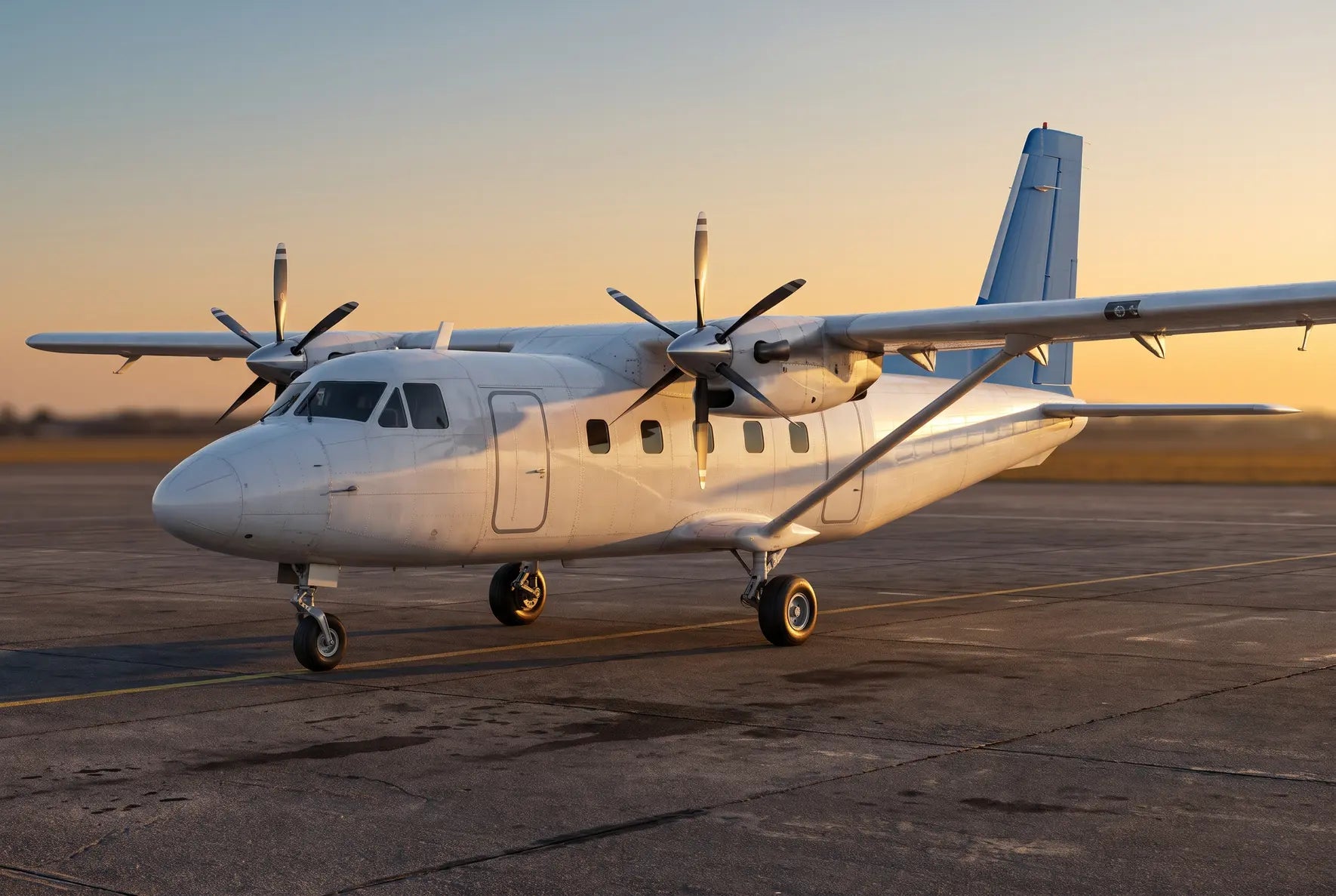
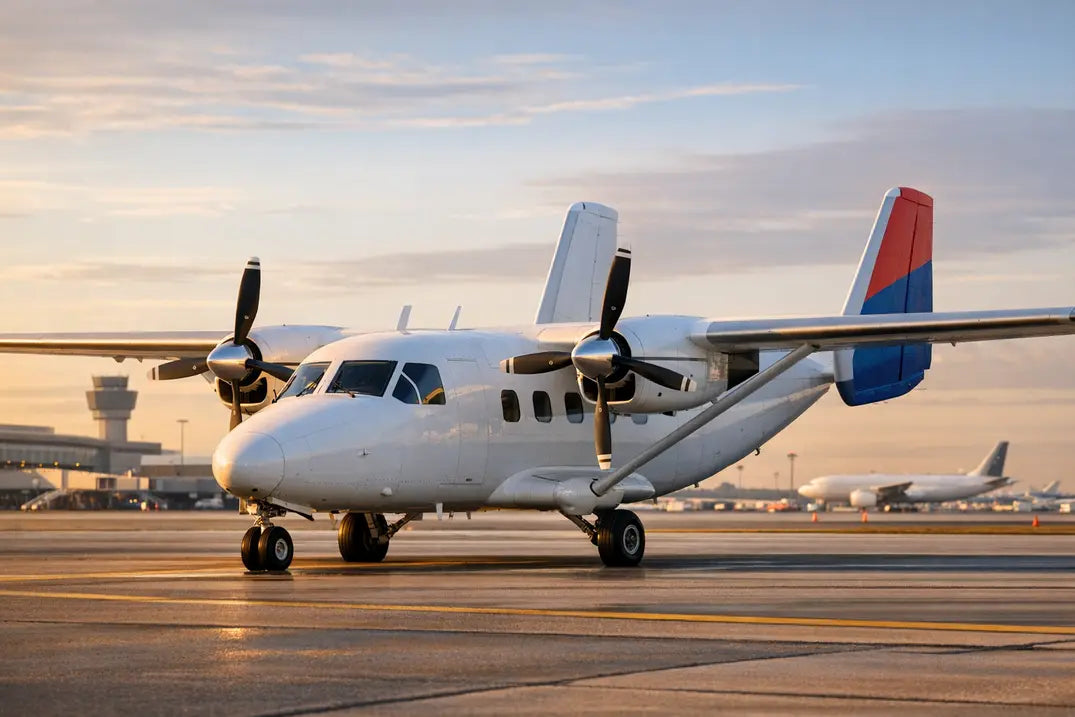
- Configuration overview high wing, fixed tricycle landing gear, and twin fin arrangement are summarised in the aircraft profile published by SKYbrary.
- Maximum takeoff weight reference 6,500 kg is listed in the technical data section of SKYbrary.
- Indicative takeoff distance reference 400 m is published as indicative performance data by SKYbrary.
- Installed engine class the manufacturer timeline confirms AN 28 flights with TVD 10B engines (see chronology in Antonov), and the Polish built equivalent designation TWD 10B or PZL 10S is documented by Pratt & Whitney Rzeszów.
- Engine takeoff power 960 horsepower for the TWD 10B or PZL 10S is published by Pratt & Whitney Rzeszów.
- Engine mass and fuel consumption total mass 230 kg and fuel consumption 347 g/KMh are published in the parameter table on Pratt & Whitney Rzeszów.
Systems and handling relevant technology
The An 28 design philosophy prioritises field operability and mission flexibility: STOL capability is explicitly part of the aircraft concept described by Antonov, and the overall airframe layout is consistent with utility operations, including a high wing and fixed tricycle landing gear as summarised by SKYbrary. In practical terms, the high wing supports obstacle clearance on rough or contaminated surfaces and keeps propeller and wing structures farther from debris, while fixed gear reduces system complexity compared with retractable arrangements.
For pilots, the handling relevant focus is typically the low speed regime associated with STOL operations and the need to manage energy carefully during steep approaches into short strips. For engineers and maintainers, the simplicity of a fixed gear commuter turboprop is often advantageous in remote networks where infrastructure and spares depth can be limited. Across the remaining fleet, cockpit and mission equipment can differ widely because aircraft have been produced over a long period and then adapted for specific missions such as patrol, survey, or medical evacuation, which can influence weight, balance, and performance margins.
Published performance figures for the An 28 should be read with their stated basis and assumptions. The manufacturer figures are presented as cruise speed, operational range, and operational ceiling, while other sources may publish additional values as reference or indicative data. Differences typically come from aircraft mass, payload, mission kit, propeller configuration, engine condition, and the atmospheric and runway assumptions used for calculation, including runway surface condition and obstacle clearance requirements. This is particularly important for short strip operations where small changes in weight or density altitude can drive large changes in takeoff and landing distance margins.
Engines and propellers: TVD 850 to TVD 10B and PZL 10S
Antonov documents two key propulsion milestones for the AN 28 programme: a first flight on 29 January 1973 with TVD 850 engines, followed by a first flight on 23 April 1975 with TVD 10B engines. That sequence highlights a transition from early test installations to the engine type associated with later development and service use, and it is recorded in the chronology on the manufacturer history page for the AN 28.
For aircraft built and supported through Polish industrial channels, the TWD 10B or PZL 10S naming is a key practical detail. Pratt & Whitney Rzeszów describes the TWD 10B or PZL 10S as a 960 horsepower twin rotor design with a free turbine and integral reducers, positioning it as a robust turboprop suitable for passenger aircraft operations. The same source also emphasises its service experience in harsh climatic conditions and its use across multiple countries.
On the operational side, propeller choice and its integration with the engine matter for noise, vibration, and maintenance workload. Pratt & Whitney Rzeszów notes that the engine has been optimised through the use of a Hartzell propeller, with the goal of reducing noise emitted by the propulsion system, and it publishes additional engine parameters, including mass and fuel consumption, in its product data for TWD 10B or PZL 10S.
In terms of engine family context and cross platform use, Pratt & Whitney Rzeszów lists the engine as being used in the Beriejew 30 and Antonov An 28 aircraft, linking it to a broader set of regional utility applications beyond a single airframe. For additional background on how the TVD 10 family relates to later modifications, including the TVD 10B associated with the An 28, a consolidated historical overview is provided in the Omsk Engine Design Bureau profile on GlobalSecurity.org.
Comparison of Regional Turboprop Aircraft: Antonov An-28, ATR 42-300, SAAB 340B, Embraer EMB 120
Scroll horizontally to see more →
| Parameter | Antonov An-28 | ATR 42-300 | SAAB 340B | Embraer EMB 120 Brasilia |
|---|---|---|---|---|
| Entry into service | 1977 | 1985 | 1989 | 1985 |
| Engines | 2 × Glushenkov TVD-10B | 2 × Pratt & Whitney PW120 | 2 × GE CT7-5A2 | 2 × Pratt & Whitney PW118 |
| Length | 13.1 m | 17.7 m | 19.7 m | 20.0 m |
| Wingspan | 22.1 m | 24.6 m | 21.4 m | 20.0 m |
| Height | 4.9 m | 7.1 m | 6.6 m | 6.5 m |
| Typical seating and layout | 1-class: 17 passengers | 1-class: 42 passengers | 1-class: 34 passengers | 1-class: 30 passengers |
| MTOW | 6.5 t | 16.9 t | 13.2 t | 11.5 t |
| Range | 737 nm | 1,500 nm | 1,000 nm | 960 nm |
| Cruise speed | 0.18 Mach | 0.24 Mach | 0.27 Mach | 0.28 Mach |
| Service ceiling | 20,000 ft | 25,000 ft | 31,000 ft | 30,000 ft |
| Program note | Soviet light STOL utility transport for local routes | Baseline regional turboprop airliner, 40-50 seats | Modern commuter turboprop, efficient short-haul | Brazilian pressurized commuter turboprop |
Scroll horizontally to see more →
This table compares key performance and design specifications of four regional turboprop aircraft. The Antonov An-28 is the smallest and lightest with only 17 seats and limited range, while the ATR 42-300 supports up to 42 passengers and offers the longest range at 1,500 nm. The SAAB 340B and EMB 120 provide similar capacities and speeds, but differ in ceiling and layout. Each model serves different operational needs in regional aviation.
Antonov An‑28 typical routes, missions and airlines worldwide
Antonov An‑28 operations are shaped by the aircraft’s original intent as a rugged, short range commuter and utility turboprop for local airlines. Antonov describes the An‑28 as designed to carry passengers, mail and cargo on local routes, while also supporting specialist work such as forest patrol, aerial photography, geological survey, ice patrol, fish survey, paratroop training and ambulance missions. https://antonov.com/en/history/an-28
Typical routes are short to medium sectors linking a small regional hub with multiple secondary airports or basic landing sites. Antonov lists a cruise speed of 352 km/h and an operational range of 1,370 km (with an operational ceiling of 6,000 m), which places most passenger missions in the sub two hour category when payload, weather, alternates and reserve fuel are considered. In Russia’s Far East, for example, a scheduled local service from Yelizovo (Petropavlovsk Kamchatsky) to Palana was planned with departure at 22:15 UTC and the crew reported in to Palana at 00:05 UTC, illustrating that a near two hour sector is operationally realistic for the type in remote regional airline use.
Daily utilisation tends to look like commuter operations rather than classic airline “out and back” trunk flying. The An‑28 flight manual sets practical cycle limits for repeated short hops: at aerodrome elevations up to 1,000 m and outside air temperature not above 40°C, up to three consecutive takeoff and landing cycles are permitted, with a minimum interval of 10 to 15 minutes between sequential landings; at elevations of 1,000 to 1,500 m and temperature not above 26°C, the limit is two consecutive cycles (with the same minimum interval). In practice, this fits the An‑28’s common pattern of short sectors with quick turnarounds, sometimes arranged as multi stop rotations from a regional base to several settlements, then a longer positioning leg back to the maintenance base.
Network structure is usually hub and spoke from a single regional airport with fuel, engineers and basic spares to multiple thin routes, rather than high frequency point to point competition. Operators often choose the An‑28 where runway length, surface, weather and limited ground infrastructure make larger commuters inefficient. Operational planning still needs discipline: flights can involve mountainous terrain, rapidly changing weather, icing exposure and limited nav aid coverage. For flight planning fundamentals relevant to aircraft like the An‑28 (performance margins, weather risk, icing awareness and operational decision making), see the reference material in https://readyfortakeoffbook.com/blogs/aviation-technical-knowledge.
Where the Antonov An‑28 operates around the world
Globally, the Antonov An‑28’s airline footprint has shifted from regular scheduled networks toward niche regional operators, charter work and government or utility roles. In Europe, the type has been associated with short range regional flying and small fleet operators, including in the Baltics and in parts of Russia’s European territory. In North and South America, operations have been concentrated in thin, infrastructure limited markets, notably interior flights from small city airports to remote strips. In Asia, usage is strongly linked to remote domestic connectivity across Russia and Central Asia, where sparse populations and long surface travel times favour small commuter turboprops. In Africa, An‑28 operations have historically included charter and utility flying supporting domestic connectivity, logistics, and occasional specialist missions in challenging weather and terrain.
- Europe: Aeroflot used the An‑28 as a short range regional airliner in the former Soviet system, where the aircraft supported local air lines feeding larger hubs. In the Baltic region, Air Livonia and Enimex are associated with An‑28 commuter operations suited to small airports and limited passenger volumes. In Eastern Europe and nearby markets, small operators such as Tepavia Trans and Avluga Trans are linked with passenger and utility work where flexible schedules and cargo capable cabins were valuable.
- North and South America: Blue Wing Airlines is closely associated with An‑28 use on interior services from Paramaribo’s Zorg en Hoop airport toward remote airstrips, a mission profile where short runway capability and robust systems matter more than cabin comfort. In South America, the type has also appeared with non scheduled operators such as Overtec (documented in connection with demonstration flying) and with state operators such as the Peruvian Army, reflecting that the An‑28 family often serves government and utility transport roles alongside pure airline service.
- Asia: Russia is central to modern An‑28 airline operations. SiLA has used the type for regular passenger flying on thin domestic links, including remote city pairs where ground transport is slow and winter operations are common. The Kamchatka Aviation Enterprise (Petropavlovsk Kamchatsky based) is associated with local services linking the regional capital with outlying towns in Kamchatka, a classic hub and spoke model for sparse populations. Other operators linked with the An‑28 in the region include Vostok Airlines (historically active in Russia’s Far East) and Central Asian carriers such as Tajik Air and Kyrgyzstan Airlines, where the aircraft’s short field performance supported small airport networks.
- Africa: The An‑28 has been used in a range of utility and charter contexts. Operators linked with the type include Ecuato Guineana (Equatorial Guinea), TRACEP Congo Aviation and Victoria Air in the Democratic Republic of the Congo, where missions have included domestic logistics and ad hoc transport in demanding terrain and weather. In West Africa, Weasua Air Transport has been associated with An‑28 operations, consistent with the aircraft’s broader niche as a rugged commuter capable of operating where infrastructure is limited.
Typical seating and cabin layouts
In passenger airline service, the Antonov An‑28 is most commonly encountered as a single class commuter with up to 17 passengers seated in a compact cabin. The typical layout is three abreast in a one plus two arrangement, optimised for short sectors where turnaround speed and payload flexibility are more important than premium cabin features. Compared with larger regional turboprops, baggage stowage is limited and operators often rely on strict weight control and careful load planning, especially on unpaved runways and in hot, high or icing conditions.
For mixed missions, seats are frequently removed or folded to create a combi style cabin for mail, freight and passengers on the same flight, or reconfigured for specialist roles such as medevac and paratroop support. This philosophy is mirrored in later Polish built developments of the same airframe, which are offered in passenger and combi versions for up to 19 passengers, highlighting the enduring operational preference for fast reconfiguration in austere environments. https://pzlmielec.pl/versions
This video explores a rare flying experience aboard four exotic Antonov aircraft—the An-22, An-28, An-38, and An-140—showcasing the engineering behind some of the 22,000 planes Antonov has produced worldwide.
Antonov An‑28 safety record and how safe it is for passengers
The Antonov An-28 is a twin engine utility and regional turboprop built for short sector operations, often into small aerodromes with limited ground infrastructure. Any fair assessment of its safety record must account for that mission profile: many flights take place in marginal weather, with terrain and icing risks, and with fewer navigation aids and emergency services than a major hub would provide.
In aviation safety, accidents are normally discussed in relation to traffic volume, because the world fleet flies tens of millions of flights per year. For example, IATA reports 40.6 million flights in 2024. For the Antonov An-28 specifically, a consolidated total of fleet flights and hours is not publicly published, so context comes from production numbers, years in service, and known utilisation of individual airframes. According to Antonov, the type entered regular passenger operations in February 1986 and 170 aircraft were manufactured in Poland from 1984 to 1992. Even within that relatively small fleet, individual aircraft can rack up high cycle counts on short hops: one An-28 involved in a 2012 accident had logged 11,947 airframe hours and 8,891 takeoff and landing cycles.
Public accident records, such as the Aviation Safety Network database list for AN28, indicate that the most severe events have typically involved controlled flight into terrain during approach in marginal weather, and icing related events that escalate into loss of propulsion or loss of control. These are not unique to the Antonov An-28, but they can be amplified by the environments where the aircraft is commonly used. The practical takeaway is that the aircraft design is only one part of the safety picture: maintenance standards, crew training, dispatch discipline, and conservative standard operating procedures tend to dominate outcomes.
Major accidents and serious incidents to know about
- Petropavlovsk Kamchatsky Air Enterprise, 2012 An Antonov An-28 (RA 28715) crashed during the approach to Palana after deviation from the specified approach pattern and premature descent in mountainous terrain; the official investigation also reported alcohol detected in both pilots. The Interstate Aviation Committee identified gaps in operational oversight and highlighted that a ground proximity warning system could have helped, reinforcing the need for strict instrument procedure compliance, effective flight monitoring, and robust alcohol control policies.
- SiLA, 2021 An Antonov An-28 (RA 28728) made a forced landing in Tomsk region with no fatalities after a dual engine shutdown associated with icing conditions. The Interstate Aviation Committee completed the investigation and issued a final report in September 2023, keeping attention on conservative decision making around icing, correct and timely use of anti icing systems, and ensuring crew workload does not erode monitoring and checklist discipline.
- Blue Wing Airlines, 2008 An Antonov An-28 (PZ TSO) was lost during operations to an interior strip in Suriname, with the database record describing a collision with terrain while attempting to land. With limited publicly available investigation material, the safety lessons are mainly operational: conservative go around decision gates, clear coordination at airstrips where runway occupancy information may be imperfect, and obstacle clearance planning for short runways surrounded by rising terrain. Aviation Safety Network record.
- Blue Wing Airlines, 2010 Another Antonov An-28 (PZ TSV) crashed en route in eastern Suriname, with only limited confirmed detail available in open sources beyond the outcome. Events with sparse technical data still tend to influence practice by pushing operators toward more conservative weather avoidance, improved company flight following, and stronger oversight of operational control on remote routes where diversion options are limited. Aviation Safety Network record.
How safe is the Antonov An-28 in general
How safe the Antonov An-28 is depends on where and how it is flown. As an airframe, it is a proven twin turboprop that has served for decades and was designed for local routes with a focus on practical operability. In a well regulated commercial environment with audited maintenance, conservative weather minima, disciplined instrument approach procedures, and a functioning safety management system, it can deliver safety performance comparable to other small commuter turboprops of its era. Risk increases when the aircraft is operated at the edges of the transport system, for example remote strips with limited navigation aids, demanding winter icing, and high workload schedules that reduce monitoring margins.
The most effective mitigations are typically procedural and organisational: standardised briefings, stabilised approach criteria, strict go around gates, clear icing recognition and anti icing use, formal dispatch risk assessment, and duty and rest practices that protect alertness.
Scale also matters for passenger perception. Global commercial aviation operates at enormous volume, and IATA reports that in 2024 the overall accident rate was 1.13 accidents per million flights, with accidents remaining rare in relation to the 40.6 million flights flown. The Antonov An-28 represents only a tiny fraction of that traffic, so its safety record cannot be reduced to a simple like for like rate comparison without reliable exposure data, but the direction of travel is consistent across the industry: stronger oversight, better data, and continuous learning reduce risk. See the headline statistics in the IATA Annual Safety Report 2024 release and broader regional safety context in the EASA Annual Safety Review.
Ultimately, the Antonov An-28 is best understood as a capable aircraft whose real world safety is shaped by operational discipline, training, and infrastructure. When those elements are in place, risks are managed to very low levels, and aviation remains one of the safest modes of transport.
01 What is the typical range and mission profile of the Antonov An-28?
The Antonov An-28 has a maximum range of about 1,365 km with full fuel and a lighter payload, or around 700 km with maximum payload of 1,750 kg. It excels in short-haul regional flights, serving remote areas with its STOL capabilities for short, unpaved runways. Common missions include passenger transport, cargo delivery, and operations in challenging terrains like islands or mountains.
02 How is the cabin laid out on the Antonov An-28, and what is the passenger experience like?
The Antonov An-28 accommodates up to 17-18 passengers in a single-class layout with a cabin length of 5.26 m, width of 1.74 m, and height of 1.6 m. Expect a utilitarian feel with basic seating, adequate legroom for short flights, and higher noise levels from the twin turboprop engines. Windows provide good views, and the high-wing design minimizes turbulence visibility.
03 Which airlines operate the Antonov An-28 and on what routes?
Airlines in regions like Eastern Europe, Russia, Indonesia, Nepal, and South America operate the Antonov An-28, often under local carriers serving domestic or regional networks. It flies short routes connecting small airports, island chains, or remote communities where larger jets cannot operate. Examples include feeder services in Poland, Guyana, and Vietnam.
04 How does the Antonov An-28 perform compared to similar aircraft?
The Antonov An-28 cruises at 300-335 km/h with a short takeoff run of 270-410 m and landing run of 197-315 m, outperforming many peers in STOL operations from unprepared strips. Powered by reliable turboprops like the TVD-10B or PZL ASz-62IR, it offers good fuel efficiency for its class at about 300 kg/h. Compared to the Cessna Caravan, it carries more payload over similar ranges with twin-engine safety.
05 What is the safety record and key design features of the Antonov An-28?
The Antonov An-28 features an automatic propeller feathering system and rudder trim tab that counter engine failure effects, enhancing single-engine stability. Its rugged high-wing construction suits harsh environments, with a service ceiling up to 6,000-7,000 m. While specific accident data varies, its design prioritizes reliability in remote ops without notable systemic flaws.
06 What should passengers know about flying on the Antonov An-28, like seat choice or turbulence?
Opt for seats near the wings for smoother rides during turbulence, as the Antonov An-28 handles it steadily due to its sturdy build and low cruise speeds. All seats offer window views of the props and terrain below, ideal for scenic short flights. Pack light, as cargo configs are common, and expect quick boarding via the rear clam-shell door.