

Ilyushin Il-18: History, Development Path and Variant Evolution
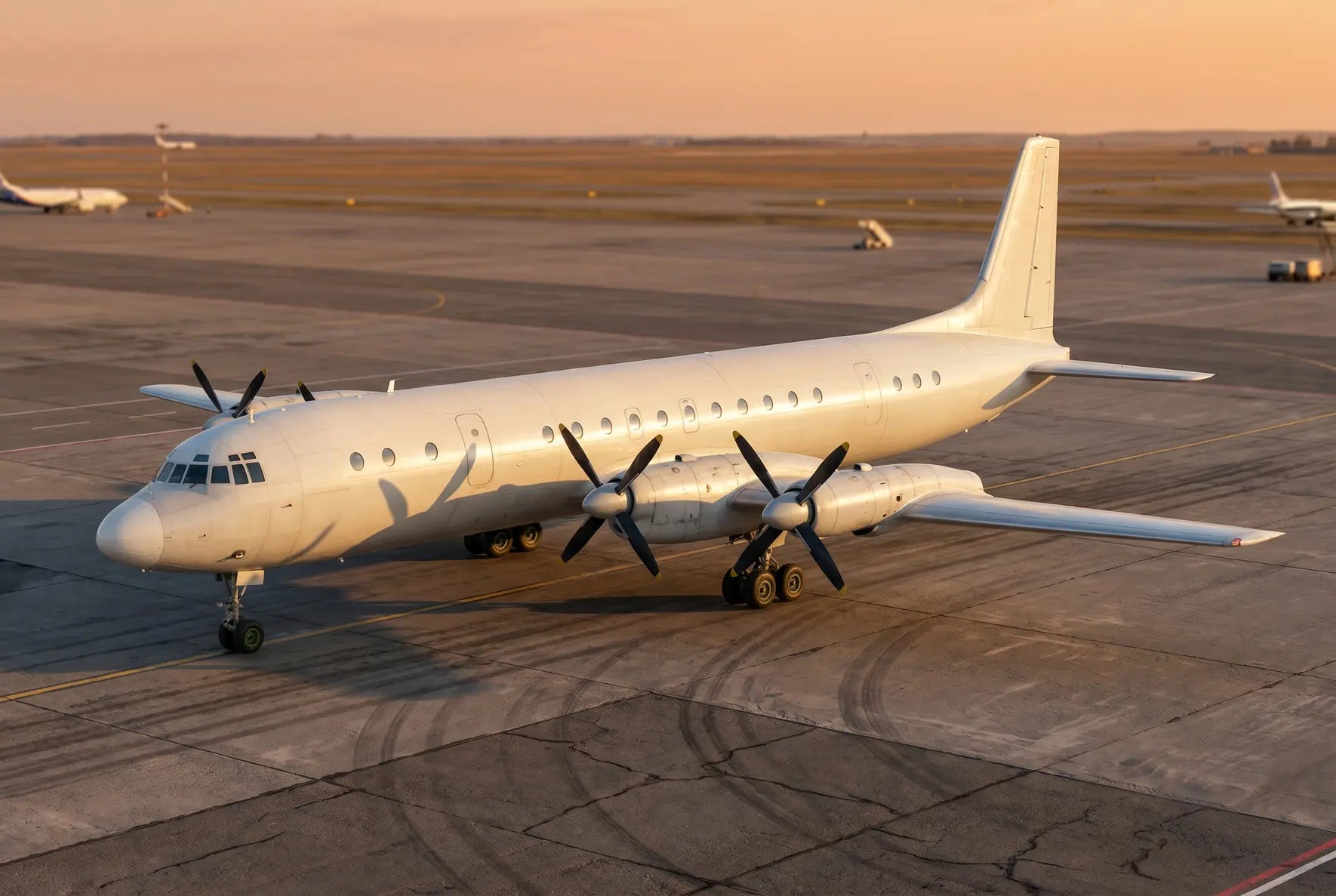
The Ilyushin Il-18 is a four-engined turboprop airliner that became one of the most recognisable and durable Soviet-era commercial aircraft. Designed by the Ilyushin Design Bureau (OKB-240) under the leadership of Sergey Vladimirovich Ilyushin, the programme responded to a pressing Soviet need for a modern, reliable medium- to long-range passenger transport capable of operating from the relatively austere airfields common across the USSR.
The Il-18 designation had previously been applied to a four-engined, piston-powered airliner prototype developed by the same bureau in 1946. That earlier aircraft, intended for around 66 passengers, never entered series production. When the turboprop programme was launched in the mid-1950s, OKB-240 drew on lessons learned from that earlier project and from the successful Ilyushin Il-12 and Il-14 piston-engined transport family, but the 1957 Il-18 was an entirely new design.
The formal impetus came on 30 December 1955, when a Soviet Council of Ministers directive tasked the Kuznetsov and Ivchenko engine design bureaux with developing new turboprop powerplants, and instructed both Ilyushin and Antonov to design airliners around those engines. Antonov's response became the An-10, while Ilyushin's became the Il-18. Design work at OKB-240 had in fact begun as early as 1954, before the directive was formally issued, focused on a low-wing, four-engine monoplane with a circular pressurised fuselage and tricycle undercarriage.
The sole prototype, registered SSSR-L5811, was rolled out at the Khodynka facility in Moscow in June 1957, initially fitted with four Kuznetsov NK-4 turboprops. High-speed taxi tests began on 1 July 1957, and the maiden flight took place on 4 July 1957 from Khodynka airfield. During the subsequent flight-test programme through 1957 and 1958, evaluation of the rival Ivchenko AI-20 engine proved favourable, and the authorities standardised on the AI-20 for all production aircraft. The prototype flew again in its re-engined configuration on 17 September 1958.
The Moscow Machinery Plant No. 30 (Zavod 30) at Khodynka was selected as the primary manufacturing facility. During 1957, production of the Il-14 was wound down to make way for Il-18 assembly. State certification trials were completed by mid-1959, and Aeroflot introduced the type on scheduled passenger services in the second half of 1959, rapidly replacing older piston-engined types on key domestic and international routes. By 1961, the Il-18 was being delivered to export customers including LOT Polish Airlines, TAROM, CSA Czechoslovak Airlines, Interflug, and later Cubana, Air Mali, and others across Africa, Asia, and the Middle East.
Over a production run spanning from approximately 1959 to 1978 (with some military and specialist variants continuing to around 1985), a total of roughly 719 civil airframes were built. By 1990, Il-18s had set some 25 world records in payload, range, and endurance categories. Many individual airframes accumulated over 45,000 flight hours, a testament to the structural robustness of the design. The type's versatility also spawned important military derivatives, including the Il-20 (ELINT/reconnaissance), the Il-22 (airborne command post), and the Il-38 maritime patrol aircraft, which first flew in September 1968 and remains in limited service today. The large number of crew required to operate aircraft like the Il-18 stands in contrast to modern multi-crew pilot licensing pathways that now streamline training for two-pilot flight decks.
What Distinguishes Each Ilyushin Il-18 Sub-Variant
The Ilyushin Il-18 evolved through a series of progressively improved sub-variants, each addressing range, capacity, or powerplant limitations of its predecessor.
The Il-18A was the initial production model, built in small numbers (approximately 20 airframes) during 1958-1959. These early aircraft were powered by the first-series Ivchenko AI-20 engines and seated around 75 to 84 passengers. They were soon superseded by the Il-18B, the first major production standard, which entered service around 1960-1961 with improved AI-20 engines offering increased time between overhauls and a refined interior for approximately 84 passengers. The Il-18B became the variant used by the first wave of export customers.
The most numerous sub-variant was the Il-18V, with 334 built between 1961 and 1965. Powered by uprated Ivchenko AI-20K turboprops, it typically seated 90 to 100 passengers and formed the backbone of Aeroflot's domestic and international turboprop network throughout the 1960s. The Il-18E, introduced in the mid-1960s, featured the more powerful AI-20M engine and accommodated up to 122 passengers, but without additional fuel capacity. The Il-18D (from dalniy, meaning long-range) represented the definitive long-haul development: also powered by AI-20M turboprops, it incorporated an extra centre-section fuel tank that extended range to approximately 6,500 km with reduced payload. The Il-18D became the platform for the majority of later special-mission and VIP conversions.
Key identifiers across the principal Ilyushin Il-18 variants:
- Il-18A: Ivchenko AI-20 engines, 75-84 seats, initial production standard (~20 built)
- Il-18B: Improved AI-20 engines, ~84 seats, first major production variant
- Il-18V: Ivchenko AI-20K engines, 90-100 seats, 334 built (1961-1965), most-produced variant
- Il-18E: Ivchenko AI-20M engines, up to 122 seats, no additional fuel tank
- Il-18D: Ivchenko AI-20M engines, up to 122 seats, extra centre-section fuel tank, range up to ~6,500 km
- Cruise speed (all late variants): approximately 625 km/h at 8,000 m
- Maximum speed: approximately 675 km/h
- Service ceiling: approximately 11,800 m

A Rossiya Airlines Ilyushin Il-18 aircraft is captured mid-flight against a clear blue sky. The plane's distinctive design and Russian lettering are visible.
Ilyushin Il-18 Technical Specifications, Systems, and Engine Overview
The Ilyushin Il-18 was designed as a four-engine medium-range turboprop airliner built to serve the vast Soviet domestic route network while offering respectable payload and range. Conceived in the mid-1950s by the Ilyushin Design Bureau, the aircraft balanced short-field capability with the ability to cruise efficiently at altitudes up to 10,000 m. Its low-wing, pressurised-fuselage design drew on established Soviet engineering practice, prioritising structural robustness and tolerance of poorly prepared runways. All main civil variants (Il-18B, Il-18V, Il-18D, Il-18E) share the same external dimensions, differing primarily in engine mark, fuel system configuration, and cabin layout. The Il-18D, for example, added a centre-fuselage fuel tank to extend range well beyond the earlier Il-18V, while the Il-18E traded that extra tank for additional passenger seats.
In terms of design trade-offs, the Il-18 favoured operational flexibility over outright speed. Its turboprop powerplants delivered lower fuel burn compared with contemporary jet airliners, making it economical on sectors of 2,000 to 5,000 km. For readers interested in how different design philosophies shaped early widebody jets, the Airbus A300B4-200 overview provides a useful contrast from the following generation of commercial aircraft.
- Length: 35.9 m
- Wingspan: 37.4 m
- Height: 10.17 m
- Wing area: 140 m²
- Typical passenger capacity: 80 to 122, depending on variant and cabin configuration
- MTOW: approximately 61,200 kg (Il-18V) to 64,000 kg (Il-18D/E)
- Operating empty weight: approximately 32,350 kg (Il-18V) to 35,000 kg (Il-18D)
- Cruise speed: approximately 625 km/h at 8,000 m altitude
- Maximum speed: approximately 675 km/h
- Service ceiling: 10,000 m (32,800 ft)
- Range with maximum payload: approximately 4,300 km
- Maximum range (Il-18D, reduced payload): approximately 6,500 km
- Fuel capacity: approximately 23,700 litres (Il-18V/D)
- Engines: 4 x Ivchenko AI-20 series turboprops (AI-20K on Il-18V; AI-20M on Il-18D/E)
- Takeoff field length: approximately 1,000 m (conditions-dependent)
Systems, Flight Controls, and Onboard Technology
The Il-18 employs a conventional mechanical flight-control architecture typical of 1950s airliner design. Primary surfaces (ailerons, elevators, rudder) are operated through cables, pushrods, and bellcranks, with hydraulic boost assistance. Trim tabs on the elevator and rudder are adjusted via manual trim wheels in the cockpit. High-lift devices consist of double-slotted trailing-edge flaps; no leading-edge slats are fitted on standard civil variants. Each engine drives a four-bladed, constant-speed, fully feathering and reversible-pitch propeller (AV-68 series), providing effective deceleration on landing roll-out.
The pressurisation system uses engine bleed air to maintain a comfortable cabin environment up to the aircraft's 10,000 m service ceiling. Anti-icing and de-icing protection includes pneumatic boots on wing and tail leading edges, electrically heated propeller blades and engine air intakes, and heated windshields. The cockpit features a conventional analogue instrument panel with dual attitude indicators, radio altimeter, ADF, and a nose-mounted weather radar. Soviet-built aircraft were equipped with RSBN radio navigation (a VOR/DME equivalent), while export and later examples often carried VOR/ILS receivers. Some late-production or retrofitted Il-18D aircraft received GPS and updated inertial navigation systems.
Published performance figures for the Il-18 vary depending on the specific variant, operator-configured cabin density, actual takeoff weight, atmospheric conditions, and runway surface. Range values, in particular, differ between manufacturer brochure numbers and real-world airline operations. For instance, the often-quoted 6,500 km maximum range for the Il-18D assumes a significantly reduced payload and favourable conditions, while the practical range with a full passenger load is closer to 4,300 km. Takeoff distances also depend heavily on elevation, temperature, and aircraft weight, so numbers should always be interpreted with appropriate context.
Ivchenko AI-20 Turboprop Engines
The Ilyushin Il-18 is powered by four Ivchenko AI-20 turboprop engines, a single-shaft design created by the Ivchenko Design Bureau (later Ivchenko-Progress) in Zaporizhzhia, Ukraine, during the mid-1950s. Serial production began around 1958, primarily at Motor Sich JSC (Zaporizhzhia) and the Kazan Engine Plant. Over 15,000 AI-20 engines were manufactured across all variants, making it one of the most widely produced turboprops of the Soviet era.
The AI-20's architecture consists of a 10-stage axial compressor, an annular combustion chamber with 10 fuel injectors, and a three-stage axial turbine. It drives a four-bladed constant-speed reversible propeller through a front-mounted reduction gearbox. Principal variants fitted to the Il-18 include the AI-20K, rated at approximately 4,000 equivalent horsepower (about 2,940 kW), used on the Il-18V; and the AI-20M, uprated to approximately 4,250 equivalent horsepower (about 3,125 kW), used on the Il-18D and Il-18E. The higher-power AI-20D, producing around 5,180 equivalent horsepower (about 3,810 kW), was developed for more demanding applications. Specific fuel consumption at takeoff is in the region of 0.53 lb/(hp·h), comparable to other large turboprops of the period.
Beyond the Il-18, the AI-20 engine family powered a wide range of Soviet aircraft, including the Antonov An-10 medium-range airliner, the Antonov An-12 military transport, the Antonov An-32 tactical transport (using the uprated AI-20D), and the Beriev Be-12 amphibious maritime patrol aircraft. Military derivatives of the Il-18 airframe, such as the Il-38 maritime patrol aircraft and the Il-20 reconnaissance platform, also rely on AI-20 series engines. In China, a derivative known as the WJ-6 was produced under licence and powers the Shaanxi Y-8 and Y-9 transport aircraft. A scaled-down version of the AI-20, the Ivchenko AI-24, was developed for the smaller Antonov An-24 regional airliner family.
Ilyushin Il-18 vs An-10 vs Vanguard vs L-188 Electra: Turboprop Airliner Comparison
Scroll horizontally to see more →
| Parameter | Ilyushin Il-18 | Antonov An-10 | Vickers Vanguard | Lockheed L-188 Electra |
|---|---|---|---|---|
| Entry into service | 1959 | 1959 | 1961 | 1959 |
| Engines | 4 × Ivchenko AI-20 turboprop | 4 × Ivchenko AI-20K turboprop | 4 × Rolls-Royce Tyne 512 turboprop | 4 × Allison 501-D13 turboprop |
| Length | 35.9 m | 34.4 m | 37.6 m | 31.8 m |
| Wingspan | 37.4 m | 38.0 m | 36.6 m | 30.2 m |
| Height | 10.2 m | 10.0 m | 8.2 m | 10.0 m |
| Typical seating and layout (short description + approximate passengers) | Single-class: 80–100 passengers | Single-class: 80–100 passengers | 2-class: 120–140 passengers | Single-class: 85–99 passengers |
| MTOW | 64 t | 61 t | 64 t | 52 t |
| Range | 3,500 nm | 1,350 nm | 2,100 nm | 2,200 nm |
| Cruise speed | 0.50 Mach | 0.48 Mach | 0.52 Mach | 0.53 Mach |
| Service ceiling | 39,400 ft | 32,800 ft | 25,000 ft | 28,400 ft |
| Program note | Long-range Soviet turboprop airliner that became a backbone of Aeroflot medium- and long-haul services and the basis for several military derivatives. | Short- to medium-haul Soviet turboprop developed alongside the Il-18, used mainly on domestic routes within the USSR. | British medium-haul turboprop designed as a high-capacity successor to the Viscount for trunk routes in Europe and within the Commonwealth. | US medium-haul turboprop aimed at major domestic airlines, later better known as the basis for the P-3 Orion maritime patrol aircraft. |
Scroll horizontally to see more →
The table compares four late-1950s/early-1960s four‑engine turboprop airliners across size, capacity and performance. The Il‑18 stands out for long range (3,500 nm) and the highest ceiling (39,400 ft), while the An‑10 trades range (1,350 nm) for similar seating and dimensions. Vanguard carries the most passengers (120–140) at comparable MTOW to the Il‑18, and the L‑188 is lighter (52 t) yet fastest (0.53 Mach) with mid-range capability.
Ilyushin Il-18 Operations: Airlines, Routes and Missions Around the World
The Ilyushin Il-18 was designed as a medium- to long-range turboprop airliner, and throughout its service life it fulfilled that role across dozens of airlines on four continents. With a cruising speed of approximately 625 km/h at 8,000 m and a practical range of 3,700 to 6,500 km depending on payload and variant, the aircraft typically operated sectors between 1,000 and 4,000 km. Flight times ranged from roughly 1.5 hours on shorter domestic segments to 6 or 7 hours on longer international legs. On maximum-range missions with reduced payload, the Il-18D could remain airborne for over 8 hours.
Daily utilisation for the Ilyushin Il-18 in scheduled service generally fell between 5 and 10 block hours per day, lower than modern narrowbody jets but typical for turboprop airliners of its generation. Aircraft were commonly rostered for two to four sectors per day on medium-haul trunk routes, or a single long round-trip on intercontinental services. Turnaround times were longer than for later jets, partly due to the maintenance demands of the four Ivchenko AI-20 turboprop engines and propeller systems.
In terms of network role, the Ilyushin Il-18 was primarily a trunk-route aircraft. Within the Soviet Union, Aeroflot deployed it in a highly centralised hub-and-spoke system radiating from Moscow to republic capitals and major regional centres such as Novosibirsk, Tashkent and Tbilisi. Smaller feeder aircraft like the An-24 and Yak-40 connected outlying cities into these hubs. Outside the Soviet bloc, export operators often used the Il-18 in point-to-point networks linking their capital with regional destinations and a handful of international cities. The type was engineered with robust landing gear capable of handling less-developed runways, which made it attractive for airlines operating from secondary or remote airports in Africa, Asia and the Soviet Far East.
Operators faced several notable challenges. Cabin noise and vibration from the four turboprops reduced passenger comfort, particularly in seats near the wing. The AI-20 engines, while reliable, required relatively short overhaul intervals and access to Soviet-standard spare parts, which could be difficult for airlines in developing nations. Cold-weather operations in Siberia demanded rigorous de-icing procedures and reduced utilisation during winter months. As jet aircraft such as the Tupolev Tu-154 entered service in the 1970s, the Ilyushin Il-18 was progressively displaced from frontline passenger routes and reassigned to cargo, charter and secondary services.
Where the Ilyushin Il-18 Operated
The Ilyushin Il-18 saw service across Europe, Asia, Africa and the Americas, though its presence was overwhelmingly concentrated in countries aligned with the Soviet Union. In Europe, almost every Eastern Bloc national carrier flew the type on scheduled domestic and international services. In Asia, it served trunk routes in China, North Korea, Vietnam and Afghanistan, often connecting capitals with Moscow. Across Africa, Soviet-aligned governments received Il-18s as part of trade and aid agreements, using them on regional and intercontinental routes. In the Americas, only Cuba operated the type, through both its national airline and a regional carrier.
- Europe: Aeroflot was by far the largest operator, deploying hundreds of Il-18s on domestic trunk routes and international services from Moscow to cities across Europe, the Middle East and Africa. Interflug (East Germany) operated up to 16 Il-18s from Berlin Schönefeld on routes to Eastern Bloc capitals and charter services to Cuba and North Africa. LOT Polish Airlines used around 10 aircraft from 1961, connecting Warsaw with Moscow, London, Paris and Middle Eastern destinations on sectors of 1,000 to 3,000 km. Malév Hungarian Airlines flew the Il-18V from Budapest to Moscow and Western European cities. CSA Czechoslovak Airlines operated the type on European and African routes from Prague. Balkan Bulgarian Airlines and TAROM (Romania) also deployed Il-18s on scheduled and charter services across Europe and to the Middle East.
- Americas: Cubana de Aviación was the sole major Western Hemisphere operator, receiving Il-18B and Il-18D aircraft in the early 1960s. Cubana used them on transatlantic services from Havana to Prague via Gander, on routes to Madrid, Mexico City and other Latin American capitals, and on domestic trunk routes such as Havana to Santiago de Cuba. Aero Caribbean, also based in Cuba, operated Il-18V aircraft on domestic and regional Caribbean charter flights from the 1980s into the 1990s.
- Asia: CAAC (the predecessor of China's major airlines) operated Il-18s on domestic trunk routes such as Beijing to Shanghai and Guangzhou, and on international services to Moscow and Pyongyang. Air Koryo (North Korea) used the type from Pyongyang to Beijing and Moscow, and retained at least one Il-18D into the 2010s for special and charter flights. Vietnam Civil Aviation flew Il-18s on the long Hanoi to Moscow route via intermediate stops, as well as on regional services. Ariana Afghan Airlines operated the type from Kabul to Moscow and Tashkent. In the Middle East, Egyptair (formerly United Arab Airlines) used several Il-18s on services from Cairo to Khartoum, Beirut, Jeddah and European cities.
- Africa: Ghana Airways ordered 8 Il-18s (4 were later returned to the USSR) and used the remainder on West African regional routes from Accra and on intercontinental services to London and Rome. Air Guinée flew a small fleet on regional routes from Conakry to Dakar and Abidjan, and on services to Europe. Air Mali used 2 to 3 aircraft from Bamako for West African and international services. Daallo Airlines (Somalia) was among the last commercial operators, using Il-18s on regional routes from Mogadishu and Hargeisa to Djibouti, Jeddah and Dubai through the 1990s and 2000s.
Typical Seating Configurations
The Ilyushin Il-18 featured a circular-section fuselage with a single aisle and four-abreast seating in a 2-2 arrangement. Total passenger capacity varied significantly by variant and operator. The early Il-18A seated around 89 passengers, while the Il-18B was configured for approximately 84 in a slightly more spacious layout. The Il-18V, the most widely produced passenger variant, typically carried between 90 and 100 passengers depending on the airline. The long-range Il-18D could accommodate up to 120 to 122 passengers in high-density economy configurations.
Seat pitch generally ranged from approximately 76 cm (30 in) in the densest layouts to around 84 cm (33 in) for operators prioritising comfort. Most airlines configured the cabin in a single economy class, particularly on domestic Soviet routes, though some international operators divided it into a smaller forward section with greater legroom and a larger rear economy cabin. VIP and government versions, designated Il-18 Salon, reduced seating to as few as 20 to 40 places to create lounge areas and private compartments. Late in the type's career, many aircraft were converted to all-cargo or combi configurations, with passenger capacity reduced to 50 to 80 seats to accommodate freight pallets. Compared to turboprop contemporaries like the Lockheed L-188 Electra or Vickers Vanguard, the Il-18 offered a similar cabin cross-section and comfort level, though with characteristically higher noise levels near the engines.
In this video, watch the very rare and last Ilyushin IL-18 Phoenix ex-75466 depart from Ostend Airport, capturing a true classic turboprop that arrived unannounced in darkness on 13/10/1999.
Ilyushin Il-18 Safety Record: Accident History and How Safe Is It?
The Ilyushin Il-18 entered scheduled airline service in 1959 and remained in front-line commercial use for roughly three decades, with a small number of airframes flying into the 2000s. Approximately 678 aircraft were built between 1957 and 1985, serving more than 40 operators worldwide, including Aeroflot, CSA Czechoslovak Airlines, Malev Hungarian Airlines, Cubana, Air Koryo, and several military air forces. Over that long career, the Aviation Safety Network database for the Il-18 records around 90 to 100 hull-loss events and approximately 75 to 85 fatal accidents. Putting those figures into perspective, the Il-18 fleet accumulated millions of flight hours across challenging operating environments, often in regions with limited navigational infrastructure, austere airports, and harsh climates. The majority of incidents occurred during the 1960s and 1970s, a period in which global aviation safety standards, crew-resource management, and ground-proximity warning systems were far less mature than they are today.
Notable Accidents and Lessons Learned
Several high-profile accidents shaped both the operational history of the Il-18 and broader aviation safety improvements. The following events are among the most significant.
- Aeroflot Flight 909 (1976): On 6 March 1976, an Il-18E operating as Aeroflot Flight 909 crashed near Verkhnyaya Khava in the Voronezh region of Russia, killing all 111 people on board and 7 on the ground. The cause was traced to a failure in the 36-volt electrical bus, which knocked out critical flight instruments at night. The crew experienced spatial disorientation and lost control. This disaster reinforced the need for redundant electrical power to essential instruments and contributed to improved emergency-procedure training for partial instrument failures across Soviet aviation.
- United Arab Airlines, Aswan (1969): On 20 March 1969, an Il-18 operated by United Arab Airlines crashed on approach to Aswan Airport in Egypt, killing 100 of the 105 occupants. The aircraft descended below the correct glide path in poor visibility, resulting in controlled flight into terrain (CFIT). The accident highlighted the critical importance of strict adherence to published approach minima and reinforced procedural discipline for non-precision approaches, particularly at airports with limited ground-based approach aids.
- China Southwest Airlines Flight 4146 (1988): On 18 January 1988, an Il-18D crashed approximately 5.7 km from Chongqing Baishiyi Airport in China, killing all 108 people on board. An engine fire in the nacelle area led to structural damage and loss of control during the approach phase. The accident prompted stricter engine-inspection regimes and maintenance oversight within Chinese civil aviation and contributed to the decision to phase older Soviet-designed turboprops out of scheduled passenger service.
- IRS Aero Flight 9601/02 (2001): On 19 November 2001, an Il-18V on a flight from Khatanga to Moscow crashed near Kalyazin in the Tver region, killing all 27 people on board. The investigation pointed to a probable malfunction of the elevator trim system while the autopilot was engaged, causing an unrecoverable nose-down pitch. Serious maintenance violations, including engines stored beyond approved life limits and falsified logbooks, were also documented. This crash was the decisive event that led Russian authorities to ban commercial passenger operations of the Il-18 by October 2002, effectively ending the type's airline career in Russia.
How Safe Is the Ilyushin Il-18 Today?
Assessing the safety of the Il-18 requires historical context. Most of the type's accidents occurred in an era when CFIT, spatial disorientation, and inadequate maintenance oversight were leading causes of airline disasters worldwide. The design itself was robust for its time: a four-engine turboprop with structural redundancy, straightforward handling characteristics, and proven Ivchenko AI-20 engines. However, the Il-18 lacked modern safety systems such as enhanced ground-proximity warning (EGPWS), traffic-collision avoidance (TCAS), and digital flight-data monitoring that are standard on contemporary aircraft. Operating environments also played a role, as many Il-18 operators flew into austere airfields with minimal navigational aids, sometimes in remote polar and sub-arctic regions where weather and terrain are unforgiving.
Today, the Il-18 is effectively retired from scheduled passenger service. Fewer than a handful of airframes remain nominally airworthy worldwide, used occasionally for cargo or special missions. According to data compiled by the International Civil Aviation Organization (ICAO), global airline accident rates have fallen dramatically since the Il-18's peak years. Modern standard operating procedures, mandatory crew-resource management training, and comprehensive regulatory oversight have transformed air transport into one of the safest modes of travel. While the Il-18's accident record reflects the challenges of its operational era, the lessons drawn from its incidents contributed meaningfully to the safety improvements the industry enjoys today.
01 What kind of aircraft is the Ilyushin Il-18 and what missions was it designed for?
The Ilyushin Il-18 is a Soviet four-engined turboprop airliner that entered service in the late 1950s. It was designed for medium- to long-range passenger operations on domestic trunk routes and some international services, with a strong reputation for reliability and endurance. Many aircraft were later adapted for cargo, military transport, and special-purpose roles such as calibration and reconnaissance.
02 How far can the Ilyushin Il-18 fly and what routes is it best suited to?
Typical Il-18 variants were built for long sectors in their era, with range depending on payload and version; roughly speaking, it was well suited to routes of around 2,500 to 5,500 km. That made it practical for long domestic legs, remote regional services, and international routes across the Soviet Union, Eastern Europe, the Middle East, and parts of Asia. Its turboprop engines gave it good fuel economy and runway performance compared with early jets on similar missions.
03 What is the cabin like on an Ilyushin Il-18?
The Il-18 cabin is generally remembered as sturdy and functional rather than luxurious. Compared with modern airliners, it is usually noisier and vibration is more noticeable because of the four turboprop engines, although the large fuselage and classic layout can feel spacious on some aircraft. Window seat views are often good, and the high-wing design gives a clear look at the engines and wing during flight.
04 Which airlines still operate the Ilyushin Il-18 today?
The Ilyushin Il-18 is no longer used by major passenger airlines, but a small number remain in service with military, government, cargo, and charter operators. Surviving examples are most often found in Russia and a few other countries, typically on special missions, executive transport, or occasional enthusiast flights rather than scheduled airline routes. When it does appear, it is usually on niche operations rather than everyday commercial service.
05 How does the Ilyushin Il-18 compare with similar aircraft in efficiency and performance?
In its day, the Il-18 was respected for combining long range, good payload, and strong short- and medium-runway performance. Compared with early jet airliners, it was usually more fuel-efficient on moderate-length routes and could use airfields with less demanding infrastructure. Against later turboprops and jets, however, it is slower, noisier, and less economical by modern standards.
06 Is the Ilyushin Il-18 a safe aircraft to fly on?
The Il-18 has an important place in aviation history and was known for a robust airframe and four-engine redundancy. Like many aircraft of its generation, its safety record reflects both long service life and varied operators, so condition and maintenance standards matter greatly. For travelers, the key practical point is that surviving Il-18s in active use are usually operated for special missions under modern oversight rather than routine mass-transport service.