

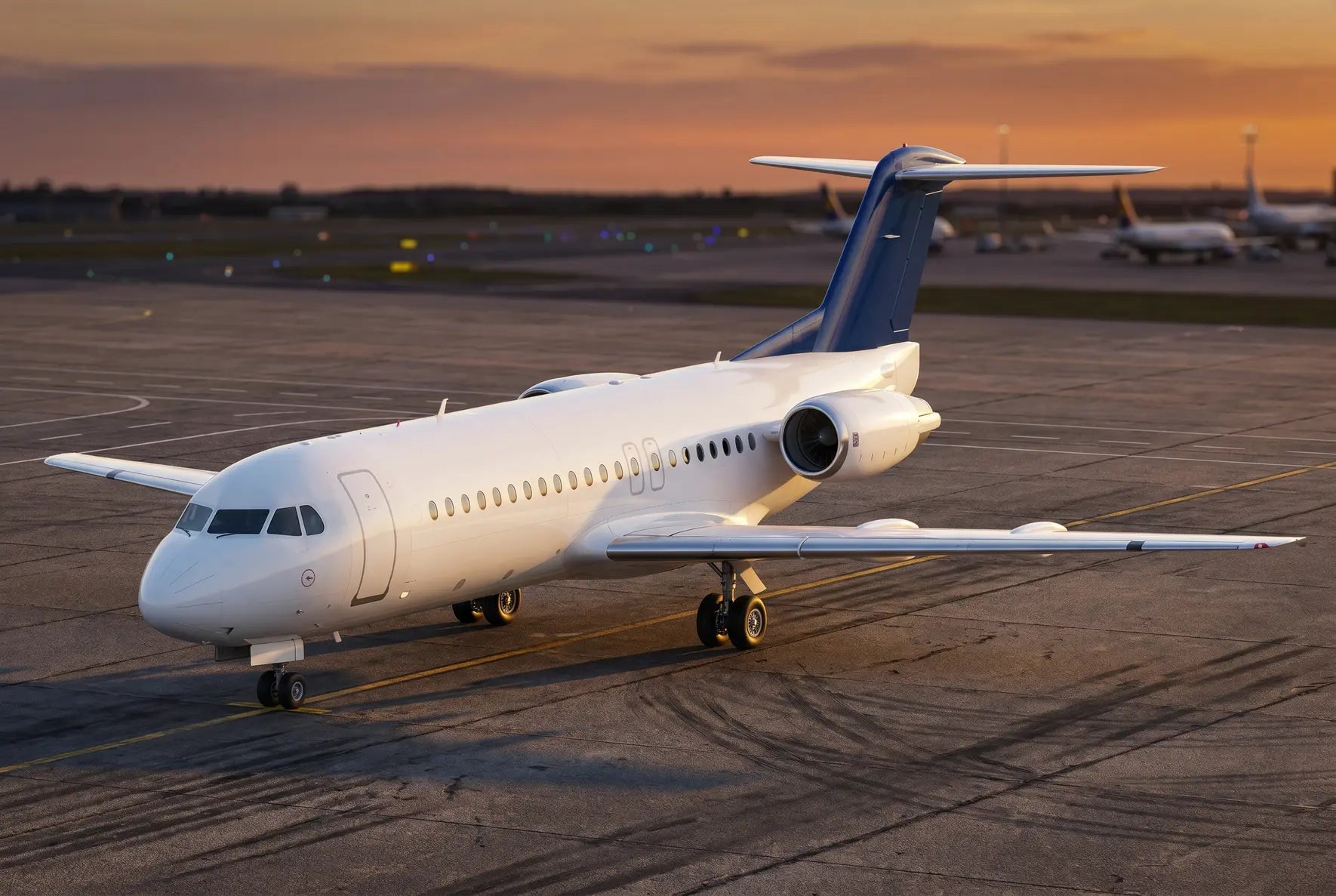
Fokker 70: History, Program Launch, and Development of the Short-Body Regional Jet
The Fokker 70 emerged in the early 1990s as a shorter-fuselage derivative of the Fokker 100, itself a modernised successor to the venerable Fokker F28 Fellowship. Both jets belonged to a lineage of rear-engined, T-tail regional aircraft built by the Dutch manufacturer Fokker, founded by Anthony Fokker on 22 February 1912. Over the decades, Fokker became synonymous with European regional aviation, producing the F27 Friendship turboprop and the F28 Fellowship twin-jet before launching the larger Fokker 100 in 1983. When airlines began requesting a right-sized jet for thinner routes and performance-limited airports, Fokker responded by developing a shortened version of the Fokker 100, officially designated the F28 Mk 0070 under the existing F28 type certificate.
The Fokker 70 programme was formally launched in November 1992, without a committed launch customer. Development moved quickly because the aircraft shared extensive structural and systems commonality with the Fokker 100. The fuselage was shortened by approximately 4.62 metres compared to the Fokker 100, while the wing, tailplane, cockpit and most systems remained virtually identical. This commonality allowed pilots to hold a single type rating for both aircraft, a significant advantage for operators running mixed F70/F100 fleets.
After roughly six months of prototype conversion work, the first flight of the Fokker 70 took place on 4 April 1993 from Fokker's facility at Woensdrecht in the southern Netherlands. The first production aircraft flew in July 1994, and type certification was granted on 14 October 1994 under the European Joint Aviation Authorities (JAA) framework, building on the existing F28 series certificate. The first delivery followed swiftly in October 1994 to Ford Motor Company, configured as an executive jet. The first commercial airline operator was Sempati Air of Indonesia, which introduced the type into scheduled service in 1995.
Powered by two rear-mounted Rolls-Royce Tay 620-15 turbofan engines, each rated at approximately 61.6 kN (13,850 lbf) of thrust, the Fokker 70 offered strong field and climb performance from short runways. Its maximum take-off weight stood at around 41,730 kg (92,000 lb), and the type could accommodate between 70 and 80 passengers in a typical five-abreast, single-class layout, with a maximum certified capacity of approximately 85 seats. Compared with older types serving similar routes, the Fokker 70 brought jet speed and comfort to airports previously accessible only to turboprops, in a similar spirit to how aircraft such as the Boeing 737-200C once opened up new route possibilities for operators.
The programme, however, was cut short by financial difficulties at the parent company. Fokker declared bankruptcy in 1996 after failing to secure sufficient government and shareholder support. Despite the collapse, production continued long enough to fulfil outstanding orders. The final Fokker 70, and the last aircraft ever built by Fokker, was delivered to KLM Cityhopper on 22 April 1997. In total, 47 airframes were completed, including the prototype. The low production volume stood in stark contrast to the aircraft's operational reputation: the Fokker 70 proved reliable and economical, and many airframes remained active well into the 2010s with operators across Europe, Australasia and beyond.
What Sets the Fokker 70 Apart from the Fokker 100 and the F28 Fellowship
While the Fokker 70 shares its DNA with the Fokker 100, several characteristics make it a distinct variant. Relative to the Fokker 100, it uses the lower-thrust Tay 620 engines instead of the Tay 650 (rated at approximately 67.2 kN), resulting in a lighter, more efficient package for shorter sectors. The shortened fuselage gives the F70 a superior range-to-capacity ratio, with a typical range of around 1,850 nautical miles, making it well suited for thin regional routes. The aircraft was also certified for steep approaches, including operations at London City Airport's demanding 5.5-degree glideslope, aided by a distinctive tail-mounted airbrake.
Compared with the original F28 Fellowship from the 1960s, the Fokker 70 represented a generational leap. It replaced the Rolls-Royce Spey low-bypass engines with the quieter, more fuel-efficient Tay series. It introduced a fully digital glass cockpit featuring Rockwell Collins EFIS displays, a dual Flight Management System and an integrated automatic flight control system capable of CAT IIIA autoland. The aerodynamically redesigned wing, inherited from the Fokker 100, was approximately 3 metres wider in span than the F28's original wing and featured extended leading and trailing edges, delivering an estimated 30% improvement in cruise efficiency. Noise levels were certified more than 24 EPNdB below ICAO Annex 16 Chapter 3 limits, ensuring the Fokker 70 could operate at noise-sensitive airports without restriction.
The following list summarises the key variant identifiers of the Fokker 70:
- Official designation: Fokker F28 Mk 0070
- Engines: 2 x Rolls-Royce Tay 620-15 turbofans (61.6 kN each)
- Typical seating: 70 to 80 passengers (five-abreast); maximum approximately 85
- MTOW: approximately 41,730 kg (92,000 lb)
- Fuselage: 4.62 m shorter than the Fokker 100
- Cockpit: digital EFIS glass cockpit with dual FMS and CAT IIIA autoland capability
- Steep-approach certification: approved for 5.5-degree glideslope operations
- Total production: 47 airframes (1992 to 1997)

A KLM Cityhopper Fokker 70 aircraft is captured in flight, showcasing its distinct blue and white livery against a clear blue sky. The airplane is in profile, with landing gear extended.
Fokker 70 Technical Specifications, Systems and Engine Overview
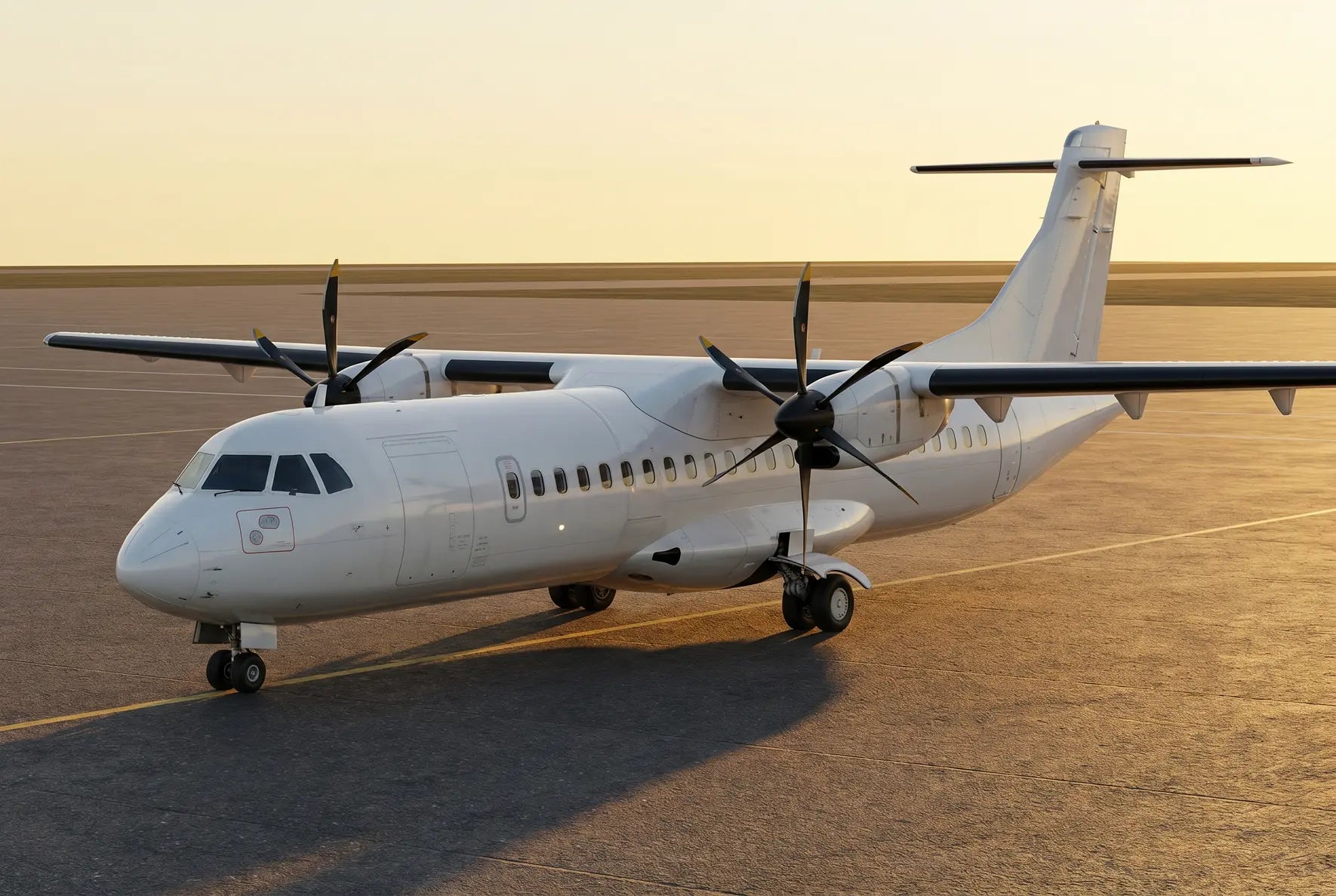
The Fokker 70 was conceived as a shortened derivative of the Fokker 100, optimised for regional routes of up to roughly 1,800 NM with around 70 to 80 passengers. By removing six fuselage frames, Fokker retained the proven wing, tail section, hydraulic systems and cockpit of the larger sibling while reducing structural weight and operating costs on thinner sectors. The result is a low-wing, T-tail monoplane with a circular semi-monocoque fuselage, rear-mounted engines and hydraulically deployed tail-cone airbrakes. In terms of design trade-offs, the Fokker 70 prioritises short-field capability and low seat-mile cost over transcontinental range, occupying a niche comparable to turboprops such as the ATR 72-200 but with pure jet speed and passenger comfort.
Although production ended in 1997 after Fokker's bankruptcy, the aircraft remained in scheduled and charter service well into the 2020s, a testament to the durability of its airframe and the reliability of its Rolls-Royce Tay powerplant. Below is a summary of the key specifications and systems that define this regional jet.
- Overall length: 30.91 m (101.4 ft)
- Wingspan: 28.08 m (92.1 ft)
- Height: 8.50 m (27.9 ft)
- Wing area: 93.5 m²
- Typical seating: 70 to 80 passengers in all-economy layout (31-33 in pitch)
- Maximum take-off weight (MTOW): approximately 39,910 kg (87,985 lb)
- Operating empty weight (OEW): approximately 22,800 kg (50,265 lb)
- Maximum landing weight (MLW): approximately 36,740 kg (80,996 lb)
- Maximum zero-fuel weight (MZFW): approximately 33,560 kg (74,000 lb)
- Fuel capacity: approximately 13,360 litres (3,530 US gal)
- Engines: 2 x Rolls-Royce Tay Mk 620-15 turbofans, each rated at 13,850 lbf (61.6 kN)
- Manufacturer range (max payload): approximately 3,470 km (1,873 NM)
- Typical cruise speed: Mach 0.73 to 0.77, approximately 450 to 462 KTAS at altitude
- Service ceiling: 35,000 ft
- Take-off field length: approximately 1,300 m (4,265 ft) at typical operating weights
- Landing field length: approximately 1,210 m (3,970 ft) at typical operating weights
- Avionics baseline: Rockwell Collins EFIS glass cockpit with dual FMS and integrated automatic flight control system
Systems Architecture and Handling Technology
The Fokker 70 relies on a conventional hydro-mechanical flight control system rather than fly-by-wire. Primary surfaces, including ailerons, elevators and rudder, are actuated by dual hydraulic circuits with mechanical linkages from the cockpit. Artificial feel units provide control feedback, and manual reversion is available on certain axes in the event of hydraulic failure. Unlike later-generation types such as the Airbus A320 family, there are no hard flight-envelope protections or control-law modes; stall and overspeed awareness is provided through stick shaker, stick pusher and aural warnings.
The automation philosophy follows a classic early-1990s two-crew EFIS paradigm. A dual-channel autopilot and flight director system offers heading, VOR/LOC, LNAV, vertical speed, IAS/Mach hold and glideslope coupling for ILS approaches down to CAT I or CAT II, depending on operator certification. The Rockwell Collins EFIS suite presents information on CRT-based EADI and EHSI displays, with a central engine and status panel. A dual Flight Management System handles lateral and vertical navigation, but the pilot retains full authority at all times without automation-imposed restrictions.
Braking is hydraulically actuated with a conventional anti-skid system that modulates pressure to prevent wheel lock-up. The Tay 620 engines use hydro-mechanical fuel control units with electronic trim and limiting, rather than a full-authority digital engine control (FADEC). Thrust is set manually via N1 or EPR reference with cockpit instrument guidance. Maintenance support comes from built-in test equipment (BITE) and a central maintenance computer that stores fault codes and exceedance data; many later operators added ACMS or ACARS-based trend-monitoring capabilities as retrofit options.
Published performance figures for the Fokker 70 can vary noticeably between sources. Differences arise from cabin density, operator-selected weight limits, atmospheric assumptions (ISA versus hot-and-high conditions), runway surface state and the specific Tay engine thrust mark installed. Range values, for instance, depend on payload, reserves policy and cruise altitude. Any specification should therefore be read in context rather than taken as an absolute guarantee of performance.
Rolls-Royce Tay 620: The Fokker 70's Sole Powerplant
The Fokker 70 is exclusively powered by two Rolls-Royce Tay Mk 620-15 turbofans, each delivering 13,850 lbf (61.6 kN) of static thrust at sea level under ISA conditions, flat-rated to 30 °C. The Tay is a two-spool, medium-bypass turbofan with a bypass ratio of approximately 3.04:1. Its architecture includes a single-stage wide-chord fan of about 44 inches in diameter, a three-stage intermediate-pressure compressor, a twelve-stage high-pressure compressor, an annular combustion chamber, a two-stage HP turbine and a three-stage LP turbine.
Developed by Rolls-Royce in the mid-1980s, the Tay drew its core technology from the proven RB.183 Spey lineage while incorporating fan and compressor advances from the RB.211 programme. The Tay 620 entered service with the Fokker 100 in 1988 and subsequently became the standard fit for the Fokker 70 from 1994 onward. Its higher-thrust sibling, the Tay 650, rated at 15,100 lbf (67.2 kN), was reserved for later Fokker 100 variants requiring additional take-off performance. Beyond the Fokker family, the Tay engine also powers the Gulfstream IV and IV-SP (Tay 611 variant) and the Gulfstream G350/G450 (Tay 611-8C variant), making it one of the most widely used powerplants in the business-jet segment. Overall, Rolls-Royce produced approximately 3,056 Tay engines across all marks, earning the family a strong reputation for reliability and relatively low specific fuel consumption of around 0.69 lb/lb/hr in the cruise regime.
Fokker 70 vs Fokker 100 vs CRJ700 vs ERJ 170: Regional Jet Specifications Comparison
Scroll horizontally to see more →
| Parameter | Fokker 70 | Fokker 100 | Bombardier CRJ700 | Embraer ERJ 170 |
|---|---|---|---|---|
| Entry into service | 1994 | 1988 | 2001 | 2002 |
| Engines | 2 × Rolls-Royce Tay 620 turbofans | 2 × Rolls-Royce Tay 650 turbofans | 2 × General Electric CF34-8C5 turbofans | 2 × General Electric CF34-8E turbofans |
| Length | 30.9 m | 35.5 m | 32.5 m | 29.9 m |
| Wingspan | 28.1 m | 28.1 m | 23.2 m | 26.0 m |
| Height | 8.5 m | 8.5 m | 7.6 m | 9.7 m |
| Typical seating and layout (short description + approximate passengers) | 2-class: 70–80 passengers | 2-class: 97–109 passengers | 2-class: 66–78 passengers | 2-class: 66–78 passengers |
| MTOW | 38 t | 45 t | 34 t | 38.8 t |
| Range | 1,840 nm | 1,700 nm | 1,700–2,000 nm | 2,100 nm |
| Cruise speed | 0.75 Mach | 0.75 Mach | 0.78 Mach | 0.78 Mach |
| Service ceiling | 35,000 ft | 35,000 ft | 41,000 ft | 41,000 ft |
| Program note | Shortened regional derivative of the Fokker 100 aimed at 70-seat short-haul markets. | Baseline 100-seat narrow-body from which the Fokker 70 was developed. | Competing regional jet family from Bombardier targeting similar 70-seat routes with higher cruise altitude. | Early Embraer E-Jet family member offering similar capacity with modern regional jet economics. |
Scroll horizontally to see more →
The table compares key specs of four regional jets. The Fokker 70 is a shortened Fokker 100, sharing wingspan and cruise Mach 0.75, but with fewer seats and lower MTOW. CRJ700 and ERJ 170 offer similar 66–78 seat capacity to the F70, yet cruise faster at Mach 0.78 and reach 41,000 ft. ERJ 170 also shows the longest range at 2,100 nm.
Fokker 70 Operations: Typical Routes, Missions and Airlines Around the World
The Fokker 70 was designed for short-to-medium-range regional services, and its operational profile reflects that mission. With a practical range of approximately 2,000 to 2,350 km (1,070 to 1,270 nm) under a full passenger load and standard fuel reserves, the type typically covers sectors between 500 and 1,500 km. At a cruise speed of around 845 km/h (456 kt), this translates into block times of roughly 40 minutes on the shortest legs and up to two hours on longer routes. The airframe was engineered for high-cycle operations, with a design life of 90,000 landings, making it well suited to schedules involving multiple short rotations per day.
Most operators have used the Fokker 70 in hub-and-spoke feeder networks, connecting secondary and regional airports to major hubs. Airlines such as KLM Cityhopper and Austrian Airlines historically deployed the type on dense intra-European routes, feeding traffic into Amsterdam Schiphol and Vienna respectively. The aircraft's ability to operate from relatively short runways (take-off field length of approximately 1,300 m) also makes it suitable for airports with constrained infrastructure, a factor that has kept it relevant in regions like Africa, the Caribbean and Oceania. Some operators also use it on point-to-point routes where passenger demand matches its 70- to 80-seat capacity.
A key challenge for remaining Fokker 70 operators is fleet sustainability. Production ended in 1997 after only 47 airframes were built, and the shrinking global fleet means spare parts sourcing is increasingly difficult and expensive. Fokker Services Group continues to provide engineering support, AOG logistics and heavy maintenance programmes, but operators must plan carefully around parts availability and diminishing economies of scale for training, tooling and component pooling.
Where the Fokker 70 Operates
At its peak, the Fokker 70 could be found across Europe, Asia, the Americas and Africa. In Europe, the type served as a backbone regional jet for major flag-carrier subsidiaries throughout the 1990s and 2000s, connecting capitals and business centres with high-frequency schedules. In the Americas, small Caribbean and South American carriers adopted the Fokker 70 for inter-island and cross-border services where its range and runway performance offered a practical advantage over larger narrowbodies. In Asia and the Pacific, national carriers used it on domestic trunk routes and short international sectors, while in Africa a handful of operators continue to rely on the type for domestic and regional connectivity in East Africa. Government and military operators in Africa and Asia also maintain VIP and transport-configured airframes.
- Europe: KLM Cityhopper was among the largest Fokker 70 operators worldwide, flying an extensive intra-European network from Amsterdam to cities in the UK, Germany, Scandinavia and Eastern Europe before retiring its last aircraft in October 2017. Austrian Airlines (via Tyrolean Airways under the Austrian Arrows brand) operated the type on Central and Eastern European routes from Vienna until phasing it out around 2015-2017. Other notable European operators included Air France Regional, British Midland Airways, Malev Hungarian Airlines and Alitalia, all of which replaced the Fokker 70 with Embraer or Airbus regional jets. No European airline operates the type today.
- North and South America: Fly All Ways, based in Paramaribo, Suriname, operates up to three Fokker 70s on routes to Cuba, Guyana, Barbados and Jamaica. Jetair Caribbean flies two aircraft from Willemstad, Curacao to destinations including Medellin, St Maarten, Kingston, Paramaribo and Aruba. In Peru, WayraPerú has been listed with up to two Fokker 70s for domestic services, though its current operational status is uncertain. Historically, Mesa Airlines operated the type as America West Express on US regional routes in the late 1990s. Much like the DHC-6 Twin Otter, which also thrives in the Caribbean region, the Fokker 70 has proven valuable on routes linking island communities with limited infrastructure.
- Asia and Oceania: Air Niugini, the national carrier of Papua New Guinea, currently operates four Fokker 70s on domestic routes from Port Moresby to cities such as Lae, Mount Hagen and Rabaul, though the fleet is gradually being replaced by Airbus A220s. The Myanmar Air Force maintains two ex-KLM Cityhopper airframes for military transport. Former Asian operators include SilkAir, Vietnam Airlines and TransNusa of Indonesia, all of which retired the type in favour of newer equipment. In Australia, Alliance Airlines is the world's largest remaining Fokker 70 operator, with approximately 10 to 14 airframes used primarily for charter and fly-in fly-out mining services from Brisbane and Perth.
- Africa: Skyward Express operates a single Fokker 70 on domestic Kenyan routes from Nairobi alongside its Fokker 50 and Fokker 100 fleet. A Kenyan-registered aircraft has also been noted flying the Nairobi-Juba route under lease arrangements. The Kenya Air Force operates one VIP-configured Fokker 70, seating 26 passengers, for government transport missions.
Typical Seating Configurations
The Fokker 70 cabin is arranged in a five-abreast (2-3) layout across a single aisle, with an internal cabin width of approximately 3.1 m. According to the manufacturer's specifications, the standard single-class configuration seats 79 passengers at a 32-inch (81 cm) pitch. A maximum of 85 seats is possible at a tighter 30-inch pitch, though this high-density arrangement was rarely used in scheduled service. In a typical two-class layout, the aircraft accommodates around 72 passengers, with a small business class cabin at 36-inch (91 cm) pitch forward and economy at 32 inches aft.
Network carriers historically favoured two-class or flexible premium layouts. KLM Cityhopper, for example, refitted its Fokker 70 fleet with 80 slimline ACRO seats, incorporating a European Business Class section and an Economy Comfort zone with additional legroom. Air Niugini currently flies a two-cabin configuration with 6 business class and 70 economy seats. Charter and regional operators tend to opt for simpler all-economy cabins. Alliance Airlines configures its Fokker 70s with 80 economy seats at a 33-inch pitch, providing generous legroom for a regional jet. In the United States, the Fokker 70's capacity was capped at 70 seats to comply with pilot union scope clauses, effectively increasing seat pitch or allowing additional galley and wardrobe space compared to maximum-density layouts.
In this video, fly a rare Fokker 70 in 2025 on an economy-class review from Brisbane to Gladstone, featuring cabin impressions, onboard experience, and highlights of this short domestic hop.
Fokker 70 Safety Record: How Safe Is This Regional Jet?
The Fokker 70 holds one of the strongest safety records of any regional jet ever produced. Across a production run of 47 airframes delivered between 1994 and 1997, the type has accumulated roughly three decades of commercial operations with zero passenger or crew fatalities. Operators such as KLM Cityhopper, Austrian Airlines, Alliance Airlines and Air Niugini have logged hundreds of thousands of flight hours and cycles on the aircraft. The Aviation Safety Network type database lists several incidents for the Fokker 70, yet none resulted in a hull loss with fatalities. For a type that has served on demanding regional routes across Europe, Australia, Papua New Guinea, East Africa and the Caribbean, this is a remarkable achievement.
Notable Incidents and Safety Improvements
Although the Fokker 70 has never been involved in a fatal accident, a handful of incidents prompted meaningful safety improvements for the fleet.
- Austrian Airlines OE-LFO, Munich, 5 January 2004. Flight OS 111 from Vienna experienced a dual loss of engine power during descent in icing conditions. The investigation found that ice impact trays inside both Rolls-Royce Tay 620 engines came loose after heavy ice shedding, causing compressor damage and severe thrust loss. The crew declared an emergency and performed a forced landing in a snow-covered field approximately four kilometres from Munich Airport. All 28 passengers and four crew members evacuated without injury. The aircraft sustained substantial damage but was later repaired and returned to service. In the aftermath, Rolls-Royce and Fokker Services issued service bulletins covering inspection and reinforcement of engine ice impact panels, while operators revised cold-weather operating procedures for the Tay engine, including stricter use of continuous ignition and minimum power settings during descent in icing.
- KLM Cityhopper PH-KZH, Amsterdam Schiphol, 30 November 1997. This Fokker 70 sustained substantial damage on the ground when a passenger bus collided with the aircraft wing on the apron. No occupants were injured. Although the cause was unrelated to the aircraft design, the event reinforced the importance of ground-handling safety procedures at busy hub airports.
- EASA wing anti-icing mandate, 2009. Following several icing-related events across the Fokker 70 and Fokker 100 fleets, the European Aviation Safety Agency mandated the installation of improved wing leading-edge heating apparatus and temperature monitoring systems. The directive also introduced revised flight-manual procedures for operating in known or forecast icing, reducing the risk of residual ice on critical surfaces during take-off and climb. A separate directive in December 1996 had already required all operators to inspect thrust reversers to prevent inadvertent deployment.
Each of these events illustrates how the aviation safety system works: incidents are investigated, root causes are identified, and targeted improvements in hardware, training and regulation follow. The Fokker 70 benefited directly from this iterative process throughout its service life.
How Safe Is the Fokker 70?
When measured against traffic volume, the Fokker 70 demonstrates an exceptionally low accident rate. With zero fatal accidents across a fleet of 47 aircraft operating over roughly 30 years, the type compares very favourably with both its regional-jet peers and the global commercial jet average. According to data compiled by Boeing's Statistical Summary of Commercial Jet Airplane Accidents, the overall fatal accident rate for Western-built jets has fallen steadily since the 1960s, and the Fokker 70 sits well within the safest end of that curve.
Several factors contribute to this strong record. The aircraft was certified to JAR-25 and FAR Part 25 transport-category standards, which impose strict requirements on structural strength, system redundancy, fire protection and emergency evacuation. Its twin Rolls-Royce Tay 620 engines are rear-fuselage mounted, reducing the risk of uncontained engine debris reaching the cabin or wing fuel tanks. The flight deck features an electronic flight instrument system (EFIS), a flight management system (FMS), terrain awareness and warning system (TAWS) and traffic collision avoidance system (TCAS), all of which are at least dual-redundant. A distinctive tail-mounted airbrake allows steep-approach operations at airports such as London City without compromising go-around margins. These design choices, combined with rigorous continuing airworthiness oversight from EASA and national regulators, have kept the Fokker 70 safe throughout its operational life. For readers interested in how a more recent narrow-body compares in terms of design philosophy, the Airbus A321-100 overview offers a useful point of reference.
Aviation remains one of the safest modes of transport in the world, and the Fokker 70 is a clear example of that principle in action. Its clean safety record reflects not only sound engineering but also the combined effect of well-trained crews, standardised operating procedures and a global regulatory framework that continually learns from every event.
01 What is the Fokker 70 used for?
The Fokker 70 is a short- to medium-range regional jet designed for thin routes where a 100-seat aircraft would be too large. It was developed from the larger Fokker 100 and was aimed at airline missions such as feeder services, domestic sectors, and business-heavy city pairs. Its typical role is to connect secondary cities or operate on routes with moderate demand.
02 How far can a Fokker 70 fly?
The Fokker 70 has a maximum range of about 2,000 nautical miles, depending on payload and operating conditions. In airline service, that makes it suitable for many European, Middle Eastern, and similar short-haul routes, but not for long-haul flying. Real-world range is often lower once headwinds, reserves, and full passenger loads are factored in.
03 What is the Fokker 70 cabin like?
The Fokker 70 usually seats around 80 to 85 passengers in a single-class layout, with a 2-3 seating arrangement across a relatively narrow cabin. Compared with larger narrow-body jets, it feels more intimate and can be comfortable for short flights, especially for passengers who value fewer seats and faster boarding. Overwing and rear-seat engine placement also means the aircraft can feel noisier toward the back than some newer jets.
04 Is the Fokker 70 a noisy aircraft?
The Fokker 70 is generally considered louder than modern regional jets and newer narrow-bodies, mainly because it uses older turbofan technology and rear-mounted engines. Seats near the front and ahead of the wing are usually quieter than those at the back. For many travelers, the noise level is acceptable on short flights, but it is not as quiet as more recent designs.
05 Which airlines have operated the Fokker 70?
The Fokker 70 has been operated by a mix of European and regional airlines, with notable use in the Netherlands, Austria, and parts of Africa and Asia. KLM Cityhopper and Austrian Airlines were among the better-known operators, and the type has also appeared with carriers such as Kenya Airways and Alliance Air. It is most often found on domestic and short international routes where capacity needs are modest.
06 Is the Fokker 70 safe and easy to fly on?
The Fokker 70 was built with a conventional twin-engine regional jet design, a pressurized cabin, and systems intended for short-haul airline service. Like any aircraft type, its safety record depends on operator maintenance, training, and airport conditions, but it has been used widely in commercial service for decades. For passengers, turbulence behavior is similar to other small jets: it may feel a bit more lively than on a large airliner, but that does not mean it is less airworthy.