

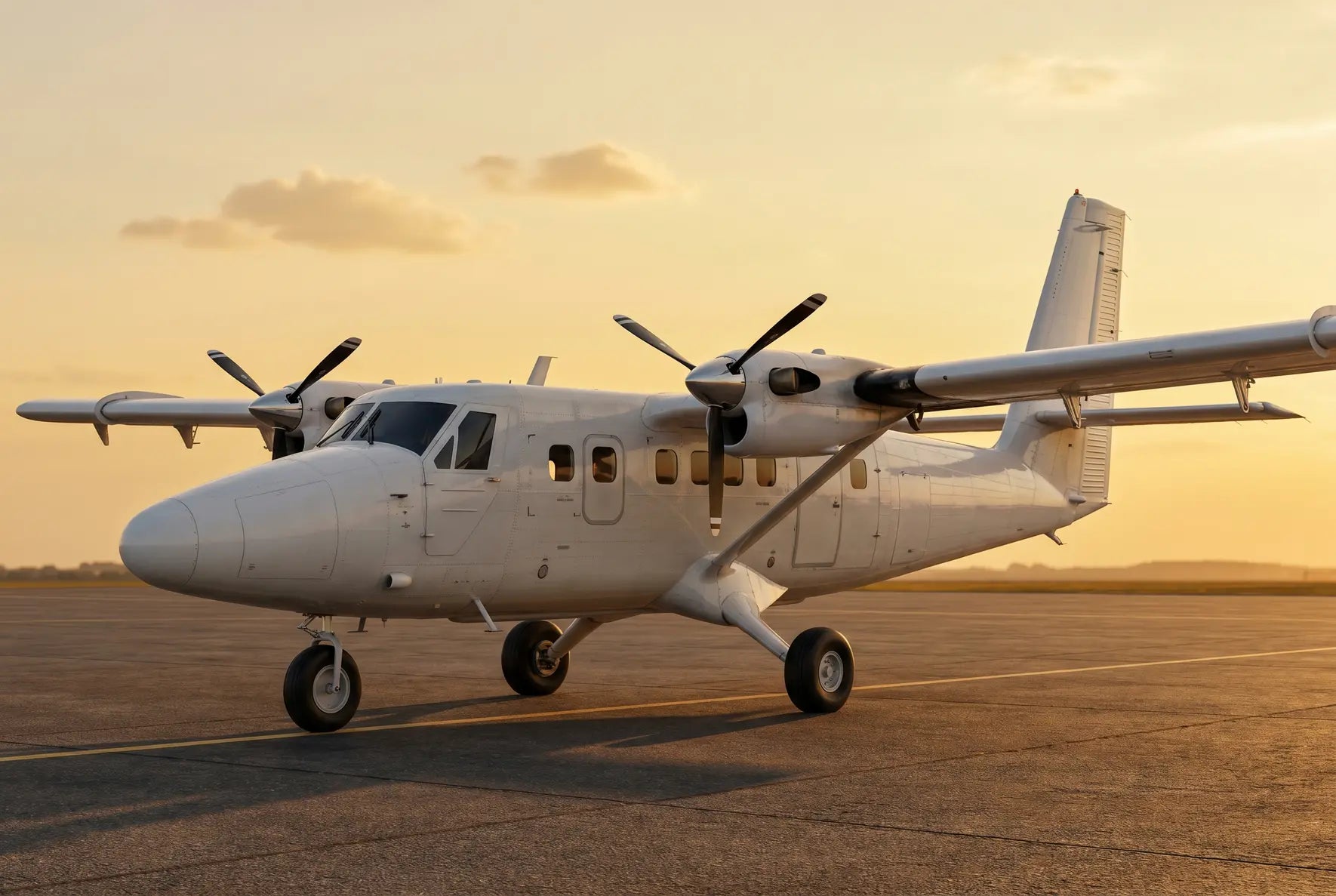
History and Development of the De Havilland Canada DHC-6 Twin Otter
The De Havilland Canada DHC-6 Twin Otter traces its origins to the mid 1960s, when de Havilland Canada (DHC) set out to create a rugged, twin engine STOL (Short Takeoff and Landing) utility aircraft capable of serving remote communities across Canada's north. Building on the proven lineage of the single engine DHC-3 Otter and DHC-2 Beaver, the company designed a 19 passenger commuter plane that could operate equally well on wheels, skis or floats from unprepared strips as short as 1,200 feet.
The prototype made its first flight on 20 May 1965 at the DHC facility in Downsview, Ontario. Canadian type certification followed in 1966, with the FAA Type Certificate A9EA granted shortly after. The first production aircraft, designated Series 100, entered service in July 1966, quickly finding operators among bush airlines, military units and scientific expeditions around the world.
The original manufacturer, de Havilland Canada, had been a subsidiary of the British de Havilland Aircraft Company before becoming a Crown corporation in 1974. DHC developed and produced all three legacy series of the Twin Otter at its Downsview plant in Toronto. In 1986, the Canadian government sold DHC to Boeing, which continued production briefly before halting the Twin Otter line in late 1988 after a total of 844 aircraft (Series 100, 200 and 300 combined) had been built. Boeing subsequently sold the DHC division to Bombardier Aerospace in 1992. Bombardier focused on larger regional aircraft such as the Dash 8 and did not restart Twin Otter production, yet global demand for the type never faded. In February 2006, Victoria based Viking Air Ltd. acquired the DHC-6 type certificate from Bombardier. Engineers digitally scanned parts from retired airframes to create modern production tooling, and the revived Series 400 completed its first flight on 16 February 2010. Transport Canada approved the Series 400 on 24 June 2010, with FAA validation following on 11 June 2012. Viking Air later rebranded as De Havilland Aircraft of Canada under parent company Longview Aviation Capital, and the aircraft remains in production today. In May 2025, De Havilland Canada celebrated the 60th anniversary of the Twin Otter's maiden flight.
What Distinguishes Each Twin Otter Series
Although all DHC-6 variants share the same high wing, fixed undercarriage, unpressurised airframe layout, each series introduced meaningful upgrades in powerplant, structure and systems.
The Series 100 (serial numbers 7 through 115, totalling 115 aircraft) was the baseline production model, powered by two Pratt & Whitney Canada PT6A-20 turboprops rated at 550 shp each. It featured a short nose section with a compact forward baggage compartment.
The Series 200 entered production in 1968 (serial numbers 116 through 230, totalling 115 aircraft). Its most visible change was an extended nose section, roughly 0.68 metres longer than the Series 100, providing a significantly larger forward baggage compartment and an expanded rear cargo shelf. The engines remained the PT6A-20. Aileron and flap refinements further enhanced STOL handling.
The Series 300, which began production in 1969, became the most widely built legacy variant with approximately 614 airframes completed before the line closed in 1988. The key upgrade was a pair of more powerful PT6A-27 engines, each producing 620 shp (flat rated to 680 shp), which improved climb performance, hot and high capability and useful load. Operators could specify either the short or extended nose depending on mission requirements. The Series 300 is still flown by organisations such as the British Antarctic Survey for polar science missions.
The Series 400, produced by Viking Air and now De Havilland Canada, represents the modern production standard. It is fitted with PT6A-34 engines rated at 750 shp each and features a fully integrated Honeywell Primus Apex avionics suite replacing the analogue instruments of earlier series. Composite materials in select structural areas reduce empty weight, while modernised electrical and lighting systems improve reliability. Unlike larger freighter types such as the Airbus A330 200F, the Twin Otter is purpose built for short field operations rather than long haul cargo, yet both aircraft illustrate how manufacturers adapt proven platforms to evolving market needs.
The following list summarises the key variant identifiers across the DHC-6 family:
- Series 100: PT6A-20 engines (550 shp), short nose, 115 built (1966 to 1968)
- Series 200: PT6A-20 engines (550 shp), extended nose (+0.68 m), larger baggage compartments, 115 built (1968 to 1969)
- Series 300: PT6A-27 engines (620/680 shp), short or extended nose options, approx. 614 built (1969 to 1988)
- Series 400: PT6A-34 engines (750 shp), Honeywell Primus Apex glass cockpit, composite weight savings, extended nose only, in production from 2010
- Classic 300-G: Current production variant based on the Series 300 configuration with modern avionics and reduced empty weight, manufactured in Calgary, Alberta
With over 60 years of continuous operational history and active production under De Havilland Canada, the DHC-6 Twin Otter remains one of the most enduring utility aircraft programmes in aviation. Its ability to adapt across series, from analogue bush plane to digitally equipped modern platform, is central to its longevity in more than 100 countries worldwide.

A WinAir De Havilland Canada DHC-6-300 Twin Otter aircraft is captured in motion as it flies low over a tropical beach with blue skies and ocean in the background. The airplane's design is distinctive with a vibrant color scheme and visible landing gear.
DHC-6 Twin Otter Technical Specifications, Systems and Engine Overview
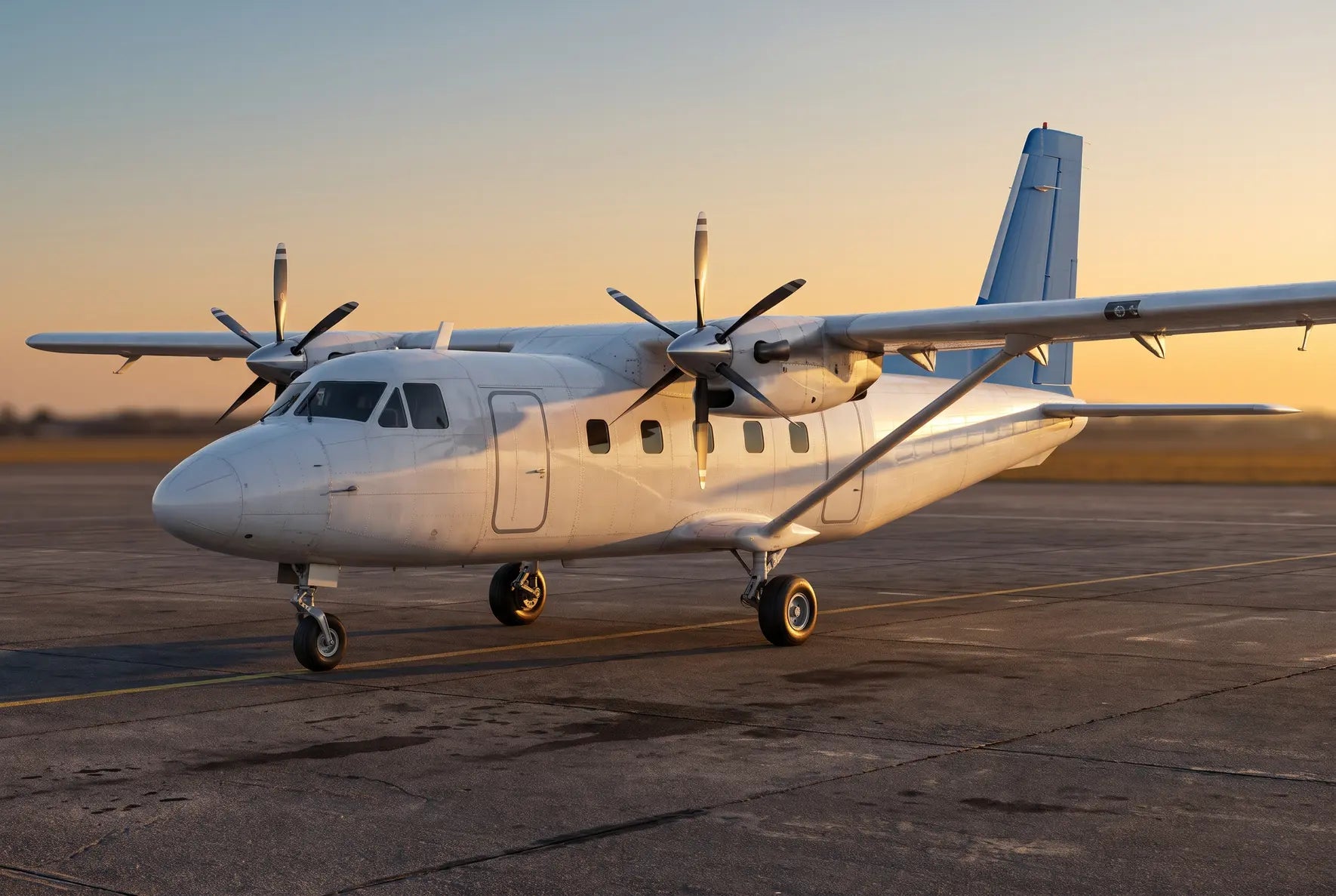
The De Havilland Canada DHC-6 Twin Otter was conceived as a rugged, versatile STOL (Short Takeoff and Landing) utility aircraft capable of operating from unprepared strips, water, snow and ice. Its design philosophy centres on simplicity, reliability and access to remote locations rather than speed or pressurised comfort. The high, strut-braced wing with double-slotted trailing edge flaps generates the lift needed for extremely short field performance, while the fixed tricycle landing gear (with options for floats, amphibious floats or skis) eliminates hydraulic complexity and adds ruggedness. Across its production history, the Twin Otter has evolved through four main series: the Series 100, 200, 300 and the current Series 400 produced by De Havilland Canada (formerly Viking Air).
From a design trade-off perspective, the Twin Otter prioritises low-speed handling, payload flexibility and minimal runway requirements over cruise speed and range. The aircraft accommodates up to 19 passengers in a standard commuter layout, but the cabin can be rapidly reconfigured for cargo, medevac, parachute operations or VIP transport. Its relatively modest cruise speed and unpressurised cabin are deliberate engineering choices that keep weight, cost and maintenance demands low, qualities valued by operators flying into challenging environments worldwide. For readers interested in the operational realities airline crews face across different carriers, this overview of pilot working conditions at Corsair International offers an interesting comparison point.
- Wingspan: 19.81 m (65 ft 0 in)
- Overall length: 15.77 m (51 ft 9 in)
- Wing area: 39 m² (420 sq ft)
- Maximum takeoff weight (MTOW): 5,670 kg (12,500 lb) for Series 300 and 400
- Operating empty weight (OEW): approximately 3,363 kg (7,415 lb) for Series 300
- Maximum cruise speed: 182 KTAS at FL100
- Service ceiling: 25,000 ft (7,620 m)
- Range (Series 400, standard tanks, zero payload): approximately 763 to 799 nmi (1,413 to 1,480 km); with long-range tanks up to 925 nmi (1,713 km)
- STOL takeoff distance (to 50 ft obstacle): approximately 366 m (1,200 ft) at MTOW
- STOL landing distance (from 50 ft): approximately 320 m (1,050 ft)
- Fuel capacity (Series 400, standard): 1,430 litres (378 US gal)
- Rate of climb: 1,600 ft/min (8.1 m/s)
- Engines: two Pratt & Whitney Canada PT6A turboprops (PT6A-27 on Series 300; PT6A-34 on Series 400)
- Propellers: Hartzell three-bladed, fully feathering and reversible
- Passenger capacity: up to 19 in standard commuter configuration
- Avionics (Series 400 and Classic 300-G): Garmin G1000 NXi integrated flight deck with FMS, synthetic vision and weather radar
Systems, Flight Controls and Handling Technology
The Twin Otter uses a conventional, fully manual cable-operated flight control system with no hydraulic power assistance. Primary surfaces, including ailerons, elevators and rudder, are connected to the cockpit via cables, bellcranks and pulleys. Trim is provided by a mechanically driven jackscrew on the elevator and adjustable trim tabs on the ailerons and rudder. This architecture keeps maintenance straightforward and suits operations in austere environments where hydraulic servicing would be impractical. The double-slotted flaps work in concert with the ailerons to deliver the high-lift performance essential for STOL operations, enabling stable approaches at speeds as low as approximately 56 knots indicated.
Braking on the ground relies on conventional wheel brakes on the main landing gear, while in-flight deceleration and ground roll reduction benefit from the fully reversible propellers. The fixed landing gear eliminates retraction mechanisms entirely, reducing weight and failure points. For operations in known icing conditions, the aircraft can be equipped with full de-icing protection for the airframe, windshield and propeller blades. The Series 400 and the refreshed Classic 300-G variant feature a Garmin G1000 NXi glass cockpit with an integrated flight management system, synthetic vision, GPWS and traffic advisory capabilities, a significant modernisation over the analogue panels of earlier series.
Published performance figures for the Twin Otter can vary considerably depending on operator-specific configuration, cabin density, selected MTOW, atmospheric conditions (temperature, altitude, humidity) and runway surface type. Manufacturer specifications typically reference ISA (International Standard Atmosphere) conditions at sea level with a dry, paved runway. Real-world STOL performance on gravel, grass or water will differ. Range values are particularly sensitive to payload weight, fuel load, cruise altitude and speed selection (maximum cruise versus economy cruise). Any performance number should therefore be interpreted with its stated assumptions in mind rather than taken as an absolute.
Pratt & Whitney Canada PT6A: The Twin Otter's Proven Powerplant
Every variant of the DHC-6 Twin Otter has been powered by engines from the Pratt & Whitney Canada PT6A family, one of the most successful turboprop engine lines in aviation history. Development of the PT6 began in 1958 at Pratt & Whitney Canada's Longueuil, Quebec facility. The engine achieved its first flight in 1961 and entered service in 1964. Its hallmark is a free-turbine, reverse-flow design: intake air enters at the rear, passes through a multi-stage compressor (three axial stages plus one centrifugal stage) and annular combustor, then exits forward through a single-stage compressor turbine and a free power turbine connected to a planetary reduction gearbox that drives the propeller.
The Series 100 Twin Otter was originally fitted with the PT6A-20, rated at 578 shp (431 kW). The Series 300 moved to the PT6A-27, offering 680 shp and a dry weight of approximately 315 lb (143 kg), flat-rated to ISA+18 °C at sea level. The current Series 400 employs the PT6A-34, which produces up to 750 shp with a dry weight of about 331 lb (150 kg), flat-rated to ISA+32 °C, providing better hot-and-high performance. Both engines drive Hartzell three-bladed, constant-speed, fully feathering and reversible propellers.
The PT6A family has accumulated over 400 million flight hours across more than 100 engine variants. Beyond the Twin Otter, PT6A engines power a wide range of aircraft including the Beechcraft King Air series, Cessna 208 Caravan, Pilatus PC-12, Piper Cheyenne and numerous agricultural and military trainers. The engine's reputation for reliability, ease of maintenance through a modular hot section design and proven performance in extreme climates, from equatorial heat to polar cold, is a key reason why the Twin Otter remains in active production and operational service worldwide decades after its original certification.
DHC-6 Twin Otter vs ATR 42-500 Specifications and Series Comparison
Scroll horizontally to see more
| Parameter | De Havilland Canada DHC-6 Twin Otter | DHC-6 Twin Otter Series 100 | DHC-6 Twin Otter Series 400 | ATR 42-500 |
|---|---|---|---|---|
| Entry into service | 1966 | 1966 | 2008 | 2010 |
| Engines | 2 × P&WC PT6A-27 | 2 × P&WC PT6A-20 | 2 × P&WC PT6A-34 | 2 × P&WC PW127M |
| Length | 15.8 m | 15.1 m | 15.8 m | 24.6 m |
| Wingspan | 19.8 m | 19.8 m | 19.8 m | 24.6 m |
| Height | 5.9 m | 5.8 m | 5.9 m | 7.1 m |
| Typical seating and layout | Single class: 19 passengers | Single class: 19 passengers | Single class: 19 passengers | 2-class: 42–48 passengers |
| MTOW | 5.7 t | 4.8 t | 5.7 t | 18.6 t |
| Range | 920 nm | 771 nm | 871 nm | 1,500 nm |
| Cruise speed | 0.24 Mach | 0.21 Mach | 0.24 Mach | 0.32 Mach |
| Service ceiling | 25,000 ft | 25,000 ft | 25,000 ft | 30,000 ft |
| Program note | Classic Series 300 baseline STOL utility transport for short rough strips | Original Series 100 piston-powered entry model | Modern Series 400 glass cockpit upgrade with enhanced performance | Larger regional turboprop competitor for longer routes and more passengers |
Scroll horizontally to see more
The table compares key specs for the De Havilland Canada DHC-6 Twin Otter family (Series 100 and Series 400) against the ATR 42-500. The Twin Otter is a 19-seat STOL utility aircraft with lower MTOW (4.8–5.7 t) and shorter range (771–920 nm), while the ATR 42-500 carries 42–48 passengers, has far higher MTOW (18.6 t), longer range (1,500 nm), faster cruise (0.32 vs 0.21–0.24 Mach), and a higher ceiling (30,000 ft).
De Havilland Canada DHC-6 Twin Otter: Typical Routes, Missions and Airlines Worldwide
The De Havilland Canada DHC-6 Twin Otter is one of the most versatile utility aircraft ever built, designed from the outset for short takeoff and landing (STOL) operations in environments where conventional airliners simply cannot go. Its typical missions range from scheduled commuter services and island hopping to bush flying, cargo transport, aerial survey, medevac, skydiving and scenic tourism flights. The aircraft regularly operates from unpaved strips as short as 300 to 400 metres, from water on floats, and even from snow and ice on skis, making it uniquely suited to some of the world's most challenging airfields.
Typical sector lengths for the DHC-6 Twin Otter are short, generally between 30 and 90 minutes, covering distances of roughly 50 to 200 nautical miles per leg. With a cruising speed of approximately 150 to 160 knots and an endurance of four to six hours at survey speeds, the aircraft can cover more than 600 nautical miles when maximum fuel is carried. Daily utilisation depends heavily on the operator and mission type: commuter and bush operators frequently achieve six to ten flight hours per day across multiple short sectors, while survey or charter operators may fly fewer but longer sorties. In demanding environments such as the Canadian Arctic or Papua New Guinea, fleet utilisation can be exceptionally high, with some operators historically logging tens of thousands of cycles per year across their fleets.
The DHC-6 Twin Otter thrives in point to point and hub and spoke networks linking remote communities, islands and outposts to regional centres. It is rarely found at major international hubs; instead, it connects secondary, regional and unimproved airstrips that larger aircraft cannot serve. Operators face specific challenges including high maintenance costs for ageing airframes, the logistics of supporting aircraft in isolated locations, corrosion management in maritime and tropical climates and the need for crews trained in demanding visual flight operations. Despite these challenges, the type remains in production as the Series 400, a testament to its enduring operational value.
Where the DHC-6 Twin Otter Operates Around the World
As of 2020 data, approximately 315 Twin Otters were in active service globally. The fleet distribution reflects the aircraft's niche: around 110 units in North and South America, 117 in Asia Pacific and the Middle East, 26 in Europe and 13 in Africa. Across all regions, the common thread is access to places other aircraft cannot reach, whether that means frozen tundra, tropical atolls, mountainous terrain or desert airstrips.
In Europe, the type serves island communities and remote highland routes. In the Americas, it is the backbone of Arctic and sub Arctic air transport and also supports scenic tourism. Across Asia, seaplane resort transfers in the Maldives represent the single largest concentration of Twin Otters anywhere, while bush operations in Papua New Guinea and regional services in the Pacific islands add further numbers. In Africa, the aircraft connects archipelagos and supports safari and humanitarian flying. For pilots and crew interested in the realities of operating in varied airline environments, this overview of airline working conditions provides useful context.
- Europe: Loganair operates Twin Otters on scheduled services to remote Scottish islands, maintaining vital links to communities with limited transport options. Isles of Scilly Skybus uses the type for regular flights between the Isles of Scilly and mainland England. Zimex Aviation in Switzerland operates a fleet primarily for cargo and utility missions. Historically, Widerøe in Norway was once the world's largest Twin Otter operator, using the aircraft extensively on short field commuter routes until around 2000.
- North and South America: In Canada, Air Inuit and Air Borealis fly Twin Otters to serve Indigenous and northern communities in Arctic Quebec and Labrador. Kenn Borek Air operates one of the largest fleets, supporting polar research and Antarctic logistics. Harbour Air Seaplanes uses float equipped examples for commuter and scenic services in British Columbia. In the United States, Grand Canyon Airlines (also known as Scenic Airlines) operates Twin Otters for scenic flights over the Grand Canyon. In South America, Aerovías DAP in Chile uses the type for Patagonian and Antarctic charter services, while LADE in Argentina connects remote Patagonian communities with scheduled flights.
- Asia: Trans Maldivian Airways is the world's largest Twin Otter operator, with a fleet of over 60 aircraft used as seaplanes for resort transfers across the Maldives. Maldivian also operates the type on inter atoll commuter routes. In Indonesia, Airfast Indonesia supports remote island and resource sector operations. FlyBig in India uses the DHC-6 for regional connectivity to airstrips in the northeast and hilly regions. Across the Pacific, Air Vanuatu, Air Kiribati and operators in New Caledonia use Twin Otters for essential island hopping services.
- Africa: Air Seychelles operates a fleet of Twin Otters for scheduled inter island services across the Seychelles archipelago. Airkenya Express uses the type for scenic safari flights and commuter connections to remote airstrips in Kenya. Humanitarian organisations such as Mission Aviation Fellowship also rely on the Twin Otter in several African countries for aid delivery and medevac.
Typical Seating Configurations and Cabin Layouts
The standard cabin layout for the DHC-6 Twin Otter is a single class configuration seating 19 passengers in a 1+2 arrangement: one seat on the left side of the aisle and two on the right. Seat pitch is typically around 30 inches (76 cm) with a seat width of approximately 16 to 17.5 inches (40 to 44 cm). This layout is used by the majority of commuter operators including Air Seychelles, Winair, Loganair and FlyBig. The maximum certified seating is 20 passengers, though 19 is far more common in practice. Detailed seat maps for various operators can be found on Seatmaps.com.
Leisure and VIP operators frequently reduce the seat count for greater comfort. Configurations of 14 seats offer a balance between capacity and passenger space, while dedicated VIP layouts may seat as few as eight passengers with enhanced furnishings, a bulkhead door and an aft lavatory. Charter and scenic flight operators sometimes use open seating arrangements that maximise window views and the distinctive open cockpit visibility that passengers enjoy on the Twin Otter.
One of the aircraft's defining strengths is its rapid reconfigurability. Seats can be removed or repositioned quickly to create mixed passenger and cargo layouts, or full freighter configurations for bulk transport and supply missions. The Twin Otter Classic 300 G, the latest production variant, features modernised cabin interiors with LED lighting, updated passenger service units and improved window design, while retaining the same flexible seating and cargo options that have defined the type for decades.
In this video, discover the insane capabilities of the De Havilland Canada DHC-6 Twin Otter, with real information and the story behind its development, design, and reputation as a rugged utility aircraft.
De Havilland Canada DHC-6 Twin Otter Safety Record and How Safe Is It
The De Havilland Canada DHC-6 Twin Otter has been in continuous service since 1966, accumulating six decades of operational history across some of the most demanding environments in aviation. With approximately 1,000 airframes built and around 220 still in airline service worldwide, the Twin Otter fleet has logged millions of flight hours on bush strips, glacier landings, island runways, and mountainous terrain. The Aviation Safety Network database catalogues well over 100 hull loss events across the type's history. When placed in context, however, many of these accidents occurred in remote, high-risk environments where few other aircraft could operate at all. The Twin Otter's safety profile must be assessed with an understanding that it routinely flies into conditions and airstrips that most commercial aircraft never encounter.
Notable Accidents and Safety Lessons
Several significant incidents involving the DHC-6 Twin Otter have led to measurable improvements in aviation safety.
- Widerøe Flight 933, Norway (11 March 1982) – A DHC-6 Twin Otter 300 (LN-BNK) operating a scheduled domestic flight crashed into the Barents Sea off Gamvik, killing all 15 people on board. Four official Norwegian investigations concluded that clear air turbulence caused structural overload and failure of the vertical stabiliser, making the aircraft uncontrollable. The accident highlighted the risks of severe turbulence in polar regions and led to enhanced weather awareness protocols and structural inspection requirements for Twin Otters operating in similar environments. Details of the event are recorded on the Aviation Safety Network.
- Grand Canyon Mid-Air Collision, United States (18 June 1986) – Grand Canyon Airlines Flight 6, a DHC-6 Twin Otter (N76GC), collided with a Helitech Bell 206B helicopter during sightseeing operations over the Grand Canyon. All 25 people aboard both aircraft were killed. The NTSB final report (AAR-87/03) determined that the probable cause was the failure of both flight crews to see and avoid each other, compounded by inadequate FAA oversight of scenic flight operations in congested airspace. This tragedy directly led to the passage of the National Parks Overflights Act of 1987, which established Special Flight Rules Areas, altitude separation between fixed-wing aircraft and helicopters, and stricter routing around national parks.
- Tara Air Flight 193, Nepal (24 February 2016) – A nearly new Viking Air DHC-6-400 Twin Otter (9N-AHH) with 23 occupants crashed into a mountainside in Myagdi district at approximately 3,590 metres elevation. There were no survivors. The official investigation report by Nepal's Aircraft Accident Investigation Commission identified controlled flight into terrain (CFIT) caused primarily by the crew's decision to continue flying into instrument meteorological conditions in mountainous terrain despite weather warnings. The accident prompted renewed calls for improved pilot training, stricter weather minima enforcement, and enhanced ground proximity warning system compliance in Nepalese aviation.
Across these events, a consistent pattern emerges: environmental and human factors, rather than fundamental design deficiencies, have been the primary contributors to Twin Otter accidents. Each incident generated investigation findings that strengthened regulations, procedures, and crew training across the industry.
How Safe Is the De Havilland Canada DHC-6 Twin Otter
When evaluating overall safety, the DHC-6 Twin Otter benefits from a design philosophy centred on redundancy, ruggedness, and simplicity. Its twin Pratt & Whitney Canada PT6A turboprop engines provide power redundancy, ensuring continued flight capability if one engine fails. The fixed tricycle undercarriage eliminates the mechanical complexity associated with retractable gear, reducing a common source of landing incidents. The aircraft's high-wing configuration, short takeoff and landing performance, and ability to operate on wheels, floats, or skis allow it to reach destinations that would otherwise require long and hazardous overland journeys. These characteristics make the Twin Otter a lifeline in regions from the Canadian Arctic to the Himalayas and the South Pacific. Much like other pioneering aircraft that opened up new routes and operating environments, such as the Lockheed L-049 Constellation, the Twin Otter plays a role that extends well beyond simple point-to-point transport.
The type is certified under stringent airworthiness standards overseen by Transport Canada and recognised by EASA and the FAA. Operators must comply with detailed standard operating procedures, recurrent pilot training programmes, and maintenance schedules that are continuously updated in response to service experience and safety directives. The Series 400, produced by Viking Air (now De Havilland Canada), incorporates modern avionics including glass cockpit displays, enhanced ground proximity warning systems, and weather radar, further closing the gap on older variants.
While the Twin Otter's overall accident count reflects the inherently higher risk of bush and mountain flying, it is important to note that commercial aviation as a whole remains one of the safest modes of transport available. Continuous improvements in aircraft design, training standards, and regulatory oversight have driven global accident rates to historic lows. The DHC-6 Twin Otter, supported by decades of operational learning and ongoing manufacturer support, continues to serve as a dependable workhorse in environments where safe air access is not a luxury but a necessity.
01 What is the typical range and mission profile of the De Havilland Canada DHC-6 Twin Otter?
The De Havilland Canada DHC-6 Twin Otter has a maximum range of about 900 nautical miles with full passenger load, making it ideal for short to medium regional flights. It excels in missions like bush flying, remote access, and island hopping due to its ability to operate from unpaved runways and water landings with amphibious versions. Common profiles include commuter services and cargo transport in challenging terrains.
02 How is the cabin laid out on the De Havilland Canada DHC-6 Twin Otter, and what is the passenger experience like?
The DHC-6 Twin Otter typically seats 19 passengers in a high-density configuration or fewer for more comfort, with a single-aisle layout and large windows for scenic views. Noise levels are higher than modern jets due to its turboprop engines, but the sturdy build provides a stable ride. Passengers often enjoy the intimate feel and excellent visibility, especially on sightseeing flights.
03 Which airlines operate the De Havilland Canada DHC-6 Twin Otter and on what routes?
Operators include regional carriers like Kenn Borek Air in the Arctic, Air Inuit in Canada, and Scenic Air Tours in Alaska, flying routes to remote communities. It serves short-haul networks in places like the Scottish Islands, New Zealand's South Island, and Antarctic support missions. These routes often involve gravel strips or seaplane bases inaccessible to larger aircraft.
04 How does the performance and fuel efficiency of the De Havilland Canada DHC-6 Twin Otter compare to similar aircraft?
The Twin Otter cruises at 210 knots with excellent short takeoff and landing performance, outperforming the Cessna Caravan in range and payload capacity. Its fuel efficiency suits low-volume routes, burning about 140 gallons per hour while carrying more passengers. Compared to newer turboprops like the Quest Kodiak, it offers proven reliability at lower operating costs in rugged environments.
05 What is the safety record of the De Havilland Canada DHC-6 Twin Otter?
The DHC-6 Twin Otter has a strong safety record over 50+ years, with thousands built and millions of flight hours, bolstered by its rugged design and twin-engine redundancy. Key features include forgiving stall characteristics, high propeller clearance, and STOL capabilities that enhance safety on short runways. Incidents are typically linked to operational factors rather than design flaws, per aviation authority data.
06 What should passengers know about flying on the De Havilland Canada DHC-6 Twin Otter, like seat choice and turbulence?
Opt for window seats on the left side for better views during turns on scenic routes, as the cabin offers good overhead space despite prop noise. It handles turbulence well due to its low wing loading and stable airframe, common on regional hops. Luggage limits apply strictly due to weight sensitivity, so pack light for smoother operations.