

Convair 880: History, Development, and What Made This Jetliner Unique
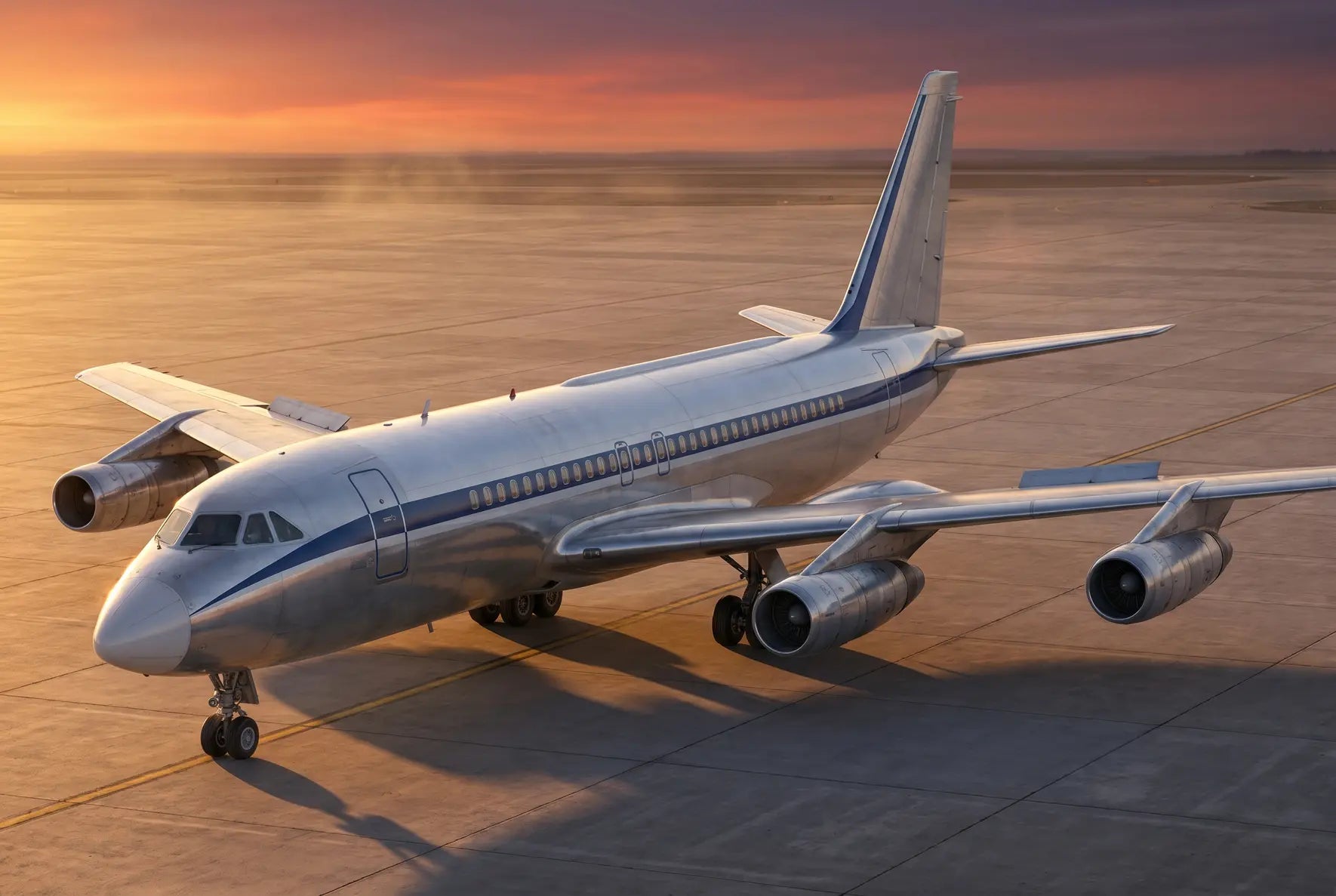
The Convair 880 was a four-engine narrow-body jetliner developed by the Convair Division of General Dynamics in the late 1950s. Conceived as a smaller, faster alternative to the Boeing 707 and Douglas DC-8, the aircraft was designed to give airlines a speed advantage on medium-range transcontinental routes across the United States. Its development was driven in large part by the ambitions of Howard Hughes, who as the controlling figure behind TWA wanted the airline to operate the fastest commercial jet in the sky.
The program originated under several working names. Convair initially referred to the project as "Skylark", then "Golden Arrow", before settling on "Convair 600", a nod to its target top speed of 600 mph. The final marketing name, Convair 880, was derived from an approximate maximum speed of 880 feet per second (roughly 600 mph or 966 km/h), a figure intended to underscore the aircraft's high-speed credentials against its rivals.
Development formally began in April 1956, shortly after Boeing and Douglas had announced their respective jet transport programmes. Hughes Tool Company, acting on behalf of TWA, placed a launch order for 30 aircraft in March 1956, providing the commercial foundation for the programme. Delta Air Lines followed as a second anchor customer, and Convair reportedly allocated the first 40 delivery positions to these two carriers.
The prototype Convair 880, often referred to as "Ship One", completed its maiden flight on 27 January 1959 from Convair's plant in San Diego, California. The aircraft was powered by four General Electric CJ-805-3 turbojet engines, a civil derivative of the military J79. The FAA granted the initial type certificate in late 1959, clearing the way for airline deliveries. Delta received its first 880 in February 1960 and inaugurated scheduled revenue service on 15 May 1960, making the Convair 880 the fastest jet airliner in commercial operation at that time, cruising at approximately Mach 0.85 (615 mph). TWA followed with its own 880 service in January 1961.
Despite its impressive speed, the Convair 880 struggled commercially. Its five-abreast (2-3) seating layout offered a maximum capacity of around 110 passengers, significantly fewer than the six-abreast Boeing 707 or DC-8. Combined with the CJ-805 engines' higher fuel consumption relative to the Pratt & Whitney JT3C engines powering the 707, the 880 suffered a notable seat-mile cost disadvantage. Boeing further undercut Convair by introducing the Boeing 720, a medium-range 707 derivative that directly targeted the same market segment at a lower acquisition cost. Beyond jet airliners, some airlines found creative ways to optimise existing types for specific markets, as seen with the Boeing 747-100SR, which was adapted for high-density, short-range operations in Japan.
Only 65 Convair 880s were built between 1959 and 1962 at the San Diego facility. Operators beyond TWA and Delta included Swissair, Cathay Pacific, Japan Airlines, VIASA, Northeast Airlines, and Civil Air Transport. General Dynamics incurred losses of at least $185 million on the 880 programme alone, with combined losses on the 880 and its stretched successor, the Convair 990 Coronado, reaching an estimated $425 to $500 million in 1960s dollars. These losses effectively ended Convair's involvement in the commercial jetliner market.
Convair 880-22 vs 880-22M: Key Variant Differences
The Convair 880 was produced in two main variants: the initial 880-22 (Model 22) and the improved 880-22M. Of the 65 aircraft built, 48 were 880-22s and 17 were 880-22Ms. The 880-22M introduced several aerodynamic and structural upgrades designed to address the original variant's high approach speeds and limited field performance.
The most significant change on the 880-22M was the addition of four leading-edge slats per wing on the outboard sections, along with Krueger leading-edge flaps between the fuselage and inboard engines. These high-lift devices increased maximum lift, reduced stall and approach speeds, and improved takeoff and landing performance. Other improvements included a power-boosted rudder for better directional control (particularly in engine-out scenarios), strengthened landing gear, upgraded CJ-805-3B engines delivering approximately 11,650 lbf of thrust each (compared to roughly 11,200 lbf on the original CJ-805-3A), and increased fuel capacity that extended range.
The following list summarises the key identifiers that distinguish the two Convair 880 production variants:
- Engines: CJ-805-3A (880-22) vs CJ-805-3B with higher thrust (880-22M)
- Leading-edge devices: Clean wing (880-22) vs four slats per wing plus Krueger flaps (880-22M)
- MTOW: Approximately 184,500 lb / 83,500 kg (880-22) vs approximately 203,400 lb / 92,300 kg (880-22M)
- Rudder: Conventional (880-22) vs power-boosted (880-22M)
- Landing gear: Standard (880-22) vs strengthened for higher weights (880-22M)
- Cruise speed: Both variants approximately Mach 0.85 (615 mph / 990 km/h); Mmo around 0.88
- Seating: Five-abreast (2-3), typically 80 to 110 passengers in both variants
The Convair 880 remains notable as the fastest first-generation subsonic jet airliner ever to enter commercial service. Although only 65 examples were produced and the programme was a significant financial failure for General Dynamics, the aircraft represented an ambitious attempt to compete on speed rather than capacity, an approach that ultimately proved unsustainable against the economics of the early jet age.

This image shows a Convair 880 jet airliner in Delta Airlines livery, captured during flight. The aircraft is notable for its sleek design and was used primarily in the 1960s.
Convair 880 Technical Specifications, Systems and Engine Overview
The Convair 880 was designed as a smaller, faster alternative to the Boeing 707 and Douglas DC-8. Built by Convair, a division of General Dynamics, the aircraft prioritised outright cruise speed over passenger capacity. Its five-abreast seating configuration resulted in a narrower fuselage than the six-abreast cabins of its competitors, a deliberate trade-off that emphasised speed and handling over seat-mile economics. The 880 inherited its high-speed swept-wing aerodynamics from Convair's extensive experience with military delta-wing aircraft, and its four General Electric turbojet engines were derived directly from a proven military powerplant.
This design philosophy produced an aircraft widely praised by flight crews for its responsive handling and high cruise Mach number, but it came at the cost of higher fuel consumption, reduced payload capacity, and demanding low-speed characteristics due to the absence of leading-edge high-lift devices. Only 65 airframes were built between 1959 and 1962, and the programme was a significant commercial loss for Convair. Two principal sub-variants existed: the baseline Model 22 and the improved 880-22M, which featured uprated engines and a higher maximum take-off weight.
- Length: 129 ft 4 in (39.42 m)
- Wingspan: 120 ft 0 in (36.58 m)
- Height: approximately 36 ft 4 in (11.07 m)
- Wing area: approximately 2,000 sq ft (186 m2), swept 35 degrees at quarter-chord
- Typical seating: 88 to 110 passengers depending on cabin layout
- Crew: 3 (two pilots and one flight engineer)
- Operating empty weight: approximately 92,500 lb (Model 22) / 94,000 lb (22M)
- Maximum take-off weight (MTOW): 184,500 lb (83,700 kg) for Model 22; 193,000 lb (87,500 kg) for 880-22M
- Fuel capacity: 10,584 US gal (Model 22) / 12,538 US gal (22M), carried in integral wing tanks
- Maximum cruise speed: 615 mph (535 kt / 990 km/h), approximately Mach 0.88
- Range: approximately 2,470 nmi (Model 22) / 2,500 nmi (22M), based on manufacturer data with typical payload
- Service ceiling: 41,000 ft
- Take-off field length: approximately 8,750 ft (Model 22) / 7,550 ft (22M), standard atmosphere conditions
- Engines: 4 x General Electric CJ805-3 turbojet (Model 22) or CJ805-3B (22M)
- Thrust per engine: approximately 11,200 lbf (CJ805-3) / 11,650 lbf (CJ805-3B)
- Cabin pressurisation: maximum differential 8.3 psi; sea-level cabin maintained to 21,000 ft, 6,000-ft cabin altitude at 41,000 ft
Systems, Flight Controls and Handling Technology
The Convair 880 used a conventional mechanical flight control system with hydraulic boost, typical of first-generation jet transports. Primary controls comprised ailerons, elevators, rudder and spoilers, while secondary controls included trim tabs, a trimmable horizontal stabiliser, trailing-edge flaps and speed brakes. Notably, the aircraft had no leading-edge high-lift devices such as slats or Krueger flaps. This simplified the wing but resulted in higher approach and take-off speeds than comparable types, demanding greater skill during engine-failure scenarios at V1.
Automation was provided by an analog automatic flight control system (AFCS) incorporating a three-axis autopilot, dual flight directors, speed stability augmentation and ILS localiser/glideslope tracking. Some operators received approval for Category II approaches, which was advanced for an aircraft entering service in 1960. A yaw damper, using the rudder channel of the autopilot, was engaged shortly after take-off and disengaged on touchdown to manage the swept-wing Dutch roll tendency common to jets of this generation.
The braking system was notably comprehensive. Hydraulic multi-disc brakes served the main gear, supplemented by a distinctive nose-wheel braking system, activated only when both brake pedals were pressed together with the nose strut compressed and wheels centred. All four engines were fitted with thrust reversers, and a pneumatic emergency brake system provided backup using high-pressure air. In an emergency descent, the main landing gear could be extended as a drag device at speeds up to 375 kt or Mach 0.88, a testament to the structural robustness of the gear design. The electrical system relied on four engine-driven AC generators with constant speed drives, feeding transformer-rectifier units for 28-V DC buses, with a single battery for emergency power. Airlines such as British Airways and other carriers of that era operated in environments where such redundancy was essential for safe scheduled operations.
Published performance figures for the Convair 880 vary depending on the sub-variant (Model 22 vs 22M), operator-specific equipment, cabin configuration, fuel load and atmospheric assumptions. Take-off distances, for example, differ significantly between variants partly due to the 22M's higher-thrust engines and revised weight limits. Range values depend on payload, reserves policy and cruise altitude. All figures should be understood in context: manufacturer brochure numbers, airline operations manual data and independent test results may not align precisely due to differing baseline conditions.
General Electric CJ805: The Engine Behind the Convair 880
The General Electric CJ805 was a single-shaft, axial-flow turbojet developed as the civilian derivative of the General Electric J79, one of the most successful military jet engines of the Cold War era. The J79 powered a remarkable range of military aircraft including the Lockheed F-104 Starfighter, McDonnell Douglas F-4 Phantom II, Convair B-58 Hustler and North American A-5 Vigilante. Its adaptation for commercial use as the CJ805 represented General Electric's first entry into the civil aviation engine market.
The baseline CJ805-3, fitted to the original Convair 880 Model 22, featured a 17-stage axial compressor and a 3-stage turbine, producing approximately 11,200 lbf (49.8 kN) of static thrust at take-off. The improved CJ805-3B, used on the 880-22M from 1960, delivered approximately 11,650 lbf (51.8 kN), offering better take-off performance and enabling the higher gross weight of the later variant. Both versions were straight turbojet engines without bypass, which contributed to the 880's high fuel consumption relative to the Pratt & Whitney JT3D turbofans later fitted to competing Boeing 707 and DC-8 variants.
General Electric also developed the CJ805-23, an innovative aft-fan derivative that is widely regarded as one of the first turbofan engines to enter airline service. The CJ805-23 added a fan stage at the rear of the engine, increasing take-off thrust by approximately 40% while reducing specific fuel consumption by around 15%, according to the Smithsonian National Air and Space Museum. This engine powered the Convair 990 Coronado, the 880's successor. However, the CJ805-23 proved troublesome in service and did not achieve the reliability of contemporary Pratt & Whitney designs. The CJ805 family was ultimately limited to the Convair 880 and 990, and no other airliner type adopted these engines. Despite its commercial shortcomings, the CJ805 programme gave General Electric critical experience in the civil engine market, laying groundwork for the highly successful CF6 and GE90 families that followed decades later.
Convair 880 vs Boeing 720 vs Douglas DC-8-30 vs Boeing 707-120 Specifications Comparison
Scroll horizontally to see more →
| Parameter | Convair 880 | Boeing 720 | Douglas DC-8-30 | Boeing 707-120 |
|---|---|---|---|---|
| Entry into service | 1960 | 1960 | 1959 | 1958 |
| Engines | 4 × General Electric CJ805-3B turbojets | 4 × Pratt & Whitney JT3D-1 turbofans | 4 × Pratt & Whitney JT4A-3 turbojets | 4 × Pratt & Whitney JT3C-6 turbojets |
| Length | 39.42 m | 41.63 m | 45.90 m | 44.22 m |
| Wingspan | 36.58 m | 39.90 m | 43.40 m | 39.90 m |
| Height | 11.00 m | 12.93 m | 12.90 m | 12.93 m |
| Typical seating and layout (short description + approximate passengers) | 2-class: 88–110 passengers | 2-class: 131–149 passengers | 2-class: 142–176 passengers | 2-class: 140–179 passengers |
| MTOW | 87.7 t | 106 t | 147 t | 123 t |
| Range | 2,940 nm | 3,200 nm | 5,720 nm | 5,750 nm |
| Cruise speed | 0.88 Mach | 0.82 Mach | 0.82 Mach | 0.82 Mach |
| Service ceiling | 41,000 ft | 41,000 ft | 41,000 ft | 41,000 ft |
| Program note | Medium-range narrow-body jet positioned as a smaller, faster alternative to early 707/DC-8 models. | Shorter-range derivative of the 707 optimized for medium-haul routes and shorter runways. | Early long-range narrow-body jetliner offering greater capacity and range in the first DC-8 family. | Baseline Boeing jet airliner that established the 707 family on medium- and long-haul routes. |
Scroll horizontally to see more →
The table compares four first-generation U.S. jetliners across size, capacity, weight, and performance. The Convair 880 is the smallest and lightest (87.7 t MTOW) with fewer seats, but it stands out with the highest cruise speed at Mach 0.88. The Boeing 720 adds more seats and MTOW (106 t) with moderate range. The DC-8-30 and 707-120 are larger and much longer-range (~5,7xx nm), suiting long-haul missions.
Convair 880 Operations: Airlines, Typical Routes and Missions Worldwide
The Convair 880 was conceived as a smaller, faster alternative to the Boeing 707 and Douglas DC-8, targeting medium-range routes where speed offered a competitive edge. Powered by four General Electric CJ-805 turbojet engines, it cruised at Mach 0.85, making it the fastest of the first-generation jet airliners. With a published range of approximately 2,500 nmi (4,630 km), the aircraft was best suited for domestic trunk routes and regional international sectors, typically covering stage lengths between 500 and 2,000 nmi with flight times of roughly 1.5 to 5 hours.
Only 65 Convair 880s were built between 1959 and 1962, split into 48 CV-880-22 and 17 CV-880-22M variants. This small production run meant operators never benefited from the large spares pools and widespread maintenance networks available for 707 and DC-8 fleets. The aircraft's five-abreast cabin (2+3 seating) limited revenue potential compared to the six-abreast layouts of its competitors, and its GE CJ-805 engines consumed more fuel per seat-mile. Airlines that committed to the type found themselves operating an aircraft that was fast and comfortable but economically challenging, especially after the Boeing 720 entered the market as a cheaper, derivative alternative.
Most operators deployed the Convair 880 on hub-and-spoke networks connecting major airports, where its speed advantage could attract time-sensitive passengers on high-demand corridors such as New York-Miami, New York-Houston, and intra-Asian routes. Its relatively high approach speeds, a consequence of having no leading-edge high-lift devices, meant it performed best at longer runways typical of major hubs rather than secondary or regional airports. Convair's own financial model assumed high daily utilisation with turnaround times of just 25 minutes, but in practice, many operators struggled to achieve the block hours necessary to offset the type's higher operating costs. For aviation professionals and enthusiasts interested in the economics behind aircraft like the Convair 880, resources such as Ready for Takeoff offer useful perspectives on the business of aviation.
By the early 1970s, rising fuel costs and the availability of more efficient narrow-body jets such as the Boeing 727 accelerated the Convair 880's retirement from mainline passenger service. Several airframes found a second career as bulk freighters, particularly in Caribbean and Latin American cargo operations, where low acquisition costs temporarily offset high fuel burn. One notable freighter operator reported carrying 54,000 to 55,000 lb of cargo per flight on routes between Miami and Venezuela.
Where the Convair 880 Operated Around the World
The Convair 880's operator base was small but geographically diverse, spanning North America, Europe, Asia, and to a lesser extent Central and South America. In North America, it served as a front-line jet on competitive domestic trunk routes. In Asia, flag carriers used it on regional international sectors. European involvement was limited to a brief interim deployment. Africa saw virtually no Convair 880 operations, as the type's high operating costs and limited range made it impractical for the continent's route structures.
- North America: Delta Air Lines was the launch customer, operating 17 Convair 880s from May 1960 to 1973 on routes including New York-Houston, New York-Atlanta, and later Caracas and Montego Bay. Trans World Airlines (TWA) deployed approximately 29 aircraft on domestic trunk services and transcontinental routes. Northeast Airlines operated 6 aircraft from December 1960 on its SuperJet and YellowBird services between Boston, Philadelphia, and Miami. Alaska Airlines used a single CV-880-22M from 1961 to 1966 on Golden Nugget services between Seattle, Anchorage, and Fairbanks, configured for 74 passengers. Several charter and cargo operators, including Monarch Aviation and Groth Air, later acquired second-hand airframes for freight and ad-hoc charter work, primarily out of Miami.
- South and Central America: VIASA (Venezuela) operated 3 to 4 aircraft on Caribbean and Latin American routes, including services to North America and Europe. LANICA (Nicaragua) flew several Convair 880s from 1972 to 1977 on routes connecting Managua with Mexico City, Miami, and other Central American cities before replacing them with Boeing 727-100s. Various small operators used converted freighters on cargo runs throughout the Caribbean.
- Asia: Japan Air Lines (JAL) was the only major Asian flag carrier to order the type new, operating approximately 10 aircraft on medium-haul regional routes. The last-ever Convair 880 delivery went to JAL on 3 July 1963. Cathay Pacific acquired 5 to 6 aircraft, deploying them on regional services from Hong Kong to destinations such as Bangkok, Manila, and Taipei throughout the 1960s.
- Europe: Swissair received only 2 of 5 ordered CV-880-22M aircraft, operating them briefly as interim jets from August 1961 to May 1962 before transitioning to the Convair 990 Coronado. No other European airline operated the type in scheduled service, making the continent's involvement with the Convair 880 minimal.
Typical Seating Configurations and Cabin Layouts
The Convair 880 featured a narrow-body fuselage with five-abreast seating arranged in a 2+3 configuration. This layout offered passengers more shoulder room per seat than the six-abreast cabins of the Boeing 707 and DC-8, but it came at the cost of reduced total capacity. The maximum design capacity was approximately 110 passengers in an all-economy arrangement.
In practice, configurations varied significantly by operator. Delta Air Lines fitted its fleet with just 84 seats in a mixed-class layout that included a forward lounge area, with 2+2 seating in first class and 2+3 in economy at generous pitch. TWA, by contrast, configured some aircraft with up to 110 seats, closer to the design maximum, using tighter economy pitch of around 32 inches. Northeast Airlines opted for a dual-class arrangement seating 98 passengers. Alaska Airlines went even further toward comfort, seating only 74 passengers. The differences between these configurations illustrate a pattern common in aviation: network carriers serving competitive trunk routes tended toward higher-density layouts, while operators on thinner or more premium routes favoured spacious cabins to differentiate their product. As a freighter, the Convair 880 could carry between 54,000 and 55,000 lb of bulk cargo, according to first-hand pilot accounts.
In this video, discover why pilots still compare the Convair 880 and Boeing 720, exploring performance, design tradeoffs, airline choices, and how this overlooked rivalry shaped early jet travel and cockpit opinions.
Convair 880 Safety Record: Accidents, Incidents and How Safe Was It?
Only 65 Convair 880s were manufactured between 1959 and 1962, making it one of the smallest first-generation jet airliner fleets ever produced. The type served with major carriers such as Delta Air Lines, Trans World Airlines (TWA), Japan Air Lines (JAL), Swissair and Cathay Pacific, primarily during the 1960s and early 1970s. Most mainline operators had retired the CV-880 by the mid-1970s, although a handful of airframes continued flying in cargo, government and military roles into the mid-1990s. According to the Aviation Safety Network database, the Convair 880 was involved in approximately 22 hull-loss accidents over the course of its operational life, resulting in around 171 fatalities. Given the small fleet size, these numbers represent a high attrition rate compared to contemporaries like the Boeing 707 or Douglas DC-8, which benefited from far larger production runs and more extensive operator experience.
Notable Convair 880 Accidents and Their Legacy
Several serious events shaped the safety narrative of the Convair 880. While none pointed to a fundamental structural flaw in the aircraft, they exposed critical gaps in training procedures, approach management and aviation security that led to lasting industry improvements.
- TWA Flight 128, Cincinnati, 1967: On 20 November 1967, a TWA Convair CV-880-22-1 (N821TW) crashed during a night approach to Greater Cincinnati Airport, killing 70 of the 82 people on board. The NTSB investigation (AAR-69-05) determined the probable cause was the crew's attempt to conduct a visual approach without using the available glide-slope guidance, combined with inadequate altimeter cross-checking in deteriorating weather. The aircraft struck trees approximately 2,800 metres short of the runway. This accident prompted the installation of a full Approach Lighting System (ALS) and enhanced ILS equipment at CVG, and reinforced industry-wide emphasis on stabilised approach procedures, instrument monitoring during night operations, and mandatory use of available precision-approach aids.
- Cathay Pacific Flight 700Z, 1972: On 15 June 1972, a Cathay Pacific Convair 880 (VR-HFZ) flying from Bangkok to Hong Kong broke apart in flight after a bomb detonated inside the cabin. All 81 passengers and crew perished. The cause was sabotage, not any mechanical or design failure. This tragedy, alongside other bombings of the era, accelerated the development of stricter passenger-baggage matching policies, enhanced baggage screening protocols and stronger ICAO security standards (Annex 17) that applied across the entire civil aviation industry.
- Delta Air Lines training crash, Atlanta, 1960: On 23 May 1960, a Delta Convair 880 (N8804E) crashed and burned during a crew-training takeoff at Atlanta Municipal Airport, killing all four crew members on board. The Civil Aeronautics Board (CAB) concluded the probable cause was the stalling of the aircraft at an altitude too low to permit recovery, though the specific reason for the stall was listed as undetermined. The event underscored the risks associated with in-aircraft training manoeuvres on newly introduced jet types.
- Japan Air Lines training crash, Moses Lake, 1969: On 24 June 1969, a JAL Convair 880 (JA8028) overran the runway during a high-speed rejected-takeoff training exercise at Grant County Airport, Washington, killing three cabin attendants. The NTSB report (AAR-70-11) attributed the accident to inadequate training and operational procedures for high-speed rejected takeoffs. Recommendations from this investigation encouraged the use of high-fidelity flight simulators for practising critical manoeuvres, clearer instructor-intervention protocols and more rigorous crew-coordination standards during training sorties.
How Safe Was the Convair 880?
Assessing the overall safety of the Convair 880 requires context. The type's hull-loss rate appears elevated, but this partly reflects its very small fleet of 65 aircraft, short production run and the era in which it operated. The early 1960s jet age was a period of rapid learning for the entire industry: cockpit resource management, standardised approach procedures and advanced simulator training were still evolving. Many Convair 880 accidents involved crew training flights rather than revenue passenger operations, skewing the per-airframe statistics relative to aircraft that accumulated far more commercial cycles. Crucially, no recurring structural defect or inherent design flaw was identified across the CV-880 fleet. The accidents were predominantly linked to human factors, procedural shortcomings or, in one case, deliberate sabotage.
The lessons drawn from Convair 880 incidents contributed meaningfully to the broader safety improvements that have made modern commercial aviation remarkably safe. Principles such as stabilised-approach criteria, mandatory use of precision-approach aids at night, enhanced simulator-based training and robust aviation security screening all trace part of their lineage to accidents involving this aircraft. For those interested in how airline operational standards continue to evolve, the Convair 880 story serves as a reminder that each generation of aircraft has helped refine the safety culture passengers rely on today. According to data compiled by organisations such as the Aviation Safety Network, the global fatal accident rate for commercial jets has fallen dramatically since the era of the CV-880, confirming that air travel remains one of the safest modes of transport in the world.
01 What kind of routes and range did the Convair 880 typically fly?
The Convair 880 was designed as a medium- to long-range jet airliner, optimized for fast services on domestic U.S. trunk routes and some shorter international sectors. In typical airline configuration, it was used on routes of roughly 2,000 to 3,000 miles, such as transcontinental flights across the United States or medium-haul services within Asia and Europe. Airlines chose it for schedules where high cruise speed and quick turnarounds were more important than maximum seating capacity. This made the Convair 880 a niche aircraft compared with larger jets that focused on carrying more passengers over similar distances.
02 How comfortable was the Convair 880 cabin for passengers?
The Convair 880 had a relatively narrow fuselage and typically seated around 80 to 110 passengers in a four-abreast or mixed four- and five-abreast layout, so it felt more intimate than wide-body jets or higher-capacity narrow-bodies. Seat pitch and comfort depended on the airline, but the smaller cabin often gave a quieter, less crowded feel in premium configurations. However, the early-generation turbojet engines could be noisy, especially for passengers seated near the wings and rear of the aircraft. Overhead bins and storage were more limited than on modern aircraft, and amenities varied widely between operators and eras.
03 Which airlines operated the Convair 880 and on what types of routes?
Major early operators of the Convair 880 included airlines such as American Airlines, Delta Air Lines and TWA, with other carriers in Europe and Asia using smaller fleets. These airlines deployed the Convair 880 on high-speed, premium services where relatively low seat counts could be justified by stronger yields and schedule advantages. Typical routes included U.S. transcontinental flights, key business city pairs, and regional international routes in Japan, the Middle East and Europe. Over time, as larger and more efficient jets entered service, the Convair 880 was moved to secondary routes, charter operations or sold to smaller and niche airlines.
04 How did the Convair 880 perform compared with similar jets like the Boeing 707?
The Convair 880 was known for its high cruise speed, often quoted as being faster than contemporary Boeing 707 and Douglas DC-8 variants on similar routes. This speed advantage came at the cost of fuel efficiency, as its four turbojet engines were relatively thirsty and the airframe carried fewer passengers than competing designs. The aircraft was therefore less economical for airlines focused on capacity and cost per seat, which limited its commercial success. In performance terms, it appealed to carriers that valued speed and quick schedules, but it struggled to compete in an environment that increasingly rewarded efficiency and larger cabins.
05 What is known about the Convair 880 safety record and design features?
The Convair 880 incorporated typical design features of first-generation jet airliners, including swept wings, powered controls and multiple redundant systems for critical functions. Its safety record reflects a small fleet size and intensive use, with a limited number of accidents over its service life, many linked to operational or weather-related factors rather than fundamental design flaws. The aircraft did not achieve the same long-term, large-scale operational history as some competitors, which also means fewer total flight hours for comparison. As with any older jet, safety outcomes depended heavily on operator maintenance standards, crew training and adherence to procedures.
06 What should a passenger know if flying on a preserved or chartered Convair 880 today?
Very few Convair 880 aircraft remain in any kind of operational or taxiable condition, and most surviving examples are museum exhibits rather than flying airliners. If a special event or static experience is offered, passengers can expect a narrow, vintage-style cabin with smaller overhead storage and a more enclosed feeling than modern jets. Window views may be good, especially in the forward cabin, but seats near the wings and engines would historically have been noisier. Any operational experience today would be highly regulated and usually limited, with the main attraction being the historical atmosphere rather than modern comfort or amenities.