

Cessna 408 SkyCourier: Program History, Development Path and Variant Overview
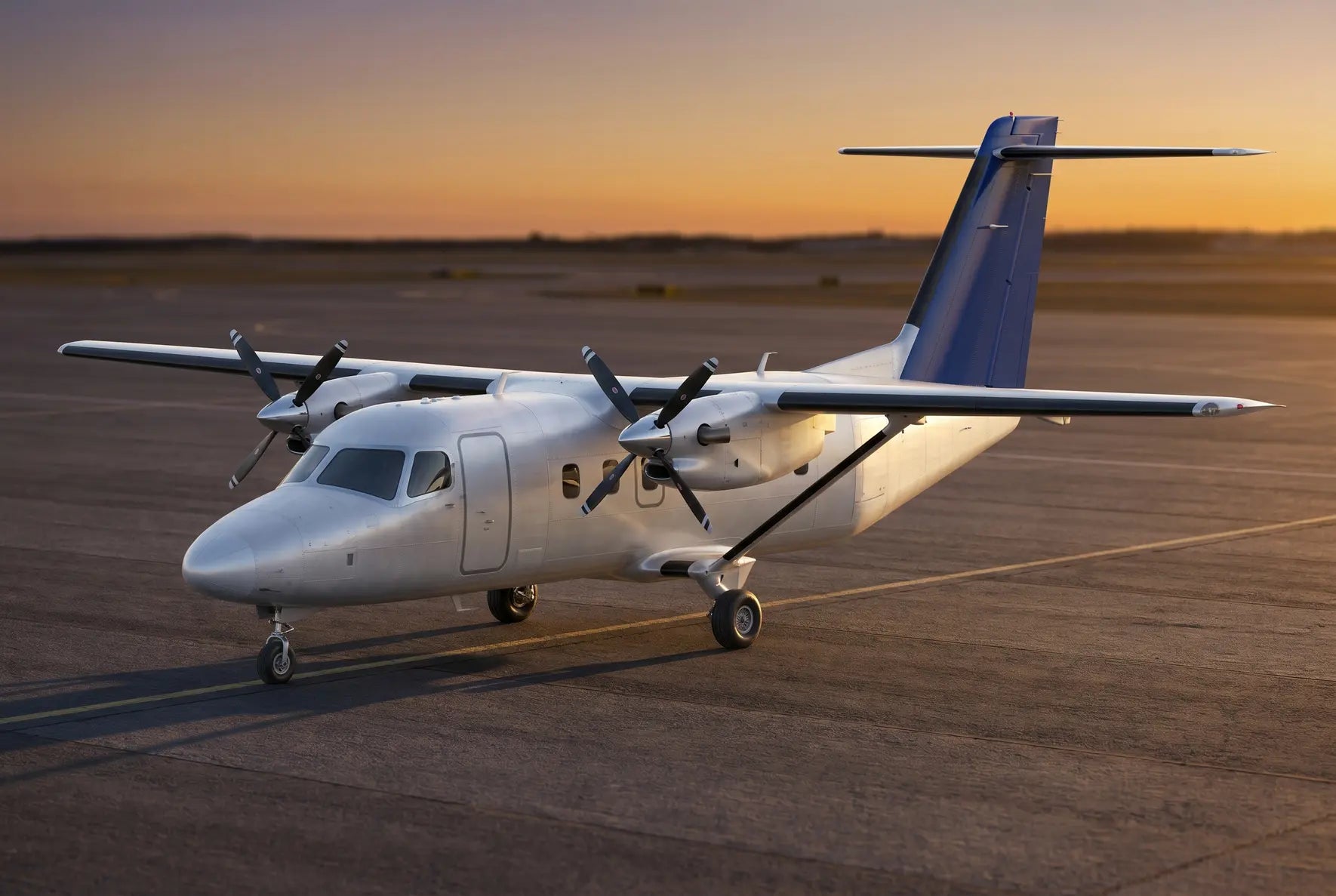
The Cessna 408 SkyCourier is a clean-sheet, twin-turboprop, high-wing utility aircraft developed by Textron Aviation through its Cessna division. Unlike incremental upgrades to existing airframes, the SkyCourier was designed from a blank page to fill a specific gap in the regional utility market: a rugged, high-payload turboprop capable of hauling three LD3 shipping containers or carrying up to 19 passengers while operating from short and unpaved runways. The program was born from a direct operational need expressed by FedEx Express, which required a modern replacement for aging Cessna 208 Caravans in its extensive FedEx Feeder network.
While the SkyCourier serves a similar market segment to older utility turboprops, its purpose-built design sets it apart from legacy platforms. It occupies a niche between smaller single-engine workhorses like the Caravan and larger regional turboprops, offering roughly double the payload capacity of its single-engine predecessor. In the broader landscape of purpose-built transport aircraft, the development approach contrasts with programmes that evolved from existing airframes, such as the Ilyushin Il-96-300, which was derived from a well-established widebody family.
Program Launch and Key Milestones
Textron Aviation officially launched the Cessna 408 SkyCourier programme on 28 November 2017, simultaneously announcing a firm order from FedEx Express for 50 cargo-configured aircraft, with options for an additional 50. The deal, valued at approximately $550 million, made FedEx the launch customer and anchored the entire programme. Textron Aviation led design, prototyping, testing, certification and production entirely from its facilities in Wichita, Kansas. FedEx engineers collaborated closely on cargo-specific requirements, including the oversized aft cargo door, flat-floor cabin and LD3 container compatibility.
Initial wind tunnel testing was completed by March 2018, validating the aerodynamic configuration for high-payload, short-field operations. The first prototype, configured as a passenger variant, completed its maiden flight on 17 May 2020 from Beech Factory Airport in Wichita, logging a flight of approximately two hours and 15 minutes. This represented a delay from the original 2019 target, attributable to extended ground testing of fuel systems, engines and avionics, as well as disruptions caused by the COVID-19 pandemic. A second airframe, the first production-conforming freighter, flew in August 2020 and was used for engine, propeller, avionics and environmental testing.
Following more than 2,100 flight test hours accumulated across multiple test articles, the Cessna 408 SkyCourier received FAA type certification on 11 March 2022, under FAR Part 23. The first production aircraft was rolled out on 3 February 2022, and FedEx Express took delivery of its first SkyCourier freighter on 9 May 2022. The first revenue service flight followed on 3 January 2023, operated by Mountain Air Cargo, a FedEx Feeder contractor.
International certifications followed at a steady pace. Brazil's National Civil Aviation Agency (ANAC) granted approval on 8 August 2023. The Civil Aviation Authority of the Philippines (CAAP) certified the type in August 2024, and Transport Canada followed in December 2024. As of early 2026, no EASA certification had been publicly confirmed.
Beyond commercial operators, the SkyCourier has attracted government interest. In January 2026, Jamaica placed the first government order for two aircraft designated for light tactical transport, and Belgium ordered five for special operations support, marking the type's entry into military roles.
What Distinguishes the Cessna 408 SkyCourier Variants
The Cessna 408 SkyCourier shares a common airframe, powerplant and avionics suite across all configurations. All variants are powered by two Pratt & Whitney Canada PT6A-65SC turboprops, each producing 1,100 shp, paired with four-bladed McCauley constant-speed, fully feathering, reversible-pitch propellers. The cockpit features a Garmin G1000 NXi integrated flight deck, and the aircraft is certified for single-pilot operations. The differences between variants are defined by cabin configuration, door arrangements and payload optimisation rather than structural or powerplant changes.
The freighter (408F) features a large aft cargo door measuring 87 by 69 inches, a flat-floor cargo cabin with an 884 cubic-foot volume, and capacity for three LD3 containers or up to 6,000 lb of freight. It has minimal cabin windows and is optimised for rapid cargo loading. The passenger variant (408P) accommodates 19 passengers in a 2+1 seating layout with 32-inch seat pitch, large cabin windows, separate crew and passenger doors, and a built-in rear airstair. Its maximum passenger payload is 5,000 lb. The combi variant (408C), which received FAA certification in May 2024, allows operators to carry nine passengers forward with a dedicated rear cargo area, blending both roles on mixed-demand routes. The first combi delivery went to Everts Air in July 2024. Quick-release seat fixtures allow conversion between passenger and cargo configurations in approximately one hour by two people.
Key identifiers that define the Cessna 408 SkyCourier across its variants include:
- Engines: Two Pratt & Whitney Canada PT6A-65SC turboprops (1,100 shp each)
- Avionics: Garmin G1000 NXi integrated flight deck, single-pilot certified
- Maximum takeoff weight: 19,000 lb (8,618 kg)
- Maximum cruise speed: 210 KTAS
- Service ceiling: 25,000 ft
- Configurations: Freighter (408F), Passenger (408P) and Combi (408C)
- Cargo capacity (freighter): 6,000 lb payload, 884 cu ft volume, three LD3 containers
- Landing gear: Fixed, suitable for unpaved runways with optional gravel kit

The Cessna SkyCourier is captured in mid-flight against a clear blue sky. This twin-engine utility aircraft features a high-wing design, ideal for short-haul cargo or passenger transport.
Cessna 408 SkyCourier: Technical Specifications, Systems and Engine Overview
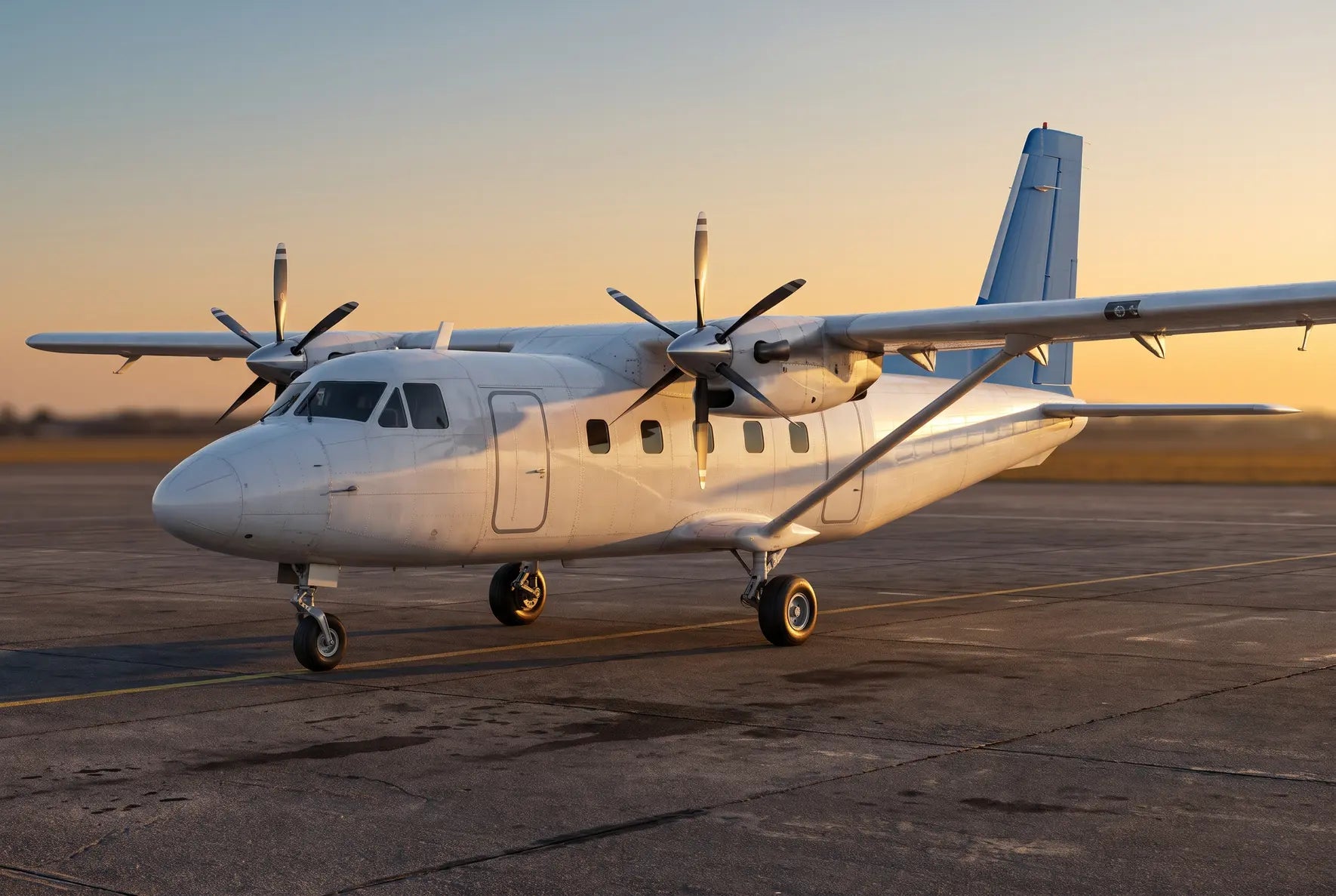
The Cessna 408 SkyCourier is a twin-engine, high-wing, strut-braced turboprop designed from the ground up for high-utilisation utility operations. Available in both a 19-passenger configuration and a dedicated freighter variant, the aircraft prioritises payload capacity, short-field performance and low operating costs over speed or pressurised comfort. Its unpressurised fuselage and fixed tricycle landing gear reflect deliberate trade-offs: reduced mechanical complexity, lower acquisition cost and easier maintenance in remote or austere environments. The SkyCourier shares no direct airframe lineage with the single-engine Cessna Caravan family, though its mission profile and robust design philosophy echo the same utility-first ethos that made the Caravan a benchmark in regional cargo operations.
Certified by the FAA on 11 March 2022, the SkyCourier was developed in close collaboration with launch customer FedEx Express, which shaped many of the freighter's design requirements. Twin-engine redundancy, generous useful load and a large rear cargo door make the freighter variant particularly suited to overnight feeder routes. The passenger version, meanwhile, targets regional airlines and charter operators seeking economical short-haul capacity. Like other iconic utility aircraft or long-range workhorses such as the Boeing 747SP, the SkyCourier was purpose-built to fill a specific operational niche.
- Wingspan: 72 ft 3 in (22.02 m); high-wing, strut-braced configuration
- Overall length: 55 ft 1 in (16.80 m)
- Height: 20 ft 8 in (6.30 m)
- Wing area: 441 sq ft (40.97 sq m)
- Maximum takeoff weight (MTOW): 19,000 lb (8,618 kg)
- Maximum ramp weight: 19,070 lb (8,650 kg)
- Maximum landing weight: 18,600 lb (8,437 kg)
- Useful load (passenger variant): 6,345 lb (2,878 kg)
- Maximum payload (freighter): 6,000 lb (2,722 kg); cargo volume 884 cu ft
- Maximum payload (passenger): 5,000 lb (2,268 kg); up to 19 passengers
- Usable fuel capacity: 4,826 lb / 720 US gal (2,725 litres)
- Maximum cruise speed: 210 KTAS (389 km/h)
- Stall speed: 74 KCAS (137 km/h)
- Range (manufacturer, max fuel, NBAA IFR reserves): approximately 900 nm (1,667 km)
- Range (19 passengers, long-range cruise, 100 nm IFR reserves, FL100): 386 nm (715 km)
- Service ceiling: 25,000 ft (7,620 m)
- Takeoff field length (passenger, MTOW, SL/ISA): 3,580 ft (1,091 m)
- Takeoff distance (freighter): 2,700 ft (823 m)
- Landing distance: 2,540 ft (774 m)
- Engines: 2 x Pratt & Whitney Canada PT6A-65SC, 1,110 shp (828 kW) each
- Propellers: 4-blade McCauley C779 Blackmac aluminium, 110-inch diameter, auto-feathering and reversing
- Avionics: Garmin G1000 NXi integrated flight deck
- Crew: single-pilot certified (IFR)
Systems, Avionics and Handling Technology
The SkyCourier employs conventional mechanical flight controls with electric trim, paired with a Garmin GFC 700 autopilot fully integrated into the G1000 NXi glass cockpit. The avionics suite features dual 10.4-inch high-resolution displays (PFD and MFD), synthetic vision technology, terrain awareness (TAWS), ADS-B In/Out compliance and an integrated flight management system supporting WAAS/LPV approaches. Engine parameters such as N1, N2, ITT, torque and fuel flow are monitored through the built-in engine indication system (EIS), giving crews a consolidated view of powerplant health.
The McCauley C779 propellers are hydraulically controlled and feature both auto-feathering and full reverse capability, which supports short-field operations and efficient ground handling. The fixed tricycle landing gear uses hydraulic multi-disc brakes on the main wheels. An on-board maintenance diagnostics system, integrated into the avionics, enables real-time fault monitoring and helps operators reduce turnaround times. The aluminium airframe and single-point refuelling further contribute to the aircraft's reputation for straightforward line maintenance.
Published performance figures for the SkyCourier can vary significantly depending on configuration and assumptions. The freighter variant, with its lower operating empty weight (approximately 11,200 lb / 5,080 kg versus around 12,725 lb for the passenger version), achieves shorter takeoff distances and greater payload flexibility. Range figures are particularly sensitive to passenger count, cruise altitude, reserve policy and atmospheric conditions. Textron Aviation's published specifications assume standard-day, sea-level, paved-runway conditions; real-world performance at high-altitude or hot airfields will differ. Operators should always refer to the approved flight manual for dispatch planning.
Powerplant: Pratt & Whitney Canada PT6A-65SC
The SkyCourier is powered by two Pratt & Whitney Canada PT6A-65SC turboprop engines, each rated at 1,110 shp (828 kW) for takeoff. The PT6A-65SC belongs to the "Large PT6A" family (models A-64 through A-68), which features a five-stage compressor (four axial stages plus one centrifugal stage) and a two-stage free power turbine driving the propeller through a reduction gearbox. This reverse-flow architecture, where air enters at the rear and exhaust exits forward through side ducts, has been a hallmark of PT6 design since the engine's first run in 1961.
The broader PT6A family, produced by P&WC (a subsidiary of RTX Corporation), is widely regarded as the most successful turboprop engine programme in aviation history. With over 51,000 engines delivered, more than 400 million flight hours accumulated and an in-flight shutdown rate of just 1 per 651,126 hours (as of 2016), the PT6A has earned an exceptional reputation for reliability. The engine entered service in 1964 and has since been developed into more than 65 variants covering a power range from 580 to 1,940 shp.
The -65 series was introduced in the 1980s and 1990s to meet demand for higher-power applications, particularly in agricultural aviation and heavy utility roles. Sibling variants include the PT6A-65AG (optimised for agricultural spraying, powering the Air Tractor AT-802), the PT6A-65B (used on the Cessna Grand Caravan EX and Basler BT-67 DC-3 conversion), and the PT6A-65AR (configured for reversible-pitch propeller operations on Thrush agricultural aircraft). The -65SC variant was specifically designed for high-cycle, high-utilisation missions. On the SkyCourier, the PT6A-65SC is paired with the McCauley C779 propeller at a maximum propeller speed of 1,700 rpm. Published TBO for the -65 series typically starts at 3,600 hours, with extensions available through P&WC maintenance programmes, and the McCauley C779 propeller itself carries a 5,000-hour TBO.
Cessna 408 SkyCourier vs PC-12 NGX vs King Air 360 vs ATR 42-600: Specs Comparison
Scroll horizontally to see more →
| Parameter | Cessna 408 SkyCourier | Pilatus PC-12 NGX | Beechcraft King Air 360 | ATR 42-600 |
|---|---|---|---|---|
| Entry into service | 2020 | 1991 | 1988 | 1984 |
| Engines | 2 × Pratt & Whitney Canada PT6A-65SC turboprop | 1 × Pratt & Whitney Canada PT6A-67D turboprop | 2 × Pratt & Whitney Canada PT6A-60A turboprop | 2 × Pratt & Whitney Canada PW127F turboprop |
| Length | 16.8 m | 12.1 m | 14.6 m | 22.7 m |
| Wingspan | 22.0 m | 16.3 m | 16.6 m | 24.6 m |
| Height | 6.3 m | 4.3 m | 5.1 m | 7.6 m |
| Typical seating and layout | Single-class commuter: 19 passengers | Single-class executive: 6–9 passengers | Single-class commuter: 6–9 passengers | Single-class regional: 42–52 passengers |
| MTOW | 8.6 t | 3.8 t | 5.7 t | 18.6 t |
| Range | 920 nm | 1,970 nm | 2,240 nm | 1,400 nm |
| Cruise speed | 0.30 Mach | 0.36 Mach | 0.34 Mach | 0.44 Mach |
| Service ceiling | 25,000 ft | 29,000 ft | 35,000 ft | 27,000 ft |
| Program note | Modern clean-sheet twin-turboprop commuter freighter and cargo courier for regional feeder and specialty operations with strong payload and low operating cost | Premium single-engine personal and executive transport emphasizing hot-and-high capability, pressurization, and light-duty cargo versatility | Proven twin-engine business and commuter workhorse providing exceptional reliability, pressurization, and range for charter and corporate operations | Established regional airliner designed for scheduled service connecting tier-2 and tier-3 airports with higher passenger capacity and flight-hour efficiency |
Scroll horizontally to see more →
The table compares key specifications of four turboprops, showing how mission profiles differ. The SkyCourier targets 19-seat regional cargo/commuter work with moderate range (920 nm) and 25,000 ft ceiling, while the PC-12 NGX and King Air 360 prioritize longer range (1,970–2,240 nm) and higher ceilings up to 35,000 ft for executive/charter use. The ATR 42-600 stands out for capacity (42–52 seats), size, and higher cruise Mach (0.44), suited to scheduled regional airlines.
Cessna 408 SkyCourier Operations: Airlines, Routes and Missions Worldwide
The Cessna 408 SkyCourier is a twin-engine, high-wing turboprop built from the ground up for cargo feeder operations, regional passenger transport and special missions. With a maximum cruise speed of approximately 210 knots (390 km/h) and a range of around 386 nautical miles (715 km) carrying 19 passengers, or up to 920 nautical miles (1,700 km) in ferry configuration, the aircraft is optimised for short regional hops of 100 to 400 nautical miles, typically lasting one to two hours per leg. Its single-point pressure refueling system enables turnarounds of 30 to 60 minutes, allowing operators to achieve four to six or more daily sorties and log six to ten flight hours per day in intensive feeder operations.
The aircraft excels in hub-and-spoke networks, shuttling cargo and passengers between small regional airports and major hubs. Textron Aviation designed it with an optional gravel kit for unimproved runways, making it equally suited to point-to-point services connecting remote or underserved communities. Its high-wing layout, rugged fixed landing gear and flat-floor cabin simplify loading and unloading at airstrips that lack sophisticated ground-handling equipment. Operators can reconfigure the cabin from passenger to freighter overnight, which maximises asset utilisation by enabling daytime passenger flights and nighttime cargo runs on the same airframe.
Operational challenges include payload-range trade-offs: the freighter variant can carry up to 6,000 lb (2,722 kg), but at maximum payload the range decreases significantly. The non-pressurised cabin limits practical cruise altitudes, and production is still ramping up, with around 61 aircraft registered in the United States as of early 2026. For operators familiar with older turboprops such as the Cessna 208 Caravan, the SkyCourier represents a step up in capacity and speed while remaining in the utility-turboprop cost bracket, much like how the Boeing 737-300 once bridged the gap between smaller regional jets and larger narrowbodies.
Where the Cessna 408 SkyCourier Operates Around the World
Since its first delivery to FedEx Express in 2022, the Cessna 408 SkyCourier fleet has expanded across multiple continents, although North America remains the dominant market. In the Americas, the type serves primarily as a cargo feeder for express-parcel networks and as a passenger or combi aircraft for remote communities. Europe is entering the picture through both commercial and military channels. In Asia, charter and government operators are beginning to adopt the aircraft for its versatility on short routes and unimproved strips, while Africa is seeing its first orders aimed at aero-medical and humanitarian transport.
- North & South America: The largest concentration of Cessna 408 SkyCourier aircraft is found here. FedEx Express, the launch customer, ordered 50 freighter variants, with deliveries ongoing. FedEx feeder partners Mountain Air Cargo (12 aircraft in service by mid-2025), Corporate Air (9 aircraft), Empire Airlines (6 aircraft) and Morningstar Air Express (4 aircraft) operate the type on overnight package routes across the United States. Bering Air uses four freighters for cargo operations in Alaska, while Everts Air flies both freighter and combi versions for remote Alaskan communities. Western Aircraft/Lanai Air became the first passenger operator, using two passenger variants and two freighters in Hawaii. Kamaka Air, also in Hawaii, operates a freighter variant. In Canada, Air Bravo placed a freighter into service in early 2025. In Latin America, Cleiton Táxi Aéreo in Brazil received the first combi variant in June 2025, while Altair in Mexico took delivery of a freighter in late 2025. Samaritan's Purse operates a combi version for humanitarian missions from Alaska, with two more on order.
- Europe: The Belgian Air Force confirmed an order for five Cessna 408 SkyCourier aircraft in April 2026 for its Special Operations Forces, covering troop transport, logistics, casualty evacuation and crisis response, making Belgium the first military operator outside the United States. On the commercial side, Titan Airways in the United Kingdom ordered two combi variants in February 2024, signalling interest in the type for flexible European charter and ad-hoc freight work.
- Asia: Hunnu Air in Mongolia ordered two passenger variants expected for delivery in 2026, planning to use them for charter services across the vast, sparsely connected Mongolian interior. Hinterland Aviation in Australia ordered two passenger variants in February 2024 for regional routes in Queensland. Air Marshall Islands ordered two passenger variants in November 2024 for inter-island transport in the Pacific. Leading Edge Air Services Corporation (LEASCOR) in the Philippines ordered a passenger variant. The Thailand Department of Royal Rainmaking and Agricultural Aviation received two passenger variants in spring 2026 for government special missions.
- Africa: Tassili Travail Aérien (TTA) in Algeria placed the first African order for two aircraft configured for aero-medical transport, with deliveries planned for 2026. Africair, operating a Textron demonstrator, has been showcasing the passenger version to potential operators across the continent, where the aircraft's ability to handle unpaved strips and carry medical supplies could prove particularly valuable.
Typical Seating and Cabin Configurations
The Cessna 408 SkyCourier passenger variant seats up to 19 passengers in a 2+1 (two-aisle-one) single-class layout. The cabin measures approximately 70 inches (1.78 m) in both height and width, offering a stand-up interior for most passengers. Seats provide a generous 32-inch (81 cm) pitch with wider-than-average cushions for the utility-turboprop category, along with USB charging ports, individual lighting, adjustable air gaspers and overhead storage bins. Large oval windows at every row admit natural light. A fold-down airstair at the forward passenger door speeds up boarding at airports with minimal ground infrastructure.
Network and freight-focused operators often choose the combi configuration (designated 408C), which places nine passenger seats in the forward cabin with a cargo section aft, separated by a movable bulkhead. This layout, certified by the FAA in May 2024, allows airlines serving remote communities to carry both passengers and essential supplies on the same flight. The pure freighter variant (408F) removes all seating and fits three LD3 containers or equivalent bulk cargo, accessed through an 87-inch-wide (221 cm) cargo door. Thanks to patented quick-release seat fixtures and an optional roller-mat floor, two ground crew can convert the cabin from full passenger to full freighter configuration in roughly one hour. According to Textron Aviation's official specifications, this flexibility is a core design feature intended to maximise revenue across different mission profiles throughout the day.
In this video, we compare the Cessna SkyCourier and the Twin Otter in the 2026 utility aviation battle, examining performance and real-world profitability to reveal which aircraft actually makes you money.
Cessna 408 SkyCourier Safety Record: How Safe Is This Twin Turboprop?
The Cessna 408 SkyCourier entered revenue service in early 2023, making it one of the newest utility turboprops on the market. Developed by Textron Aviation, the aircraft received FAA type certification on 11 March 2022, following more than 2,100 hours of flight testing from its maiden flight on 17 May 2020. As of early 2026, approximately 61 airframes were registered with the FAA, primarily operating in the FedEx Express feeder network along with a growing number of passenger and special-mission operators. Given the relatively small fleet and short operational history, the safety record of the Cessna 408 SkyCourier is still developing. However, the type has recorded no fatal accidents, no hull losses and no serious injuries since entering service. For an aircraft operating high-frequency cargo and regional routes, often from short and unpaved runways, this is a positive start.
Known Incidents Involving the Cessna 408 SkyCourier
Because the SkyCourier has been in commercial operation for only a few years, the list of reported safety events is very short. As of mid-2026, the Aviation Safety Network records a single occurrence for the type:
- Narsarsuaq Airport, Greenland (January 2026): A Cessna 408 SkyCourier registered as N408TL, operated by TVPX Ars Inc Trustee, sustained damage to its rudder and fuselage while at Narsarsuaq Airport (UAK). No injuries were reported, and the event is classified as a non-fatal ground incident. As of the latest available information, no detailed investigation report has been publicly released by Danish or Greenlandic aviation authorities.
No other accidents or serious incidents involving the Cessna 408 SkyCourier appear in the NTSB Aviation Accident Database or other recognised international safety databases. This clean early record reflects both the small fleet size and the robust engineering that went into the clean-sheet design. It is worth noting that the absence of events in the early years of a programme does not replace long-term statistical analysis. As more aircraft accumulate flight hours and cycles, the safety picture will become more complete.
How Safe Is the Cessna 408 SkyCourier?
Evaluating how safe the Cessna 408 SkyCourier is requires looking beyond raw accident numbers and considering its design philosophy, operational environment and regulatory framework. The aircraft was built from scratch for demanding utility operations. Its high-wing configuration protects the propellers during ground operations on unprepared surfaces. The fixed tricycle landing gear is heavy-duty and designed to absorb hard landings on rough strips, removing the risk associated with retractable gear malfunctions. Twin Pratt & Whitney Canada PT6A-65SC turboprops provide engine-out capability, an important safety margin for single-pilot cargo flights over remote terrain. The PT6A engine family has accumulated tens of millions of flight hours across thousands of aircraft worldwide and is widely regarded as one of the most reliable turboprop powerplants ever produced.
In the cockpit, the Garmin G1000 NXi avionics suite provides synthetic vision, terrain awareness, traffic alerting and electronic stability protection through the GFC 700 autopilot. These systems significantly reduce pilot workload and help prevent loss-of-control scenarios, which remain a leading cause of accidents in general and commuter aviation. FlightSafety International serves as the factory-approved training provider, ensuring that crews receive standardised, simulator-based instruction before operating the aircraft.
From a regulatory standpoint, the SkyCourier was certified under the latest revision of 14 CFR Part 23, which applies performance-based safety standards to normal-category aeroplanes. This framework demands rigorous structural testing, damage tolerance analysis and crashworthiness evaluation. The aircraft has also received type certification from Transport Canada and the Brazilian ANAC, adding layers of international regulatory scrutiny. Operators flying the type under Part 135 or Part 121 rules must comply with additional maintenance, crew training and operational requirements set by the FAA.
While it is still too early to compare the Cessna 408 SkyCourier's accident rate against mature types with decades of data, the combination of modern avionics, proven engines, a conservative airframe design and strict certification requirements places it in a strong position. Readers interested in how different aircraft types compare across eras may also find value in exploring the history of the Ilyushin Il-12, a post-war transport that operated in a very different regulatory and technological landscape. Such comparisons illustrate just how far aviation safety standards have progressed. Overall, commercial and utility aviation remains one of the safest modes of transport, and the SkyCourier benefits from every lesson learned over decades of industry-wide safety improvements.
01 What is the typical range and mission profile of the Cessna 408 SkyCourier?
The Cessna 408 SkyCourier has a maximum range of about 930 nautical miles with full payload, making it ideal for short to medium regional routes. It excels in cargo and passenger missions, often serving remote airports with short runways due to its STOL capabilities. Common profiles include feeder services connecting small communities to hubs.
02 What is the cabin layout and passenger experience like on the Cessna 408 SkyCourier?
The SkyCourier features a spacious cabin configurable for 19 passengers in a single-class layout with comfortable seating and overhead bins. Noise levels are low for a turboprop, thanks to composite materials and advanced soundproofing, providing a quiet ride. Large windows offer good views, and the high-wing design ensures smooth handling in turbulence.
03 Which airlines operate the Cessna 408 SkyCourier and on what routes?
Operators include FedEx Feeder for cargo on short-haul networks and passenger airlines like Boutique Air for regional routes in the US. They typically fly prop-to-prop services linking small towns to major airports, such as routes in Alaska or the Midwest. These flights support essential connectivity for underserved areas.
04 How does the Cessna 408 SkyCourier perform compared to similar aircraft?
Powered by twin Pratt & Whitney PT6A engines, the SkyCourier offers strong short-field performance with a takeoff distance under 2,500 feet. It provides better fuel efficiency than older twins like the Cessna Caravan due to modern avionics and aerodynamics. Versus the ATR 42, it prioritizes rugged utility over speed on very short routes.
05 What is the safety record and key design features of the Cessna 408 SkyCourier?
The Cessna 408 SkyCourier has an excellent safety record since certification in 2022, with no major incidents reported in commercial service. Design highlights include a robust airframe tested for harsh conditions, redundant systems, and advanced flight controls for reliability. Its high-wing configuration enhances propeller clearance and stability on unpaved runways.
06 What should passengers know about flying on the Cessna 408 SkyCourier?
Seat choices near the front minimize turbulence effects and allow quicker boarding on these smaller aircraft. Windows are generously sized for scenic views, especially useful on regional flights over varied terrain. The aircraft handles bumps well due to its sturdy build, though like most turboprops, it may feel more motion on windy days.