


History and Development of the Ilyushin Il-12: From Wartime Vision to Soviet Workhorse
The Ilyushin Il-12 was born from a wartime imperative to modernize Soviet civil aviation. By the early 1940s, the backbone of Aeroflot's fleet was the Lisunov Li-2, a Soviet licence-built version of the American Douglas DC-3. While reliable, the Li-2 was a taildragger with limited payload, modest speed and aging technology. In late 1943, the Ilyushin Design Bureau (OKB), led by Sergei Vladimirovich Ilyushin, launched a private venture to create a substantially more capable successor. The goal was ambitious: a pressurized, 29-seat airliner with tricycle landing gear, a cruising speed of approximately 400 km/h, and a range of up to 5,000 km. It would be the first Soviet transport aircraft designed from the outset with a nosewheel configuration.
In early 1944, Ilyushin submitted a formal design report to Joseph Stalin, who approved the program. The initial concept called for four Shvetsov M-88V supercharged radial engines. However, the configuration was soon revised to a twin-engine layout using two Charomskiy ACh-31 V-12 diesel engines rated at approximately 1,900 hp each for takeoff. A full-scale mock-up was completed by autumn 1944, and the first prototype was constructed at Zavod No. 240 MAP at Moscow-Khodynka.
Ground trials began in June 1945, and the first prototype took to the air on 15 August 1945, powered by the ACh-31 diesels. Testing quickly revealed that the diesel engines were unreliable for sustained commercial operations. The design team pivoted, re-engining the prototype with two Shvetsov ASh-82FN 14-cylinder, air-cooled radial engines, each producing approximately 1,380 kW (1,850 hp) at takeoff. The re-engined prototype completed its maiden flight on 9 January 1946. Early flights exposed propeller-related vibration problems, which were resolved through propeller refinements. The cabin pressurization feature from the original specification was also dropped to simplify production and improve reliability.
State trials took place during summer and autumn of 1946, and the aircraft was publicly displayed at Tushino on 18 August 1946. Confident in its potential, the Soviet authorities ordered the Ilyushin Il-12 into series production even before state trials had concluded. On 1 May 1947, a formation of Il-12s flew over Red Square in Moscow, catching the attention of Western observers and earning the NATO reporting name "Coach". The type formally entered service with Aeroflot in the summer of 1947, initially on domestic medium-haul routes.
Production ran from 1947 to 1949, with a total of 663 aircraft completed: five test airframes and 658 production models. Of these, 183 were built in 1947 (including 45 of the Il-12T cargo variant), 258 in 1948 (including 213 Il-12T), and 217 in 1949. Aeroflot operated at least 338 examples. International Aeroflot service expanded rapidly: the Il-12 flew the Moscow to Sofia route in 1948, reached Berlin and Belgrade, and eventually served the Moscow to Paris route beginning in 1954. Several Warsaw Pact nations and China also operated the type. The Ilyushin Il-12 remained in Aeroflot service until approximately 1970.
What Distinguished the Ilyushin Il-12 from Related Variants
The Ilyushin Il-12 was a clean-sheet design compared to the Li-2 it replaced, offering a modern tricycle undercarriage, all-metal construction, superior speed and payload capacity, and improved pilot visibility during taxi and landing. However, the type was itself considered interim technology by the Ilyushin OKB. Its direct successor, the Il-14 (first flight 1950, Aeroflot service from 1954), featured a comprehensively redesigned wing with constant dihedral and three degrees of forward sweep, upgraded ASh-82T engines with longer overhaul intervals, faster-retracting landing gear, hydraulic redundancy, and refined engine cowlings that improved both single-engine safety and ground servicing access. These enhancements addressed operational limitations identified during Il-12 service. Within the Il-12 production run itself, several sub-variants served different roles. Much like other postwar twins such as the Saab 340A, which also carved a niche in regional operations decades later, the Il-12 filled a critical gap in medium-haul capacity for its era.
Key variant identifiers within the Ilyushin Il-12 family include:
- Il-12 (baseline passenger variant): seating for 18 to 32 passengers, powered by two Shvetsov ASh-82FN radial engines, maximum takeoff weight of approximately 17,250 kg, cruise speed around 376 km/h, range up to 2,000 km, service ceiling of 6,700 m.
- Il-12T: dedicated freight and military transport variant with reinforced metal floor, cargo tie-downs, winches, and tip-up bench seats; payload capacity of approximately 3,000 kg; some examples adapted for glider towing (Yak-14 and Ts-25 gliders) with a modified tailcone.
- Il-12D: military transport prototype converted under a government decree of 11 March 1947; equipped for carrying 18 paratroopers and for towing cargo gliders; also used for auxiliary bomber trials.
- Il-12TB: glider tug variant with a truncated tail section to accommodate a tow attachment.

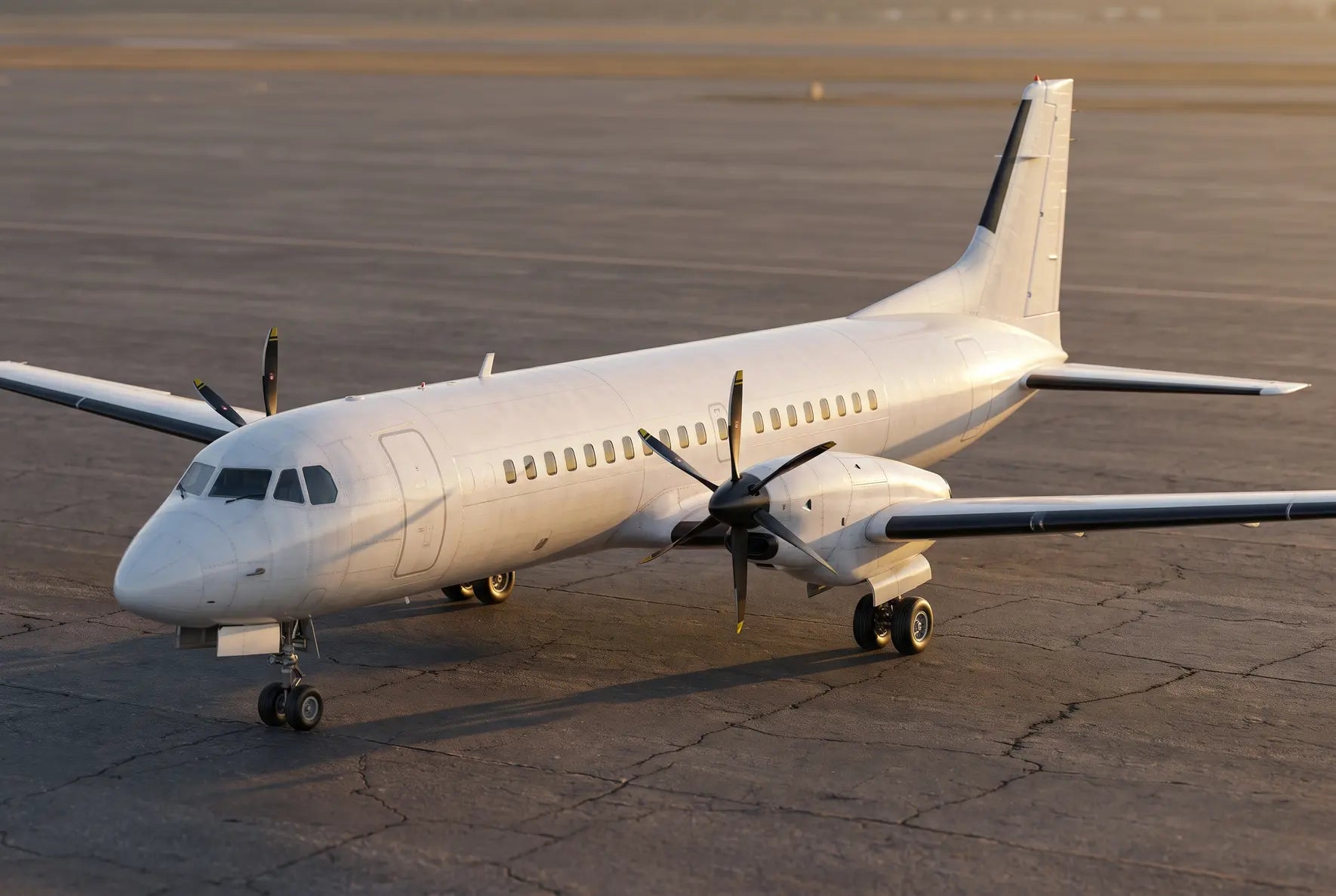
An Ilyushin Il-12 aircraft is displayed outdoors at the Datanshan Chinese Aviation Museum in Beijing, China, with another plane partially visible in the background.
Ilyushin Il-12 Technical Specifications, Systems and Engine Overview
The Ilyushin Il-12 was conceived in 1944 as a modern replacement for the Lisunov Li-2, itself a Soviet licence built version of the Douglas DC-3. The design brief called for an all metal, low wing monoplane capable of carrying passengers on medium haul domestic routes across the Soviet Union, including operations from unprepared or semi prepared airstrips. Early concepts envisioned four supercharged engines and a pressurised cabin, but practical constraints led Sergei Ilyushin's bureau to simplify the design into a twin engine, unpressurised transport with tricycle landing gear. That tricycle configuration, a notable step forward from the taildragger Li-2, gave the Il-12 improved ground handling, better pilot visibility during taxiing and landing, and enhanced rough field capability.
The airframe was built primarily of aircraft grade aluminium alloy with conventional semi monocoque construction. Its wing featured a modest 3 degrees of forward sweep and constant dihedral, both chosen to improve single engine handling qualities. The original prototype first flew in August 1945 with Charomskiy ACh-31 diesel engines, but these powerplants proved immature and unreliable. Ilyushin subsequently swapped them for the proven Shvetsov ASh-82FN radial engines, and the revised aircraft first flew on 9 January 1946. Production commenced shortly after, with approximately 663 airframes completed before the line closed in 1949.
- Wingspan: 31.70 m (104 ft 0 in)
- Length: 21.31 m (69 ft 11 in)
- Height: 7.80 m (25 ft 7 in)
- Wing area: 100.0 m² (1,076 sq ft)
- Empty weight: approximately 11,045 kg (24,350 lb)
- Maximum takeoff weight: 17,250 kg (38,030 lb)
- Powerplant: 2 × Shvetsov ASh-82FN, 14 cylinder two row air cooled radials, each rated at 1,380 kW (1,850 hp) for takeoff
- Propellers: four blade variable pitch with feathering capability
- Fuel capacity: 4,170 litres across six wing centre section tanks
- Maximum speed: 407 km/h (220 kn; 253 mph)
- Cruise speed: 320 km/h (173 kn; 199 mph)
- Range: 1,500 to 2,000 km (810 to 1,080 nmi) depending on payload and configuration
- Service ceiling: 6,700 m (21,980 ft)
- Crew: 3 (two pilots, one radio operator/navigator)
- Passenger capacity: 18 to 32 depending on cabin layout
Systems, Flight Controls and Handling Technology
The Il-12 employed conventional, cable actuated flight controls with mechanically linked ailerons, elevators and a single rudder. Trim tabs on all primary surfaces allowed the crew to manage asymmetric thrust conditions, a critical consideration for a twin engine piston aircraft of this era. Flaps were hydraulically operated and designed to improve low speed performance for operations into short or unpaved strips. The hydraulic system also powered landing gear retraction: the nose wheel retracted rearward into the fuselage, while the twin wheel main gear units folded forward into the engine nacelles, reducing drag in the event of an engine failure.
Fire suppression relied on a carbon dioxide extinguisher system installed in each engine nacelle. Thermal de icing was available for critical surfaces, using heated air ducted from the engines. Instrumentation followed standard Soviet conventions of the late 1940s, with analogue engine gauges, basic navigation aids, and a radio station operated by the third crew member. There was no autopilot in the original production configuration, though later modifications to some airframes introduced incremental improvements to avionics and cockpit ergonomics.
Published performance figures for the Il-12 vary across sources for several reasons. Maximum takeoff weight ranged from 17,000 kg to 17,250 kg depending on production batch and operator modifications. Cabin density fluctuated between 18 and 32 seats, directly affecting payload and range. Atmospheric assumptions, airfield elevation, runway surface condition, and temperature all influenced takeoff distances and climb performance. Some references cite maximum speed as high as 407 km/h, while others list 375 km/h; these differences likely reflect variations in altitude, weight, and measurement methodology. Range figures similarly span from 1,500 km to 2,000 km, depending on passenger load, fuel reserves, and cruise altitude selected.
The Shvetsov ASh-82FN: History, Specifications and Applications
The Shvetsov ASh-82FN was a 14 cylinder, two row, air cooled radial engine developed at OKB-19 under chief designer Arkadiy Shvetsov. Its lineage traced back to the Shvetsov M-62, which was itself a Soviet evolution of the American Wright R-1820 Cyclone produced under licence. Shvetsov shortened the piston stroke to 155 mm while retaining the original cylinder bore of 155.5 mm, creating a compact powerplant with a total displacement of 41.2 litres (2,515 cu in). The base M-82 passed Soviet state acceptance tests in May 1941 and was initially rated at 1,250 hp.
The critical advancement of the FN (forsirovannyy nyeposredstvennyy, meaning boosted direct injection) variant was the introduction of direct fuel injection via an RNB-03 pump, replacing the carburettor used on earlier versions. This change increased takeoff power to 1,850 hp (1,380 kW) at 2,500 RPM with a boost pressure of 1.6 atm (48 inHg) and substantially improved altitude performance, reliability in extreme cold, and resistance to negative G fuel starvation. The engine featured a single stage, single speed centrifugal supercharger, two sodium cooled exhaust valves per cylinder, a compression ratio of 7.05:1, and a 9:16 reduction gear ratio. Dry weight was approximately 868 to 900 kg depending on variant and accessories fitted.
Beyond the Il-12, the ASh-82FN powered several landmark Soviet aircraft. It was the engine behind the Lavochkin La-5FN and La-7 fighters, which proved decisive on the Eastern Front during World War II, and it also served in the Tupolev Tu-2 medium bomber. Postwar, the further developed ASh-82T variant (rated at 1,900 hp) powered the successor Ilyushin Il-14 transport. The Chinese Dongan HS-7 was a licence built copy of the ASh-82 family, extending the engine's service life well into the latter half of the 20th century. Tens of thousands of ASh-82 series engines were manufactured across all variants, making it one of the most produced Soviet piston aero engines in history.
Ilyushin Il-12 vs Il-14 vs Lisunov Li-2 vs Douglas DC-3 Specifications Comparison
Scroll horizontally to see more →
| Parameter | Ilyushin Il-12 | Ilyushin Il-14 | Lisunov Li-2 | Douglas DC-3 |
|---|---|---|---|---|
| Entry into service | 1947 | 1950 | 1937 | 1936 |
| Engines | 2 × Shvetsov ASh-82FN | 2 × Shvetsov ASh-82T | 2 × Wright R-1820 Cyclone | 2 × Wright R-1820 Cyclone |
| Length | 21.3 m | 21.5 m | 19.4 m | 19.6 m |
| Wingspan | 31.7 m | 31.6 m | 29.0 m | 29.0 m |
| Height | 8.1 m | 7.8 m | 6.3 m | 6.4 m |
| Typical seating and layout | 2-class: 18–32 passengers | 2-class: 24–36 passengers | 2-class: 14–28 passengers | 2-class: 21–32 passengers |
| MTOW | 17 t | 17 t | 12 t | 11 t |
| Range | 1,080 nm | 810 nm | 1,500 nm | 1,500 nm |
| Cruise speed | 0.26 Mach | 0.23 Mach | 0.18 Mach | 0.18 Mach |
| Service ceiling | 21,000 ft | 23,000 ft | 22,000 ft | 23,200 ft |
| Program note | Soviet medium-haul airliner, post-WWII design replacing DC-3 | Improved Il-12 with better engines and rough-field performance | License-built DC-3 for Soviet short/medium routes | WWII-era benchmark twin, basis for Soviet designs |
Scroll horizontally to see more →
The table compares four classic piston twins, highlighting how the postwar Il-12 and improved Il-14 were larger and heavier (17 t MTOW) than the Li-2 and DC-3 (~11–12 t) and cruised faster (0.23–0.26 Mach vs 0.18). The Il-14 trades range (810 nm) for a higher ceiling, while the Li-2/DC-3 lead in range at 1,500 nm. Seating also shifts upward with the Il-14 (24–36).
Ilyushin Il-12 Operations, Typical Routes and Airlines Around the World
The Ilyushin Il-12, NATO reporting name "Coach", was a Soviet twin engine transport aircraft designed in the mid 1940s to replace the ageing Lisunov Li 2 on small and medium haul airline routes. Powered by two Shvetsov ASh 82FN radial engines, the type had a practical range of approximately 1,500 km (810 nm) with a full passenger load and a cruising speed of around 320 km/h (199 mph). Flights therefore typically lasted between one and four hours on individual sectors, although multi stop transcontinental services across the Soviet Union could stretch over an entire day. The longest Aeroflot routing, Moscow to Khabarovsk, required roughly 28 hours of travel with five refuelling stops along the way.
Operationally, the Ilyushin Il-12 was optimised for point to point and hub spoke networks radiating from major Soviet cities such as Moscow and Leningrad. Its robust fixed tailwheel undercarriage allowed it to operate from unpaved, grass and even compacted snow runways, making it well suited to secondary and regional airfields across Siberia, Central Asia and the Caucasus. From 1956, ice modified variants supported Soviet Antarctic expeditions, demonstrating the aircraft's adaptability to extreme operational environments. Key challenges for operators included the type's modest single engine performance and its reliance on piston power at a time when turboprop and jet transports were beginning to appear in the West, much like early variants of the McDonnell Douglas DC 8 61 that would later redefine long haul efficiency. A total of 663 Il 12s of all variants were built by the time production ended in 1949.
Where the Ilyushin Il 12 Operated
The Ilyushin Il 12 saw service almost exclusively within the Soviet sphere of influence, spanning Europe, Asia and, to a very limited extent, polar regions. No confirmed civilian operators have been recorded in North or South America or Africa. In Europe, the aircraft connected Moscow with capitals across the Eastern Bloc, while in Asia it formed the backbone of early Chinese civil and military aviation. International services from Moscow reached cities such as Sofia, Berlin, Belgrade, Budapest, Bucharest, Warsaw, Vienna, Prague, Tehran, Stockholm, Helsinki, Kabul and Ulaanbaatar. In 1954, the Ilyushin Il 12 became the first Soviet type to operate scheduled services to Western Europe when Aeroflot launched its Moscow to Paris route.
Below is a breakdown of the principal operators by region, based on documented historical records from sources such as Air Vectors.
- Europe: Aeroflot (Soviet Union) was the largest operator, receiving at least 338 airframes and flying domestic trunk routes as well as international services from 1947 until approximately 1965. LOT Polish Airlines (Poland) acquired five Il 12B aircraft in 1949, operating them on domestic and regional routes until 1957, after which they were transferred to the Polish Air Force. Czechoslovak State Airlines (CSA) purchased ten aircraft between 1949 and 1951 for short haul services. TAROM (Romania) and the joint Soviet Bulgarian carrier TABSO also operated the type on Balkan and intra Eastern Bloc routes with mixed nationality crews.
- North and South America: No confirmed civilian or military operators of the Ilyushin Il 12 have been documented in either continent.
- Asia: CAAC (China) was the most significant Asian operator, receiving at least 20 airframes for civil use; remarkably, one example remained in service as late as 1985, making it the longest serving civilian Il 12 on record. The People's Liberation Army Air Force imported 42 aircraft between 1950 and 1951 for military transport duties. Korean Airways (North Korea) also operated the type, and examples served with the Mongolian Air Force and Pathet Lao forces in Laos.
- Africa: No confirmed operators of the Ilyushin Il 12 have been identified on the African continent.
Typical Seating and Cabin Layouts
The Ilyushin Il 12 was originally designed for 29 passenger seats in a single class layout, but production models varied considerably. Early airframes were restricted to around 18 seats due to weight and performance limitations. Later Il 12B variants commonly seated between 24 and 32 passengers in a two abreast configuration on each side of a central aisle, depending on the operator and route length. LOT Polish Airlines adjusted its cabin from the initial layout to 26 seats in 1951, eventually settling on configurations between 24 and 28 seats. Long range or special mission variants, such as sanitary (medical evacuation) aircraft, carried as few as 11 passengers or litters. Military transport versions replaced passenger seating entirely with folding bench seats for 18 paratroopers or open cargo space. Unlike modern airliners, there was no differentiation between business and economy cabins; all passengers travelled in a single class. Detailed cabin drawings and historical fleet data can be found in the AirHistory.net Il 12 reference document.
In this video, explore the Ilyushin IL-12 and IL-14, the firstborn of Soviet civil aviation. Learn how, after World War II, the Soviet Union shifted to an improved aircraft for passenger service.
Ilyushin Il 12 Safety Record: Accident History and Overall Assessment
The Ilyushin Il-12 entered service with Aeroflot in 1947 and remained in frontline use throughout the 1950s. A total of 663 airframes were manufactured between 1947 and 1949, serving primarily on Soviet domestic routes as well as with operators in Poland, Czechoslovakia, and China. According to publicly available records, 56 of those 663 aircraft were lost in accidents, resulting in 465 fatalities. That hull loss ratio of roughly 8.4 percent must be understood in the context of the era: piston engine airliners of the late 1940s and 1950s worldwide operated with far fewer navigational aids, less mature air traffic control, limited weather forecasting, and less standardised pilot training than modern fleets. Many Il-12 losses occurred in severe weather, during single engine operations, or as a result of maintenance shortcomings that would be addressed by later generations of aircraft and regulation.
Notable Accidents and Their Aftermath
Several incidents involving the Ilyushin Il-12 stand out for the lessons they prompted in Soviet civil aviation.
- 30 July 1950, Karaganda, Kazakhstan (Aeroflot): An Il-12P (CCCP‑Л1803) experienced failure of the left engine shortly after departure. The crew attempted to return but lost control at low altitude; the aircraft entered a spin and crashed, killing all 25 occupants. Investigations pointed to inadequate handling of asymmetric thrust and a decision to extend the landing gear prematurely, which increased drag on the operating engine side. The accident reinforced the need for rigorous single engine failure training and prompted Aeroflot to revise its engine out procedures for twin engine piston types.
- 17 November 1951, Novosibirsk (Aeroflot): An Il-12P stalled during takeoff with ice accumulation on the wings and tail surfaces. All 23 people on board were killed. Contributing factors included insufficient de-icing before departure and poor weather forecasting at the airport. The disaster led to stricter ground de-icing protocols and improved coordination between meteorological services and flight operations within Aeroflot, measures documented in subsequent Aviation Safety Network records for the type.
- 27 October 1953, near Magadan (Aeroflot Flight 783): An Il-12P (CCCP‑Л1765) crashed after the wings accumulated severe ice in flight, compounded by the aircraft being loaded beyond its certified limits. Of 27 occupants, 22 lost their lives. The investigation highlighted the Il-12's vulnerability to in-flight icing and the dangers of weight exceedance, leading to tighter load control regulations and renewed emphasis on anti-icing procedures across Soviet transport aviation.
- 19 September 1958, Lazo District, Khabarovsk Krai (Aeroflot): An Il-12P (CCCP‑Л3904) struck a mountain slope after the crew became disoriented at night in poor weather and exhausted the aircraft's fuel supply. All 28 people on board perished. The accident underscored gaps in instrument flight training and fuel reserve planning, prompting authorities to tighten minimum fuel regulations and to mandate improved instrument proficiency checks for crews operating in remote, mountainous regions.
Across these events, recurring themes included engine reliability limitations of the Shvetsov ASh-82FN powerplants, the Il-12's marginal single engine performance, susceptibility to airframe icing, and operational pressures in a rapidly expanding Soviet airline network. Crucially, the cumulative safety lessons drawn from Il-12 operations became a direct catalyst for the development of its successor, the Ilyushin Il-14, which featured a redesigned wing, a larger vertical stabiliser for improved directional stability, and better de-icing equipment.
How Safe Is the Ilyushin Il 12 by Modern Standards?
Evaluated against today's benchmarks, the Ilyushin Il-12's record reflects the inherent risks of early postwar commercial aviation rather than a fundamentally flawed airframe. The type's hull loss rate, while high by 21st century standards, was broadly comparable to that of contemporary Western piston airliners such as the Convair CV-240 or early Martin 2-0-2 variants operating under similarly developing regulatory frameworks. Modern commercial aviation benefits from redundant fly-by-wire systems, predictive maintenance, satellite navigation, and international safety oversight coordinated through bodies like the International Civil Aviation Organization (ICAO), none of which existed in the Il-12's operational environment.
The Il-12's legacy is better measured by what it contributed to aviation safety culture. Each major accident led to procedural tightening, whether in de-icing, fuel planning, engine out handling, or weight management. These incremental improvements fed directly into safer successor types and into the broader evolution of Soviet and international aviation standards and sustainability goals. The Bureau of Aircraft Accidents Archives maintains a comprehensive listing of Il-12 events that allows researchers to trace how each incident shaped subsequent policy.
No Il-12 remains in commercial passenger service today. For historical perspective, the type's operational era was one in which the global airline industry was still learning to manage risk systematically. Aviation has since become one of the safest forms of mass transportation, with modern fatal accident rates measured in fractions per million flights, a standard built in part on hard lessons from pioneering aircraft like the Ilyushin Il-12.
01 What was the typical range and mission profile of the Ilyushin Il-12?
The Ilyushin Il-12 had a range of about 1,500 to 2,000 kilometers with a typical passenger load, making it suitable for short to medium regional routes within the Soviet Union and Eastern Bloc countries. It cruised at around 320-400 km/h, serving primarily as a replacement for older DC-3 types on domestic flights. Missions focused on passenger transport and light cargo over distances up to 1,080 nautical miles under optimal conditions.
02 How was the cabin laid out on the Ilyushin Il-12, and what was the passenger experience like?
The Ilyushin Il-12 typically seated 18 to 24 passengers in a single-aisle cabin with one seat on one side and two on the other, plus a few extra seats at the front. Noise from the radial engines was noticeable, and the unpressurized cabin meant flights stayed below 6,700 meters, offering basic comfort for short hops but limited legroom by modern standards. Passengers experienced a sturdy, no-frills ride suited to post-war travel.
03 Which airlines operated the Ilyushin Il-12 and on what kinds of routes?
Aeroflot was the primary operator of the Ilyushin Il-12, using it extensively on intra-Soviet routes like Moscow to regional cities or shorter international hops to Eastern Europe. Other airlines in the Warsaw Pact countries and some Asian carriers also flew it for regional passenger and mail services. Routes were typically under 2,000 km, avoiding long overwater flights.
04 How did the Ilyushin Il-12 perform compared to similar aircraft like the DC-3?
Powered by twin ASh-82FN radial engines, the Ilyushin Il-12 cruised faster at 320-400 km/h than the DC-3's 300 km/h, with better short-field performance thanks to its tricycle gear and robust design. It carried similar passenger loads but offered improved reliability over rough airstrips, though fuel efficiency was comparable to contemporaries. The Il-14 upgrade later enhanced speed and handling further.
05 What was the safety record and key design features of the Ilyushin Il-12?
The Ilyushin Il-12 had a solid safety record for its era, with design tweaks addressing early issues like engine-out handling through refined aerodynamics and faster gear retraction. Key features included all-metal construction, twin radial engines with fire suppression, and modifications for single-engine flight safety. Over 660 units were built, serving reliably until the 1960s.
06 What practical details should travelers know about flying on the Ilyushin Il-12?
Seats near the front offered quicker boarding via the forward door, with larger windows on the port side for better views during low-altitude flights. The aircraft handled turbulence steadily due to its low-wing design but expect propeller noise and basic amenities on these short routes. Luggage space was limited, so pack light for regional trips.