

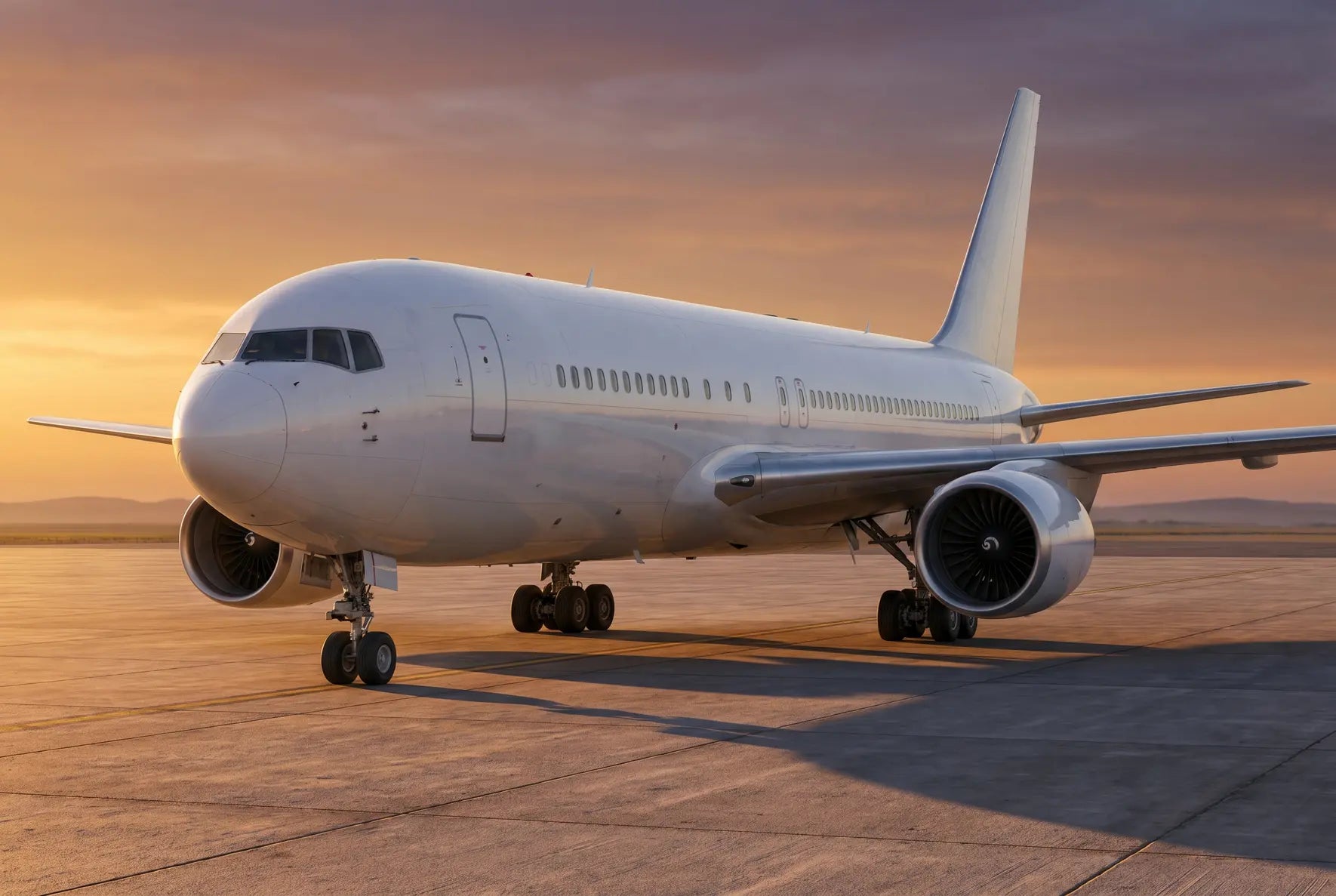
Boeing 767-200 History: Program Launch, Development Path and Variant Origins
The Boeing 767-200 is the original production variant of the Boeing 767 family, an American wide-body twinjet developed and manufactured by Boeing Commercial Airplanes in Everett, Washington. It was conceived in the mid-1970s to fill a growing market gap between single-aisle narrowbodies such as the 727 and 737, and larger wide-bodies like the 747 and DC-10. Airlines wanted a medium-capacity, fuel-efficient airliner with transcontinental range that could replicate the wide-body passenger experience at lower operating cost. The rising price of fuel and the competitive success of the Airbus A300, the world's first twin-engine wide-body (in service from 1974), accelerated Boeing's commitment to a twinjet configuration.
From the 7X7 Program to the Boeing 767-200
The aircraft that became the Boeing 767-200 originated as the internal 7X7 program, whose definition phase ran from May 1973 to December 1977. Early concepts included short-haul STOL wide-bodies and trijet configurations, but airline feedback steered the project toward a longer-range, twin-engine layout. By 1976, a conventional twinjet baseline similar to the A300 had been adopted. In February 1978, Boeing formally assigned the 767 designation and defined three initial variants: the 767-100 (approximately 190 seats), the 767-200 (approximately 210 seats), and a trijet long-range model. The 767-100 was soon dropped as the parallel 757 program covered comparable capacity, and the trijet concept was abandoned.
The 767 program was officially launched on 14 July 1978, when United Airlines placed a landmark order for 30 Boeing 767-200 aircraft. Orders from American Airlines and Delta Air Lines followed later that year. By the time the prototype rolled out, Boeing held 173 firm orders from 17 customers, including Air Canada, All Nippon Airways, Transbrasil, and TWA.
Key Milestones: First Flight, Certification and Entry into Service
Assembly of the first Boeing 767-200 began in July 1979 at Boeing's Everett factory. The prototype, registered N767BA and powered by Pratt & Whitney JT9D-7R4D engines, was rolled out on 4 August 1981. The aircraft completed its maiden flight on 26 September 1981, beginning a multi-aircraft test campaign. On 30 July 1982, the 767-200 received FAA type certification. The first delivery to United Airlines took place on 19 August 1982, and United inaugurated commercial service on 8 September 1982 on the Chicago-Denver route using a JT9D-powered 767-200. Delta Air Lines followed approximately three months later, becoming the first operator of the General Electric CF6-80A-powered variant in December 1982.
The Boeing 767-200 introduced several firsts for Boeing. It was the company's first wide-body twinjet and featured a pioneering two-crew digital glass cockpit with CRT displays, eliminating the need for a flight engineer. This cockpit was designed with significant commonality with the Boeing 757, and in the mid-1980s the FAA approved a common type rating for the two aircraft, allowing pilots to fly both types with minimal additional training.
A pivotal moment in the variant's operational history came in 1985, when the Boeing 767 became the first twin-engine commercial jet to receive ETOPS-120 approval, permitting routine transatlantic operations up to 120 minutes from a diversion airport. This regulatory milestone opened oceanic routes previously reserved for tri- and quad-engine aircraft. Later ETOPS-180 approvals further expanded the type's reach. Several airlines that benefited from the 767's ETOPS capabilities developed significant long-haul networks; operators such as Virgin Atlantic are among those that have leveraged twin-engine wide-bodies for transatlantic services.
What Distinguishes the Boeing 767-200 from Other 767 Variants
The baseline Boeing 767-200 was designed primarily for medium-range, high-density domestic and transcontinental routes. It differs from later members of the 767 family in several important ways. The 767-200ER (Extended Range), first ordered by Ethiopian Airlines in December 1982 and entering service with El Al in 1984, shares the same fuselage length and cross-section but features increased fuel capacity (via an additional centre-section fuel tank), a substantially higher maximum takeoff weight, and structural reinforcements to the wings and landing gear, boosting range from approximately 3,900 nautical miles to around 6,590 nautical miles. The 767-300, which entered service in 1986, introduced a fuselage stretch of approximately 6.4 metres (21 feet), raising typical two-class seating from about 216 to roughly 269 passengers while retaining a similar wing and systems architecture. The 767-300ER added extended-range capability with a maximum takeoff weight of approximately 186,880 kg (412,000 lb).
The following list summarises the verified variant identifiers specific to the baseline Boeing 767-200:
- Engine options: Pratt & Whitney JT9D-7R4D; General Electric CF6-80A (CF6-80A2 on later builds)
- Typical two-class seating: approximately 216 passengers in a 2-3-2 cabin layout
- Range: approximately 3,900 nautical miles (7,200 km) with standard payload
- Maximum takeoff weight: approximately 142,880 kg (315,000 lb), depending on build standard
- Cockpit: two-crew digital glass cockpit with CRT displays; common type rating with the Boeing 757
- Fuselage length: approximately 48.5 m (159 ft)
- Wingspan: approximately 47.6 m (156 ft 1 in)
- ETOPS: first commercial twinjet to receive ETOPS-120 approval (1985)

A Delta Air Lines Boeing 767-332 aircraft is captured in mid-air ascent against a clear blue sky. The plane displays the airline's distinctive livery, highlighting its sleek design and powerful engines in flight.
Boeing 767-200 Technical Specifications, Systems Highlights and Engine Options
The Boeing 767-200 was conceived as a medium- to long-range widebody twinjet, optimised for transcontinental and early transatlantic routes with lower seat counts than the 747. Its design philosophy balanced range against payload: a relatively wide fuselage (twin-aisle, seven-abreast in economy) paired with a moderate wing area of 283.3 m² and a sweep of 31.5 degrees, giving it efficient cruise performance at Mach 0.80 without the fuel penalty of a larger airframe. As Boeing's first widebody designed from the outset for a two-pilot digital glass cockpit, the 767-200 shares its cockpit philosophy, avionics architecture and handling qualities with the narrowbody 757, enabling a common type rating between the two aircraft.
In terms of design trade-offs, the baseline 767-200 targets a lighter maximum take-off weight and shorter range than the later -200ER, -300 and -300ER variants. This makes it well suited to domestic and regional international operations, with shorter field-length requirements and lower operating costs per trip. The airframe inherits the 767 family's conventional hydraulic flight controls, triple-redundant hydraulic systems, and EICAS-based crew alerting, all of which became standards that later 767 variants and the 777 built upon.
- Length: 48.5 m (159 ft 2 in)
- Wingspan: 47.6 m (156 ft 1 in), no winglets on the original variant
- Height: 15.8 m (approximately 52 ft)
- Wing area: 283.3 m² (3,050 sq ft), sweep 31.5 degrees
- Cabin width: 4.72 m (186 in), twin-aisle configuration
- Typical seating: approximately 216 passengers in two-class layout, up to around 250 in high-density configuration
- MTOW (baseline 767-200): 143,789 kg (317,000 lb)
- OEW (typical): approximately 80,128 kg (176,650 lb)
- Fuel capacity: approximately 63,000 litres (16,700 US gal)
- Range (manufacturer, typical two-class load): approximately 3,900 NM (7,200 km)
- Cruise speed: Mach 0.80 (approximately 470-480 kt TAS at cruise altitude)
- Service ceiling: approximately 13,137 m (43,100 ft)
- Engines (baseline 767-200): 2x Pratt & Whitney JT9D-7R4 or 2x General Electric CF6-80A
- Thrust class (baseline engines): approximately 213-234 kN (48,000-52,500 lbf) per engine
- Take-off field length (MTOW, ISA, sea level): approximately 1,920 m (6,300 ft)
- Landing distance (typical landing weight): approximately 1,448 m (4,750 ft)
- Crew: 2 pilots (flight engineer eliminated by design)
- Avionics baseline: six-CRT glass cockpit with EFIS, EICAS, dual FMS, and triple IRS
Systems Architecture and Handling Technology
The 767-200 uses a conventional hydraulic flight control system powered by three independent hydraulic systems (left, centre, right). Primary flight controls (ailerons, elevators and rudder) are actuated by hydraulic power control units connected to the cockpit via mechanical linkages. There is no fly-by-wire on the 767; Boeing retained the traditional "feel and hydraulics" philosophy, with yaw dampers and Mach trim providing stability augmentation through the flight control computers rather than imposing envelope protection. Multiple spoiler panels on each wing serve as in-flight speedbrakes and as automatic ground spoilers on landing to maximise weight on wheels and braking effectiveness.
The autoflight system integrates an autopilot, flight director and autothrottle through dual Flight Control Computers (FCCs). The Flight Management System provides lateral and vertical navigation (LNAV/VNAV), performance calculations and full route management from a centralised CDU. Autoland capability up to CAT IIIb was offered as an option, with appropriate dual-autopilot redundancy. The automation philosophy follows Boeing's "pilot-in-command" principle: modes are explicitly selected on the Mode Control Panel and clearly annunciated, without hidden mode transitions.
Braking is handled by multi-disc hydraulic wheel brakes with electronic anti-skid protection and a selectable autobrake system (including RTO mode and graduated landing deceleration settings). The EICAS displays engine parameters (N1, EGT, fuel flow) and system status on CRT screens, replacing the flight engineer's panel with electronic crew alerts and system synoptic pages that also aid post-flight maintenance troubleshooting. While not as integrated as modern ACARS-linked health monitoring, this centralised architecture significantly reduced line-maintenance time compared to earlier Boeing widebodies.
Published performance numbers for the 767-200 can vary significantly between references. Differences arise from operator-specific options such as engine model and thrust rating, cabin configuration and passenger count, structural weight variants and optional auxiliary fuel capacity. Atmospheric assumptions (ISA versus hot-and-high conditions), runway surface state and regulatory margins also affect stated take-off and landing distances. Range figures, for example, depend on payload assumptions and reserve policy, so any value should be read with its stated basis rather than taken as absolute. Airlines operating the 767 on diverse route networks, such as those flying long-haul transatlantic services, may see real-world performance that differs from manufacturer brochure numbers.
Engine Options: JT9D, CF6 and PW4000
The baseline 767-200 launched in 1982 with two engine choices: the Pratt & Whitney JT9D-7R4 and the General Electric CF6-80A. Both are high-bypass turbofans developed to make widebody twin-engine operations viable. As 767 production evolved and the -200ER emerged, higher-thrust variants became available, notably the GE CF6-80C2 and the Pratt & Whitney PW4000 (94-inch fan).
The Pratt & Whitney JT9D-7R4 family was the original P&W powerplant for the 767. The JT9D traces its lineage to the late 1960s, when it was developed as the first high-bypass turbofan for the Boeing 747. The -7R4D, -7R4E and -7R4E4 sub-variants were tailored specifically for the 767 and are considered exclusive to the type. On the 767-200 they delivered approximately 48,000 lbf (213 kN) of thrust, with later sub-variants capable of up to 60,000 lbf. The engine weighs roughly 3,905 kg (8,608 lb). Although the broader JT9D family also powered the 747, DC-10 and early A300, the 7R4 sub-series was eventually superseded by the PW4000 across the industry.
The General Electric CF6-80A was the launch GE option. Part of the second-generation CF6 family, it offered a higher bypass ratio and improved materials compared to the JT9D, contributing to lower specific fuel consumption and reduced noise. Thrust ratings on the 767-200 ranged from approximately 48,000 to 52,500 lbf depending on sub-variant, with an engine weight of roughly 3,975 kg (8,770 lb). The CF6-80A also powered the Airbus A310. Delta Air Lines, for example, operated its early 767-200 fleet on CF6-80A engines from the type's entry into service in 1982.
For the 767-200ER and later builds, the General Electric CF6-80C2 became widely used. This evolution of the CF6 offered significantly higher thrust, up to approximately 62,100 lbf (276 kN) in the -80C2B7F variant, with an engine weight of 4,300 to 4,470 kg. The CF6-80C2 saw broad adoption beyond the 767, powering the Boeing 747-400, Airbus A300 and A310, McDonnell Douglas MD-11, Kawasaki C-2 and Lockheed Martin C-5M Super Galaxy. The Pratt & Whitney PW4000-94 series also became available on the 767 family, with variants such as the PW4062 rated at approximately 282 kN (63,300 lbf). The PW4000 incorporated full-authority digital engine control, an advancement over the earlier JT9D's hydromechanical fuel control with electronic trim.
Boeing 767-200 vs 767-200ER vs 767-300ER vs Airbus A310-300 Specifications Comparison
Scroll horizontally to see more →
| Parameter | Boeing 767-200 | Boeing 767-200ER | Boeing 767-300ER | Airbus A310-300 |
|---|---|---|---|---|
| Entry into service | 1982 | 1984 | 1988 | 1986 |
| Engines | 2 × Pratt & Whitney JT9D or GE CF6 | 2 × GE CF6-80C2 or PW4000 | 2 × GE CF6-80C2 or PW4000 or RR RB211 | 2 × GE CF6-80C2 or PW4000 |
| Length | 48.5 m | 48.5 m | 54.9 m | 46.7 m |
| Wingspan | 47.6 m | 47.6 m | 47.6 m | 43.9 m |
| Height | 15.9 m | 15.9 m | 15.9 m | 15.8 m |
| Typical seating and layout (short description + approximate passengers) | 2-class: 181–224 passengers | 2-class: 181–245 passengers | 2-class: 218–269 passengers | 2-class: 220–280 passengers |
| MTOW | 144 t | 164 t | 186 t | 164 t |
| Range | 3,900 nm | 6,590 nm | 5,980 nm | 5,150 nm |
| Cruise speed | 0.80 Mach | 0.80 Mach | 0.80 Mach | 0.80 Mach |
| Service ceiling | 43,100 ft | 43,100 ft | 43,100 ft | 41,000 ft |
| Program note | Original medium- to long-haul wide-body twin, baseline member of the 767 family for transcontinental and early transatlantic routes. | Extended-range development of the 767-200 optimized for longer transatlantic and intercontinental missions with higher MTOW. | Stretched, higher-capacity 767 variant widely used for long-haul passenger and cargo operations, becoming the family’s most popular version. | Contemporary Airbus wide-body twin positioned for similar medium- to long-haul markets, offering a slightly smaller alternative to the 767. |
Scroll horizontally to see more →
The table compares key specifications of the Boeing 767-200, 767-200ER, 767-300ER and Airbus A310-300. The 767-300ER is longest (54.9 m) and has the highest MTOW (186 t) with larger typical capacity. The 767-200ER delivers the longest range at 6,590 nm, exceeding both the 767-300ER (5,980 nm) and A310-300 (5,150 nm). Wingspan and cruise speed are similar across types.
Boeing 767-200 Operations: Typical Routes, Missions and Airlines Worldwide
The Boeing 767-200 was conceived as a medium- to long-range widebody, and its operational profile reflects that versatility. With a design range of approximately 3,900 nautical miles (7,200 km) carrying around 216 passengers in a typical two-class layout, it served comfortably on transcontinental domestic sectors of 2,000 to 2,600 miles, lasting roughly 3.5 to 5.5 hours per leg. The extended-range 767-200ER pushed that envelope to around 6,590 nautical miles (12,200 km), opening the door to transatlantic and intercontinental missions of 5 to 7 hours or more.
Daily utilisation varied by mission type. Airlines operating the Boeing 767-200 on domestic and mixed networks in the 1990s typically logged around 8 to 10 block hours per aircraft per day. Carriers that deployed the 767-200ER on dedicated long-haul routes achieved higher figures: US Airways, for example, reported average daily utilisation above 11 hours on its transatlantic 767-200ER fleet. Freighter-converted examples, operated by cargo integrators on overnight express networks, often matched or exceeded those figures thanks to round-the-clock scheduling.
Within airline networks, the Boeing 767-200 served both hub-and-spoke and point-to-point models. Major US carriers initially placed the type on high-demand trunk routes radiating from hubs such as Chicago O'Hare, Atlanta and Dallas/Fort Worth. Over time, however, the aircraft's favourable seat-mile economics on thinner routes encouraged a shift. As documented by industry sources, the 767 family propelled the growth of point-to-point flights that bypassed major hubs in favour of direct services between secondary cities, a paradigm shift that reshaped transatlantic travel in particular.
Operators did face challenges. The Boeing 767-200 sat in an awkward middle ground between high-capacity narrowbodies such as the Boeing 757 and larger widebodies like the 767-300ER. On shorter sectors, its widebody weight structure translated into higher trip costs compared with increasingly capable single-aisle jets. As newer, more fuel-efficient types entered service, small sub-fleets of 767-200s became harder to justify economically, and many carriers retired them in favour of a single 767 variant or moved to entirely different families like the A330 or 787.
Where the Boeing 767-200 Operates and Key Airlines by Region
At its peak, the Boeing 767-200 could be found on every major continent, serving network carriers, charter airlines and cargo operators alike. In North America, it dominated domestic transcontinental corridors and, after ETOPS certification in 1985, became the most common airliner crossing the North Atlantic. European carriers adopted it for medium-haul leisure routes and transatlantic links. In Asia and the Pacific, it filled a niche on domestic trunk routes and regional international services. African and South American operators used the type on long-haul intercontinental connections where demand did not warrant larger widebodies. Today, the Boeing 767-200 is exceptionally rare in passenger service, with most surviving airframes converted to freighters.
- North & South America – United Airlines was the launch customer in 1982, deploying the type on routes like Chicago–Los Angeles and Chicago–San Francisco. American Airlines and Delta Air Lines followed, using the 767-200 on high-density domestic sectors and, with the ER variant, on transatlantic services from JFK and Boston. TWA flew the 767-200ER from New York and St. Louis to Europe. Air Canada operated the type on transcontinental routes such as Toronto–Vancouver and on transborder services to the United States. The original Eastern Air Lines operated the 767-200 on US domestic and Caribbean routes before its 1991 shutdown. In South America, VARIG used the 767-200ER on services from Brazil to North America and Europe, while Lloyd Aéreo Boliviano connected Bolivia with Miami and European destinations. Today, most North American 767-200 airframes serve cargo operators: ABX Air, Cargojet and Air Transport International fly freighter-converted 767-200s on express parcel networks.
- Europe – British Airways operated the 767-200ER on European, North African and selected transatlantic routes before retiring the type. Condor used it for leisure charter flights from Germany to the Mediterranean, Canary Islands and Caribbean. Lauda Air flew the 767-200ER on long-haul routes from Vienna to Southeast Asia and North America. LOT Polish Airlines relied on it for diaspora-driven long-haul services from Warsaw to Chicago, New York and Toronto. UTair Aviation in Russia remains one of the last scheduled passenger operators, flying three 767-200ERs on medium- and long-haul leisure routes.
- Asia & Pacific – All Nippon Airways used early 767-200s on Japanese domestic trunk routes before transitioning to the 767-300 and later the 787. China Airlines and EVA Air in Taiwan deployed the type on regional Asian services in the 1980s and 1990s. Ansett Australia operated the 767-200 on key domestic corridors such as Sydney–Melbourne and Sydney–Perth, as well as trans-Tasman services to New Zealand, until the airline's collapse in 2001.
- Africa – EgyptAir used the 767-200ER on medium- and long-haul routes from Cairo to Europe, the Gulf and East Africa. Air Zimbabwe is among the very few African carriers still listed with the type, holding two 767-200ERs historically used on the Harare–London route and regional African services. Astral Aviation in Kenya operates 767 freighters on cargo missions across the continent.
Typical Seating Configurations on the Boeing 767-200
The Boeing 767-200 features a twin-aisle cabin with a standard economy cross-section of 2-3-2 abreast, offering a notably wider seat than narrowbody alternatives. According to Boeing's airport planning documentation, the 767-200 accommodates up to 216 passengers in a typical two-class arrangement. The 767-200ER, often configured with a larger premium cabin for long-haul routes, typically seats around 181 passengers.
Network and full-service carriers historically fitted the Boeing 767-200 with a two-class layout comprising 20 to 30 business-class seats in a 2-2-2 configuration forward and around 180 to 190 economy seats at 31- to 32-inch pitch. Some operators added a small first-class cabin, reducing total capacity to roughly 170 to 180 seats. Leisure and charter airlines pushed density higher: UTair, for instance, operates its 767-200ER in an all-economy layout seating 249 passengers in a tight 2-4-2 eight-abreast configuration at approximately 30-inch pitch. Omni Air International, a US-based charter specialist, markets the 767-200ER with customisable cabin layouts to suit different contract requirements. The practical seating range for the Boeing 767-200 therefore spans from about 170 seats in premium-heavy configurations up to approximately 250 in maximum-density layouts.
In this video, explore the Boeing 767 through a concise history overview and a full aircraft tour, highlighting key cockpit and cabin features, systems, and what it is like to fly this iconic widebody jet.
Boeing 767-200 Safety Record: How Safe Is This Widebody Jet?
The Boeing 767-200 has been in commercial service since September 1982, making it one of the longest-serving widebody twinjets in aviation history. Boeing delivered approximately 128 baseline 767-200 airframes and 121 extended-range 767-200ER variants, totalling around 249 aircraft. Over more than four decades of operations spanning passenger, cargo, and government roles, the type has accumulated millions of flight hours and cycles worldwide. The broader Boeing 767 family has recorded 19 hull-loss accidents across all variants out of more than 1,360 deliveries. The overall 767 programme maintains a hull-loss rate below 0.5 per million departures, placing it among the lowest for widebody aircraft. Within this family, the 767-200 accounts for a small share of total events, and most of its recorded incidents occurred in the 1980s and 1990s, when global accident rates across all commercial jet types were considerably higher than they are today.
Notable Accidents and Incidents Involving the Boeing 767-200
Several high-profile events involving the 767-200 led to meaningful improvements in procedures, training, and equipment across the aviation industry.
- Air Canada Flight 143 , the Gimli Glider (July 1983) - A 767-233 (C-GAUN) ran out of fuel at 41,000 feet over Manitoba, Canada, after a metric-to-imperial conversion error during refuelling left the aircraft with roughly half the required fuel. Both engines flamed out, and the crew glided the aircraft to a deadstick landing at a disused Royal Canadian Air Force base in Gimli, Manitoba. All 61 passengers and 8 crew survived with only minor injuries. The investigation by Transport Canada's Board of Inquiry identified systemic failures in fuel-planning procedures during the country's metric transition. As a result, stricter Minimum Equipment List (MEL) limitations were imposed for dispatch with inoperative fuel quantity indication systems, standardised cross-check procedures for fuel calculations were introduced, and enhanced training on unit conversions was mandated for flight and ground crews across Canadian carriers.
- TWA Flight 843 (July 1992) - A Trans World Airlines 767-231 (N605TW) rejected its takeoff at New York JFK after rotation when the captain perceived the aircraft was not climbing. The jet settled back onto the runway with the gear collapsing, departed the paved surface, and was destroyed by a post-impact fuel-fed fire. All 292 occupants evacuated and survived. The NTSB attributed the accident primarily to an improper decision to reject the takeoff after V1 and rotation, compounded by configuration issues. The event strengthened industry-wide emphasis on rejected-takeoff (RTO) decision-making training, particularly the principle that once V1 and rotation have been achieved, the crew should continue the takeoff unless the aircraft is clearly unable to fly. Airlines and manufacturers reinforced these principles in standard operating procedures and recurrent simulator training.
- Ethiopian Airlines Flight 961 (November 1996) - A 767-260ER (ET-AIZ) was hijacked shortly after departure from Addis Ababa. The hijackers demanded the aircraft fly to Australia, refusing to allow diversion for fuel. Both engines flamed out due to fuel exhaustion, and the crew attempted a ditching near the Comoros Islands. Of the 175 occupants, 125 lost their lives and 50 survived. The Aviation Safety Network record and subsequent investigation identified unlawful interference as the direct cause. The accident renewed global attention on passenger safety briefings regarding seat belt use during emergencies, ditching survivability research for widebody aircraft, and crew training for hijack scenarios involving potential fuel exhaustion.
- Air China Flight 129 (April 2002) - A 767-2J6ER (B-2552) crashed into a hillside during a circling approach to Gimhae Airport in Busan, South Korea, in instrument meteorological conditions. Of the 166 people on board, 129 perished. The Korean Aviation and Railway Accident Investigation Board determined that the crew failed to follow published approach procedures, displayed poor crew resource management (CRM), and lost situational awareness during the circling manoeuvre. This accident contributed to the broader regulatory push for mandatory Enhanced Ground Proximity Warning Systems (EGPWS) on all transport-category aircraft, tighter stabilised-approach criteria, and reinforced CRM training requirements at airlines worldwide.
How Safe Is the Boeing 767-200 Today?
When evaluated against the volume of flights completed over its service life, the Boeing 767-200 has demonstrated a safety record that is consistent with, and in some respects better than, other widebody aircraft of its generation. The 767 family's hull-loss rate of under 0.5 per million departures compares favourably with earlier widebodies such as the Boeing 747-100/200 and the McDonnell Douglas DC-10, both of which entered service in an era when industry-wide accident rates were significantly higher. Newer types like the Boeing 777 and Airbus A330 benefit from further advances in technology and regulatory standards, but the 767-200's design philosophy, built around twin-engine redundancy, fly-by-wire-era cockpit automation, and conservative structural margins, established the foundation for the twin-aisle twinjet safety standards that followed.
Every major accident involving the 767-200 led to tangible improvements in aviation safety, from fuel management protocols after the Gimli Glider incident to CFIT prevention systems after the Busan crash. These lessons were absorbed not only into the 767 programme but across the global fleet. The type operates under continuous regulatory oversight from authorities such as the FAA and EASA, with mandatory airworthiness directives, ageing aircraft inspections, and service bulletins ensuring the remaining fleet meets current safety standards. According to Boeing's Statistical Summary of Commercial Jet Airplane Accidents, the fatal accident rate for commercial jets has declined by approximately 65 percent over recent decades, even as total departures have grown. The Boeing 767-200 has been part of that positive trend. Commercial aviation remains, by a wide margin, one of the safest forms of mass transportation available.
01 What kind of routes and range was the Boeing 767-200 designed for?
The Boeing 767-200 was designed primarily for medium- to long-haul routes, such as transcontinental flights within North America and early transatlantic services. In its standard configuration, it offers a range of roughly 3,800 to 4,000 nautical miles, depending on weight and engine choice. Some extended-range variants, like the 767-200ER, can fly significantly farther and opened up thinner long-haul routes that did not justify larger widebodies. This made the 767-200 popular on routes linking major hubs with secondary international cities.
02 What is the typical cabin layout and passenger experience on a Boeing 767-200?
Most passenger Boeing 767-200 aircraft were configured with a 2-3-2 seating layout in economy, which means only one middle seat per row and relatively easy access to the aisle. Wide seats and generous shoulder room compared with single-aisle aircraft contributed to a comfortable experience on longer flights. Cabin noise is generally moderate for a twin-jet of its era, with the quietest seats usually located forward of the wings and away from the engines. Because many 767-200s have now moved to cargo roles, passenger experiences today are mostly limited to a few operators or charter and special-mission variants.
03 Which airlines operated the Boeing 767-200 and on what kinds of routes?
Major airlines such as United Airlines, American Airlines, Delta Air Lines, and Air Canada were early and large operators of the Boeing 767-200. They used it heavily on high-density transcontinental routes, like New York–Los Angeles, and on some of the first twin-engine transatlantic flights under ETOPS rules. Several international carriers, including All Nippon Airways and Japan Airlines, also used the type on regional and medium-haul international routes in Asia and the Pacific. Today, most 767-200s are in service as freighters with cargo airlines or in government and military roles rather than mainstream passenger fleets.
04 How does the Boeing 767-200 perform compared with similar widebody aircraft?
When introduced, the Boeing 767-200 offered a good balance of capacity, range, and fuel efficiency compared with older tri-jets and early 747 variants on medium- to long-haul routes. Its twin-engine design reduced fuel burn and maintenance costs while still providing the widebody comfort that airlines wanted for premium transcontinental and transatlantic markets. The aircraft’s wing and engine combination allowed efficient cruise at typical long-haul altitudes and speeds around Mach 0.80. Modern twinjets like the Boeing 787 and Airbus A330neo are more efficient, but the 767-200 helped establish the economic model of mid-size, long-range twin-engine operations.
05 What is the safety record and notable design features of the Boeing 767-200?
The Boeing 767-200 has accumulated a large number of flight hours over several decades, with a safety record broadly in line with other Western-built widebody jets of its generation. It introduced advanced two-crew cockpit automation for a widebody, replacing the traditional flight engineer and improving systems monitoring and workload management. The aircraft’s robust airframe and systems later supported cargo, military, and special-mission adaptations, demonstrating structural resilience and design flexibility. As with any aircraft, safety outcomes also depend heavily on operator maintenance standards, crew training, and regulatory oversight.
06 As a passenger, what should be considered when choosing a seat on a Boeing 767-200?
On a Boeing 767-200 with the typical 2-3-2 economy layout, window and aisle seats are relatively easy to secure because there is only one middle seat per row. Seats forward of the wing tend to offer a quieter ride and slightly less engine noise, while seats over the wing often experience reduced turbulence sensations due to proximity to the aircraft’s center of lift. Aisle seats near the front can provide quicker boarding and disembarkation, which is helpful on business-heavy routes. Because remaining passenger 767-200s often have varied, sometimes older interiors, checking the specific airline’s seat map and recent passenger reviews can help identify the best rows for legroom and comfort.