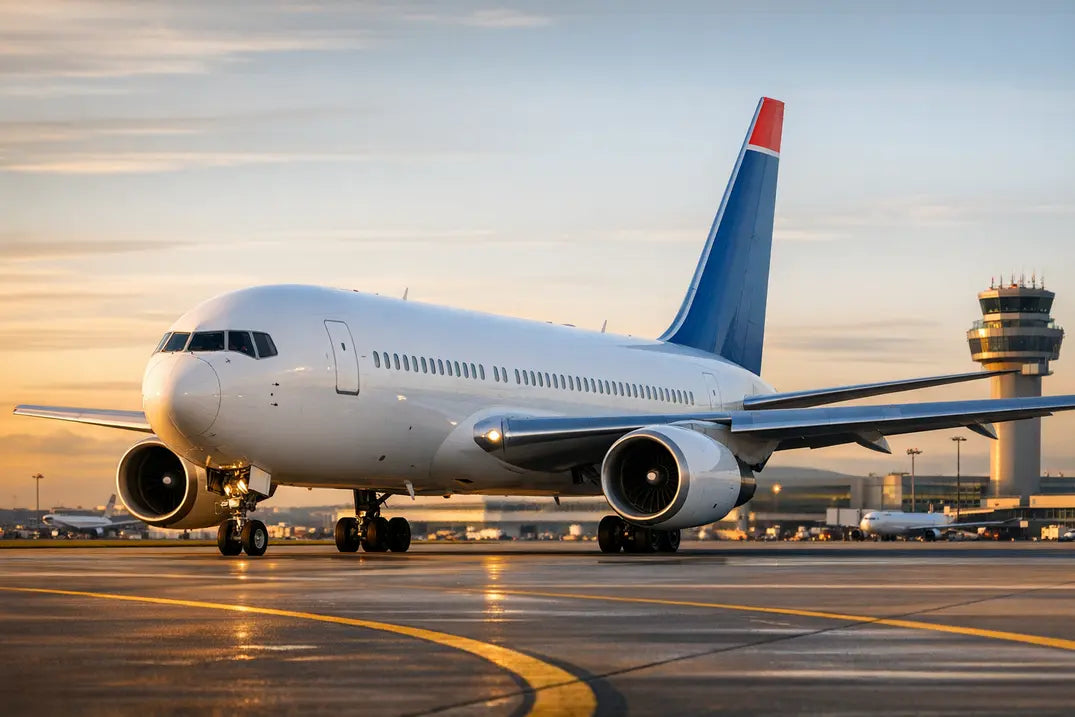
Boeing 767-200ER history, launch, development and what set it apart
Programme origins and development milestones
The Boeing 767-200ER is the extended range version of the original 767-200, created to extend the 767-200 mission profile while retaining the same basic airframe size. It was aimed at operators needing longer range performance and payload capability than the baseline 767-200 could provide.
Boeing launched the 767 programme with a major airline commitment: July 1978 brought United Airlines’ order for 30 767-200s, assembly began in July 1979, and the prototype first flew on September 26, 1981. The initial 767-200 gained US Federal Aviation Administration certification in July 1982, was delivered to United on August 19, 1982, and entered service on September 8, 1982. Within months, Boeing was already developing more capability: the 767-200ER was first ordered by Ethiopian Airlines in December 1982 and entered airline service in 1984, combining extra fuel capacity with higher load capability. Its extended range credentials were underlined in 1988 when an Air Mauritius 767-200ER set a long distance record for a commercial twin engine jet on a flight from Halifax to Port Louis, covering 10,042 miles (16,162 km). Source: Encyclopaedia Britannica.
Industrialisation and delivery were led by Boeing Commercial Airplanes, with 767 final assembly at Everett, Washington. In airline operations, FlightGlobal records the 767-200ER beginning revenue service with Ethiopian Airlines in May 1984. That combination of long range and modest capacity helped keep the short fuselage 767 relevant alongside later, larger derivatives such as the 767-300ER and 767-400ER. Source: FlightGlobal 767 programme notes.
As the family matured, Boeing kept the Boeing 767-200ER relevant through incremental cabin and systems upgrades. A clear example came on November 10, 2000, when Continental Airlines took delivery of its first 767-200ER featuring the 777 style interior that had been introduced to the 767 line with the 767-400ER. Boeing noted that certifying this new interior on the 767-200 required additional FAA flight and ground testing, and quoted a 767-200ER range of 6,615 nautical miles (12,250 km). Source: Boeing media release.
For technical reference, Boeing publishes airport planning data for the 767 family through its Airplane Characteristics for Airport Planning library, used by airports and operators for infrastructure compatibility work. On the regulatory side, the 767 series is approved under FAA type certification, referenced in official publications such as the US Federal Register with Type Certificate No. A1NM for the Boeing 767 series. See: Federal Register notice.
What differentiates the Boeing 767-200ER from nearby variants
In simple terms, the Boeing 767-200ER keeps the baseline 767-200 fuselage size but is configured to fly substantially farther. Compared with the non ER 767-200, the extended range model’s additional fuel capability supports longer stage lengths and enables higher payload capability on missions that would otherwise be payload limited.
The closest later passenger derivatives, the 767-300 and 767-300ER, achieve their additional capacity primarily through a longer fuselage. The 767-200ER therefore remained attractive where demand did not justify the stretch, but route economics still benefited from a twin aisle aircraft with long range and belly cargo capability. Boeing has described the 767-200ER as the smallest member of the 767 family, which helps explain its niche on long haul routes that are too thin for larger widebodies.
Operationally, the variant sits within the Boeing 767 type rating framework, so introducing it into an airline fleet is as much about training and standardisation as it is about performance. For background on how training is delivered in practice, including the responsibilities of a type rating instructor, see this overview of the TRI role.
Variant identifiers that are commonly associated with the Boeing 767-200ER include:
- Extended range configuration with extra fuel capacity, enabling longer flight ranges.
- Higher load capability than the baseline 767-200 in long range missions.
- Range quoted by Boeing of 6,615 nautical miles (12,250 km).
- Marketed by Boeing within the 180 to 250 seat twin aisle segment, and described as the smallest passenger member of the 767 family.
- Early programme milestones: first order in December 1982 and entry into airline service in 1984.

A Delta Air Lines Boeing 767-300 aircraft, registered as N130DL, is shown taking off against a clear blue sky, with its landing gear partially retracted.
Boeing 767‑200ER technical specifications and systems highlights
The Boeing 767‑200ER is the extended range development of the 767‑200, tuned for medium and long haul missions where twin engine economics and ETOPS capability are valuable. In Boeing’s 767 airplane characteristics for airport planning (Rev K), the 200ER stands out mainly through higher certified weights (maximum takeoff weight up to 395,000 lb) and greater usable fuel (up to 24,140 US gal), compared with the 767‑200 figures of 315,000 lb and 16,700 US gal.
Technically, the 200ER keeps the same two engine widebody concept, but the higher weights move the aircraft’s performance envelope: more brake energy on rejected takeoffs, higher climb fuel flow in the initial segment, and a stronger dependence on thrust rating when departing hot and high. For pilots and engineers, the most useful performance conversations start with weight capability, fuel capacity, and engine model rather than a single headline range figure.
- Dimensions: wingspan 47.60 m, length 48.50 m, height 15.90 m (see SKYbrary B762 aircraft data).
- Maximum design takeoff weight (MTOW): up to 395,000 lb (179,169 kg) (Boeing airport planning data).
- Maximum design taxi weight: up to 396,000 lb (179,622 kg).
- Maximum design landing weight: up to 300,000 lb (136,077 kg).
- Maximum design zero fuel weight: up to 260,000 lb (117,934 kg).
- Typical operating empty weight (OEW): about 181,130 to 181,610 lb (82,159 to 82,376 kg).
- Maximum structural payload: up to 78,500 lb (35,607 kg).
- Usable fuel (maximum): 24,140 US gal (91,379 L), equivalent to 161,738 lb (73,378 kg).
- Cruise and ceiling (indicative): Mach 0.80 cruise, ceiling FL430 (see B762 aircraft data).
- Engine options and thrust class: Pratt & Whitney PW4000‑94 (52,000 to 62,000 lbf thrust class) and GE Aerospace CF6‑80C2 (52,200 to 61,960 lbf maximum sea level power); Boeing also lists Rolls‑Royce RB211‑524G powered configurations in 767‑200ER performance charts.
Systems and handling highlights
Within the 767 family, Boeing highlights several technology milestones including the first two crew flight deck on a widebody, early adoption of carbon fibre brakes, and early 120 and 180 minute ETOPS approvals. For the 767‑200ER operator, these themes translate into a cockpit and dispatch philosophy built around disciplined procedures, fuel planning, and robust diversion strategy, with brake energy and cooling considerations becoming more prominent at the higher certified weights.
Boeing’s airport planning manual also lists a single point hydraulic service connection and a total system capacity of 80 US gal (303 L), with a 150 psig fill pressure. While not a handling parameter in itself, it underlines the degree to which hydraulics are central to widebody system redundancy and the practicalities of line maintenance and turnaround servicing.
On PW4000 powered aircraft, full authority digital electronic control supports consistent thrust setting and provides a foundation for modern fault monitoring and troubleshooting. For pilots planning an airline career path towards widebody types, regulatory age constraints are summarised in this pilot age limits overview.
Published performance numbers for the 767‑200ER can vary substantially because operators choose different engine and weight configurations, cabin layouts and optional equipment, and because quoted figures may assume different atmospheric standards, runway slopes, contamination levels, or reserve fuel policies. A meaningful comparison therefore specifies the weight used, the engine model and thrust rating, and whether the figure represents still air cruise, long range cruise, or a dispatch range with reserves.
Engines on the 767‑200ER: PW4000 and CF6 families
Pratt & Whitney PW4000‑94: Pratt & Whitney states that the PW4000 94 inch fan engine covers the 52,000 to 62,000 lbf thrust class and uses service proven technologies including full authority digital electronic control, with 180 minute ETOPS approval (PW4000‑94 engine overview). A company milestone note reports more than 35 years of operational experience and over 150 million flight hours, and places the engine across Boeing 747 and 767 fleets, as well as MD‑11, Airbus A300 and A310, and the KC‑46A (PW4000‑94 milestone).
GE Aerospace CF6: GE notes that the CF6 family began with the CF6‑6 (40,000 lbf) selected by United Airlines and American Airlines in 1968 for the DC‑10 Series 10, evolved through the CF6‑50 for the DC‑10 Series 30 and later the Airbus A300 and Boeing 747, and that the CF6‑80A was selected to power the Boeing 767 and Airbus A310 (CF6 engine family). In GE’s published comparison table, the CF6‑80C2 is listed with 52,200 to 61,960 lbf maximum sea level power, about 106 in maximum diameter, and an overall pressure ratio range of 27.1 to 31.8 at max power. GE also positions the CF6 as a major widebody freighter conversion engine, emphasising durability, reliability, and used material availability for maintenance planning.
Rolls‑Royce RB211 option: Boeing performance charts for the 767‑200ER also cover airframes equipped with Rolls‑Royce RB211‑524G engines, reflecting that the type was delivered with multiple powerplant options. Regardless of engine choice, the practical differences seen by crews come down to installed thrust rating, specific fuel consumption, and the maintenance ecosystem, which then feed directly into payload range planning and cost per trip.
Comparison of Boeing 767 and 787 Widebody Aircraft
Scroll horizontally to see more
| Parameter | Boeing 767-200ER | Boeing 767-300ER | Boeing 767-400ER | Boeing 787-8 |
|---|---|---|---|---|
| Entry into service | 1984 | 1988 | 2000 | 2011 |
| Engines | 2 × GE CF6-80C2 | 2 × GE CF6-80C2 | 2 × GE CF6-80E1 | 2 × GE GEnx-1B |
| Length | 48.5 m | 54.9 m | 61.4 m | 57.0 m |
| Wingspan | 47.6 m | 47.6 m | 52.6 m | 60.1 m |
| Height | 15.9 m | 15.9 m | 15.9 m | 17.0 m |
| Typical seating and layout | 3-class: 180–220 passengers | 3-class: 210–260 passengers | 3-class: 240–290 passengers | 3-class: 240–290 passengers |
| MTOW | 179 t | 187 t | 204 t | 228 t |
| Range | 6,600 nm | 7,000 nm | 5,600 nm | 7,300 nm |
| Cruise speed | 0.80 Mach | 0.80 Mach | 0.80 Mach | 0.85 Mach |
| Service ceiling | 43,000 ft | 43,000 ft | 43,000 ft | 43,000 ft |
| Program note | Original extended-range widebody twinjet for medium-long haul routes | Stretched-fuselage version with increased capacity and range | Longer advanced variant with raked wingtips and updated avionics | Modern composite successor with superior efficiency and range |
Scroll horizontally to see more
This table compares the specifications of Boeing 767 variants against the newer Boeing 787-8. The 787-8 offers the highest range at 7,300 nm and the most efficient engines, while the 767-300ER balances range and capacity. The 767-400ER has the longest fuselage but shorter range than the 767-300ER. Overall, the 787-8 stands out with modern design and advanced performance.
Boeing 767‑200ER operations: routes, missions and airlines worldwide
Designed as the extended range member of the early 767 family, the Boeing 767-200ER is often chosen when long haul capability is needed without the passenger volume of larger widebodies. Boeing cites a range of 6,615 nautical miles (12,250 km), making thin intercontinental city pairs feasible. In manufacturer planning data, a representative mixed class cabin is 216 seats (18 First plus 198 Economy) with an FAA exit limit of 255 in a one class layout, while the lower deck provides 3,070 cubic feet (86.9 m³) for baggage and freight.
Utilisation usually follows long haul patterns: one out and back rotation within 24 hours, with value generated mainly when airborne. GE Aerospace reports that US Airways operated its Boeing 767-200ER fleet on transatlantic routes with an average daily utilisation of more than 11 hours, underlining the productivity expected from a schedule driven widebody. As passenger fleets have retired, many Boeing 767-200ER airframes have moved into freighter conversions, shifting use towards night operations and rapid ramp turnarounds.
Operationally, the Boeing 767-200ER fits well in hub and spoke networks and in market testing: it can open new long distance routes from secondary airports, or protect frequency from major hubs when demand is seasonal. Challenges for operators include ETOPS dispatch discipline for overwater sectors, ageing airframes, and a fuel burn disadvantage versus newer generation twins, making maintenance planning and weight control critical. Boeing has also highlighted a common type rating across the Boeing 757 and 767 family, which supports flexible crew assignment. Airline selection processes often probe this operational context; structured practice is available via this mock interview resource.
Where the Boeing 767-200ER operates
Passenger Boeing 767-200ER flying is now niche, but the variant retains a global footprint through historic fleets, VIP operators and airframes later converted for cargo. In North & South America, it became a workhorse for hub based long haul services and transatlantic schedules. In Europe, it appeared in leisure charter fleets and at smaller network airlines seeking true intercontinental range without moving up to larger widebodies. In Asia, it supported long overwater missions and high demand services linking the Middle East and Central Asia with Europe and North America. In Africa, airlines used the type to connect capitals and islands to Europe and Asia, matching modest demand with widebody capability.
Across all regions, typical missions combined passenger revenue with belly cargo, and operators used the aircraft to keep frequency high when demand was insufficient for larger types. Where airframes remain active today, schedules vary widely, from long haul passenger sectors to multi stop logistics after conversion.
- Europe Britannia Airways used high density Boeing 767-200ERs for long haul leisure flying from UK bases. LOT Polish Airlines and Malev Hungarian Airlines used the type for long haul services where passenger volumes favoured a smaller twin aisle aircraft. Comlux shows the VIP side of the platform, operating 767-200ER aircraft configured for charter missions rather than scheduled airline service.
- North & South America Continental Airlines introduced the Boeing 767-200ER for international growth from Newark, with Boeing noting roles in services to Europe and South America. US Airways flew a transatlantic 767-200ER fleet with reported average daily utilisation above 11 hours. Delta Air Lines used the 767-200 family for transcontinental growth and later brought extended range aircraft into transatlantic service before retiring its 767-200 fleet in 2006. After consolidation, United Airlines inherited 767-200ER aircraft through the Continental merger.
- Asia El Al Israel Airlines was an early operator, using the Boeing 767-200ER to extend twin engine long haul service on North Atlantic sectors. Kuwait Airways acquired the type for longer range international missions from the Gulf. Kazakhstan Airlines is another historic customer associated with the 767-200ER, using it on international routes from Central Asia.
- Africa Ethiopian Airlines was the first airline to order the Boeing 767-200ER, using it to expand long haul capability. Air Mauritius took delivery of two 767-200ERs in April 1988 and used them on long haul services from Mauritius. Air Zimbabwe has operated the type in passenger service, and LAM Mozambique Airlines is another African operator historically associated with the 767-200ER.
Typical seating and cabin layouts
Cabin density on the Boeing 767-200ER spans a wide range. Boeing airport planning data lists a representative mixed class cabin of 216 seats and an FAA exit limit of 255 in a one class configuration; it also notes that 290 seats are possible with a second overwing exit door option, a useful reference point when comparing high density charter layouts with lower density network cabins.
Premium heavy layouts can sit well below 200 seats. Boeing press releases covering Continental Airlines deliveries describe 174 passengers in two classes (25 BusinessFirst plus 149 economy), illustrating the space trade between premium seating, galleys, and payload margin on long range routes. In most passenger fleets, economy seating remains seven abreast, with the aircraft often chosen specifically for its balanced cabin comfort and widebody boarding speed.
This video presents the five passenger variants of the Boeing 767, highlighting the evolution and diversity of this iconic aircraft that has seen over 1300 units produced, with cargo models still in demand today.
Boeing 767-200ER safety record and how safe this airliner is overall
Boeing 767-200ER is the extended range version of the original 767-200 twin engine widebody. It entered airline service in 1984 and has accumulated more than four decades of operations on medium and long range routes, later shifting heavily into cargo and special mission roles. Boeing delivered 121 767-200ERs, making it a relatively small subfleet inside the wider 767 programme. Flight exposure is therefore often discussed at family level: in a 1998 767-200ER order announcement, Boeing noted the 767 fleet was flying almost 1,700 trips (flight cycles) per week across the North Atlantic, illustrating the large operational base behind the type’s safety record. Against that kind of utilisation, serious accidents involving the 767-200ER and closely related 767-200 subvariants are comparatively rare, and safety lessons have mainly centred on fuel management, security, and maintenance driven fire risks rather than any single inherent handling issue.
Notable accidents and the safety changes that followed
- Air Canada Flight 143, 1983 (767-200) experienced fuel exhaustion after a fuel quantity indication problem and a miscalculated fuel uplift during unit conversion. The aircraft was landed safely, and the incident became a widely used reference for disciplined fuel planning. Subsequent practice emphasised clearer fuel quantity procedures, independent cross checks between cockpit and ground calculations, and training that treats dispatch deviations and manual measurement workarounds as high risk tasks (see the FAA lessons learned summary).
- Ethiopian Airlines Flight 961, 1996 (767-200ER) ended in a ditching after an unlawful interference event that forced the flight to continue until fuel was exhausted. The primary drivers were security and human factors rather than a technical limitation of the Boeing 767-200ER airframe. The long term response across aviation has included progressively stronger cockpit security measures, improved crew training in threat and error management, and harmonised international approaches to preventing and responding to cockpit intrusion (overview in the Aviation Safety Network record).
- ABX Air Flight 1611, 2008 (767-200 freighter) was substantially damaged by a ground fire before engine start. The NTSB investigation identified vulnerabilities involving conductive supplemental oxygen hoses and inadequate separation from electrical wiring, allowing an electrical fault to initiate and accelerate a fire. The resulting recommendations and follow on actions strengthened attention to oxygen system materials, wiring separation practices, and detection philosophy in cargo operations.
- Dynamic International Airways Flight 405, 2015 (767-200ER) experienced a fuel leak and fire during taxi after maintenance did not secure a fuel line coupling as required, and the event also highlighted the importance of coordinated evacuation decision making between cockpit and cabin. The public NTSB docket illustrates the kinds of improvements that typically follow: tighter maintenance quality assurance, clearer sign off for critical fuel system tasks, and renewed training focus on communication and evacuation procedures.
How safe is the Boeing 767-200ER?
In normal operations, the Boeing 767-200ER benefits from a conventional transport category safety philosophy: redundancy in key systems, robust performance margins for engine out scenarios, and an operating framework built on standard operating procedures, checklists, dispatch requirements and recurrent simulator training. Long range twin engine routes are conducted under extended operations approvals, adding reliability tracking, additional maintenance requirements and strict diversion planning. Put simply, the safety of any mature widebody is a product of design, maintenance and operational discipline working together. When safety is viewed against traffic volume, commercial accidents are rare across the industry: IATA recorded 40.6 million flights in 2024 and an all accident rate of 1.13 per million flights (IATA 2024 Safety Report). The 767-200ER’s long service history sits within this broader pattern of continuous improvement, where lessons from incidents translate into better procedures, training, and regulatory oversight. For readers comparing safety across very different missions and designs, the regional BAe 146-200 provides an interesting contrast in operating environment. Overall, aviation remains one of the safest modes of transport.
01 What is the typical range of a Boeing 767-200ER and what routes is it suited for?
The Boeing 767-200ER has a maximum range of approximately 6,587 nautical miles (12,200 kilometers) with maximum fuel and payload, making it ideal for transatlantic and long-haul international routes. The aircraft became the first 767 to complete a nonstop transatlantic flight and can carry 181 passengers in a typical three-class configuration over these extended distances. This range capability makes it well-suited for connecting major international hubs across the Atlantic and other long-range markets.
02 How many passengers does the Boeing 767-200ER typically carry?
The Boeing 767-200ER typically seats between 181 and 245 passengers depending on the cabin configuration. A standard three-class layout carries 181 passengers, while high-density seating arrangements can accommodate up to 245 passengers. The fuselage length of 159 feet (48.5 meters) and twin-aisle configuration provide a balanced cabin environment for these capacity levels.
03 How fuel-efficient is the Boeing 767-200ER compared to similar aircraft?
The Boeing 767-200ER burns approximately 1,176 to 1,766 gallons per hour depending on cruise conditions and engine type, with fuel consumption around 4,450 kilograms per hour at economic cruise speeds. The aircraft achieves approximately 0.19 kilometers per kilogram of fuel at cruise altitude, making it reasonably efficient for its class, though it has been noted as having a relatively slower long-range cruise speed of Mach 0.80 compared to some competing jetliners. The 767-300ER, a larger variant, eventually overshadowed the 200ER due to superior fuel efficiency and capacity.
04 What is the cruise speed and maximum altitude of the Boeing 767-200ER?
The Boeing 767-200ER has a maximum cruise speed of approximately 885 kilometers per hour (Mach 0.82) at 10,000 meters altitude, with an economical cruise speed of 858 kilometers per hour (Mach 0.80). The aircraft has a service ceiling of 12,800 to 13,140 meters (approximately 43,100 feet), allowing it to operate above most weather systems and cruise efficiently at typical international flight levels. The maximum operating speed is Mach 0.86 at 9,000 meters.
05 What engines power the Boeing 767-200ER and what are their specifications?
The Boeing 767-200ER is powered by two turbofan engines, typically either General Electric CF6-80A2 or Pratt & Whitney JT9D-7R4E engines, each producing approximately 48,000 to 62,020 pounds of thrust depending on the specific variant. These twin-engine configuration provides redundancy and reliability for long-distance flights over oceans. The engines deliver sufficient power for a rate of climb of 2,000 feet per minute during initial climb and 4,300 feet per minute in optimal conditions.
06 What takeoff and landing distances does the Boeing 767-200ER require?
The Boeing 767-200ER requires approximately 8,150 feet (2,480 meters) of runway for takeoff at maximum takeoff weight under standard sea-level conditions, and approximately 4,921 feet (1,500 meters) for landing. These relatively moderate runway requirements made the aircraft compatible with a wide range of international airports, contributing to its appeal for long-haul operations. The aircraft can operate from airports with adequate infrastructure while maintaining its impressive range capability.