

Boeing 757-200F: History, Program Launch, and Development of the Freighter
The Boeing 757-200F is the dedicated all-cargo member of the 757 family, a narrow-body, twin-engine airliner manufactured by Boeing Commercial Airplanes at its Renton, Washington plant. The 757 programme itself was announced in early 1978 as a fuel-efficient replacement for the ageing Boeing 727, sharing the same fuselage cross-section as the 707, 727 and 737. Launch customers Eastern Air Lines and British Airways placed orders on 31 August 1978, and the baseline 757-200 passenger variant completed its maiden flight on 19 February 1982. The FAA granted type certification on 21 December 1982, and the aircraft entered revenue passenger service with Eastern Air Lines in January 1983.
With a proven airframe already in airline service, Boeing turned its attention to the express-parcel market. The 757-200PF (Package Freighter) programme was formally announced on 30 December 1985, following a launch order from UPS Airlines for 20 aircraft plus 15 options. UPS needed a modern, efficient freighter to replace older types on its medium-haul overnight parcel network, and the 757-200 airframe offered the right combination of range, payload and operating economics. The first factory-built 757-200PF was rolled out at Renton on 15 July 1987 and completed its first flight on 11 August 1987. UPS received its initial two aircraft on 16-17 September 1987, marking the variant's entry into commercial freight service. In total, 80 factory-built 757-200PF freighters were produced before 757 production ended in October 2004, with the last airframe delivered on 28 November 2005. UPS took delivery of roughly 75 of those 80 aircraft, making it by far the dominant operator of the factory-built freighter.
Beyond the production freighter, Boeing launched the 757-200SF (Special Freighter) passenger-to-freighter conversion programme in 2000, with DHL as the launch customer for 44 aircraft. The first 757-200 arrived at Boeing's Wichita, Kansas modification centre in July 2000, and the initial converted 757-200SF entered service with DHL in early 2001. Conversion work included removal of all passenger furnishings, installation of a large main-deck cargo door on the forward port fuselage, reinforcement of floor beams for pallet loads, and fitment of a powered cargo-handling system with roller tracks and locks. Independent conversion houses soon followed: Precision Aircraft Solutions (formerly Precision Conversions) developed the 757-200PCF (Precision Converted Freighter), which received FAA certification in 2005 and had delivered more than 120 aircraft by April 2020. ST Aerospace (ST Engineering) began an eight-year programme in 2007 to convert 119 passenger 757-200s, and Israel Aerospace Industries (IAI) also performed batches of conversions. These programmes gave carriers such as FedEx, DHL, Icelandair Cargo and many ACMI operators access to economical freighter capacity. Today, more than 320 converted 757 freighters are in active cargo service worldwide, alongside the original factory-built PF fleet. For a look at how different Caribbean and international carriers structure their operations around aircraft like the 757, the wider airline ecosystem provides useful context.
What Distinguishes the Boeing 757-200F from Other 757 Sub-Variants
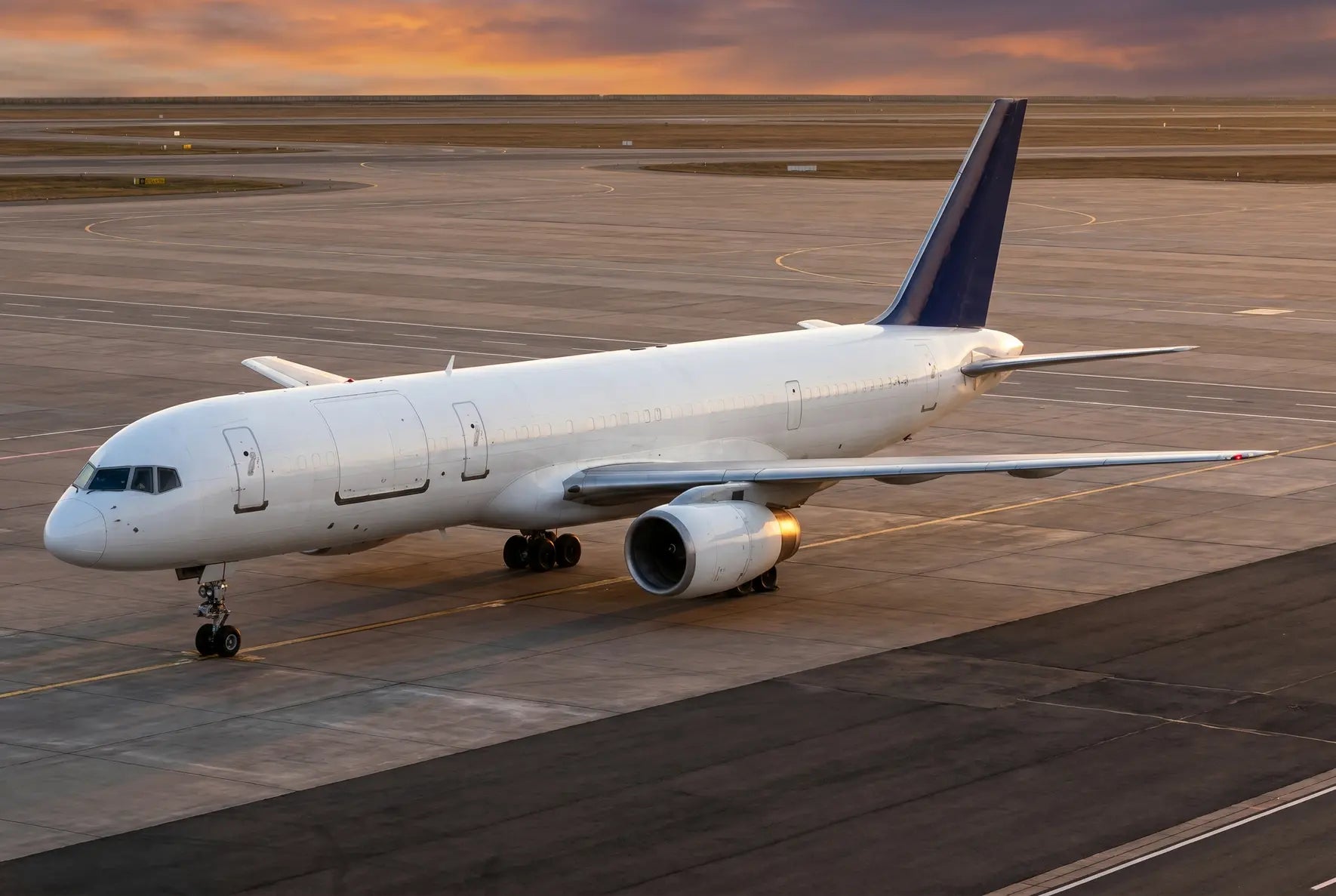
The 757-200F designation is commonly used as an umbrella term covering both the factory-built 757-200PF and the converted 757-200SF and 757-200PCF. Although all three share the same basic airframe and engines, they differ in meaningful ways. The factory 757-200PF was built from new without cabin windows, passenger doors or interior furnishings; it features only a small crew-entry door adjacent to the main-deck cargo door, and its fuselage skin is smooth with no window cut-outs. Converted 757-200SF aircraft retain the structural traces of their original cabin windows (plugged and painted over) and keep the two forward passenger doors plus the vestibule area, reducing usable main-deck positions from 15 to 14 full-size pallets plus one LD-3. The 757-200PCF from Precision replaces the forward passenger doors with a PF-style crew door, restoring 15 full main-deck pallet positions and giving the nose area a cleaner, factory-freighter appearance.
Key variant identifiers for the Boeing 757-200F family, verified against Boeing's official freighter specification sheet, include:
- Engines: Rolls-Royce RB211-535E4B or Pratt & Whitney PW2037/PW2040, each producing approximately 36,600 to 43,100 lbf of thrust.
- Maximum take-off weight (MTOW): 250,000 lb (113,400 kg) or 255,000 lb (115,660 kg) depending on engine and weight option selected.
- Maximum structural payload: approximately 87,700 lb (39,800 kg) for the factory PF; converted variants vary by STC.
- Total cargo volume: over 8,400 ft³ (238 m³), comprising roughly 6,600 ft³ on the main deck and 1,830 ft³ in the lower holds.
- Main-deck cargo door: approximately 134 in x 86 in (3.40 m x 2.18 m), hydraulically operated, forward port side.
- Range at maximum payload: approximately 2,935-3,150 nmi (5,435-5,830 km), depending on mission rules and MTOW option.
- Cockpit: two-crew EFIS glass flight deck with high commonality to the Boeing 767, reducing training costs for mixed-fleet operators.

A Delta Air Lines Boeing 757-200 aircraft is seen on final approach to Boston Logan International Airport. The plane, identifiable by its distinctive livery, flies against a clear blue sky.
Boeing 757-200F Technical Specifications, Systems Highlights and Engine Options
The Boeing 757-200F is a dedicated, factory-built freighter variant of the narrow-body 757-200, designed from the outset for high-volume package and cargo operations. Sharing the same fuselage cross-section, wing and empennage as the passenger model, the 757-200F trades seats for a reinforced main-deck cargo floor, a large forward port-side cargo door and a 15-pallet main-deck capacity. The result is a medium-range freighter that combines the 757 family's efficient high-bypass engines and proven systems with the structural payload capability required by integrators such as UPS and FedEx. Its relatively narrow fuselage keeps aerodynamic drag low, while powerful engine options in the 38,000-43,000 lbf thrust class give it strong runway performance, an important trait for time-critical freight networks that rely on shorter regional runways.
The design philosophy behind the 757-200F balances payload against range. At maximum structural payload the aircraft can cover roughly 2,900 nmi, but lighter loads extend that figure beyond 3,100 nmi. With a maximum takeoff weight of up to 255,000 lb depending on customer option, the type sits in a sweet spot between light regional feeders and larger widebody freighters. Its commonality with the passenger 757-200 and the Boeing 767 flight deck allows operators to benefit from shared crew type ratings, spare-parts pools and training programs. For aviation professionals looking for a comprehensive reference on aircraft types and their roles, the book Ready for Takeoff offers detailed coverage. In some jurisdictions, you may even deduct the purchase from your taxes as a professional resource.
- Overall length: 47.32 m (155 ft 3 in)
- Wingspan: 38.05 m (124 ft 10 in)
- Height: 13.56 m (44 ft 6 in)
- Main-deck cargo door: approximately 134 in x 86 in (3.40 m x 2.18 m), forward port side, upward-opening
- Main-deck pallet positions: 15 (standard 88 x 125 in containers/pallets)
- Total cargo volume: approximately 8,100-8,400 ft³ (230-240 m³) including lower holds
- Maximum takeoff weight (MTOW): up to 255,000 lb (115,660 kg), with a common option at 250,000 lb (113,400 kg)
- Maximum structural payload: approximately 72,210 lb (32,755 kg) at high-weight option
- Range with maximum payload: approximately 2,900 nmi (5,370 km) at Mach 0.80, extending to roughly 3,150 nmi at reduced payload
- Typical cruise speed: Mach 0.80 (approximately 460 kt TAS at cruise altitude)
- Service ceiling: 42,000 ft (12,802 m)
- Fuel capacity: approximately 11,276 US gal (42,680 L)
- Engines: two Rolls-Royce RB211-535E4 (40,100-43,100 lbf) or two Pratt & Whitney PW2037/PW2040 (38,250-41,700 lbf)
- Avionics baseline: two-crew EFIS glass cockpit with FMS/FMC, dual autopilot, EGPWS, and predictive windshear capability
Systems Architecture and Handling Technology
The 757-200F retains the conventional, mechanically signalled flight-control system common to the entire 757 family. Ailerons, elevators and rudder are cable-operated from the cockpit and hydraulically powered at the surfaces, backed by three independent hydraulic systems, each driven by an engine-driven pump plus electric backups. Spoilers provide roll augmentation in flight and ground lift-dump on landing. This architecture, while not fly-by-wire, has proven highly reliable across decades of intensive freight operations.
Automation centres on the Flight Management Computer integrated with the autopilot and flight director, enabling LNAV/VNAV navigation, performance-based thrust management and ILS-coupled approaches with autoland on suitably equipped aircraft. A 1999 Boeing avionics upgrade package introduced EGPWS with forward-looking terrain display, predictive windshear and GPS-capable FMC options, features widely adopted across the freighter fleet. Braking uses multi-disc wheel brakes on the main gear with an electronic anti-skid system and selectable autobrake modes that deliver preset deceleration rates. Both PW2000 and RB211-535 engines feature full-authority digital engine control (FADEC), which manages thrust limits, engine start sequencing and integration with the FMC for derated and assumed-temperature takeoffs while outputting health-monitoring data for maintenance trending.
Published performance figures for the 757-200F can vary significantly between sources. Differences arise from the specific MTOW option selected at delivery, operator-installed equipment, atmospheric conditions assumed (ISA vs ISA+15, sea level vs elevated airports), runway surface state and the balance between payload and fuel load. Range figures, for instance, assume a stated payload at a given cruise Mach number; adjusting any variable changes the outcome. For this reason, specifications should always be read in context and cross-checked against the aircraft's specific Airplane Flight Manual rather than treated as universal absolutes.
Engine Options: Rolls-Royce RB211-535E4 and Pratt & Whitney PW2000
The 757-200F is certified with two engine families, each with a distinct engineering philosophy. The Rolls-Royce RB211-535E4 is a three-spool, high-bypass turbofan that traces its lineage to the original RB211 developed for the Lockheed L-1011 TriStar in the early 1970s, the first production three-spool engine ever built. The -535E4 variant entered airline service on the 757 in October 1984 and introduced a wide-chord, unshrouded fan that improved fuel efficiency and foreign-object-damage resistance over the earlier -535C. Available at takeoff thrust ratings from 40,100 to 43,100 lbf, the RB211-535E4 became the dominant 757 engine, powering around 59% of all 757s built and equipping 43 of 55 operators. Rolls-Royce highlights a world-record on-wing life exceeding 40,500 hours without removal, a figure nearly double that of competing engines in the class. Beyond the 757, variants of the broader RB211 family power the Boeing 747 (RB211-524), Boeing 767 and Tupolev Tu-204.
The Pratt & Whitney PW2000 series takes a two-spool approach with a notably higher bypass ratio of approximately 6.0:1 compared to the RB211's 4.4:1. The engine originated as the JT10D concept in the late 1970s before being redesigned as the PW2037, which entered service alongside the 757-200 in 1983. The higher-thrust PW2040 (up to 41,700 lbf) followed in 1987, initially selected by UPS for its 757 freighter fleet. Comparative operator studies have shown the PW2000 delivers roughly a 2% fuel-burn advantage over the RB211-535E4 on typical 757 sectors, attributed to its two-stage high-pressure turbine, five-stage low-pressure turbine and higher bypass ratio. The PW2000 family also serves as the basis for the F117-PW-100 military derivative that exclusively powers the Boeing C-17 Globemaster III, while the PW2040 variant equips the U.S. Air Force C-32A VIP transport. Both engine options are ETOPS-180 certified and meet stringent ICAO Chapter 3 and Chapter 4 noise standards with comfortable margins, a factor that keeps the 757-200F welcome at noise-sensitive airports worldwide.
Boeing 757-200F vs 757-200 vs 767-300F vs Airbus A321P2F: Key Specifications
Scroll horizontally to see more →
| Parameter | Boeing 757-200F | Boeing 757-200 | Boeing 767-300F | Airbus A321P2F |
|---|---|---|---|---|
| Entry into service | 2001 | 1983 | 1995 | 2020 |
| Engines | 2 × Rolls-Royce RB211-535E4 or 2 × Pratt & Whitney PW2037 | 2 × Rolls-Royce RB211-535E4 or 2 × Pratt & Whitney PW2037 | 2 × General Electric CF6-80C2 or 2 × Pratt & Whitney PW4060 | 2 × CFM International CFM56-5B |
| Length | 47.3 m | 47.3 m | 54.9 m | 44.5 m |
| Wingspan | 38.1 m | 38.1 m | 47.6 m | 35.8 m |
| Height | 13.6 m | 13.6 m | 15.9 m | 11.8 m |
| Typical seating and layout (short description + approximate passengers) | All-cargo configuration: 15 main-deck pallet positions plus lower-hold containers | 2-class: 178–200 passengers | 2-class: 210–250 passengers | All-cargo configuration: up to 14 main-deck container positions plus belly cargo |
| MTOW | 113 t | 116 t | 186 t | 93.5 t |
| Range | 3,200 nm | 3,900 nm | 3,255 nm | 2,300 nm |
| Cruise speed | 0.80 Mach | 0.80 Mach | 0.80 Mach | 0.78 Mach |
| Service ceiling | 41,000 ft | 42,000 ft | 43,000 ft | 39,000 ft |
| Program note | Factory-built narrow-body freighter derived from the 757-200, optimized for express parcel and medium-haul cargo routes | Baseline 757 passenger variant, serving medium-haul routes with high field performance and later converted into many freighters | Wide-body freighter offering higher payload and volume than the 757, positioned for regional and intercontinental cargo operations | Converted A321 passenger aircraft turned freighter, positioned as a new-generation narrow-body cargo option and 757 replacement on thinner routes |
Scroll horizontally to see more →
The table compares key dimensions, performance and roles of the 757-200F, 757-200, 767-300F and A321P2F. The 767-300F is the largest with the highest MTOW (186 t) and ceiling (43,000 ft), while the A321P2F is smaller and lighter (93.5 t) with the shortest range (2,300 nm). The 757 passenger has the longest range (3,900 nm), and the 757-200F trades some range for dedicated pallet capacity on express cargo routes.
Boeing 757-200F Operations: Typical Routes, Missions and Airlines Worldwide
The Boeing 757-200F was purpose-built for the overnight express-parcel market. Its combination of roughly 87,700 lb (39.8 t) maximum payload, a usable range of about 2,935 nmi (5,435 km) with a full cargo load, and strong short-field performance makes it a natural fit for medium-haul cargo networks. Most operators fly sectors between 400 and 1,600 nmi (roughly 1.5 to 4 hours block time), well below the structural maximum, in order to maximise payload and daily cycles.
Daily utilisation typically falls in the 6 to 10 block-hour range, spread across two to four sectors. Express integrators such as UPS Airlines, FedEx Express and DHL schedule the aircraft predominantly on nighttime hub-and-spoke banks, where parcels are collected from spoke cities, flown to a central sorting hub, and redistributed before dawn. The tight overnight windows and fixed hub-sort schedules, rather than airframe endurance, are the main limiting factor on utilisation.
Outside the integrator world, the Boeing 757-200F also serves point-to-point charter and ACMI (Aircraft, Crew, Maintenance and Insurance) operators, regional e-commerce carriers, and humanitarian organisations. Its ability to use secondary and regional airports with shorter runways gives it an operational edge over larger widebody freighters on thinner routes.
Operational Environments and Challenges
In hub-and-spoke networks, the 757 freighter typically connects secondary cities to major cargo hubs such as Louisville (SDF) for UPS, Memphis (MEM) for FedEx, Leipzig (LEJ) for DHL in Europe, and Shenzhen (SZX) for SF Airlines in Asia. Stage lengths on these feeder routes commonly range from 300 to 900 nmi. On trunk segments between hubs or on transcontinental routes, sectors stretch to 1,200-1,800 nmi.
Operators face several recurring challenges. All Boeing 757-200F airframes are ageing, as production ended in 2004; heavy structural inspections and a gradually thinning parts supply require careful fleet planning. Converted 757-200SF aircraft carry the additional fatigue history of their prior passenger lives. Noise and emission regulations are tightening across Europe and parts of Asia, which may eventually limit night-time access at some airports. Centre-of-gravity management during loading demands precision, especially on short sectors where low fuel weight leaves cargo as the dominant factor. Finally, the emergence of newer converted freighters such as the Boeing 737-800BCF and Airbus A321P2F is gradually challenging the 757-200F on shorter, lighter routes, pushing operators to deploy it where its payload-range sweet spot remains unmatched. Pilots and flight crews seeking to understand the type ratings and career pathways associated with freighter operations can explore resources on pilot recruitment in cargo aviation.
Where the Boeing 757-200F Operates Around the World
The Boeing 757-200F fleet is concentrated in North America and Europe, with a significant and growing presence in Asia. In North America, integrators dominate: UPS Airlines operates around 75 factory-built 757 freighters out of its Louisville Worldport, while FedEx Express flies roughly 90 converted 757-200SF aircraft through Memphis and Indianapolis. Cargojet Airways runs about 16 units on Canadian domestic trunk routes from Hamilton. In Europe, DHL is the principal operator, distributing approximately 36 units across subsidiaries including DHL Air UK, DHL Air Austria and European Air Transport Leipzig, covering intra-European and near-Atlantic routes. Spanish carriers Cygnus Air and Swiftair provide charter and ACMI services, often on behalf of integrators.
In Asia, the 757 freighter has found a second life in the e-commerce boom. SF Airlines in China operates around 43 converted units on domestic express routes, making it one of the largest 757 freighter fleets worldwide. YTO Cargo Airlines and China Postal Airlines add further capacity within China. Blue Dart Aviation in India uses the type for its domestic overnight network. In Africa, no major locally based 757-200F operator exists; the continent is primarily served by European-based carriers such as DHL subsidiaries and Cygnus Air on contract or charter missions into North and West Africa. In South America, dedicated 757 freighter operations are limited, with Amerijet International (based in Miami) providing the main link between the United States, the Caribbean and northern South America.
- Europe - DHL Air UK, DHL Air Austria, European Air Transport Leipzig (all DHL group), Cygnus Air and Swiftair (both Spain), Icelandair Cargo (Iceland), and Aviastar-TU (Russia). These carriers use the 757-200F on intra-European express routes, near-Atlantic cargo services, and ACMI/charter operations for integrators and logistics clients.
- North & South America - UPS Airlines and FedEx Express (United States), Cargojet Airways and Morningstar Air Express (Canada), Air Transport International and Amerijet International (United States). UPS and FedEx run the largest fleets on domestic hub-and-spoke networks, while Cargojet covers Canadian east-west trunk routes. Amerijet extends operations into the Caribbean and northern South America. Asia Pacific Airlines, registered in Guam, connects Micronesia and Hawaii to the wider network.
- Asia - SF Airlines, YTO Cargo Airlines, China Postal Airlines and China Air Cargo (all China), plus Blue Dart Aviation (India). Chinese operators use the 757 freighter on dense domestic trunk routes fuelled by e-commerce growth. Blue Dart, affiliated with DHL, operates a domestic Indian overnight network. Smaller Central Asian operators such as My Freighter and Fly Khiva also fly the type on regional cargo charters.
- Africa - No major Africa-based 757-200F operator is currently active. Cargo services into Africa are provided by European carriers, particularly DHL subsidiaries, Cygnus Air and Swiftair, on contracted or ad-hoc charter missions to North African and West African destinations.
Cabin Configuration and Crew Layout
The Boeing 757-200F is a dedicated freighter and carries no passenger cabin. The entire main deck behind the cockpit area is a cargo compartment fitted with ball-mat rollers and pallet locks for up to 15 standard 88 x 125 in (224 x 318 cm) ULD positions on factory-built 757-200PF aircraft, or typically 14 full-size positions on 757-200SF conversions. Total cargo volume reaches approximately 6,600 ft3 on the main deck plus around 1,830 ft3 in the lower bulk holds, for a combined capacity of roughly 8,400 ft3 according to Boeing's 757-200F technical documentation.
The only seating on board consists of the two flight-crew positions and a small number of supernumerary seats located immediately behind the cockpit, forward of a rigid 9g cargo barrier. A typical layout includes one or two observer jump seats and a double supernumerary bench, giving space for up to four additional occupants besides the two pilots. A compact galley (with oven and hot-cup facilities) and a flushing lavatory are installed in this forward area. There is no dedicated crew-rest bunk, consistent with the aircraft's use on short- and medium-haul sectors that rarely exceed five hours. Further details on the full list of current and historical 757 operators and the Boeing 757 programme history are available for reference.
In this video, watch a SkyGuard Boeing 757-200F in close-up 4K as it lands and departs Belgrade Nikola Tesla Airport, capturing detailed runway action and showcasing one of the airport’s special visitors.
Boeing 757-200F Safety Record: How Safe Is This Freighter?
With 1,050 units built between 1982 and 2004, the Boeing 757 family has accumulated over four decades of commercial service. Across that entire period, the type has recorded approximately ten hull-loss accidents, a rate well below 1% of the total fleet. The 757-200F freighter variants, both the 80 factory-built 757-200PF models and a growing number of passenger-to-freighter conversions (PCF, SF, BDSF), account for only a small fraction of those events. Cargo 757s have been in continuous heavy-cycle operation since the mid-1980s for the production freighters and since the early 2000s for the converted models, with operators such as FedEx, UPS and DHL logging thousands of hours per airframe each year. When placed against this volume of operations, the number of serious safety events specific to the Boeing 757-200F remains remarkably low.
Notable Accidents and Safety Lessons
Although the following events involve different 757-200 sub-variants, they share the same fundamental airframe and systems architecture as the 757-200F, and the safety improvements that followed apply equally to the freighter fleet.
- American Airlines Flight 965 (1995) - A 757-200 struck mountainous terrain near Cali, Colombia, during a night approach after the crew selected an incorrect waypoint in the flight management system. The investigation found that crew navigation errors and delayed response to the ground-proximity warning system were the primary factors. This accident was a major catalyst for the FAA mandate of Terrain Awareness and Warning Systems (TAWS/EGPWS) on all turbine-powered aircraft, replacing older GPWS units with terrain-database-driven alerts that provide earlier and more precise warnings.
- Birgenair Flight 301 (1996) - A 757-200 departed Puerto Plata, Dominican Republic, at night and crashed into the sea shortly after take-off. A blocked pitot tube, likely caused by insect contamination during an extended period of inactivity, produced erroneous airspeed readings. Conflicting cockpit indications led to crew confusion and loss of control. The disaster reinforced industry focus on pitot-static system maintenance, pre-flight contamination checks, and improved training for unreliable airspeed scenarios, lessons that were later embedded in standard operating procedures across the entire 757 fleet including freighter operators.
- Uberlingen mid-air collision (2002) - A DHL 757-200PF cargo aircraft collided at cruise altitude with a Bashkirian Airlines Tupolev Tu-154 over southern Germany. The accident killed both DHL crew members and all 69 occupants on the Tu-154. The investigation by the German BFU found that an understaffed ATC position and conflicting TCAS versus controller instructions were central causes. In response, ICAO and national regulators strengthened ACAS/TCAS procedures, making it mandatory for pilots to follow TCAS resolution advisories immediately, even when they conflict with air traffic control instructions. This change applies to all commercial aircraft, including the 757-200F freighter fleet.
- DHL Aero Expreso runway excursion, Costa Rica (2022) - A 757-200 cargo aircraft suffered a ruptured hydraulic hose due to fatigue on departure from San Jose, disabling the autobrake system, nosewheel steering and several spoiler panels. The crew returned for an emergency landing but lost directional control on the runway; the aircraft broke apart after overrunning the paved surface. Both pilots survived with minor injuries. The event underlined the importance of hydraulic system inspection intervals and emergency handling procedures for freighter crews operating with degraded systems.
How Safe Is the Boeing 757-200F Today?
When measured against the millions of flight cycles the 757 family has completed, the accident rate is extremely low. Most hull-loss events in the type's history were attributed to external factors, human-factor issues or deliberate acts rather than to structural or systems-design shortcomings. The 757-200F benefits from the same fail-safe structural design philosophy, dual-redundant hydraulic systems and modern avionics upgrades that underpin the entire 757 platform. Freighter conversion programmes are certified under stringent supplemental type certificates that mandate reinforced cargo floors, fire-suppression systems and large cargo door integrity testing, adding further layers of oversight. Regulatory bodies including the FAA and EASA continue to issue airworthiness directives that keep the ageing fleet aligned with current safety standards. Operators such as FedEx, UPS and the DHL network follow rigorous standard operating procedures, mandatory crew training cycles and maintenance programmes that meet or exceed manufacturer recommendations. For aviation professionals and enthusiasts looking to understand how airline operational culture affects safety outcomes, exploring the working environment at carriers like Lauda Europe offers useful context. Taken together, the combination of robust design, continuous regulatory oversight and decades of operational learning confirms that aviation, and the Boeing 757-200F within it, remains one of the safest modes of transport available.
01 What is the Boeing 757-200F typically used for and what is its range?
The Boeing 757-200F is a dedicated freighter version of the 757, designed primarily for express parcel, e-commerce, and general cargo operations. With a full payload, its range is typically around 2,900–3,200 nautical miles, allowing non-stop flights on regional and transcontinental routes. Airlines often use it on overnight hub-and-spoke networks where speed and short turnarounds are important. Its performance makes it well suited to medium-haul routes linking major cargo hubs with secondary cities.
02 Which airlines and cargo operators commonly fly the Boeing 757-200F?
The Boeing 757-200F is widely used by express and cargo operators rather than passenger airlines. Major users include FedEx Express, UPS Airlines, and DHL-related carriers, along with several regional and ACMI cargo operators in Europe, North America, and the Middle East. Many former passenger 757-200s have been converted to freighters, so fleets are a mix of factory-built 757-200F aircraft and passenger-to-freighter conversions. This broad operator base helps ensure good global support and parts availability.
03 How does the Boeing 757-200F compare with similar freighters like the 737-800F and 767-300F?
The Boeing 757-200F sits between narrowbody freighters such as the 737-800F and widebody freighters like the 767-300F in both capacity and range. It typically offers a higher payload and longer range than a 737-based freighter, while being more economical on medium-density routes than a larger 767. Its strong runway performance allows operations from shorter or hot-and-high airports where some widebodies would be more limited. For many operators, it fills a useful niche for medium-haul, high-volume express freight.
04 What is the cargo capacity and main deck layout of the Boeing 757-200F?
The Boeing 757-200F main deck is configured for standard cargo pallets and containers, usually accommodating around 15 standard 88 x 125 inch ULD positions on the main deck plus additional bulk cargo in the lower holds. Total structural payload is typically in the 34–39 tonne range, depending on the specific variant and operator configuration. The aircraft features a large main deck cargo door on the left side forward of the wing, along with powered loading systems to speed up ground handling. This standardized layout makes the 757-200F easy to integrate into established cargo hub operations.
05 Does the Boeing 757-200F carry any passengers, and what is the onboard environment like for crew?
The Boeing 757-200F is designed as a freighter and does not carry fare-paying passengers, although it has a small crew compartment at the front of the aircraft. This area usually includes cockpit seats, jumpseats, basic galley facilities, and rest seats or a small rest area for flight and loadmaster crew. Noise and vibration levels in the crew area are comparable to a passenger 757 near the front of the cabin, but the rest of the fuselage is an open cargo bay. For travellers, the main relevance is that parcels and freight, not passengers, are transported on this type.
06 What is notable about the Boeing 757-200F’s performance and safety record?
The Boeing 757-200F benefits from the strong performance characteristics of the 757 family, including powerful engines and efficient aerodynamics that provide good climb rates and reliable operations from demanding airports. Its design is based on the proven passenger 757, which has a long operational history and a solid safety record in worldwide service. Freighter operators typically pair the aircraft with strict maintenance programs and modern avionics upgrades, supporting reliability on intensive overnight schedules. For many cargo airlines, the 757-200F remains a trusted workhorse in medium-haul freight fleets.