

Boeing 747-8F: History and Development of Boeing's Final Jumbo Freighter
The Boeing 747-8F represents the final and most capable freighter version of the iconic 747 family, a lineage that began in the late 1960s when Boeing pioneered the widebody airliner. By the early 2000s, the ageing 747-400 needed a successor that could compete in the very large aircraft segment against the newly launched Airbus A380, while preserving the 747's unique advantage: a hinged nose cargo door for oversized freight. The 747-8F was Boeing's answer, blending the proven 747 fuselage with technology developed for the 787 Dreamliner program.
Boeing formally launched the 747-8 family on 14 November 2005, with the freighter as the lead model. The launch order comprised 18 aircraft, split between Cargolux and Nippon Cargo Airlines. Firm configuration of the freighter was completed on 31 October 2006, and the first aircraft entered final assembly at the Everett, Washington plant in August 2008.
The program was not without difficulty. On 14 November 2008, Boeing announced a schedule delay, one of several that pushed the timeline back amid engineering and supply-chain pressures shared with the concurrent 787 effort. Flight testing eventually began when the prototype, registered N747EX, made its first flight on 8 February 2010 from Paine Field. The FAA and EASA granted type certification for the freighter on 19 August 2011. Boeing delivered the first production 747-8F, registration LX-VCB, to launch customer Cargolux on 12 October 2011, with revenue service beginning shortly after.
What sets the Boeing 747-8F apart
The 747-8F differs from earlier and later 747 models in several defining ways. Compared with the 747-400F, it features a fuselage stretched by 5.6 m (18 ft 4 in) for a total length of 76.3 m (250 ft 2 in), adding four main-deck and three lower-deck pallet positions and delivering roughly 16% more cargo revenue volume. It also introduces an entirely new wing with raked wingtips derived from 787 aerodynamic research, replacing the older wing's high-lift devices with a simpler flap system. Older 747-400 freighters used CF6, PW4000 or RB211 engines; the 747-8F instead carries four General Electric GEnx-2B67 turbofans, each rated at about 66,500 lbf (296 kN), for lower fuel burn, reduced noise and improved emissions.
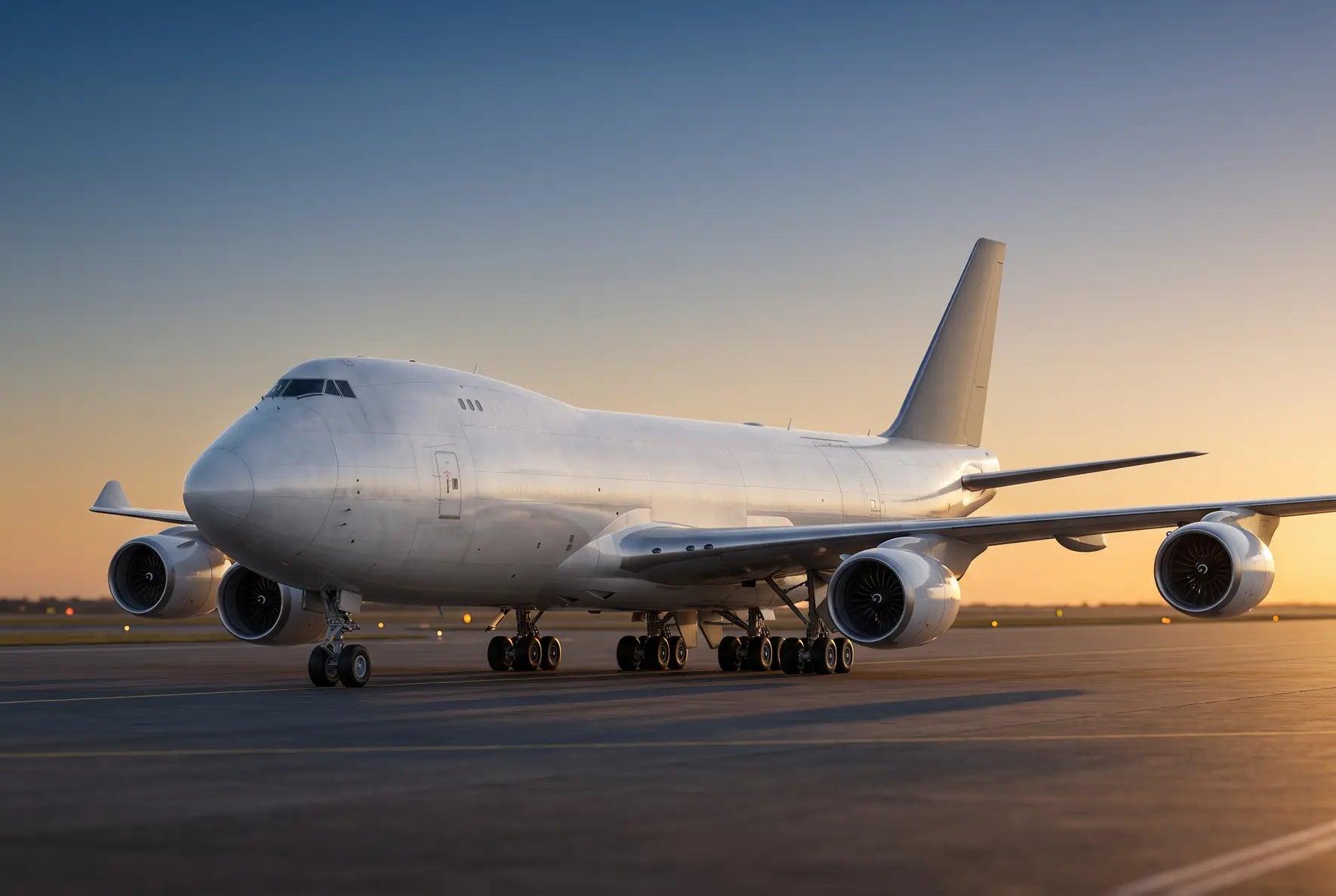
Against the passenger 747-8 Intercontinental (747-8I), the freighter retains the shorter upper deck required to preserve the nose-loading cargo door, whereas the passenger model uses a longer upper deck for additional seating. Both variants share the same wing, engines and modernized flight deck, but the freighter is optimized for maximum payload and shorter range rather than long-haul passenger endurance. Readers interested in earlier Boeing freighter heritage can explore the Boeing 707-320C, an early jet that helped establish the company's cargo-conversion legacy.
The main variant identifiers of the 747-8F are summarised below:
- Engines: four General Electric GEnx-2B67 turbofans, about 66,500 lbf (296 kN) each.
- Wing: new 787-influenced design with raked wingtips and a wingspan of 68.4 m (224 ft 5 in).
- Length: 76.3 m (250 ft 2 in), a 5.6 m stretch over the 747-400F.
- Maximum takeoff weight: approximately 447,700 kg (987,000 lb).
- Payload: roughly 137 to 140 t of structural cargo capacity.
- Systems: fly-by-wire spoilers and a modernized avionics suite shared with the 777 and 787 families.
The 747-8F went on to become the last 747 variant in production. The final 747 rolled out and was delivered in January 2023, closing more than five decades of jumbo-jet manufacturing, with the last airframes built as freighters for Atlas Air. Today the type serves major cargo carriers including Cargolux, Lufthansa Cargo, Korean Air Cargo and Atlas Air, remaining a mainstay of global heavy-freight logistics.

A Lufthansa Boeing 747-8i aircraft is captured in flight against a clear blue sky. The plane, showing its landing gear extended, exhibits the distinctive livery of the airline.
Boeing 747-8F Technical Specifications and Systems Overview
The Boeing 747-8F is the freighter variant of the stretched 747-8 family, built around a single mission: moving very heavy and outsized cargo over long distances with lower fuel burn than the 747-400 Freighter it replaced. Its design trades some ultra-long range for structural payload capability, so the airframe is optimised for a high maximum takeoff weight, a strong wing and a fuselage stretch that adds usable main-deck volume. The variant inherits the classic 747 layout, including the distinctive nose door for straight-in loading, while adopting a new supercritical wing with raked wingtips (not winglets) and the GE GEnx-2B67 engines that define its efficiency gains.
For pilots and engineers, the numbers that matter are the weights, the payload-range trade and the cargo openings, since these govern how the aircraft is loaded, dispatched and flown. Geometry and performance data below are drawn largely from Boeing's 747-8 Airport Compatibility (ACAP) document, which covers both the freighter and passenger models.
- Overall length: approximately 76.3 m (about 250 ft), the longest 747 built.
- Wingspan: approximately 68.4 m (about 224 ft 7 in), with raked wingtips.
- Tail height: approximately 19.4 m (about 63-64 ft).
- Maximum takeoff weight (MTOW): about 447,700 kg (987,000 lb) design airframe capability.
- Maximum structural payload: about 140,000 kg (308,000 lb), roughly 154 short tons.
- Main-deck cargo volume: 24,462 ft³ (about 693 m³); total cargo volume about 792 m³ including lower holds and bulk.
- Range with maximum payload: approximately 4,390-4,475 nmi (about 8,130-8,290 km), per Boeing-derived payload-range data.
- Typical cruise speed: Mach 0.845-0.855; maximum recommended operating speed Mach 0.90.
- Service ceiling: about 43,100 ft (13,100 m).
- Usable fuel capacity: about 63,034 US gallons (238,610 L).
- Engines: four GE GEnx-2B67 turbofans, each rated near 66,500 lbf (296 kN).
- Main-deck side cargo door: clear opening about 3.4 m × 3.1 m, plus a flip-up nose door for long loads.
Systems, flight controls and handling
The 747-8 keeps the twin-crew glass flight deck philosophy of the 747-400 to preserve pilot commonality and training efficiency, while modernising displays, avionics integration and crew alerting. A key evolution is the move to fly-by-wire control of the outboard ailerons and spoilers: pilot inputs are transmitted electrically to control computers that command the hydraulic actuators. This supports refined roll authority across the flight envelope and enables wing load alleviation, which is valuable on the longer, more flexible 747-8 wing. Braking uses hydraulically powered anti-skid systems, and performance computation is handled through the flight management system, while modern engine controls (FADEC) and health-monitoring functions reduce crew workload and support maintenance planning. Unlike the initial 787 engine, the GEnx-2B67 retains a conventional bleed-air system to match the 747-8's pneumatic architecture.
Published performance figures should be read with context. Real-world range, takeoff field length and landing distance depend on operator options, actual weights, cargo density, temperature and altitude, runway condition and reserve assumptions. For that reason, quoted values represent manufacturer or operator reference conditions rather than fixed guarantees, and operators rely on detailed Boeing performance manuals for dispatch. Enthusiasts comparing this widebody freighter with smaller modern jets such as the Embraer E190-E2 will notice how mission requirements drive very different design choices.
Engines: the GE GEnx-2B67
The 747-8F is powered exclusively by four General Electric GEnx-2B67 engines, built by GE Aviation (GE Aerospace). The GEnx family is GE's next-generation widebody engine, developed from GE90 technology to succeed the long-serving CF6. It uses lightweight composite fan blades, a lean TAPS (Twin Annular Premixed Swirler) combustor for reduced NOx emissions, and high pressure ratios to improve efficiency. The 2B67 has a fan diameter of about 2.66 m and a bypass ratio near 8:1, and delivers roughly 15% better fuel burn than the CF6 that powered earlier 747s. The family exists in two main variants: the GEnx-1B, developed for the Boeing 787 Dreamliner, and the GEnx-2B, tailored specifically for the 747-8 Intercontinental and Freighter. GE also cites longer on-wing life and fewer parts than the CF6, contributing to lower maintenance costs across the fleet.
Boeing 747-8F vs Airbus A380-800 vs Boeing 777F vs Boeing 747-400F Specifications Comparison
Scroll horizontally to see more →
| Parameter | Boeing 747-8F | Airbus A380-800 | Boeing 777F | Boeing 747-400F |
|---|---|---|---|---|
| Entry into service | 2012 | 2007 | 2009 | 1993 |
| Engines | 4 × General Electric GEnx-2B67 | 4 × Engine Alliance GP7200 or Rolls-Royce Trent 900 | 2 × General Electric GE90-110B1/GE90-115B | 4 × Pratt & Whitney PW4056 or General Electric CF6-80C2 or Rolls-Royce RB211-524G/H |
| Length | 76.3 m | 72.7 m | 63.7 m | 70.7 m |
| Wingspan | 68.5 m | 79.8 m | 64.8 m | 64.4 m |
| Height | 19.4 m | 24.1 m | 18.6 m | 19.4 m |
| Typical seating and layout (short description + approximate passengers) | All-cargo: 0 passengers | 3-class: 500–550 passengers | All-cargo: 0 passengers | All-cargo: 0 passengers |
| MTOW | 442 t | 575 t | 347 t | 396 t |
| Range | 4,475 nm | 8,000 nm | 4,970 nm | 4,400 nm |
| Cruise speed | 0.85 Mach | 0.85 Mach | 0.84 Mach | 0.85 Mach |
| Service ceiling | 43,000 ft | 43,100 ft | 43,100 ft | 41,000 ft |
| Program note | Latest-generation 747 freighter offering higher payload efficiency and modern engines compared with earlier 747 cargo variants. | Very-large flagship passenger wide-body optimized for high-capacity long-haul routes with unmatched cabin volume. | Long-haul twin-engine freighter positioned as an efficient high-payload cargo workhorse with lower fuel burn than four-engine freighters. | Previous-generation 747 freighter that established the wide-body nose-loading cargo standard later refined by the 747-8F. |
Scroll horizontally to see more →
The table compares key specs of the 747-8F, A380-800, 777F, and 747-400F, highlighting how mission drives design. The A380 is the heaviest and widest with the longest range and passenger layout, while the freighters carry no passengers. The 777F uses two engines and offers strong range, whereas the 747-8F is longer and has higher MTOW than the 747-400F, reflecting a newer, more efficient cargo update.
Boeing 747-8F Operations: Routes, Missions and Cargo Airlines Worldwide
The Boeing 747-8F is a trunk-route freighter built for heavy intercontinental cargo. Its design payload point is roughly 140 tonnes over about 4,475 nmi (8,280 km), according to Boeing type data. In daily service this translates into sectors of roughly 3,000 to 5,000 nmi, with cruise around Mach 0.845. A 3,000 nmi leg takes about 6 to 7 hours, while a 4,500 nmi leg runs closer to 9 to 10 hours, usually with step climbs into the FL350 to FL430 band.
Utilisation typically targets 10 to 14 block hours per day, often built around one long intercontinental leg plus a shorter feeder or repositioning sector, giving roughly 1 to 1.5 cycles per 24 hours. Ground time at major hubs is commonly 2 to 4 hours, since palletised loading is fast. Many operators fly overnight departures to hit early-morning sort waves, then reposition during the day.
Operational environment and challenges
The aircraft is deployed almost exclusively in hub-and-spoke networks. Its very large volume, around 30,800 ft³ across the main and lower decks, and up to 46 main-deck pallet positions make it best suited to consolidating freight between major gateways, where smaller freighters such as the 777F, 767F or 737F handle regional spokes. Pure point-to-point use is limited to a few high-density lanes. The main operator challenges are filling that capacity profitably, the four-engine fuel burn compared with modern twins, and the need for long, strong runways at heavy weights.
Where the Boeing 747-8F operates
The type serves four broad regions. Across Europe, operations centre on Luxembourg-based global trunk flying. In North & South America, United States integrators and ACMI carriers dominate, while South America is served mainly by visiting foreign fleets rather than home-based operators. Asia hosts the widest range of operators, connecting Hong Kong, Seoul, Tokyo and mainland China with the Americas and Europe. In Africa, the aircraft appears mostly on inbound services from Eurasian carriers rather than local fleets.
- Europe – Cargolux was the launch customer and remains the largest European operator, with around 14 aircraft flying global routes from its Luxembourg hub. AirBridgeCargo historically operated a substantial fleet on Europe–Asia corridors, though most frames have been inactive in recent years. Group carriers such as Lufthansa Cargo connect via Frankfurt within the broader network. European crew and base considerations for cargo carriers are illustrated in this overview of Lauda Europe pilot conditions.
- North & South America – UPS Airlines is the largest single operator of the type, with about 28 aircraft feeding its Louisville global hub. Atlas Air flies roughly 17 on ACMI and charter contracts and took delivery of the final 747-8F ever built in early 2023, as noted by Atlas Air. Polar Air Cargo operates within the same United States cargo ecosystem.
- Asia – Cathay Cargo runs around 14 aircraft on Asia–Americas and Asia–Europe lanes via Hong Kong. Korean Air Cargo uses the type from Seoul Incheon, Nippon Cargo Airlines flies it from Tokyo Narita, and Air China Cargo operates it alongside older 747-400F freighters. Silk Way West Airlines connects Europe, Asia and the Middle East through its Baku hub.
- Africa – there are no large home-based 747-8F fleets. Carriers such as Cargolux and Silk Way West Airlines route the type into hubs like Johannesburg, Nairobi and Addis Ababa on their intercontinental services, while most local 747 cargo work still uses the 747-400F.
Typical cargo layout and configuration
As a dedicated freighter, the 747-8F has no passenger cabin. Instead its main deck carries a full complement of 96 x 125 in pallets and containers, typically around 46 main-deck positions, with additional lower-hold positions for LD-series containers, for a combined volume near 30,800 ft³. It carries roughly seven more main-deck containers than the 747-400F, about a 16% payload gain. A defining feature is the upward-hinging nose cargo door, which allows loading of long or outsized items across several pallet positions.
Configuration trends divide by operator type. Network and integrator carriers such as UPS and Atlas Air favour high-density mixed-ULD layouts optimised for express and e-commerce flows, while combination cargo carriers like Cargolux and Cathay balance general freight with project and oversized loads that exploit the nose door. Structural payload is about 140 tonnes, though long legs typically plan 110 to 135 tonnes to trade weight against fuel. Detailed capacity and configuration references are published by SKYbrary.
In this video, join a rare cargo flight from Baku, Azerbaijan to Amsterdam aboard Silk Way West’s Boeing 747-8F freighter, exploring the experience of flying Boeing’s largest aircraft.
Boeing 747-8F Safety Record: How Safe Is This Freighter?
The Boeing 747-8F entered commercial service on 12 October 2011 with launch customer Cargolux, after receiving its amended type certificate from the FAA and EASA in August 2011. Around 70 to 74 freighters were built during the programme, flown by carriers such as Cargolux, UPS, Korean Air Cargo, Cathay Pacific Cargo, AirBridgeCargo and Nippon Cargo Airlines. Across more than a decade of intensive cargo operations, the 747-8 Freighter has recorded no fatal accidents and no hull losses. The events on file are a small number of serious incidents, none of which caused injuries, a strong outcome when weighed against the fleet size, high daily utilisation and the many thousands of flight cycles accumulated worldwide. The wider 747 family history includes older hull losses, but these belong to earlier variants such as the 747-100, -200 and -400, not the 747-8.
Notable serious incidents and their lessons
- Polar Air Cargo, Tokyo Narita, 2017. A near-maximum-weight 747-8F (N852GT) departed the shorter North runway using reduced-thrust settings intended for the longer South runway after a late runway change. The aircraft lifted off close to the runway end with no damage and no injuries. The Japan Transport Safety Board report highlighted the need for rigorous verification of FMC thrust settings, reinforcing crew cross-checks in standard operating procedures.
- UPS, Hong Kong, 2021. After a GEnx-2B engine was shut down in flight for excessive engine speed, the crew returned and landed safely; a fuel-fed engine fire developed after landing and was quickly extinguished. The Hong Kong AAIA investigation traced the cause to an improperly installed fuel metering unit bypass valve fitting, prompting FAA Airworthiness Directive 2022-04-07 requiring inspection of affected engines.
- AirBridgeCargo engine events, 2012 and 2013. Two 747-8F flights experienced GEnx-2B issues, a takeoff engine malfunction that spread debris and a later core-icing event that damaged engines en route. Both ended with safe landings and no injuries, contributing to refined engine monitoring and icing operating guidance.
How safe is the Boeing 747-8F?
Measured against the volume of traffic it handles, the 747-8F is a very safe aircraft. It is a late-generation derivative that inherits decades of 747 operational experience, incorporating a modern flight deck, integrated crew alerting and multiple redundant hydraulic, electrical and flight-control systems certified to current transport-category standards. Its safety in service rests on three pillars: robust engineering, disciplined standard operating procedures, and strong regulatory oversight from bodies such as the FAA and EASA under ICAO safety management frameworks. Human factors remain central, which is why crew fitness is tightly controlled; pilots must hold a valid medical certificate, and prospective aviators can learn more about the process in this guide to the EASA Class 1 medical. Long-term data confirm the broader picture: the Boeing Statistical Summary of Commercial Jet Airplane Accidents shows a steady decline in fatal accident rates per million departures, and IATA safety data consistently confirm that commercial aviation remains one of the safest modes of transport available today.
01 What is the Boeing 747-8F designed to do?
The Boeing 747-8F is Boeing’s dedicated freighter version of the 747-8, built for large-volume, long-haul cargo missions. It is designed to move heavy freight efficiently on intercontinental routes rather than to operate short-haul, high-frequency domestic sectors. Its combination of a nose door, side cargo door, and large main deck makes it especially flexible for oversized or palletised freight.[1][11]
02 How much cargo can the Boeing 747-8F carry?
The Boeing 747-8F has a maximum payload of about 140 metric tonnes, or roughly 308,000 pounds. Boeing and other aviation references also note that it offers about 16 percent more cargo volume than the 747-400F, which helps it carry more freight on each flight. Typical figures given for its full-payload range are around 4,120 nautical miles, with some references listing slightly different range values depending on payload and assumptions.[1][4][10]
03 Which airlines and operators use the Boeing 747-8F?
The Boeing 747-8F is commonly seen with major cargo operators and integrators that need high-capacity, long-range lift. Well-known users have included carriers such as Cargolux, UPS, Cathay Cargo, Korean Air Cargo, Nippon Cargo Airlines, and Atlas Air, depending on fleet changes and market demand. It is typically assigned to long-haul freight routes linking major cargo hubs in North America, Europe, Asia, and the Middle East rather than short regional services.[1][11]
04 What are the Boeing 747-8F's key performance numbers?
The Boeing 747-8F has a maximum takeoff weight of about 987,000 pounds and a service ceiling around 43,000 feet. Published cruise-speed figures are around Mach 0.85 to Mach 0.90, and its long, wide cargo body gives it one of the largest freight capacities of any current large jet freighter. Compared with older 747 freighters, it was designed to improve fuel burn, noise, and payload efficiency through updated aerodynamics and GEnx engines.[1][4][10][12]
05 Is the Boeing 747-8F safer or more advanced than older 747 freighters?
The Boeing 747-8F uses newer engines, updated wing aerodynamics, and modern flight-deck systems compared with earlier 747 variants, which improves operational efficiency and noise performance. In safety terms, it benefits from the long-established 747 design lineage and is covered by standard aviation oversight and safety databases, with no special sensational risk profile unique to the type. Like any large cargo aircraft, its real safety record depends more on operator training, maintenance, weather, and route environment than on the airframe alone.[1][11]
06 What should a traveller know when spotting a Boeing 747-8F?
A Boeing 747-8F has no passenger cabin, so travellers usually encounter it as a freight aircraft at airports, often on overnight or cargo-heavy operations. A useful detail to look for is the long upper-deck hump, the very large nose cargo door, and the stretched fuselage, which make it easy to distinguish from older 747 freighters. Because it is a freighter, comfort questions such as seat choice and window views do not apply, but its large size can make it appear smooth and stable in flight during climb and cruise when seen from the ground or another aircraft.[1][7][11]