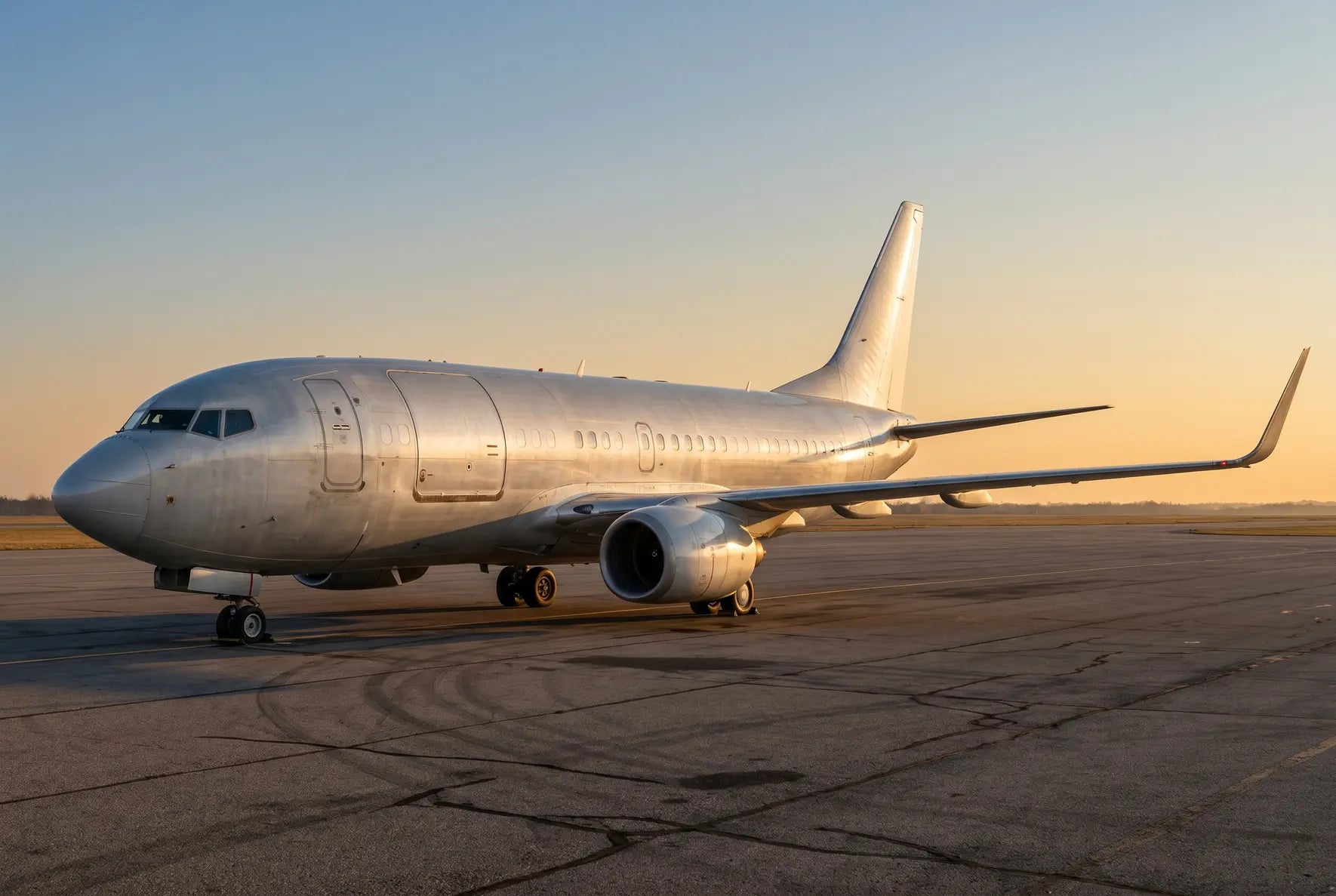
Boeing 737-700C: History, Development and Origins of the Convertible Variant
The Boeing 737-700C is the convertible passenger-freighter derivative of the 737 Next Generation (NG) family. The "C" in its designation stands for Convertible, reflecting the aircraft's defining capability: the ability to switch between all-passenger, all-cargo and mixed (combi) configurations using the same airframe. Developed by Boeing Commercial Airplanes in Renton, Washington, the 737-700C filled a niche that earlier convertible 737 variants, such as the 737-200C, had served during the Classic era, but on a modern, more efficient platform.
The 737 Next Generation programme was launched in the early 1990s to replace the ageing 737 Classic series (-300/-400/-500). Boeing redesigned the wing for greater area and fuel capacity, adopted the CFM International CFM56-7 engine family, introduced an advanced glass cockpit and improved aerodynamics with optional blended winglets. The baseline 737-700 rolled out on 8 December 1996, completed its maiden flight on 9 February 1997, received FAA type certification on 7 November 1997 and entered service with Southwest Airlines in December 1997. With this proven platform established, Boeing developed the 737-700C as a structural derivative optimised for cargo flexibility.
The programme was driven primarily by military demand. In September 1997, the United States Naval Reserve placed the launch order for the convertible variant, selecting it as the basis for the C-40A Clipper logistics aircraft. The C-40A was intended to replace the ageing C-9B Skytrain II in the fleet logistics support role. Boeing adapted the 737-700 airframe by adding a large main-deck cargo door on the left forward fuselage, reinforcing the cabin floor for palletised loads and installing a cargo-handling system with rollers and locks. The wings were strengthened to the same specification as the Boeing Business Jet (BBJ) and the 737-800, supporting a higher maximum takeoff weight of approximately 171,000 lb (77,564 kg).
The Boeing 737-700C embarked on its flight-test programme on 14 April 2000. Two test airframes conducted 55 flights totalling 124 flight hours before earning FAA type certification on 31 August 2000. Boeing noted that this certification covered the basic airframe, while individual passenger and cargo interior configurations were certified separately. The first C-40A Clipper was delivered in April 2001 to Fleet Logistics Support Squadron VR-59 at NAS JRB Fort Worth, Texas. By 2014, the U.S. Navy operated multiple C-40As across six fleet logistics support squadrons, and two additional aircraft were later procured for the U.S. Marine Corps.
On the commercial side, the 737-700C remained a niche product. Boeing itself described the convertible variant as a specialised aeroplane with limited but purposeful demand. In July 2014, Boeing confirmed an order from Air Algerie for two 737-700Cs, making the Algerian flag carrier the first scheduled commercial airline to operate the type. That same month, the 5,000th 737 Next Generation built rolled off the Renton line as a C-40A for the U.S. Navy, underscoring the military's dominant role in the variant's order book. The convertible concept serves operators that need to adjust capacity between passengers and freight depending on seasonal demand or mission requirements, a challenge familiar to carriers serving remote or island destinations such as those in the Caribbean. Airlines like Air Caraibes, which connects mainland France with overseas territories, illustrate how route networks with fluctuating passenger and cargo needs benefit from flexible fleet strategies.
What Sets the Boeing 737-700C Apart from Other 737-700 Sub-Variants
The standard 737-700 is a fixed-configuration passenger airliner with no main-deck cargo door and cargo limited to the lower belly holds. The 737-700ER (Extended Range) is optimised for maximum range using auxiliary fuel tanks and the 737-800 wing, but it remains a passenger-only aircraft. The BBJ1 (Boeing Business Jet) shares the 737-700C's strengthened wing structure but is configured as a long-range VIP transport without a cargo door. The 737-700C is the only sub-variant designed from the outset for rapid role changes between passengers and freight.
The military C-40 family further differentiates based on the 737-700C platform. The C-40A Clipper retains the full convertible capability for fleet logistics. The C-40B and C-40C, operated by the U.S. Air Force, are derived from the BBJ rather than the 737-700C and focus on VIP transport and secure communications rather than palletised cargo operations.
Key identifiers and specifications of the Boeing 737-700C, based on U.S. Navy data and Boeing published figures:
- Engines: 2x CFM International CFM56-7B series turbofans
- Main-deck cargo door: large upward-hinged door on the left forward fuselage
- Strengthened wing: identical to the BBJ/737-800 wing structure
- All-passenger capacity: up to 149 seats (single-class)
- All-cargo capacity: up to 8 pallets, approximately 40,000 lb (18,144 kg)
- Combi configuration: 3 pallets plus approximately 70 passengers
- Range (passenger): approximately 3,215 nmi (5,954 km)
- Range (cargo): approximately 2,875 nmi (5,324 km)
- MTOW: approximately 171,000 lb (77,564 kg)

A Delta Air Lines Boeing 737-800 is seen ascending into a clear blue sky, showcasing its distinct livery and design. The aircraft's engines and fuselage are prominently visible.
Boeing 737-700C Technical Specifications, Systems and Engine Overview
The Boeing 737-700C (Convertible) is a dual-role variant of the 737 Next Generation family, purpose-built to switch between all-passenger, all-cargo and combi configurations. Its design trade-offs centre on operational flexibility rather than outright range or seat count: the airframe incorporates a large main-deck cargo door on the forward left fuselage, an integrated cargo handling system with rollers and pallet locks, and strengthened wings identical to those on the Boeing Business Jet (BBJ). These structural reinforcements support higher operating weights and the stresses of frequent cargo loading cycles.
Because the 737-700C shares the Next Generation wing, empennage and cockpit with the standard 737-700, it retains the same aerodynamic efficiency and systems architecture. The convertible capability, however, introduces a measurable weight penalty: the cargo door structure, floor reinforcement and cargo system hardware increase the empty weight compared with a pure-passenger 737-700. Boeing positions the variant for operators that need to maximise asset utilisation across seasonal passenger demand and freight contracts. The FAA certified the 737-700C in September 2000, making it the first new all-cargo 737 Boeing had developed since the 737-200C in 1966. A Quick Change (QC) option with pallet-mounted seats allows conversion from passenger to freighter layout in less than one hour.
- Overall length: 33.63 m (110 ft 4 in)
- Wingspan: 34.31 m (112 ft 7 in) without winglets; approximately 35.79 m (117 ft 5 in) with blended winglets
- Height: approximately 12.5 m (41 ft 2 in)
- Typical MTOW: up to 70,080 kg (154,500 lb); higher-gross-weight versions (as on the C-40 military derivative) reach 77,564 kg (171,000 lb)
- Maximum payload (cargo layout): up to 18,656 kg (41,130 lb)
- Range (passenger layout): up to 3,215 nm (5,954 km)
- Range (cargo layout): up to 2,875 nm (5,324 km)
- Fuel capacity: approximately 6,875 US gal (26,025 litres)
- Cruise speed: Mach 0.78 to 0.82 (approximately 828 km/h / 514 mph), depending on weight and altitude
- Service ceiling: 41,000 ft
- Engines: 2 x CFM International CFM56-7B series turbofans (FADEC controlled), rated from approximately 20,600 to 26,300 lbf depending on sub-variant
- Passenger capacity: up to 149 in all-economy layout; combi example: 70 passengers plus 6,804 kg (15,000 lb) cargo
- Avionics: NG 737 glass cockpit with six flat-panel LCD displays, dual FMS with GPS integration, dual autopilot capable of CAT II/III ILS approaches
- ETOPS: certified for 180-minute ETOPS operations (subject to operator approval)
Systems, Flight Controls and Handling Technology
The 737-700C uses the same conventional flight-control architecture found across the NG 737 family: hydraulically powered ailerons, elevator and rudder, with manual reversion available as a backup. Spoiler panels on the upper wing surface serve as speed brakes and ground spoilers, and an autobrake system with anti-skid protection is standard. The dual-channel autopilot and flight director system supports automated approaches, while the Flight Management Computer (FMC) integrates GPS and multi-mode receiver (MMR) inputs to provide ILS, GLS and VOR/DME navigation. Engine control is handled entirely through Full Authority Digital Engine Control (FADEC), which optimises fuel scheduling and monitors parameters such as exhaust gas temperature (EGT), N1 and N2 rotor speeds. Maintenance crews benefit from the onboard Central Maintenance Computer (CMC), which logs faults and supports troubleshooting through BITE (Built-In Test Equipment) across major systems.
Published performance figures for the 737-700C should always be read in context. Range, payload and field-length numbers vary with operator-selected MTOW, cabin density, atmospheric conditions (temperature, pressure altitude), runway surface state and regulatory performance margins (e.g., FAR 25 vs. EU-OPS). Boeing's stated range of 3,215 nm in passenger configuration, for example, assumes a specific seat count and standard atmospheric conditions. Operators flying from hot-and-high airports or with heavier cabin fits will see lower effective range and longer required runway lengths. Airlines such as KM Malta Airlines, which operate in the Mediterranean region, must factor these variables into daily dispatch calculations.
CFM56-7B Engines: History, Variants and Applications
The sole engine option for the Boeing 737-700C is the CFM56-7B, produced by CFM International, a 50/50 joint venture between GE Aerospace (United States) and Safran Aircraft Engines (France). The CFM56 programme dates back to the 1970s, with the first variant entering service in the early 1980s on re-engined KC-135R tankers and DC-8-70 freighters. The -7B sub-family was developed specifically for the 737 Next Generation and entered service in 1997 with the 737-700.
The CFM56-7B is a high-bypass, dual-spool turbofan featuring a single-stage fan (approximately 61 inches / 1.55 m diameter), a 3-stage low-pressure compressor, a 9-stage high-pressure compressor, a single-stage high-pressure turbine and a 4-stage low-pressure turbine. Across the -7B family, take-off thrust ratings range from approximately 19,500 to 27,300 lbf. The sub-variants most commonly associated with the 737-700 include the CFM56-7B20 (approximately 20,600 lbf), the CFM56-7B22 (approximately 22,700 lbf), and the CFM56-7B24 (approximately 24,200 lbf). Higher-gross-weight 737-700C airframes, including military C-40 variants, may use the CFM56-7B26 rated at approximately 26,300 lbf. Dry weight is typically around 2,370 kg (5,216 lb), with a bypass ratio of approximately 5.1 to 5.5 depending on the thrust rating.
From around 2007, CFM introduced the Tech Insertion package for the -7B, incorporating redesigned high-pressure compressor blades, improved turbine cooling and updated materials. A later Performance Improvement Package (PIP) further reduced fuel consumption and extended time on wing. The broader CFM56 family has accumulated over 30,000 deliveries and powers a wide range of types beyond the 737NG, including the Boeing 737 Classic (-300/-400/-500) with the CFM56-3 variant, the Airbus A320ceo family (A318, A319, A320, A321) with CFM56-5B engines, and the Airbus A340-200/300 with the CFM56-5C. Military platforms powered by CFM56 variants include the E-3 Sentry AWACS, E-6B Mercury and KC-135R Stratotanker.
Boeing 737-700C vs 737-700 vs 737-800 vs Airbus A319 Specifications Comparison
Scroll horizontally to see more →
| Parameter | Boeing 737-700C | Boeing 737-700 | Boeing 737-800 | Airbus A319 |
|---|---|---|---|---|
| Entry into service | 2001 | 1998 | 1998 | 1996 |
| Engines | 2 × CFM International CFM56-7B22 turbofans | 2 × CFM International CFM56-7B22 turbofans | 2 × CFM International CFM56-7B26/27 turbofans | 2 × CFM International CFM56-5B turbofans |
| Length | 33.6 m | 33.6 m | 39.5 m | 33.8 m |
| Wingspan | 35.8 m | 35.8 m | 35.8 m | 34.1 m |
| Height | 12.5 m | 12.5 m | 12.5 m | 11.8 m |
| Typical seating and layout (short description + approximate passengers) | 2-class: around 120–140 passengers or all-cargo layout | 2-class: around 126–149 passengers | 2-class: around 162–189 passengers | 2-class: around 120–140 passengers |
| MTOW | 70 t | 70 t | 79 t | 75.5 t |
| Range | 3,750 nm | 3,440 nm | 3,060 nm | 3,750 nm |
| Cruise speed | 0.78 Mach | 0.78 Mach | 0.79 Mach | 0.78 Mach |
| Service ceiling | 41,000 ft | 41,000 ft | 41,000 ft | 39,000 ft |
| Program note | Convertible NG-family 737 variant that can be configured for passengers or main-deck cargo, aimed at airlines needing flexible mixed freight/passenger operations. | Baseline Next-Generation 737 model offering a balance of range and capacity for short- to medium-haul routes, popular with full-service and low-cost carriers. | Stretched high-capacity NG 737 variant optimized for dense short- and medium-haul operations, becoming one of the most widely used narrow-body jets. | Short-fuselage member of the A320 family positioned against the 737-700, offering similar capacity and range with commonality across Airbus single-aisle jets. |
Scroll horizontally to see more →
The table compares key specs of the Boeing 737-700C against the 737-700, 737-800 and Airbus A319. The 737-700C matches the -700 in size and engines but adds convertible passenger/cargo capability and a longer listed range (3,750 nm vs 3,440 nm). The 737-800 is longer and seats more but has shorter range. The A319 is similar in capacity to the -700C with comparable range, but a lower ceiling.
Boeing 737-700C Operations: Routes, Missions and Airlines Around the World
The Boeing 737-700C is a niche convertible variant designed for operators that need to switch between passenger, cargo and combi configurations using a single airframe. Unlike a standard 737-700, it features a reinforced floor, a large main-deck cargo door and, optionally, pallet-mounted Quick Change (QC) seat modules that allow a full cabin conversion in under one hour. These structural adaptations make it suited to missions where flexibility outweighs the need for pure seat capacity or dedicated freighter economics.
In passenger configuration the aircraft can carry approximately 120 to 149 passengers and fly up to around 3,205 nautical miles. In all-cargo mode it can transport up to roughly 18,780 kg (41,420 lb) of palletised freight on the main deck, with a reduced range of approximately 2,880 nautical miles. A combi layout, such as the one certified for the U.S. Navy C-40A Clipper, can accommodate around 70 passengers alongside approximately 6,800 kg (15,000 lb) of main-deck cargo. Typical stage lengths range from 500 to 2,500 nautical miles, although longer legs are possible when payload and fuel allow. Daily utilisation patterns depend heavily on the operator: military squadrons may fly one or two medium-haul logistics legs per day, while a commercial or corporate operator can run daytime passenger sectors and convert to a freighter for night-time cargo runs.
Operationally, the Boeing 737-700C does not fit the classic hub-and-spoke or point-to-point airline model. It thrives in environments where demand fluctuates seasonally or where a single route mixes passenger and cargo needs. Oil-and-gas shuttle operations between industrial bases and regional airports, military logistics between continental hubs and forward staging fields, and mixed passenger-cargo services in markets with thin but variable demand are all typical use cases. The convertible hardware adds empty weight compared with a standard 737-700, resulting in slightly higher fuel burn. This trade-off, combined with the small production run of roughly 20 airframes, explains why the type remains rare. For readers interested in the broader economics of aircraft ownership, this resource on aviation-related tax deductions offers useful context on how operators manage the financial side of specialised fleets.
Where the Boeing 737-700C Operates
The Boeing 737-700C has a very limited operator base, concentrated primarily in North America through U.S. military service, with a small number of civilian airframes scattered across Africa and the Middle East. No confirmed European or Asian commercial airlines have operated the type. In North America, the overwhelming majority of 737-700C airframes serve the United States armed forces under the C-40 Clipper designation, performing inter-theatre and intra-theatre logistics across the continental United States and overseas. In Africa, Air Algerie is the most prominent civil operator, using the convertible capability for flexible passenger and cargo services across North African and regional routes. In the Middle East, Saudi Aramco has used the type as a corporate shuttle, alternating between personnel transport and equipment logistics for the oil sector. Angola also saw 737-700C service through SonAir, which supported offshore oil operations with a mixed passenger-cargo mission.
- North America: The United States Navy is the single largest operator, with 17 C-40A Clipper aircraft assigned to Fleet Logistics Support squadrons such as VR-57, VR-58 and VR-59. These aircraft perform troop and cargo transport in all-passenger, all-cargo or combi layouts across global theatre routes. The United States Air Force operates 10 related C-40B and C-40C variants, primarily configured for VIP and senior-leader transport rather than convertible cargo work.
- Africa: Air Algerie operates two Boeing 737-700C airframes (registrations 7T-VJP and 7T-VJQ). These aircraft serve domestic and regional routes, with the airline shifting between higher passenger density during summer peaks and increased cargo capacity in off-peak periods. SonAir in Angola historically operated one 737-700C (registration D2-EAS) on oil-industry charter and shuttle routes, transporting both workers and equipment to and from offshore staging points.
- Middle East: Saudi Aramco took delivery of two Boeing 737-700C airframes in 2001, using them as corporate shuttles between oil facilities, regional bases and hubs. The convertible cabin allows them to carry company staff on one rotation and switch to equipment and supply logistics on the next.
- Europe and Asia: No confirmed airline operations of the Boeing 737-700C have been documented in either region. European and Asian operators requiring combi or convertible narrow-body capability have historically relied on older 737-200C, 737-300QC or converted 737-800 freighter variants rather than the factory-built 737-700C.
Typical Seating Configurations of the Boeing 737-700C
In full passenger mode, the Boeing 737-700C shares the standard 737-700 single-aisle, six-abreast cabin with a 3-3 seating arrangement. Industry sources cite a typical range of 120 to 140 seats in a standard airline layout, while a maximum-density single-class configuration can reach up to 149 seats. Seat pitch in economy typically falls around 76 cm (30 inches), consistent with standard short- and medium-haul practice.
Military C-40A operators use a different approach. The U.S. Navy configures the cabin for up to approximately 121 passengers in a troop-transport layout, or reduces seating to around 70 seats when the forward section is loaded with palletised cargo. The Boeing 737 Technical Site provides detailed documentation on these layout options. Corporate and industrial operators such as Saudi Aramco may use lower-density layouts tailored to crew-shuttle comfort, with the balance of cabin space allocated to equipment and supplies. Across all operator types, the defining feature of the Boeing 737-700C cabin remains its modularity: pallet-mounted seat rows, galley units and lavatory modules can be rolled in or out through the main-deck cargo door, allowing the same airframe to serve radically different missions within a single operational day.
In this video, explore Boeing’s rare 737-700ER and learn why just two were ever built. Discover how it fits into the 1,164-strong 737-700 production run and what makes it unique.
Boeing 737-700C Safety Record: How Safe Is This Convertible Variant?
The Boeing 737-700C belongs to the 737 Next Generation (NG) family, one of the most widely operated and thoroughly scrutinised aircraft families in commercial aviation history. Boeing delivered over 7,100 737NG aircraft across all sub-variants, and the type has accumulated tens of millions of flight cycles since entering service in the late 1990s. According to Boeing's Statistical Summary of Commercial Jet Airplane Accidents, the 737NG recorded a hull-loss rate of 0.17 per million departures during the 1959-2017 analysis period, considerably lower than the 0.71 figure for the Classic series and 1.75 for the Original 737. With approximately 20 aircraft built, most of which serve the United States Navy as C-40A Clippers, the 737-700C itself has no recorded hull-loss accident or fatal event. Its safety profile is therefore best understood through the broader 737-700 and 737NG record, which provides a statistically meaningful dataset.
Notable Accidents and Incidents Involving the Boeing 737-700
Although no accident has been attributed to the 737-700C convertible specifically, several events involving the standard Boeing 737-700 have shaped safety practices across the entire NG fleet.
- Southwest Airlines Flight 1248 (2005) - On 8 December 2005, a Boeing 737-7H4 overran runway 31C at Chicago Midway International Airport during a snowstorm, breaching the perimeter fence and striking vehicles on an adjacent road. One person on the ground was killed. The NTSB investigation (AAR-07/06) identified the crew's failure to apply reverse thrust promptly as the probable cause, compounded by a tailwind on a short, contaminated runway and the absence of an Engineered Materials Arresting System (EMAS). This accident accelerated the FAA's development of the Runway Condition Assessment Matrix (RCAM) and drove widespread EMAS installation at land-constrained airports across the United States.
- Aires Flight 8250 (2010) - On 16 August 2010, a Boeing 737-700 operated by Colombian carrier Aires crashed approximately 80 metres short of the runway at San Andres Island during a night approach in heavy rain and thunderstorms. Two of the 131 occupants lost their lives. Investigators attributed the accident primarily to a misjudged approach path, exacerbated by a black-hole visual illusion and inadequate pilot training. The event reinforced industry emphasis on stabilised-approach criteria and improved training for night operations in degraded visual environments.
- Southwest Airlines Flight 1380 (2018) - On 17 April 2018, a Boeing 737-7H4 suffered an uncontained failure of its left CFM56-7B engine at FL320 when fan blade No. 13 fractured due to low-cycle fatigue. Engine inlet and fan-cowl fragments struck the fuselage, blowing out a cabin window and causing rapid depressurisation. One passenger was fatally injured. The NTSB final report (AAR-19/03) led the FAA to issue Airworthiness Directives mandating recurring eddy-current inspections of CFM56-7B fan-blade dovetails, significantly tightening inspection intervals. Boeing and CFM International also revisited fan-cowl structural integrity standards. This case illustrates how a single event can generate fleet-wide maintenance improvements that benefit every 737NG operator, including those flying the 737-700C.
Each of these events resulted in measurable changes to aircraft design, maintenance programmes, standard operating procedures (SOPs) or regulatory oversight. The ability of investigation authorities such as the NTSB and ICAO member states to translate findings into actionable directives is a cornerstone of modern aviation safety. Pilots involved in operating convertible and multi-role variants like the 737-700C benefit directly from this continuous improvement cycle, an area covered in depth when examining the responsibilities of a Type Rating Instructor (TRI) who ensures pilots master variant-specific procedures.
How Safe Is the Boeing 737-700C Today?
When measured against the volume of traffic it supports, the Boeing 737-700 family maintains an excellent safety record. The 737NG as a whole achieved a hull-loss rate roughly ten times lower than the Original 737 series, a reflection of advances in structural design, glass-cockpit avionics, enhanced ground-proximity warning systems and improved crew training standards. Regulatory bodies including the FAA and EASA impose continuous airworthiness requirements that apply equally to the convertible variant, covering everything from repetitive structural inspections to engine-related Airworthiness Directives. The small 737-700C fleet benefits from additional oversight given its military and corporate operator base, where maintenance standards are often more conservative than the minimum regulatory requirements.
Broader industry data confirm the trend. According to the Aviation Safety Network, the global fatal accident rate for commercial jets has fallen steadily over the past two decades, reaching historically low levels. Design philosophy on the 737NG, including fail-safe structures, redundant hydraulic and flight-control systems and dual-channel autoflight, provides multiple layers of protection. Combined with rigorous SOPs and ongoing regulatory scrutiny, these factors make the Boeing 737-700C a safe and reliable platform. Aviation remains, by a wide margin, one of the safest forms of mass transportation in the world.
01 What is the Boeing 737-700C and how is it different from a standard 737-700?
The Boeing 737-700C is a convertible, or “Combi,” version of the 737-700 that can be configured for passengers, cargo, or a mix of both. It has a large main-deck cargo door on the left forward fuselage and a strengthened floor to handle pallets and containers. Operators can reconfigure the cabin with removable seats and partitions, making the aircraft flexible for changing demand. In pure passenger service the experience is similar to a regular 737-700, but cabin space may be slightly reduced depending on how much of the main deck is dedicated to cargo.
02 Which airlines operate the Boeing 737-700C and on what kinds of routes is it used?
The Boeing 737-700C is relatively rare and is used mainly by operators that need both passenger and freight capability, such as some government and military fleets, corporate shuttle operators, and a few cargo-focused airlines. It is often seen on medium-haul routes, including remote or low-density destinations where there is demand for both people and critical freight. Typical missions include connecting main hubs with outlying bases, islands, or industrial sites. Flight lengths commonly range from about 1 to 4 hours, well within the aircraft’s design range.
03 What is the typical range and performance profile of the Boeing 737-700C?
The Boeing 737-700C has a maximum range broadly comparable to the passenger 737-700, typically around 3,000 to 3,500 nautical miles depending on configuration, payload, and weather. In practice, operators often fly it on shorter segments to balance cargo weight and schedule flexibility. The type is known for good short-field performance among narrowbody jets, allowing operations from mid-length runways and some airports with performance constraints. Its CFM56 engines provide reliable climb performance and efficient cruise at around Mach 0.78 to 0.79.
04 What is the passenger experience like on a Boeing 737-700C flight?
When configured for passengers, the Boeing 737-700C cabin feels similar to other 737 Next Generation aircraft, with a single-aisle layout and 3–3 seating across the cabin. Seat pitch, width, and amenities depend entirely on the operator, so comfort can vary from basic charter-style layouts to more spacious corporate or VIP configurations. If part of the main deck is used for cargo, the passenger section may be shorter, which can slightly change boarding flow and seat count but not safety or basic comfort. Noise levels are typical for a 737, with most passengers finding seats ahead of the wing slightly quieter than those near the engines.
05 How does the Boeing 737-700C compare to similar aircraft in fuel efficiency and role?
The Boeing 737-700C shares its core airframe, engines, and systems with the standard 737-700, so its fuel efficiency per seat is similar when configured with a comparable cabin. Its main advantage is versatility: it can carry pallets on the main deck without requiring a separate freighter aircraft, which can be more economical for niche routes where passenger and cargo demand fluctuate. Compared with larger narrowbodies like the 737-800 or A321, it typically carries fewer passengers but can be better suited to thinner routes or operations to airports with shorter runways. This makes it attractive for specialized operators rather than high-density airline trunk routes.
06 Is the Boeing 737-700C safe, and is there anything travellers should know when choosing seats?
The Boeing 737-700C is part of the 737 Next Generation family, which has a strong safety record when operated and maintained according to regulations. Safety standards, emergency equipment, and crew training are the same as for other 737 passenger operations in the same jurisdiction. For a smoother ride, many travellers prefer seats over the wing, where the aircraft structure dampens some turbulence sensations, while those seeking a quieter experience often choose seats toward the front, away from the engines. As layouts differ by operator, checking the seating chart in advance is helpful, especially on combi flights where some forward cabin space may be dedicated to cargo.