

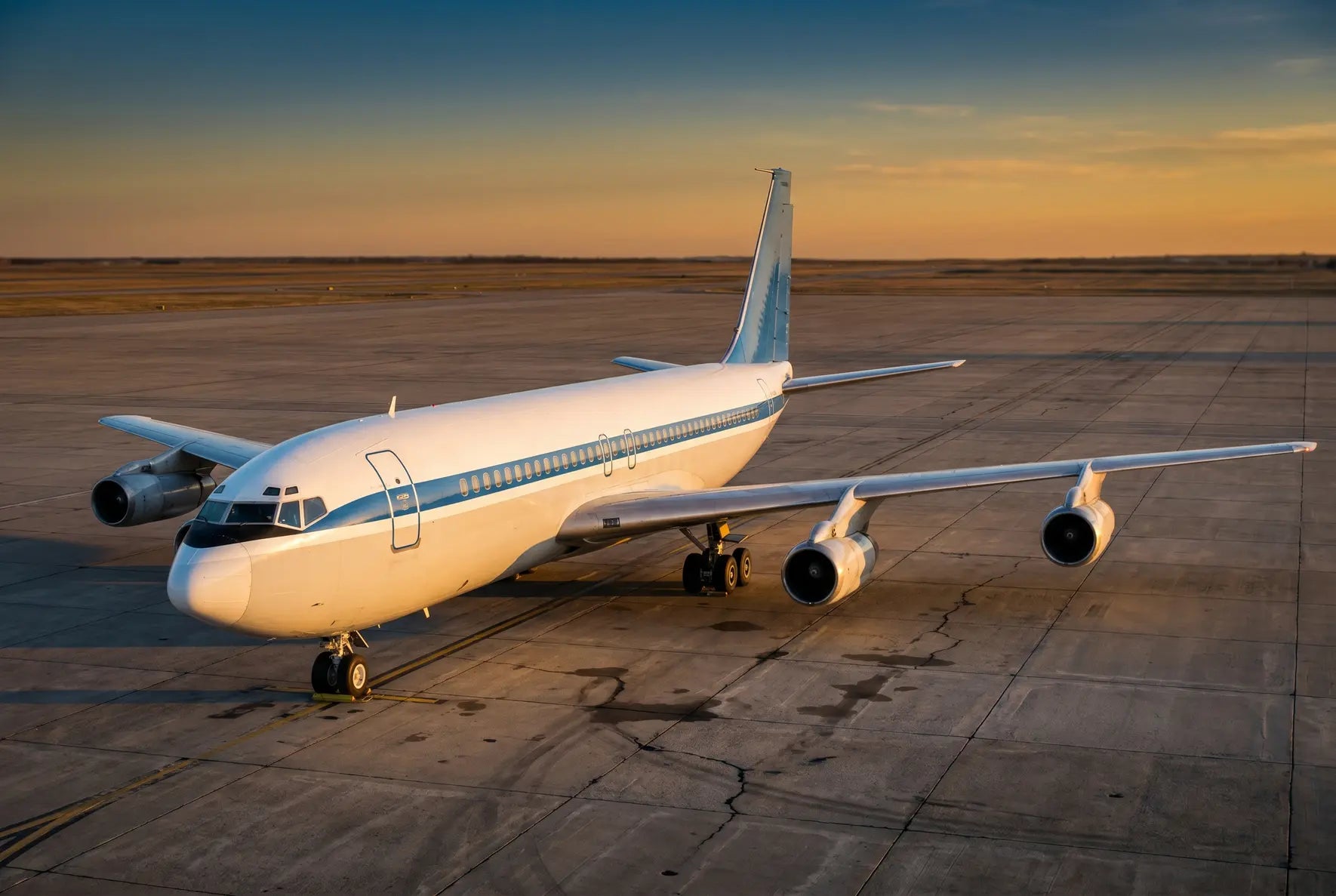
Boeing 720: History, Development, and Origins of the Lighter 707 Derivative
The Boeing 720 emerged in the late 1950s as a purpose-built derivative of the Boeing 707, designed to serve short- to medium-haul routes from shorter runways. While the 707-120 had proven the viability of commercial jet travel on long-range intercontinental services, airlines such as United Airlines needed a lighter, faster variant capable of operating profitably on domestic routes with higher frequency. At the same time, Boeing faced growing competitive pressure from the Convair 880, which promised higher cruise speeds. The 720 was Boeing's strategic response: a lower-cost adaptation of a proven airframe that could be developed quickly and efficiently.
Program Launch and Key Milestones
Boeing announced the new model in July 1957, initially designating it the 707-020. At the request of launch customer United Airlines, the designation was changed to Boeing 720 to clearly distinguish it in the marketplace. Because it was derived from the existing 707 production line at Boeing's Renton, Washington facility, development costs remained low, allowing the programme to reach profitability despite relatively modest sales volumes.
The first Boeing 720-022 (registered N7201U) was completed on 12 November 1959 and made its maiden flight on 23 November 1959 from Renton Field. The flight-test programme progressed rapidly, and the FAA issued Type Certificate A3WE on 30 June 1960. Just five days later, on 5 July 1960, United Airlines inaugurated commercial service with the Boeing 720 on its Los Angeles-Denver-Chicago route. American Airlines followed shortly after, commencing 720 operations on 31 July 1960.
Boeing continued to refine the type almost immediately. The Boeing 720B, fitted with Pratt & Whitney JT3D turbofan engines in place of the original JT3C-7 turbojets, made its first flight on 6 October 1960. The 720B entered service with American Airlines in March 1961, offering significantly improved fuel efficiency and increased range. Northwest Orient Airlines received a fleet of 17 Boeing 720Bs between 1961 and 1964, initially powered by JT3D-1 turbofans and later upgraded to JT3D-3 engines for improved maintenance commonality with its 707-320 fleet.
Production of all Boeing 720 variants took place at the Renton factory between 1959 and 1967. Boeing built a total of 154 aircraft: 65 original turbojet-powered 720s and 89 turbofan-powered 720Bs. The 720B proved the more popular version by a considerable margin. Notable operators beyond the launch customers included Pakistan International Airlines (PIA), Western Airlines, Eastern Air Lines, Lufthansa, and Iran Air. PIA's 720B famously set a speed record on the London-Karachi route on 2 January 1962. By the mid-1960s, the Boeing 727 trijet was rapidly taking over short- and medium-haul duties, and most 720s were retired from mainline service by the late 1970s and early 1980s.
What Distinguishes the Boeing 720 from the 707-120
Although the Boeing 720 shared the same fuselage cross-section and basic wing planform as the 707-120, it incorporated a series of targeted structural and aerodynamic changes that made it a distinct aircraft. The fuselage was 8 feet 4 inches (2.54 m) shorter, achieved by removing four frames forward of the wing and one frame aft. Boeing used lighter forged metal parts and thinner fuselage skins to reduce the empty weight substantially, bringing the maximum takeoff weight down to approximately 229,300 lb (104,009 kg) compared to the heavier 707-120.
The wing received a distinctive inboard leading-edge glove that increased the local sweep angle between the fuselage and the inboard engines. This modification reduced transonic drag and raised the drag-divergence Mach number by approximately 0.02, enabling the 720 to cruise at up to Mach 0.90, faster than the 707-120. Additional Krueger flaps outboard of the outer engines lowered approach and takeoff speeds, improving short-field performance. A visual recognition detail is the turbocompressor configuration: the 720 carried turbocompressor inlets only on its two inboard engine pods, whereas most 707 variants featured three or four, providing a useful spotting distinction.
The 720B variant further differentiated itself by replacing the JT3C-7 turbojets with Pratt & Whitney JT3D turbofan engines producing up to 18,000 lbf of thrust each. This upgrade delivered roughly 15-20% better fuel consumption and extended range to approximately 3,200 nautical miles. Many of the aerodynamic innovations first introduced on the 720 were subsequently adopted by the 707-120B, underscoring the variant's role as a proving ground for improvements across the 707 family.
Key variant identifiers of the Boeing 720 include:
- Engines (720): 4 x Pratt & Whitney JT3C-7 turbojets (12,500 lbf each)
- Engines (720B): 4 x Pratt & Whitney JT3D-1/-3 turbofans (up to 18,000 lbf each)
- Fuselage length: 136 ft 2 in (41.50 m), approximately 2.54 m shorter than the 707-120
- Maximum takeoff weight: 229,300 lb (720) / 234,000 lb (720B)
- Maximum cruise speed: Mach 0.90 (720), Mach 0.91 (720B)
- Wing modification: Inboard leading-edge glove with increased sweep; Krueger flaps outboard of outer engines
- Turbocompressors: Inboard engines only (2), versus 3 or 4 on most 707 variants
- Total production: 154 aircraft (65 x 720, 89 x 720B), built 1959-1967
For those preparing for aviation theory exams or looking to deepen their knowledge of classic jet airliners, the aviation exam resources at Ready for Takeoff offer a valuable study companion.

A Cyprus Airways Boeing 720B aircraft is captured in flight against a clear blue sky. The airplane features the airline's distinct livery and registration number G-BCBB.
Boeing 720 Technical Specifications, Systems, and Engine Overview
The Boeing 720 was conceived in the late 1950s as a short- to medium-range derivative of the Boeing 707, optimised for domestic and regional routes between 150 and 1,500 miles. To achieve better takeoff performance from shorter runways, Boeing trimmed 100 inches (2.54 m) from the 707-120 fuselage, lightened the airframe structure, increased the leading-edge sweep on the inboard wing section, and added full-span Krueger leading-edge flaps. These modifications lowered the maximum takeoff weight and improved field performance considerably: the 720 required roughly 8,300 ft of runway at MTOW, compared to approximately 11,000 ft for the 707-120B. The result was a narrowbody jetliner that could operate profitably on thinner routes without the range penalty of carrying excess structural weight.
Two main production variants existed. The original 720, powered by Pratt & Whitney JT3C turbojet engines, entered service with United Airlines in July 1960. The improved 720B swapped those turbojets for Pratt & Whitney JT3D turbofan engines, offering better thrust, lower fuel burn, and extended range. Boeing built a total of 154 airframes (65 original 720s and 89 720Bs) between 1959 and 1967. Much like later clean-sheet short-range designs such as the Airbus A220-100, the 720 demonstrated how a focused design brief targeting a specific route category could fill a genuine market need.
- Length: 136 ft 2 in (41.50 m)
- Wingspan: 130 ft 10 in (39.88 m)
- Height: 41 ft 7 in (12.65 m)
- Wing area: 2,432 sq ft (226 m²)
- MTOW (720): approximately 229,300 lb (104,010 kg)
- MTOW (720B): up to 234,000 lb (106,140 kg)
- OEW (720): approximately 110,800 lb (50,258 kg)
- OEW (720B): approximately 112,883 lb (51,200 kg)
- Fuel capacity: approximately 16,060 US gal (60,793 litres)
- Passenger capacity: 131-137 (two-class) or up to 156-165 (single-class)
- Range (720): approximately 2,800 nmi (5,200 km) with typical payload
- Range (720B): approximately 3,680 nmi (6,820 km) with typical payload
- Cruise speed: Mach 0.82, approximately 540 kn (1,000 km/h)
- Maximum speed: Mach 0.906 at 23,400 ft
- Service ceiling: 42,000 ft (12,800 m)
- Takeoff field length (at MTOW): approximately 8,300 ft (2,530 m)
- Landing field length: approximately 5,750-6,200 ft (1,740-1,890 m)
- Engines (720): 4 x Pratt & Whitney JT3C-7 turbojets, approximately 12,000 lbf each
- Engines (720B): 4 x Pratt & Whitney JT3D-1 or JT3D-3 turbofans, 17,000-18,000 lbf each
- Flight crew: 3
Systems, Flight Controls, and Handling Technology
The Boeing 720 shared its fundamental systems architecture with the 707 family. Flight controls were hydraulically powered, with manual reversion available as a backup. The aircraft used conventional cable-and-pulley linkages for primary control surfaces (ailerons, elevator, and rudder), assisted by hydraulic boost. The dual hydraulic system provided redundancy for flight-critical functions including landing gear retraction, nosewheel steering, and brakes. Braking on the main gear used a basic anti-skid system, standard for the era, which helped prevent tyre blowouts on wet or contaminated runways.
The cockpit featured analogue instrumentation typical of first-generation jet transports, with a three-crew arrangement (captain, first officer, and flight engineer). The flight engineer's panel managed engine parameters, fuel distribution, pressurisation, electrical load, and hydraulic status. Performance computation was handled manually by flight crews using paper charts and slide-rule calculations, as was standard practice prior to the introduction of onboard flight management computers.
Published performance figures for the Boeing 720 and 720B can vary across sources. Differences arise from operator-specific weight configurations, cabin density choices, atmospheric assumptions (ISA versus hot-and-high conditions), fuel load trade-offs, and runway surface conditions. For example, MTOW figures differ slightly depending on the customer-specific variant: some 720Bs were delivered at higher gross weights than others. Range values are especially sensitive to payload assumptions, reserve fuel policies, and whether the quoted figure reflects still-air conditions or includes a headwind allowance. Any comparison with other types should account for these variables.
Engines: Pratt & Whitney JT3C and JT3D
The original Boeing 720 was powered by four Pratt & Whitney JT3C-7 turbojet engines, the commercial designation of the legendary J57 military engine developed by Pratt & Whitney starting in 1950. The J57/JT3C was a landmark powerplant: it was the first American engine in the 10,000 lbf (45 kN) thrust class and introduced the two-spool axial-flow compressor design that became an industry standard. The engine featured a 9-stage low-pressure compressor, a 7-stage high-pressure compressor, and a 2-stage turbine section. Each JT3C-7 on the 720 produced approximately 12,000 lbf of thrust. The JT3C-6 variant, used on early Boeing 707s, was rated at 11,200 lbf dry and up to 13,500 lbf with water-methanol injection. In total, over 21,000 J57/JT3C engines were built between 1951 and 1965. Beyond commercial aviation, the J57 powered an extraordinary range of military aircraft, including the Boeing B-52 Stratofortress, the North American F-100 Super Sabre, the McDonnell F-101 Voodoo, and the Lockheed U-2 reconnaissance aircraft. Pratt & Whitney chief engineer Leonard S. Hobbs received the Collier Trophy in 1952 for the J57's design and production.
The improved Boeing 720B switched to the Pratt & Whitney JT3D turbofan, which first ran in 1958 and entered flight testing in 1959. The JT3D was derived directly from the JT3C by replacing the first three compressor stages with two larger-diameter fan stages that extended beyond the core casing, effectively creating a low-bypass turbofan. The JT3D-1 variant delivered 17,000 lbf of thrust, while the JT3D-3 offered up to 18,000 lbf. This upgrade gave the 720B significantly better fuel economy, increased range, reduced noise, and improved takeoff performance. Over 8,000 JT3D engines were manufactured between 1959 and 1985. The JT3D also powered later variants of the Boeing 707, the Douglas DC-8, and, under the military designation TF33, the Boeing B-52H and several military transport and reconnaissance platforms. The transition from JT3C turbojet to JT3D turbofan on the 720B marked one of the earliest and most successful turbofan retrofits in commercial aviation history, demonstrating the efficiency gains that would define engine development for decades to come.
Boeing 720 vs Boeing 707 and Douglas DC-8-50 Specifications Comparison
Scroll horizontally to see more
| Parameter | Boeing 720 | Boeing 707-120 | Boeing 707-320B | Douglas DC-8-50 |
|---|---|---|---|---|
| Entry into service | 1960 | 1958 | 1962 | 1960 |
| Engines | 4 × Pratt & Whitney JT3C-7 | 4 × Pratt & Whitney JT3C | 4 × Pratt & Whitney JT3D-3 | 4 × Pratt & Whitney JT3D |
| Length | 41.5 m | 44.0 m | 46.7 m | 45.9 m |
| Wingspan | 39.9 m | 39.9 m | 44.4 m | 43.4 m |
| Height | 12.6 m | 12.9 m | 12.9 m | 12.9 m |
| Typical seating and layout | 2-class: 131–156 passengers | 2-class: 140–181 passengers | 2-class: 170–189 passengers | 2-class: 150–189 passengers |
| MTOW | 104 t | 116 t | 151 t | 136 t |
| Range | 3,200 nm | 3,680 nm | 5,750 nm | 4,600 nm |
| Cruise speed | 0.82 Mach | 0.82 Mach | 0.84 Mach | 0.82 Mach |
| Service ceiling | 42,000 ft | 41,000 ft | 41,000 ft | 41,000 ft |
| Program note | Shortened 707 for medium-range routes | Original short-fuselage 707 baseline | Longer-range 707 with turbofans | Main competitor narrowbody jetliner |
Scroll horizontally to see more
The table compares the Boeing 720 with early Boeing 707 variants and the Douglas DC-8-50 across key specs. The 720 is shorter and lighter (104 t MTOW) with a medium-range focus (3,200 nm), while the 707-320B offers the longest range at 5,750 nm and higher MTOW (151 t). Seating overlaps, but the 707-320B and DC-8-50 trend higher. Turbofans on the 707-320B and DC-8-50 align with longer-range capability.
Boeing 720 Operations: Airlines, Routes and Missions Around the World
The Boeing 720 was designed as a short-to-medium range narrowbody airliner, optimised for domestic trunk routes and regional services rather than the intercontinental missions assigned to its larger sibling, the 707. The original 720, powered by Pratt & Whitney JT3C turbojet engines, offered a range of approximately 2,800 nautical miles (5,200 km), while the improved 720B, fitted with JT3D turbofan engines, extended that to around 3,200 nautical miles (5,900 km). Typical stage lengths ranged from 1,500 to 2,500 nautical miles, making the aircraft well suited to dense domestic corridors and medium-haul regional routes.
From an operational standpoint, the Boeing 720 excelled in both hub-and-spoke and point-to-point networks. Its relatively short takeoff distance of approximately 2,700 metres and landing distance of around 1,900 metres allowed it to serve not only major hub airports but also secondary and regional fields with less sophisticated infrastructure. Airlines operating the type could schedule multiple daily rotations on high-frequency routes, maximising aircraft utilisation. The 720B variant, in particular, earned the nickname Renton Rocket at Northwest Airlines for its spirited performance and improved fuel economy over earlier pure-jet competitors.
Operators did face challenges, however. The four-engine configuration, while providing redundancy, carried higher maintenance and fuel costs compared to the trijets and twinjets that eventually replaced it. The aircraft's limited passenger capacity relative to later designs also constrained revenue potential on denser routes. By the late 1970s, more efficient types such as the Boeing 727 and Boeing 737 had largely displaced the 720 from mainline service, pushing surviving examples into charter, cargo and lease operations.
Where the Boeing 720 Operated
North America absorbed the vast majority of Boeing 720 production, with United States carriers dominating the order book for domestic trunk services. In Europe, several flag carriers and charter airlines adopted the type for intra-European routes and Mediterranean holiday flights. Across Asia and the Middle East, the aircraft served regional and medium-haul international routes, often linking capital cities with key commercial centres. In Africa and South America, a smaller number of operators used the 720 for domestic trunk and intra-continental services, though adoption remained more limited. For a broader look at how European carriers structure their pilot operations today, see this overview of easyJet Europe pilot conditions.
- North America – United Airlines was the launch customer, operating 29 examples on routes such as Los Angeles–Denver–Chicago from July 1960. American Airlines took delivery of 10 aircraft for transcontinental services, while Eastern Air Lines flew 15 units on East Coast shuttles and Caribbean routes. Northwest Airlines, Continental Airlines, Braniff International Airways, Western Airlines and Trans World Airlines also operated the type on domestic networks. Later, Pan American World Airways used 720Bs on Caribbean and South American routes out of Miami. In South America, Avianca in Colombia operated three 720Bs on domestic and Caribbean routes during the 1960s, while Aerocondor Colombia used the type for charter and cargo work into the 1970s.
- Europe – Lufthansa ordered eight 720Bs for European medium-haul services, and Aer Lingus in Ireland operated three aircraft on transatlantic and European routes. In the United Kingdom, Monarch Airlines flew 720s on package-holiday routes to Spain and Greece, while Conair of Scandinavia and Maersk Air in Denmark used the type extensively for cargo charters through the mid-1980s.
- Asia and the Middle East – Pakistan International Airlines operated multiple 720s on medium-haul international services linking Karachi with the Middle East and Europe. Saudi Arabian Airlines used two 720Bs on domestic and Gulf routes. Middle East Airlines in Lebanon was one of the largest operators outside the United States, flying up to 16 720Bs on routes from Beirut to Europe and across the region, with some aircraft remaining in service until the mid-1990s. El Al in Israel and Ariana Afghan Airlines also operated the type on regional routes.
- Africa – Ethiopian Airlines was an original 720B customer, using three aircraft on African and European routes from Addis Ababa. Air Rhodesia operated three 720s for regional African services, while Air Tanzania leased the type for domestic operations during the 1970s.
Typical Cabin Layouts and Seating Configurations
As a narrowbody aircraft with a fuselage diameter of approximately 3.76 metres, the Boeing 720 featured a single-aisle cabin arranged in a standard six-abreast, 3-3 seating configuration. In a typical two-class layout, the aircraft seated around 112 to 137 passengers, with a smaller first-class cabin forward and a larger economy section aft. In a high-density, all-economy arrangement, capacity rose to 156 passengers over the full 3,200-nautical-mile range of the 720B.
Network carriers such as United Airlines and American Airlines generally favoured the two-class configuration to offer premium service on competitive domestic routes. Charter and leisure operators, by contrast, maximised seat count. Eastern Air Lines configured its 720-025 variant for up to 170 passengers in a high-density layout, incorporating additional over-wing emergency exits and brake cooling fans to support rapid turnarounds on short-haul services. Historic cabin layouts for the Boeing 720 and other classic airliners can be explored through the AeroLOPA historic seat-map archive.
In this video, discover how the Boeing 720 was designed for versatile operations and shorter runways, why it was seen as able to land almost anywhere, and the key reasons it ultimately failed in the market.
Boeing 720 Safety Record: Accident History and How Safe Was This Jet?
The Boeing 720 entered service with United Airlines in July 1960 and remained in commercial operation for roughly three decades, with the last airframe retired in 2012. A total of 154 aircraft were built, split between 65 original 720s and 89 turbofan-powered 720Bs. Over that lifespan the type recorded 23 hull-loss accidents. Twelve of those hull losses involved fatalities, accounting for 175 deaths, while an additional 81 lives were lost in a single act of sabotage. Set against thousands of revenue flights accumulated across more than 30 operators worldwide, these figures reflect both the operational realities of early jet aviation and the broader industry trend of steadily improving safety through lessons learned. The Aviation Safety Network database maintains a full listing of Boeing 720 occurrences for reference.
Notable Accidents and Their Impact on Aviation Safety
Northwest Orient Airlines Flight 705 (1963) – On 12 February 1963, a Boeing 720-051B (N724US) broke apart in mid-air over the Florida Everglades roughly 15 minutes after departing Miami, killing all 43 occupants. The investigation, which took more than two years, determined that the aircraft encountered severe turbulence during climb-out. The resulting vertical upset, combined with large corrective control inputs by the crew, drove the airframe beyond its structural limits. As documented in the Civil Aeronautics Board accident report, no pre-existing structural defect was found. The accident spurred research into clear-air turbulence detection, improved weather dissemination procedures and better crew training for upset recovery, all of which influenced later regulatory guidance.
Pakistan International Airlines Flight 705 (1965) – On 20 May 1965, a PIA Boeing 720-040B (AP-AMH) crashed into a sandhill approximately ten kilometres from Cairo International Airport during a night approach in foggy conditions, killing 121 of the 127 people on board. The crew had reported a flap malfunction shortly before impact. The official finding stated that the aircraft failed to maintain adequate circuit height and continued an abnormal descent for reasons that could not be conclusively determined. This remains the deadliest accident involving a Boeing 720 and contributed to tighter approach-monitoring standards and improved crew coordination procedures for instrument approaches.
Middle East Airlines Flight 438 (1976) – On 1 January 1976, an MEA Boeing 720 was destroyed by a bomb detonation in the forward cargo hold while en route from Beirut to Dubai, killing all 81 on board. The act of sabotage underscored the need for enhanced cargo screening and baggage reconciliation. Alongside several other bombing incidents during the 1970s, this event accelerated international efforts to strengthen airport security protocols, eventually feeding into ICAO Annex 17 provisions on aviation security.
NASA/FAA Controlled Impact Demonstration (1984) – Although not an airline accident, this deliberate test crash of a remotely piloted Boeing 720 at Edwards Air Force Base on 1 December 1984 deserves mention. Conducted jointly by NASA and the FAA, the experiment aimed to evaluate anti-misting kerosene (AMK) as a means of reducing post-crash fire intensity. While the AMK additive did not suppress flames as hoped, the test generated invaluable data on cabin survivability, seat reinforcement and fireproof interior materials. These findings influenced subsequent updates to FAR Part 25 crashworthiness and fire-protection requirements and encouraged further development of burn-resistant cabin components used in later aircraft types, including short-range jets such as the BAC One-Eleven 500.
How Safe Is the Boeing 720 by Modern Standards?
Evaluating the Boeing 720 purely by its raw accident tally can be misleading without context. First-generation jet airliners operated in an era of less mature air traffic control, fewer weather-detection tools and evolving crew-resource-management practices. Many of the type's accidents involved factors such as clear-air turbulence, instrument-approach errors in poor visibility or acts of sabotage rather than inherent design flaws. Boeing's own Statistical Summary of Commercial Jet Airplane Accidents shows a dramatic decline in hull-loss rates across all early jet types as operational experience grew and regulations tightened.
The 720 shared the proven wing and fuselage architecture of the Boeing 707, benefiting from continuous airworthiness directives issued by the FAA throughout its service life. Each significant incident led to tangible improvements in turbulence forecasting, approach procedures, security screening or cabin fire protection. By the time the last 720 was retired, commercial aviation had evolved into one of the safest forms of transport, a status built in part on the hard lessons drawn from early jets like the Boeing 720.
01 What is the Boeing 720 and when was it developed?
The Boeing 720 is a mid-size, narrow-body jet airliner developed by Boeing in the late 1950s as a shorter-range variant of the successful Boeing 707. First flying in 1959 and entering service in 1960, the 720 was designed for medium-range routes with faster cruise speeds and improved hot-and-high performance compared to its larger sibling. The aircraft remained in commercial service through the 1980s and is today primarily found in freight operations or preserved examples.
02 What was the typical cabin layout and passenger capacity of the Boeing 720?
The Boeing 720 typically carried 131 to 189 passengers depending on the operator's configuration, though some high-density layouts reached up to 219 seats. The aircraft featured a single-deck cabin with a typical six-abreast seating arrangement in economy, and many airlines offered first-class sections with increased seat pitch and amenities. Cabin width of 3.76 meters provided moderate comfort for the era, though modern passengers would find the interior dimensions modest by today's standards.
03 Which airlines operated the Boeing 720 and what routes did they use it for?
Major operators of the Boeing 720 included United Airlines, American Airlines, Braniff International, Northwest Orient Airlines, and numerous international carriers such as Japan Airlines, Air India, and KLM. Airlines typically deployed the 720 on medium-range trunk routes—roughly 3,000 to 4,000 kilometers—between major city pairs where its combination of speed, range, and fuel efficiency offered a competitive advantage over smaller turboprops and older piston-engine aircraft.
04 How did the Boeing 720 compare in performance and fuel efficiency to similar aircraft of its era?
The Boeing 720 cruised at approximately 907 kilometers per hour, significantly faster than the Douglas DC-7 or Lockheed Constellation it often replaced, while offering better range and fuel economy than those piston-engine types. Powered by four Pratt & Whitney JT3C turbojets, the 720 consumed roughly 5,000 to 6,000 kilograms of fuel per hour depending on cruise conditions and load, making it more efficient per passenger-kilometer than competing jet airliners of the early 1960s. Its hot-and-high performance made it particularly valuable for operations from high-altitude or warm-climate airports where other jets faced payload restrictions.
05 What was the safety record and notable design features of the Boeing 720?
The Boeing 720 established a strong safety record during its operational life, with accidents typically resulting from pilot error, weather, or maintenance issues rather than design flaws; the aircraft itself proved structurally sound and reliable. Key design features included fully powered flight control surfaces, comprehensive redundancy in hydraulic systems, and robust pressurization and air-conditioning systems that were considered advanced for the 1960s. The 707/720 series demonstrated Boeing's commitment to safety through rigorous testing and a design philosophy that influenced commercial aviation standards for decades.
06 What should a traveler know about comfort and the passenger experience on a Boeing 720?
Passengers aboard the Boeing 720 experienced pressurized cabin service at altitudes around 10,000 to 11,000 meters, with reasonable noise levels for a jet airliner of that generation, though considerably louder than modern aircraft. Windows were smaller than those on today's airliners, and the cabin environment—humidity, air circulation, and temperature control—reflected 1960s technology; forward and aft cabin positions offered subtle differences in noise and vibration. Meals and service were typically more attentive and generous than modern economy offerings, reflecting the era's approach to commercial aviation hospitality.