

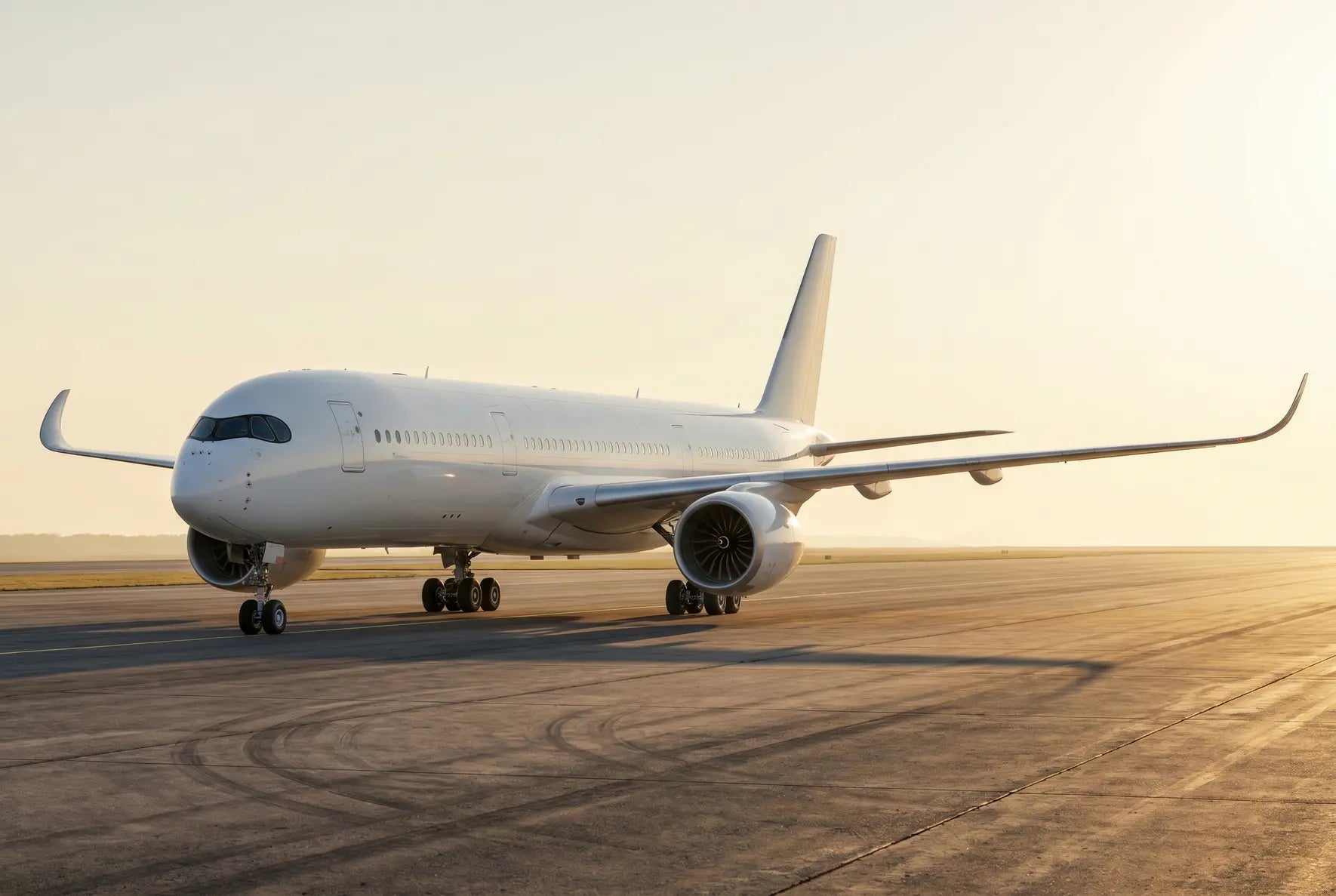
Airbus A350-1000: History, Program Launch, and Development of the Largest XWB
The Airbus A350-1000 is the largest member of the A350 XWB (eXtra Wide Body) family, a clean-sheet, long-range, twin-aisle aircraft programme developed by Airbus to compete directly with Boeing's 777 and 787 Dreamliner families. Conceived to fill a gap in the Airbus wide-body portfolio, the A350-1000 was designed from the outset as a high-capacity, long-range variant capable of challenging the Boeing 777-300ER on premium intercontinental routes.
The origins of the programme date back to December 2004, when Airbus shareholders approved an "authority to offer" for an aircraft initially based on a modified A330 fuselage with new wings and engines. However, after strong criticism from airlines who considered it insufficiently competitive against the Boeing 787, Airbus went back to the drawing board. On 1 December 2006, the Airbus board of directors approved the industrial launch of the fully redesigned A350 XWB as a clean-sheet programme encompassing three variants: the A350-800, A350-900, and A350-1000. The A350-800 was eventually shelved, but the -900 and -1000 moved ahead as the programme's twin pillars.
Airbus, headquartered in Toulouse, France, led the development and final assembly of all A350 variants at its Toulouse-Blagnac facility. The manufacturer invested heavily in advanced composite manufacturing, with the A350-1000 airframe comprising approximately 54% carbon-fibre-reinforced polymer (CFRP) by structural weight. This made it one of the most composite-intensive commercial aircraft ever built. Major aerostructure partners, including Spirit AeroSystems, GKN Aerospace, and Premium AEROTEC, supplied key sections of the fuselage, wings, and empennage.
The family-wide development saw the A350-900 reach its first flight on 14 June 2013, followed by EASA type certification on 30 September 2014 and FAA certification shortly after in November 2014. Qatar Airways inaugurated commercial service with the A350-900 on 15 January 2015. These milestones paved the way for the larger variant.
The first A350-1000 prototype was assembled in Toulouse during 2016, and on 24 November 2016 the aircraft completed its maiden flight from Toulouse-Blagnac. A dedicated flight-test campaign followed, involving multiple test airframes. On 21 November 2017, the A350-1000 received simultaneous type certification from EASA (Type Certificate EASA.A.151) and the FAA (TCDS T00063IB), covering the model designation A350-1041. The first production aircraft was delivered to launch customer Qatar Airways on 20 February 2018, and scheduled passenger services began on 24 February 2018.
Since entry into service, the A350-1000 has expanded to operators including Cathay Pacific, Virgin Atlantic, British Airways, Air Caraïbes, and others. In December 2025, Philippine Airlines became the tenth airline worldwide to operate the A350-1000. A notable programme development is the A350-1000ULR variant ordered by Qantas for its Project Sunrise missions, featuring an additional 20,000-litre rear centre fuel tank to enable ultra-long-haul flights of up to approximately 22 hours between Sydney, London, and New York. First deliveries of this ultra-long-range configuration are anticipated in late 2026. For those interested in how advanced technologies and automation continue to reshape the aviation industry, this resource on AI agents in aviation offers useful context.
What Distinguishes the A350-1000 from the A350-900
While the A350-1000 shares its basic wing design, cockpit systems, and fly-by-wire architecture with the A350-900, several critical differences set it apart. The fuselage is approximately 7 metres longer (73.8 m versus 66.8 m), enabling around 40 to 70 additional seats in typical configurations. This stretch is achieved through forward and aft fuselage plugs, with reinforced floor beams and structural members to handle higher loads.
The powerplant is another key differentiator. The A350-1000 uses the Rolls-Royce Trent XWB-97 engine, rated at approximately 97,000 lbf (432 kN) of thrust, compared to the Trent XWB-84 on the -900 rated at about 84,000 lbf. Maximum take-off weight rises to approximately 308 tonnes, compared to around 280 tonnes for the standard A350-900. To handle this increased mass, the A350-1000 features a distinctive six-wheel (triple-bogie) main landing gear on each side, replacing the four-wheel bogies of the -900. This keeps pavement loading within acceptable limits for existing airport infrastructure.
The following list summarises the key variant identifiers of the Airbus A350-1000:
- Model designation: A350-1041 (EASA/FAA type certificate)
- Engines: 2x Rolls-Royce Trent XWB-97 (approximately 97,000 lbf each)
- Fuselage length: 73.8 m (242 ft 1 in)
- Wingspan: 64.75 m (212 ft 5 in) with curved blended CFRP wingtip devices
- MTOW: approximately 308,000 kg (308 tonnes)
- Range: up to 8,700 nm (16,100 km) in standard configuration
- Airframe composite content: approximately 54% CFRP by weight
- Main landing gear: six-wheel triple-bogie configuration per side
- ETOPS: approved for 180-minute and beyond-180-minute extended operations

The image shows an Airbus A350-941 aircraft, branded with 'Qatar Airways' and 'A350 XWB Launch Customer,' flying at an angle against a clear sky. This wide-body airliner is known for its modern design and efficiency.
Airbus A350-1000 Technical Specifications, Systems and Engine Overview
The Airbus A350-1000 is the largest member of the A350 XWB (Extra Wide Body) family, stretching approximately 7 metres longer than the A350-900 to reach an overall length of 73.78 m. Designed for high-capacity, ultra-long-range operations, it targets routes previously served by four-engine widebodies such as the A340-600 and Boeing 777-300ER, while offering substantially lower fuel burn per seat. The aircraft's structure uses over 53% carbon fibre reinforced polymer (CFRP) by weight, combined with titanium and aluminium-lithium alloys, resulting in a lighter airframe with improved fatigue and corrosion resistance compared to conventional aluminium designs.
From an engineering standpoint, the A350-1000 balances increased payload capacity against impressive range. Its higher maximum take-off weight and uprated Trent XWB-97 engines allow it to carry more passengers over distances that rival many smaller variants, while sharing a common type rating across the A350 family. These design trade-offs make it suitable for dense long-haul trunk routes as well as point-to-point ultra-long-haul services.
- Overall length: 73.78 m (242 ft 0.7 in)
- Wingspan (geometric): 64.75 m (212 ft 5.2 in), with blended winglets
- Height: 17.08 m (56 ft 0.5 in)
- Fuselage external width: 5.96 m (234 in); max cabin width 5.61 m (225 in)
- Typical seating: 375 to 400 passengers in a 3-class layout; up to 480 in high-density configuration
- Maximum take-off weight (MTOW): 322 tonnes
- Maximum landing weight (MLW): 236 tonnes
- Maximum zero fuel weight (MZFW): 223 tonnes
- Range: approximately 16,700 km (9,000 nm) as published by Airbus, based on a typical 3-class cabin
- Cruise Mach: M 0.85 (maximum operating Mach Mmo: M 0.89)
- Engines: 2 x Rolls-Royce Trent XWB-97, rated at approximately 431 kN (97,000 lbf) each
- Maximum fuel capacity: 168,300 litres
- Cargo capacity: up to 44 LD3 containers or 14 pallets in the lower hold
- Track (main gear): 10.73 m; wheelbase: 32.48 m
Flight Controls, Avionics and Systems Technology
The A350-1000 features a fully fly-by-wire flight control system with no mechanical backup for primary controls. Instead, backup is entirely electrical, relying on a combination of conventional hydraulic actuators, Electro-Hydrostatic Actuators (EHAs) and Electro-Backup Hydraulic Actuators (EBHAs). This architecture, evolved from the A380, is managed by three Primary Flight Computers (PRIMs) and three Secondary Flight Control Computers (SECs). Primary surfaces include four ailerons, 14 spoilers, two elevators, a trimmable horizontal stabiliser and a single rudder. In normal law, the system provides full flight-envelope protections including angle-of-attack limiting, overspeed protection and bank-angle protection, following the familiar Airbus side-stick control philosophy.
The cockpit is built around a next-generation Integrated Modular Avionics (IMA) platform with six large LCD displays. Touchscreen-enabled interfaces were introduced as a first for Airbus on the A350, along with optional Head-Up Display (HUD) integration for enhanced situational awareness during low-visibility approaches. The braking system uses carbon brakes with electronic control and integrated anti-skid, along with Airbus's Brake-to-Vacate (BTV) function. BTV allows pilots to select a desired runway exit, and the system automatically optimises deceleration to reach it, reducing brake and tyre wear while improving runway occupancy predictability. Health monitoring is deeply integrated via IMA, enabling real-time status checks across avionics, flight controls, hydraulics and engines, supporting predictive maintenance and condition-based servicing for operators. For readers interested in how narrowbody aircraft like the Boeing 737-700 approach similar systems at a different scale, the comparison highlights how widebody complexity scales with mission requirements.
Published performance figures for the A350-1000 should always be read in context. Range, payload and field-length numbers vary depending on operator-selected cabin configurations, passenger and cargo loading, MTOW options, atmospheric conditions (temperature, pressure altitude, wind), and runway surface state. Airbus's stated 16,700 km range assumes a typical three-class layout and standard atmospheric conditions. Operators flying denser configurations or from hot-and-high airports will see different real-world numbers. Fuel burn comparisons between variants or competitors are similarly sensitive to mission profile and assumptions.
Rolls-Royce Trent XWB-97: The A350-1000's Exclusive Engine
The A350-1000 is powered exclusively by two Rolls-Royce Trent XWB-97 turbofan engines, each rated at approximately 431 kN (97,000 lbf) of take-off thrust. There is no alternative engine option for this variant. The Trent XWB family was selected in 2006 as the sole powerplant for the entire A350 XWB programme. It is a three-shaft, high-bypass-ratio turbofan with a fan diameter of approximately 3.00 m (118 in), a bypass ratio of around 9.6:1 and an overall pressure ratio of approximately 50:1. The compressor section comprises an 8-stage intermediate-pressure and a 6-stage high-pressure compressor, with an annular combustor.
While the smaller Trent XWB-84 variant powers the A350-900 at around 84,200 lbf (375 kN) of thrust, the XWB-97 was specifically developed for the heavier and longer A350-1000. To achieve its higher thrust output, the XWB-97's fan runs approximately 6% faster than the XWB-84, requiring enhanced turbine cooling, advanced thermal barrier coatings and increased temperature margins throughout the core. Rolls-Royce has described the XWB-97 as the highest-thrust engine in the Trent family and has implemented multiple enhancement packages to improve durability, particularly for operations in dusty or high-temperature environments, reporting significant increases in time on wing for affected operators.
The Trent XWB family is exclusive to the Airbus A350 programme and does not power any other aircraft type. Since entering service, the family has accumulated approaching 25 million flying hours with dispatch reliability quoted by Rolls-Royce at around 99.9%. The engine is integrated into the Rolls-Royce TotalCare services programme, enabling real-time engine health monitoring and predictive maintenance, which aligns with the A350's broader IMA-based health monitoring philosophy. With its high bypass ratio, optimised fan design and modern nacelle acoustics, the Trent XWB-97 contributes to both the A350-1000's fuel efficiency and its reduced noise footprint compared to earlier-generation widebody powerplants.
Airbus A350-1000 vs A350-900 vs Boeing 787-10 vs 777-300ER: Specs Comparison
Scroll horizontally to see more →
| Parameter | Airbus A350-1000 | Airbus A350-900 | Boeing 787-10 | Boeing 777-300ER |
|---|---|---|---|---|
| Entry into service | 2018 | 2015 | 2018 | 2004 |
| Engines | 2 × Rolls-Royce Trent XWB-97 | 2 × Rolls-Royce Trent XWB-84 | 2 × General Electric GEnx-1B / Rolls-Royce Trent 1000 | 2 × General Electric GE90-115B |
| Length | 73.8 m | 66.8 m | 68.3 m | 73.9 m |
| Wingspan | 64.8 m | 64.8 m | 60.1 m | 64.8 m |
| Height | 17.1 m | 17.1 m | 17.0 m | 18.5 m |
| Typical seating and layout (short description + approximate passengers) | 3-class: 350–410 passengers | 3-class: 300–350 passengers | 3-class: 330–340 passengers | 3-class: 365–396 passengers |
| MTOW | 319 t | 283 t | 254 t | 351 t |
| Range | 8,000 nm | 8,500 nm | 6,430 nm | 7,370 nm |
| Cruise speed | 0.85 Mach | 0.85 Mach | 0.85 Mach | 0.84 Mach |
| Service ceiling | 43,100 ft | 43,100 ft | 43,100 ft | 43,100 ft |
| Program note | Largest A350 variant; stretched long-haul flagship with higher thrust and capacity than the A350-900. | Baseline A350 model; the lower-capacity, longer-range core of the family. | Competitor widebody; efficient composite long-haul twin positioned between the A350-900 and A350-1000 in size. | Earlier large twin-aisle competitor; very high-capacity long-haul aircraft from the previous generation. |
Scroll horizontally to see more →
This table compares key specifications of the Airbus A350-1000, A350-900, Boeing 787-10, and 777-300ER. The A350-900 leads range at 8,500 nm, while the A350-1000 trades some range (8,000 nm) for higher typical capacity. The 787-10 is shorter-range at 6,430 nm with similar cruise speed (Mach 0.85). The 777-300ER has the highest MTOW (351 t) and comparable size, but is an older design (2004 entry).
Airbus A350-1000 Operations: Routes, Airlines and Global Missions
The Airbus A350-1000 is designed for long-haul and ultra-long-haul missions, with a maximum range of 16,100 km (8,700 nm) according to Airbus. In typical airline service, sectors range from 8 to 14 hours, covering distances between 4,000 and 7,000 nautical miles. Mature fleets average approximately 12 to 14 block hours per day, per aircraft. The type can fly up to 17 to 18 hours without refuelling in a standard commercial configuration, making it suitable for routes such as Tokyo to New York or Doha to Auckland.
Most operators deploy the Airbus A350-1000 in hub-and-spoke networks, connecting major intercontinental hubs with high-demand spoke cities. Airlines such as Qatar Airways, British Airways and Cathay Pacific schedule it from their primary hubs in Doha, London Heathrow and Hong Kong respectively, feeding passengers from regional connections onto long-haul trunk routes. The aircraft's capacity of 350 to 410 seats in a typical three-class layout makes it ideal for high-volume corridors where filling a large widebody is sustainable year-round. Some carriers also use it in quasi point-to-point fashion on dense city pairs, for example Japan Airlines on Tokyo Haneda to New York JFK or Los Angeles.
Operational challenges include matching the aircraft's large seat count to seasonal demand fluctuations, managing Rolls-Royce Trent XWB-97 engine maintenance and spare engine logistics across global networks, and complying with crew duty-time regulations on ultra-long-haul sectors of 15 hours or more that require augmented crew complements. Airports must also provide adequate Code E gate capacity and ground handling resources to turn around an aircraft of this size efficiently. The career opportunities generated by this growing fleet are significant across the industry, as airlines continue to recruit pilots and cabin crew for widebody operations. For readers interested in airline working conditions and recruitment, resources like this overview of pilot careers offer useful insight into life at various carriers.
Where the Airbus A350-1000 Operates Around the World
The Airbus A350-1000 serves intercontinental routes across four broad regions. In Europe, it is a staple on transatlantic and Europe-to-Asia trunk routes, flown by network carriers based at major hubs like London and Paris. In Asia, flag carriers and premium start-ups use the type on transpacific routes to North America and westbound to Europe and the Middle East. North America does not yet have an active operator of the variant, though Delta Air Lines has 20 on order. In Africa, Ethiopian Airlines deploys the type from its Addis Ababa hub to connect the continent with destinations in Europe, Asia and the Americas.
- Europe: British Airways operates 18 Airbus A350-1000s from London Heathrow on long-haul routes to North America, Asia and Southern Africa. Virgin Atlantic flies the type from London Heathrow and Manchester primarily on transatlantic routes to the United States and the Caribbean, with two distinct cabin configurations depending on whether the route is business-focused or leisure-oriented. French Bee, a low-cost long-haul carrier, operates high-density Airbus A350-1000s from Paris Orly to destinations including the French overseas territories and the United States. Air Caraibes uses the type on routes from Paris Orly to the French Caribbean.
- Asia: Cathay Pacific operates 18 Airbus A350-1000s from Hong Kong to North America and Europe, including routes to London, New York, Los Angeles and San Francisco. Japan Airlines uses the type as its international flagship from Tokyo Haneda to New York JFK, Los Angeles, Dallas-Fort Worth, London and Paris. Starlux Airlines of Taiwan deploys its Airbus A350-1000s on transpacific routes from Taipei to Los Angeles and other US destinations. Qatar Airways, the launch customer and largest operator with 28 aircraft, flies the type from Doha to destinations across Europe, North America, Asia and Oceania. Etihad Airways operates the variant from Abu Dhabi to key long-haul markets including London, New York and Sydney.
- North & South America: No airline in North or South America currently operates the Airbus A350-1000 in commercial service. Delta Air Lines has ordered 20 aircraft, with deliveries expected in the coming years for deployment on transpacific and transatlantic routes from hubs such as Atlanta, Detroit and Los Angeles. Air Canada has ordered 8 Airbus A350-1000s for delivery by 2030.
- Africa: Ethiopian Airlines operates the Airbus A350-1000 from its hub at Addis Ababa Bole International Airport. The airline uses the type on intercontinental routes connecting Africa with Europe, Asia and the Americas, leveraging Addis Ababa's geographic position as a transfer hub between continents.
Typical Seating Configurations on the Airbus A350-1000
Cabin layouts on the Airbus A350-1000 vary significantly depending on whether the operator is a premium network carrier or a leisure-oriented airline. Network carriers typically configure the aircraft with 320 to 370 seats in two or three classes. Qatar Airways seats 327 passengers in two classes: 46 Qsuite business class seats and 281 economy seats. British Airways fits 331 seats in three classes, including 56 Club Suite business seats with closing doors, 56 premium economy seats and 219 economy seats. Cathay Pacific uses a similar three-class arrangement with 334 seats: 46 business, 32 premium economy and 256 economy. For more detail on these layouts, SeatMaps.com provides cabin diagrams for each operator.
At the premium end of the spectrum, Japan Airlines configures its Airbus A350-1000 with just 239 seats across four classes, including 6 first class suites, 54 business class seats, 24 premium economy and 155 economy seats, one of the lowest-density layouts of any operator. Starlux Airlines seats 306 passengers in a four-class layout featuring 4 first class suites, 26 business suites, 36 premium economy and 240 economy seats.
Leisure and low-cost long-haul operators take the opposite approach. French Bee configures its Airbus A350-1000s in a high-density all-economy layout with approximately 480 seats and a 3-4-3 arrangement. Virgin Atlantic offers two variants: a 335-seat business-heavy version with 44 Upper Class suites, 56 premium seats and 235 economy seats, and a 397-seat leisure configuration with 16 Upper Class seats and 325 economy seats. This range, from 239 to approximately 480 seats on the same airframe, illustrates how flexibly airlines can tailor the Airbus A350-1000 to different markets and business models. Further details on individual airline configurations are available on the Airbus A350-1000 official page.
In this video, learn why airlines are hesitant to buy the Airbus A350-1000, with clear insights into market demand and real-world factors shaping widebody aircraft sales and fleet decisions.
Airbus A350-1000 Safety Record: Accidents, Incidents and How Safe It Really Is
Since its first commercial flight with Qatar Airways in February 2018, the Airbus A350-1000 has built one of the strongest safety records among modern widebody aircraft. By August 2025, Airbus had delivered 100 A350-1000 airframes to operators worldwide, accumulating over 1.7 million flight hours across more than 220 routes. The variant has recorded zero hull losses and zero passenger or crew fatalities in over seven years of service. Across the broader A350 family, including the A350-900, the fleet has completed more than two million flights and carried over 530 million passengers with no on-board fatalities. Operational reliability for the A350 programme consistently sits around 99.2%, reflecting the maturity of its systems and the effectiveness of predictive maintenance tools that allow operators to detect potential issues before they affect flight safety.
Notable Incidents Involving the A350 Family
No aircraft type is immune to incidents, and several events involving A350 variants have contributed to safety improvements across the programme. While none of the following involved fatalities on board an A350, each prompted regulatory or procedural changes.
- Cathay Pacific CX383, September 2024 (A350-1000, B-LXI): During a flight from Hong Kong to Zurich, an engine fire indication occurred on the No. 2 Rolls-Royce Trent XWB-97. The crew shut down the engine, discharged a fire extinguisher bottle and returned safely to Hong Kong. The Hong Kong AAIA preliminary report identified a ruptured steel-braided secondary fuel manifold hose connected to a fuel spray nozzle, with additional hoses showing frayed braids or collapsed internal structures. EASA subsequently issued Airworthiness Directive 2024-0174-E, linking the damage to a specific cleaning process used during engine overhaul. That process was discontinued, and fleet-wide inspections were mandated on A350-1000 aircraft fitted with XWB-97 engines. No passengers or crew were injured.
- Japan Airlines Flight 516, January 2024 (A350-900, JA13XJ): On landing at Tokyo Haneda, the A350-900 collided with a Japan Coast Guard DHC-8 that had entered the active runway without clearance. The A350 was destroyed by post-impact fire, making it the only hull loss in A350 history. All 379 occupants evacuated successfully, a result widely attributed to the composite fuselage's fire resistance and well-drilled cabin crew procedures. The JTSB interim report identified a runway incursion by the Coast Guard aircraft and a failure by air traffic control to act on automated runway-occupancy warnings. Changes that followed include formalised controller response procedures for runway-safety alerts, enhanced training on alert interpretation and a review of runway lighting to improve the conspicuity of stationary aircraft.
- Air Caraibes F-HNET, December 2021 (A350-900): On approach to Cayenne in French Guiana, the aircraft encountered a severe vertical gust. Cabin crew who were not yet seated suffered injuries, including a serious ankle fracture. The French BEA investigation attributed the event to localised turbulence and highlighted the importance of securing the cabin as early as possible during the approach phase. Procedures for managing in-flight emergencies were reinforced across several operators as a result.
How Safe Is the Airbus A350-1000?
By every measurable metric, the A350-1000 ranks among the safest commercial aircraft in service. With zero fatalities and zero hull losses after more than 1.7 million flight hours, its record compares favourably to any widebody of its generation. According to data published by IATA, the global jet hull-loss rate has fallen to roughly 0.1 per million flights, a figure approximately 10 to 20 times lower than rates recorded during the early decades of the jet age. The A350-1000 benefits from several design features that support this trend: a full fly-by-wire flight control system with envelope protections that reduce the risk of loss-of-control events, extensive use of carbon-fibre-reinforced polymer and titanium for superior fatigue and corrosion resistance, ETOPS 370 certification that reflects exceptionally high engine and systems reliability, and Integrated Modular Avionics that enable real-time health monitoring of critical systems.
Regulatory oversight from EASA and the FAA ensures that any emerging issue triggers mandatory inspections and airworthiness directives, as demonstrated by the swift response to the Cathay Pacific engine-hose event. Standardised operating procedures, recurrent simulator training and crew resource management further reduce risk in daily operations. While no transport system can guarantee absolute safety, the data confirms that flying on a current-generation aircraft such as the A350-1000 remains one of the safest ways to travel.
01 What kind of routes is the Airbus A350-1000 used on?
The Airbus A350-1000 is a long-haul widebody designed for high-capacity intercontinental routes. Airlines commonly use it on dense premium markets and long sectors such as transatlantic, Middle East, Asia-Pacific, and ultra-long-haul flights where range, payload, and fuel efficiency matter. Its published range is about 16,100 km, so it can cover many of the world’s longest scheduled services with comfortable fuel reserves.
02 How does the Airbus A350-1000 cabin feel for passengers?
The Airbus A350-1000 is widely regarded as a very comfortable long-haul cabin. Its lower cabin altitude, high humidity, and very quiet interior can reduce fatigue on long flights, while the cabin is also wider than many older twin-aisle jets. In practice, this often means better headroom, a calmer sound environment, and more flexible seat layouts.
03 Which airlines commonly operate the Airbus A350-1000?
The Airbus A350-1000 is flown by several major long-haul airlines, including Qatar Airways, British Airways, Cathay Pacific, Virgin Atlantic, Japan Airlines, Singapore Airlines, and Delta Air Lines. These airlines tend to deploy it on high-demand premium routes or long flights where the aircraft’s efficiency is valuable. It is especially common on routes linking major hubs across North America, Europe, the Middle East, and Asia.
04 How efficient is the Airbus A350-1000 compared with older widebody jets?
The Airbus A350-1000 was designed to replace older large aircraft with lower fuel burn and maintenance needs. Airbus uses a high proportion of advanced materials, including carbon-fibre composites, and the aircraft’s Rolls-Royce Trent XWB engines are built for long-range efficiency. For airlines, that usually means better economics per seat on long missions than many previous-generation widebodies.
05 What is the safety record and design philosophy of the Airbus A350-1000?
The Airbus A350-1000 is part of the A350 family, which has built a strong reputation in commercial service. It uses modern fly-by-wire controls, advanced avionics, and extensive composite structures, all of which are standard features in contemporary airliner design. Like any large jet, safety depends on training, maintenance, and operations, but the type is considered a mature and well-regarded long-haul aircraft.
06 Where is the best seat on an Airbus A350-1000?
Seat choice depends on whether the priority is sleep, views, or easy access. For many travellers, window seats away from the engines offer the quietest ride, while exit-row or bulkhead seats can provide more legroom on airlines that configure them well. Because the Airbus A350-1000 often has long-haul cabin layouts, it is worth checking the airline’s exact seat map before booking, since the best seat can vary a lot by operator.