

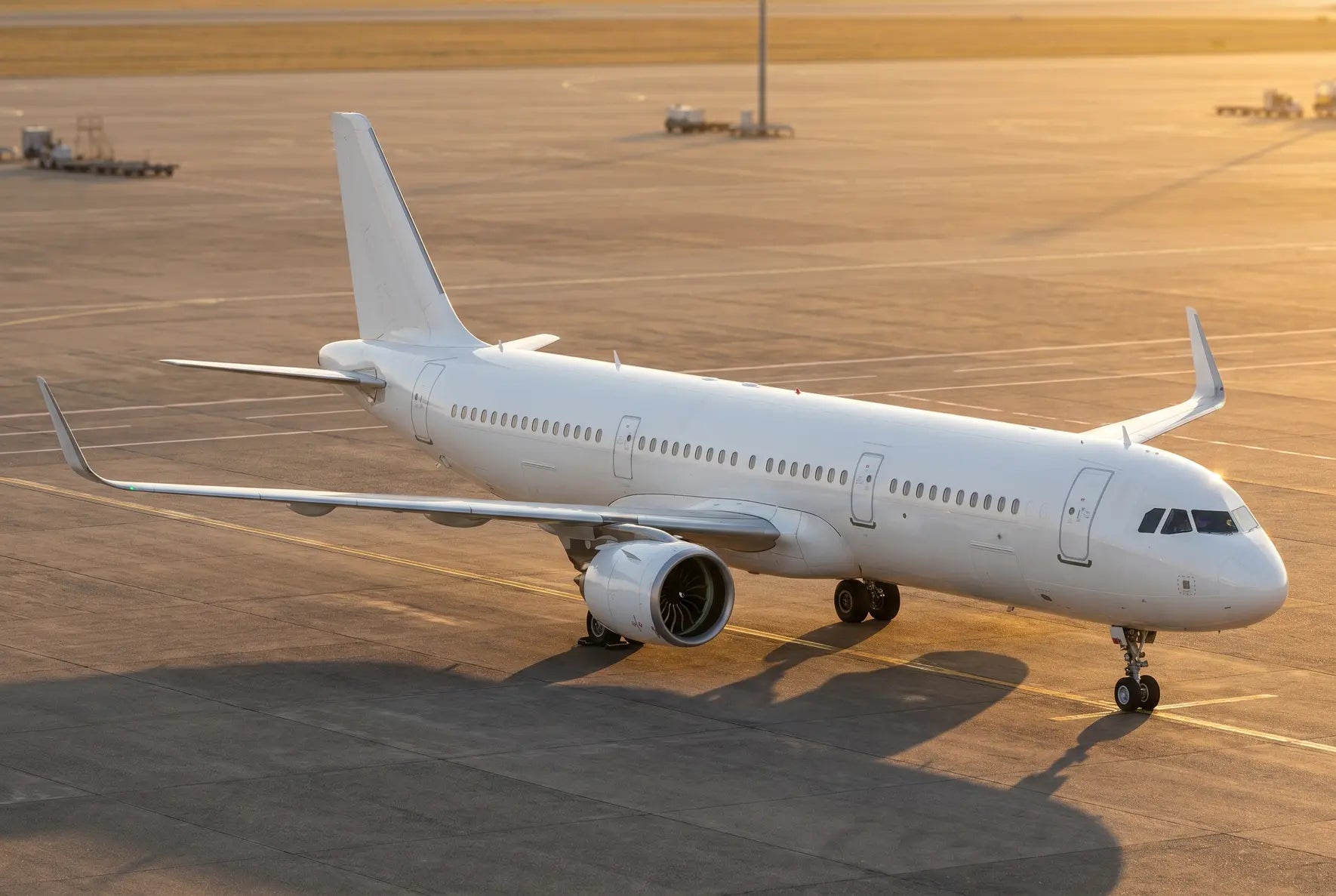
Airbus A321LR: History, Program Launch, and Development of the Long Range Variant
The Airbus A321LR (Long Range) is a derivative of the A321neo platform, itself part of the A320neo family announced by Airbus in December 2010. The A320neo family introduced next-generation engines, aerodynamic improvements including Sharklets, and cabin optimisations delivering approximately 20% lower fuel burn per seat compared with the previous-generation A320ceo family. As the largest member of the single-aisle lineup, the A321neo quickly attracted airline interest for longer, thinner routes previously served by wide-body or mid-size aircraft such as the Boeing 757. Airbus identified a growing market opportunity for a narrowbody capable of true transatlantic operations, and the A321LR was conceived to fill that gap.
In October 2014, Airbus began marketing a long-range version of the A321neo with a 97-tonne (214,000 lb) maximum take-off weight (MTOW) and up to three Additional Centre Tanks (ACTs). The variant was positioned as a direct competitor to the Boeing 757-200, offering roughly 15% to 30% lower fuel burn per seat and significantly improved economics on medium- to long-haul sectors. On 13 January 2015, Airbus formally launched the A321LR with Air Lease Corporation (ALC) as the launch customer. At that point, Airbus expressed an ambition to sell around 1,000 examples of the variant.
The first A321LR, MSN 7877, powered by CFM International LEAP-1A engines, completed its maiden flight on 31 January 2018 from Hamburg-Finkenwerder, lasting 2 hours and 36 minutes. A flight test programme of nearly 100 hours followed, including transatlantic demonstration missions. One notable test saw the aircraft fly from Toulouse to Mahé in the Seychelles, covering approximately 8,797 km (about 4,750 nm) in around 11 hours to validate long-range performance. On 2 October 2018, the A321LR received joint EASA and FAA type certification, which included approval for ETOPS 180 minutes, enabling the aircraft to operate virtually any standard North Atlantic route. The variant entered commercial service in late 2018 with Arkia Israeli Airlines as the launch operator.
Airbus assembles the A321LR primarily at its Hamburg (Germany) final assembly line, alongside production at other A320-family facilities in Toulouse, Mobile (Alabama), and Tianjin. The variant has since been adopted by airlines worldwide for transatlantic and medium- to long-haul narrowbody missions. Notable operators include JetBlue Airways, which took delivery of its first A321LR on 29 April 2021 to launch transatlantic services between New York and London, and Icelandair, which received its first example on 3 December 2024, becoming a new Airbus operator. For readers who want to dive deeper into the engineering, economics, and operational story behind aircraft like the A321LR, the book Ready for Takeoff offers a comprehensive resource that complements the technical knowledge covered here.
What Distinguishes the A321LR from the A321neo and A321XLR
The A321LR occupies a precise position between the standard A321neo and the ultra-long-range A321XLR. Structurally, the A321LR shares the same airframe as the base A321neo; the key difference lies in its fuel system and certified operating weight. While the standard A321neo can be configured for various missions, it does not include the additional fuel tankage or long-range certification of the LR. The A321LR achieves its extended range of approximately 4,000 nm (7,400 km) by installing up to three removable Additional Centre Tanks (ACTs) and certifying the airframe at 97 tonnes MTOW. These ACTs occupy space in the lower fuselage, which means a reduction in available cargo volume compared with a standard A321neo configuration.
In contrast, the A321XLR, formally launched by Airbus at the Paris Air Show in June 2019, takes a more integrated approach. It features a permanent Rear Centre Tank (RCT) of approximately 12,900 litres, a reinforced landing gear, and a higher MTOW of 101 tonnes, extending range to approximately 4,700 nm (8,700 km). The XLR is therefore a more structurally distinct variant, whereas the A321LR is essentially an A321neo adapted for longer range through modular fuel additions and associated certification changes. Both the LR and XLR offer the same engine options under the EASA type certificate for the A321neo family.
The following list summarises the verified variant identifiers of the Airbus A321LR:
- Engine options: CFM International LEAP-1A or Pratt & Whitney PW1100G-JM (Geared Turbofan)
- Wingtip type: Sharklets (as standard on all A320neo-family variants)
- MTOW: 97 tonnes (214,000 lb)
- Range: approximately 4,000 nm (7,400 km) with three ACTs
- Fuel system: up to three removable Additional Centre Tanks (ACTs)
- Seating capacity: up to 240 passengers (high-density); typically 170 to 220 in two-class layouts
- ETOPS: certified for 180-minute extended operations
- First flight: 31 January 2018
- Entry into service: late 2018 (Arkia Israeli Airlines)

A Wizz Air Airbus A321 in flight against a clear blue sky. The aircraft features the airline's distinctive pink and purple livery and is approaching for landing.
Airbus A321LR Technical Specifications, Systems and Engine Options
The Airbus A321LR (Long Range) is a derivative of the A321neo designed to unlock transatlantic and medium-haul overwater routes that were previously the domain of widebody aircraft. Its key design trade-off is straightforward: by raising the maximum takeoff weight to 97 tonnes and adding a third Additional Centre Tank (ACT) in the cargo hold, Airbus extended the range to approximately 4,000 nautical miles while retaining the A321neo's single-aisle economics and full commonality with the A320 family cockpit.
The airframe, wing, and empennage dimensions are identical to every other A321neo. What changes is the fuel system plumbing, structural reinforcement for the higher gross weight, and the performance databases loaded into the flight management system. The result is an aircraft that can seat around 206 passengers in a typical two-class layout and fly sectors such as New York-London or Dubai-Singapore nonstop, a capability that has made the A321LR popular with airlines seeking to open thin long-haul routes with lower risk than a widebody.
- Overall length: 44.51 m (146 ft)
- Wingspan (with Sharklets): 35.80 m (117 ft 5 in)
- Height: 11.76 m (38 ft 7 in)
- Wing area: 122.4 m²
- Fuselage external width: 3.95 m; cabin width approximately 3.70 m
- Maximum takeoff weight (MTOW): 97,000 kg (97 t)
- Maximum landing weight (MLW): 79,200 kg
- Maximum zero-fuel weight (MZFW): 75,600 kg
- Operating empty weight (OEW): approximately 52,100 kg (varies by operator configuration)
- Fuel capacity (with 3 ACTs): approximately 32,940 litres of usable fuel
- Range: approximately 4,000 nm (7,400 km) with a typical two-class, 206-seat layout and standard reserves
- Typical seating: 206 passengers (two-class); up to 244 in maximum single-class with Cabin-Flex exits
- Maximum cruise speed: approximately Mach 0.82 (Mmo); typical cruise around Mach 0.78
- Service ceiling: 39,000 ft (11,900 m)
- Engines: CFM International LEAP-1A or Pratt & Whitney PW1100G-JM, each rated up to approximately 35,000 lbf thrust
- Cargo volume: approximately 51.7 m³ (10 LD3-45 containers)
Systems Architecture and Handling Technology
The A321LR inherits the full Airbus fly-by-wire (FBW) flight control system common to the entire A320 family. Side-stick controllers send electrical signals to primary (PRIM) and secondary (SEC) flight control computers, which drive hydraulic actuators on the control surfaces. In normal law the system provides full envelope protections including load-factor limiting, high-angle-of-attack protection, bank-angle limiting and overspeed protection. Alternate and direct law modes are available as fallback after multiple failures, following the same logic used across every A320-family variant.
Braking is managed through a brake-by-wire system controlled by the Brake and Steering Control Unit (BSCU), which integrates autobrake modes for landing and rejected takeoff as well as anti-skid logic to optimise friction usage on the runway. Engine control on both available powerplants is handled by a Full Authority Digital Engine Control (FADEC) system, which manages fuel metering, variable geometry, start sequences and thrust-limit protection autonomously. The A321LR's flight management system (FMS) is parameterised for the variant's higher weights, additional fuel capacity and long-range mission profile, including step-climb optimisation and extended diversion time calculations relevant to ETOPS operations. The Centralised Maintenance System (CMS) and Aircraft Condition Monitoring System (ACMS) provide real-time health monitoring and fault logging, with data available for transmission via ACARS or SATCOM for predictive maintenance programmes. Pilots holding an A320 family type rating require no additional certification to fly the A321LR, thanks to full cockpit and procedural commonality.
Published performance figures for the A321LR should always be read in context. Range, takeoff field length and payload capability vary depending on the operator's cabin configuration and density, selected engine variant and thrust rating, atmospheric conditions (temperature, pressure altitude, wind), runway surface state, and the airline's reserve fuel policy. Airbus's headline figure of 4,000 nm assumes a specific two-class layout and standard reserves; a higher-density cabin or different reserve assumptions will shift the number in either direction. For regulatory dispatch, airlines rely on certified Aircraft Flight Manual data and performance computation tools rather than simplified marketing values.
Engines: LEAP-1A and PW1100G-JM Options
Airlines selecting the A321LR choose between two new-generation powerplants: the CFM International LEAP-1A and the Pratt & Whitney PW1100G-JM. Both were developed specifically for the A320neo family and deliver approximately 15 to 20 percent lower fuel consumption compared with the CFM56 and V2500 engines that powered previous-generation A321ceo aircraft.
The LEAP-1A is produced by CFM International, a 50/50 joint venture between GE Aerospace and Safran Aircraft Engines. LEAP stands for Leading Edge Aviation Propulsion. The engine family entered service in 2016, and the LEAP-1A variant received EASA type certification on the A321neo in March 2017 after more than 400 flight hours and 160 test flights. It is a direct-drive, high-bypass turbofan with a fan diameter of approximately 198 cm and a bypass ratio around 11:1. CFM has stated that the LEAP-1A was designed from the outset with 35,000 lbf thrust capability to support higher-MTOW and longer-range A321 variants, requiring no engine modifications for the A321XLR application. Beyond the A321LR, the LEAP-1A powers all A320neo-family aircraft (A319neo, A320neo, A321XLR), while the closely related LEAP-1B powers the Boeing 737 MAX family and the LEAP-1C is used on the COMAC C919.
The PW1100G-JM is part of Pratt & Whitney's PurePower Geared Turbofan (GTF) family. Its defining feature is a fan drive gear system that decouples the fan from the low-pressure turbine, allowing each to spin at its optimal speed. This geared architecture results in a larger fan diameter of approximately 206 cm and a higher bypass ratio of roughly 12:1 compared with the LEAP-1A. The A321neo received type certification with the PW1100G-JM in December 2016, making it the first engine option cleared for service on the longest-fuselage A320-family member. On the A321neo/LR the PW1100G-JM is rated in the 143 to 147 kN range (approximately 32,160 to 33,110 lbf). Related GTF variants also power the Embraer E-Jets E2 family (PW1700G/PW1900G) and the Mitsubishi SpaceJet programme (PW1200G). Much like the long-range piston airliners of earlier decades, such as the Tupolev Tu-114, the A321LR demonstrates how advances in propulsion technology continue to push the range boundaries of each aircraft generation. Both engine options share the same nacelle mounting points on the A321LR wing, and the choice between them has no impact on cockpit procedures or type rating requirements.
Airbus A321LR vs A321neo vs A321XLR vs Boeing 737 MAX 9: Specs Comparison
Scroll horizontally to see more →
| Parameter | Airbus A321LR | Airbus A321neo | Airbus A321XLR | Boeing 737 MAX 9 |
|---|---|---|---|---|
| Entry into service | 2018 | 2017 | 2024 | 2018 |
| Engines | 2 × Pratt & Whitney PW1100G-JM or CFM LEAP-1A | 2 × Pratt & Whitney PW1100G-JM or CFM LEAP-1A | 2 × Pratt & Whitney PW1100G-JM or CFM LEAP-1A | 2 × CFM International LEAP-1B |
| Length | 44.5 m | 44.5 m | 44.51 m | 42.16 m |
| Wingspan | 35.8 m | 35.8 m | 35.8 m | 35.9 m |
| Height | 11.75 m | 11.76 m | 11.76 m | 12.3 m |
| Typical seating and layout (short description + approximate passengers) | 2-class: 180–206 passengers | 2-class: 180–220 passengers | 2-class: 206–220 passengers | 2-class: 178–193 passengers |
| MTOW | 97 t | 97 t | 101 t | 88 t |
| Range | 4,000 nm | 3,500 nm | 4,700 nm | 3,300 nm |
| Cruise speed | 0.78 Mach | 0.78 Mach | 0.78 Mach | 0.79 Mach |
| Service ceiling | 39,000 ft | 39,000 ft | 39,000 ft | 41,000 ft |
| Program note | Long-range variant of the A321neo with extra fuel tanks, aimed at thinner transatlantic and long overwater narrow-body routes. | Baseline A321neo model offering improved fuel efficiency and capacity over A321ceo for short- to medium-haul markets. | Extra-long-range evolution of the A321neo with a new rear centre tank, targeting single-aisle missions traditionally flown by small widebodies. | Stretched member of the 737 MAX family, Boeing’s competitor in the high-capacity single-aisle and medium-haul segment. |
Scroll horizontally to see more →
The table compares key specs of the A321LR, A321neo, A321XLR and 737 MAX 9. Airbus variants share the same engine options and near-identical dimensions, while the MAX 9 is shorter and slightly wider in wingspan. Range is the main differentiator: A321neo leads at 3,500 nm, A321LR extends to 4,000 nm, and A321XLR reaches 4,700 nm with higher MTOW. The MAX 9 offers 3,300 nm and a higher 41,000 ft ceiling.
Airbus A321LR Operations: Routes, Missions and Airlines Around the World
The Airbus A321LR was designed to serve long, thin routes where demand does not justify a widebody aircraft such as the Boeing 787 or Airbus A330. With a maximum range of 4,000 nautical miles (7,400 km) and a maximum take-off weight of 97 tonnes, this variant bridges the gap between short-haul narrowbodies and twin-aisle long-haul jets. Its three Additional Centre Tanks (ACTs) give it the fuel capacity to cross the North Atlantic or link distant regional pairs nonstop, typically carrying around 170 to 206 passengers in a two-class configuration.
Most scheduled Airbus A321LR services fall in the 5-to-8-hour range, covering sector distances of roughly 2,500 to 3,500 nm. Transatlantic routes such as Dublin to Boston (approximately 2,600 nm) or Lisbon to New York (approximately 3,100 nm) represent the aircraft's core mission profile. Daily utilisation typically ranges from 10 to 14 block hours on long-haul-focused fleets, with operators often scheduling one transatlantic round trip per day or combining a long-haul sector with a medium-haul leg to maximise aircraft productivity.
The Airbus A321LR fits both hub-and-spoke and point-to-point network strategies. In hub operations, it serves as a spoke extender, linking a major hub to secondary or tertiary cities across an ocean that could not fill a widebody year-round. In point-to-point networks, low-cost and hybrid carriers use it to open direct city pairs bypassing traditional hubs, offering single-aisle operating economics with long-range capability. The aircraft can operate from shorter runways and requires less ground infrastructure than twin-aisle types, making it suitable for regional and secondary airports.
Operators do face specific challenges. On westbound transatlantic flights during winter, jetstream headwinds exceeding 100 knots can increase fuel burn significantly, sometimes requiring payload restrictions such as seat blocks, baggage limits or reduced cargo. The 97-tonne MTOW leaves limited margin when fuel loads are high, and belly cargo is often zeroed out on the longest sectors. The single-aisle cabin also demands careful service planning: meal service for up to 200 passengers through one aisle on a 7-hour flight requires efficient sequencing, and galley and lavatory space is tighter than on widebodies. ETOPS certification up to 180 minutes requires careful alternate planning over the North Atlantic, adding reserve fuel that further tightens payload margins. Despite these constraints, the Airbus A321LR remains highly effective on routes where demand is consistent but insufficient for larger aircraft. For a comparison with a dedicated freighter designed for a very different mission, see the Boeing 747-200F.
Where the Airbus A321LR Operates by Region
The Airbus A321LR has found its strongest foothold on transatlantic routes between Europe and North America, where it replaced older widebodies on thinner city pairs. In Europe, network carriers and leisure airlines deploy it on medium- and long-haul routes to destinations across the Atlantic and to the Middle East. In the Americas, Canadian leisure operators use it extensively on seasonal and year-round transatlantic services. Across Asia and the Middle East, full-service and low-cost carriers alike fly the type on routes connecting the Gulf region to Europe, South Asia and Southeast Asia. In Africa, no African-based carrier currently operates the Airbus A321LR, though several European operators serve African destinations with the type from their home bases.
- Europe: TAP Air Portugal operates approximately 10 to 12 Airbus A321LR aircraft on routes from Lisbon and Porto to North America and Africa, making it one of the largest European operators of the type. Aer Lingus flies around 8 units on transatlantic services from Dublin to US cities including Boston, New York and Washington. Azores Airlines (SATA) uses 3 aircraft to connect the Azores with mainland Europe and North America. SAS has deployed A321LR-configured aircraft on Scandinavian routes to the US East Coast. Hi Fly, based in Portugal, operates one unit for ACMI and wet-lease missions.
- North & South America: Air Transat is a major operator with approximately 12 Airbus A321LR aircraft, using them extensively on leisure routes between Canada and Europe, including France, the United Kingdom, Spain and Portugal. In South America, no carrier currently operates a confirmed A321LR fleet, although some European operators serve South American destinations with the type.
- Asia & Middle East: Etihad Airways has ordered 30 Airbus A321LR aircraft and has begun deploying them from Abu Dhabi to destinations including Bangkok, Phuket, Copenhagen, Düsseldorf, Kolkata and Chiang Mai. Air Arabia operates several A321LR units on medium-haul routes from the UAE. Air Astana flies approximately 3 aircraft from Kazakhstan to European destinations such as London and Paris. In East Asia, Air Busan operates the type on longer regional leisure routes from South Korea.
- Africa: No African-registered airline currently operates the Airbus A321LR. However, TAP Air Portugal and Azores Airlines serve African destinations from their European bases using the type, connecting cities in West Africa and North Africa to Lisbon and the Azores.
Typical Seating Configurations on the Airbus A321LR
Cabin layouts on the Airbus A321LR vary significantly depending on the operator's business model. Network carriers typically configure the aircraft with 160 to 190 seats in two classes, featuring lie-flat business class seats in the forward cabin and a 3-3 economy layout at approximately 30 to 31 inches of pitch. Aer Lingus, for example, fits 16 business class and 168 economy seats for a total of 184. Etihad Airways stands out with a rare three-class narrowbody configuration: 2 First Suites, 14 business class seats and 144 economy seats, totalling 160.
Leisure and hybrid operators tend toward higher-density layouts in the range of 190 to 210 seats. Air Transat configures its fleet with 12 Club Class recliner seats and 187 economy seats for a total of 199, balancing a modest premium offering with strong capacity. At the premium end of the spectrum, JetBlue offers one of the most distinctive layouts: just 114 seats total, with 24 Mint lie-flat suites including 2 front-row Mint Studio suites, alongside approximately 90 Core economy seats. Low-cost carriers that adopt the A321LR generally favour single-class economy layouts of 200 to 220 seats with 28 to 30 inches of standard pitch and a small number of extra-legroom rows. Across all operator types, the Airbus A321LR demonstrates remarkable cabin flexibility, allowing airlines to tailor the interior from ultra-premium boutique to high-density leisure depending on the route and market.
In this video, fly Air Transat’s Airbus A321LR from Calgary to Montreal, showcasing Canada’s first A320neo family aircraft and explaining why this airline is the country’s third largest operator.
Airbus A321LR Safety Record: How Safe Is This Long-Range Narrowbody?
The Airbus A321LR has been in commercial service since 2018, when TAP Air Portugal took the first delivery. Since then, the type has accumulated thousands of revenue flights across operators such as Aer Lingus, JetBlue, Air Transat, SAS and Etihad Airways. As of early 2025, well over 200 A321LR airframes had been delivered worldwide, and the broader A321neo family counts several thousand aircraft in active service. In that time, no A321LR or A321neo variant has been involved in a hull-loss accident or fatal crash. The Aviation Safety Network A321 database confirms that all recorded hull-loss events and fatal accidents for the A321 type occurred on earlier ceo-generation airframes, not the neo or LR sub-variants.
This clean record should be viewed in context. The A321LR is part of the wider Airbus A320 family, which has logged more than 293 million flights since entering service in 1988. Through 2015 the entire family recorded a fatal hull-loss rate of roughly 0.12 per million departures, placing it among the safest single-aisle fleets ever built. According to Airbus's own statistical analysis, Generation 4 fly-by-wire aircraft (which include every A320-family member) have reduced loss-of-control-in-flight fatal accident rates by 91 percent compared with the preceding generation, and have recorded zero fatal LOC-I or CFIT events over the most recent ten-year window.
Notable A321 Accidents and Their Legacy
Although the A321LR itself has no hull-loss history, several high-profile events involving the older A321ceo have shaped the safety standards that protect today's fleet.
- Metrojet Flight 9268 (October 2015) - An A321-231 broke up in flight over the Sinai Peninsula after departing Sharm el-Sheikh for St. Petersburg, killing all 224 occupants. Investigators determined that a terrorist bomb caused the in-flight disintegration. The event was unrelated to any airframe deficiency but prompted sweeping improvements to airport screening procedures and baggage security protocols at high-risk airports worldwide.
- Airblue Flight 202 (July 2010) - An A321-231 struck the Margalla Hills near Islamabad during a circling approach in poor visibility, resulting in 152 fatalities. The investigation classified the crash as Controlled Flight Into Terrain (CFIT) caused by procedural deviations and inadequate cockpit resource management. It reinforced the importance of strict adherence to standard operating procedures, enhanced approach training and effective crew coordination, lessons now embedded in every A320-family operator's training programme.
- Ural Airlines Flight 178 (August 2019) - An A321-211 ingested a flock of birds shortly after take-off from Zhukovsky near Moscow, causing dual-engine power loss. The crew performed a gear-up landing in a cornfield with 233 people on board; there were no fatalities. The event highlighted the need for improved wildlife-hazard management around airports and became a textbook case for off-airport forced-landing procedures. It also reinforced training scenarios for dual-engine-failure emergencies across the industry.
Each of these events, though involving earlier A321ceo airframes, fed directly into design refinements, updated training syllabi and tightened regulations that benefit every current A321neo and A321LR operation.
How Safe Is the Airbus A321LR Today?
The A321LR inherits the Airbus fly-by-wire flight-envelope protection philosophy that has been central to the A320 family since 1988. In normal law, the flight control computers prevent the aircraft from exceeding safe angle-of-attack limits, structural load factors, maximum bank angles and speed boundaries. Features such as alpha-floor protection, which automatically commands go-around thrust when the angle of attack becomes critically high, provide an additional safety net against low-energy scenarios. These protections have been directly credited with the 91 percent reduction in loss-of-control accidents for Generation 4 Airbus types.
Compared with the A321ceo, the A321LR benefits from new-generation engines (CFM LEAP-1A or Pratt & Whitney PW1100G-JM) with advanced FADEC monitoring, an updated flight management system and enhanced predictive-maintenance capabilities. For long-range missions, the variant must also meet stringent ETOPS/EDTO certification requirements, which impose higher standards for systems reliability, dispatch conditions and crew preparedness than standard short-haul operations. These requirements add another layer of regulatory scrutiny from authorities such as EASA and the FAA.
From a statistical perspective, the global commercial jet fatal accident rate stood at approximately 0.03 fatalities per million sectors in recent years, and the A320 family consistently performs at or below that benchmark. Passengers travelling on an A321LR, or on a comparable modern narrowbody such as the Boeing 767-400ER, benefit from decades of iterative safety improvements, rigorous airworthiness directives and continuous oversight by international regulators.
Aviation remains one of the safest forms of transport. The A321LR's combination of a clean accident record, proven fly-by-wire protections, modern powerplants and strict regulatory oversight places it firmly among the most reliable commercial aircraft currently in service.
01 What is the typical range and mission profile of the Airbus A321LR?
The Airbus A321LR is the long-range version of the A321neo, designed to fly medium- to long-haul routes that do not require a widebody aircraft. Its advertised range is about 4,000 nautical miles, which makes it suitable for transatlantic city pairs, thinner long-haul markets, and longer domestic routes where demand is not high enough for larger jets. In practice, airlines use it to connect secondary cities, open new nonstop routes, and improve economics on routes that would otherwise need a connection.
02 How does the Airbus A321LR compare with the A321neo and A330 on comfort?
The Airbus A321LR has the same narrow-body cabin width as other A321 variants, so it usually feels more compact than a widebody such as the A330. Comfort depends heavily on airline layout, but the A321LR is often fitted with fewer premium seats, slimmer seats, and enhanced cabin features to make longer flights more manageable. For many passengers, the main advantage is direct service on routes that would otherwise require a connection, even if the cabin is not as spacious as a twin-aisle aircraft.
03 Which airlines commonly operate the Airbus A321LR and what routes do they use it for?
The Airbus A321LR is used by a mix of full-service and low-cost airlines, especially carriers that want to open long thin routes efficiently. It is common on transatlantic services, longer Europe-to-Middle East or Europe-to-Africa sectors, and extended domestic or regional routes in markets such as North America, Europe, and Asia-Pacific. Airlines often deploy it where demand is strong enough for a nonstop flight but not enough to fill a widebody every day.
04 Is the Airbus A321LR fuel efficient?
Yes. The Airbus A321LR is widely chosen because it offers better fuel efficiency per seat than many older narrow-body and some widebody aircraft on lower-demand long routes. That efficiency comes from the A321neo family’s newer engines, improved aerodynamics, and the ability to carry more passengers with lower trip costs than a larger aircraft would need. It is especially attractive for airlines trying to reduce operating costs while keeping nonstop service.
05 What should passengers know about seats, windows, and cabin noise on the Airbus A321LR?
The Airbus A321LR is a narrow-body aircraft, so seat width and aisle space depend a lot on the airline’s chosen cabin layout. Window alignment can vary by row because different airlines use different seat maps and exit configurations, so checking the exact aircraft seat plan before booking is useful. Cabin noise is usually lower than on older narrow-bodies thanks to newer engine technology, but it will still feel louder than most widebody aircraft in the main cabin.
06 Is the Airbus A321LR safe, and what design features matter most?
The Airbus A321LR is part of the well-established A320 family, one of the most widely operated aircraft families in commercial aviation. Its safety record is tied to the broader A321neo and A320neo platform, which includes modern flight controls, updated avionics, and efficient turbofan engines certified for demanding commercial use. As with any airliner, safety depends on the operator’s maintenance, training, and procedures, but the type itself is a mature and heavily regulated design.