

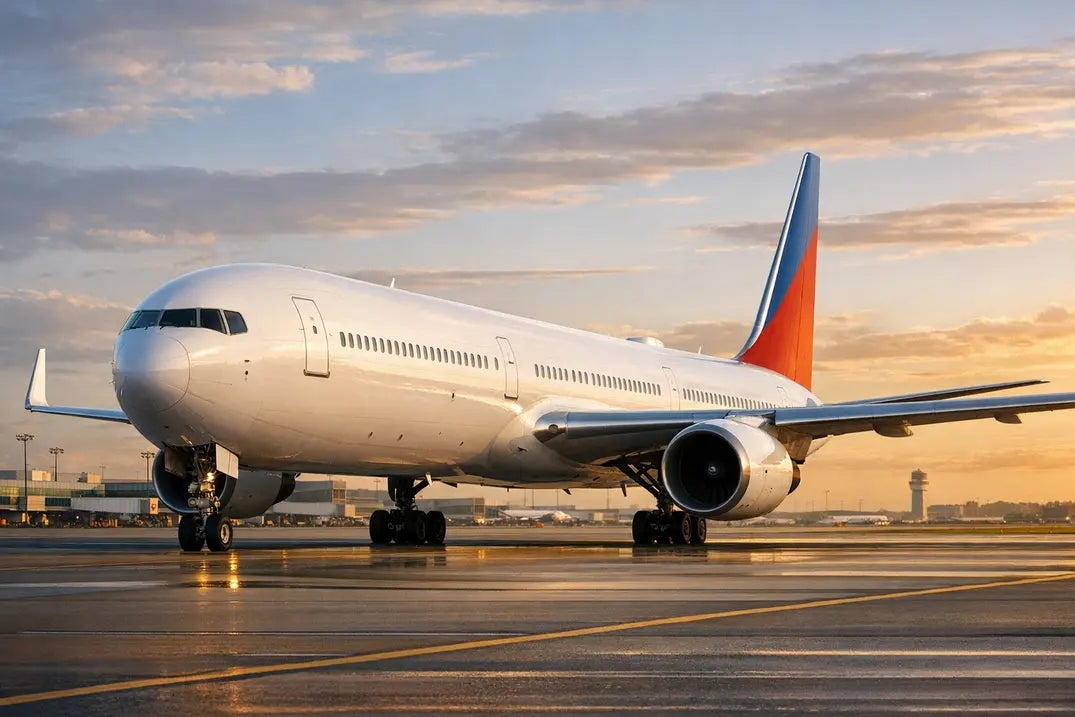
Boeing 767‑400ER programme history: launch, development and what changed
The Boeing 767 family was designed as a twin aisle widebody for medium and long haul routes. By the late 1990s, airlines operating older tri jets were seeking similar capacity with lower fuel and maintenance costs, while keeping crew training and fleet flexibility under control. Boeing created the Boeing 767‑400ER as the largest passenger 767, positioned between the 767‑300ER and the 777‑200 and aimed at replacements such as Continental’s DC‑10s and Delta’s L‑1011s, as described in Boeing’s Continental delivery release and Boeing’s Delta delivery coverage.
Regulatory and programme work started before the public launch. In January 14, 1997 Boeing applied for an amendment to FAA Type Certificate No. A1NM to include the new Model 767‑400ER. The FAA later issued special conditions describing a strengthened airframe with seating up to 375 and a maximum takeoff weight of 450,000 lb, published in the Federal Register. Boeing formally launched the programme in April 1997 with an order for 21 aircraft from Delta Air Lines, as stated in Boeing’s first flight news release.
Manufacture and flight testing were centred in Everett, Washington. Boeing rolled out the first aircraft in August 1999 and flew it on October 9, 1999 from Paine Field, starting a multi aircraft flight test programme planned at about 800 flight hours. Boeing highlighted defining upgrades including a 777 style display arrangement, aerodynamic wingtip extensions, revised landing gear and higher electrical capacity for full cabin inflight entertainment, as described in Boeing’s first flight announcement. On the propulsion side, GE developed the CF6‑80C2B8F as a CF6 variant intended for the 767‑400ER, detailed by GE Aerospace.
The FAA certification milestone came on July 20, 2000, when Boeing announced approval of the amended type certificate and production authorisation for the 767‑400ER (see Boeing’s certification announcement). On August 21, 2000 Boeing said the FAA granted the flight crew qualification endorsement supporting the 767 type rating and the 757/767 common type rating philosophy (see FAA common type rating endorsement). Customer deliveries began in August 2000. Delta took delivery of its first aircraft on August 11, 2000 and began revenue service on October 1, 2000 (see Delta Flight Museum fleet history). Continental took delivery on August 31, 2000, with Boeing emphasising raked wing tips, increased takeoff weight and an all new main landing gear (see Continental first delivery release). In September 2000 Boeing said it had begun production on a longer range 767‑400ER advertised at 6,150 nautical miles (see Boeing’s October 2000 programme update).
For pilots and engineers, the 767‑400ER’s distinctiveness is as much about commonality as it is about size. Boeing linked the common type rating to cockpit design choices, including an all glass flight deck and a six display layout intended to reduce parts count and simplify maintenance (see FAA common type rating endorsement). Because crews can qualify with minimal instruction from other 757 and 767 variants, operators can focus training on procedural differences. Modern tools such as virtual reality as a method for training pilots can support that transition before full flight simulator sessions.
The programme also launched during a period of intense manufacturer competition and fleet renewal. FlightGlobal reported that Boeing’s exclusive supply agreements with major US airlines, including the Continental deal that covered the 767‑400ER, drew antitrust scrutiny in the European Commission review of Boeing’s McDonnell Douglas acquisition (see FlightGlobal’s coverage).
How the Boeing 767‑400ER differs from the closest 767 subvariants
Compared with the 767‑300ER, the 767‑400ER is a 21 foot fuselage stretch. Delta’s fleet history records the stretch to 201.4 ft and a wingspan increase of 14.3 ft to 170 ft 4 in, achieved with raked wing tips intended to improve fuel efficiency (see Delta Flight Museum fleet history). The FAA certification basis records the strengthened structure and the 450,000 lb maximum takeoff weight used to support higher loads and weights (see the Federal Register special conditions). Boeing also highlighted improved electrical and air conditioning systems plus an all new main landing gear on first customer deliveries (see the Continental first delivery release).
Variant identifiers that help confirm a Boeing 767‑400ER include:
- Fuselage stretch of 21 foot relative to the 767‑300ER (overall length 201.4 ft).
- Raked wing tips and a 170 ft 4 in wingspan (an increase of 14.3 ft).
- Strengthened structure with a maximum takeoff weight of 450,000 lb.
- Flight deck updates supporting the 757/767 common type rating philosophy.
- Systems changes including higher electrical capacity and improved air conditioning systems.
- Engine listings typically cite Pratt & Whitney PW4062 or GE CF6‑80C2B8F (see SKYbrary’s B764 profile for a consolidated overview).
For deeper technical cross checks (geometry, servicing and pavement data), Boeing publishes airport planning manuals for the 767 family via its Airplane Characteristics for Airport Planning library.

A Delta Air Lines Boeing 767-332 aircraft, registration N130DL, takes off against a clear blue sky, showcasing the airline's distinctive red, white, and blue livery.
Boeing 767‑400ER technical specifications and systems highlights
The Boeing 767‑400ER is the stretched, highest weight passenger variant of the 767 family, built to add seating and payload while retaining twin engine widebody economics. In Boeing’s Airplane Characteristics for Airport Planning it is described as 21 ft longer than the 767‑300, paired with a new generation wing design and new engines to support long range missions with additional payload.
To fit airline fleets already flying the 757 and 767, the 767‑400ER introduced a flight deck upgrade aimed at common controls, displays and procedures, and it retains the same type rating as the 767‑200 and 767‑300. Fleet commonality also shapes training capacity and pilot recruitment planning.
- Overall length: 201 ft 4 in (61.37 m) airline published on Delta’s 767‑400ER specifications.
- Wingspan: 170 ft 4 in (51.9 m) airline published on Delta’s specifications.
- Tail height: 55 ft 4 in (16.9 m) airline published on Delta’s specifications.
- Maximum design taxi weight: 451,000 lb (204,570 kg) in Boeing airport planning data.
- Maximum design takeoff weight (MTOW): 450,000 lb (204,116 kg) in Boeing airport planning data; the FAA certification notice also cites 450,000 lb.
- Maximum design landing weight: 350,000 lb (158,757 kg) in Boeing airport planning data.
- Maximum design zero fuel weight: 330,000 lb (149,685 kg) in Boeing airport planning data.
- Typical operating empty weight (OEW): 227,400 lb (103,146 kg) with GE engines and 229,000 lb (103,872 kg) with Pratt & Whitney engines, per Boeing airport planning data.
- Maximum structural payload: 102,600 lb (46,538 kg) with GE engines and 101,000 lb (45,812 kg) with Pratt & Whitney engines, per Boeing airport planning data.
- Usable fuel: 24,140 US gal (91,379 L), fuel weight 161,738 lb (73,377 kg) in Boeing airport planning data.
- Lower deck cargo volume: 4,905 cu ft (138.9 m³) in Boeing airport planning data, with space for 20 LD‑2 containers forward, 18 LD‑2 containers aft, plus a 345 cu ft bulk compartment.
- Cabin layouts (reference configurations): 243 three class, 296 two class, and 409 all economy are shown in Boeing airport planning data (weights are published for a baseline configuration of 296 passengers). An FAA notice for the model describes seating capacity up to 375.
- Published cruise speed and range: 525 mph (845 km/h) and 6,020 miles (9,688 km) on Delta’s specifications page; treat as configuration dependent.
- Engine options and thrust class: GE CF6‑80C2B8F or Pratt & Whitney PW4062; Boeing planning data lists a 60,600 lbf takeoff thrust rating, while the FAA certification notice describes each engine as capable of 62,000 lbf.
Flight deck, control architecture and maintenance features
The FAA certification basis for the Model 767‑400ER describes a swept wing, conventional tail, twin engine transport, with flight controls unchanged beyond the adaptations required by the stretched configuration. For crews, this continuity helps keep core handling and procedural expectations aligned with earlier 767 variants even though the airframe is heavier and longer.
According to the 767‑400ER flight deck upgrade brief, commonality drove the cockpit design so the aircraft could operate as part of existing 757 and 767 fleets with the same type rating. The upgrade’s large format display system uses six 8 by 8 inch LCD displays to present primary flight and navigation, engine indication and crew alerting system, system synoptics, interface controls and maintenance pages.
Behind the screens, the upgraded architecture reduces component count and replaces older display technology, while improving redundancy so the display system can remain usable after failures. The same brief also highlights maintenance driven enhancements including a third multifunction control display unit to improve access to maintenance data, improved built in test equipment, easier equipment access, and wider use of onboard software loading to support faster troubleshooting and software currency.
A more subtle operational change is landing gear control: the brief notes a move from a three position mechanically actuated lever to a two position electrically actuated lever, using auto off logic to remove hydraulic pressure once the landing gear is fully up and locked.
Published performance figures for the 767‑400ER vary because they depend on assumptions about payload, passenger count, reserves, atmospheric model, engine rating, and the regulatory takeoff and landing definitions being used. Operator options such as cabin density and equipment, as well as day to day factors like temperature, wind, runway slope and contamination, can move the limiting weight and required runway length significantly, so figures should be read as scenario based rather than absolute.
Engines and propulsion: CF6 and PW4000 family options
The 767‑400ER was offered with two high bypass turbofan options: the GE Aerospace CF6‑80C2B8F and the Pratt & Whitney PW4062. Boeing planning data lists both in the 60,600 lbf takeoff thrust class, while the FAA certification notice describes each engine as capable of 62,000 lbf.
The CF6‑80C2 family is a long running GE widebody programme. In GE’s CF6‑80C2 programme overview, the manufacturer reports entry into service in 1985, more than 3,800 engines delivered, and more than 173 million flight hours, with certification across multiple widebody applications including Boeing 767 and 747 aircraft, Airbus A300 and A310, and the MD‑11. For the 767‑400ER specifically, GE’s development release on the CF6‑80C2B8F reports a thrust increase of more than two percent over the CF6‑80C2B7F and the introduction of GE90 derived turbine architecture with a Rene 88 high pressure turbine rotor, targeting improved durability and parts life.
The PW4062 belongs to Pratt & Whitney’s PW4000‑94 inch family. Pratt & Whitney states that the PW4000‑94 covers 52,000 to 62,000 pounds of thrust, uses full authority digital engine control, and is approved for 180 minute ETOPS. In a programme milestone update, Pratt & Whitney reports that the PW4000‑94 has more than 35 years of operational experience and has surpassed 150 million flight hours, with applications that include Boeing 747 and 767 fleets, the MD‑11, Airbus A300 and A310, and the KC‑46A.
Comparison of Boeing 767 and 777 Widebody Aircraft Variants
Scroll horizontally to see more →
| Parameter | Boeing 767-400ER | Boeing 767-300ER | Boeing 767-200ER | Boeing 777-200ER |
|---|---|---|---|---|
| Entry into service | 2000 | 1988 | 1984 | 1997 |
| Engines | 2 × GE CF6-80C2 or PW4000 | 2 × GE CF6-80C2 or PW4000 | 2 × GE CF6-80 or PW4000 | 2 × GE90 or PW4000 or Trent 800 |
| Length | 61.4 m | 54.9 m | 48.5 m | 63.7 m |
| Wingspan | 51.9 m | 47.6 m | 47.6 m | 60.9 m |
| Height | 16.8 m | 15.9 m | 15.9 m | 18.5 m |
| Typical seating and layout | 3-class: 245 passengers | 3-class: 218 passengers | 3-class: 174 passengers | 3-class: 301 passengers |
| MTOW | 204 t | 187 t | 156 t | 297 t |
| Range | 5,625 nm | 6,750 nm | 6,850 nm | 7,725 nm |
| Cruise speed | 0.80 Mach | 0.80 Mach | 0.80 Mach | 0.84 Mach |
| Service ceiling | 43,000 ft | 43,000 ft | 43,000 ft | 43,100 ft |
| Program note | Stretched long-range variant of 767 family with extended fuselage and raked wingtips | Baseline extended-range workhorse of 767 family | Original short-fuselage long-range pioneer of 767 family | Larger twin-aisle competitor with greater capacity and range |
Scroll horizontally to see more →
This table compares key specifications of the Boeing 767-400ER, 767-300ER, 767-200ER, and 777-200ER. The 767-400ER is the largest and newest 767 variant with a long fuselage and raked wingtips, but it has a shorter range than the earlier 767-300ER and 767-200ER. The 777-200ER offers significantly greater capacity, range, and overall size, showcasing its position as a higher-performance, newer-generation widebody.
Boeing 767‑400ER: typical routes, missions and airlines worldwide
The Boeing 767‑400ER, often filed as 764 in schedules, sits between long range widebody routes and high demand domestic flying. Delta Air Lines lists a cruising speed of 525 mph and a range of 6,020 miles for its Boeing 767‑400ER, giving it practical reach for transatlantic services, premium transcontinental sectors and selected South America missions. In passenger airline service, the type is chiefly flown by Delta Air Lines and United Airlines, with Continental Airlines as the launch operator. Key in service figures and a current seat map are published on Delta Air Lines.
Typical missions and flight lengths
On the North Atlantic, the Boeing 767‑400ER is commonly used on overnight westbound departures and daylight eastbound returns that feed hub connection banks. A scheduled Atlanta to London Heathrow sector can be about 8 hours 15 minutes, while London Heathrow to Atlanta is about 9 hours 15 minutes to 10 hours 10 minutes depending on season. United Airlines operates similar stage lengths such as Newark to Paris Charles de Gaulle at around 7 hours 45 minutes. When deployed on long domestic routes, block times typically sit in the 4 to 6 hour range, for example New York JFK to San Diego around 6 hours 23 minutes westbound and about 5 hours 20 minutes eastbound.
In South America flying, the type can cover near 10 hour missions: United Airlines lists Washington Dulles to Sao Paulo (UA861) at about 9 hours 50 minutes, with the return about 9 hours 55 minutes to 10 hours 10 minutes. These timings drive utilisation patterns that are easy to recognise in schedules: one long haul out and back can deliver roughly 17 to 20 hours of airborne time in a calendar day, whereas domestic pairings create more turnarounds and ground handling cycles for the same aircraft. Individual aircraft assignments change frequently, so routes may be seasonal or short term.
Operationally, the Boeing 767‑400ER is best suited to hub and spoke networks with widebody gates, long range catering and baggage capacity, and strong premium demand. Using it on domestic routes can be attractive for capacity and cargo, but it also requires widebody ground equipment and can lengthen turnarounds compared with narrowbody fleets. Because each operator runs a small number of 767‑400ERs, maintenance events can reduce schedule resilience and force last minute equipment swaps.
Where the Boeing 767‑400ER operates worldwide
Today, the Boeing 767‑400ER is most visible on routes linking North & South America with Europe, plus selected long domestic sectors within the United States. In Europe, it is a familiar visitor at large transatlantic gateways such as London Heathrow and Paris Charles de Gaulle. In North & South America, it supports both domestic trunk flying and international routes such as Washington Dulles to Sao Paulo. In Asia, scheduled appearances are uncommon and typically occur as substitutions or positioning flights. In Africa, the type remains rare but has been selected for Atlanta to Marrakech, announced by Delta Air Lines for launch on October 25, 2025, with details published in Delta Air Lines route updates.
- Europe: Delta Air Lines uses the Boeing 767‑400ER on transatlantic services from its hubs to major gateways such as London Heathrow. United Airlines uses it from Newark and Washington Dulles to cities such as Paris Charles de Gaulle. Continental Airlines introduced the type on transatlantic flying from Newark.
- North & South America: Delta Air Lines uses the 767‑400ER on long domestic routes and premium heavy markets, and for positioning ahead of international departures. United Airlines uses it on domestic sectors and long haul to Brazil, including Washington Dulles to Sao Paulo. Continental Airlines operated the variant on US domestic and international services from its hubs.
- Asia: There is no major Asia based airline fleet of the Boeing 767‑400ER. Delta Air Lines has scheduled occasional one off substitutions such as Tokyo Haneda to Honolulu. United Airlines and Continental Airlines have generally focused the type on the Atlantic and the Americas rather than scheduled Asia routes.
- Africa: The Boeing 767‑400ER is uncommon in African skies compared with other widebodies. Delta Air Lines plans 767‑400ER operations on Atlanta to Marrakech. United Airlines serves Africa with other aircraft types, so 767‑400ER appearances are limited. Continental Airlines did not build a sustained Africa network with this variant.
Typical seating and cabin layouts
The Boeing 767‑400ER is almost exclusively used by network carriers, so cabin layouts prioritise premium products over maximum density. Economy is normally arranged in a 2‑3‑2 layout, avoiding a middle seat pair by the windows and keeping aisles relatively clear. Delta Air Lines publishes a 238 seat configuration with four cabins: 34 Delta One, 20 Delta Premium Select, 28 Delta Comfort+, and 156 Main Cabin, plus seat dimensions on its Delta Air Lines Boeing 767‑400ER page. For engineers and planners assessing gate fit and servicing constraints, Boeing’s airport planning manuals provide standardised aircraft characteristics for the 767 family.
This video presents a closer look at United Airlines' least used aircraft in recent times, the Boeing 767-400ER, and explores how a number of these jets returned to service after long-term storage.
Boeing 767-400ER safety record and how safe the type is today
Boeing 767-400ER is the largest passenger member of the 767 family and has been in airline service since 2000. Boeing delivered Delta Air Lines’ first aircraft in August 2000, and Delta was the launch customer with an order for 21 aircraft; Continental Airlines also introduced the type with an order for 26. That limited production run means the passenger fleet is small, but it has still accumulated extensive exposure through routine long haul and high utilisation hub flying: every sector adds flight hours and a pressurisation cycle. In terms of recorded safety history, the Boeing 767-400 (ICAO type designator B764) entries in the Aviation Safety Network database show a small number of occurrences and no fatal events.
From a certification standpoint, the 767-400ER was approved under the same FAA transport category framework applied to other large jets, including published special conditions during the amended type certificate process. The model also received an FAA common type rating endorsement with other 767 variants and the 757, supporting standardised training and operating procedures across fleets. For broader context when discussing how safe the Boeing 767-400ER is, global airline operations are enormous: IATA reported about 40.6 million flights in 2024, with an all accident rate of 1.13 per million flights.
Notable Boeing 767 family events that shaped today’s safety standards
- Lauda Air, 1991 (Boeing 767-300ER): An uncommanded in flight thrust reverser deployment during climb led to loss of control. The FAA’s safety case study highlights that high speed and high thrust reverser airflow effects could be more severe than earlier assumptions, and that safeguards and system segregation must make such events extremely improbable. Subsequent industry actions focused on strengthening thrust reverser protections and ensuring certification analyses and testing covered the critical conditions revealed by the accident (FAA lessons learned summary).
- American Airlines, 2016 (Boeing 767-323): An uncontained engine failure on the take off roll led to fire and an emergency evacuation. The NTSB found the initiating event was failure of a high pressure turbine stage 2 disk, with broader safety issues including inspection methods for critical rotating parts, the need for checklist design that clearly addresses an engine fire on the ground, and flight deck to cabin communication. The investigation produced safety recommendations on enhanced inspection technologies, improved checklist architecture, and stronger cabin crew training and coordination (NTSB accident report).
- Atlas Air, 2019 (Boeing 767-375BCF): A rapid descent followed inadvertent activation of go around mode and was linked to spatial disorientation and inappropriate control inputs, with contributing factors including monitoring and wider pilot hiring record gaps. The NTSB recommended awareness actions for 767 and 757 crews about inadvertent go around activation risks, improvements to pilot records processes, and further work on safety technologies and data capture that can help prevent loss of control accidents (NTSB accident report).
How safe is the Boeing 767-400ER in everyday airline service?
In everyday commercial service, the Boeing 767-400ER operates under the same layered safety system as other modern airliners: conservative design with redundancy, strict maintenance programmes and Airworthiness Directives, and airline SOPs reinforced by recurrent simulator training and flight data monitoring. The major 767 family investigations above show how safety improvements often target both engineering defences (for example, engine inspection regimes and system safeguards) and operational defences (automation mode awareness, CRM and clear cockpit to cabin communication). These themes also appear in airline pilot selection and recurrent assessment, where scenario based judgement and procedural discipline are tested; structured preparation resources such as these pilot interview questions and answer tips help clarify what airlines typically probe. At the system level, global safety statistics published by ICAO and industry bodies confirm that fatal accidents remain rare relative to traffic volume. When flown by major operators and maintained to its approved programme, the 767-400ER is a safe aircraft by any reasonable operational measure, and aviation remains one of the safest modes of transport.
01 What is the typical range of the Boeing 767-400ER?
The Boeing 767-400ER has a maximum range of about 5,625 to 6,020 nautical miles, suitable for long-haul transatlantic or transpacific routes with full payload. This range comes from its fuel capacity of around 24,140 US gallons, though it is shorter than some earlier 767 extended-range models due to similar fuel tanks. Airlines use it for missions up to 10,000 km with reserves.
02 Which airlines operate the Boeing 767-400ER and on what routes?
Delta Air Lines and United Airlines are the primary operators of the Boeing 767-400ER. Delta flies it on transatlantic routes like New York to Europe and some domestic long-haul flights, while United uses it for similar international services. Only a small number of these aircraft remain in service due to its limited production run of 37 units.
03 What is the passenger capacity and cabin layout of the Boeing 767-400ER?
The Boeing 767-400ER typically seats 245 passengers in a three-class configuration, stretching to around 375 in high-density economy setups. Its fuselage measures 61.4 meters long with a 51.9-meter wingspan, offering spacious cabins compared to earlier 767 variants. Passengers appreciate the extended raked wingtips that improve fuel efficiency and ride smoothness.
04 How does the Boeing 767-400ER perform in terms of speed and fuel efficiency?
It cruises at Mach 0.80 to 0.82, around 845-885 km/h, with a maximum operating speed of Mach 0.86. Powered by GE CF6-80C2 engines producing 60,800 lbs thrust each, it offers good fuel efficiency for its size on medium to long routes, though slower than some newer widebodies. Compared to the 767-300ER, it has higher MTOW up to 450,000 lbs but similar fuel burn rates.
05 What safety features distinguish the Boeing 767-400ER?
The Boeing 767-400ER was certified for 180-minute ETOPS operations from entry into service, allowing twin-engine flights over remote areas. It features strengthened wings, longer landing gear with Boeing 777 brakes, and a service ceiling of 13,100 meters. Its safety record aligns with the 767 family's strong overall performance, with advanced avionics shared from the 777.
06 What should passengers know about flying on the Boeing 767-400ER?
Expect a quiet cabin thanks to its efficient engines and wing design, with good turbulence handling from the extended wingspan. Window seats in economy offer decent views, and seat choices near the wings provide the smoothest ride. Frequent flyers note comfortable long-haul legroom in premium configurations on airlines like Delta.