

Amerijet International Overview & Company Profile
Amerijet International is a U.S.-based all-cargo airline founded in 1974 as "Professional Charter Services" in Fort Lauderdale, Florida. The company transitioned to freight-only operations in 1976 and adopted the Amerijet International name in 1982. Today, it is headquartered at Miami International Airport (MIA) and operates as one of the leading cargo carriers serving the Caribbean, Mexico, Central America, and South America. The airline is wholly owned by ZS Fund L.P., a private equity firm that acquired Amerijet in July 2016.
From its Miami hub, Amerijet serves 38 direct cargo destinations across the Caribbean basin, Latin America, and beyond. Through interline partnerships with other carriers, its network extends to an impressive 476 global destinations spanning Europe, Asia, the Pacific, Africa, and the Middle East. The airline handles a wide range of freight, including time-sensitive shipments, hazardous materials, temperature-controlled pharmaceuticals (holding IATA CEIV Pharma certification), live animals, and oversized cargo. Amerijet also operates domestic staffed stations at Los Angeles (LAX), Chicago (ORD), Houston (IAH), Atlanta (ATL), and New York (JFK) to support trucking and consolidation.
With approximately 260 pilots on its roster and annual revenues estimated around $477 million, Amerijet is a mid-size cargo operator that competes in the ACMI (Aircraft, Crew, Maintenance, and Insurance) segment alongside larger players like Atlas Air and Kalitta Air. The airline also operates ACMI services for third-party clients, including Maersk Air Cargo, using several of its Boeing 767 freighters. Under CEO Joe Mozzali, the company has publicly stated ambitions to double its fleet within five years to support expansion into European and Asian markets.
Fleet Composition & Aircraft Types
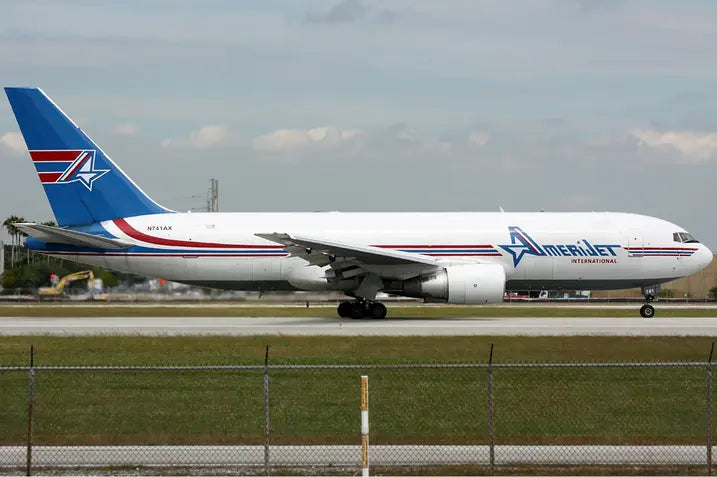
Amerijet operates an all-Boeing 767 freighter fleet, having retired its last Boeing 757-200 cargo aircraft in recent years. The fleet is composed of a mix of 767-200 and 767-300 variants, including both factory freighters and passenger-to-freighter conversions (BCF and BDSF models). As of mid-2025, the active fleet stands at approximately 10 aircraft, down significantly from a peak of 22 in 2022. This reduction reflects contract losses, aircraft returns, and a broader downsizing in the post-pandemic cargo market.
| Aircraft Type | Role | In Service | Notes |
|---|---|---|---|
| Boeing 767-200PCF | Freighter | 1 | Passenger-to-cargo conversion. Older variant. |
| Boeing 767-300ER/BCF | Freighter | 1 | Newly acquired in 2024. Boeing Converted Freighter. |
| Boeing 767-300ER/BDSF | Freighter | 8 | Bedek Special Freighter conversion. Core of the active fleet. |
Fleet data as of mid-2025 per Wikipedia and ch-aviation reports. The AirlinePilotCentral profile (updated December 2023) listed 15 B767 and 6 B757, but several aircraft have since been parked or returned.
The Boeing 767 is the workhorse of the mid-size cargo world, offering a payload capacity of roughly 40 to 58 tonnes depending on the variant. For pilots, the 767 is a two-crew widebody with a glass cockpit, widely regarded as a solid platform for building international heavy jet experience. The aircraft is well suited to Amerijet's Caribbean and Latin American network, with the range to cover routes from Miami to destinations across the region and beyond.
Despite recent downsizing, Amerijet management has stated a long-term goal to double the fleet within five years. The addition of a brand-new Boeing 767-300BCF in 2024 signaled renewed investment. However, the airline is proceeding cautiously: a $33 million loss reported in the 12 months through late 2024, combined with a 23% cargo revenue decline, has tempered the pace of expansion. The 2023 ALPA CBA also includes a built-in Boeing 777 pay scale, suggesting management has considered widebody fleet diversification, though no 777 acquisitions have been announced.
Operating a single aircraft type simplifies training, maintenance, and crew scheduling. For pilots, it means there is no fleet bidding or transition process: everyone flies the 767. The downside is limited variety and fewer long-term career pathways within the airline. Pilots seeking to fly multiple aircraft types or transition to next-generation widebodies (787, A350) will eventually need to look elsewhere. The built-in 777 pay scale in the CBA is a positive signal, but until new types actually arrive, Amerijet remains a one-fleet operation.
Pilot Salary & Compensation Breakdown
Amerijet International pilot compensation underwent a dramatic overhaul with the ratification of the 2023 ALPA Collective Bargaining Agreement (CBA) on June 26, 2023. The new contract delivered pay increases of approximately 45% across the board, making Amerijet one of the more competitive ACMI cargo carriers for pilot compensation. The CBA runs for three years, with scheduled 3% annual raises on the agreement anniversary dates (June 2024 and June 2025).
Compensation at Amerijet is structured around an hourly pay rate multiplied by a 74-hour monthly guarantee across 13 pay periods per year (totaling 962 guaranteed hours annually). This guarantee includes new-hire training hours. Flying on a day off is compensated at 150% of the regular hourly rate.
Captain Pay Scale (Boeing 767)
| Seniority | Est. Hourly Rate | Est. Annual Gross (min. guarantee) | Notes |
|---|---|---|---|
| Year 1 | ~$190/hr | ~$182,700 | Entry Captain rate under 2023 CBA |
| Year 3 | ~$224/hr | ~$215,500 | Confirmed by pilot reports on forum discussions |
| Year 5 | ~$240/hr | ~$230,900 | Represents ~48% increase over pre-CBA rates |
| Year 12+ | ~$312/hr | ~$300,000+ | Top of scale. Per ALPA and Pilot Career Center reporting |
Estimates derived from forum reports, ALPA press releases, and Pilot Career Center data. Actual hourly rates are confidential under the CBA. Annual gross assumes 74-hour monthly guarantee x 13 periods. Actual earnings vary with overtime, day-off flying (150%), and international overrides.
First Officer Pay Scale (Boeing 767)
| Seniority | Est. Hourly Rate | Est. Annual Gross (min. guarantee) | Notes |
|---|---|---|---|
| Year 1 | ~$120/hr | ~$115,400 | Entry FO. Significant jump from pre-CBA rates (~$47/hr on older 727 scale) |
| Year 3 | ~$140/hr | ~$134,700 | Mid-career FO |
| Year 5+ | ~$160/hr | ~$153,900 | Senior FO, approaching upgrade eligibility |
FO rates are estimates based on typical ACMI cargo industry ratios and forum reports. Exact scales are not publicly available. The 45% uplift applied proportionally across all positions.
Additional Compensation Elements
The exact pay scales under the 2023 Amerijet-ALPA CBA are not publicly available. The figures above are estimates compiled from ALPA press releases, Pilot Career Center reporting, AirlinePilotForums pilot posts, and industry benchmarks. A 12-year Captain earning over $300,000 annually has been confirmed by multiple sources. First Officer rates are extrapolated from industry norms and the 45% uplift applied across the contract. Always verify with the current CBA or your ALPA MEC representative before making career decisions.
Roster Pattern & Quality of Life
Amerijet operates under FAA Part 121 flight time limitation rules. The airline's roster system is seniority-based, with all flying assigned through a line-bid process. Pilots can choose between two scheduling formats: a 28-day bid (16 days on, 12 days off) or a 56-day bid (32 days on, 24 days off, split proportionally rather than consecutive). The 2023 CBA also introduced a one-month-on/one-month-off option during low-load periods.
📅 Sample Month: 28-Day Bid (Boeing 767 First Officer)
All Amerijet pilots are home-based, meaning there is no requirement to live near a specific crew base. The airline provides positive-space (guaranteed seat) travel to and from trip pairings, typically out of Miami. This is a significant quality-of-life advantage: pilots can live anywhere in the continental United States and commute to their assignments. However, roughly one-third of operations originate from Miami, so living in or near South Florida reduces commuting friction considerably.
Unlike many passenger airlines that require pilots to live within a certain radius of a crew base, Amerijet's home-basing policy gives pilots genuine geographic freedom. The company covers the cost of travel to and from your trip pairing. This is particularly attractive for pilots with families who want to live in lower-cost-of-living areas while flying out of Miami. The trade-off is that cargo schedules often involve red-eye departures, irregular hours, and multi-day trips away from home, which is typical of the freight industry. Cargo flying is a lifestyle choice: less glamour, more flexibility.
Benefits, Retirement & Perks
The 2023 ALPA CBA brought significant improvements to Amerijet's benefits package, particularly in retirement security. While the airline does not match the comprehensive benefits of major integrators like FedEx or UPS, its package is competitive within the ACMI cargo segment and includes several notable provisions.
Amerijet's 401(k) structure is worth highlighting. At 10% after two years of service, the airline offers one of the highest direct contribution rates among ACMI cargo carriers. Crucially, this is a direct contribution, not a match, meaning Amerijet deposits 10% of your eligible earnings into your 401(k) regardless of whether you contribute your own money. For comparison, Kalitta Air offers a 12% direct contribution, while Atlas Air provides up to 16% in combined matching. The Amerijet DC is competitive and represents a significant improvement over the pre-ALPA era.
As a cargo-only airline, Amerijet does not offer staff travel benefits on passenger airlines. This is a common trade-off in the cargo world. Pilots at passenger carriers often cite free or heavily discounted personal travel as a major perk. At Amerijet, the positive-space commuting to trip pairings is valuable for work purposes, but there are no leisure travel benefits. Pilots who prioritize travel perks for family vacations should factor this into their career calculus.
Career Progression & Seniority
Career progression at Amerijet follows the standard U.S. airline model: a seniority-based system where your position on the seniority list determines your schedule preferences, line-bid priority, and eligibility for Captain upgrade. As a single-type operator (Boeing 767), there are no fleet transitions to navigate. Your career path at Amerijet is straightforward: enter as a First Officer, build hours and seniority, and upgrade to Captain when slots become available.
One of the most notable aspects of Amerijet's current career environment is the accelerated upgrade opportunity. Due to pilot shortages and the airline's relatively small size, Captain upgrades have been available after as few as 1,000 qualifying hours at the company. This is significantly faster than at larger cargo carriers where upgrade waits can stretch to 5 or more years. For pilots seeking a quick path to the left seat on a widebody freighter, Amerijet is one of the faster options in the U.S. cargo industry.
| Career Milestone | Typical Timeline | Notes |
|---|---|---|
| Join as First Officer (B767) | Day 1 | All new hires start on the Boeing 767. No fleet choice. |
| Initial training (MIA) | ~6-8 weeks | Company-paid hotel during training. Type rating on B767. |
| Line-qualified FO | ~3 months | IOE (Initial Operating Experience) completed on line flights. |
| Captain upgrade eligibility | ~1,000 qualifying hrs | Accelerated due to pilot shortages. Historically 3,000-4,000 hrs. |
| Captain upgrade training | ~4-6 weeks | Sim assessment + line training + check ride. |
| Senior Captain | 5+ years | Top of pay scale at Year 12. Best line bids and schedules. |
The current upgrade timeline at Amerijet (as few as 1,000 qualifying hours) is remarkably fast by industry standards. For comparison, Captain upgrades at Atlas Air or FedEx can take 5 to 10+ years. This speed is a product of Amerijet's small pilot group and ongoing staffing challenges. The benefit is obvious: left-seat experience on a widebody freighter early in your career, with Captain pay to match. The risk is equally clear: a small airline in a volatile cargo market with recent financial losses and furlough discussions. Fast upgrades often indicate staffing pressure, which can be a symptom of deeper operational challenges.
Amerijet does not operate a formal direct-entry Captain program, but experienced pilots with significant Boeing 767 or widebody time may be hired and fast-tracked to upgrade. The 2023 CBA introduced additional "upgrade slots" and improved the training pipeline for qualified candidates. There is no fleet transition path within Amerijet (only the 767), so long-term career development beyond Captain on the 767 would require moving to another airline.
Recruitment Process & Requirements
Amerijet recruits experienced pilots for First Officer positions on the Boeing 767 on a rolling basis. The airline does not operate a cadet or ab-initio program. All candidates must meet FAA Part 121 requirements and bring a minimum level of flight experience. The hiring process is straightforward and typically moves quickly, reflecting the airline's ongoing need for qualified pilots.
Minimum Requirements
Selection Stages
Application & Phone Screening
Submit your application through the Amerijet careers portal or via AirlineApps. A recruiter conducts an initial phone screening to verify qualifications, flight experience, availability, and motivation. This step is typically brief and focuses on confirming you meet the minimum requirements.
Records & Database Review
Amerijet reviews your flight records, logbooks, FAA certificates, and employment history. Expect a thorough check of your PRIA (Pilot Records Improvement Act) records and any FAA enforcement actions. Clean records are essential.
In-Person Interview
Conducted at the Miami headquarters or via video. The interview covers technical knowledge (CRM, systems, aviation regulations), situational judgment, and behavioral questions. Expect questions about your experience with international operations, cargo-specific scenarios, and crew resource management.
Simulator Evaluation
A simulator session assessing your flying skills, instrument proficiency, and decision-making under pressure. The sim eval typically uses a Boeing 767 or equivalent full-motion simulator. Standard maneuvers include approaches, engine failures, and abnormal procedures.
ATP Check Ride & Onboarding
Successful candidates receive a conditional offer, undergo a First-Class medical (if not current), complete background checks, and begin initial training in Miami. The company provides hotel accommodation during training. Type rating on the Boeing 767 is company-funded.
Amerijet is actively hiring for B767 First Officer positions as of 2025-2026. The airline emphasizes the 1,500-hour minimum and company-paid type rating in its recruitment materials. Prior widebody or international experience is a plus but not required. The airline also participates in pathway programs, including the U.S. Aviation Pathway Program, which provides a structured route from regional airlines into Amerijet. Given the relatively low entry barrier (1,500 hours vs. 3,000+ at some majors), Amerijet can be an excellent stepping stone for pilots looking to gain widebody freighter experience early in their career.
How Amerijet Compares: Airline Radar Chart
How does Amerijet stack up against two of its closest U.S. cargo competitors: Atlas Air and Kalitta Air? All three operate Boeing widebody freighters, are ALPA-represented, and compete in the ACMI/cargo segment. Below is a comparative analysis across five key metrics. Scores are editorial estimates based on publicly available data and pilot feedback.
Key Takeaways from the Comparison
Amerijet leads on per-hour pay rates. With Captains earning an estimated $224/hr at Year 3 (and $312/hr at top of scale), Amerijet's hourly rates are competitive with or above both Atlas Air and Kalitta Air for Boeing 767 flying. The 74-hour monthly guarantee and 13 pay periods per year further boost annualized earnings. However, Atlas Air and Kalitta offer more total fleet diversity and higher-paying widebody types (747, 777) that can push top-end earnings even higher for senior Captains.
Fleet and scale favor Atlas Air and Kalitta. Atlas operates 107 aircraft across four types (747, 777, 767, 737), while Kalitta flies 36 aircraft including 747s and 777s. Amerijet's 10-aircraft, single-type fleet is its biggest weakness. More aircraft types mean more career variety, and larger fleets provide better job security and schedule flexibility. Atlas Air's sheer scale, with approximately 2,900 pilots, offers a level of stability that a 260-pilot operation cannot match.
Benefits are strongest at Atlas Air. Atlas offers up to 16% in 401(k) matching, paid commuting allowances ($1,250 each way), and comprehensive health and life coverage. Kalitta provides a 12% direct contribution, slightly above Amerijet's 10%. All three airlines are ALPA-represented, ensuring collective bargaining protections.
Amerijet's advantage is speed to upgrade. With Captain upgrades available after as few as 1,000 qualifying hours, Amerijet offers the fastest path to the left seat of the three. At Atlas or Kalitta, expect significantly longer waits. For a pilot prioritizing command experience on a widebody freighter, Amerijet is the accelerated option.
Scores are editorial estimates based on publicly available salary data, CBA details, fleet statistics, pilot forum reports, and industry benchmarks from AirlinePilotCentral, ALPA, and aviation media. They represent a general assessment for an experienced pilot evaluating a cargo career. Individual experiences vary based on seniority, market conditions, and personal priorities.
Union & Industrial Relations
Amerijet International pilots are represented by the Air Line Pilots Association (ALPA), the world's largest pilot union with over 80,000 members across more than 40 airlines. Amerijet pilots voted to join ALPA in 2020, and the first ALPA-negotiated collective bargaining agreement was ratified on June 26, 2023. Prior to ALPA, pilots were represented by Teamsters Local 769 from approximately 2009 to the late 2010s.
ALPA MEC Leadership
The transition from Teamsters to ALPA marked a turning point for Amerijet pilots. The 2023 CBA delivered pay raises of approximately 45%, a 74-hour monthly guarantee (up from 60 hours), schedule flexibility improvements, and enhanced retirement security. Since taking office in March 2024, the new MEC has focused on proper contract implementation, negotiating three memorandums of understanding, and successfully averting a potential pilot furlough.
Recent Industrial History
Joining ALPA gave Amerijet pilots access to one of the most powerful labor organizations in aviation. Beyond contract negotiations, ALPA provides legal representation, aeromedical services, accident investigation support, and a political voice in Washington on issues like FAA regulations, fatigue rules, and pilot training standards. The MEC's 2025 priority is continuing pilot education about the CBA, ensuring every pilot understands their contractual rights, and building out standing committees. For prospective hires, ALPA representation provides a level of professional security and advocacy that was absent during the Teamsters era.
Verdict: Who Is Amerijet For?
🎯 Our Take
Amerijet International occupies a specific niche in the U.S. cargo airline landscape: a small, Miami-based all-cargo operator offering competitive pay rates, fast Captain upgrades, and home-basing flexibility on the Boeing 767. The 2023 ALPA CBA was a genuine turning point, lifting compensation from below-market to competitive within the ACMI segment, with top Captains earning over $300,000 annually and a 10% direct 401(k) contribution after two years.
The trade-offs are significant and should not be minimized. Amerijet's fleet has shrunk from 22 aircraft to roughly 10 in just a few years. The airline posted a $33 million loss in the 12 months through late 2024, and furlough discussions have cast a shadow over job security. The single-type fleet (Boeing 767 only) limits long-term career variety, and the absence of passenger travel perks is a real lifestyle consideration. The volatile nature of the global cargo market means revenue can swing dramatically from year to year.
For the right pilot, though, Amerijet offers something valuable: the chance to fly a widebody freighter internationally, build Captain-level experience quickly, and do it all while living wherever you choose in the United States. It is best suited as either a career destination for pilots who value the cargo lifestyle, or as a strategic stepping stone to larger cargo carriers like FedEx, UPS, Atlas Air, or the passenger majors.
1 What aircraft does Amerijet fly?
Amerijet operates an all-Boeing 767 freighter fleet, including 767-200 and 767-300 variants (BCF and BDSF conversions). The airline previously flew Boeing 757-200 freighters, but these have been retired. All pilots fly the same type, so there is no fleet bidding or transition process. The 2023 CBA includes a built-in Boeing 777 pay scale, but no 777 aircraft have been acquired yet.
2 How much do Amerijet pilots make?
Under the 2023 ALPA CBA, Captain pay at the top of the scale (Year 12+) exceeds $300,000 annually, with an estimated hourly rate around $312/hr. Third-year Captains earn approximately $224/hr ($215,000+/year at minimum guarantee). First Officers start at an estimated $120/hr ($115,000+/year). All figures are based on the 74-hour monthly guarantee and 13 pay periods per year, with additional earnings from international overrides, per diem, and day-off flying at 150%.
3 How fast can I upgrade to Captain at Amerijet?
Captain upgrades at Amerijet have been available after as few as 1,000 qualifying hours at the company, which is exceptionally fast by industry standards. This accelerated timeline is driven by the airline's small pilot group and ongoing staffing needs. However, upgrade availability fluctuates with hiring cycles and market conditions. During periods of downsizing or reduced flying, upgrade slots may slow.
4 Do Amerijet pilots have a base?
All Amerijet pilots are home-based, meaning you can live anywhere in the United States. The airline provides positive-space (guaranteed) travel to and from your trip pairings, which typically originate at Miami International Airport. There is no requirement to relocate to Miami, although living nearby reduces commuting time and complexity.
5 Is Amerijet financially stable?
This is the key question for prospective hires. Amerijet posted a $33 million loss in the 12 months through late 2024 and saw a 23% decline in cargo revenue. The fleet has been reduced from 22 to approximately 10 aircraft. Pilot furlough discussions occurred in 2024, though the ALPA MEC successfully negotiated protections. On the positive side, management has stated plans to double the fleet within five years, and the airline continues hiring for B767 FO positions. The cargo market is cyclical, and Amerijet's fortunes are closely tied to Caribbean and Latin American trade volumes.
6 What are the minimum flight hours to apply?
Amerijet requires a minimum of 1,500 hours of total fixed-wing pilot time, an unrestricted FAA ATP certificate with multi-engine rating, a First-Class medical certificate, and an FCC Restricted Radiotelephone Operator Permit. Prior widebody or international experience is preferred but not mandatory. The airline provides company-funded type rating training on the Boeing 767.
7 Does Amerijet offer travel benefits?
As a cargo-only airline, Amerijet does not offer passenger travel benefits (free or discounted tickets on passenger airlines). The airline does provide positive-space travel for commuting to and from trip pairings, and company-paid hotel accommodation during training periods in Miami. Pilots who value leisure travel perks should note this is a common trade-off in the cargo sector.
8 How does Amerijet compare to Atlas Air or Kalitta Air?
Amerijet offers higher per-hour pay rates and faster Captain upgrades than Atlas Air or Kalitta Air, but is significantly smaller (260 pilots vs. 2,900 at Atlas and 835 at Kalitta). Atlas and Kalitta offer more fleet diversity (747, 777, 767, 737), more base options, and higher 401(k) contributions (up to 16% at Atlas, 12% at Kalitta vs. 10% at Amerijet). Job security is generally stronger at larger operators with diversified client bases. Amerijet's sweet spot is speed to Captain and competitive hourly rates on the 767.
Official Links & Resources
Before applying or making career decisions, always verify information directly with official sources. These are the key websites and organizations relevant to an Amerijet International pilot career:
The AirlinePilotForums cargo section contains active discussion threads about Amerijet, including pilot reviews of the 2023 CBA, pay scale analysis, and quality-of-life reports. While forum posts should be taken as individual opinions rather than official data, they provide valuable real-world perspective from pilots who fly the line. The Amerijet-specific threads from 2023-2024 are particularly informative regarding the CBA transition and its practical impact.