
Air Arabia Overview & Company Profile
Air Arabia is the Middle East and North Africa's largest low-cost carrier, founded on 3 February 2003 and headquartered at Sharjah International Airport (SHJ) in the United Arab Emirates. Commercial operations began on 28 October 2003, making it the first LCC in the Arab world. Listed on the Dubai Financial Market (DFM) as a public joint-stock company (PJSC), Air Arabia has grown from a single-hub regional operator into a multi-hub group flying to over 200 routes across more than 37 countries.
The airline carried 21.8 million passengers in 2025 (a 16% increase year-on-year) and posted record revenue of AED 7.78 billion (approximately USD 2.12 billion) with a net profit before tax of AED 1.8 billion. Air Arabia operates from six hubs: Sharjah and Ras Al Khaimah in the UAE, Abu Dhabi (through Air Arabia Abu Dhabi), Casablanca and other Moroccan cities (Air Arabia Maroc), Alexandria in Egypt (Air Arabia Egypt), and Karachi in Pakistan (Fly Jinnah, a joint venture with the Lakson Group). The group employs over 1,200 pilots across its network and operates approximately 390 flights per day at peak capacity.
Air Arabia's business model is a textbook low-cost carrier operation: single-class cabins, high aircraft utilisation, point-to-point routes, ancillary revenue focus, and lean operating costs. Despite its LCC positioning, the airline has delivered 22 consecutive years of profitability since its launch, making it one of the most consistently profitable airlines in the region. It does not belong to any global airline alliance but has codeshare and interline agreements with several carriers, including Etihad Airways (through the Air Arabia Abu Dhabi joint venture).
The group structure has expanded significantly over the past decade. Air Arabia Abu Dhabi, launched in 2020 as a joint venture with Etihad Aviation Group, operates 12-14 A320s from Abu Dhabi International Airport and increased its operational capacity by 40% in 2025. Air Arabia Maroc serves as the North African arm, operating from Casablanca, Fez, and Tangier with approximately 11 aircraft. Air Arabia Egypt operates from Alexandria's Borg El Arab Airport with 4 aircraft. Fly Jinnah, a joint venture with Pakistan's Lakson Group launched in 2023, operates from Karachi with a growing fleet. The airline also recently expanded into Saudi Arabia through Air Arabia DMM LLC, based in Dammam. This multi-hub strategy is central to Air Arabia's pilot proposition: unlike most Gulf carriers that concentrate all operations in a single city, Air Arabia offers genuine geographic diversity across its base network.
The route network spans the Middle East, North Africa, the Indian Subcontinent, Central Asia, the Caucasus, and increasingly Europe. In 2025, the airline added 30 new routes including services to Munich, Warsaw (Modlin), and Prague from Sharjah, signalling a strategic push into the European market. With the A321XLR deliveries expected from 2026-2027, the network will extend further into continental Europe, opening new operational possibilities for pilots.
From a regulatory standpoint, Air Arabia operates under the oversight of the General Civil Aviation Authority (GCAA) of the UAE, which sets pilot licensing, medical certification, and flight time limitation standards. The GCAA follows ICAO standards and has signed mutual recognition agreements with several national aviation authorities, making GCAA-issued licences relatively portable for pilots planning future career moves. Pilots joining from EASA or FAA backgrounds will need to validate their licence with the GCAA, a process that typically takes 4-8 weeks and involves document verification, a GCAA theory exam (for some licence types), and a medical conversion.
Fleet Composition & Aircraft Types
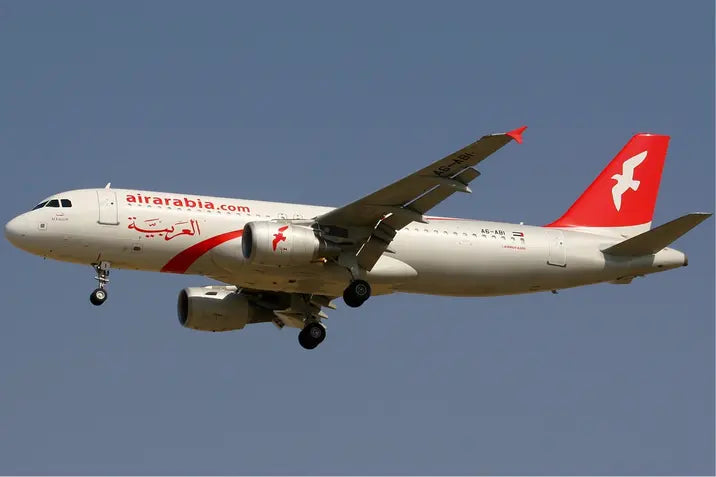
Air Arabia operates an all-Airbus, single-type-family fleet consisting exclusively of A320 and A321 variants. This is a deliberate strategic choice: a single-type fleet reduces training costs, simplifies maintenance, and maximises crew flexibility across the network. As of early 2026, the group fleet has reached approximately 90 aircraft, with the first A320neo deliveries arriving in late 2025 as part of a massive 120-aircraft order placed with Airbus in 2019.
The fleet renewal programme is centred on the A320neo and A321neo/XLR variants, which offer approximately 15-20% fuel savings per seat compared to the current-generation (ceo) models. The A321XLR, with its extended range of up to 4,700 nautical miles, will be a game-changer for Air Arabia, enabling the airline to reach destinations in Southern and Eastern Europe, East Africa, and Central Asia that are currently beyond the range of its A320 fleet. The first A320neo was delivered in September 2025, and the airline expects to take 4-5 neo deliveries per year through the end of the decade.
The fleet is distributed across the group's subsidiaries: Air Arabia's Sharjah mainline operates the largest share (approximately 55-60 aircraft), while Air Arabia Abu Dhabi has 12-14 A320s with plans to reach 16 by late 2026. Air Arabia Maroc operates approximately 11 aircraft, Air Arabia Egypt has 4, and Fly Jinnah in Pakistan operates 5 aircraft with growth planned. Aircraft are periodically reallocated between subsidiaries based on seasonal demand, which gives pilots exposure to different operating environments within the same fleet type.
| Aircraft Type | Role | In Service | Notes |
|---|---|---|---|
| Airbus A320-200 (ceo) | Short/medium-haul | ~76 | Fleet backbone. Average age ~10 years. Gradual phase-out as neos arrive. |
| Airbus A320neo | Short/medium-haul | 5 | First delivery September 2025. Part of 73-aircraft neo order. 15% fuel savings. |
| Airbus A321-200 (ceo) | Medium-haul (higher capacity) | 3 | Used on high-demand routes. Some leased. |
| Airbus A321neo / A321LR | Medium/long-range | 6 | Longer range capability. Part of 27 A321neo + 20 A321XLR order. |
| Total in service | ~90 | ||
| On order | 120 | 73 A320neo + 27 A321neo + 20 A321XLR. Deliveries through ~2030. | |
Fleet data as of early 2026. Numbers include aircraft across all Air Arabia Group subsidiaries (Sharjah, Abu Dhabi, Maroc, Egypt, Fly Jinnah). Exact breakdown by subsidiary varies with seasonal reallocation.
A single-type fleet is a significant advantage for pilots: one type rating covers the entire fleet, making you deployable across all bases and routes. All Air Arabia pilots fly the A320 family, whether based in Sharjah, Morocco, or Pakistan. For new joiners, the A320 type rating is required at entry (typically self-sponsored for direct-entry pilots). The upcoming A321XLR will open new route possibilities without requiring an additional type rating, as it falls under the same A320 family endorsement.
The A320neo and A321neo variants feature the LEAP-1A or PW1100G engines, updated avionics, and improved cockpit ergonomics compared to the ceo models. Pilots transitioning from A320ceo to neo versions will find the cockpit layout fundamentally similar, with differences primarily in engine management, fuel system architecture, and some display updates. The transition training is typically a short differences course rather than a full type rating, making fleet modernisation relatively seamless from a crew perspective. The A321XLR, expected to enter Air Arabia's fleet from 2026-2027, will introduce new operational considerations including extended range operations, ETOPS considerations, and potentially longer duty days. Pilots interested in medium-haul or extended-range operations will find these aircraft particularly interesting.
Pilot Salary & Compensation Breakdown
Air Arabia pilot salaries are structured as a combination of a fixed monthly base (which includes housing and transport allowances) plus variable flying pay based on block hours flown. All compensation is 100% tax-free under UAE law, which is one of the strongest draws for expatriate pilots. There is no income tax, no social security deduction, and no pension contribution withheld from your paycheck. What you earn is what you take home.
It is important to note that Air Arabia, as a low-cost carrier, pays less than its premium neighbours Emirates and flydubai. However, the tax-free status, lower cost of living in Sharjah (compared to Dubai), and the multi-hub flexibility partially offset the salary gap. The airline also uses a tiered flying-pay system where per-hour rates increase with block hours flown in a given month.
To put these numbers in perspective: a post-training First Officer at Air Arabia earning approximately AED 24,000-28,000/month (with flying pay) takes home roughly USD 78,000-92,000 per year, entirely tax-free. A comparable First Officer at a European LCC such as Ryanair or easyJet might earn a similar gross amount, but after income tax (20-45% depending on country) and social contributions, the net take-home would be significantly lower. This tax advantage is the single most important financial differentiator of flying in the Gulf. Similarly, a Captain earning AED 40,000-46,000/month takes home USD 131,000-150,000 annually, net. While this is less than flydubai Captains (AED 48,485/month base + flying pay) or Emirates Captains (AED 69,500/month), it remains a competitive LCC Captain salary when adjusted for the zero-tax environment.
First Officer (F/O) Pay Scale
| Phase | Monthly Package (AED) | Annual Gross (AED) | Annual Gross (USD est.) |
|---|---|---|---|
| Training period (3 months) | 12,853 | ~154,000 (annualised) | ~$42,000 |
| Post-training (base, up to 60 hrs/mo) | 20,199 | ~242,000 | ~$66,000 |
| With avg. flying pay (70-80 hrs/mo) | ~24,000 - 28,000 | ~288,000 - 336,000 | ~$78,000 - $92,000 |
| Senior F/O (5+ years, high hours) | ~28,000 - 32,000 | ~336,000 - 384,000 | ~$92,000 - $105,000 |
Monthly package includes basic salary, housing allowance (~AED 6,500), and transport allowance (~AED 2,000). Flying pay is variable and tiered: AED 20-160 per block hour depending on monthly total.
Captain Pay Scale
| Phase | Monthly Package (AED) | Annual Gross (AED) | Annual Gross (USD est.) |
|---|---|---|---|
| Training period (3 months) | 22,000 | ~264,000 (annualised) | ~$72,000 |
| Post-training (base, up to 60 hrs/mo) | 33,800 | ~406,000 | ~$110,000 |
| With avg. flying pay (70-80 hrs/mo) | ~40,000 - 46,000 | ~480,000 - 552,000 | ~$131,000 - $150,000 |
| Senior Captain (high hours) | ~46,000 - 52,000 | ~552,000 - 624,000 | ~$150,000 - $170,000 |
Captain flying pay is tiered at AED 35-280 per block hour. Per diem for layovers and training days is approximately AED 184/day.
Contract Variations by Base
It is important to understand that Air Arabia operates different contract structures depending on the base location. Pilots hired for the Sharjah main base typically receive open-ended contracts with the standard salary package described above. Pilots hired for Fly Jinnah (Pakistan) or Air Arabia DMM (Saudi Arabia) are offered 15-month fixed-term contracts, which may have different salary components and allowance structures. Air Arabia Maroc and Air Arabia Egypt pilots may be employed under local labour law in their respective countries, with salary packages denominated in local currency and adjusted for the local cost of living. These regional variations mean that the same "Air Arabia pilot" title can represent meaningfully different compensation and conditions depending on the base. Always clarify the exact contract terms, base assignment, and salary breakdown during the recruitment process.
These figures are compiled from multiple public sources including airline job postings, pilot job network databases, Gulf News reporting, and pilot community feedback. Actual compensation depends on the specific contract, base location, block hours flown, and any renegotiations. Air Arabia operates different contract types for different bases (e.g., 15-month fixed-term contracts for Fly Jinnah in Pakistan versus standard open-ended UAE contracts). Subsidiary and regional base contracts may differ significantly from Sharjah-based packages. Always verify with the latest official job postings on the Air Arabia Group Careers portal.
Consider an Air Arabia Captain earning AED 480,000 per year (approximately USD 131,000). In the UAE, the entire amount is take-home pay. A Captain at a comparable European LCC earning €130,000 gross in France would pay approximately €35,000-45,000 in income tax and social charges, leaving €85,000-95,000 net. In the UK, a similar gross of £115,000 would yield approximately £75,000-80,000 after tax and National Insurance. The Air Arabia pilot therefore takes home 40-70% more in real terms than the European pilot on a similar gross salary. This gap is the primary reason pilots relocate to the Gulf, and it compounds significantly over a multi-year career when factored into savings and investment returns.
Roster Pattern & Quality of Life
Air Arabia operates under the General Civil Aviation Authority (GCAA) of the UAE flight time limitation rules, which set strict caps on flying hours and duty periods. The roster structure is designed around high aircraft utilisation (typical for LCCs), with most operations being same-day turnarounds from the home base. This means pilots generally return home after each duty day, which is a significant quality-of-life advantage over airlines with extensive overnight layover networks.
Pilots receive 30 days of paid annual leave per year, plus rostered days off guaranteeing at least 7 consecutive days off per month. Typical block hours range from 70 to 80 hours per month, depending on seasonal demand and base allocation. The roster pattern is largely fixed-day-off with some flexibility for swaps and bidding based on seniority.
📅 Sample Month: A320 First Officer (Sharjah Base)
The GCAA imposes the following duty and flight time limitations: a maximum of 100 flight hours per 28 consecutive days, no more than 900 flight hours per 12 months, and duty time caps of 60 hours per 7 days, 105 hours per 14 days, 210 hours per 28 days, and 1,950 hours per 12 months. These limits are comparable to EASA regulations and provide a solid framework for fatigue management.
As a predominantly point-to-point LCC, most Air Arabia operations are same-day return flights, meaning pilots typically wake up and return to their home base the same day. Typical duty patterns involve 2-4 sectors per day on shorter routes (e.g., Sharjah to Bahrain, Kuwait, or Muscat) or a single return sector on medium-haul routes (e.g., Sharjah to Istanbul, Tbilisi, or Kathmandu). Early morning departures and late-night returns are common, as LCC scheduling maximises aircraft utilisation. Overnight layovers are less frequent than at legacy carriers, but do occur on some longer routes or during schedule disruptions.
One important consideration is the hot climate. Operating from Sharjah, Ras Al Khaimah, or Abu Dhabi during the summer months (May to September) means temperatures regularly exceed 45°C on the ground. While cockpits are air-conditioned, the heat affects turnaround operations, aircraft performance (higher density altitude), and general comfort during commutes to and from the airport. Pilots coming from cooler climates should factor this into their quality-of-life assessment.
A typical flying day for a Sharjah-based First Officer might involve reporting at 04:30 for a 05:30 departure to Bahrain (1h15 sector), turning around for an 08:00 return to Sharjah, then operating a second rotation to Muscat (1h00 sector) with a 14:00 return. Total duty: approximately 10-11 hours, with 4 sectors and roughly 5 block hours. On medium-haul routes, a typical pattern might be a single return to Istanbul (3h30 each way) or Tbilisi (3h00 each way), with a longer turnaround at the destination. Sector lengths vary from as short as 45 minutes (to Bahrain or Ras Al Khaimah) to over 5 hours (to some Central Asian or European destinations on A321LR/neo equipment).
Most Air Arabia pilots based in Sharjah choose to live in either Sharjah itself or nearby Dubai, which is approximately 20-30 minutes by car from Sharjah International Airport. Sharjah offers significantly lower rents than Dubai (often 30-40% less for comparable accommodation), making the housing allowance stretch further. The UAE lifestyle is well-suited to expatriate pilots: modern infrastructure, excellent healthcare, international schools, year-round sunshine, and a large multicultural community. Pilots based at other hubs (Morocco, Egypt, Pakistan) experience very different living conditions and cost structures, so it is important to clarify your base assignment during the recruitment process.
For pilots with families, Sharjah and Dubai offer a wide selection of international schools (British, American, Indian, and IB curricula), although school fees can be significant (AED 20,000-60,000+ per year depending on the school and curriculum). The children's education allowance provided by Air Arabia helps offset this cost. Healthcare is of a high standard throughout the UAE, and the company-provided medical insurance covers most needs. The social scene for pilots in the UAE is active, with large expat pilot communities at multiple airlines (Emirates, flydubai, Etihad, Air Arabia) creating a supportive network for newcomers.
Benefits, Perks & Allowances
Air Arabia's benefits package reflects a typical Gulf LCC offering: competitive but not lavish. The standout advantage remains the tax-free salary in the UAE, which effectively boosts take-home pay by 20-40% compared to equivalent roles in Europe or North America. Beyond the base salary, pilots receive a structured set of allowances and benefits governed by UAE Labour Law and company policy.
It is worth noting what Air Arabia does not offer compared to some competitors. There is no company-provided accommodation (pilots receive a cash housing allowance and find their own housing). There is no company pension scheme (only the UAE statutory end-of-service gratuity). There is no loss-of-license insurance included as standard (pilots should arrange this independently). Staff travel, while valuable, is limited to Air Arabia's own network, which is narrower than what Emirates or Etihad staff enjoy through alliance and interline agreements.
Unlike European pension systems, the UAE does not have a mandatory pension scheme for expatriate workers. Instead, UAE Labour Law mandates an end-of-service gratuity payable when the employment contract ends. For the first five years, this equals 21 days of basic salary per year of service. After five years, it increases to 30 days per year. This is calculated on the basic salary component only (not the full package), so pilots should plan their own long-term savings and retirement strategy accordingly.
Many expat pilots invest their tax savings into private pension plans, property, or other instruments. Some popular approaches include: investing in property in their home country while earning tax-free in the UAE, contributing to international pension plans (SIPPs, offshore savings), or building investment portfolios during their Gulf career. The key advantage is that pilots retain full control over their retirement planning, but the responsibility falls entirely on the individual. There is no employer pension contribution and no mandatory retirement savings mechanism. Pilots coming from countries with strong state pension systems (France, Germany, UK) should be aware that years spent flying in the UAE will not contribute to their home-country pension entitlements.
Career Progression & Seniority
Career progression at Air Arabia is seniority-based, with hire date determining your position on the seniority list. This list drives upgrade priority, base bidding, and roster preferences. Unlike legacy carriers where seniority lists can be decades long, Air Arabia's rapid growth means promotion opportunities are more frequent. The airline advertises "fast-track" progression for high-performing pilots, and with fleet growth of 120 new aircraft on order, the demand for Captains is expected to remain strong through the late 2020s.
Air Arabia does accept direct-entry Captains, unlike some legacy carriers. However, most Captains progress internally after a period as First Officer. The typical upgrade path requires a minimum of 2,500-3,000 hours on type and 2-3 years as a First Officer with the airline, though this varies with operational demand and individual performance. The Captain upgrade process includes a comprehensive command course with simulator assessments, line training under supervision, and a final line check.
An important career consideration at Air Arabia is the multi-hub structure. Pilots may be offered positions at different bases depending on operational needs, and career progression can be influenced by willingness to relocate. For example, a pilot willing to take a position at a newer or less popular base (such as Fly Jinnah in Pakistan or Air Arabia DMM in Saudi Arabia) may find faster upgrade opportunities due to less competition for Captain slots. Conversely, the Sharjah main base, being the largest and most established, may have longer waiting times for upgrades. The ability to move between bases within the group (while maintaining seniority) is a distinctive feature of the Air Arabia career path.
| Career Milestone | Typical Timeline | Notes |
|---|---|---|
| Join as F/O (direct entry, A320 rated) | Day 1 | Requires existing A320 type rating + min. 2,000 hrs total. |
| Line check completion | 3-4 months | Training period on reduced salary. Line training on revenue flights. |
| Eligible for Captain upgrade | 2-3 years as F/O | Min. 2,500-3,000 hrs on type. Subject to seniority and company need. |
| Captain command course | ~3 months | Simulator assessment, line training under supervision, final check. |
| Training Captain / TRI / TRE | Variable | Requires separate selection. Additional pay premium. |
| Base transfer (to Morocco, Egypt, Pakistan, etc.) | By request / company need | Seniority-based bidding. Contract terms may differ by base. |
With 120 aircraft on order and the fleet expected to nearly double by 2030, Air Arabia will need to recruit and upgrade hundreds of pilots in the coming years. The airline added 30 new routes in 2025 alone, with further European expansion planned. This growth trajectory means upgrade timelines should remain relatively short compared to more established carriers. For pilots joining now, the combination of fleet expansion and new base openings creates genuine fast-track career opportunities that are harder to find at mature airlines.
The financial backing is solid: Air Arabia reported record revenue of AED 7.78 billion in 2025 with a net profit before tax of AED 1.8 billion, making it one of the most profitable airlines globally on a per-aircraft basis. The company is publicly listed on the Dubai Financial Market, which adds a layer of financial transparency and accountability. The airline's Q3 2025 net profit alone was AED 656 million (a 16% year-on-year increase), demonstrating sustained demand across its network. For pilots evaluating long-term job security, these financial indicators are significantly stronger than those of many European LCCs and several larger Gulf carriers that have historically relied on government subsidies.
Recruitment Process & Requirements
Air Arabia recruits pilots through two main pathways: direct entry (for experienced pilots with an A320 type rating) and the Cadet Pilot Programme (for candidates with no prior flight experience, covered in the next section). The airline runs recruitment drives across multiple markets, with recent campaigns targeting pilots in the UAE, Saudi Arabia, Pakistan, South America, and Eastern Europe.
Direct Entry First Officer: Requirements
Direct Entry Captain: Requirements
Selection Stages (Direct Entry)
The Air Arabia direct-entry selection process is structured but varies somewhat depending on whether recruitment is conducted at the company's Sharjah headquarters or at international roadshow events. Recent recruitment drives have been held in cities including Karachi, Dammam, Bogota, Colombo, and several Eastern European capitals. At roadshow events, the process may be condensed into 1-2 days. The full process typically takes 2-4 weeks from initial application to contract offer.
Online Application
Submit your CV, licence copies, logbook summary, and supporting documents through the Air Arabia Group Careers portal. Applications are reviewed against minimum requirements. Recruiters may also reach out at aviation job fairs and roadshows (recent events held in Karachi, Dammam, Bogota, and Colombo). Ensure your A320 type rating is current and that you have a clean logbook summary with total hours, hours on type, and recent flying hours clearly listed.
Assessment Centre
Invited candidates attend an assessment day that includes psychometric testing (cognitive ability, personality profiling), a technical knowledge exam (A320 systems, ATPL theory), and a structured competency-based interview. The focus is on CRM skills, decision-making, situational awareness, and cultural fit.
Simulator Assessment
A practical evaluation in the A320 full-flight simulator. Candidates are assessed on standard operating procedures, manual flying skills, handling of non-normal situations, and crew coordination. The sim check typically lasts 1-2 hours. Captains may face a more challenging scenario set including engine failures and weather diversions.
Final Interview & Document Verification
A final panel interview with senior management, followed by thorough verification of all flying documents, licences, and references. Successful candidates receive a conditional offer pending medical clearance.
GCAA Medical & Contract
A Class 1 medical examination conducted by a GCAA-approved aeromedical examiner in the UAE. Upon medical clearance, pilots sign their contract and begin the 3-month training/integration period at their assigned base. This training period is compensated at a reduced rate (F/O: AED 12,853/month; Captain: AED 22,000/month).
Air Arabia values recency and type currency highly. If your A320 type rating has lapsed or you have not flown the type in over 6 months, you may need to complete a refresher course before applying. The airline also looks favourably on LCC experience, as the operational tempo, turnaround times, and route structure differ significantly from legacy carrier flying. Arabic language skills are a bonus but not required for most positions. For the latest open positions and upcoming recruitment events, check the careers portal regularly and follow Air Arabia on LinkedIn.
Pilots who are currently unemployed or between contracts should note that Air Arabia has historically been more flexible on recency requirements during active recruitment drives, particularly at roadshow events in markets where pilot supply is competitive. If you meet the hour requirements but are slightly outside the recency window, it may still be worth applying. The airline's sim assessment is conducted in Sharjah or at a partner facility and is based on standard A320 SOPs. Preparation should focus on raw data manual flying, single-engine approaches, and non-normal procedures. CRM and communication skills are assessed throughout the entire process, from the initial interview through to the simulator session. Finally, be prepared to discuss your understanding of LCC operations, cost consciousness, and high-utilisation flying environments during the competency-based interview.
Air Arabia Cadet Pilot Programme
Air Arabia operates its own Cadet Pilot Programme through the Air Arabia Academy (formerly Alpha Aviation Academy), based at Sharjah Airport. This MPL (Multi-crew Pilot Licence) programme is designed to take candidates with zero flight experience and train them to become A320 First Officers over a period of approximately 20-24 months, although real-world timelines can extend due to scheduling, weather, and training slot availability.
The programme is self-funded at a cost of approximately AED 700,000 (around USD 190,000) for the 2025 intake, with instalment payment options available. Upon completing the required 1,500 flying hours (including line training with Air Arabia), cadets who meet the airline's standards will receive a job offer as a First Officer. Cadets who accept the role are subject to a 5-year bond with the airline.
The Air Arabia Academy is GCAA-approved and EASA-integrated, meaning the training standards align with European regulatory frameworks. The academy operates its own single-engine training aircraft (equipped with Garmin G1000 avionics), FNPT II fixed-base simulators, an A320 Multi-Function Training Device (MFTD), and access to A320 Level-D full-flight simulators for the type rating phase. The core flying phase is conducted abroad at partner flight schools (currently in the Czech Republic), providing cadets with experience in a different airspace and weather environment before returning to the UAE for advanced training phases.
Cadet Programme Requirements
Selection Stages
Document Submission
Candidates submit their application package including passport copies, education certificates, CV, recent photograph, and sponsor documentation (if applicable) to the Air Arabia Academy.
ADAPT Assessment (Phase 1)
A comprehensive aptitude testing battery (approximately 2-3 hours) assessing personality traits, cognitive ability, mathematical reasoning, physics knowledge, English proficiency, logical reasoning, flight simulation coordination, and multitasking. Fee: AED 8,000. Candidates who fail may retake the assessment after a cooling-off period (up to 2 attempts).
GCAA Class 1 Medical (Phase 2)
Candidates must pass a full aeromedical examination by a GCAA-approved examiner. This covers vision, hearing, cardiovascular health, neurological assessment, and general physical fitness.
Panel Interview (Phase 3)
A structured interview with HR and aviation staff covering motivation, aviation knowledge, current affairs, and a personal project or presentation. Retake fee of AED 1,500 applies if the candidate fails (up to 2-3 attempts, with a 3-month cooling period between each).
Training Programme (20-24 months)
The training progression includes: ground school theory, core single-engine flying (conducted abroad, e.g., at a partner school in the Czech Republic), FNPT II simulator training, A320 MFTD and FFS (full-flight simulator) type rating, aircraft base training, and finally 1,500 hours of supervised line training with Air Arabia on revenue flights.
The AED 700,000 cost is a substantial investment, and the programme is entirely self-funded (unlike cadet schemes at some legacy carriers which are fully or partially airline-funded). The 5-year bond means leaving before the bond period expires may require repayment of a portion of the training costs. Additionally, some pilot forums report that real-world completion timelines can extend significantly beyond the advertised 20-24 months due to simulator slot availability, instructor scheduling, and other factors. Prospective cadets should research thoroughly, visit the academy if possible, and speak with current or former cadets before committing. For comparison, flydubai offers a Second Officer pathway with a type-rating cost of approximately USD 33,000 (significantly less, but entry requirements differ).
How Air Arabia Compares: Airline Radar Chart
How does Air Arabia stack up against its two closest regional competitors: flydubai (the Dubai-based LCC) and Jazeera Airways (the Kuwait-based LCC)? Below is a comparative analysis across five key metrics relevant to pilots evaluating these airlines for their next career move.
| Category | Air Arabia | flydubai | Jazeera Airways |
|---|---|---|---|
| Hub(s) | Multi-hub: SHJ, RAK, AUH, CMN, HBE, KHI | Single hub: Dubai (DXB) | Single hub: Kuwait (KWI) |
| Fleet | ~90 Airbus A320 family | ~88 Boeing 737-800/MAX | ~25 Airbus A320neo |
| F/O Monthly (base) | AED 20,199 | AED 35,250 | ~AED 18,000-22,000 |
| Captain Monthly (base) | AED 33,800 | AED 48,485 | ~AED 35,000-40,000 |
| Annual Leave | 30 days | 42 days | 30 days |
| Roster | Fixed-day-off, 7 consec. off/month | ~14 on / 14 off block pattern | Variable roster, 8 days off/month |
| Tax Status | Tax-free (UAE) | Tax-free (UAE) | Tax-free (Kuwait) |
| Aircraft on Order | 120 (A320neo/A321neo/XLR) | 263 (737 MAX) | 28 (A320neo family) |
Salary figures are base package (including housing and transport allowances) before variable flying pay. Sources: airline career pages, Aviation A2Z, PilotJobsNetwork (2025 data).
Key Takeaways from the Comparison
flydubai pays significantly more. A flydubai First Officer earns approximately AED 35,250/month (base + housing + transport) versus Air Arabia's AED 20,199/month post-training. flydubai Captains earn around AED 48,485/month base compared to Air Arabia's AED 33,800/month. When variable flying pay is included, the gap narrows somewhat, but flydubai consistently offers 40-60% higher total compensation. This is the single biggest differentiator between the two carriers.
Air Arabia offers more base flexibility. With six operational hubs across the UAE, Morocco, Egypt, and Pakistan, Air Arabia provides genuine geographic diversity that flydubai (single Dubai hub) and Jazeera (single Kuwait hub) cannot match. This can be a significant advantage for pilots who want to be based closer to home, particularly those from North Africa, the Indian subcontinent, or the Gulf region.
Job security favours both UAE carriers. Both Air Arabia and flydubai are well-capitalised and growing rapidly. Air Arabia's consistent profitability (22 consecutive profitable years) and 120-aircraft order book provide strong long-term visibility. flydubai benefits from government backing through the Investment Corporation of Dubai. Jazeera Airways, while profitable, operates at a smaller scale and is more exposed to regional economic fluctuations.
Fleet comparison is straightforward. Air Arabia and Jazeera both operate all-Airbus A320 family fleets, while flydubai is an all-Boeing 737 operator. For pilots with an A320 type rating, Air Arabia and Jazeera offer direct entry without retraining. The A321XLR deliveries expected from 2026-2027 will give Air Arabia a range advantage over both competitors.
Leave and roster patterns differ significantly. flydubai offers 42 days of annual leave, the highest among the three, and operates a roster pattern that typically provides longer consecutive blocks of days off. Air Arabia and Jazeera both offer 30 days of annual leave. Air Arabia guarantees 7 consecutive days off per month, while Jazeera typically provides around 8 days off per month but with less consistency in consecutive-day blocks. For pilots who value extended time off for travel or family commitments, flydubai's 42-day leave policy is a notable advantage.
The flydubai-to-Emirates pathway is unique. flydubai pilots have an informal (and increasingly formalised) pathway to transition to Emirates, which operates wide-body Airbus and Boeing fleets on global long-haul routes. Air Arabia has no equivalent flow-through agreement with any legacy carrier. For pilots who view their Gulf LCC position as a stepping stone to a premium long-haul airline, this is a meaningful difference worth considering in the decision.
Contract structures differ. flydubai offers open-ended contracts with 42 days of paid leave and a well-structured Second Officer training programme (type-rating cost approximately USD 33,000 with a 5-year training bond). Air Arabia's direct-entry contracts are also generally open-ended for UAE-based positions, but fixed-term contracts (15 months) apply for some subsidiary bases (Fly Jinnah, Air Arabia DMM). The cadet programme bond is 5 years with a significantly higher financial commitment (AED 700,000 versus USD 33,000 at flydubai). Jazeera Airways typically offers 2-3 year fixed-term contracts with renewal options. Pilots should carefully review the contract terms, notice periods, and any financial penalties for early departure before committing to any of these airlines.
Scores are editorial estimates based on publicly available salary data, pilot job postings, airline financial reports, fleet data, and pilot community feedback. They represent a general assessment for an experienced pilot evaluating a long-term career. Individual experiences vary based on seniority, base location, contract type, and personal priorities. Note that Wizz Air Abu Dhabi, which was previously a competitor in the Abu Dhabi market, ceased operations in September 2025.
Verdict: Who Is Air Arabia For?
🎯 Our Take
Air Arabia is the largest and most established low-cost carrier in the MENA region, offering a unique combination of tax-free income, rapid career progression, multi-hub flexibility, and operational stability backed by 22+ years of consecutive profitability. The all-A320-family fleet keeps things simple, and the 120-aircraft order book signals sustained growth through the end of the decade.
The trade-offs are clear: salaries are lower than flydubai, Emirates, or the major Gulf legacy carriers. The benefits package, while solid, is basic compared to what you would receive at a European flag carrier with pension schemes and strong union protections. The UAE has no pilot union, no collective bargaining, and employment conditions are defined by individual contracts and company policy. The self-funded cadet programme (AED 700,000) is a substantial financial commitment with a 5-year bond attached.
For pilots seeking an accessible entry point into Gulf aviation, a stepping stone to larger carriers, or a long-term LCC career with genuine growth potential, Air Arabia is a strong and credible option. The multi-hub structure offers lifestyle flexibility that few competitors can match, and the fleet expansion creates real upgrade opportunities in the near term.
The ideal Air Arabia pilot is someone who values: tax-free earnings and the ability to save aggressively, a single-type fleet with no complex bidding wars, the option to be based in multiple countries across the Middle East and North Africa, relatively fast upgrade to Captain (2-3 years versus 10-15+ at legacy carriers), and a stable, profitable employer in a region where some airlines have come and gone (Wizz Air Abu Dhabi being the most recent example). The airline may not be the highest-paying in the Gulf, but it offers a reliable and growing platform for building an aviation career.
1 Is Air Arabia pilot salary tax-free?
Yes. The UAE does not levy personal income tax on salaries. All Air Arabia pilot compensation (base salary, housing allowance, transport allowance, flying pay, and per diems) is paid tax-free. This means your gross pay equals your net take-home pay, which is one of the primary financial advantages of flying in the Gulf region. However, pilots should check their home country's tax obligations, as some countries (e.g., the United States) tax citizens on worldwide income regardless of residence.
2 Do I need an A320 type rating to join Air Arabia?
For direct-entry positions (both First Officer and Captain), yes. Air Arabia requires a current A320 type rating, ideally with recent flying experience on the type within the last 6 months. The type rating is typically self-sponsored for direct-entry pilots. For the Cadet Pilot Programme, no prior type rating or flight experience is required, as the full training (including A320 type rating) is included in the programme.
3 How does Air Arabia compare to flydubai for pilots?
flydubai offers higher salaries across the board (roughly 40-60% more for both First Officers and Captains), 42 days of annual leave (versus 30 at Air Arabia), and government-backed financial stability. Air Arabia offers more base options (six hubs versus one), an all-Airbus fleet (versus Boeing at flydubai), and typically faster upgrade timelines due to rapid growth. Both are tax-free, both offer similar benefits structures, and both are considered reputable Gulf LCCs. The choice often comes down to whether salary or base flexibility is your priority.
4 Can I choose my base at Air Arabia?
Base assignment depends on operational need and available positions at the time of recruitment. Sharjah is the main hub and absorbs the majority of pilots, but positions are also available at Ras Al Khaimah, Abu Dhabi, Morocco, Egypt, and Pakistan (Fly Jinnah). Some recruitment campaigns specifically target pilots for certain bases (e.g., Dammam in Saudi Arabia). Once assigned, base transfers are possible but subject to seniority and company approval. Different bases may have different contract terms and salary structures.
5 Is there a pilot union at Air Arabia?
No. The UAE does not have formal pilot unions or collective bargaining structures. Pilot working conditions are governed by individual employment contracts, company policy, and UAE Labour Law. The GCAA (General Civil Aviation Authority) sets the regulatory framework for flight time limitations, licensing, and safety standards, but does not negotiate employment terms on behalf of pilots. This is a fundamental difference from European aviation, where strong unions (BALPA, SNPL, Vereinigung Cockpit) actively negotiate salaries and conditions. For pilots accustomed to union representation, this means that any issues regarding pay, roster, or working conditions must be addressed through HR channels and management directly. The absence of collective bargaining also means that salary increases and benefits improvements are at the company's discretion rather than the result of negotiated agreements. On the positive side, the regulatory environment is stable and the GCAA's safety standards are internationally recognised, providing a consistent framework for pilot operations.
6 How long does it take to upgrade to Captain at Air Arabia?
The typical upgrade timeline is approximately 2-3 years as a First Officer, provided you meet the minimum hours on type (2,500-3,000 hours) and the airline has operational demand for Captains. With 120 aircraft on order and rapid network expansion, upgrade opportunities are expected to remain frequent through the late 2020s. Air Arabia also recruits direct-entry Captains from outside, so the Captain pool is not exclusively internal promotion. The upgrade process itself includes a command course with simulator assessments, supervised line training, and a final line check. Pilots who are willing to accept base assignments at newer hubs (Abu Dhabi, Morocco, Pakistan, Saudi Arabia) may find faster upgrade opportunities due to less competition for Captain positions at those locations.
7 What is the cost of living like in Sharjah?
Sharjah is significantly cheaper than neighbouring Dubai, with rents typically 30-40% lower for comparable accommodation. A one-bedroom apartment near the airport costs around AED 2,000-3,500/month, while a two-bedroom family apartment runs AED 3,500-5,500/month. Groceries, dining, and transport are also more affordable than Dubai. Many Air Arabia pilots choose to live in Sharjah to maximise savings, while some prefer Dubai for its lifestyle and commute to the airport (20-30 minutes by car). The housing allowance of ~AED 6,500/month comfortably covers rent in most areas of Sharjah, and many pilots save a portion of the allowance if they choose more modest accommodation. Utilities (electricity, water, cooling) typically add AED 500-1,000/month depending on the size of the apartment and season. Internet and mobile services are reliable and affordable by international standards.
8 Is Air Arabia a good stepping stone to Emirates or Etihad?
Many pilots view Gulf LCC positions as a pathway to the larger legacy carriers. Building hours on the A320 at Air Arabia while living in the UAE puts you in a strong position for future applications to Emirates (wide-body, primarily Airbus), Etihad, or other premium carriers in the region. The GCAA licence is well-recognised, and the operational environment provides relevant experience. However, there is no formal flow-through agreement between Air Arabia and any legacy carrier. flydubai does have an informal pathway to Emirates, which Air Arabia does not. That said, many pilots have successfully transitioned from Air Arabia to Emirates, Etihad, Qatar Airways, and other major airlines after building sufficient hours and command experience. The key factors for a successful transition are total flight hours (typically 3,000+ for Emirates First Officer applications), a clean record, and strong performance reviews.
9 What happens if I want to leave before my contract ends?
UAE Labour Law requires a notice period (typically 1-3 months depending on contract terms) for resignation. If you are on a fixed-term contract and wish to leave early, there may be financial penalties or a requirement to reimburse certain training costs. For cadet programme graduates, the 5-year bond means that leaving before the bond period expires may trigger repayment obligations. Direct-entry pilots on open-ended contracts generally have more flexibility, but should review the specific resignation and notice clauses in their individual contract before signing. It is strongly recommended to negotiate these terms before accepting an offer, as contract terms can vary between bases and recruitment campaigns.
10 Does Air Arabia provide accommodation or do I find my own?
Air Arabia provides a housing allowance (approximately AED 6,500/month) rather than company-provided accommodation. Pilots are responsible for finding and paying for their own housing. This is standard practice among Gulf LCCs and gives pilots flexibility to choose where they live. Most pilots find accommodation through online platforms (Property Finder, Dubizzle, Bayut) or through real-estate agents. Some pilots share accommodation to reduce costs further. The allowance is sufficient to cover a comfortable one-bedroom apartment in Sharjah or a studio/shared apartment in Dubai. Families may need to supplement the allowance for larger apartments, though Sharjah's lower rents make family accommodation more affordable than Dubai.
Official Links & Resources
Before applying or making any career decisions, always verify information directly with official sources. These are the key websites and organisations relevant to an Air Arabia pilot career:
Bookmark the Air Arabia Group Careers portal and check it weekly. The airline posts new positions frequently, and recruitment drives for specific bases (Saudi Arabia, Pakistan) can open and close quickly. Also follow Air Arabia on LinkedIn and monitor aviation job boards like PilotJobsNetwork and PilotsGlobal for the latest openings and contract details.