

Xian MA600: History and Development of China's Upgraded Turboprop
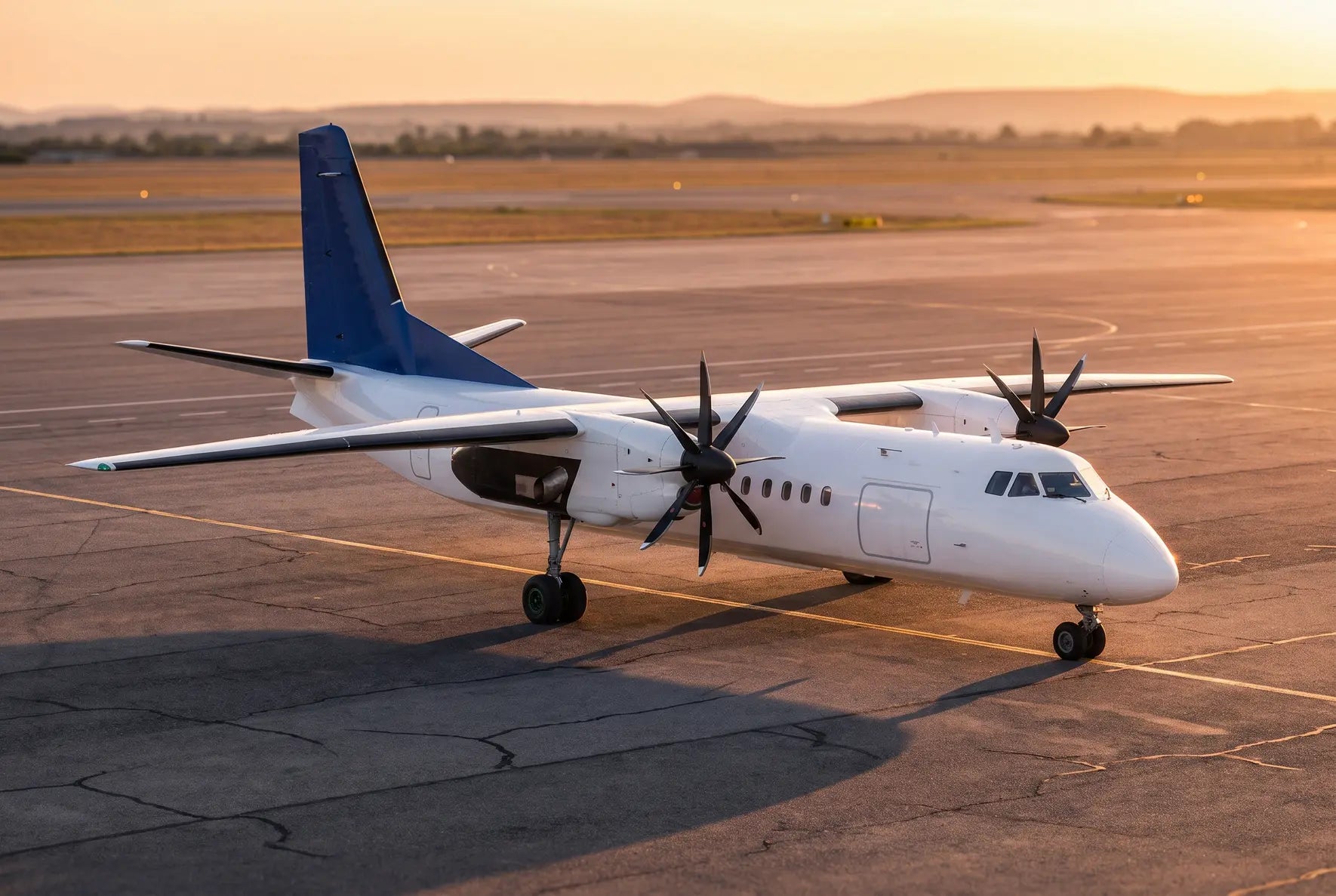
The Xian MA600 (Modern Ark 600, or Xinzhou 600) is a 60-seat regional turboprop built by Xi'an Aircraft Industrial Corporation (XAC), a subsidiary of the state-owned Aviation Industry Corporation of China (AVIC). It exists as a modernized derivative of the earlier MA60, itself descended from the Xian Y-7, a Chinese development of the Soviet Antonov An-24. The lineage matters: rather than a clean-sheet design, the MA600 retained the proven MA60 fuselage and wing while updating the systems that most affected safety perception, operating economics and export appeal.
The MA60 entered commercial service in 2000 with Sichuan Airlines after receiving type certification from the Civil Aviation Administration of China (CAAC) in June 2000. Although capable, the MA60 faced criticism over its ageing avionics and limited acceptance in Western-regulated markets. XAC responded with a dedicated upgrade programme, and after roughly three years of research and development the manufacturer rolled out the first MA600 on 29 June 2008. The aircraft made its maiden flight in October 2008. The manufacturer stated it expected airworthiness certification and entry into service in the second half of 2009, with the first aircraft delivered to the Civil Aviation Flight University of China (CAFUC) in Sichuan Province and batch deliveries beginning in 2010.
The programme centred on three practical improvements over the MA60: more capable engines, a modern flight deck, and a refreshed cabin. The MA600 is powered by two Pratt & Whitney Canada PW127J turboprops of about 2,148 kW (2,881 shp) each, driving four-bladed constant-speed propellers consistent with the MA60 installation. The flight deck adopts a Rockwell Collins Pro Line 21 integrated glass cockpit with LCD displays, flight-management and modern navigation systems, replacing the older instrumentation of its predecessor. Combined with an improved passenger cabin, these changes define the variant.
What sets the MA600 apart from the MA60 and MA700
Relative to the MA60, the MA600 is a systems-and-performance evolution on the same airframe rather than a new aircraft: the headline differences are the uprated PW127J engines, the Western glass cockpit and the upgraded interior. Looking forward, the later MA700 is a far more radical, larger and substantially redesigned turboprop, positioning the MA600 firmly as the mid-life modernization of the family. In performance terms the MA600 sits close to Western regional turboprops such as the ATR 72-600, though it carries fewer passengers and lacks the ATR's broad global certification and support network.
The following identifiers summarise what distinguishes this specific variant:
- Engines: two Pratt & Whitney Canada PW127J, approx. 2,148 kW (2,881 shp) each.
- Avionics: Rockwell Collins Pro Line 21 integrated glass cockpit.
- Seating: nominally 60 passengers, up to around 64 in high-density layouts.
- Maximum takeoff weight: about 21,800 kg (48,100 lb).
- Maximum speed: around 514 to 515 km/h (about 278 kn); economy cruise near 430 km/h.
- Range: roughly 1,430 km with a representative load, up to about 1,650 km in maximum-range configuration.
- Service ceiling: approximately 7,600 m (25,000 ft).
- Dimensions: length about 24.71 m, wingspan about 29.2 m.
Public information notes that MA600 production and international deployment remained modest, with operators concentrated in China and a small number of carriers in Africa and Southeast Asia, often alongside MA60 aircraft. The programme's principal significance was therefore procedural and technical: by fitting certified Western engines and a modern flight deck, XAC and AVIC aimed to raise the family's reliability and marketability while retaining a low-cost, proven airframe for regional routes and short, less-developed runways.

A Xian MA-600 aircraft, painted in blue and white, is seen flying against a clear sky. It is a modern turboprop airliner developed in China, known for its efficiency.
Xian MA600 Technical Specifications, Systems and Engines
The Xian MA600 (Modern Ark 600) is a 60-seat twin-turboprop regional airliner developed by AVIC and Xi'an Aircraft Industrial Corporation as an evolution of the earlier MA60. Its intended mission is short-haul regional service, connecting secondary airports where jet economics are marginal and where robust field performance matters more than outright speed. The design accepts the classic turboprop trade-off: modest cruise speed in exchange for low fuel burn, good short-field capability and lower seat-mile costs on sectors typically under 800 nautical miles. From its family lineage the MA600 inherits the proven MA60 airframe while adopting modernised systems, notably an integrated glass cockpit and updated cabin.
What matters technically for pilots and engineers is how the aircraft balances payload, range and runway needs. Its high-mounted wing and turboprop layout suit unpaved or shorter runways, while quoted range figures are tightly tied to passenger load and reserve assumptions. This makes the MA600 a practical regional workhorse in markets across Asia and Africa, where similar aircraft operate for carriers detailed in resources such as this overview of Saudia operations and pilot conditions.
- Length: 24.71 m (81 ft 1 in), per published MA600 data
- Wingspan: 29.20 m (95 ft 10 in)
- Height: 8.86 m (29 ft 1 in)
- Operating empty weight (OEW): 13,730 kg (30,269 lb)
- Maximum takeoff weight (MTOW): 21,800 kg (48,061 lb)
- Maximum payload: approximately 5,500 kg (12,100 lb)
- Typical seating: 60 passengers, single-class, with a crew of two
- Cruise speed: around 430 km/h (230 kt), with a maximum near 514 km/h (278 kt)
- Range: roughly 1,430 km (770 nmi) with 56 passengers and reserves
- Service ceiling: about 7,622 m (25,000 ft)
- Engines: two Pratt & Whitney Canada PW127J turboprops
- Avionics baseline: Rockwell Collins Pro Line 21 integrated suite
Systems and Handling-Relevant Technology
The MA600 pairs a conventional turboprop configuration with a modernised flight deck built around the Rockwell Collins Pro Line 21 avionics suite, which provides integrated multifunction displays for flight, navigation and engine information. Compared with the analogue MA60, this reduces crew workload and improves situational awareness. The engines drive six-blade, constant-speed, full-feathering Hamilton Sundstrand propellers, a configuration matched to the PW127 series that allows efficient cruise settings and effective reverse thrust on landing. Anti-skid braking and reversible propellers support operations on the shorter runways the type is designed to serve.
Published performance numbers for the MA600 should be read with context. Figures vary because operators choose different cabin densities, weights and reserve policies, while runway length, surface condition, temperature and airport elevation all shift real takeoff and landing distances. For example, the frequently quoted range of about 1,430 km assumes 56 passengers with defined reserves, whereas lighter loads extend it. Certified dispatch data from the aircraft flight manual, not summary tables, should always govern operational planning.
The PW127J Engines and Their Family
The MA600 is powered by two Pratt & Whitney Canada PW127J engines, each in the 2,750 shp (about 2,050 kW) take-off class. These are members of the broader PW100 turboprop family, developed by Pratt & Whitney Canada and in service since the early to mid-1980s. The PW100/150 family is a two-spool, free-turbine design that has accumulated well over 100 million flight hours worldwide, valued for high propulsive efficiency, low specific fuel consumption and long time-on-wing.
The PW127 subset is one of the most successful regional turboprops in production. Beyond the MA60 and MA600, PW127-series engines power the ATR 42 and ATR 72 in variants such as the PW127E, PW127M and the newer PW127XT, as well as the Airbus (CASA) C-295 military transport with the PW127G, the Fokker 60 with the PW127B, and the Ilyushin Il-114. Related PW100 members include the PW150A on the Bombardier Q400 and the PW118 on the Embraer EMB-120 Brasilia. This shared heritage gives the MA600 a mature, globally supported powerplant with an established spares and maintenance network.
Xian MA600 vs ATR 72-600 vs Bombardier Q400 vs COMAC ARJ21-700: Key Specifications
Scroll horizontally to see more →
| Parameter | Xian MA600 | ATR 72-600 | Bombardier Q400 | COMAC ARJ21-700 |
|---|---|---|---|---|
| Entry into service | 2012 | 2010 | 2000 | 2016 |
| Engines | 2 × Pratt & Whitney Canada PW127J turboprop | 2 × Pratt & Whitney Canada PW127M turboprop | 2 × Pratt & Whitney Canada PW150A turboprop | 2 × General Electric CF34-10A turbofan |
| Length | 24.71 m | 27.17 m | 32.83 m | 33.46 m |
| Wingspan | 29.20 m | 27.05 m | 28.42 m | 27.29 m |
| Height | 8.86 m | 8.78 m | 8.30 m | 8.44 m |
| Typical seating and layout (short description + approximate passengers) | Single-class: 56–60 passengers | Single-class: 68–78 passengers | Single-class: 70–78 passengers | 2-class: 78–95 passengers |
| MTOW | 21.8 t | 23.0 t | 29.3 t | 40.5 t |
| Range | 770 nm | 825 nm | 1,100 nm | 1,300 nm |
| Cruise speed | 0.36 Mach | 0.37 Mach | 0.41 Mach | 0.78 Mach |
| Service ceiling | 25,000 ft | 25,000 ft | 27,000 ft | 39,000 ft |
| Program note | Chinese-developed regional turboprop positioned as a modernized MA60 with improved avionics and performance for short-haul routes. | European benchmark regional turboprop offering efficient short-haul performance and widely used on regional routes worldwide. | High-performance regional turboprop designed for faster speeds and higher capacity, competing at the upper end of the turboprop market. | Chinese regional jet providing higher speed and capacity than turboprops, aimed at short- to medium-haul routes in the same regional market segment. |
Scroll horizontally to see more →
The table compares four regional aircraft across dimensions, capacity, weights, and performance. MA600 is the smallest, seating about 56–60 with 770 nm range and Mach 0.36 cruise. ATR 72-600 carries more (68–78) with slightly longer range. Q400 offers the best turboprop speed and range (Mach 0.41, 1,100 nm) and higher MTOW. ARJ21 stands apart as a jet, with far higher cruise and ceiling (Mach 0.78, 39,000 ft) plus the longest range.
Xian MA600 Operations: Routes, Missions and Airlines Worldwide
The Xian MA600 is a twin-turboprop built for short-haul regional flying, effectively an upgraded evolution of the MA60 with modern avionics and an improved cabin. Its designed role centres on connecting small and secondary cities where a 50-seat turboprop is more economical than a jet. With a maximum cruise around 514 km/h and an economy cruise near 430 km/h, the aircraft is optimised for frequent, relatively short cycles rather than long stage lengths.
Typical sectors fall into two broad bands. Many operators fly short legs of roughly 200-500 km on domestic feeder routes, while medium regional sectors of up to 800-1,200 km remain within comfortable reach. Published commercial range figures sit around 1,430 km with 56 passengers plus reserves, with wider databases quoting up to about 1,650 km and a theoretical maximum near 2,450 km under lighter conditions. Because turboprops excel on short cycles, daily utilisation tends to favour multiple short rotations, allowing several segments per day when demand and airport spacing permit.
Operationally, the type suits both hub-and-spoke feeding, carrying passengers from remote or thinly served airfields into national hubs for onward jet connections, and point-to-point regional links between smaller cities. It is marketed for demanding conditions, including hot-and-high and short-runway environments, making it relevant for inland and mountainous regions. The main challenges are less about core performance and more about its niche global footprint: limited certification reach, a relatively small and geographically concentrated fleet that complicates parts and technical support, and competition from established Western turboprops such as the ATR 42/72 and the De Havilland Canada Dash 8. If you are curious about the correct phrasing for common aviation terminology, see this explainer on ready for take-off or takeoff.
Where the Xian MA600 Operates
Deployment of this aircraft is concentrated in Asia and Africa, with limited overlap in the Middle East. There is no strong evidence in authoritative public sources of meaningful service in Europe or across North & South America, where ATR and Dash 8 families dominate the regional segment. In Asia, the type is used for domestic feeder and point-to-point regional flying, and also for civil training. In Africa, it appears mostly within the broader MA60/MA600 family fleets serving national and regional links. Many public operator lists group the MA60 and MA600 together, so subtype attribution is not always precise.
- Europe: No documented scheduled operators of the type. The regional market here is served overwhelmingly by ATR and Dash 8 turboprops, and authoritative sources do not list European carriers using this aircraft.
- North & South America: No credible evidence of operators in either continent. Regional networks in the Americas rely on other turboprop and regional-jet families, leaving the type effectively absent from this market.
- Asia: Joy Air operates the type on domestic Chinese regional routes; the Civil Aviation Flight University of China received an example for training use; Lao Skyway and Lao Airlines in Laos are reported within MA60/MA600 fleets on domestic and regional services; Cambodia Bayon Airlines uses the family for domestic and regional flying; and Felix Airways of Yemen appears in regional aircraft databases as an operator of the type.
- Africa: Camair-Co of Cameroon is listed as an operator within the MA60/MA600 family, and Air Zimbabwe has been associated with the MA series for regional services. Public sources rarely separate MA600 from MA60 among African carriers.
Typical Seating and Cabin Layouts
The cabin is a single-aisle, single-class layout in a 2-2 abreast arrangement. Standard regional configurations carry about 50-60 economy passengers, with some technical references citing up to 64 seats in higher-density fits. Cabin dimensions are roughly 10.8 m long, 2.7 m wide and 1.9 m high, which supports comfortable economy seating within a compact regional envelope. Network carriers feeding hubs typically favour the fuller 56-60 seat layouts to maximise feed capacity, while operators on thinner or remote routes may run lighter loads to preserve range and hot-and-high performance. The type is marketed with an improved cabin over the MA60, implying updated interiors and potential flexibility toward mixed passenger and freight use where documented. Detailed seat data for specific carriers is limited, but reference layouts can be reviewed through resources such as Joy Air MA600 seat maps and the type overview on the aircraft's technical summary.
In this video, join a rare flight review aboard Lao Skyway’s MA600, reportedly the only aircraft of its type in bookable scheduled service as of October 2024, and see the cabin, service, and overall experience.
Xian MA600 Safety Record and How Safe Is It in Service
The Xian MA600 is a modernised development of the Xian MA60, a 60-seat regional turboprop whose lineage traces back through the Xian Y-7 to the Soviet Antonov An-24. Because the MA600 entered service more recently and in far smaller numbers than the MA60, its documented safety history is limited. Independent accident databases such as the Aviation Safety Network and the Bureau of Aircraft Accident Archives record no confirmed fatal crash or major hull loss attributed specifically to the MA600. Fleet figures published in the mid-2010s counted roughly 80 combined MA60 and MA600 aircraft, with about 30 in storage, so cycles and flight hours accumulated by the variant remain modest compared with mainstream Western turboprops. Any assessment of the MA600 therefore has to be read against the broader record of its close relatives.
Major Accidents and Serious Incidents in the Family
The most relevant events involve the MA60 rather than the MA600 itself, but they shaped procedures and oversight for the whole family:
- Merpati Nusantara Airlines, Indonesia, 2011. An MA60 crashed into the sea on approach to Kaimana, killing all 25 on board. The official investigation summary found the aircraft airworthy, pointing instead to loss of situational awareness and control on a visual approach in poor weather. The finding reinforced the importance of type-specific crew familiarisation and stabilised-approach discipline.
- Myanma Airways, Myanmar, 2013. An MA60 veered off the runway after a hydraulic pressure drop caused loss of braking and steering. The event highlighted the need for closer inspection and maintenance of hydraulic and landing-gear systems shared across the family.
- Global fleet grounding, 2014. The Civil Aviation Administration of China issued an airworthiness directive covering the nose undercarriage and gear annunciation systems on higher-cycle aircraft. The manufacturer extended inspections and nose-gear overhauls to the wider in-service fleet, a clear example of active regulatory follow-up.
These outcomes drove practical changes in training emphasis, mandatory inspections and manufacturer support rather than pointing to a single systemic design flaw. Robust, rugged airframes of this An-24 heritage are examined in more detail in our overview of the Fokker F27-400, another high-wing regional turboprop of the same era.
How Safe Is the Xian MA600?
Judged purely on documented events, the MA600 has no confirmed fatal accident, though its small fleet and limited traffic volume mean the statistical sample is too thin to draw firm long-term conclusions. Its design philosophy favours a proven, rugged configuration suited to short-field and secondary-airport operations, upgraded with Pratt & Whitney Canada PW127J engines and modern avionics over the earlier MA60. The type holds CAAC certification and operates under that regulator's oversight, but it was not submitted for FAA or EASA approval, which limits acceptance in some jurisdictions. As with any aircraft, real-world safety depends heavily on operator standards, standard operating procedures, crew training and maintenance support. Set against global figures, commercial aviation as a whole records very low fatal accident rates per flight, as tracked in the ICAO Global Aviation Safety Report and IATA annual safety data, confirming that air travel remains one of the safest modes of transport.
01 What is the Xian MA600 used for?
The Xian MA600 is a twin-engine regional turboprop designed for short-haul passenger service, with around 60 seats in a typical layout. It is mainly used on domestic and regional routes where runway lengths, demand, and operating costs favor a turboprop over a jet. Sources also describe it as suitable for freight, maritime patrol, medical evacuation, and other utility roles in some configurations.
02 How far can the Xian MA600 fly?
Published specifications give the Xian MA600 a range of about 890 nautical miles, or roughly 1,650 km, at typical mission assumptions. That makes it well suited to short and medium regional sectors rather than longer trunk routes. Its service ceiling is listed at about 25,000 ft, which is normal for this class of turboprop.
03 What is the cabin like on the Xian MA600?
The Xian MA600 has a relatively compact regional-cabin feel, with a width of about 2.70 m and a cabin height of about 1.90 m. The aircraft is generally configured for about 60 passengers, and sources note an improved passenger cabin compared with the earlier MA60. For travelers, that usually means a simple no-frills interior designed for quick regional hops rather than long-haul comfort.
04 Is the Xian MA600 noisy or uncomfortable to fly on?
Like most turboprops, the Xian MA600 is usually noisier than a jet at the same cabin size, especially during takeoff and climb. In cruise, turboprops can feel steady on shorter sectors, but passengers may notice propeller vibration and engine sound more than on a jet. Seat comfort will depend heavily on the airline’s interior fit-out, since the aircraft itself is built for utility and efficiency rather than premium cabin space.
05 Which airlines operate the Xian MA600?
The Xian MA600 has been operated in small numbers rather than becoming a large global fleet. Reported operators include Air Zimbabwe, Lao Airlines, Felix Airways, Joy Air, Camair-Co, and Cambodia Bayon Airlines, mainly on short domestic or regional routes. Because the fleet is limited, it is not an aircraft that travelers will see as commonly as major Western regional turboprops.
06 Is the Xian MA600 related to the MA60, and what design features matter?
Yes, the Xian MA600 is an improved version of the MA60, with upgraded avionics, a revised cabin, and Pratt & Whitney Canada PW127J engines with increased thrust. Its published maximum speed is about 514 km/h, or 278 knots, which is typical for a modern regional turboprop of this size. Public sources do not show a large, widely documented accident history for the type, but its limited fleet size means any safety assessment should be based on the specific operator, maintenance standard, and route conditions rather than the model alone.