Tupolev Tu-114: History, Development, and What Made This Giant Turboprop Unique
The Tupolev Tu-114, NATO reporting name Cleat, was a Soviet long-range turboprop airliner derived directly from the Tu-95 "Bear" strategic bomber. It remains the fastest propeller-driven passenger aircraft ever to enter regular commercial service. Understanding why this aircraft existed requires looking at the political and technological pressures of the mid-1950s Soviet Union, where intercontinental air travel capability was both a strategic necessity and a matter of national prestige.
In the early 1950s, the USSR lacked an airliner capable of flying nonstop across Siberia or reaching major Western capitals without multiple refuelling stops. The Tupolev Design Bureau (OKB-156), led by Andrei Tupolev, already had a proven long-range platform in the Tu-95 bomber, which featured swept wings and the extraordinarily powerful Kuznetsov NK-12 turboprop engines with contra-rotating propellers. In August 1955, the Soviet Council of Ministers issued a formal directive ordering Tupolev to design a long-range passenger aircraft based on the Tu-95, with a minimum range requirement of 8,000 km. Design work began immediately at the Tupolev bureau in Moscow.
As an interim solution while the Tu-114 was being developed, two Tu-95 bombers were converted into the Tu-116 VIP transport by installing a pressurised passenger cabin in the bomb bay. These aircraft, completed around 1957-1958, could carry approximately 20-24 passengers and served as government transports, but were never intended for regular airline service.
The Tu-114 prototype, registered CCCP-L5611 and named Rossiya, was completed at Plant No. 156 in Moscow in the summer of 1957. Its maiden flight took place on 15 November 1957 at Zhukovsky airfield. Extensive flight testing continued through 1960, during which the aircraft demonstrated a range exceeding 10,900 km and a maximum speed of approximately 880 km/h, comparable to early jet airliners of the era. In 1958, the prototype made its international public debut at the Brussels World Exhibition (Expo 58). In September 1959, while still in pre-service testing, a Tu-114 carried Soviet Premier Nikita Khrushchev on his historic first visit to the United States, a highly publicised demonstration of Soviet aviation capability.
Serial production took place at the Kuibyshev aviation plant (now Aviakor, in Samara) during the early 1960s, with approximately 32 aircraft built between 1960 and 1964. The Tu-114 entered regular commercial service with Aeroflot on 24 April 1961 on the Moscow (Vnukovo) to Khabarovsk route. Over the following years, it expanded to international destinations including Copenhagen, Paris, Tokyo (in a cooperative arrangement with Japan Airlines), New Delhi, Montreal, and Havana. Airlines operating long international sectors during this period relied on aircraft with significant range and crew endurance, factors that also shaped pilot working conditions across the industry.
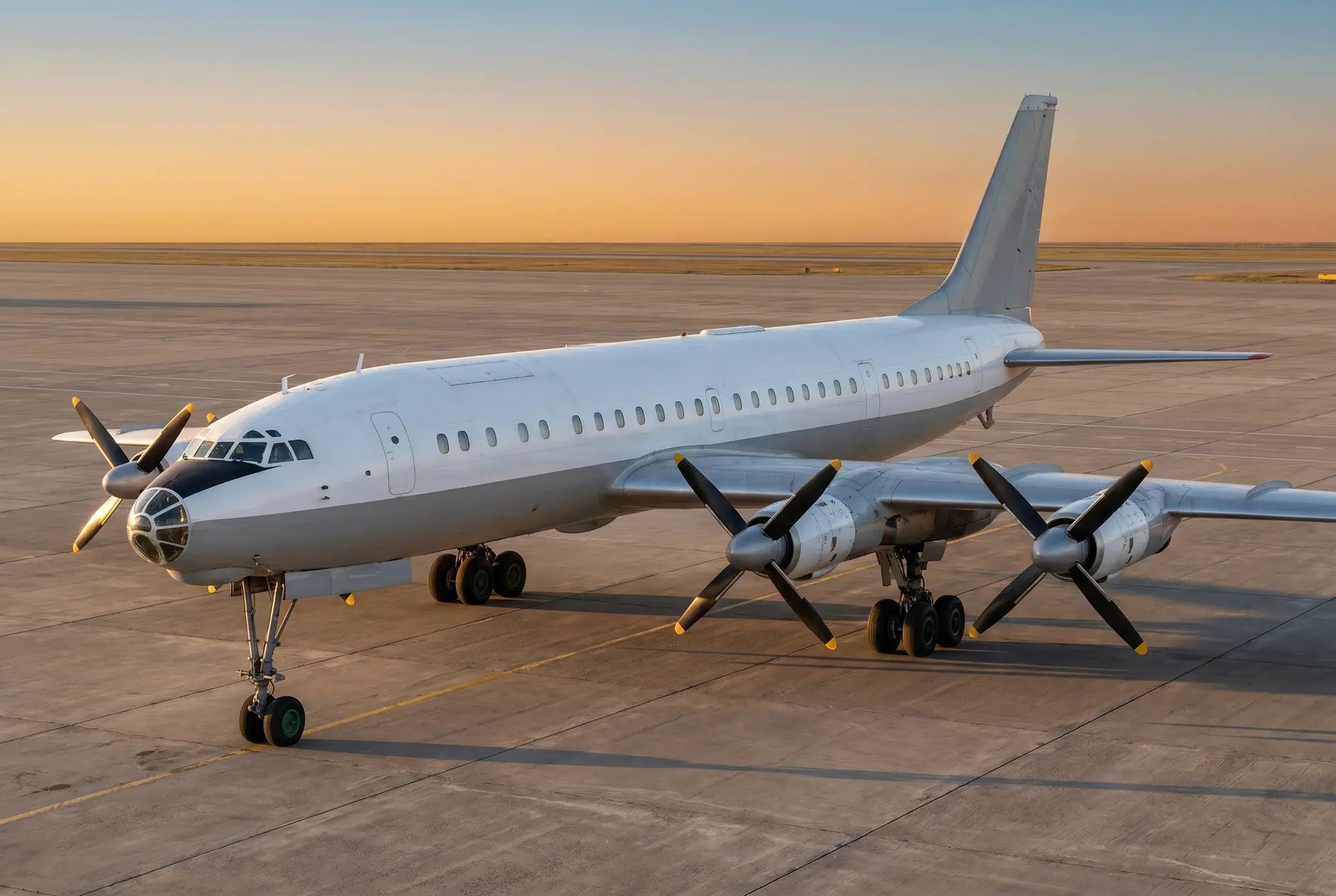
The Tu-114 was powered by four Kuznetsov NK-12MV turboprops, each producing approximately 14,795 shp (11,033 kW), driving massive contra-rotating propellers. These engines, among the most powerful turboprops ever built, gave the Tu-114 its exceptional speed and range but also produced considerable cabin noise and vibration, a notable drawback compared to jet competitors. The aircraft's low-wing configuration required exceptionally tall landing gear to provide clearance for the large propeller discs, giving it a distinctive high stance on the ground that often required special boarding stairs at airports.
By the mid-1970s, most Tu-114 airframes had approached their structural fatigue life of approximately 14,000 flight hours. The type was progressively replaced by the Ilyushin Il-62 long-range jet and was retired from Aeroflot commercial service around 1976, having carried more than six million passengers over its 15-year operational career. Only one fatal accident was recorded during the type's service history.
What Distinguishes the Tu-114 From Related Variants
The Tu-114 shared its wing, engines, and much of its landing gear with the Tu-95 bomber, but featured a completely new, much wider pressurised fuselage with a low-wing configuration. This is in stark contrast to the Tu-116, which simply inserted a small VIP cabin into the Tu-95's existing narrow bomb-bay fuselage while retaining the bomber's high-wing layout. The Tu-116 accommodated only about 20-24 passengers; the Tu-114 carried up to 220 in high-density layouts.
Within the Tu-114 family itself, the most significant production sub-variant was the Tu-114-200, an upgrade that reconfigured the cabin to seat approximately 200 passengers through denser seating arrangements and revised galley and lavatory placement. Most operational Tu-114s were eventually brought to this standard. Three Tu-114-200 airframes were further modified as the Tu-114D (dalniy, meaning "long-range"), which added extra fuel tanks and reduced passenger capacity to around 120-150 seats to enable nonstop Moscow-Havana service with a range extended to approximately 13,000 km. Several other variants remained unbuilt proposals, including the Tu-114 6NK-8, a projected version with six Kuznetsov NK-8 turbofan engines that was never constructed.
The following list summarises the key identifiers of the baseline Tupolev Tu-114:
- Engines: 4 x Kuznetsov NK-12MV turboprops with contra-rotating propellers, each rated at approximately 14,795 shp
- Maximum takeoff weight: approximately 171,000 kg (376,990 lb)
- Maximum speed: approximately 880 km/h (547 mph)
- Range: up to 10,900 km (6,775 mi)
- Passenger capacity: 120 to 220, depending on configuration
- Wingspan: 51.1 m (167 ft 8 in); length: 54.1 m (177 ft 6 in)
- Distinctive features: low-wing layout with exceptionally tall landing gear; swept wings derived from the Tu-95; widest airliner fuselage of its era
- Total production: approximately 32 aircraft (1960-1964)

A black and white photograph of a large aircraft on the tarmac at Schiphol Airport. The airplane is surrounded by people and vehicles, highlighting its significant size.
Tupolev Tu-114 Technical Specifications, Systems and Engine Overview
The Tupolev Tu-114 "Rossiya" was designed in the mid-1950s to fulfil the Soviet Union's need for a true intercontinental airliner capable of connecting Moscow with destinations across Asia, Europe, and the Americas. Rather than developing an entirely new airframe, the Tupolev design bureau derived the Tu-114 from the Tu-95 strategic bomber, reusing its 35-degree swept wing planform, Kuznetsov NK-12 turboprop engines, and basic landing gear concept. However, it introduced a completely new, wider pressurised fuselage in a low-wing configuration, making it a distinct civil aircraft rather than a mere conversion.
The central design trade-off was speed and range versus cabin comfort and airport compatibility. The four enormous contra-rotating propellers gave the Tu-114 jet-rivalling cruise speeds and excellent fuel efficiency for its era, but at the cost of significant cabin noise and vibration. Its exceptionally tall landing gear, necessary to provide ground clearance for the 5.6-metre-diameter propellers, created challenges at foreign airports that lacked suitable boarding equipment. Despite these compromises, the Tu-114 remains recognised as the fastest turboprop airliner ever to enter commercial service.
- Length: 54.1 m (177 ft 6 in)
- Wingspan: 51.1 m (167 ft 8 in)
- Height: 15.44 m (50 ft 8 in)
- Wing area: 311.1 m2 (3,349 ft2)
- Wing sweep: 35 degrees
- Empty weight: approximately 91,000 to 93,000 kg (200,600 to 205,000 lb)
- Maximum takeoff weight (MTOW): 171,000 to 175,000 kg (377,000 to 385,800 lb), depending on source and configuration
- Passenger capacity: 120 to 224, depending on cabin layout (typical Aeroflot configurations seated around 170 with berths and lounge areas)
- Engines: 4 x Kuznetsov NK-12MV turboprops, each producing approximately 11,000 kW (14,800 shp)
- Propellers: contra-rotating, eight-bladed per engine (two four-blade rows), AV-60 series, 5.6 m diameter
- Maximum speed: approximately 470 knots (870 km/h) at 26,000 ft
- Typical cruise speed: approximately 420 knots (770 km/h), around Mach 0.71
- Range (with maximum fuel and typical payload): approximately 4,830 NM (8,950 km)
- Service ceiling: approximately 12,000 m (39,000 ft)
- Takeoff distance at MTOW: approximately 2,500 m (8,200 ft)
- Landing distance: approximately 1,400 m (4,600 ft)
- Crew: 5 to 6 flight deck crew (captain, first officer, navigator, flight engineer, radio operator)
Systems and Handling-Relevant Technology
The Tu-114 used conventional mechanical flight controls with hydraulic power assistance, typical of large 1950s transport aircraft. Primary control surfaces (ailerons, elevators, rudder) were actuated via cables, rods, and hydraulic boosters. There was no fly-by-wire system. Large Fowler-type flaps provided the high lift needed for approach and landing at the aircraft's considerable weight, and the flap system was powered by redundant hydraulic circuits. Trim was managed through mechanical trim wheels with electrically driven trim motors for fine adjustments during long cruise phases.
Propeller control relied on constant-speed governors integrated with the engine fuel control units to maintain selected RPM and power settings. The propellers were fully reversible and featherable for engine-out scenarios. The flight deck featured individual power levers, propeller control levers, and comprehensive instrumentation for the period, including torque, RPM, exhaust gas temperature, and fuel flow readings. Avionics included radio compasses (ADF), VHF and HF communications, weather radar, and an autopilot system capable of heading and altitude hold. Long-range navigation was supported by Doppler radar equipment and, on some aircraft, celestial navigation aids. The complexity of crew coordination on long-haul operations was a defining aspect of the Tu-114 cockpit, requiring a dedicated navigator, flight engineer, and radio operator alongside the pilots.
Published performance figures for the Tu-114 vary across sources for several reasons. The MTOW is reported between 171,000 kg and 175,000 kg depending on the reference and the specific production block. Range figures are particularly sensitive to payload assumptions: the commonly cited 4,830 NM figure assumes maximum fuel with a reduced passenger load, while shorter range values reflect higher-density cabin configurations. Atmospheric conditions, runway elevation, and temperature also affect field performance data. The takeoff distance of approximately 2,500 m, for instance, applies to sea-level conditions at maximum weight and should not be treated as an absolute figure for all operational scenarios.
Kuznetsov NK-12: The World's Most Powerful Turboprop Engine
The Tupolev Tu-114 was powered exclusively by the Kuznetsov NK-12 series turboprop, specifically the NK-12MV variant. Designed by the Kuznetsov Design Bureau (OKB-276) in Kuibyshev (now Samara), the NK-12 remains the most powerful production turboprop engine ever built. Its architecture comprises a 14-stage axial compressor, 12 cannular combustion chambers, and a 5-stage turbine driving a reduction gearbox connected to the contra-rotating propeller assembly.
The NK-12's origins trace back to post-war German turboprop research, particularly the Junkers Jumo 022 programme. German engineers, including Ferdinand Brandner, contributed to early Soviet prototypes designated TV-022 and TV-2. These early engines produced around 5,000 equivalent horsepower but fell short of the power demands for intercontinental bombers and transports. A comprehensive redesign under Nikolai Kuznetsov, incorporating Nimonic heat-resistant alloys and improved turbine cooling, yielded the TV-12, later redesignated NK-12. By 1956, the NK-12M had passed state acceptance testing at around 12,000 shp. The mature NK-12MV variant installed on the Tu-114 produced approximately 15,000 shp (11,000 kW) per engine, with a specific fuel consumption at cruise of roughly 0.158 kg/(hp.h), which was remarkably efficient for its era.
Each NK-12MV drove an AV-60 series contra-rotating propeller assembly consisting of two coaxial four-blade rows (eight blades total per engine) with a diameter of 5.6 metres. The blades were constructed from duralumin using a NACA-16 series airfoil profile optimised for high subsonic tip speeds, rotating at approximately 736 RPM in cruise. The dry engine weight was around 2,900 kg, with the complete propeller assembly adding approximately 1,155 to 1,190 kg.
Beyond the Tu-114, the NK-12 family powered several other notable aircraft. The Tupolev Tu-95 strategic bomber and its maritime patrol derivative, the Tu-142, used the NK-12MV and later modernised variants (NK-12MP, NK-12MPT). The Tupolev Tu-126 airborne early warning aircraft, based on the Tu-114 airframe, also used the same engine. The Antonov An-22 "Antei" heavy military transport employed the NK-12MA variant with larger 6.2-metre AV-90 propellers, while the A-90 "Orlyonok" ekranoplan (wing-in-ground-effect craft) used the NK-12MK adaptation. The NK-12 programme also laid groundwork for later Kuznetsov engines, including the NK-8 and NK-86 turbofans that powered subsequent Soviet airliners.
Tupolev Tu-114 vs DC-8-63 vs Boeing 707-320B vs Ilyushin Il-62 Specifications
Scroll horizontally to see more →
| Parameter | Tupolev Tu-114 | Douglas DC-8-63 | Boeing 707-320B | Ilyushin Il-62 |
|---|---|---|---|---|
| Entry into service | 1961 | 1968 | 1962 | 1967 |
| Engines | 4 × Kuznetsov NK-12MV turboprop | 4 × Pratt & Whitney JT3D-7 turbofan | 4 × Pratt & Whitney JT3D-3B turbofan | 4 × Kuznetsov NK-8-4 turbofan |
| Length | 54.1 m | 57.1 m | 46.6 m | 53.1 m |
| Wingspan | 51.1 m | 45.2 m | 44.4 m | 43.2 m |
| Height | 15.4 m | 12.9 m | 12.9 m | 12.3 m |
| Typical seating and layout (short description + approximate passengers) | 2-class: 170–200 passengers | 2-class: 200–259 passengers | 2-class: 140–189 passengers | 2-class: 160–195 passengers |
| MTOW | 171 t | 158 t | 152 t | 165 t |
| Range | 4,830 nm | 4,630 nm | 5,750 nm | 5,400 nm |
| Cruise speed | 0.78 Mach | 0.82 Mach | 0.82 Mach | 0.80 Mach |
| Service ceiling | 39,000 ft | 36,000 ft | 41,000 ft | 40,000 ft |
| Program note | Long-range Soviet turboprop flagship based on the Tu-95 bomber, optimized for intercontinental services with high speed and fuel efficiency. | Stretched long-range version of the DC-8 family, aimed at high-capacity intercontinental routes in the late 1960s. | Early long-range jetliner variant that became a benchmark for intercontinental travel in the 1960s jet age. | Soviet long-range jet airliner positioned as the national flagship and eventual jet successor to turboprops like the Tu-114. |
Scroll horizontally to see more →
The table compares four long-range airliners across era, size, capacity, performance, and roles. The Tu-114 stands out as the only turboprop and has the widest wingspan and a high 39,000 ft ceiling. The DC-8-63 is longest and typically seats the most, while the 707-320B leads range at 5,750 nm and ceiling at 41,000 ft. The Il-62 is a jet counterpart with competitive range and MTOW.
Tupolev Tu-114 Operations: Routes, Airlines and Missions Worldwide
The Tupolev Tu-114 was designed from the outset as a long-range flagship airliner, and its operational profile reflected that ambition. Powered by four Kuznetsov NK-12MV turboprop engines driving massive contra-rotating propellers, it combined a cruise speed of around 770-800 km/h with a range of approximately 6,200 km in standard configuration, extendable to over 9,000 km in the long-range Tu-114D variant. These figures made it the fastest propeller-driven airliner ever built, a record recognised since 1960.
Typical missions fell into two categories: intercontinental international services and long-haul domestic trunk routes within the Soviet Union. International sectors ranged from around 3 hours (Moscow to Paris) to over 19 hours (Moscow to Havana with intermediate stops). On the Moscow-Tokyo route, scheduled flight times were approximately 10 h 35 min westbound and 11 h 25 min eastbound. Domestic services such as Moscow-Khabarovsk covered roughly 6,100-6,400 km in about 7 to 8 hours of flight time. Exact fleet-wide daily utilisation figures were never publicly released by Aeroflot, but given the long sectors, extended turnaround times and demanding maintenance requirements, an estimated 4 to 8 flight hours per day per airframe is considered realistic for the era.
Operationally, the Tu-114 functioned within a hub-and-spoke model centred on Moscow Sheremetyevo Airport (SVO), and initially Moscow Vnukovo, for international services. When the Ilyushin Il-62 jet began replacing it on intercontinental routes from the late 1960s, remaining Tu-114s were reassigned to long domestic sectors out of Moscow Domodedovo (DME). The aircraft required long runways of at least 2,500 metres and reinforced pavements due to its considerable weight and tall landing gear inherited from the Tu-95 bomber. Operators faced several challenges: the NK-12MV engines and their complex gearboxes demanded intensive maintenance; cabin noise and vibration levels were very high compared to contemporary jets such as the Boeing 707; and spare-part logistics outside the USSR were extremely limited. Despite these constraints, the Tu-114 was regarded as reliable, safe and fuel-efficient for its time, carrying over six million passengers during its Aeroflot career. For comparison with a much later regional turboprop-era design philosophy, see how manufacturers approached different mission requirements with aircraft like the Embraer ERJ-135.
Where the Tupolev Tu-114 Operated
Only 32 Tu-114s were built between 1958 and 1963, and the type served exclusively with Aeroflot as its sole airline operator. The only other carrier involvement was Japan Air Lines (JAL), which participated in a joint-operation agreement on the Moscow-Tokyo route starting 17 April 1967, using Aeroflot-owned Tu-114s with mixed Soviet-Japanese crews and a small JAL logo on the fuselage. The aircraft also served the Soviet Air Force and government VIP transport duties, including Nikita Khrushchev's high-profile flight to the United States in 1959. Regular Aeroflot passenger service ran from 24 April 1961 until 1977, while military and government use continued into the late 1980s.
International destinations spanned Europe, Asia, the Americas and transit points in Africa. The Tu-114 was a Cold War-era prestige aircraft, and its route network was shaped as much by diplomacy as by commercial demand. No Western airline ever operated the type directly.
- Europe: Aeroflot operated Tu-114 services from Moscow to Paris and Copenhagen, using the aircraft on sectors of around 2,400-2,500 km. These relatively shorter flights of approximately 3 hours demonstrated the type's versatility beyond ultra-long-haul missions. European services were among the first to transition to the Il-62 jet in the late 1960s.
- North and South America: The most strategically important route was Moscow to Havana, a service that began on 10 July 1962. Due to political pressures during the Cold War, routing changed multiple times, initially via Conakry (Guinea), then Dakar (Senegal), then Algiers (Algeria), and eventually via a high-latitude Arctic routing through Olenya near Murmansk. The Tu-114D long-range variant was developed specifically for this mission, with seating reduced to around 60 and 15 additional fuel tanks installed. Aeroflot also served Montreal once weekly, with scheduled times of 11 h 50 min westbound and 10 h 30 min eastbound. Some combined Moscow-Montreal-Havana routings appeared in 1968 timetables.
- Asia: The Moscow-Tokyo service, operated jointly with Japan Air Lines, was a flagship route. Aeroflot also operated Tu-114 flights to New Delhi with a scheduled time of approximately 7 hours. The Tokyo service ended in May-June 1969 when Il-62 jets took over, and the four Tu-114s used on that route were reconfigured back to higher-density domestic layouts of around 200 seats. Domestic long-haul services to Asian parts of the USSR, such as Moscow to Khabarovsk, Novosibirsk, Alma-Ata (now Almaty) and Tashkent, represented the backbone of Tu-114 operations from the late 1960s onward.
- Africa: The Tu-114 did not operate scheduled commercial services to African destinations as endpoints. However, several African cities served as critical refuelling stops on the Moscow-Havana route, including Conakry, Dakar and Accra. One notable incident involved Aeroflot Flight 065 in 1966, which was operating a Moscow-Conakry-Accra-Brazzaville routing.
Typical Seating Configurations on the Tupolev Tu-114
The Tu-114 featured a notably spacious cabin for its era, with a multi-compartment layout that anticipated later multi-class configurations. In its highest-density arrangement, the aircraft could seat up to approximately 220 passengers in an all-economy configuration with 3+3 seating. However, Aeroflot typically operated the aircraft with around 170 passengers on international services, incorporating sleeping berths and a dining lounge, features that were exceptional for commercial aviation in the early 1960s.
Three broad classes of layout were documented. The economy configuration offered standard rows in a 3+3 arrangement. A first-class section featured rows of individual seats with personal tables and reading lamps. Most unusually, some aircraft included four coupe compartments, essentially sleeping cabins resembling Soviet railway berths, positioned in the forward section of the fuselage. The aircraft also had a dedicated dining compartment, coat closets and a full galley, all arranged across multiple cabin sections from front to rear.
The most distinctive variant was the two-class configuration used on the Moscow-Tokyo Japan Air Lines joint service, which seated 105 passengers with a dedicated first-class section in the forward cabin. On the opposite end of the spectrum, the Tu-114D long-range variant configured for the Havana route carried only about 60 passengers, with the freed cabin space used for 15 supplementary fuel tanks. VIP and government transport versions featured even lower densities, with lounge-style seating, sofas and interiors decorated to resemble official state rooms. More technical details on the aircraft's design heritage can be found on the Aerospaceweb Tu-114 reference page.
In this video, discover the Soviet propeller aircraft engineered to deliver jet-like performance. Learn how its design, power, and innovations pushed speed and handling beyond typical prop planes.
Tupolev Tu-114 Safety Record: Accidents, Incidents and How Safe Was It?
The Tupolev Tu-114 compiled a relatively modest operational history compared with mass-produced Western contemporaries. Only 32 airframes were built between 1958 and 1963, and the type served primarily with Aeroflot on prestigious long-haul routes from 1961 until its retirement in 1976. Over roughly fifteen years of scheduled service, major aviation databases record just two hull-loss accidents, one of which was fatal. That translates into one of the lower loss rates among large Soviet-era airliners of the period, although the small fleet size means the statistical sample is limited and direct rate comparisons should be interpreted with caution. The Aviation Safety Network Tu-114 type page confirms these two events as the only recorded accidents for the type.
Major Accidents and Incidents Involving the Tu-114
- 7 August 1962, Moscow-Vnukovo (CCCP-76479) - An Aeroflot Tu-114D was involved in an accident at Vnukovo Airport that resulted in the aircraft being damaged beyond economic repair. No fatalities were recorded. Detailed public information on the causal chain remains limited, as was common with many Soviet-era incidents, but the airframe was written off. The event did not result in publicly documented fleet-wide changes, likely due to the opacity of Soviet aviation safety reporting at the time.
- 17 February 1966, Moscow-Sheremetyevo (CCCP-76491) - Aeroflot Flight 065 - This remains the only fatal accident involving a Tupolev Tu-114. During a night-time takeoff in winter conditions, the aircraft's left main landing gear struck a snow drift on or near the runway edge. The crew applied right bank to compensate, which caused the No. 3 propeller to strike the runway surface. The aircraft veered off the runway to the right, crashed, and caught fire. Of the 66 occupants on board, 21 were killed (13 crew members and 8 passengers) and 45 survived, many with injuries. Investigators identified inadequate snow clearance on the runway and shoulders as a primary contributing factor, alongside the crew's corrective control input that led to the propeller strike. The accident reinforced the importance of rigorous runway maintenance procedures during winter operations at Soviet airports, a concern that applied broadly across all aircraft types operating in harsh conditions.
Beyond these two events, no other hull losses, hijackings, or major structural incidents involving the Tu-114 appear in recognised safety databases such as the Bureau of Aircraft Accidents Archives (BAAA). While minor technical events such as engine shutdowns or diversions undoubtedly occurred during routine operations, none escalated to the level of a reportable accident in publicly available records. The careful management of crew training and dispatch by Aeroflot's international directorate, which treated the Tu-114 as a flagship aircraft, likely contributed to this outcome. Operators handling complex fleets face similar challenges today, as illustrated by the varied operational demands placed on charter carriers worldwide.
How Safe Was the Tupolev Tu-114?
Evaluating the safety of the Tupolev Tu-114 requires context. The type's design was derived from the thoroughly tested Tupolev Tu-95 strategic bomber, inheriting its swept wing, four Kuznetsov NK-12 contra-rotating turboprop engines, and much of its empennage and landing gear structure. This bomber heritage gave the Tu-114 structural robustness and four-engine redundancy, both of which contributed positively to in-flight safety. The aircraft typically carried a large cockpit crew of five or more, including pilots, a flight engineer, a navigator, and a radio operator, providing multiple layers of human oversight during operations. These characteristics aligned with the conservative design philosophy common to Soviet long-range aviation in the 1950s and 1960s.
However, the Tu-114 also posed operational challenges. Its enormous contra-rotating propellers generated significant vibration and noise, increasing maintenance demands and crew fatigue. The very tall landing gear, necessitated by propeller ground clearance, complicated ground handling. These factors meant the aircraft required well-trained, disciplined crews and meticulous maintenance to operate safely. The single fatal accident was ultimately triggered not by a design flaw but by an external factor (runway contamination) combined with crew response under pressure.
With only one fatal accident in approximately fifteen years of service and across the entire 32-aircraft fleet, the Tu-114's safety record compares favourably to many of its Soviet and international contemporaries. According to data compiled by organisations such as the Aviation Safety Network, accident rates across all aircraft types have declined dramatically since the 1960s thanks to improvements in design, crew resource management, regulatory oversight, and maintenance standards. The Tu-114 operated in an era before many of these modern safeguards existed, making its record all the more notable for the time. As with every generation of aircraft, the lessons learned from its operational experience contributed to the continuous improvement that makes aviation one of the safest modes of transport in the world today.
01 What was the Tupolev Tu-114 mainly used for?
The Tupolev Tu-114 was designed as a long-range turboprop airliner for high-capacity Soviet domestic and international routes. It entered service in the late 1950s and was used on prestige and long-distance services, including flights to major cities in the USSR and select overseas destinations. Its mission profile was to combine jet-like speed with lower fuel use than early turbojet airliners.
02 How far could the Tupolev Tu-114 fly?
The Tu-114 had a very long range for its era, commonly cited at around 8,900 km depending on payload and variant. That made it suitable for intercontinental sectors and extended overwater or remote-area operations without frequent refueling. In service, range was one of the aircraft’s key strengths alongside its high cruise speed for a turboprop.
03 How comfortable was the Tupolev Tu-114 cabin?
The Tu-114 was large for its time and could carry a relatively high passenger load, often in a spacious layout by 1950s standards. Comfort was mixed: the cabin was roomy, but the aircraft was also known for high vibration and significant propeller noise, especially compared with later jet airliners. Passengers usually remember it more for its scale and unusual character than for quietness.
04 Which airlines operated the Tupolev Tu-114?
The Tupolev Tu-114 was operated primarily by Aeroflot, the Soviet national airline, which used it on flagship long-range routes. It was not a widely exported airliner in the way many Western types were, so its operator list was very limited. That makes it a distinctive aircraft tied closely to Soviet civil aviation history.
05 Was the Tupolev Tu-114 safe and reliable?
The Tu-114 had a generally serious operational record for a large Soviet airliner, but it is also remembered for a small number of high-profile accidents and incidents, as well as the challenges of operating a very powerful turboprop design. A notable safety feature was its robust structure and use of four Kuznetsov NK-12 turboprops, which were extremely powerful but also mechanically demanding. As with any aircraft of its generation, safety standards and maintenance practices varied over time.
06 Where should a passenger sit on a Tupolev Tu-114?
For the best ride on a Tupolev Tu-114, seats farther from the engines and propeller arcs would generally be preferred, since the aircraft was famous for noise and vibration. Window seats were especially interesting because the Tu-114 had a distinctive high wing and very large propellers, giving passengers an unusual view and a strong sense of the aircraft’s scale. Travelers sensitive to engine noise would likely choose a quieter cabin section if available, though comfort depended heavily on the specific interior layout.