

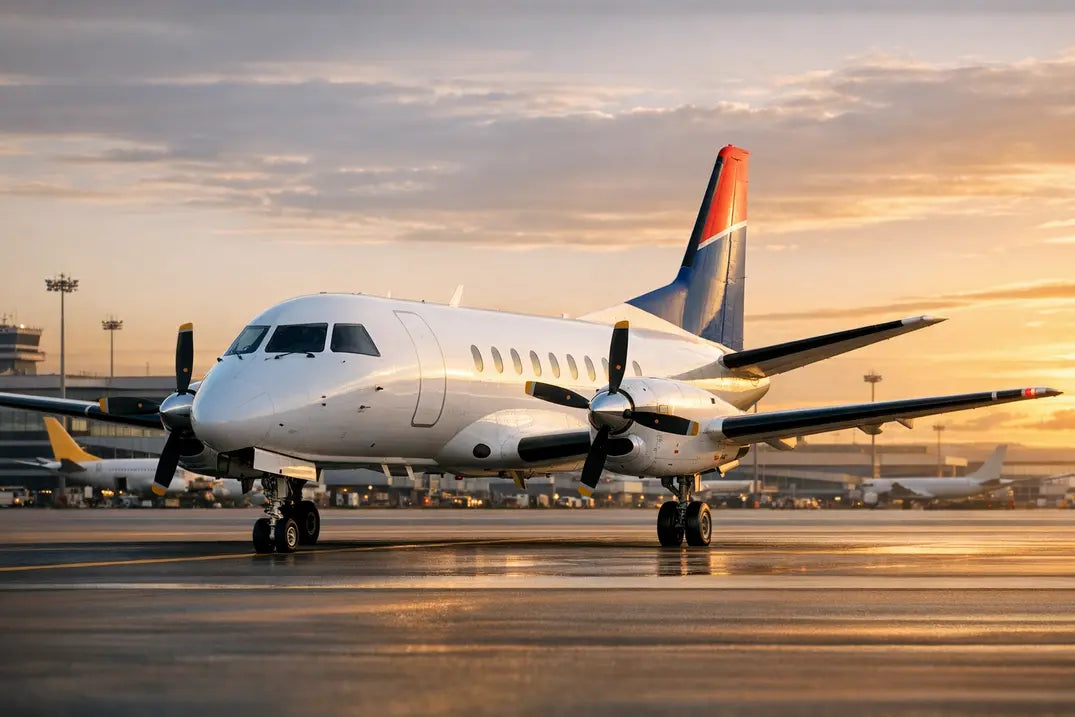
Saab 340A programme history: launch, certification, and variant evolution
The Saab 340A was the initial production member of the Saab 340 family, conceived as a pressurised regional turboprop in the 34 seat class. The programme emerged as Saab moved beyond military aircraft and targeted the growing commuter segment, including the newly deregulated US market. Early aircraft were developed in partnership with Fairchild Industries and marketed as the Saab Fairchild 340, a background that still explains why the variant is certified as SAAB SF340A in official documentation.
Programme launch and early development
January 1980 marked the signing of the Saab and Swearingen (Fairchild Industries) joint venture agreement to develop a new low wing commercial turboprop in the 34 seat class, giving rise to the Saab Fairchild 340 name. Saab’s account of the programme highlights that the partnership was intended to combine Saab’s design capability with an established route to the US market, while demand grew for efficient short haul aircraft after deregulation.
The certification record in the EASA Type Certificate Data Sheet EASA.A.068 lists a 31 March 1980 State of Design authority certification application date for the SF340A, anchoring the formal start of the type certification programme. Saab also states that the civil aircraft effort required a major industrial investment, including a new factory built in 1981 to 1982 in Linköping to support civilian production.
First flight, certification and entry into service
Saab staged a public roll out and demonstration in November 1982, followed by the aircraft’s maiden flight on 25 January 1983, as detailed in Saab’s programme history (The civilian aircraft: Flying in a Saab between Basel and Paris). The aircraft design introduced manufacturing techniques such as diffusion bonding to reduce the need for rivets, supporting weight and fatigue performance, according to Saab’s retrospective on the first flight (40 years since the Saab 340 inaugural flight).
For the Saab 340A baseline, the EASA TCDS records a 30 May 1984 State of Design authority type certificate date for the SF340A. The same document shows the certification basis under JAR 25 and lists special conditions that reflect the intended regional mission profile, including requirements addressing icing performance, gravel runway operation, and takeoff and landing with tailwind above 10 knots. It also notes approval for transport commercial operations and an all weather capability demonstrated to CAT II standards, subject to aircraft configuration and operator approval.
Summer 1984 brought entry into regular service, with Crossair operating the first scheduled route between Basel and Paris, again documented by Saab. This is where the Saab 340A becomes identifiable as a specific variant: a pressurised, twin engine regional turboprop with a certified maximum passenger seating capacity of 37, powered by two GE CT7 5A2 engines. The EASA TCDS lists a takeoff rating of 1,735 shp per engine and specifies four blade Dowty Aerospace propellers with a 3.35 m diameter.
The SF340A type certificate defines several maximum certified mass options linked to modification status, so individual Saab 340A airframes can be encountered with different weight standards. The EASA TCDS lists maximum takeoff mass values up to 12,930 kg depending on the applicable modification status. On the performance side, Saab’s published Saab 340 specifications summarise the variant’s typical envelope, including a maximum cruise speed of 271 kt and a maximum payload of 3,130 kg for the Saab 340A.
A significant programme change followed in 1985, when Saab Scania assumed full responsibility for the 340 programme because Fairchild Industries faced financial difficulties, and the aircraft was renamed Saab 340. Production ultimately ceased in 1999 after 459 aircraft had been produced, according to Saab’s historical overview.
Saab 340A versus later variants: what changed
The closest comparison point to the Saab 340A is the Saab 340B, which the EASA TCDS shows was certificated later, with a 14 September 1987 certification application date and a 03 July 1989 State of Design authority type certificate date. Technically, the 340B introduced GE CT7 9B engines, including a higher maximum takeoff rating of 1,870 shp when automatic performance reserve is available. The 340B type certificate also includes an extended wing tip modification option, increasing wingspan from 21.44 m to 22.75 m, and higher maximum certified mass options up to 13,605 kg takeoff mass depending on modification status. Saab also notes a further evolution, the 1994 Saab 340 B plus, which introduced active noise cancelling as part of the family’s refinement.
Variant identifiers for the Saab 340A include:
- Certified model designation SAAB SF340A under EASA.A.068
- Engines GE CT7 5A2 with a published takeoff rating of 1,735 shp per engine (EASA TCDS)
- Four blade Dowty Aerospace propellers, 3.35 m diameter (EASA TCDS)
- State of Design authority type certificate date 30 May 1984 (EASA TCDS)
- Maximum takeoff mass options up to 12,930 kg, dependent on modification status (EASA TCDS)
- Maximum cruise speed 271 kt and maximum payload 3,130 kg stated by Saab for the Saab 340A
Because the Saab 340A sits at the start of the Saab 340 line, it is frequently referenced in regional airline type histories, maintenance documentation, and pilot recruitment requirements.

A Flybe Saab 340 regional turboprop aircraft, registration G-LGNC, is shown in mid-flight against a clear sky, captured shortly after takeoff.
Saab 340A technical specifications and key systems highlights
The Saab 340A is the baseline commercial variant of the Saab 340 family, designed for short sector regional routes where turboprop efficiency, quick turnarounds and high cycle structural life matter. Saab’s own Saab 340A specification table summarises the headline figures: a maximum cruise speed of 271 kt, maximum operating altitude of 25,000 ft, maximum fuel capacity of 2,580 kg and maximum payload of 3,130 kg.
Structurally, Saab highlights extensive metal bonding and reports fatigue testing beyond 200,000 cycles, aligning with the type’s commuter duty cycle. Certified weights vary with configuration and approvals, but Saab airport planning data for the 340A shows a maximum design takeoff weight up to 28,500 lb (12,930 kg) and a maximum design landing weight of 27,200 lb (12,340 kg), which are the starting point for runway and climb planning.
- Length: 19.73 m
- Wingspan: 21.44 m
- Height: 6.97 m
- Passenger capacity (basic configuration): 35 seats (30 in pitch)
- Maximum cruise speed: 271 kt (502 km/h)
- Maximum operating altitude: 25,000 ft (7,620 m)
- Maximum fuel capacity: 2,580 kg
- Maximum payload: 3,130 kg
- Maximum design takeoff weight: up to 28,500 lb (12,930 kg)
- Maximum design landing weight: 27,200 lb (12,340 kg)
- Engines: two GE Aerospace CT7 5A2 turboprops
- Power rating: 1,735 shp maximum takeoff per engine
- Propellers: Dowty Rotol four blade composite, constant speed, full feathering and reverse
Systems and handling relevant technology
In basic architecture the Saab 340A stays conventional: primary flight controls are mechanical, with duplicated elevator and aileron circuits arranged so that an override remains possible. Trim tabs are electrically actuated, and gust locks are mechanically controlled for the elevator and ailerons, with an electrically controlled lock for the rudder.
The tricycle landing gear retracts forward, and Saab’s airport planning description notes disc brakes on the main gear supported by an antiskid control system. Hydraulics are based on a 3,000 psi power system used for landing gear, wheel brakes, nose wheel steering, flaps and a propeller brake, with a hand pump available for emergency operation and a 28V DC pump as the power source.
Ice protection is a key operational enabler on a commuter turboprop. Saab describes pneumatic deicing boots on the tail leading edge and electrically heated deicer boots on the propeller blades. For cabin environment and pressurisation, Saab’s published component data lists Honeywell cabin pressure control units and outflow valves plus Hamilton Sundstrand air cycle machines, supporting a pressurised cabin on short and medium sectors.
Avionics fit varies by operator and upgrade history, but Saab’s Saab 340 critical item list shows Rockwell Collins flight control computers and autopilot control panels alongside the air data and display processors used across the fleet. In service, disciplined system knowledge supports safe decision making when failures occur, from pressurisation anomalies to landing gear issues; the broader operational mindset is discussed in crisis management during flight.
Published performance numbers for the Saab 340A can differ between brochures, airport planning data and operator manuals because they are based on different assumptions and configurations. Takeoff and landing charts may assume a particular flap setting, engine rating, weight, wind, runway slope and runway condition, and some planning cases explicitly remove environmental control and deicing loads. Results will also shift with propeller type, engine condition and airline specific margins, so any single number is best treated as a reference point rather than a guarantee.
Engines and propellers: CT7 5A2 on the Saab 340A
The Saab 340A is powered by two GE Aerospace CT7 5A2 turboprops rated at 1,735 shp maximum takeoff, driving Dowty Rotol composite constant speed propellers with reverse and full feathering capability. This engine choice sets the 340A apart from later 340B variants, which moved to the more powerful CT7 9B (1,870 shp) and, depending on subvariant, could be paired with alternative propeller suppliers.
GE states that the 1,900 shaft horsepower class CT7 turboprop was certified in 1983 and entered regional airliner service in June 1984 on the Saab 340, before being selected for the CN235 later in the decade; the company also reports more than 1,200 CT7 turboprop engines delivered worldwide. Those milestones are described in GE’s CT7 programme background.
Within the broader T700/CT7 family, GE describes a design intended to operate reliably in any environment and to be easily maintained, and notes that the programme has surpassed 100 million flight hours. The same overview identifies the CT7 turboprop as a powerplant for the Saab 340 and CN235 fleet, while later civil certified CT7 derivatives such as the CT7 2E1 add features including FADEC. Further context is available in GE Aerospace’s T700/CT7 milestone release.
GE also reports that other CT7 turboprop models have logged 14 million hours powering nearly 600 Saab 340 and CN235 aircraft, and that CT7 turboprop models have been selected for aircraft such as the Let L610G and the Sukhoi S 80. Details are in GE Aerospace’s CT7 turboprop certification announcement.
Comparison of Regional Turboprop Aircraft: Saab 340A, Saab 340B, ATR 72-500, and Embraer EMB 120
Scroll horizontally to see more
| Parameter | Saab 340A | Saab 340B | ATR 72-500 | Embraer EMB 120 Brasilia |
|---|---|---|---|---|
| Entry into service | 1985 | 1989 | 1997 | 1985 |
| Engines | 2 × GE CT7-5A2 | 2 × GE CT7-9B | 2 × PW127F | 2 × PW118 |
| Length | 19.7 m | 19.7 m | 27.2 m | 20.0 m |
| Wingspan | 21.4 m | 21.4 m | 27.0 m | 20.0 m |
| Height | 7.0 m | 7.0 m | 7.7 m | 6.8 m |
| Typical seating and layout | Single class: 30–36 passengers | Single class: 34 passengers | Single class: 68–72 passengers | Single class: 30 passengers |
| MTOW | 12.9 t | 13.6 t | 22.8 t | 11.5 t |
| Range | 730 nm | 850 nm | 1,500 nm | 900 nm |
| Cruise speed | 0.45 Mach | 0.46 Mach | 0.48 Mach | 0.45 Mach |
| Service ceiling | 25,000 ft | 25,000 ft | 25,000 ft | 25,000 ft |
| Program note | Original baseline 30-36 seat regional turboprop | Improved engines and MTOW, most produced variant | Larger capacity competitor with stretched fuselage | Similar capacity pressurized turboprop alternative |
Scroll horizontally to see more
The table compares four regional turboprop aircraft across key specifications. The Saab 340A and EMB 120 entered service in 1985, with the Saab 340B offering improvements including higher MTOW and range. The ATR 72-500 stands out with significantly greater passenger capacity and range, but is also the largest and heaviest. Cruise speeds and service ceilings are similar among all, while size and capacity vary considerably.
Saab 340A operations and airlines: typical routes and missions worldwide
Typical missions and route profile
The Saab 340A is a 30 to 36 seat regional turboprop designed for short and medium sectors where frequency, operating cost and payload flexibility matter more than jet cruise speed. Typical missions include hub and spoke feeder flying from secondary airports into larger networks, thin point to point links between smaller cities, and combined passenger and cargo services to remote communities.
In service, flights are often around one hour. Saab Aircraft Leasing reported Aerolitoral achieving an average sector time of 1 hour 10 minutes and an average yearly utilisation of 3,000 hours per aircraft on its Saab 340 fleet, which corresponds to about 8.2 flight hours per day on a year round schedule (Saab Aircraft Leasing fleet utilisation example). This kind of pattern typically means several short legs per day, with aircraft returning to base overnight for routine maintenance and early departures the next morning.
Operational challenges are typical of mature turboprop fleets: strict icing and contamination discipline, careful payload and centre of gravity control (especially on mixed passenger and freight sectors), and the need to manage cabin noise and vibration expectations versus newer designs. For operators, the upside is access to smaller runways and regional ramps where turnaround time can be dominated by simple boarding, bags and fuel rather than gate infrastructure.
Where the Saab 340A operates
Although many passenger fleets have transitioned to newer turboprops or regional jets, the Saab 340A and the wider Saab 340 family remain active on specialist routes. Saab states that more than 450 Saab 340 flights per day are still being made and that the active fleet achieves dispatch reliability above 99% (Saab service history overview).
In Europe, operations are often centred on mail, express freight and short domestic links, typically using regional airports where fast turns and self contained ground handling are valuable. In North & South America, Saab 340A flying is commonly about connecting sparsely populated regions, short overwater hops and charter operations. In Asia and the wider Asia Pacific region, the Saab 340 family has served domestic networks where 30 seat capacity matches demand and where schedule frequency is more important than absolute trip time. In Africa, Saab 340 operators have historically tended toward niche regional routes and charter work, often prioritising rugged economics and infrastructure flexibility over passenger amenities.
- Europe: SprintAir uses SAAB340 aircraft in cargo and passenger roles and documents the acquisition of SAAB340A aircraft from 2005, supporting time critical freight and regional charter missions across the continent (SprintAir fleet timeline). Saab Aircraft Leasing also placed Saab 340A aircraft with regional operators such as Lagunair, Golden Air and Swedline in the early 2000s, illustrating the type's long role in European regional connectivity. For dedicated freight, Saab Aircraft Leasing delivered a Saab 340A Cargo to RAF AVIA in Riga for contract work in Europe (Saab 340A Cargo placement).
- North & South America: Saab Aircraft Leasing supported new and existing operators using the Saab 340A on regional and charter flying. Quebec Air Express launched Saab 340A services with 33 seat aircraft on daily routes from Montreal and Quebec City to remote and regional markets such as Chevery, Baie Comeau, Sept Îles, Gaspé and Rimouski. Rise Air operates SAAB 340A and SAAB 340B aircraft on scheduled flights and charters in Canada, including payload optimised passenger and cargo configurations. In the Caribbean, Fina Air introduced Saab 340A service in the Dominican Republic after receiving aircraft delivered by Saab Aircraft Leasing (Fina Air Saab 340A introduction).
- Asia: In the Asia Pacific region, Saab Aircraft Leasing recorded a Saab 340A purchase by Regional Express, and a Saab 340A placement with Air Nelson in New Zealand, reflecting the aircraft's fit for high frequency domestic sectors where demand is in the 30 seat class. In Japan, the Saab 340 family has been used on feeder and island services by operators such as Japan Air Commuter before later fleet renewal to newer turboprops.
- Africa: Saab Aircraft Leasing reported Norse Air in South Africa among new Saab 340 customers in the early 2000s, and the type has also appeared in smaller regional fleets such as Mali Air Express, Kenya Airways and Overland Airways, typically on short domestic sectors where a 30 to 34 seat turboprop can sustain frequency without overcapacity.
Typical seating and cabin layouts
Most Saab 340A passenger cabins use a single class one by two layout, with seating commonly in the low 30s when galley and baggage provisions are prioritised. Saab Aircraft Leasing described Quebec Air Express operating a 33 seat Saab 340A, while Empire Airways planned a 30 seat configuration for contract charter flying. The same airframe can also be configured for mixed missions: Rise Air publishes a 34 passenger layout and a 25 passenger layout paired with up to 4,000 lb of cargo capacity.
Despite its small size, the aircraft offers a true airliner cabin with pressurisation and a full height aisle. NASA describes a Saab 340A with a 35 passenger stand up cabin, enclosed lavatory and galleys, underscoring why the type has been adapted for everything from airline service to research and special missions (NASA Saab 340A aircraft profile). Overhead stowage is limited compared with larger narrowbody aircraft, so operators often encourage smaller carry on bags and use gate checking on fuller flights.
Cabin features vary widely across operators and conversion programmes, from pure passenger layouts to quick change configurations and dedicated freighters. For flight deck and performance minded readers, practical pilot oriented references are available in the aviation titles at Ready for Takeoff, complementing operator manuals with scenario based operational context.
This video presents the performance and features of the Saab 340, highlighting why it is considered one of the best aircraft for urgent air cargo charters, with details on speed, payload, range, and fuel capacity.
Saab 340A safety record and how safe this regional turboprop is
Saab 340A safety performance needs to be read against the scale of its operations. The Saab 340 family has been flying since 25 January 1983 and entered airline service in the mid 1980s. Saab reported in January 2023 that 459 aircraft were produced and that more than 250 were still operating, with dispatch reliability above 99%. The same Saab source also reported about 16.7 million fleet flight hours, 317 million passengers carried and more than 450 sectors per day still being flown, meaning the type has amassed a very large number of flight cycles on short, high frequency routes Saab Saab 340 fleet background.
Across that long service life, the Saab 340A and closely related Saab 340B variants have experienced accidents and serious incidents, including loss of control events and runway excursions. Investigations repeatedly show that outcomes depend as much on operational context as on the aeroplane itself: icing encounters, automation and navigation management during high workload phases, and disciplined approach and landing technique. The most instructive events are those that drove concrete changes to procedures, training and cockpit defences.
Notable accidents and serious incidents and what changed
- Crossair flight CRX 498 (2000, Saab 340B) A night departure from Zurich ended with a loss of control after an amended departure clearance. The Swiss AAIB found inappropriate crew response to the change, an FMS entry that omitted the required turn direction, non use of the autopilot during a demanding climb, and spatial disorientation. The aircraft had already accumulated more than 20,000 flight cycles, illustrating the high utilisation typical of commuter turboprops. Safety recommendations and operator actions focused on clearer FMS programming rules, greater autopilot use during high workload phases, improved crew pairing and induction, and activation of bank angle warning functions Swiss AAIB final report on CRX 498.
- Kendell Airlines incident near Eildon Weir (1998, Saab 340A) The aeroplane entered a holding pattern in IMC with ice accretion, slowed below the published holding speed and stalled without the stall warning system activating. The investigation highlighted that relying on visual ice cues and delaying wing deicing can erode margins quickly. One outcome was a revision to Saab 340 flight manual guidance, requiring the wing deice boots to be operated in continuous mode at the first sign of ice TSB Canada discussion of Saab 340 icing stall events.
- Hazelton Airlines serious incident near Bathurst (2002, Saab 340B) During an approach in icing conditions, the crew allowed airspeed and power to decay while the autopilot remained engaged, and the aircraft stalled without prior stall warning. The ATSB emphasised that ice can increase stall speed and that automation can mask developing attitude and speed issues. Subsequent safety work included ATSB recommendations to Saab and regulators to improve stall warning protection in icing and to strengthen operator training and procedures for speed and power management ATSB summary of the VH OLM serious incident investigation.
How safe is the Saab 340A
For pilots and passengers, the practical question is whether the Saab 340A is safe in normal airline service today. The design is mature, with conventional systems architecture, redundant hydraulics and electrics, and certified deicing equipment. The safety record shows that the biggest hazards are operational and therefore manageable: avoid prolonged icing exposure, protect airspeed margins, use automation appropriately, and maintain stable approaches on wet or short runways. Modern operators fly the Saab 340A under approved SOPs, recurrent simulator training and continuing airworthiness oversight, including airworthiness directives and manufacturer service bulletins when applicable. For a broader benchmark, IATA’s 2024 safety report counted 40.6 million flights worldwide with seven fatal accidents, underlining that serious accidents are rare in contemporary commercial aviation IATA 2024 airline safety statistics. Travellers comparing regional turboprops can also review other types, such as the ATR 72 200; whichever aircraft is chosen, aviation remains one of the safest modes of transport.
01 What is the typical range and mission profile of the Saab 340A?
The Saab 340A has a range of about 1,350 km or 730 nautical miles with 34 passengers and baggage, making it ideal for regional routes under 1,000 km. It excels in short-haul missions connecting smaller airports to hubs, with a cruise speed around 524 km/h. This profile suits commuter flights rather than long-distance travel.
02 How is the cabin laid out on the Saab 340A, and what is the passenger experience like?
The Saab 340A seats 30 to 36 passengers in a single-aisle configuration with comfortable spacing and often leather seats in some variants. The cabin is noted for its quiet operation due to advanced propeller design, providing a smoother and less noisy ride than many turboprops. Passengers appreciate the ample headroom and window views on shorter flights.
03 Which airlines operate the Saab 340A and on what routes?
Airlines like regional carriers in Europe, North America, and Australia use the Saab 340A for short regional hops, such as connecting rural areas to major cities. Common routes include flights under 500 nautical miles, like intra-state services or island hoppers. It remains in service with operators focusing on efficient feeder traffic.
04 How does the Saab 340A perform compared to similar aircraft?
The Saab 340A offers good fuel efficiency at 0.94 kg/km and short takeoff distance of 1,285 meters, outperforming some jets on regional routes with its turboprop engines. Compared to the ATR 42, it has similar capacity but better short-field performance for smaller airfields. Its max takeoff weight is around 13,154 kg, balancing payload and range effectively.
05 What is the safety record of the Saab 340A?
The Saab 340A has a strong safety record for a regional turboprop, bolstered by robust design features like fully-feathering reversible propellers and a high service ceiling of 7,620 meters. It includes modern avionics in later models and has served reliably for decades with low incident rates per flight hour. Key safety aspects include good stall characteristics and icing protection.
06 What should passengers know about flying on the Saab 340A, like seat choice and turbulence?
Opt for seats over the wings for minimal turbulence feel, as the Saab 340A handles bumps well due to its stable turboprop design and low wing placement. All seats offer good window access in the narrow cabin, with quick boarding thanks to its compact size. Expect a steady ride on typical regional routes, though prop noise is present but quieter than older models.