Lockheed L-188A Electra: History, Development and Program Milestones
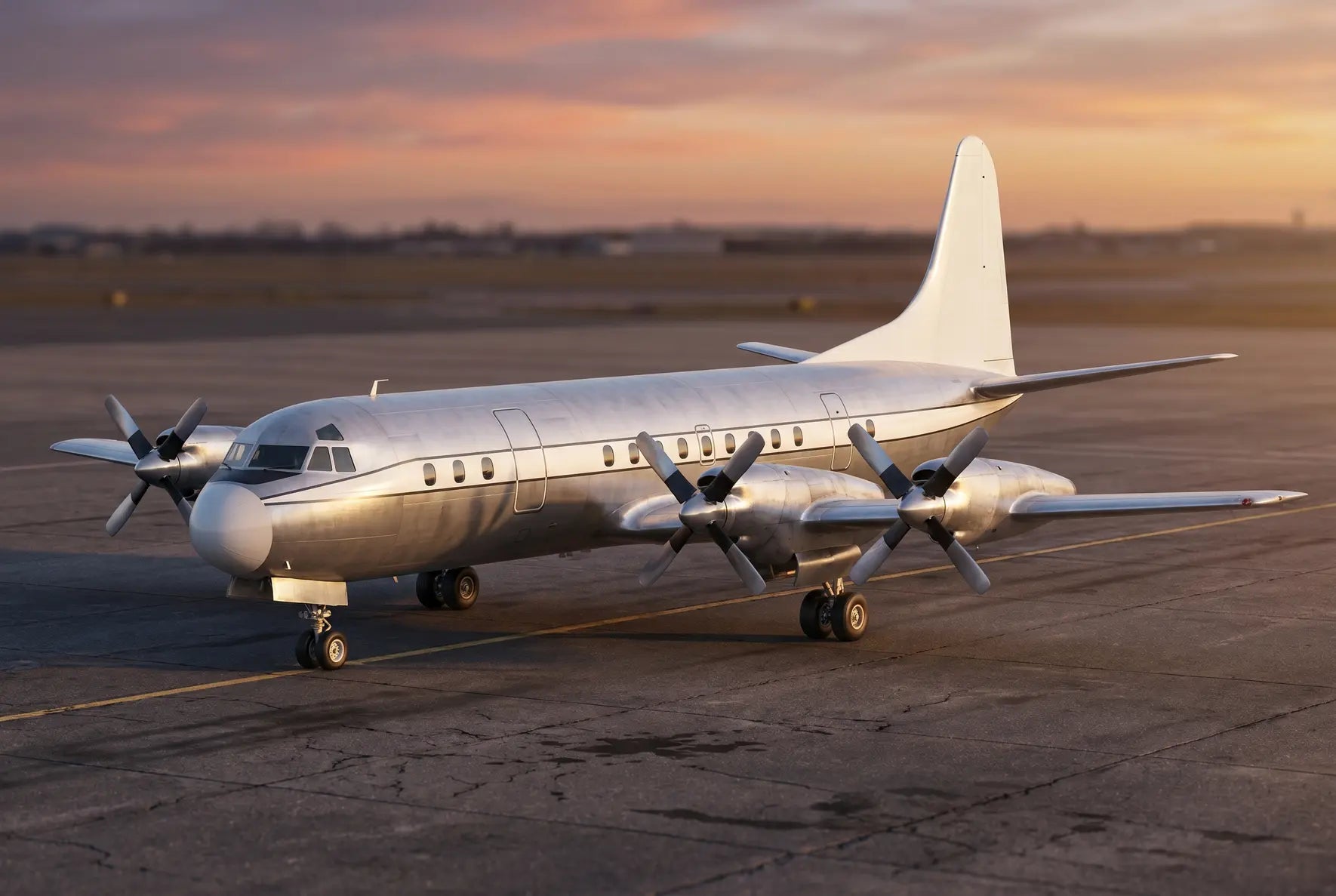
The Lockheed L-188A Electra holds the distinction of being the only large turboprop airliner designed and manufactured in the United States. Its development was a direct response to a 1954 specification issued by American Airlines, which sought a short-to-medium-range airliner capable of seating 75 to 100 passengers. Lockheed, based in Burbank, California, accepted the challenge and designed a four-engine turboprop around the Allison 501-D13 powerplant, a civilian derivative of the T56 engine already proven in the C-130 Hercules military transport.
In June 1955, American Airlines placed a launch order for 35 aircraft, giving the programme the commercial momentum it needed. Eastern Air Lines soon followed with a substantial commitment of 40 units, and by the time the prototype was completed, the order book had reached 144 airframes from multiple carriers including National Airlines, Braniff International Airways, Northwest Orient Airlines and Western Airlines.
From Prototype to Certification
Lockheed assembled the L-188 at its facility adjacent to Lockheed Air Terminal in Burbank, California. The first prototype (c/n 1001, registered N1881) completed its maiden flight on 6 December 1957, fully 56 days ahead of schedule. Chief engineering test pilot Herman R. Salmon and co-pilot Roy E. Wimmer lifted off from Burbank, and the aircraft reached 400 mph and 14,000 feet during the approximately 1.5-hour flight. Salmon described the aircraft's handling in remarkably positive terms.
The type certification process moved quickly. On 22 August 1958, the Civil Aeronautics Administration (CAA, predecessor to the FAA) issued Type Certificate No. 4A22, approving both the L-188A and the later L-188C variants. Deliveries to airlines began in late 1958, and the first commercial passenger service took place on 12 January 1959, when Eastern Air Lines Flight 602 departed Miami International Airport bound for New York and Montreal. American Airlines, the programme's launch customer, began its own Electra operations shortly after, having been delayed by a pilot strike.
The LEAP Programme and Structural Redesign
The Electra's early service was overshadowed by two catastrophic in-flight structural failures. On 29 September 1959, Braniff Airways Flight 542 broke apart near Buffalo, Texas, killing all 34 occupants. On 17 March 1960, Northwest Orient Airlines Flight 710 disintegrated near Tell City, Indiana, with 63 fatalities. Investigations by the Civil Aeronautics Board identified a previously unknown phenomenon called whirl-mode flutter, in which damaged or weakened engine nacelle mounts allowed propeller gyroscopic forces to couple with wing flex, producing catastrophic oscillations.
In response, Lockheed launched the Lockheed Electra Action Program (LEAP) in 1960. The modifications included reinforced engine nacelle structures, thicker wing skins, strengthened spar caps and upgraded mounting pylons. During the modification period, the FAA imposed speed restrictions on the fleet. The programme cost Lockheed over $25 million. Modifications to the final aircraft were completed by 5 July 1961, and the speed limitations were subsequently lifted. No further whirl-mode incidents occurred after LEAP, and the Electra went on to compile a reliable service record in both passenger and freight operations. Regional operators around the world, much like those described in profiles of turboprop-focused airlines, valued the type for its robust short-field performance and operational flexibility.
What Distinguishes the L-188A from the L-188C
Lockheed produced the Electra in two principal passenger variants. The L-188A was the initial production model and accounted for the majority of the 170 airframes built between 1957 and 1961. The L-188C, introduced for airlines requiring longer range, featured additional fuel tankage (approximately 1,000 US gallons more than the A model) and a higher maximum take-off weight. Both variants were externally identical and shared the same Allison 501-D13 engines. Later supplemental type certificates also created the L-188AF (all-freight) and L-188PF (passenger-freight convertible) configurations.
Key identifiers that distinguish the L-188A from its sibling variants include:
- Engines: Four Allison 501-D13 turboprops, each rated at 3,750 shaft horsepower (shared with L-188C)
- Maximum take-off weight: 113,000 lb (51,256 kg), versus 116,000 lb (52,617 kg) for the L-188C
- Fuel capacity: Approximately 5,520 US gallons, compared with approximately 6,500 US gallons for the L-188C
- Range: Around 2,200 nautical miles with full payload, versus approximately 2,770 miles for the L-188C
- Passenger capacity: 66 to 98 seats depending on cabin layout
- Post-LEAP structural reinforcements: Upgraded nacelle mounts, thicker wing skins and reinforced spar caps applied fleet-wide from 1960
The Electra's airframe also served as the structural basis for the Lockheed P-3 Orion, a maritime patrol aircraft that remains in military service with several nations decades after the last commercial Electra was built.

A Varig Lockheed L-188A Electra aircraft is captured mid-flight against a backdrop of the sea. The plane's sleek design is highlighted, showcasing its classic livery and distinctive logo.
Lockheed L-188A Electra: Technical Specifications, Systems and Engine Details
The Lockheed L-188A Electra was designed as a medium-range, high-capacity turboprop airliner optimised for domestic trunk routes across the United States. Lockheed prioritised short-field performance and fuel efficiency over pure speed, selecting four turboprop engines in a low-wing cantilever monoplane layout. The result was an aircraft capable of operating from shorter runways than its pure-jet contemporaries, while still offering a pressurised cabin for up to 98 passengers. Its large Fowler flaps significantly increased effective wing area when extended, granting the Electra airfield performance that few jet transports of the era could match.
The L-188A was the initial production variant, distinct from the later L-188C which featured increased fuel capacity and a higher maximum takeoff weight. The design shared its Allison 501-D turboprop powerplant lineage with the military Lockheed C-130 Hercules, a testament to the engine family's robustness. As the first large turboprop airliner built in the United States, the L-188A represented a bridge between the piston-engine era and the jet age, offering turbine reliability and smoothness at a lower operating cost than early jets. Other turboprop-powered airliners of the period, such as the Fokker F28, would later continue the tradition of efficient regional air travel.
- Length: 104 ft 6 in (31.85 m)
- Wingspan: 99 ft 0 in (30.18 m)
- Height: 32 ft 10 in (10.01 m)
- Wing area: 1,300 sq ft (120 m²)
- Seating capacity: 66 to 80 passengers (typical mixed class); up to 98 in high-density layout
- Crew: 3 (two pilots and a flight engineer)
- Maximum takeoff weight (MTOW): 113,000 lb (51,256 kg)
- Operating empty weight (OEW): approximately 57,400 lb (26,036 kg)
- Maximum landing weight (MLW): 98,000 lb (44,452 kg)
- Maximum payload: 33,800 lb (15,300 kg)
- Fuel capacity: approximately 5,520 US gal (20,900 litres)
- Engines: 4 x Allison 501-D13 turboprops, each rated at 3,750 shp (2,796 kW)
- Propellers: Aeroproducts 606 four-blade, 13 ft 6 in (4.11 m) diameter
- Cruise speed: approximately 324 kt (373 mph / 600 km/h)
- Maximum speed: 389 kt (448 mph / 721 km/h)
- Range: approximately 2,200 mi (1,910 nmi / 3,540 km) with maximum payload
- Service ceiling: 28,400 ft (8,700 m)
- Rate of climb: 1,970 ft/min
- Takeoff field length: approximately 4,700 ft (1,430 m)
- Approach speed (Vref): 120 kt
Systems, Flight Controls and Handling Technology
The L-188A featured a conventional flight control architecture with hydraulically boosted ailerons, elevator and rudder surfaces. An autopilot system was fitted as standard, and the cockpit was arranged for a three-person crew including a dedicated flight engineer station for engine and systems management. The pressurisation system maintained cabin comfort at the aircraft's service ceiling, while engine monitoring relied on torque meter assemblies and conventional analogue instrumentation typical of the late 1950s. The retractable tricycle landing gear was designed for robustness, and the aircraft was cleared for operations on both paved and unpaved runways, a notable capability that extended its operational versatility.
A critical design lesson emerged from the L-188A's service: structural investigations following two fatal accidents in 1959 and 1960 identified a phenomenon known as whirl mode, where damaged or weakened engine mounts could allow propeller gyroscopic forces to couple with the wing's natural frequency, resulting in catastrophic flutter. Lockheed subsequently reinforced the engine nacelle and wing structure under the Lockheed Electra Action Program (LEAP), and speed restrictions were imposed during the modification period. These changes resolved the issue and allowed the Electra to continue in safe service for decades.
Published performance figures for the L-188A vary depending on the source and the assumptions used. Operator-specific cabin configurations, actual payload, ambient temperature, airfield elevation and runway condition all affect real-world takeoff distances, range and fuel burn. Manufacturer data typically assumes standard atmospheric conditions (ISA) and specific weight scenarios. Figures quoted above reflect commonly published values for the L-188A variant at or near MTOW and should be interpreted as representative rather than absolute.
Allison 501-D13 Turboprop: History, Specifications and Legacy
The four Allison 501-D13 engines fitted to the L-188A are the commercial designation of the military Allison T56-A-1 turboprop. Developed by the Allison Engine Company (later acquired by Rolls-Royce in 1995), the T56 programme began in the early 1950s to meet a U.S. Air Force requirement for the C-130 Hercules transport. The first T56 engine was flight-tested aboard a modified Boeing B-17 in 1954, and production deliveries commenced that same year for the YC-130 prototype.
The 501-D13 is a single-shaft, axial-flow gas turbine engine featuring a 14-stage compressor, a six-tube cannular combustor and a four-stage turbine. Each engine produces 3,750 shaft horsepower at 13,820 rpm, driving a four-blade Aeroproducts propeller through a reduction gearbox. The engine weighs approximately 1,750 lb (794 kg) dry and measures 12 ft 1 in in length. The combination of the 501-D13 engine and the Aeroproducts 606 propeller formed a complete power package specifically certified for the Electra.
The T56/501-D engine family went on to become one of the most successful turboprop powerplants in aviation history, with over 18,000 units produced and more than 200 million flight hours logged according to Rolls-Royce. Later variants delivered increased power: the T56-A-14 and T56-A-15, producing up to 4,910 equivalent shaft horsepower, powered the Lockheed P-3 Orion maritime patrol aircraft and upgraded C-130 variants. The 501-D22 commercial derivative powered the Convair 580 freighter conversion, while the T56-A-425 served the Grumman E-2 Hawkeye airborne early warning aircraft and the C-2 Greyhound carrier onboard delivery platform. This broad application across military and commercial types cemented the T56/501-D as one of the most versatile and long-lived turboprop engine families ever produced.
Lockheed L-188 Electra vs Fokker F27 and Vickers Viscount: Specifications Comparison
Scroll horizontally to see more
| Parameter | Lockheed L-188A Electra | Lockheed L-188C Electra | Fokker F27 Friendship | Vickers Viscount 800 |
|---|---|---|---|---|
| Entry into service | 1959 | 1959 | 1958 | 1958 |
| Engines | 4 × Allison 501-D13 | 4 × Allison 501-D13 | 2 × Rolls-Royce Dart | 4 × Rolls-Royce Dart |
| Length | 31.85 m | 31.85 m | 25.59 m | 26.11 m |
| Wingspan | 30.18 m | 30.18 m | 28.00 m | 28.55 m |
| Height | 10.01 m | 10.01 m | 8.44 m | 8.25 m |
| Typical seating and layout | 2-class: 66–80 passengers | 2-class: 66–80 passengers | 2-class: 40–60 passengers | 2-class: 44–74 passengers |
| MTOW | 51 t | 59 t | 20 t | 29 t |
| Range | 1,900 nm | 2,410 nm | 1,000 nm | 1,750 nm |
| Cruise speed | 0.50 Mach | 0.50 Mach | 0.42 Mach | 0.44 Mach |
| Service ceiling | 28,400 ft | 28,400 ft | 25,000 ft | 24,500 ft |
| Program note | Baseline US turboprop airliner for medium-range routes with excellent short-field performance | Extended-range variant with greater fuel capacity for longer nonstop flights | European twin-turboprop regional airliner for short/medium routes, smaller capacity | British four-turboprop competitor with similar capacity for medium-haul services |
Scroll horizontally to see more
This table compares the Lockheed L-188A/L-188C Electra with the Fokker F27 and Vickers Viscount 800 across size, performance, and capacity. The Electra is the largest and heaviest, using four Allison 501-D13 engines and offering the longest range, especially the L-188C at 2,410 nm. The F27 is smaller with two Dart engines and a shorter 1,000 nm range, while the Viscount sits between them for capacity and range.
Lockheed L-188A Electra Operations: Routes, Airlines and Missions Worldwide
The Lockheed L-188A Electra was designed for short- to medium-haul trunk routes, with a typical stage length of around 700 miles (1,130 km) and a maximum range of approximately 2,000 miles with reserves. Cruising at roughly 400 mph (645 km/h), it bridged the gap between slower piston-engine airliners and the emerging pure jets of the late 1950s. Airlines typically scheduled three to four sectors per day, achieving around eight to ten block hours of daily utilisation. Turnaround times averaged 45 to 60 minutes, faster than the piston predecessors such as the DC-6 or Constellation, thanks to turboprop engine simplicity and efficient ground handling for its 66- to 98-seat cabin.
From a network perspective, the Lockheed L-188A Electra operated primarily on point-to-point and trunk routes between major cities rather than in a modern hub-and-spoke system. In North America, carriers deployed it on high-frequency domestic corridors such as New York to Chicago, transcontinental routes, and services to Florida. In South America and Oceania, it connected capital cities and regional hubs, sometimes landing on unpaved or semi-prepared runways, a capability that set it apart from early jets. In later decades, surviving airframes transitioned to freight and aerial firefighting roles, operating from secondary and remote airfields in Canada.
Operators faced significant challenges. The most serious was the whirl mode flutter phenomenon, a destructive resonance in which gyroscopic forces from the propellers coupled with weakened engine mounts, causing catastrophic wing failures. Two fatal accidents in 1959 and 1960 led to temporary speed restrictions and fleet groundings. Lockheed responded with the Electra Action Program (LEAP), reinforcing nacelles, engine mounts and wing spars across the entire fleet by 1962. No further whirl-mode incidents occurred after the modifications. Nevertheless, the reputational damage and the rapid advance of pure-jet competitors such as the Boeing 727 shortened the type's passenger career to roughly a decade for most airlines.
Where the Lockheed L-188A Electra Operated Around the World
In North America, the Lockheed L-188A Electra was a front-line domestic airliner for major trunk carriers during the late 1950s and 1960s. In Europe, KLM Royal Dutch Airlines was the principal operator, using the type on intra-European routes. Across South America, airlines in Brazil, Ecuador and Colombia relied on the Electra for trunk and international services. In the Asia-Pacific region, the aircraft served with carriers in Australia, New Zealand, Indonesia and Hong Kong. Africa saw limited but notable use, mainly in the Democratic Republic of Congo for passenger and cargo operations under challenging conditions. Today, the only active Lockheed L-188 airframes are cargo-converted and firefighting aircraft based in Canada, operated by Air Spray and Buffalo Airways.
- Europe - KLM Royal Dutch Airlines operated up to 12 Electras on European routes from 1959 to 1969. Several UK-based cargo carriers, including Atlantic Airlines and Channel Express, later flew freight-converted airframes across the continent. Scandinavian operators such as Fred. Olsen Airtransport in Norway also used the type for cargo missions.
- North and South America - In the United States, American Airlines (35 aircraft), Eastern Air Lines (40 aircraft), Braniff International Airways, Northwest Airlines and National Airlines were among the major passenger operators. Western Airlines, Pacific Southwest Airlines and Reeve Aleutian Airways also flew the type on domestic and regional routes. In Canada, Nordair operated four Electras for passenger service from 1972 to 1987, while Air Spray and Buffalo Airways continue to fly cargo and firefighting missions today. In South America, VARIG (Brazil) used Electras on high-density domestic routes, Ecuatoriana (Ecuador) served national and international destinations, and in Colombia, airlines operated trunk routes as well as international services to destinations such as Panama and Central America. Lloyd Aereo Boliviano and Lineas Aereas Paraguayas also flew the type.
- Asia and Oceania - Qantas (Australia) operated four Electras on trunk routes between state capitals, while Ansett Airlines and Trans Australia Airlines each flew three aircraft, including night freight services described as back of the clock operations. Air New Zealand (as TEAL) used the Electra on trans-Tasman routes between Auckland and Sydney. In Southeast Asia, Garuda Indonesia, Mandala Airlines and Cathay Pacific Airways operated the type on domestic and regional routes. For aviation professionals interested in how international carriers adapt their operations to different regulatory environments, this overview of airline pilot conditions provides useful context.
- Africa - Operations were concentrated in the Democratic Republic of Congo, where carriers such as Blue Airlines and Air Karibu used the Electra for passenger and cargo flights, often in demanding conditions with limited infrastructure.
Typical Cabin Layouts and Seating Configurations
The Lockheed L-188A Electra featured a pressurised, narrow-body fuselage with a single aisle and a six-abreast seating arrangement in economy class (three seats on each side). Standard accommodation ranged from 66 to 80 passengers in a mixed-class layout, with a small first-class cabin of 12 to 16 seats forward (typically in a two-by-two arrangement) and coach-class seating in three-by-three configuration aft. A high-density, all-economy option could seat up to 98 passengers. Seat pitch in economy typically fell between 36 and 40 inches, while first-class seats offered 42 to 46 inches.
Configurations varied considerably by operator. Northwest Airlines fitted 90 seats in an all-economy Regal Imperial layout for high-frequency domestic routes. American Airlines configured its fleet for 72 passengers in a two-class arrangement, while VARIG in Brazil favoured denser layouts of 74 to 80 seats for its shuttle services, sometimes including a distinctive rear lounge with seven seats. Qantas and KLM adopted more spacious configurations of 66 to 74 seats for their longer routes. No Lockheed L-188A Electra remains in passenger service today; all surviving airframes have been converted for cargo and aerial firefighting duties in Canada.
In this video, discover why Lockheed L-188 Electras still fly in Canada, exploring how this classic airliner found a lasting niche decades after passenger service ended, and what keeps it valuable today.
Lockheed L-188A Electra Safety Record: How Safe Was the Electra?
The Lockheed L-188A Electra entered airline service in 1959 and quickly became one of the most scrutinised airliners of its era. A total of 170 Electras were manufactured between 1957 and 1961, serving airlines across North America, South America, Europe and Australasia. According to documented records, 58 of those 170 airframes had been written off due to accidents or other causes as of 2011, a hull-loss ratio of roughly 34 percent over more than five decades of operations. That figure must be read in context: the Electra flew in an era when cockpit technology, crew resource management and regulatory oversight were far less mature than they are today. Many of the losses occurred during the aircraft's first years of service, before critical design modifications were introduced. Several airframes remained active into the 2020s with Canadian operators such as Air Spray and Buffalo Airways, performing cargo and aerial firefighting missions.
Major Accidents and What Changed Afterwards
Braniff Airways Flight 542 (September 1959) and Northwest Orient Airlines Flight 710 (March 1960) were two catastrophic events that defined the early reputation of the Lockheed Electra. In both cases, the aircraft experienced in-flight wing separation at cruise altitude, killing all occupants: 34 on the Braniff flight near Buffalo, Texas, and 63 on the Northwest flight near Tell City, Indiana. Investigations by the Civil Aeronautics Board (CAB) identified a previously unknown phenomenon called propeller whirl mode. Engine-mount weaknesses, sometimes aggravated by hard landings, reduced nacelle stiffness enough for engine vibrations to couple with the wing's natural frequency, triggering destructive flutter. Full details of the investigation and findings are documented in the FAA Lessons Learned library. In response, the FAA imposed immediate speed restrictions and Lockheed launched the Lockheed Electra Action Program (LEAP), a mandatory fleet-wide retrofit that reinforced wing structure, redesigned engine nacelles and mounts, and added vibration monitoring. Each aircraft gained approximately 1,200 pounds of structural reinforcement. No further whirl-mode failures occurred after LEAP was completed in 1961.
Eastern Air Lines Flight 375 (October 1960) highlighted a different hazard. Shortly after take-off from Boston Logan Airport, the L-188A flew into a large flock of starlings at about 120 feet. Birds were ingested into three of the four engines, causing rapid thrust loss and asymmetric power. The aircraft crashed into Winthrop Bay, killing 62 of the 72 people on board. The accident, still classified as the deadliest bird-strike event in U.S. airline history, led to stronger requirements for airport wildlife management and spurred research into engine bird-ingestion resistance that influenced later turboprop and jet engine certification standards.
Galaxy Airlines Flight 203 (January 1985) involved a 25-year-old L-188A charter departing Reno, Nevada, for Minneapolis. An air-start access door left open by ground crew caused unexpected vibrations after lift-off. The flight crew misidentified the source, reduced power on all four engines and lost airspeed, leading to an aerodynamic stall and ground impact that killed 70 of the 71 people on board. The NTSB investigation cited pilot error, inadequate crew resource management training and poor maintenance oversight as the primary factors. The accident reinforced the industry push toward standardised CRM programmes that became mandatory for all Part 121 operators.
How Safe Is the Lockheed L-188A Electra?
Assessing the safety of the Lockheed L-188A Electra requires historical perspective. The type's worst period fell within its first two years of service, when a previously unknown aeroelastic phenomenon and limited crew training standards contributed to the majority of fatal events. Once LEAP structural modifications were completed, the Electra compiled a significantly improved operational record, serving reliably in passenger, cargo and specialised roles for decades. Operators such as modern airlines featured on Ready for Takeoff benefit from layers of safety that simply did not exist in the 1950s and 1960s: mandatory crew resource management, flight data monitoring, digital maintenance tracking and continuous airworthiness directives. The Electra story is, in many ways, a case study in how the aviation industry learns from tragedy. Each accident prompted measurable improvements in aircraft design, inspection protocols and pilot training. Data from the Aviation Safety Network confirms that the overwhelming majority of L-188 losses occurred before modern safety frameworks were in place. Aviation remains, statistically, one of the safest modes of long-distance transport, and the hard lessons drawn from types like the Electra have been instrumental in achieving that record.
01 What is the Lockheed L-188A Electra and its primary role?
The Lockheed L-188A Electra is a four-engine turboprop airliner developed in the late 1950s for short- to medium-range flights carrying 60 to 98 passengers. It served as a workhorse for airlines transitioning from piston-engine aircraft to faster turboprops, offering reliable performance on routes up to 1,800 nautical miles. Airlines used it mainly for domestic and regional services before jets dominated.
02 What was the typical range and mission profile of the Lockheed L-188A Electra?
The L-188A Electra had a maximum range of about 2,000 nautical miles with reserves, suited for missions like transcontinental U.S. flights or intra-European routes. It cruised at 300-350 knots at altitudes up to 25,000 feet, balancing speed and efficiency for 2-4 hour flights. Fuel capacity allowed flexibility for shorter hops with full payloads.
03 How was the passenger cabin laid out in the Lockheed L-188A Electra?
Cabins typically featured 74-85 seats in a 2-2 configuration across 4-5 abreast seating, with some airlines offering first-class sections up front. Noise from the four Allison T56 turboprops was noticeable but managed with insulation, providing a smoother ride than propeller aircraft of the era. Passengers experienced good visibility from large windows and decent legroom by 1950s standards.
04 Which airlines operated the Lockheed L-188A Electra and on what routes?
Major operators included American Airlines, Eastern Air Lines, and KLM, using it on U.S. domestic routes like New York to Los Angeles, European intra-continental flights, and some cargo conversions later. In Latin America, airlines like Avianca flew it on regional services. By the 1970s, many shifted to freighters for cargo on short runways.
05 What is the safety record of the Lockheed L-188A Electra?
06 How did the Lockheed L-188A Electra perform compared to similar aircraft?
Compared to the Vickers Viscount, the L-188A offered higher speed and range with more powerful engines, while trailing early jets like the Caravelle in top speed but excelling in short-field performance and fuel efficiency on subsonic routes. Fuel burn was around 3,000-4,000 pounds per hour, competitive for turboprops. It bridged the gap between props and jets effectively.