

History and Development of the Junkers Ju 90: From Bomber Origins to Transport Pioneer
The Junkers Ju 90 was a four engined German transport aircraft born directly from the cancelled Junkers Ju 89 heavy bomber programme of the mid 1930s. Designed and built by Junkers Flugzeug und Motorenwerke AG in Dessau, the aircraft represented an ambitious attempt to salvage the engineering investment of the Ju 89 by mating its proven wing and tail unit concepts to a new, wider fuselage optimised for passenger and freight operations. The programme was supported by both Deutsche Luft Hansa, which needed a long range airliner, and the Reichsluftfahrtministerium (RLM), which saw potential for a future military transport.
The first prototype, designated Ju 90 V1 and registered D–AALU “Der Große Dessauer”, completed its maiden flight on 28 August 1937. It was powered by four Daimler Benz DB 600C liquid cooled inverted V 12 engines producing approximately 1,100 hp each, making it the most powerful Ju 90 ever built. Deutsche Luft Hansa conducted extensive flight testing over the following months. However, the V1 was lost during overspeed structural testing on 6 February 1938, a setback that claimed the lives of all on board and forced an early reassessment of the airframe’s structural limits.
The second prototype, Ju 90 V2 “Preussen”, was delivered to Luft Hansa in May 1938. Critically, this aircraft switched to four BMW 132 H 1 nine cylinder air cooled radial engines rated at approximately 830 hp each. The downgrade reflected wartime priority allocation of Daimler Benz powerplants to front line fighters and bombers. V2 was lost following a fatal take off accident at Bathurst, Gambia, in November 1938, likely caused by engine failure in tropical conditions.
Despite these early losses, the Ju 90A series entered limited airline service with Deutsche Luft Hansa between 1938 and 1939. The Ju 90A 1 became the standard production variant, carrying 38 to 40 passengers with a crew of four. It featured a wingspan of 35.02 m, a length of 26.3 m, and a maximum take off weight of approximately 33,680 kg. Maximum speed reached about 350 km/h at 2,500 m, with a ferry range of roughly 2,092 km. Rectangular cabin windows, a retractable tailwheel undercarriage, and a twin fin tail inherited from the Ju 89 defined the external appearance.
With the outbreak of the Second World War, the programme shifted rapidly toward military applications. Ju 90 V4, which entered Luftwaffe service in July 1941, received four Junkers Jumo 211F engines producing around 1,320 hp each, a significant power increase over the BMW 132 radials. This prototype served as a testbed for what became known informally as the Ju 90B series of militarised transports. The subsequent V5, which first flew on 5 December 1939, and V6 introduced several important structural changes: a strengthened landing gear with twin main wheels, rounded tail fins replacing the earlier horn balanced design, small circular portholes in place of the rectangular airline windows, and a powered rear loading ramp (Trapoklappe) capable of accommodating vehicles and heavy cargo. These features represented a clear evolution toward a dedicated military heavy transport. Later, V5 and V6 were re engined with BMW 801MA 14 cylinder radials of about 1,600 hp each, making them among the only Luftwaffe aircraft capable of towing the enormous Messerschmitt Me 321 heavy glider.
The final Ju 90 prototypes, V7 and V8, served as the direct bridge to the successor Junkers Ju 290. V7 featured a fuselage lengthened by 1.98 m and a tailplane with added dihedral to cure yaw instability experienced on earlier machines. V8 was configured as an armed reconnaissance prototype, fitted with two 20 mm MG 151/20 cannon and up to nine 13 mm MG 131 machine guns. These late prototypes fed directly into the Ju 290 programme, which added further wingspan, adopted BMW 801 engines as standard, and introduced heavy defensive armament for long range maritime patrol. Coordination across multi crew operations on such large aircraft foreshadowed training concepts explored much later in aviation history, including structured programmes like the Multi Crew Pilot Licence (MPL).
Only 18 Junkers Ju 90 airframes of all versions were completed before the production line transitioned to the Ju 290. No examples survived the war.
What Distinguishes the Junkers Ju 90 from Related Sub Variants
The Junkers Ju 90 occupies a distinct transitional position within the Ju 89/Ju 90/Ju 290/Ju 390 family. While the Ju 89 was a pure heavy bomber prototype, the Ju 90 repurposed its structural philosophy for civil and then military transport roles. Compared to its successor, the Ju 290, the Ju 90 retained a shorter fuselage, a smaller wing, and generally less powerful engines in its production A series form. The Ju 90A series relied on BMW 132 radials producing roughly 830 hp each, whereas the Ju 290 standardised on BMW 801 radials delivering approximately 1,700 hp. The Ju 90 also lacked the Ju 290’s extensive defensive armament and maritime reconnaissance capability.
Within the Ju 90 family itself, the A series (airline standard) and the later B series prototypes (military transport) differed significantly. The A series used BMW 132 radials, rectangular cabin windows, and a conventional fuselage floor. The B series prototypes switched to Jumo 211 engines, featured portholes, rounded tail fins, twin wheel main landing gear, and the powered rear loading ramp. The engine supply difficulties that plagued the programme, with four different engine types fitted across just 18 airframes (DB 600C, BMW 132, Jumo 211, and BMW 801), complicated logistics and likely discouraged larger scale production.
Key variant identifiers for the Junkers Ju 90 include:
- Ju 90A 1 (airline standard): 4 × BMW 132 H 1 radials (~830 hp each), rectangular cabin windows, twin fin tail with horn balance, 38 to 40 passenger capacity, MTOW ~33,680 kg
- Ju 90 V1 (prototype): 4 × Daimler Benz DB 600C (~1,100 hp each), most powerful variant, lost February 1938
- Ju 90B prototypes (V4 to V6): Jumo 211F engines (~1,320 hp each), later BMW 801MA (~1,600 hp), rounded fins, portholes, twin wheel main gear, powered rear cargo ramp
- Ju 90 V7/V8 (transition to Ju 290): fuselage lengthened by 1.98 m, dihedral tailplane, V8 armed with MG 151/20 cannon and MG 131 machine guns
- Total production: 18 airframes across all versions (prototypes, A series, and B series)

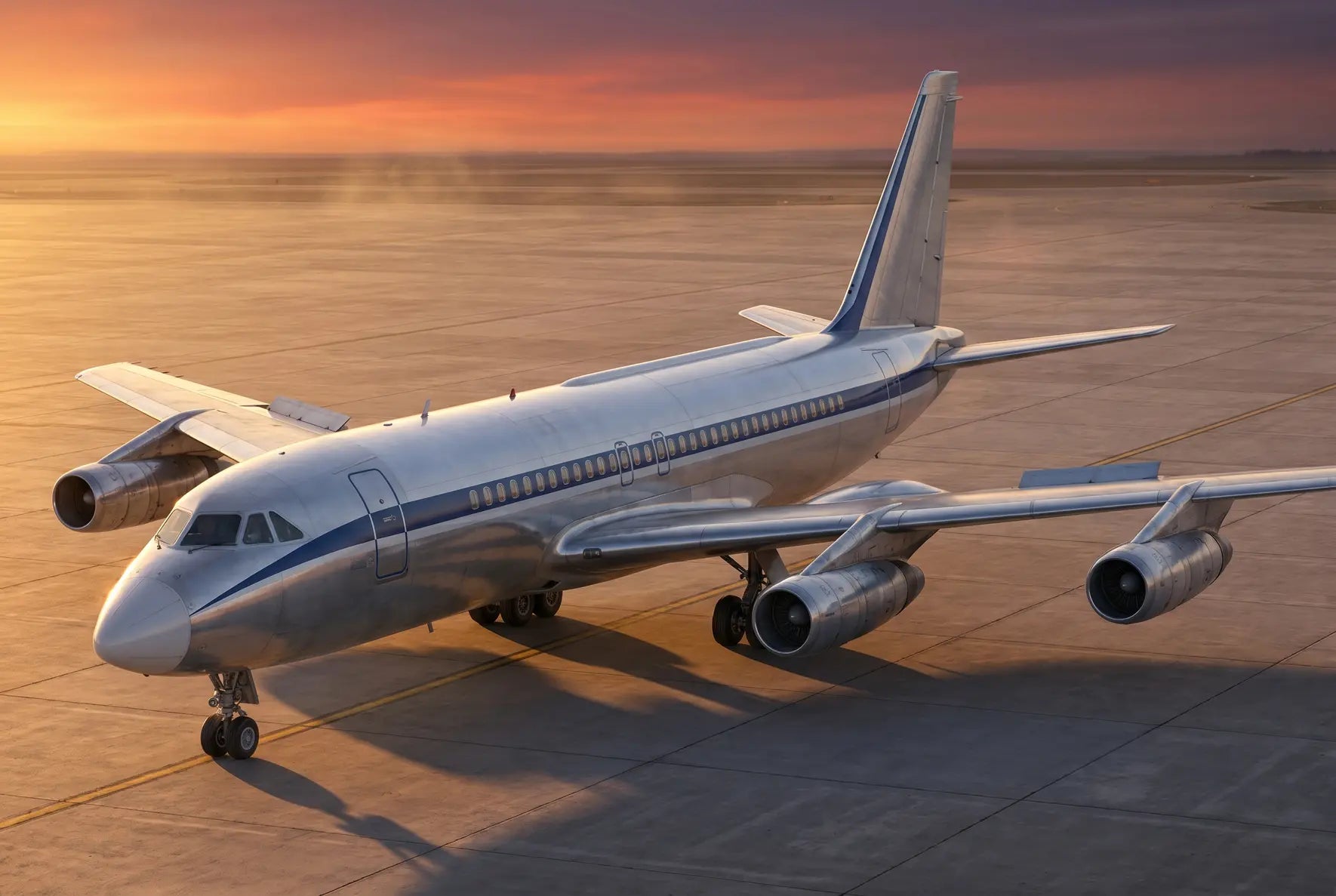
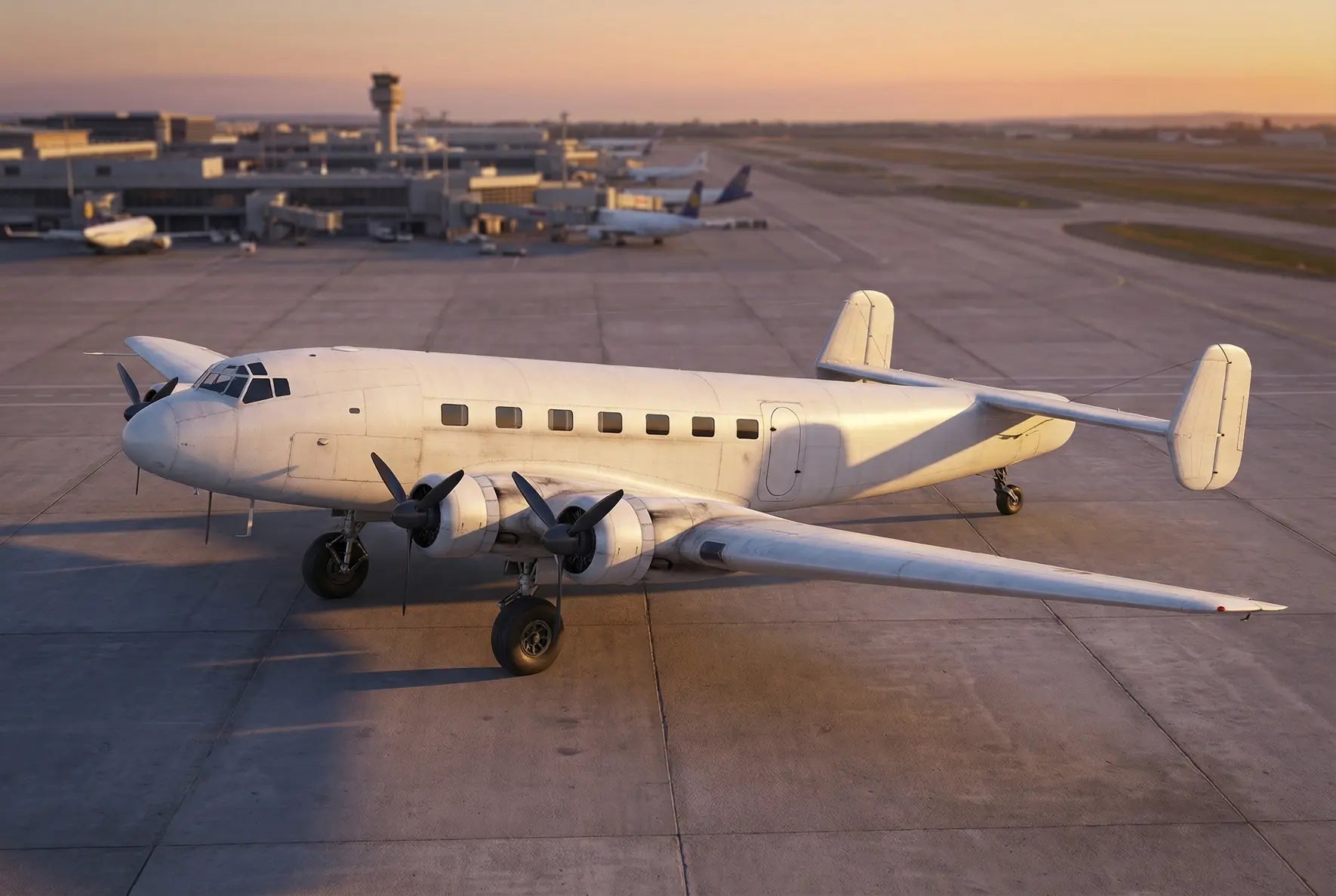
The image depicts the Junkers Ju 90, a large passenger aircraft designed for rapid transit. It features the distinctive markings and wing design, highlighting its role between 1933 and 1945.
Junkers Ju 90 Technical Specifications, Systems and Engine Overview
The Junkers Ju 90 was a four engine, all metal, low wing transport aircraft conceived as a direct civil derivative of the cancelled Junkers Ju 89 strategic bomber. Designed by Ernst Zindel at Junkers Flugzeug und Motorenwerke AG, it mated the Ju 89's proven wing structure and general layout with a completely new smooth skinned, oval cross section fuselage optimised for 38 to 40 passengers. The principal design trade off was reusing bomber derived structure, which saved development time but resulted in a relatively heavy airframe for its civil payload. Engine availability imposed a second compromise: the powerful Daimler Benz DB 600C units fitted to the first prototype were reserved for front line fighters and bombers, forcing production Ju 90A airliners to adopt the less powerful BMW 132H radial engines. That engine swap reduced climb performance, service ceiling and hot weather takeoff margins in exchange for strategic production priorities.
Structurally, the Ju 90 represented Junkers' transition from traditional corrugated skin to modern stressed duralumin panels. The wings were built around five tubular main spars with metal covering, while the fuselage used a semi monocoque design with smooth external skin. The aircraft featured twin endplate vertical stabilisers mounted on the horizontal tailplane, a configuration later refined with added tailplane dihedral to address directional stability concerns. For those preparing for technical pilot interviews, the Ju 90's evolution from bomber to airliner to military transport offers an instructive case study in airframe adaptation and design compromise.
- Crew: 4 (two pilots, radio operator, flight engineer)
- Passenger capacity: 38 to 40 in a 2+2 abreast layout across approximately 10 rows
- Length: 26.3 m (86 ft 3 in)
- Wingspan: 35.02 m (114 ft 11 in)
- Height: 7.5 m (24 ft 7 in)
- Wing area: 184 m² (1,980 sq ft)
- Empty weight: 19,225 kg (42,384 lb)
- Maximum takeoff weight: 23,000 kg (50,706 lb) per Ju 90A specification
- Engines (production Ju 90A): 4 × BMW 132H 1 nine cylinder air cooled radials, 830 hp (620 kW) each for takeoff, 750 hp normal rating
- Propellers: three bladed constant speed Hamilton Standard type, 3.27 m diameter
- Maximum speed: 350 km/h (217 mph) at 2,500 m (8,200 ft)
- Cruise speed: 320 km/h (199 mph) at 3,000 m (9,800 ft)
- Landing speed: 109 km/h (68 mph)
- Service ceiling: approximately 5,750 m (18,860 ft)
- Range: approximately 1,180 km (733 mi) with full payload; ferry range up to 2,090 km (1,300 mi)
- Takeoff distance (sea level, grass): approximately 686 m
- Landing gear: retractable tailwheel configuration, fully enclosed in flight
Systems, Flight Controls and Handling Technology
The Ju 90 employed a conventional flight control architecture for its era: cable and rod actuated ailerons, elevators and twin rudders, with no hydraulic boost. High lift devices on the trailing edge of the wing assisted with approach and takeoff performance. The landing gear was hydraulically retracted, and the constant speed propellers provided automatic rpm governing, reducing pilot workload during long range cruise segments. Electrical systems powered de icing equipment, cabin lighting and radio communications. The retractable taildragger undercarriage, while structurally simpler than a tricycle layout, imposed limitations on ground handling and crosswind operations typical of large four engine taildraggers of the period. Early aircraft exhibited light directional stability, prompting the addition of tailplane dihedral and redesigned fin profiles on later prototypes (V7 onward), modifications that were subsequently carried forward into the Junkers Ju 290 successor design. Military variants (V5 and V6) received strengthened main gear with twin wheels and a hydraulic rear loading ramp, a precursor to the Ju 290's Trapoklappe system.
Published performance figures for the Ju 90 can vary depending on the specific sub variant (A 0, A 1), engine condition, payload configuration, atmospheric assumptions and whether the values refer to sea level or altitude conditions. The figures quoted above correspond to the standard Ju 90A 1 airliner specification with BMW 132H 1 engines at standard conditions. Prototype aircraft fitted with alternative powerplants such as the DB 600C (V1) or Jumo 211 (V4) demonstrated significantly different performance envelopes. Runway distances are particularly sensitive to surface type, elevation and ambient temperature; the 686 m takeoff figure applies to sea level operations on a grass strip at normal operating weight.
Engines: BMW 132, Daimler Benz DB 600C and Junkers Jumo 211
The production Ju 90A series was powered by four BMW 132H 1 nine cylinder, single row, air cooled radial engines. The BMW 132 was a licensed development of the American Pratt & Whitney R 1690 Hornet, progressively redesigned by Bayerische Motoren Werke (BMW) in Munich during the early 1930s with German supercharger and fuel system improvements. In the H 1 variant fitted to the Ju 90, the engine produced approximately 830 hp (620 kW) at takeoff and 750 hp at its normal continuous rating, with supercharger boost maintaining constant power up to about 2,600 m altitude. Each engine drove a three bladed constant speed propeller of 3.27 m diameter. The BMW 132 family was one of the most widely used German radial engines of the pre war and early war period, also powering the Junkers Ju 52/3m transport (BMW 132A and 132T variants), early marks of the Heinkel He 111 bomber, the Arado Ar 196 floatplane and the Blohm & Voss Ha 139 transatlantic mailplane.
The first prototype, Ju 90 V1, flew with four Daimler Benz DB 600C liquid cooled inverted V 12 engines producing approximately 1,100 hp (820 kW) each. These offered substantially higher performance but were urgently needed for fighters such as the Messerschmitt Bf 109, so production airliners reverted to the less powerful BMW radials. Later, the V4 airframe was re engined with four Junkers Jumo 211 liquid cooled inverted V 12 engines rated at approximately 1,320 hp (980 kW) each. The Jumo 211 went on to become one of the Luftwaffe's most important powerplants, serving in the Junkers Ju 87 Stuka, Junkers Ju 88 medium bomber and Heinkel He 111H series. The dramatic difference in available power between the BMW 132H (830 hp) and the Jumo 211 (1,320 hp) directly illustrates the performance penalty imposed on the civil Ju 90 by wartime engine allocation policies and foreshadowed the more powerful engine installations adopted for the Ju 290 successor.
Junkers Ju 90 vs Ju 290 vs Fw 200 Condor vs Douglas DC-4: Specifications and Performance Comparison
Scroll horizontally to see more →
| Parameter | Junkers Ju 90 | Junkers Ju 290 | Focke-Wulf Fw 200 Condor | Douglas DC-4 |
|---|---|---|---|---|
| Entry into service | 1938 | 1943 | 1939 | 1942 |
| Engines | 4 × BMW 132 H-1 radial piston engines | 4 × BMW 801G/H radial piston engines | 4 × BMW 132H radial piston engines | 4 × Pratt & Whitney R-2000 radial piston engines |
| Length | 26.3 m | 28.6 m | 23.5 m | 28.6 m |
| Wingspan | 35.0 m | 42.0 m | 32.8 m | 35.8 m |
| Height | 7.5 m | 6.8 m | 6.1 m | 8.4 m |
| Typical seating and layout (short description + approximate passengers) | Single-class: 38–40 passengers | Single-class: ~40 passengers | Single-class: ~26 passengers | 2-class: 44–80 passengers |
| MTOW | 33.7 t | 45.0 t | 18.0 t | 33.1 t |
| Range | 1,100 nm | 2,100 nm | 2,200 nm | 3,900 nm |
| Cruise speed | 0.27 Mach | 0.34 Mach | 0.28 Mach | 0.31 Mach |
| Service ceiling | 18,900 ft | 19,700 ft | 23,000 ft | 22,300 ft |
| Program note | Pre-war German long-range airliner developed from the Ju 89 bomber design. | Enlarged and militarised development of the Ju 90 for long-range transport and maritime patrol. | Contemporary German four‑engined airliner and long‑range maritime patrol aircraft competitor. | US four‑engined long‑range airliner/transport of the same era, offering greater range and payload. |
Scroll horizontally to see more →
The table compares four contemporary four‑engined airliners/transports across dimensions, weights, performance, and service dates. The Ju 290 is larger and heavier than the Ju 90 and offers much more range (2,100 vs 1,100 nm), while the Fw 200 is lighter with a similar range but fewer passengers. The DC‑4 stands out with the longest range (3,900 nm) and a wider seating range, showing a stronger long‑haul capability.
Junkers Ju 90 Operations, Typical Routes and Airlines That Flew This Historic Airliner
The Junkers Ju 90 was conceived as a flagship long range airliner for Deutsche Luft Hansa, entering limited commercial service in 1938 before the outbreak of World War II redirected the entire fleet to military duties. Powered by four BMW 132 H 1 radial engines, the Ju 90 A 1 could carry 38 to 40 passengers over a practical range of approximately 1,250 to 2,100 km (775 to 1,300 miles), depending on payload. Cruise speed sat around 320 km/h (200 mph) at 3,000 m altitude, making it suitable for medium to long range European trunk routes. A typical sector lasted roughly three hours at cruise settings, consistent with the design mission profile documented in its engineering specifications.
Because only 18 airframes were completed across all variants, the Junkers Ju 90 never achieved the high daily utilisation rates associated with mass produced airliners. The aircraft operated primarily on point to point trunk services between major European airports rather than within a modern hub and spoke network. Its size and range suited intercity connections from Berlin to destinations such as Vienna, where prototype V3 "Bayern" inaugurated scheduled service in July 1938, logging 62,572 km that year alone. A proving flight to Bathurst (now Banjul) in Africa also demonstrated the type's long range potential. Operators faced challenges typical of a small fleet of large, complex, four engined aircraft: limited spare parts availability, high maintenance demands, and the rapid onset of wartime priorities that diverted resources away from civil aviation. Pilots comfortable with large multi engine types from this era may find parallels with the operational demands of modern versatile aircraft such as the Pilatus PC 12, which, while far smaller, also serves routes where fleet flexibility and range are paramount.
Where the Junkers Ju 90 Operated Around the World
The Junkers Ju 90 was overwhelmingly a European aircraft. Its brief civilian career took place exclusively within the Deutsche Luft Hansa network across Europe, while its subsequent military career with the Luftwaffe saw it deployed to Northern Europe, the Eastern Front, and the Mediterranean theatre. South African Airways in Africa placed an order for two examples fitted with Pratt & Whitney Twin Wasp engines, but these were never delivered due to the war. No confirmed operators existed in North or South America or Asia. The aircraft thus remained a uniquely German product whose operational footprint, though geographically wide during wartime, was commercially limited to a single airline.
- Europe: Deutsche Luft Hansa was the sole confirmed airline operator. The Ju 90 served on scheduled trunk routes such as Berlin to Vienna from mid 1938. With the onset of World War II, the fleet was impressed into Luftwaffe service. Military transport operations included the invasion of Norway in 1940 with Lufttransportstaffel 290 (LTS 290), emergency resupply missions on the Eastern Front including attempts to supply the encircled 6th Army at Stalingrad, and transport duties across the Mediterranean theatre through late 1943.
- Africa: South African Airways contracted two Ju 90 A 1 airframes powered by American Pratt & Whitney R 1830 Twin Wasp engines rated at approximately 900 hp each. The order was cancelled when war broke out, so no Ju 90 ever entered revenue service on the continent. A Deutsche Luft Hansa proving flight to Bathurst (Banjul), Gambia, in November 1938 ended in the loss of the V2 prototype "Preußen," which crashed during a failed takeoff.
- North & South America: No airlines in this region operated or ordered the Junkers Ju 90. The type's production run was far too limited and its operational window too short for transatlantic commercial service to be established.
- Asia: No civilian or military operators of the Junkers Ju 90 have been documented in Asia. Some later derivative types, such as the Ju 290, conducted long range missions in the direction of the Middle East, but the Ju 90 itself did not serve in this region.
Typical Cabin Layout and Seating of the Junkers Ju 90
The Junkers Ju 90 A 1 featured a single aisle cabin with an internal width of approximately 2.83 m (9 ft 3.5 in), generous by late 1930s standards. Passengers sat in a 2+2 club style configuration with seats arranged in facing pairs on either side of the central aisle. The cabin was divided into four or five separate compartments, each lit by paired rectangular windows, with each section seating eight passengers. This arrangement yielded a maximum capacity of 40 seats across five sections or 38 in a four section layout, as noted by Military Factory. Amenities included toilets aft of the passenger compartments, a cloakroom, a forward baggage hold, and a mail storage area. Later Ju 90 B series prototypes replaced the rectangular cabin windows with smaller round portholes and introduced a powered rear loading ramp (Trapoklappe) for vehicle and cargo access, reflecting the shift toward military transport configuration. There was no differentiation between premium and economy classes; all passengers travelled in a single cabin class typical of the era's long range airliners. The spacious, compartmentalised interior was considered comfortable for its time but was ultimately overtaken by wartime conversion, which stripped most civil fittings in favour of cargo capacity and military utility.
In this video, a British military training film from Analysis Films Ltd. uses animated models to teach aircraft recognition, comparing the Halifax I with the Junkers Ju 90 and highlighting key visual differences.
Junkers Ju 90 Safety Record: Accidents, Incidents and Overall Assessment
The Junkers Ju 90 was produced in very limited numbers, with only approximately 18 airframes completed across all variants between 1937 and the early 1940s. The fleet was split between Deutsche Luft Hansa (which received seven production Ju 90 A‑1 airliners) and the Luftwaffe, which requisitioned several civil examples and operated prototype conversions as long range transports. Given such a small fleet, the total number of flights and cycles was inherently modest compared with mass produced airliners of the same era. Despite this, the type experienced a proportionally significant number of hull losses, ranging from prototype test flight accidents to a fatal icing related disaster in scheduled passenger service. Two airframes survived the war, both of which were scrapped shortly afterwards by Allied forces.
Major Accidents and Incidents Involving the Junkers Ju 90
Several documented events shaped the short operational history of the Ju 90 and provided lessons that influenced subsequent Junkers designs.
- Ju 90 V1 "Der Große Dessauer" (D‑AALU), February 1938: The first prototype was lost near Dessau during a manufacturer test flight. The aircraft suffered a loss of control, and while two crew members bailed out successfully, a third occupant was killed. No formal public accident report has survived, and the precise initiating failure (whether flutter, structural failure or a control system malfunction) remains undetermined. The crash prompted Junkers engineers to refine the wing and control surface design on subsequent prototypes, contributing to the structural evolution that ultimately led to the reinforced airframe of the Junkers Ju 290.
- Ju 90 V2 lost during hot weather testing in Gambia, 1938: The second prototype was destroyed after two engines failed during a hot weather take off. The accident killed the Junkers chief test pilot aboard. This event underlined the critical importance of conservative take off performance margins in high temperature conditions and influenced engine installation and cooling system refinements for later four engine Junkers transports.
- Ju 90A D‑AVMF "Brandenburg", 8 November 1940: Operating a scheduled Deutsche Luft Hansa passenger service from Berlin Tempelhof to Budapest, this Ju 90 A‑1 encountered severe icing in cloud. Ice accumulation of 1.5 to 2 cm was found on the airframe after impact, and investigators determined that ice had bridged the gap between the elevator external balance and the tailfin end cap, jamming the elevator in a full nose down position. The aircraft entered an uncontrolled descent and crashed near the municipality of Schönteichen, Germany. All 29 occupants (6 crew and 23 passengers) were killed. According to data recorded in the Aviation Safety Network database, this remains the deadliest accident involving the type. The investigation highlighted a critical vulnerability in the Ju 90 tailplane design under icing conditions and prompted design changes to tail clearances, control linkages and operational limitations in known severe icing environments. These lessons directly informed the tail geometry and anti icing provisions of the successor Ju 290.
- Ju 90 D‑AEDS "Preussen" (earmarked for South African Airways as ZS‑AHN), circa 1939 to 1940: This airframe, originally allocated to South African Airways but operated by Lufthansa, stalled at low speed, collided with a palm tree and caught fire. Several occupants sustained serious injuries. The incident reinforced the need for strict adherence to approach speed margins and improved crew training for low speed handling of large four engine aircraft. The airframe was never delivered to SAA, and the outbreak of World War II effectively cancelled the export order.
Later wartime losses included the Ju 90 V8, shot down during aerial combat on 22 April 1945 with 14 of 18 occupants killed, and several other airframes destroyed in air raids, landing gear failures and controlled flight into terrain in poor weather. These military operational losses, while tragic, did not generate formal civil safety recommendations but fed into incremental improvements for Junkers transport aircraft.
How Safe Was the Junkers Ju 90?
Assessing the safety of the Junkers Ju 90 in modern terms is challenging because of its extremely small production run and the wartime context that dominated most of its operational life. With roughly 18 airframes and a combined civil and military service span of barely seven years (1938 to 1945), the type accumulated far fewer flight hours and cycles than contemporary mass produced transports. The accident rate, when measured against such a tiny fleet, appears high in absolute terms: at least five hull losses and one fatal passenger accident are documented, which for 18 aircraft is a substantial proportion.
From a design philosophy standpoint, the Ju 90 represented a significant step forward for Junkers. Its all metal, multi spar, smooth stressed skin wing offered greater structural redundancy and fatigue resistance than the corrugated skin of the older Junkers Ju 52. The twin fin tail arrangement provided directional control redundancy, while the full span Junkers "double wing" flap and aileron system helped maintain controllability at low speeds and during asymmetric engine out scenarios. These features were progressive for the late 1930s and reflected a genuine effort to improve occupant safety.
However, the prototype losses and the fatal Brandenburg icing accident revealed weaknesses, particularly in tailplane design and engine reliability under extreme conditions, that had not been fully resolved before the type entered airline service. The rapid pace of development, the small fleet size that limited operational feedback, and the pressures of wartime requisitioning all compressed the normal cycle of identifying, reporting and correcting safety deficiencies. Many of the lessons learned from the Ju 90 were applied not to the type itself but to its successor, the Ju 290, which inherited a reinforced structure, improved tail geometry and more powerful BMW 801 radial engines.
It is important to note that modern aircraft families benefit from decades of accumulated regulatory oversight, standardised operating procedures, advanced materials and redundant flight control systems that simply did not exist in the late 1930s. Today, aviation regulatory bodies such as EASA and the FAA enforce rigorous certification standards, mandatory occurrence reporting and continuous airworthiness requirements that make commercial flight one of the safest modes of transport in the world. The Junkers Ju 90, for all its limitations, played a part in that broader arc of progress: its accidents generated tangible engineering and operational changes that fed into successor designs and contributed, however modestly, to the culture of learning from failure that underpins aviation safety today.
01 What was the Junkers Ju 90 originally designed to do, and how far could it fly?
The Junkers Ju 90 was originally developed in the late 1930s as a long‑range airliner for Deutsche Lufthansa before being adapted as a military transport. In its early Ju 90A-1 airliner configuration it could carry around 38–40 passengers over about 2,000–2,100 km in ferry range, making it suitable for longer European and near‑intercontinental sectors of the era. This range allowed it to link major German cities with destinations such as southern Europe and North Africa without refuelling under favorable conditions. Later military versions prioritized payload and special equipment over maximum range.
02 What was the passenger cabin like on the Junkers Ju 90?
The passenger cabin of the Junkers Ju 90A airliner was arranged in sections, each with eight seats in pairs facing each other across a central aisle, giving a capacity of roughly 38–40 passengers. Large rectangular windows provided good outside visibility on early versions, later replaced by smaller portholes on some variants to strengthen the structure and streamline the fuselage. For its time, the aircraft offered a relatively spacious and comfortable environment compared with earlier German airliners that had narrower fuselages. Noise levels from the four radial engines would have been noticeable but typical for 1930s long‑range piston airliners, with less sound insulation than modern cabins.
03 Which airlines and operators used the Junkers Ju 90, and on what kinds of routes?
Only a small number of Junkers Ju 90s were built, and the primary civil operator was Deutsche Lufthansa. Lufthansa used early Ju 90s on long‑distance routes, including services to southern Europe, the Iberian Peninsula, and Africa, where its range and payload could be fully exploited. With the outbreak of World War II, most surviving Ju 90s were taken over by the Luftwaffe and used as military transports for cargo, personnel, and occasionally for glider towing. Because of its limited production run, the type never achieved the broad international airline service of contemporaries like the Douglas DC‑3.
04 How did the performance of the Junkers Ju 90 compare with similar aircraft of its time?
In the Ju 90A-1 version, the aircraft cruised at about 320 km/h and had a maximum speed of roughly 350 km/h, powered by four BMW 132 radial engines of about 820 hp each. This placed it in a similar speed and altitude band to other late‑1930s four‑engined transports, although its overall production and operational use were far more limited. Structurally, the Ju 90 used an all‑metal low‑wing design with Junkers double‑wing flaps, giving good low‑speed handling and relatively low landing speeds for its size. Later prototypes with more powerful BMW 801 engines and redesigned tails provided performance steps that directly fed into the improved Junkers Ju 290 family.
05 What is notable about the design and safety record of the Junkers Ju 90?
The Junkers Ju 90 was notable for its wide fuselage for the time, twin end‑plate vertical tails, and advanced all‑metal stressed‑skin construction, features that made it a modern airliner by late‑1930s standards. Some later prototypes introduced a powered rear loading ramp, known as the Trapoklappe, which could act as both a cargo ramp and a device to level the fuselage, anticipating later cargo aircraft concepts. Only about 18 Ju 90s of all versions were completed, so the overall safety record is based on a very small fleet, and several aircraft were lost in accidents and wartime operations rather than in sustained commercial service. Unlike more numerous types, there is not a large statistical database of incidents, but no single systemic design flaw is highlighted in historical sources.
06 Can travellers still experience a flight on a Junkers Ju 90 today?
No, it is no longer possible to fly on a Junkers Ju 90 today. Only a very small number were produced, most were lost during World War II, and the last surviving examples were scrapped after the conflict. The type never entered post‑war airline service, and no complete airframes are known to be airworthy or on public display. Enthusiasts mainly experience the Junkers Ju 90 through photographs, drawings, models, and its direct descendants, particularly the Junkers Ju 290, which inherited much of its layout and structure.