

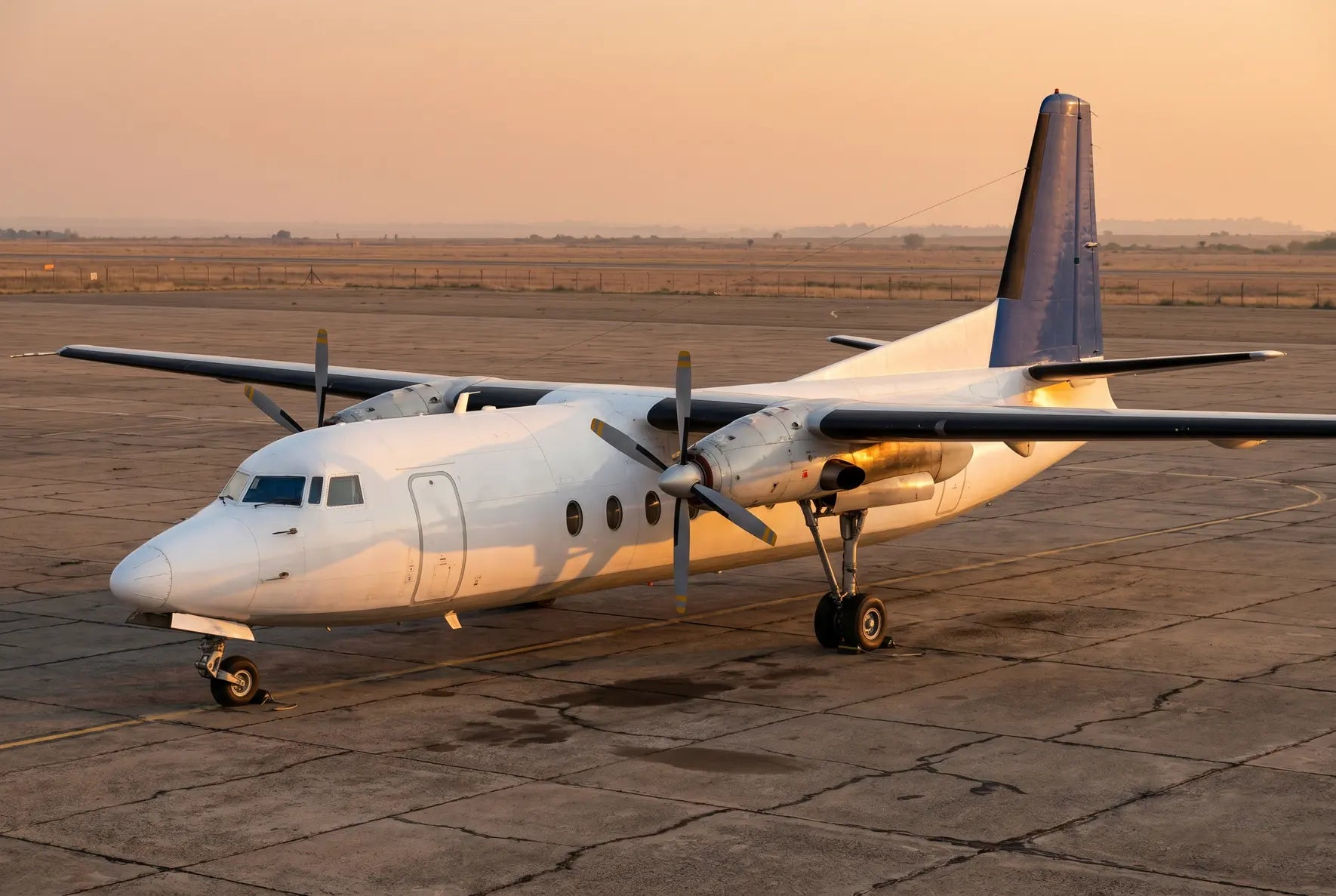
Fokker F27-500: History, Development and What Sets This Stretched Variant Apart
The Fokker F27 Friendship family was conceived in the early 1950s by the Dutch manufacturer Fokker as a modern turboprop replacement for the ageing piston powered airliners that dominated regional routes, most notably the Douglas DC‑3. The original design, known internally as the P275, evolved through wind tunnel testing and government backed funding into a pressurised, high wing twin turboprop powered by Rolls‑Royce Dart engines. The prototype made its maiden flight on 24 November 1955 from the Netherlands, and the production F27 Mk 100 followed with its first flight on 23 March 1958. Aer Lingus became the launch operator, receiving its first aircraft in December 1958. Over the following decade, Fokker introduced successive marks (100, 200, 300, 400) with incremental engine, structural and cabin improvements, while the American manufacturer Fairchild built 206 examples under licence. In total, 787 F27 Friendships were produced: 581 by Fokker and 206 by Fairchild.
By the mid 1960s, growing demand for higher capacity on short haul regional routes prompted Fokker to develop a stretched derivative. The result was the Fokker F27-500 (also designated Mk 500), which extended the fuselage by 1.50 m (4 ft 11 in) compared to the standard airframe. The additional length was distributed as 90 cm forward of the wing and 60 cm aft. The prototype, registered PH‑FLM, completed its first flight on 15 November 1967. Type approval by the Dutch civil aviation authority (RLD) followed swiftly, and EASA type certificate A.036 records the F27 Mark 500 as approved on 17 May 1968. The variant was subsequently certified by the FAA in May 1970. The Mk 500 entered airline service shortly after European certification, becoming a popular choice for operators in Europe, Australasia and beyond. According to production records compiled by Aeropedia, 112 examples of the F27-500 were built during the production run that continued until 1986.
The stretched Friendship served airlines across multiple continents, including operators in the Netherlands, Australia, New Zealand, Ireland and Turkey, among others. It also proved versatile enough to spawn military and freight sub variants: the F27-500M served as a troop transport, while the F27-500F was a dedicated freighter version with modified door arrangements. In later decades, several F27-500 airframes were converted to all cargo configuration, extending their operational lives well into the 2000s. The knowledge accumulated during the Mk 500 programme directly informed the development of the Fokker 50, a thoroughly modernised turboprop that entered service in 1987 and replaced the F27 on production lines. For context on how regional turboprops shaped Caribbean airline operations, the F27 family played a notable role connecting island communities during the same era.
What Distinguishes the Fokker F27-500 from Other F27 Variants
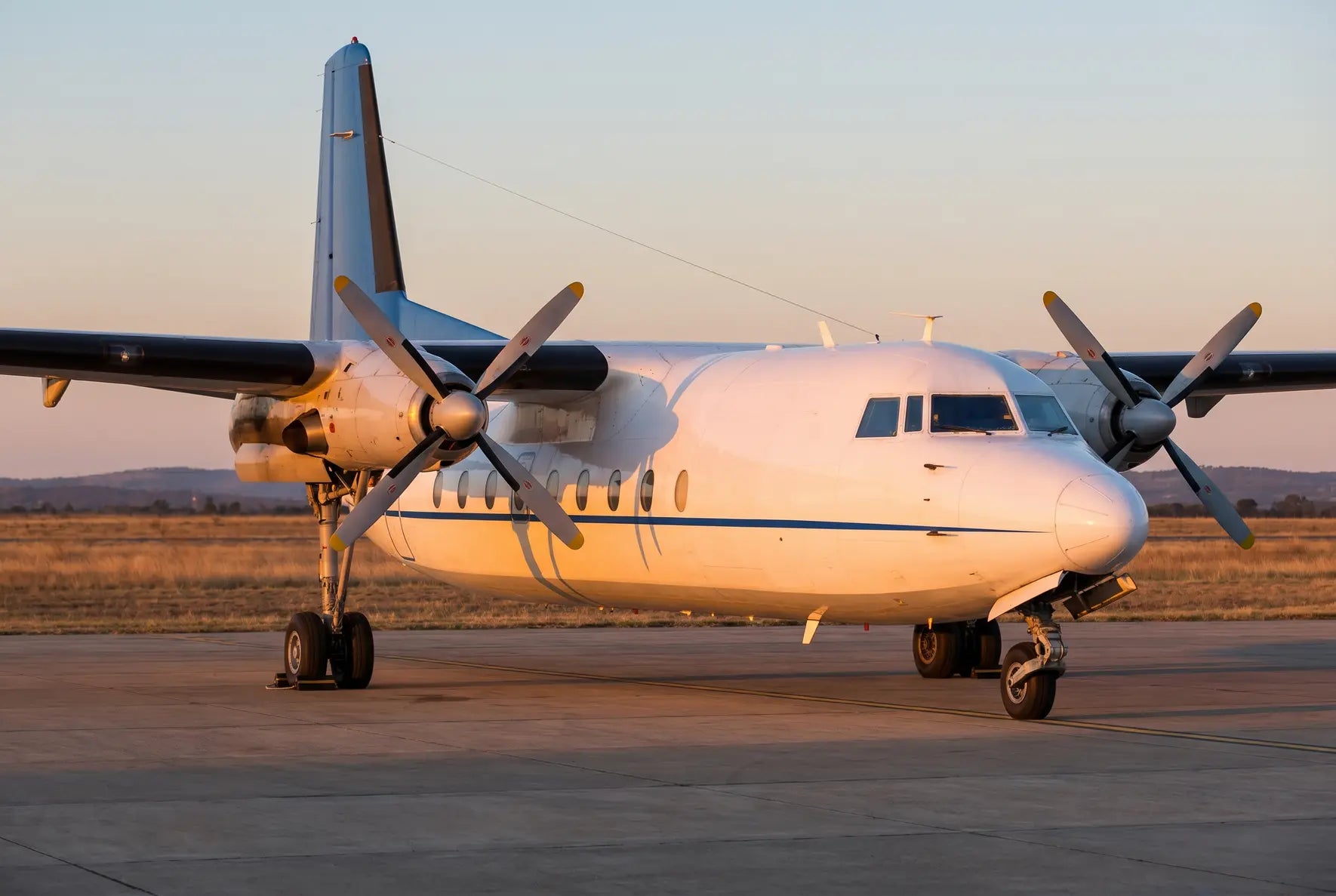
The EASA type certificate data sheet describes the F27 Mark 500 as identical to the Mark 200 or Mark 600 except for its stretched fuselage. In practice, this single structural change had significant operational implications. The 1.50 m fuselage plug raised maximum seating capacity to 52 passengers in a high density layout, compared with approximately 44 for the standard length marks. The overall fuselage length grew to 25.06 m, versus 23.56 m for the Mk 200 and Mk 600. The powerplant remained in the Rolls‑Royce Dart family; the Mk 500 was fitted with Rolls‑Royce Dart 532‑7R engines, consistent with other late production F27 variants. Unlike the Mk 400, which featured a large forward cargo door for quick change passenger/freight operations, the Mk 500 was designed primarily as a passenger transport with conventional door arrangements. The F27-600, which first flew in November 1968, retained the short fuselage of the Mk 200 but incorporated the cargo door of the Mk 400, making it a complementary rather than competing variant. The American built Fairchild FH‑227 was a separate stretched derivative that preceded the Mk 500 by nearly two years, but it was engineered independently by Fairchild Hiller and should not be confused with the Fokker designed F27-500.
The following list summarises the key variant identifiers for the Fokker F27-500:
- Fuselage length: 25.06 m (1.50 m stretch over standard F27 marks)
- Engines: 2 × Rolls‑Royce Dart 532‑7R turboprops
- Passenger capacity: up to 52 in high density configuration
- Type certificate: EASA A.036, approved 17 May 1968
- Production total: 112 aircraft built by Fokker
- Sub variants: F27‑500M (military transport), F27‑500F (freighter)
- Wingspan: 29.00 m (unchanged across all F27 marks)

A Fokker F27 Friendship aircraft, used by the U.S. Army Parachute Team, is shown in flight. The plane is labeled with 'Golden Knights' and features military insignia.
Fokker F27-500 Technical Specifications, Systems and Engine Overview
The Fokker F27-500 is the stretched member of the F27 Friendship family, designed to increase seat capacity on short to medium regional routes while retaining the rugged airfield performance that defined the original airframe. Compared with the standard fuselage variants (Mk 200, 300, 400), the F27-500 adds approximately 1.5 metres of fuselage length, enabling accommodation for up to 52 passengers in a high density layout. The trade off is straightforward: more payload per rotation at the cost of a modest reduction in range with a full cabin. The aircraft keeps the same 29.00 m high wing, unpressurised or lightly pressurised cabin options, and proven Rolls Royce Dart turboprop powerplant shared across the F27 line, making it a predictable step up for operators already flying shorter body Friendships.
The F27-500 first flew in November 1967 and went on to serve with airlines, military operators and cargo carriers worldwide. Its ability to operate from short and unprepared strips, combined with a simple systems architecture and low maintenance footprint, positioned it as a dependable workhorse well into the 1990s. For anyone familiar with the Boeing 747 8i and its evolution within a long running aircraft family, the F27-500 represents a similar philosophy at the opposite end of the size spectrum: incremental refinement of a proven platform.
- Length: 25.06 m (82 ft 3 in)
- Wingspan: 29.00 m (95 ft 2 in)
- Height: approximately 8.71 to 8.84 m (28 ft 7 in to 28 ft 10 in), depending on configuration
- Typical seating: 44 to 52 passengers
- Maximum takeoff weight (MTOW): up to 20,410 kg (45,000 lb) with applicable Service Bulletins, per EASA Type Certificate Data Sheet A.036
- Maximum landing weight: up to 19,051 kg (42,000 lb) with modifications
- Operating empty weight (OEW): approximately 11,150 to 12,150 kg (24,585 to 26,786 lb)
- Range with maximum payload: approximately 991 km (535 nm)
- Range with maximum fuel: approximately 1,827 km (987 nm)
- Cruise speed: 460 to 480 km/h (248 to 259 kt)
- Service ceiling: approximately 8,990 m (29,500 ft)
- Engines: 2 × Rolls Royce Dart RDa.7 Mk 532 7 turboprops, each rated at 1,678 kW (2,250 shp)
- Propellers: Dowty Rotol four blade, featherable
Systems, Flight Controls and Handling
The F27-500 uses manual, mechanically linked primary flight controls. Ailerons, elevator and rudder are operated through push pull rods and cable runs, with servo tabs to reduce pilot effort. There is no hydraulic power boost on the primary surfaces, which simplifies the maintenance envelope but requires appreciable physical input at higher speeds. Double slotted flaps, deployable to 40 degrees for landing, provide the short field capability for which the Friendship became well known. Hydraulic multi disc brakes on the main wheels are paired with an anti skid system that activates after wheel spin up. Nosewheel steering is controlled via a cockpit tiller. Avionics on production aircraft typically included dual VHF communications, ADF, VOR/ILS, and optional weather radar, with an optional SPZ 600 autopilot providing heading, course hold and basic pitch control. No autothrottle or flight envelope protection was fitted.
Published performance figures for the F27-500 vary considerably depending on operator configuration, cabin density, approved weight modifications (many MTOW and MLW values depend on specific Fokker Service Bulletins), atmospheric assumptions and runway surface condition. Range figures are especially sensitive to payload: the gap between max payload range and max fuel range can exceed 800 km. When comparing numbers across sources, it is important to confirm whether the data refers to the base weight or a modified weight, and whether the range is quoted at standard day conditions.
Rolls Royce Dart: The Engine Behind the Friendship
The F27-500 is powered by two Rolls Royce Dart RDa.7 Mk 532 7 single shaft turboprop engines, each producing 1,678 kW (2,250 shp). The Dart was designed by Rolls Royce Limited in the United Kingdom, with its first run completed in 1946. It entered airline service in 1948 aboard the Vickers Viscount, becoming the world's first production turboprop to power a commercial airliner. The engine uses a two stage centrifugal compressor and drives a Dowty Rotol four blade propeller through a reduction gearbox. Over its production life, the Dart was built in more than 7,000 units and progressively uprated from around 1,120 kW (1,500 shp) in early marks to nearly double that figure in later variants.
Beyond the Fokker F27 family, the Dart also powered a diverse roster of aircraft, including the Vickers Viscount, the Armstrong Whitworth Argosy, the Avro (Hawker Siddeley) 748, the Grumman Gulfstream I, the NAMC YS 11 and the Breguet 1050 Alize maritime patrol aircraft. Its reputation for reliability, low vibration and relatively quiet operation made it one of the most successful turboprop engines of the 20th century and a defining element of the Fokker F27's appeal to regional airlines around the world.
Fokker F27 Variants vs ATR 42-500 Specifications Comparison
Scroll horizontally to see more →
| Parameter | Fokker F27-500 | Fokker F27-400 | Fokker F27-200 | ATR 42-500 |
|---|---|---|---|---|
| Entry into service | 1967 | 1967 | 1958 | 1996 |
| Engines | 2 × Rolls-Royce Dart Mk.532-7 | 2 × Rolls-Royce Dart Mk.532 | 2 × Rolls-Royce Dart R.Da.7 | 2 × Pratt & Whitney PW127E |
| Length | 25.1 m | 23.6 m | 23.6 m | 27.5 m |
| Wingspan | 29.0 m | 29.0 m | 29.0 m | 24.6 m |
| Height | 8.7 m | 8.5 m | 8.5 m | 7.6 m |
| Typical seating and layout | Economy: 50-52 passengers | Economy: 44 passengers | Economy: 44 passengers | 2-class: 42-48 passengers |
| MTOW | 20 t | 20 t | 19 t | 18.6 t |
| Range | 1,400 nm | 1,400 nm | 1,200 nm | 1,500 nm |
| Cruise speed | 0.40 Mach | 0.40 Mach | 0.40 Mach | 0.42 Mach |
| Service ceiling | 29,500 ft | 27,800 ft | 27,800 ft | 30,000 ft |
| Program note | Stretched high-capacity variant for regional routes | Standard baseline passenger version | Early long-range model with auxiliary tanks | Modern successor turboprop for regional service |
Scroll horizontally to see more →
The table compares key specs of three Fokker F27 variants (200/400/500) against the ATR 42-500, covering dimensions, engines, seating, weights, and performance. The F27-500 is the capacity-focused stretch (50–52 seats) while the -400/-200 are smaller at 44 seats. ATR 42-500 is newer (1996), has the longest range (1,500 nm) and slightly higher cruise (0.42 Mach), while F27 models share wider wings (29.0 m) and similar 1,200–1,400 nm ranges.
Fokker F27-500 Operations: Typical Routes, Missions and Airlines Worldwide
The Fokker F27-500, the stretched variant of the Fokker F27 Friendship family, was designed for short to medium haul regional services. With a maximum payload range of approximately 1,250 km (675 nautical miles) and a ferry range of up to 1,970 km (1,065 nautical miles), the aircraft typically operated sectors lasting between 45 minutes and two hours. Its Rolls Royce Dart turboprop engines gave it a cruising speed of around 460 km/h (250 knots), making it well suited for routes connecting secondary cities to major hubs or linking regional airports across relatively short distances.
First flown in November 1967, the Fokker F27-500 entered a market hungry for reliable regional capacity. A total of 123 units of the Mk 500 variant were built by Fokker in Amsterdam, serving both passenger and freight operators. The type excelled in hub and spoke networks, feeding traffic from smaller cities into larger connecting hubs, but it also proved effective on point to point routes linking communities with limited air service. Its ability to operate from short and semi prepared runways made it especially valuable at secondary and regional airports where longer runways were unavailable.
Operators valued the aircraft's robust landing gear and high wing design, which allowed it to serve airfields with basic infrastructure across diverse climates and terrain. However, the Fokker F27-500 posed challenges in its later years of service. The pneumatic system was known for persistent air leaks that were difficult to detect and recharge, particularly at remote airfields lacking compressed air facilities. As the fleet aged, spare parts for the Dart engines became increasingly scarce, with hot section components requiring costly specialised welding. Noise levels in the cabin and cockpit were also a concern, contributing to its gradual replacement by quieter and more fuel efficient turboprops such as the ATR 42, ATR 72 and de Havilland Canada Dash 8.
Where the Fokker F27-500 Operated Around the World
The Fokker F27-500 served airlines and cargo carriers across four broad regions, adapting to widely different operational environments. In Europe, the variant was a staple of regional airline networks from the late 1960s through the 1990s, connecting secondary cities to national hubs and supporting overnight postal and newspaper freight services. In North and South America, the type filled a niche on feeder routes, particularly in cargo operations. Across Asia, the aircraft was well suited for inter island and domestic trunk routes, especially in archipelago nations where short runways were common. In Africa, the rugged design of the Fokker F27-500 allowed it to reach communities with limited airport infrastructure, supporting both scheduled passenger and freight services.
Given the long production run and the fact that many airframes passed through multiple operators over their service lives, the Fokker F27-500 accumulated an extensive and diverse operational history. The following list highlights confirmed operators by region.
- Europe: Jersey European Airways operated multiple Fokker F27-500s on passenger routes from Jersey and across the United Kingdom, including aircraft such as G JEAH and G JEAG. Channel Express, also based in the Channel Islands, used the F27-500 for scheduled overnight freight services carrying newspapers from Bournemouth to Jersey. In France, a fleet of 15 Fokker F27-500s was acquired for Air France postal operations on behalf of La Poste, flying nightly mail runs between French cities. In Italy, MiniLiner operated the variant on regional services. Other European operators included various charter and regional carriers across the Netherlands, Scandinavia and the United Kingdom, where the type fed passengers to larger hubs at airports like Amsterdam Schiphol.
- North and South America: In the United States, FedEx Feeder (operated through Mountain Air Cargo) used Fokker F27-500F freighters, including N719FE (c/n 10467), for regional parcel distribution within the FedEx network. In South America, SJL Aeronáutica operated an F27-500 variant, and the type was also found with smaller regional carriers supporting domestic connectivity across the continent.
- Asia: The Fokker F27-500 was especially popular in Indonesia, where carriers such as Merpati Nusantara Airlines, Sempati Air and Garuda Indonesia used the F27 family extensively for inter island services across the archipelago. In India, Indian Airlines and East West Airlines flew the type on domestic regional routes. Iran Aseman Airlines in Iran and Myanma Airways in Myanmar also operated F27 variants including the Mk 500, serving domestic networks where short runway capability was essential.
- Africa: United African Airlines operated confirmed Fokker F27-500 aircraft, while Air Egypt used the variant on scheduled routes including Sharm el Sheikh to Cairo. In South Africa, F27-500 airframes served with regional operators. The type's ability to handle unpaved or short strips made it valuable for connecting remote communities across the continent, where infrastructure remained limited and alternative aircraft options were few. The distinctive oval cabin windows of the Friendship became a familiar sight at airfields from West Africa to the Horn of Africa.
Typical Seating Configurations on the Fokker F27-500
The Fokker F27-500 featured a pressurised cabin measuring 15.6 m in length, 2.1 m in width and 2.0 m in height. In a standard single class layout, the cabin accommodated up to 52 passengers in a 2+2 abreast arrangement, an increase over the 44 seats found in earlier, shorter fuselage variants. Regional airlines operating scheduled passenger services typically configured the cabin with 48 to 52 seats at a tight pitch to maximise revenue on short sectors. The stretched fuselage of the Mk 500 added eleven oval cabin windows per side rather than the ten found on shorter variants, providing slightly more natural light for passengers.
Some operators, particularly those in Australia, configured the cabin for 56 to 60 passengers in high density layouts, taking advantage of a modified door arrangement. The F27-500F freighter variant removed passenger seating entirely, offering approximately 56 cubic metres of cargo volume and a payload capacity of 6,500 kg, loaded via internal pallet systems. Combi configurations also existed, allowing airlines to mix passenger seating with cargo in the rear cabin, which was particularly useful on thin routes where a combination of freight and passengers made the service economically viable.
In this video, watch Microsoft Flight Simulator 2020 footage of the Fokker F-27-500 Friendship, a compact turboprop converted from FSX to MSFS, showcasing its handling, cockpit views, and in-flight performance.
Fokker F27-500 Safety Record: Accident History and How Safe Is This Turboprop?
The Fokker F27-500 belongs to the broader F27 Friendship family, one of the most successful turboprop airliners ever produced. Fokker built approximately 586 airframes, while Fairchild manufactured around 206 under licence in the United States, bringing total production to roughly 792 aircraft across all variants. Of these, 123 were F27-500 models, a stretched version first flown in November 1967 and seating up to 52 passengers. The type entered commercial service in 1958, and production continued until 1987, giving the F27 family more than six decades of operational presence worldwide. Over that span the entire F27 fleet accumulated millions of flight hours and cycles with more than 100 operators on every inhabited continent. According to data compiled by the Aviation Safety Network, the F27 family recorded approximately 161 hull loss occurrences across all variants, a figure that must be weighed against the exceptionally large number of flights performed over many decades, often on short regional sectors in challenging environments. A significant share of those events involved earlier marks operating under conditions or regulatory frameworks that have since been substantially improved.
Notable Accidents and Incidents Involving the Fokker F27-500
Several documented events specifically involved the F27 Mk 500 or its sub-variants. Each contributed, directly or indirectly, to safer practices within the broader turboprop community.
- Air New Zealand Flight 4374 (ZK-NFC), 17 February 1979, Auckland, New Zealand. During an approach to Auckland International Airport in heavy rain and reduced visibility, the Fokker F27-500 struck water approximately one kilometre short of the runway threshold. Two of the four occupants lost their lives. Investigators determined the crew became spatially disoriented and failed to monitor flight instruments adequately during a visual illusion scenario. The accident reinforced the importance of stabilised approach procedures and instrument cross-checking, particularly in degraded visual conditions, and contributed to improved crew resource management (CRM) training standards in the region.
- Channel Express G-CEXF, 5 June 2001, Jersey, Channel Islands. Shortly after takeoff on an empty positioning flight, this F27 Mk 500 suffered an uncontained failure of the left engine high pressure turbine disc. Debris severed a low pressure fuel line, triggering a significant nacelle fire. The crew shut down the engine, activated the fire drill and completed a safe single engine landing back at Jersey Airport. There were no fatalities. The UK Air Accidents Investigation Branch (AAIB) published Report 4/2004, which highlighted the minimal fatigue strength margin of the Rolls-Royce Dart HPT disc and its vulnerability to vibratory resonance cracking. The findings prompted enhanced engine inspection intervals and renewed attention to ageing turbine component management on Dart powered fleets.
- Merpati Nusantara Airlines PK-MFL, 2001, Juanda Airport, Surabaya, Indonesia. A Fokker F27-500F operating a training flight was destroyed during a loss of control event at the airport. All three crew members on board lost their lives. The accident underlined the risks associated with training operations on ageing airframes and the need for rigorous oversight of flight training programmes, particularly for operators transitioning crews between aircraft types.
Beyond these F27-500 specific events, several accidents involving other F27 marks, such as controlled flight into terrain occurrences in South and Southeast Asia during the 1970s and 1980s, led to wider industry changes. These included the global adoption of ground proximity warning systems (GPWS), mandatory CRM training and tighter regulatory oversight of regional operators.
How Safe Is the Fokker F27-500 Today?
Assessing how safe the Fokker F27-500 is requires context. The type's accident history is spread across more than five decades and encompasses operations on unpaved strips, in mountainous terrain and under regulatory regimes that varied enormously. Many incidents involved factors such as inadequate maintenance, pilot experience shortfalls or environmental conditions rather than fundamental design flaws. The F27's high wing, robust landing gear and reliable Rolls-Royce Dart turboprop engines were specifically chosen for versatility and dependability, and the aircraft earned a reputation for ruggedness in austere operating environments. Modern standard operating procedures (SOPs) and regulatory frameworks, including those set by ICAO and national civil aviation authorities, have raised the safety baseline for every aircraft type still in service. The few remaining F27-500s in operation are subject to ageing aircraft programmes, mandatory service bulletins and airworthiness directives that address structural fatigue, engine life limits and avionics upgrades. When these measures are followed, the type continues to meet current certification standards. As with any aircraft, safety ultimately depends on the quality of maintenance, crew training and operational oversight. Statistics published by organisations such as the International Air Transport Association (IATA) consistently confirm that commercial aviation remains one of the safest modes of transport, with fatal accident rates at historic lows across all aircraft categories.
01 What is the typical range and mission profile of the Fokker F27-500?
The Fokker F27-500 has a maximum range of about 2,000 kilometers with full payload, making it ideal for regional flights under 1,000 km. It excels in short-haul routes connecting smaller airports to hubs, often operating multiple daily sectors. Passengers can expect quick turnarounds and reliable service on these missions.
02 How is the cabin laid out on the Fokker F27-500, and what is the passenger experience like?
The Fokker F27-500 typically seats 52 to 60 passengers in a single-class layout with two seats on each side of a narrow aisle. The cabin feels cozy for regional hops, with decent legroom in economy and lower noise levels thanks to its rear-mounted engines. Overall, travelers report a comfortable ride for flights under two hours.
03 Which airlines operate the Fokker F27-500 and on what routes?
Airlines like Air New Zealand, Aer Lingus, and regional carriers in Asia and Africa have used the Fokker F27-500 extensively. They deploy it on low-frequency routes to remote areas, island hops, and feeder services to major airports. Many are still flying cargo conversions today.
04 How does the Fokker F27-500 perform compared to similar aircraft?
The Fokker F27-500 offers good short-field performance with a takeoff distance under 1,500 meters, outperforming some jets like the early CRJ in rough airstrips. It is fuel-efficient for props, burning less per seat than turboprops like the ATR 42 on short legs. Its rugged design suits unpaved runways better than contemporaries.
05 What is the safety record of the Fokker F27-500?
The Fokker F27-500 has a solid safety record with few hull losses relative to its 500+ units produced, bolstered by features like a high-mounted wing for obstacle clearance and robust landing gear. Key design strengths include good stall characteristics and propeller auto-feathering for engine failures. Incidents are mostly weather-related, typical for regional ops.
06 What should passengers know about flying on the Fokker F27-500, like seat choice and turbulence?
Choose seats A or F for window views on the Fokker F27-500, as the slim fuselage offers good vistas; rows 1-5 feel less motion in turbulence due to the stable prop design. Expect some propeller noise but minimal vibration, and prop wash makes boarding breezy. It's smooth in light chop thanks to forgiving handling.