


Fokker F27-400: History, Development, and What Sets This Combi Variant Apart
The Fokker F27-400 belongs to the Fokker F27 Friendship family, one of the most commercially successful turboprop airliners ever produced. Developed by the Dutch manufacturer Fokker, headquartered near Schiphol Airport in the Netherlands, the F27 program aimed to create a modern, pressurised replacement for the ageing piston engine airliners that dominated short haul routes in the early postwar era, most notably the Douglas DC-3.
Design work on what would become the Friendship began in the early 1950s under the internal designation P275. The project envisioned a high wing, twin engine turboprop capable of operating from short and unprepared airstrips while offering the comfort and speed advantages of turbine power. Fokker selected the Rolls Royce Dart turboprop as the powerplant for the entire family, a decision that would define every subsequent variant. The first F27 prototype, registered PH-NIV and powered by Dart 6 Mk 507 engines, completed its maiden flight on 24 November 1955. The first production model, the F27-100, flew on 23 March 1958, and revenue service began with Aer Lingus on 15 December 1958.
As airline and military operators demanded more versatility, Fokker developed a branching family of variants through the late 1950s and 1960s. The F27-200 introduced the more powerful Rolls Royce Dart 7 Mk 528 engines and new straight tipped propellers. The F27-300 Combiplane added a large forward cargo door to the F27-100 airframe, enabling mixed passenger and freight operations. It was the logical combination of these two advances that gave rise to the Fokker F27-400.
The F27-400 married the upgraded Dart 7 Mk 528-7 (or 532-7) engines and square tipped propellers of the F27-200 with the large forward cargo door of the F27-300 Combiplane. The result was a civilian combi variant with greater power and operational flexibility. According to Aeropedia, the first Fokker F27-400 flew on 6 October 1961. A total of 16 F27-400 aircraft were built for civil combi operations, as recorded by fokker-aircraft.info.
The military derivative, designated F27-400M Troopship, followed with its first flight on 24 April 1965. The F27-400M proved far more prolific, with 81 units produced. It was configured to carry up to 46 paratroopers, 24 stretchers with attendants, or approximately 6,000 kg of cargo. Known operators included the Royal Netherlands Air Force (whose F27-300M preceded it), the Islamic Republic of Iran Air Force, the Bolivian Air Force, the Senegalese Air Force, and the United States Army, which operated the type under the designation C-31A. The last US Army C-31A was retired in September 2019. In its military transport role, the F27-400M filled a niche comparable to that of other tactical turboprop transports of the era, such as the Antonov An-26, serving as a versatile platform for short field logistics and paradrop missions.
Production of the entire Fokker F27 Friendship family continued at Schiphol until 1987, when the type was succeeded by the Fokker 50. Across all variants, Fokker built a total of 586 aircraft, while an additional 205 were manufactured under licence by Fairchild in the United States.
What Distinguishes the Fokker F27-400 from Neighbouring Variants
The Fokker F27-400 occupies a specific position in the Friendship lineage. It shares the standard 23.56 m fuselage of the F27-100, F27-200, and F27-300, distinguishing it from the stretched F27-500 (25.06 m). Its defining characteristics are the combination of the Dart 7 Mk 528/532 engines and the large forward cargo door, features that were split across the F27-200 and F27-300 respectively. The later F27-600 is nearly identical to the F27-400 but replaces the standard cabin floor with an all metal cargo floor designed for heavier freight loads.
The following summary highlights the verified variant identifiers of the Fokker F27-400:
- Engines: Two Rolls Royce Dart 7 Mk 528-7 or Mk 532-7 turboprops
- Propellers: Dowty Rotol constant speed units with straight (square) tips, replacing the rounded tips of earlier marks
- Cargo door: Large forward fuselage cargo door inherited from the F27-300 Combiplane
- Fuselage length: 23.56 m (standard, non stretched)
- Wingspan: 29.00 m
- Production total (F27-400 civilian): 16 aircraft
- Production total (F27-400M Troopship): 81 aircraft
- First flight: 6 October 1961 (civilian); 24 April 1965 (400M)

A Fokker F27 Friendship aircraft is shown in flight, belonging to the U.S. Army Parachute Team. The plane is prominently marked with 'Golden Knights' insignia.
Fokker F27-400 Technical Specifications, Systems and Engine Overview
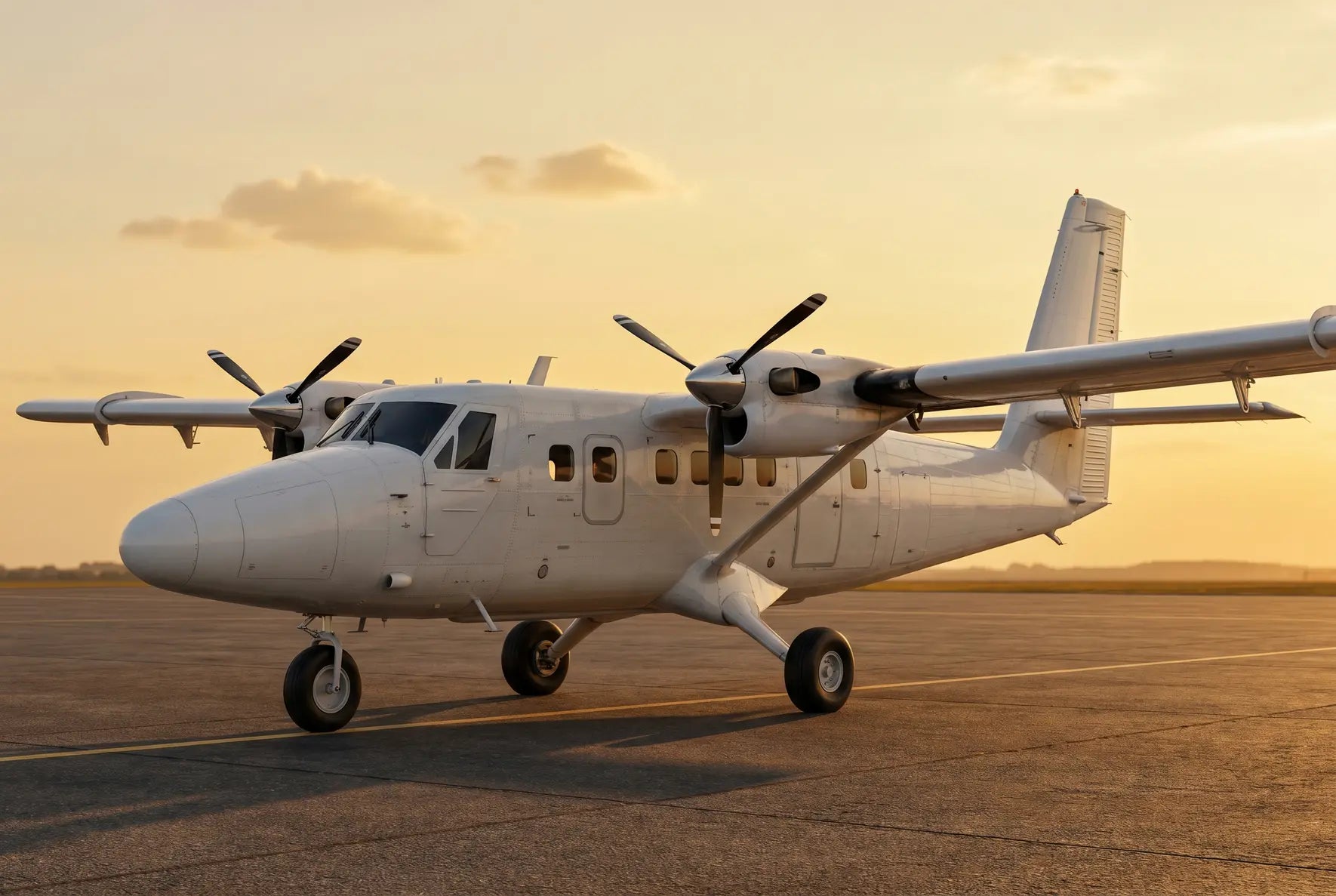
The Fokker F27-400 is the combi variant of the Friendship family, combining the airframe and powerplant of the F27-200 with a large forward cargo door measuring approximately 2.32 by 1.78 metres, originally introduced on the short lived F27-300 Combiplane. This configuration allowed operators to switch rapidly between passenger, mixed passenger/freight and all cargo layouts, making the aircraft especially versatile on thin regional routes where demand fluctuated between people and goods. The high wing design, paired with long main landing gear legs that retract rearward into the engine nacelles, gives the F27-400 generous ground clearance and the ability to operate from unprepared or semi prepared strips, a trait that made the entire F27 line a favourite in developing regions and military service.
Like all short fuselage F27 variants, the dash 400 retains the proven structural philosophy of a pressurised, circular section fuselage built with metal bonded Aerolaminate skin panels, which helped control fatigue and corrosion over the type's long service life. Two Rolls-Royce Dart 532-7 turboprop engines, each driving a four blade Dowty Rotol constant speed propeller, provide the thrust. The design trades range against payload flexibility: the large cargo door adds structural weight and complexity, but opens the cabin for palletised freight without requiring a dedicated freighter conversion.
- Length: 23.56 m (77 ft 4 in)
- Wingspan: 29.00 m (95 ft 2 in)
- Height: 8.50 m (27 ft 11 in)
- Typical seating: 44 passengers in standard layout; up to 48 in high density configuration
- MTOW: approximately 19,773 kg (43,600 lb), with higher options reported for modified airframes
- Cruise speed: 460 to 480 km/h (248 to 260 kt), depending on altitude and weight
- Service ceiling: approximately 7,620 to 8,475 m (25,000 to 27,800 ft)
- Range: up to 2,600 km (1,400 nmi) with maximum fuel; significantly less at maximum payload
- Engines: 2 x Rolls-Royce Dart 532-7 turboprops (approximately 2,140 SHP each), as confirmed by the EASA Type Certificate Data Sheet for Noise
- Propellers: Dowty Rotol four blade, constant speed, fully feathering
- Cargo door: large forward fuselage door (2.32 x 1.78 m) for mixed or all freight operations
- Military derivative: F27-400M Troopship, capable of carrying 48 paratroops or 24 stretchers
Systems, Flight Controls and Handling
The F27-400 uses manual, mechanically linked flight controls augmented by servo tabs on the ailerons, elevator and rudder. There is no hydraulic power boost on the primary surfaces, which keeps the system simple and reduces maintenance burden but does require appreciable control forces at higher speeds. Double slotted flaps span the trailing edge of each wing, providing effective lift augmentation for short field operations. Typical flap settings include intermediate positions for takeoff and a full 40 degree deployment for landing. The aircraft features hydraulic multi disc brakes on the main wheels, with an anti skid system that activates once wheel rotational speed is established. Nosewheel steering is available via a cockpit tiller for ground manoeuvring.
An optional SPZ-600 Automatic Flight Control System provides heading, course hold and pitch control, though the F27 predates autothrottle or envelope protection technology. Standard avionics include dual VHF communications, ADF, VOR/ILS and weather radar as an option. The pressurised cabin supports operations up to approximately FL250. For operators using the F27-400M in military roles such as maritime patrol, additional mission systems including search radar and navigation equipment could be fitted, as seen in examples operated by several air forces worldwide.
Published performance figures for the F27-400 can vary noticeably depending on operator specific modifications, cabin density, actual operating weight, atmospheric conditions and runway surface. The MTOW, for instance, could differ between airframes depending on approved service bulletins and structural reinforcement kits. Range figures are particularly sensitive to payload: a full passenger cabin with baggage will reduce range well below the maximum fuel figure. Cruise speed also depends on chosen altitude and power setting, so numbers should always be read with their underlying assumptions in mind.
The Rolls-Royce Dart 532-7: History, Specifications and Legacy
The Rolls-Royce Dart is one of the most successful turboprop engines ever produced. First run in 1946 and flight tested on a converted Avro Lancaster in October 1947, the Dart went on to power the Vickers Viscount on its maiden flight in 1948, ushering in the era of turbine powered commercial aviation. Production continued for over four decades, ending in 1987, with more than 7,100 engines delivered. The Dart 532-7 fitted to the F27-400 belongs to the mature RDa.7 family, representing decades of refinement from the original 990 SHP prototype to outputs exceeding 2,100 SHP in later marks.
The engine architecture centres on a two stage centrifugal compressor feeding seven straight flow combustion chambers, which in turn drive a three stage axial turbine. This arrangement proved remarkably reliable and easy to maintain in the field. The Dart 532-7 produces approximately 2,140 SHP at 15,000 RPM, with a specific fuel consumption of around 0.58 lb per equivalent horsepower per hour and an overall pressure ratio of approximately 5.6:1. Dry weight for the Dart family in this power class is roughly 547 kg (1,207 lb). The propeller is driven through a two stage reduction gearbox.
Beyond the F27, the Dart family powered a wide range of aircraft across civil and military roles. The Vickers Viscount, which remains the best selling turboprop airliner in history, used earlier Dart marks (RDa.3 through RDa.7). The Hawker Siddeley HS 748 (originally Avro 748) flew with Dart 529 and 532 series engines, while the Japanese NAMC YS-11 regional airliner relied on Dart 542 and 543 variants producing up to 2,555 SHP. The Grumman Gulfstream I executive transport used the high output RDa.10 at 2,555 SHP, and the Breguet Alizé anti submarine aircraft was powered by the Dart Mk 21. The Lockheed L-1649 Starliner, a contemporary of the early Dart era though piston powered itself, illustrates the rapid technological transition of the late 1950s, when turboprops like the Dart equipped F27 began displacing piston engine airliners on regional routes. The Convair 600, a turboprop conversion of the Convair 240, and the Armstrong Whitworth Argosy freighter also relied on Dart power. This breadth of application across four decades underscores the engine's adaptability, reliability and the confidence that manufacturers placed in Rolls-Royce's centrifugal compressor design philosophy.
Fokker F27 Variants vs ATR 42-300 Specifications Comparison
Scroll horizontally to see more →
| Parameter | Fokker F27-400 | Fokker F27-500 | Fokker F27 Mk100 | ATR 42-300 |
|---|---|---|---|---|
| Entry into service | 1967 | 1967 | 1958 | 1985 |
| Engines | 2 × Rolls-Royce Dart Mk532-7 | 2 × Rolls-Royce Dart Mk536 | 2 × Rolls-Royce Dart Mk514 | 2 × Pratt & Whitney PW120 |
| Length | 23.6 m | 25.1 m | 23.6 m | 22.7 m |
| Wingspan | 29.0 m | 29.0 m | 29.0 m | 24.6 m |
| Height | 8.5 m | 8.8 m | 8.5 m | 7.1 m |
| Typical seating and layout | Single-class: 44 passengers | Single-class: 52 passengers | Single-class: 40 passengers | Single-class: 42 passengers |
| MTOW | 20.4 t | 20.8 t | 18.4 t | 16.9 t |
| Range | 1,900 nm | 1,400 nm | 1,500 nm | 1,500 nm |
| Cruise speed | 0.28 Mach | 0.28 Mach | 0.28 Mach | 0.32 Mach |
| Service ceiling | 27,800 ft | 27,800 ft | 27,800 ft | 30,000 ft |
| Program note | Standard passenger version with high-performance Dart engines for regional routes | Stretched fuselage version for higher capacity | Original baseline version with standard engines | Modern successor design with advanced turboprops |
Scroll horizontally to see more →
The table compares key specs of Fokker F27 variants (Mk100, -400, -500) against the ATR 42-300. The F27-500 is the longest and seats the most (52) with slightly higher MTOW, while the F27-400 offers the longest listed range (1,900 nm). The ATR 42-300 is newer, has a higher cruise Mach and ceiling, but lower MTOW and shorter wingspan.
Fokker F27-400 Operations: Typical Routes, Missions and Airlines Worldwide
The Fokker F27-400 is the combi variant of the Fokker F27 Friendship family, distinguished from other marks by a large forward cargo door that allows rapid conversion between passenger, mixed passenger/cargo and all freight configurations. This flexibility made the F27-400 especially attractive to operators serving thin regional routes where a single aircraft needed to carry both passengers and freight on the same sector. Powered by two Rolls Royce Dart turboprop engines rated at 2,140 SHP each, the type cruises at approximately 470 km/h (254 kt) and covers stage lengths of around 1,000 to 1,300 km, which translates into flights of roughly one to two hours. Maximum range with payload reaches about 1,740 km (940 nm), while ferry range can extend beyond 2,100 km.
The short field performance of the Fokker F27-400 is one of its strongest operational assets. With a takeoff run as short as 1,003 m at maximum takeoff weight, the aircraft can access secondary and regional airports with limited runway infrastructure. That capability positioned it as a natural hub and spoke feeder, connecting smaller communities with larger network hubs. Operators also deployed the type on point to point services between provincial centres where traffic volumes did not justify larger equipment. In cargo and combi roles, the large forward door accepts standard pallets, enabling a total cargo volume of 62 m³ and a maximum payload of approximately 6,200 kg. Typical daily utilisation for regional turboprops of this generation ranged between six and ten block hours per day, depending on sector length and turnaround times, with multiple short sectors being the norm in scheduled service.
Operational challenges for the Fokker F27-400 centre on the age of the airframe and its Rolls Royce Dart powerplants. Spare parts availability has become increasingly difficult, and the engines, while exceptionally reliable, are no longer in mainstream production support. Noise and emissions profiles also fall short of contemporary standards, which has restricted the type from operating at airports with strict environmental regulations. As a result, the number of active Fokker F27-400 aircraft has declined significantly, with only a handful remaining in commercial or government service by the mid 2010s.
Where the Fokker F27-400 Operates and Its Key Airlines
The Fokker F27-400 served operators across four broad regions, reflecting the worldwide appeal of the Friendship family. In Europe, the variant found a natural home with Dutch operators, given Fokker's Amsterdam base. In the Asia Pacific region, Air New Zealand and its predecessor, New Zealand National Airways Corporation, were among the most prominent users, flying the combi version on domestic provincial routes. In Africa and the Middle East, the type's rugged design and short field capability suited operations into austere airstrips. Military use of the F27-400M variant added further geographic reach, particularly in the Middle East.
- Europe: Schreiner Airways, based in the Netherlands, operated the Fokker F27-400 on regional passenger and cargo charters. The aircraft's combi door made it well suited to the mixed traffic demands of North Sea and intra Benelux services. Dutch operators benefited from proximity to the Fokker factory at Schiphol for maintenance and technical support.
- Asia and Oceania: Air New Zealand (and predecessor NAC) operated a fleet of 24 Fokker F27 Friendships from 1960 to 1990, including F27-400 Combi variants. These aircraft connected provincial centres such as Hamilton, Napier, Nelson, Blenheim and Invercargill to main trunk hubs like Auckland, Wellington and Christchurch. The combi configuration proved invaluable on routes where freight demand supplemented modest passenger loads. After retirement by Air New Zealand, several F27-400 airframes were sold to overseas operators. Equatorial International Airlines also operated an F27-400M.
- Africa: Tunisavia in Tunisia acquired three ex Air New Zealand F27-400 aircraft and used them for regional passenger and cargo services across North Africa. The type's ability to operate from shorter runways was an advantage in serving secondary airports across the region.
- Middle East: The Imperial Iranian Air Force was the largest military customer for the variant, acquiring 19 Fokker F27-400M transport aircraft in 1972. These were used for tactical airlift, troop transport and logistical resupply missions. For aspiring pilots interested in the career paths that lead from regional turboprop flying to major airlines, cadet programmes such as the Ryanair Future Flyer Programme illustrate how regional type experience remains valued in modern recruitment.
Typical Seating and Cabin Configurations
The Fokker F27-400 shares the standard short fuselage of the Mk 200 series, measuring 23.56 m in length. The pressurised cabin seats passengers in a 2+2 abreast layout with a single centre aisle. In a standard all passenger arrangement, seating ranges from 40 to 44 passengers, though some operators installed up to 48 seats in higher density layouts. Seat pitch on regional services typically fell between 29 and 32 inches, consistent with short haul turboprop norms of the era.
What set the Fokker F27-400 apart from pure passenger marks was the forward cargo door, which allowed operators to partition the cabin. In a typical combi layout, the forward section was devoted to palletised freight while the rear section retained passenger seating for around 32 to 36 travellers. Quick change capability meant an airline could fly passengers during the day and convert the cabin for overnight freight operations, maximising asset utilisation. Military F27-400M versions featured reinforced cabin floors and provisions for troop seating or litter installations. Crew complement was two pilots, with a single flight attendant on passenger services. The cabin width of 2.57 m and headroom of 2.03 m, while modest by modern standards, provided adequate comfort for sector lengths rarely exceeding two hours.
In this video, watch a TAM Bolivia Fokker F-27-400M Troopship FAB-90 as it starts engines, taxis, and departs runway 32 from Rurrenabaque Airport on flight TAM571.
Fokker F27-400 Safety Record: Accident History and How Safe Is This Aircraft?
The Fokker F27-400 belongs to the broader Fokker F27 Friendship family, one of the most widely produced turboprop airliners in aviation history. Across all variants, approximately 786 aircraft were built between 1955 and 1987, serving airlines, cargo operators and military forces on every continent. The F27-400 itself was a combi cargo variant of the F27-200, while the closely related F27-400M Troopship was its dedicated military transport counterpart, of which around 79 were manufactured. Over decades of service beginning in the late 1950s, the F27 family accumulated millions of flight hours and cycles in demanding regional and short haul operations. The Aviation Safety Network database records numerous hull loss accidents for the entire F27 type across all sub-variants, many of which involved older airframes operating in challenging environments or under military conditions with limited regulatory oversight. It is important to place these figures in context: the F27 operated for more than five decades, often on unpaved airstrips in tropical, mountainous or conflict affected regions, which inherently elevated operational risk compared to mainline jet operations on well equipped airports.
Notable Accidents Involving the Fokker F27-400 and F27-400M
Several serious accidents have involved the F27-400M military variant specifically. While no single event led to a global airworthiness directive unique to the F27-400 sub-type, the cumulative lessons from these occurrences influenced military operating procedures, crew training standards and fleet management decisions in the countries concerned.
- Iranian Air Force, April 1992 (registration 5-8815): An F27-400M was destroyed near Saveh, Iran, with the loss of all 39 occupants on board. Limited public information is available regarding the investigation findings, as is common with military accidents in the region. The Aviation Safety Network record confirms the aircraft, manufactured in 1974, was written off.
- Indonesian Air Force, April 2009 (registration A-2703): An F27-400M returning from a parachuting exercise crashed into a hangar during an approach at Bandung Husein Sastranegara Airport in heavy rain, killing all 24 occupants, including 17 special forces paratroopers. The aircraft went out of control shortly before touchdown, and weather conditions were cited as a significant contributing factor. The accident raised questions about the age and maintenance state of the Indonesian Air Force transport fleet.
- Indonesian Air Force, June 2012 (registration A-2708): During a training sortie involving touch and go exercises at Jakarta Halim Perdanakusuma Airport, an F27-400M stalled on final approach and crashed into a residential area, killing all seven crew members and four people on the ground. Reports indicated an excessively low approach speed during a turning manoeuvre left insufficient altitude for recovery. Following this event, Indonesian President Susilo Bambang Yudhoyono publicly questioned whether the ageing F27 fleet should continue in service, accelerating discussions about replacing the type with modern transport aircraft such as the Airbus and CASA/Airbus C-295 platforms.
A recurring theme across these occurrences was the advanced age of the airframes, many of which had logged tens of thousands of flight hours, combined with the inherently demanding nature of military transport missions. Investigation findings, where publicly available, pointed primarily to human factors, weather conditions and operational pressure rather than fundamental structural or design deficiencies in the F27 airframe itself.
How Safe Is the Fokker F27-400?
Evaluating the safety of the Fokker F27-400 requires distinguishing between the aircraft's design integrity and the operational environments in which it served. The F27 Friendship was engineered by Fokker with a robust high wing layout, a reliable Rolls Royce Dart turboprop powerplant and a rugged undercarriage designed for unprepared strips. These features gave it a well earned reputation for structural resilience. When operated under strict civilian regulatory oversight with proper maintenance schedules, the F27 demonstrated respectable reliability for its generation. Many of its hull loss events occurred in military or quasi military contexts, in regions where maintenance resources, crew training and regulatory enforcement were less consistent than in Western civil aviation. The SKYbrary reference page for the F27 provides additional context on the type's operational characteristics and certification basis.
As with any legacy turboprop, direct comparison of the F27-400 accident rate with modern regional aircraft such as the ATR 72 or the Bombardier Dash 8 would be misleading without accounting for era, fleet composition, operating region and regulatory framework. Today, only a handful of F27s remain in active service, and those still flying are subject to the same airworthiness requirements as any other certified aircraft. Aviation as a whole continues to be one of the safest modes of transport, and the lessons drawn from the F27 programme have contributed to the safety standards applied to every turboprop that followed it.
01 What is the typical range and mission profile of the Fokker F27-400?
The Fokker F27-400 has a range of around 2,600 km, making it suitable for regional flights of 1-2 hours. It excels on short to medium-haul routes connecting smaller airports, often serving as a feeder liner for larger hubs. Operators use it for missions requiring good short-field performance due to its turboprop design.
02 How is the cabin laid out on the Fokker F27-400, and what is the passenger experience like?
The Fokker F27-400 typically seats 44 passengers in a single-class layout with a cabin width of 2.1 meters and height of 2.0 meters. Passengers appreciate the relatively spacious feel for a regional turboprop, though noise from the Rolls-Royce Dart engines is noticeable but manageable. Window seats offer good views due to the high-wing design.
03 Which airlines operated the Fokker F27-400 and on what routes?
Airlines like Air New Zealand, Garuda Indonesia, and various regional carriers in Europe and Asia operated the Fokker F27-400. They used it primarily on domestic and intra-regional routes, such as island-hopping in Indonesia or connecting remote areas in New Zealand to main hubs. It remains in service with some cargo and smaller operators today.
04 How does the Fokker F27-400 perform compared to similar aircraft?
The Fokker F27-400 cruises at about 486 km/h with a service ceiling of 8,475 meters, powered by two Rolls-Royce Dart 532-7 turboprops. It offers better short-field capabilities than jets like the early BAe 146 but trades speed for efficiency on routes under 1,500 km. Fuel efficiency is solid for its era, with lower operating costs on regional networks versus larger turboprops like the ATR 42.
05 What is the safety record of the Fokker F27-400?
The Fokker F27-400 shares the strong safety record of the F27 family, with thousands built and over 50 years of service worldwide. Key design features include robust construction, reliable Dart engines, and good handling in adverse weather. Incidents were typically linked to operational factors rather than inherent flaws, per aviation safety databases.
06 What should passengers know about flying on the Fokker F27-400, like seat choice or turbulence?
Opt for seats over the wing for minimal turbulence feel, as the Fokker F27-400 handles bumps well due to its sturdy build and turboprop stability. Expect propeller noise but comfortable seating for short flights; larger windows enhance views on scenic routes. It performs steadily in turbulence at speeds of 163-179 knots, lighter than jets.