

Convair CV-440 History and Development: Metropolitan Explained
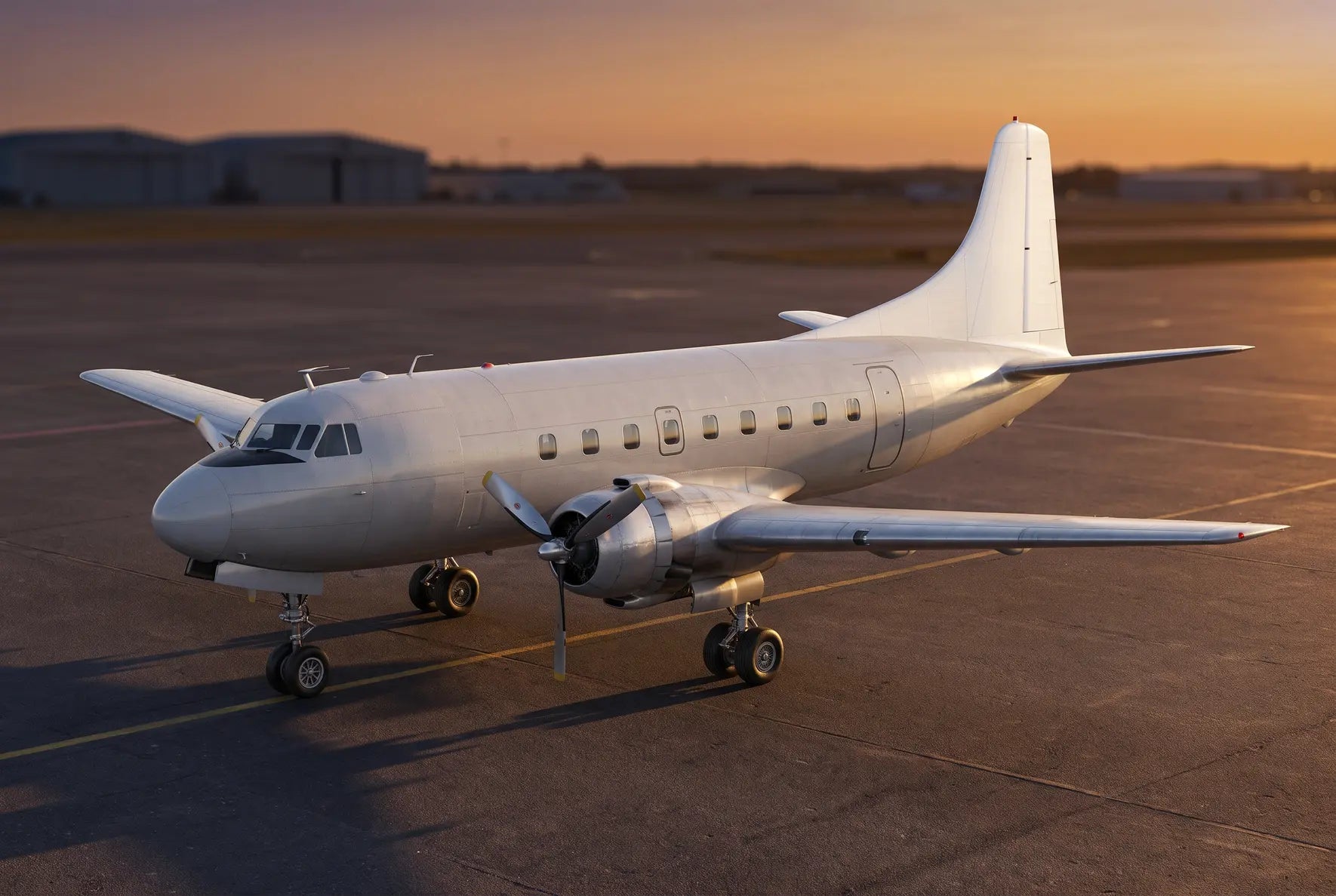
The Convair CV-440 Metropolitan was the last and most refined piston-engined member of the Convairliner family, the CV-240/340/440 series developed by Convair to replace the ageing Douglas DC-3 on short and medium routes. The programme began right after World War II, when American Airlines asked for a modern, pressurized twin-engine airliner. Convair first drew the unpressurized Model 110, then reworked it into the Model 240, one of the first pressurized twin-engine airliners, which first flew in March 1947 and entered service with American Airlines in February 1948. A stretched, longer-range derivative, the CV-340, followed and first flew in October 1951. You can read a broad overview of this lineage in the Convair CV-240 family reference.
By the mid-1950s, turboprops such as the Vickers Viscount were entering service, offering smoother, quieter and faster travel. To keep a competitive piston product on the market, Convair introduced the CV-440 Metropolitan as an improved CV-340 rather than a wholly new design. It first flew on 6 October 1955, and airframes were being certified and delivered by early 1957, with airline operators flying the type from 1956 onward. Convair, formally Consolidated Vultee Aircraft Corporation, built the Convairliners at its San Diego Division; by the time the CV-440 appeared, well over 900 transports in the series were already in service worldwide, and the wider family eventually exceeded 1,000 aircraft flown by more than 100 operators.
Convair was best known in civil aviation for this family, though it also produced military aircraft and missiles. The demanding operational profiles typical of these piston twins, including workloads discussed in this look at pilot conditions, shaped the refinements built into the Metropolitan.
What sets the CV-440 apart from the CV-340 and CV-240
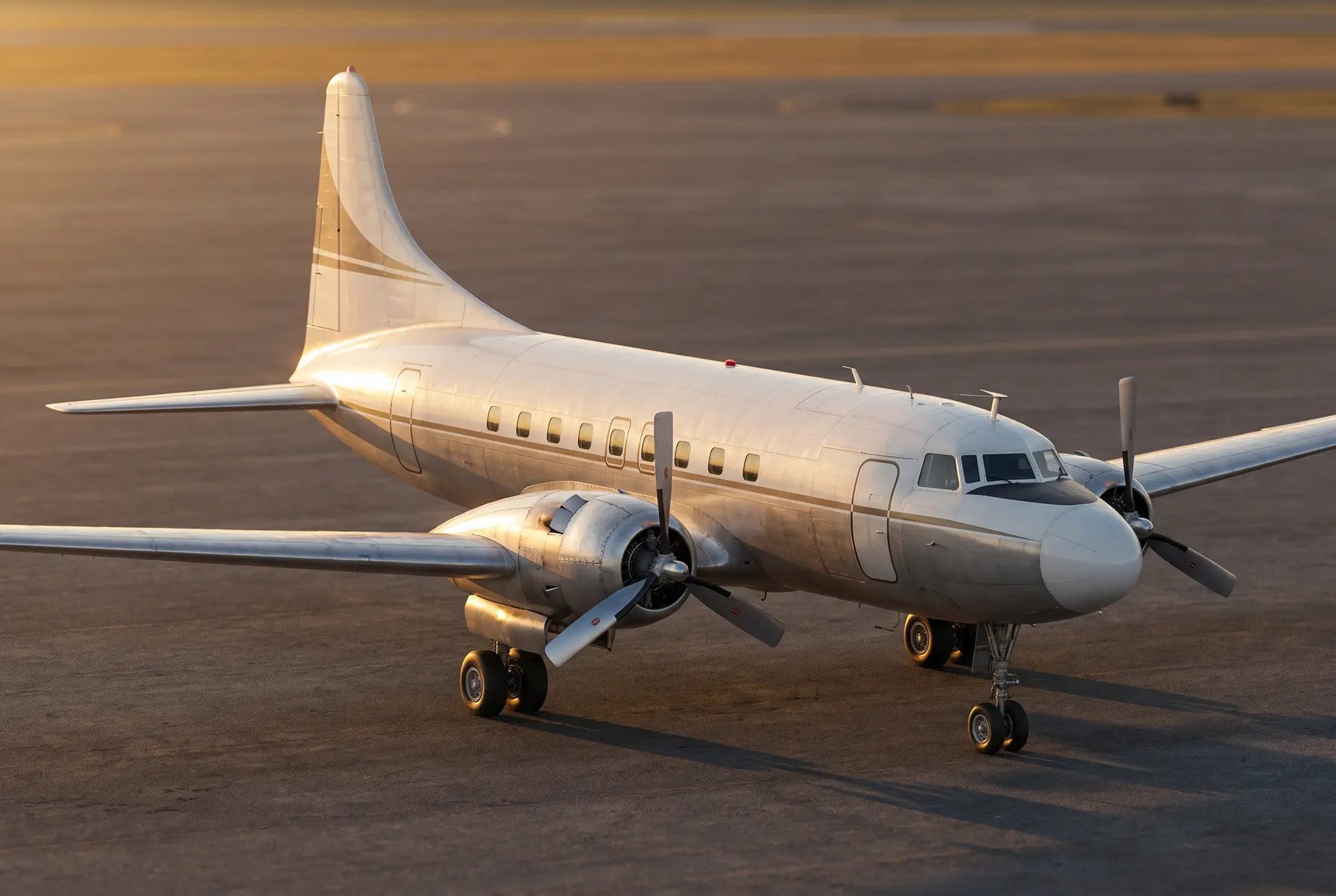
The CV-440 shares the same basic low-wing, twin-piston, pressurized layout as its predecessors, and it is dimensionally close to the CV-340. Rather than a structural redesign, it introduced targeted refinements: more streamlined engine cowlings, a revised exhaust system, significantly improved cabin soundproofing and increased operating weights that allowed more payload or fuel. Because the changes were largely aerodynamic, acoustic and equipment-related, many existing CV-340s were later brought up to CV-440 standard. Detailed engine data supporting these figures can be cross-checked against the Convair 440 Metropolitan technical profile.
The following variant identifiers summarise the features that distinguish the CV-440 from its closest sub-variants:
- Engines: two Pratt & Whitney R-2800 Double Wasp radials, with CB16 versions rated at 2,500 hp for takeoff documented on Metropolitan airframes.
- Aerodynamics: streamlined engine cowlings and a revised exhaust arrangement for reduced drag and lower external noise.
- Cabin: markedly improved soundproofing over the CV-340, with typical capacity around 52 to 54 passengers.
- Weights: increased operating weights compared with the CV-340, allowing greater payload or range.
- Performance: maximum cruise near 300 mph (about 483 km/h), service ceiling about 24,900 ft and maximum range around 1,930 miles (about 3,106 km).
The principal challenge facing the programme was not technical but commercial: the shift toward turboprops and jets shortened demand for new piston airliners. Convair answered by developing turboprop conversion programmes for existing airframes rather than re-engineering the CV-440 further. The CV-580 re-engined CV-340/440 airframes with Allison 501 turboprops, while the CV-600 and CV-640 used Rolls-Royce Dart engines. These conversions, each taking roughly 60 days, extended the Convairliner fleet's service life for decades in passenger and cargo roles, with some CV-580s still flying in the 21st century. In total, Convair built 199 CV-440s, with production running through at least 1958.

A Scandinavian Airlines System Convair CV-440 Metropolitan aircraft, named Ivar Viking, is seen flying over a coastal landscape with rugged mountainous terrain.
Convair CV-440 Metropolitan: Technical Specifications and Systems
The Convair CV-440 Metropolitan was designed as a refined, higher-weight and lower-noise development of the CV-340 within the Convair CV-240 family of twin-engine, pressurised piston airliners. Its intended mission was short- to medium-haul regional service, where the design had to balance useful payload against range while retaining the ability to operate from modest, often unpaved runways. From its predecessors it inherited the same basic airframe and pressurised fuselage, adding aerodynamic and cabin refinements plus more powerful, quieter engine installations.
Because the CV-440 targeted regional operators, the engineering trade-offs favoured robustness and field performance over outright speed. The result was an aircraft that could carry a full cabin over meaningful stage lengths, yet remain simple to maintain in the pre-turbine era. Many airframes were later converted to turboprop power (as the CV-580 and related conversions), but the CV-440 itself remained a piston-powered Metropolitan.
- Family / predecessor: Convair CV-240 family; refined derivative of the CV-340.
- Wingspan: approximately 105 ft 4 in.
- Length: about 79 ft 2 in (short nose) to roughly 82 ft 6 in with a radar nose.
- Height: 26 ft 11 in.
- Wing area: 817 sq ft.
- Maximum takeoff weight (MTOW): around 49,700 lb (CB-17 engines); about 48,000 lb with CB-16 engines.
- Maximum landing weight: about 47,650 lb.
- Passenger capacity: typically 40 to 44 seats, up to 52 in a high-density layout.
- Fuel capacity: roughly 1,730 to 1,750 US gallons.
- Cruise speed: around 220 to 250 kt TAS depending on power setting.
- Range: approximately 1,200 to 1,600 statute miles, depending on payload and reserves.
- Powerplant: two Pratt & Whitney R-2800 Double Wasp radials (CB-16 / CB-17).
- Power: about 2,400 hp per engine, rising to roughly 2,500 hp at takeoff with water injection.
- Propellers: three-blade Hamilton Standard constant-speed, full-feathering, reversible units.
Systems and handling-relevant technology
The CV-440 used conventional mechanically actuated flight controls appropriate to its era, with reversible-pitch propellers providing effective deceleration on landing and during ground handling, a valuable feature on shorter fields. Engine management relied on manual power settings, with water injection available on water-methanol-equipped engines to sustain takeoff power on hot days or at higher weights. Constant-speed, full-feathering propellers allowed the crew to feather a failed engine to reduce drag, an essential capability for safe single-engine operation on a twin.
Pressurisation and cabin refinement were central to the Convair-Liner concept, giving passengers a more comfortable ride than earlier unpressurised regional types. Operators typically flew the aircraft with a two-pilot flight deck, and maintenance practices centred on the well-understood radial engine, which supported the type's long service life with carriers across Europe and beyond, including operations documented among European regional operators.
Published performance figures for the CV-440 vary noticeably between sources, and this is expected rather than contradictory. Differences arise from operator-specific options (engine sub-variant, water injection, optional fuel tanks), cabin density and seat count, the assumed weights used for a given calculation, and atmospheric and runway assumptions. As a result, values such as cruise speed, service ceiling and range should be read as representative planning figures tied to a specific configuration, not as absolute constants.
The Pratt & Whitney R-2800 Double Wasp
The CV-440 was powered by the Pratt & Whitney R-2800 Double Wasp, an 18-cylinder, twin-row, air-cooled radial of 2,804 cubic inches (about 46 L) displacement. Pratt & Whitney, then part of the United Aircraft Corporation, began design in 1936 and first ran the engine in 1937, when it was among the most powerful aero engines in the world. Production ran from 1939 into about 1960, with total output exceeding 125,000 units, making it one of the most widely produced aircraft engines ever built.
The specific version on the CV-440 was the civil transport R-2800-CB16, with some airframes using the closely related CB-17. This CB-series Double Wasp was optimised for reliability and economy in airline service rather than combat power, with two-stage supercharging and, where fitted, water injection for short-term takeoff boost. The Smithsonian's National Air and Space Museum identifies the CB-16 as the commercial R-2800 that also powered the Convair 340, Douglas DC-6A/6B, Martin 202A and Martin 404.
Beyond the airliner world, the R-2800 earned its reputation on some of the best-known combat aircraft of the Second World War, including the Vought F4U Corsair, Grumman F6F Hellcat, Republic P-47 Thunderbolt, Northrop P-61 Black Widow and Martin B-26 Marauder. In postwar civil aviation it became a mainstay of the DC-6 and Martin 404 families, giving the type a dual legacy that spanned both military service and the rise of scheduled airline travel.
Convair CV-440 vs CV-240 vs CV-340 vs Vickers Viscount 700 Specifications Comparison
Scroll horizontally to see more →
| Parameter | Convair CV-440 | Convair CV-240 | Convair CV-340 | Vickers Viscount 700 |
|---|---|---|---|---|
| Entry into service | 1956 | 1948 | 1952 | 1953 |
| Engines | 2 × Pratt & Whitney R-2800-CB17 radial | 2 × Pratt & Whitney R-2800-CA18 radial | 2 × Pratt & Whitney R-2800 radial | 4 × Rolls-Royce Dart turboprop |
| Length | 23.25 m | 22.76 m | 23.25 m | 26.11 m |
| Wingspan | 28.65 m | 27.97 m | 28.65 m | 28.55 m |
| Height | 8.50 m | 8.20 m | 8.50 m | 8.23 m |
| Typical seating and layout (short description + approximate passengers) | Single-class: 44–52 passengers | Single-class: 40 passengers | Single-class: 44 passengers | Single-class: 53–63 passengers |
| MTOW | 21.8 t | 18.6 t | 21.3 t | 28.1 t |
| Range | 1,370 nm | 1,000 nm | 1,750 nm | 1,500 nm |
| Cruise speed | 0.45 Mach | 0.43 Mach | 0.45 Mach | 0.48 Mach |
| Service ceiling | 25,000 ft | 16,000 ft | 25,000 ft | 25,000 ft |
| Program note | Improved “Metropolitan” development of the Convair piston airliner family with higher weights, lower cabin noise and optional weather radar for regional routes | Original pressurised twin-engined Convair short-haul airliner developed as a DC-3 replacement | Stretched and higher-capacity Convair variant offering more seats and range for short- to medium-haul services | Contemporary British turboprop competitor providing higher capacity and improved efficiency on similar regional and short-haul markets |
Scroll horizontally to see more →
The table compares four classic regional airliners by service entry, dimensions, engines, capacity, and performance. The CV-440 is an improved piston Convair with higher MTOW than the CV-240 and similar size to the CV-340, while the CV-340 offers the longest range. The Viscount 700 stands out with four Dart turboprops, the highest seating and MTOW, and the fastest cruise among the group.
Convair CV-440 Operations, Routes and Airlines Worldwide
The Convair CV-440 Metropolitan was conceived as a pressurised replacement for the Douglas DC-3, built for short and medium regional sectors rather than long-haul work. In everyday airline service its practical range sat in the 900 to 1,200 mile band (roughly 1,450 to 1,900 km), while lightly loaded, high-fuel configurations could stretch toward a maximum of about 1,930 miles (3,100 km). Cruise speed was typically 240 to 250 knots (around 275 to 290 mph, or 440 to 465 km/h), figures documented by the This Day in Aviation record for the type.
Most legs flown were short, commonly 200 to 500 nautical miles (about 370 to 930 km), linking smaller cities to national and international gateways. This suited hub-and-spoke feeder networks as well as point-to-point regional services out of secondary and regional airports. With quick 30 to 60 minute turnarounds typical of piston airliners of the 1950s and 1960s, aircraft could realistically fly several sectors a day in intensive regional rotations.
The main operational challenge was the powerplant. The two Pratt & Whitney R-2800 Double Wasp radial engines, rated up to about 2,500 hp for take-off, demanded frequent overhauls and careful management of cooling, ignition and water injection systems. Rising fuel costs, cabin noise and vibration, and modest climb performance compared with newer turboprops led many airframes to be converted into the turboprop CV-580 and CV-640, as summarised by Wikipedia's Convair 240 family overview.
Where the Convair CV-440 operates
The type was most heavily used across Europe and North & South America, with a lighter footprint in Asia and Africa. In Europe, flag carriers deployed it on intra-continental feeder and trunk services connecting capitals and regional cities. In North & South America, it served dense domestic and regional networks, feeding jets at major hubs and reaching communities previously served by the DC-3. In Asia and Africa, the aircraft appeared mainly through second-hand and charter operations on short domestic and near-regional routes, though named passenger operators are sparsely documented for those regions.
- Europe: SAS Scandinavian Airlines flew it on intra-European services; Swissair, Iberia, Sabena and Finnair are all documented primary users, operating the Metropolitan on domestic and short international sectors, while Lufthansa and KLM employed the Convair family as a modern DC-3 replacement.
- North & South America: Eastern Air Lines ordered around twenty aircraft; Delta Air Lines operated the type from 1956 to 1970 with 52-seat cabins, as recorded by the Delta Flight Museum. Allegheny Airlines and North Central Airlines ran extensive regional feeder networks, and in South America the Bolivian Air Force (TAM) used a CV-440 in civil transport service.
- Asia: presence was modest, largely through charter and secondary carriers flying second-hand aircraft on short domestic legs; specific named operators are not reliably documented in authoritative sources.
- Africa: usage came mainly via second-hand Convair 340/440 airframes and later turboprop conversions on domestic and near-regional routes, though individual passenger airlines are not clearly recorded.
Typical seating and cabin layouts
The cabin was a single-aisle, four-abreast layout with 2+2 seating on either side of the aisle. Standard configurations ranged from 44 to 52 passengers, the upper figure achieved by removing the forward carry-on compartment to add two rows, giving 13 rows at about 81 cm pitch. High-density arrangements documented by Aircraft Investigation reached up to roughly 60 seats through tighter pitch. Mainline carriers such as Delta and the European flag airlines favoured comfortable 44 to 52 seat cabins with improved soundproofing, whereas regional and leisure operators tended to maximise density or, late in the aircraft's life, reconfigure airframes as executive transports. Readers comparing the CV-440 with modern regional turboprops may also find the BAe Jetstream 32 a useful point of reference for how regional cabins evolved.
This video presents a 1955 promotional film featuring the Convair CV-440 Metropolitan, showcasing its design and passenger experience. Shared by GDS Creations for educational, non-commercial viewing.
Convair CV-440 Safety Record and How Safe Is the Aircraft?
The Convair CV-440 Metropolitan was the final piston-engined member of the Convair 240/340/440 family and entered airline service in 1956, initially with Continental Airlines. Roughly 180 to 199 examples were built, and the type saw decades of use with airlines, charter operators and cargo carriers, with some airframes still flying into the 1980s. When its accident history is weighed against that long service life, the large number of operators and the cumulative flight cycles across the whole Convairliner series, the CV-440 reflects the typical safety pattern of postwar piston transports rather than any single dominant failure mode. Recorded events cluster around runway excursions, engine-related problems, weather and approach-and-landing accidents, which were common across pressurised piston airliners of its generation. Comprehensive type-wide totals should be treated cautiously, and the Aviation Safety Network is the most consistent public database tracking individual CV-440 occurrences.
Notable accidents and serious incidents
A small number of documented events illustrate the risk profile of the aircraft and its closest sub-variants.
- Lufthansa, 1966 (Bremen). A CV-440 operating as flight LH005 overshot on approach and stalled during a missed-approach sequence, with cited contributing factors including possible instrument or flight-director issues, misjudgment of height after transition to visual references, and marginal stall-recovery margins at low altitude. The event reinforced the wider industry emphasis on stabilised approach criteria, reliable instrument guidance and disciplined missed-approach and stall-recovery training. A summary is catalogued by the Bureau of Aircraft Accidents Archives.
- Convair CV-440, 1983 (registration N30DR). Listed in recognised safety databases as a recorded accident, though publicly available summaries do not detail the operator or primary factors, so no cause is asserted here.
- Combs Airways, 1984 (Pierre, South Dakota). A CV-440-62 Metropolitan is recorded with a linked final investigation report in the safety databases, again without a widely published causal summary suitable for restating here.
Where causal detail is limited, the responsible approach is to note only what authoritative sources confirm rather than to infer specific design changes that were not formally documented.
How safe is the Convair CV-440?
Judged against its traffic volume, service years and fleet size, the CV-440 performed as a competent and commercially successful design for its era, though its piston-airliner architecture predates many later safety advances such as modern terrain-awareness systems and turbine reliability. Its safety in service depended heavily on crew discipline, standard operating procedures, well-executed approaches and the regulatory oversight of certifying authorities. Understanding these limits alongside the transition to later designs is useful context, and readers comparing generations can review a jet-era counterpart such as the Fokker F28-1000. Broader statistics from bodies such as the International Civil Aviation Organization and analyses by the Flight Safety Foundation confirm that, across the industry as a whole, commercial aviation remains one of the safest modes of transport.
01 What kind of routes and mission profile did the Convair CV-440 typically fly?
The Convair CV-440 was designed primarily for short- to medium-haul regional routes, often replacing older aircraft like the DC-3 on sectors of roughly 300 to 1,500 km. With a published range around 2,600 km in passenger configuration, it could comfortably handle domestic trunk routes and shorter international legs without refuelling. Airlines used the CV-440 for high-frequency services between major cities and secondary airports, where its twin-piston engines and relatively high cruise speed made it well suited to dense, short sectors. Its performance and size also allowed operations from relatively modest runways, making it practical for regional and feeder networks.
02 How comfortable and quiet was the cabin on the Convair CV-440?
The Convair CV-440 was a refinement of the earlier Convair 340, with specific improvements aimed at reducing cabin noise and improving the passenger environment. It featured a pressurised cabin, which was a significant comfort upgrade over many of the unpressurised aircraft it replaced, allowing smoother flights at higher altitudes. Typical layouts carried around 44 to 52 passengers, giving a relatively spacious cabin compared with some later high-density regional jets. Noise levels were still noticeably higher than modern turbofan aircraft due to the large radial piston engines, but the CV-440 was regarded as quieter and more pleasant than many contemporaries in its class.
03 Which airlines operated the Convair CV-440 and on what kinds of services?
The Convair CV-440, also known as the Metropolitan, was widely used by North American and international carriers on regional and short- to medium-haul services. Operators included airlines such as Delta, which used the type in the late 1950s and 1960s to link major hubs with smaller cities before its fleet became all-jet. In South America, carriers like REAL Transportes Aéreos in Brazil took delivery of CV-440s for domestic and regional routes. Many aircraft were later converted to turboprop variants (such as CV-580 or CV-640) and continued flying for cargo operators and niche passenger airlines, extending the operational life of the basic CV-440 airframe.
04 How does the performance and efficiency of the Convair CV-440 compare with similar aircraft?
The Convair CV-440 used two Pratt & Whitney R-2800 radial piston engines rated around 2,400 to 2,500 hp, giving it a normal cruise speed in the region of 450–465 km/h and a maximum speed of about 500–540 km/h, which was competitive for piston airliners of its era. Its range of about 2,600 km with maximum fuel placed it solidly in the regional airliner category, comparable to contemporary types like the Martin 404 and later early turboprops, but with slightly higher fuel consumption typical of large piston engines. The CV-440’s refinements over the CV-340 focused on higher speed, improved cabin noise, and increased operating weights rather than radical efficiency gains. When converted to turboprop variants such as the CV-580, the underlying airframe benefited from better fuel economy and longer range while retaining the robust structure of the original CV-440.
05 What is known about the safety record and design features of the Convair CV-440?
The Convair CV-440 comes from the Convairliner family, which was built in large numbers and developed a reputation for solid, conventional engineering with few radical design features. Its robust twin-engine layout, pressurised fuselage, and relatively simple systems reflected post-war design priorities focused on reliability and incremental improvements over earlier airliners. Over decades of service, the type experienced incidents typical for piston transports of its era, but it was not associated with a unique systemic safety issue in its design. Many airframes were trusted enough to be converted for specialised roles, including cargo transport and testbed aircraft for avionics and weapons systems, which suggests confidence in the underlying structure and flight characteristics.
06 What should a passenger know about the in-flight experience on a Convair CV-440, such as seats, windows, and ride in turbulence?
A typical Convair CV-440 cabin had a single-aisle layout with 2–2 seating, giving most passengers either a window or aisle seat and relatively generous legroom by regional standards of the time. The pressurised cabin allowed flights at higher altitudes, which helped reduce low-level turbulence exposure compared with older, unpressurised aircraft that had to fly lower. Large round windows and the wing position offered good views outside, although seats close to the engines and propellers experienced more noise and vibration. In turbulence, the CV-440’s relatively heavy, sturdy airframe tended to give a firm, slightly “solid” ride, and travellers seeking a quieter experience usually preferred seats forward of the wing, away from the propeller discs and engine nacelles.