

Bombardier Dash 8 Q300 programme history and variant development
The Bombardier Dash 8 Q300 sits at a key point in the Dash 8 family: it combines the stretched Series 300 airframe, intended to carry more passengers than the original short fuselage variants, with the cabin comfort improvements associated with Bombardier’s “Q” branding. In practical terms, the Q300 is best understood as a Dash 8 Series 300 configured and marketed around a quieter cabin standard, while retaining the aircraft’s core regional turboprop identity: short sector capability, efficient fuel burn at regional speeds, and robust performance for high frequency airline schedules.
Program origins and creation of the Series 300 airframe
Within the Dash 8 programme, the Series 300 was developed to provide a higher capacity derivative than the Series 100, while keeping common design principles and systems philosophy across the family. In certification terms, the European Aviation Safety Agency type certificate data sheet for the DHC 8 family captures the Series 300 as a dedicated section, with a 9 September 1988 reference application date for EASA certification and multiple approved Series 300 models under the same framework, reflecting the maturity of the baseline design and the structured evolution of the variant family (EASA Type Certificate Data Sheet EASA.IM.A.191).
The Series 300 development path is often described as the “stretch” step in the Dash 8 line, positioned between the smaller early models and the later higher capacity Series 400. The key point for the Q300 history is that the quiet cabin designation arrived after the Series 300 airframe and its early certified configurations were already established in airline operations.
Key milestones: first flight, certification, and entry into service
The Dash 8 Series 300’s prototype first flight is recorded as 15 May 1987, with entry into service noted as 27 February 1989 in the Flight Safety Foundation Aviation Safety Network type entry for the DHC 8 300 family. These dates frame the Series 300 as an established in service platform before the later “Q” marketing emphasis became widespread.
On the certification side, the EASA type certificate data sheet lists the Transport Canada Civil Aviation certification date for the initial Series 300 model DHC 8 301 as 14 February 1989. It also records subsequent Series 300 model approvals as 31 July 1990 (DHC 8 311), 20 February 1992 (DHC 8 314), and 2 June 1995 (DHC 8 315) (EASA Type Certificate Data Sheet EASA.IM.A.191). This sequence matters for understanding the Q300 label: it emerged on top of a Series 300 line that had already progressed through several certified sub variants and engine ratings.
Incremental upgrades that shaped the platform used for the Q300
From a systems and performance perspective, the Series 300 baseline approved by EASA includes key operational and configuration data that helps define what a Q300 is built upon. For engines, the EASA type certificate data sheet lists the Series 300 engine combinations as PW123 with optional PW123B and PW123E for the DHC 8 301 and DHC 8 311, while the DHC 8 314 is associated with PW123B and the DHC 8 315 with PW123E (EASA Type Certificate Data Sheet EASA.IM.A.191). This provides a straightforward way to track the Series 300 development arc: later certified models align with later PW123 family ratings.
The same type certificate data sheet also captures operational limitations and configuration options relevant to how the aircraft was positioned in service. For example, the Series 300 section includes a maximum operating altitude of 25,000 ft and all weather capability listed as Cat II, as well as defined maximum weight sets (including a basic maximum take off weight of 18,643 kg, and higher weight schedules for certain configurations) (EASA Type Certificate Data Sheet EASA.IM.A.191). It also records fuel capacity figures for the main fuel system and an optional auxiliary fuel system, reinforcing that the Series 300 platform supported multiple mission profiles within a common approval basis.
Alongside airframe and engine development, the Q300 story includes a cabin comfort thread. By the mid 1990s, Bombardier began delivering aircraft promoted for a quieter cabin standard, with FlightGlobal reporting Bombardier deliveries of the first “quiet cabin” Dash 8Q in 1996 (FlightGlobal, 29 May 1996). A subsequent FlightGlobal report shows airline ordering language explicitly referencing the “Dash 8Q Series 300” in 1997, indicating that the quiet cabin positioning had become a clear market identifier for Series 300 customers (FlightGlobal, 15 November 1997).
The manufacturer identity is also part of the variant’s development context. While the Dash 8 line originated with De Havilland Canada, the EASA type certificate data sheet identifies De Havilland Aircraft of Canada Limited as the type certificate holder for the DHC 8 family in its current form (EASA Type Certificate Data Sheet EASA.IM.A.191). At the commercial brand level, the Q300 name reflects the period when Bombardier marketed and supported the aircraft as part of the Q series, a lineage that later transferred when Bombardier confirmed the closing of the sale of the Q Series aircraft programme to Longview in 2019 (Bombardier press release via GlobeNewswire, 3 June 2019).
Operationally, the Bombardier Dash 8 Q300 is designed for regional stage lengths rather than the extreme end of endurance flying. For context on what “long range” means at the opposite end of airline operations, see the internal overview of ultra long haul flight complexity at the world’s longest flights and ultra long haul operations.
What differentiates the Bombardier Dash 8 Q300 from nearby variants
The Bombardier Dash 8 Q300 is most accurately positioned as a Series 300 aircraft aligned with the “Q” quiet cabin marketing and delivery standard, rather than as a fundamentally new airframe series. The closest comparisons are therefore within the Dash 8 family: the earlier Series 300 aircraft delivered before the Q branding became common, the smaller Series 200, and the later higher capacity Series 400. Compared with Series 200 aircraft, the Series 300 family sits on a separate certification track in the EASA type certificate data sheet, with distinct model approvals and different weight and configuration sets; the Series 200 models DHC 8 201 and DHC 8 202 show Transport Canada certification dates in 1995, underscoring that Series 200 and Series 300 were developed in parallel but targeted different capacity and performance points (EASA Type Certificate Data Sheet EASA.IM.A.191). Compared with the Series 400, the Q300 remains closer to the classic Dash 8 concept: lower maximum weights, a lower maximum operating altitude, and the PW123 family rather than the higher power engine class used by the largest variant.
Variant identifiers for the Bombardier Dash 8 Q300, based on the certified Series 300 configuration baseline, include:
- Series family: DHC 8 Series 300 certification basis covering models 301, 311, 314, and 315 (EASA Type Certificate Data Sheet EASA.IM.A.191)
- Engine family: Pratt and Whitney Canada PW123 family, including PW123, PW123B, and PW123E depending on approved model and configuration (EASA Type Certificate Data Sheet EASA.IM.A.191)
- Operational ceiling: maximum operating altitude 25,000 ft in the Series 300 section (EASA Type Certificate Data Sheet EASA.IM.A.191)
- Approach capability: all weather capability listed as Cat II for Series 300 (EASA Type Certificate Data Sheet EASA.IM.A.191)
- Weight framework: certified maximum take off weight sets including 18,643 kg basic and higher weight schedules for defined configurations (EASA Type Certificate Data Sheet EASA.IM.A.191)

A Widerøe Bombardier DHC-8-402Q aircraft with registration LN-WDR is shown in mid-flight on approach for landing at Hamburg Airport under a partly cloudy sky.
Bombardier Dash 8 Q300 technical specs, certified limits, systems and engines
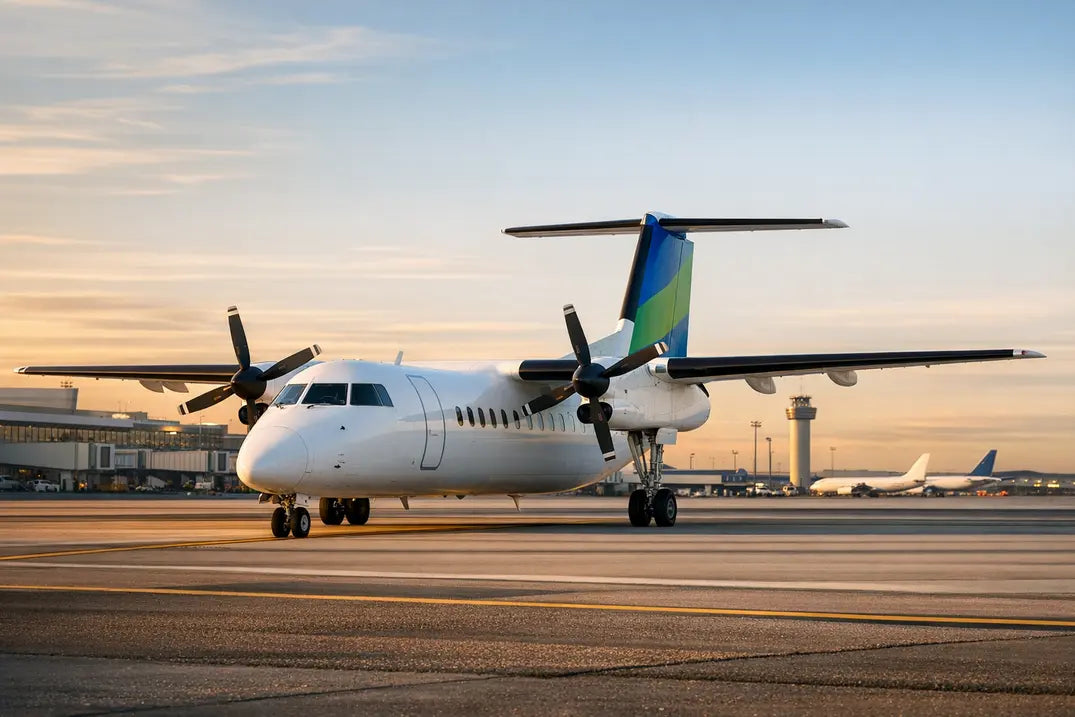
The Bombardier Dash 8 Q300 (often grouped under the Dash 8 Series 300 family) sits in the classic 50 seat turboprop segment, where runway performance, block fuel efficiency, and robust regional dispatch tend to matter more than jetlike cruise speed. Its high wing and T tail layout supports ground clearance for propellers and simplifies operations at smaller airports, while keeping a relatively compact airframe footprint for apron and stand compatibility.
Technically, the Q300 inherits the Dash 8 family approach: straightforward certified limits, multiple engine ratings within the PW100 series, and a systems philosophy designed around predictable handling and repeatable performance. For regulatory level dimensions, weights, fuel capacities, and operating speeds, the most dependable public references are the aircraft and engine type certificate data sheets published by EASA.
- Type certificated Series 300 models covered: DHC 8 301, DHC 8 311, DHC 8 314, DHC 8 315 (see EASA Type Certificate Data Sheet EASA.IM.A.191).
- Wingspan: 27.43 m.
- Length: 25.68 m.
- Height: 7.49 m.
- Wing area: 56.1 m².
- Maximum passenger seating capacity: 56 passengers.
- Maximum operating altitude: 7,620 m (25,000 ft) pressure altitude.
- All weather capability (certification statement): Category II.
- Maximum operating speed VMO (IAS schedule): 243 kt from 0 ft to 17,000 ft, 232 kt at 20,000 ft, 214 kt at 25,000 ft.
- Flap limit speeds VFE (DHC 8 301): flap 5 degrees 160 kt, flap 10 degrees and 15 degrees 149 kt, flap 35 degrees 127 kt.
- Flap limit speeds VFE (DHC 8 311, 314, 315): flap 5 degrees 163 kt, flap 10 degrees 154 kt, flap 15 degrees 150 kt, flap 35 degrees 138 kt.
- Main fuel system capacity: usable 2,575 kg and 3,160 L; total 2,615 kg and 3,208 L.
- Optional auxiliary fuel system capacity: usable 2,072 kg and 2,543 L; total 2,118 kg and 2,598 L.
- Oil capacity per engine: usable 8.0 L; total 19.3 L.
- Maximum weights (baseline set): taxi and ramp 18,734 kg; takeoff 18,643 kg; landing 18,144 kg; zero fuel 16,874 kg.
- Maximum weights (higher set, configuration dependent): taxi and ramp up to 19,595 kg; takeoff up to 19,505 kg; landing up to 19,051 kg; zero fuel up to 17,917 kg.
- Propeller system (Series 300): Hamilton Sundstrand models 14SF 15 and 14SF 23 are listed, with nominal diameter 3.96 m.
Systems and handling relevant technology
From a handling perspective, the published certified limits are the first anchor point for pilots and performance engineers. The Series 300 VMO schedule in indicated airspeed reduces with altitude, and the flap limit speeds differ between the DHC 8 301 and the DHC 8 311, 314, and 315, so variant and configuration identification matters when cross checking QRH limits or building speed cards. Category II capability is stated in the type certificate data, but operational Category II authorisation remains operator specific and depends on the aircraft equipment standard, crew training, and the regulator approval pathway.
Fuel system planning also depends on configuration. The main fuel system usable quantity is published alongside an optional auxiliary fuel system, which is why range and endurance claims for the Bombardier Dash 8 Q300 can differ substantially between operators. When flying in adverse conditions, the practical consequence is that crews and dispatch typically balance alternate planning, holding margin, and contamination or deicing penalties against available tankage and weight limits, a topic expanded in this guide on extreme weather preparation and procedures.
At the propulsion system level, the PW100 series architecture used on the Q300 is documented as an electronically controlled turboprop with a hydro mechanical backup mode, which frames how power is set and protected. In practical terms, that design intent is to give repeatable power scheduling while maintaining a fallback path for continued safe operation if the electronic channel is degraded, as described in the EASA engine Type Certificate Data Sheet for PW100 series engines.
Published performance numbers vary because the Dash 8 Q300 fleet spans multiple certified sub models and equipment configurations, with different maximum weights and optional auxiliary tanks. Operator choices such as cabin density, galley and service equipment, and installed avionics can move operating empty mass and payload. Finally, handbook performance depends on the assumptions behind the data (pressure altitude, temperature, runway slope, wind component, and runway surface condition), so comparable takeoff or climb figures require matching the same set of conditions and the same aircraft configuration.
Engines and powerplant options on the Bombardier Dash 8 Q300
The Bombardier Dash 8 Q300 is powered by Pratt and Whitney Canada engines from the PW100 family. Within the Series 300 models, the type certificate lists the following engine allocations and options: DHC 8 301 and DHC 8 311 with PW123 as the original engine and PW123B or PW123E as optional engines; DHC 8 314 with PW123B; and DHC 8 315 with PW123E. This matters for operators because ratings, temperature capability, and available power margins differ by engine model, even when the aircraft looks identical from the ramp.
In the PW100 series engine type certificate data, the rated sea level shaft power values are published in kilowatts. For the Q300 relevant engines, the maximum takeoff ratings include PW123 at 1,775 kW, PW123B at 1,865 kW, and PW123E at 1,775 kW. The same table also shows their associated normal takeoff and maximum continuous ratings, which is useful when comparing climb performance expectations or assessing power limited departures under hot conditions. The same document describes the PW100 series as a three spool turbomachine including a free turbine with a reduction gearbox, and notes electronic control via a single channel Electronic Engine Control unit with a hydro mechanical backup.
Historically, the PW100 family became a benchmark regional turboprop engine line, with many certified variants to match different airframes and mission profiles. Pratt and Whitney Canada marked the family’s 40 year milestone in 2024, noting a large installed base and wide operational footprint across regional, utility, and specialised roles (PW100 family anniversary release). Beyond the Dash 8 line, PW100 variants are also associated with aircraft such as ATR turboprops and the Airbus C295, illustrating how the same core engine family concept is adapted through different ratings and installations rather than a one size fits all approach.
Comparison of Regional Turboprop Aircraft: Dash 8 Q300 vs Competitors
Scroll horizontally to see more →
| Parameter | Bombardier Dash 8 Q300 | Dash 8 Q200 | Dash 8 Q400 | ATR 72-600 |
|---|---|---|---|---|
| Entry into service | 1999 | 1995 | 2004 | 2011 |
| Engines | 2 × PW123 (2,380 shp) | 2 × PW123 (2,150 shp) | 2 × PW150A (5,071 shp) | 2 × PW127M (2,400 shp) |
| Length | 25.7 m | 25.4 m | 32.8 m | 27.2 m |
| Wingspan | 27.4 m | 23.7 m | 28.4 m | 27.1 m |
| Height | 7.5 m | 7.8 m | 8.5 m | 7.7 m |
| Typical seating and layout | 1-class: 50-56 passengers | 1-class: 37-40 passengers | 1-class: 68-78 passengers | 1-class: 68-78 passengers |
| MTOW | 19.5 t | 16.5 t | 30.5 t | 23.0 t |
| Range | 1,100 nm | 900 nm | 1,500 nm | 1,500 nm |
| Cruise speed | 0.55 Mach | 0.55 Mach | 0.65 Mach | 0.56 Mach |
| Service ceiling | 25,000 ft | 25,000 ft | 27,000 ft | 25,000 ft |
| Program note | Mid-size Q-Series regional turboprop for 50 pax short routes | Short-fuselage baseline model, fewer passengers | Stretched high-speed flagship, 70+ pax capacity | Main competitor, similar size/capacity modern design |
Scroll horizontally to see more →
This table compares the Bombardier Dash 8 Q300 with the Dash 8 Q200, Q400, and ATR 72-600 across key specifications. The Q300 offers a balanced combination of size, performance, and capacity for short routes. The Q400 stands out with the highest speed, range, and passenger capacity. Meanwhile, the ATR 72-600 offers similar capacity to the Q400 with a lighter MTOW. The Q200 is the smallest and least powerful among the four.
Bombardier Dash 8 Q300 operations: routes, missions and airlines
Bombardier Dash 8 Q300 operations sit in the high frequency regional niche: short stage lengths, multiple daily cycles, and airports where runway length, terrain, weather, or passenger demand make larger jets inefficient. The type is widely used as a 50 seat turboprop for domestic and near regional networks, but it is also common in combi and cargo roles where payload flexibility matters more than cabin comfort.
Typical missions range from very short hops to longer domestic sectors. Air New Zealand explicitly treats Q300 flying as very short haul in parts of its onboard service design: on ATR72 and Q300 flights under 45 minutes, water only is offered. In the same airline’s published fleet statistics, the Bombardier Q300 is shown with an average daily utilisation of 7:12 hours and a cruising speed of 520 km/h, which helps explain how operators build a full day out of several short legs rather than one long sector.
Network design is usually either hub and spoke (feeding a mainline hub or regional jet bank) or thin point to point links between secondary cities. In Norway, Widerøe describes its Dash 8 300 as a 50 seat aircraft usually used on services between Bergen and cities such as Molde, Haugesund, Stavanger and Kristiansund, a classic example of medium density trunk regional flying where frequency matters. In Papua New Guinea, Air Niugini’s subsidiary Link PNG has used Dash 8 315 aircraft with 50 seats and long range fuel tanks to support longer sectors and to keep connectivity during runway upgrade periods at multiple airports.
Operational environments vary, but the recurring theme is runway access and robustness. In northern Canada, Air Inuit operates a Dash 8 Combi 300 configured with 45 seats and an enlarged aft cargo compartment, designed to balance passengers and freight while operating on 3,500 foot paved or gravel runways. In island networks, the Q300 is attractive where sectors are frequent and alternates can be limited, but dispatch reliability becomes a primary driver of fleet planning: Maldivian has worked with De Havilland on maintenance interval extensions and structural inspection requirements for its Dash 8 200 and 300 fleet, reflecting the realities of operating older turboprops in a geographically dispersed archipelago.
Challenges for operators are rarely about basic capability and more about economics and sustainment. Many Bombardier Dash 8 Q300 fleets are mature, so planning must account for structural fatigue driven by high cycle usage, parts availability, and the downtime impact of heavy checks. Performance wise, the aircraft can be well suited to short runway airports, but payload and takeoff performance planning remain central on hot days, at high elevation, or on contaminated runways. For readers who want a quick reminder on correct aviation English around departure and performance briefings, the spelling and meaning of takeoff versus take off is worth getting right in operational documentation and training materials.
Where the aircraft operates
The Bombardier Dash 8 Q300 is used across Europe, North and South America, Asia, and Africa, mostly on domestic and near regional schedules where 50 seats and turboprop economics fit thin demand. In Europe, it is associated with short to medium domestic links into larger hubs and regional capitals, often on challenging weather days and into smaller airports. In North and South America, it appears in remote community operations and in mixed passenger and cargo missions where airport infrastructure and freight demand shape the cabin. In Asia, including Asia Pacific island geographies, it is frequently a backbone aircraft for domestic connectivity across water and rugged terrain, while in Africa it is used both by national carriers and by regional airlines serving business, government, and tourism flows on short to medium sectors.
Across all regions, airline economics tend to favour high utilisation through frequent rotations, with maintenance planning built around high cycles rather than long cruise time. The result is a mission profile that can look repetitive in timetable terms but demanding in operational terms, because the aircraft is repeatedly exposed to turnarounds, weather variability, and infrastructure constraints.
- Europe: Widerøe uses the Dash 8 300 as a 50 seat aircraft on domestic links in Norway, including services between Bergen and cities such as Molde, Haugesund, Stavanger and Kristiansund, reflecting frequent regional connectivity rather than long haul stage lengths.
- North & South America: Air Inuit uses Dash 8 300 variants in combi and cargo oriented configurations to connect remote communities, balancing passengers with freight and baggage where supply chains depend on air transport and runways can be relatively short and sometimes unpaved.
- Asia: Air New Zealand uses the de Havilland Q300 extensively within New Zealand’s domestic and regional network with a 50 seat configuration; Maldivian operates Dash 8 200 and 300 aircraft across the Maldives for domestic connectivity and has entered OEM support agreements to sustain performance and maintenance planning; Link PNG (Air Niugini subsidiary) has operated 50 seat Dash 8 315 aircraft and reports using long range tanks to support longer sectors and operational resilience during airport works.
- Africa: Air Tanzania lists one Dash 8 Q300 within a mixed fleet supporting domestic and international connectivity from Dar es Salaam; CemAir operates the Q300 as a 50 passenger turboprop for regional services; Kenya based operators such as Renegade Air and Skyward Airlines list Dash 8 300 aircraft in their fleets for short haul scheduled and charter operations.
Typical seating and cabin layouts
Most passenger focused Bombardier Dash 8 Q300 cabins are single class and built around 50 seats in a four abreast layout. A clear example is Air New Zealand’s published seat map for the de Havilland Q300 showing 50 seats and a stated seat pitch of 30 to 33 inches (78 to 86 cm) in Economy, consistent with a practical regional product rather than a premium heavy layout. Widerøe also describes its Dash 8 300 as a 50 seat aircraft, aligning with typical European regional seating expectations where fast boarding and reliable turnaround are prioritised over added cabin complexity. For mixed mission operators, seating can be reduced to create cargo space: Air Inuit’s Dash 8 Combi 300 is presented with a 45 seat configuration to expand the aft cargo hold, a common approach in northern and island operations where cargo revenue and community logistics are as important as passenger numbers.
Seat maps and fleet pages can also reveal service design choices driven by sector length. Air New Zealand’s own domestic service guidance explicitly treats many Q300 flights as very short duration, which helps explain why onboard product features are kept simple and why turnaround reliability is central to the overall customer experience. Relevant references include Air New Zealand’s Q300 seat map page at airnewzealand.com and Air Inuit’s Dash 8 Combi 300 fleet page at airinuit.com.
This video presents a flight report on the QantasLink Bombardier Dash 8 Q300, covering the journey from Port Macquarie to Sydney and highlighting the onboard experience aboard this regional turboprop aircraft.
Bombardier Dash 8 Q300 safety record and overall safety assessment
The Bombardier Dash 8 Q300 is the quiet cabin variant of the Dash 8 300 series, a twin engine regional turboprop designed for short sector operations where weather, terrain, runway length, and high daily utilisation are part of normal service. In safety terms, that operating environment matters: a Dash 8 Q300 typically flies many cycles per airframe, often into smaller airports, which increases exposure to the most challenging phases of flight, takeoff and landing. As with any aircraft type, the safety record should be interpreted against decades of service, a fleet that has operated worldwide, and a regulatory framework built around continuous airworthiness, mandatory maintenance programmes, and recurring crew training.
For context on utilisation and life limits, the Dash 8 300 structure was originally designed around a high cycle regional mission, and Bombardier and Chorus Aviation launched an Extended Service Program intended to extend the Dash 8 300 service life to 120000 flight cycles from the original 80000 flight cycles. In practical terms, that focus on cycles reflects how these aircraft are used, and it also drives how safety is managed: inspection intervals, structural fatigue monitoring, and component replacement schedules become central to keeping older airframes safe and compliant. Details of the life extension concept and implementation approach are described in Bombardier and Chorus communications and related materials. Chorus Aviation release on the Dash 8 300 Extended Service Program.
On the fleet side, Bombardier programme reporting has historically separated Dash 8 production into series, with the Series 300 accounting for hundreds of delivered aircraft. This matters for safety record interpretation because a type with long service, multiple operators, and high utilisation will inevitably accumulate incidents, many of which are minor, maintenance related, or occur on the ground. The more meaningful question is whether those events reveal systemic design issues or whether they are dominated by operational factors such as stabilised approach discipline, runway incursion prevention, maintenance quality, and organisational safety culture. A helpful reference point for production and delivery totals is the Bombardier Q Series programme status reporting. Bombardier Q Series programme status report (archived).
Major accidents and serious incidents involving the Dash 8 300 series
Because the Bombardier Dash 8 Q300 is part of the Dash 8 300 series family, the most relevant safety learnings come from occurrences involving the 300 series variants used in comparable airline and government operations. The events below are selected because they are well documented, illustrate recurring risk areas in regional flying, and show how systems, procedures, and oversight evolve after an occurrence.
- Contact Air for Lufthansa CityLine, 1993, approach accident near Paris Charles de Gaulle: A Dash 8 300 series aircraft crashed short of the runway during approach following air traffic control changes that required repositioning for a different runway in very poor visibility. The core safety themes are familiar across commercial aviation: managing late changes, maintaining a stabilised approach, and executing a timely go around when approach path or energy state becomes unsafe. Subsequent industry emphasis in this area has centred on stricter stabilised approach criteria, clearer go around decision making, and crew resource management that prioritises monitoring and callouts when workload rises. BEA preliminary report (archived).
- Japan Coast Guard, 2024, runway collision at Tokyo Haneda: A Dash 8 Q300 operated in a government mission role was involved in a runway collision with an Airbus A350 during night operations. Investigative material highlighted runway incursion risk, including the importance of unambiguous clearances, effective monitoring, and reliable runway stop bar and alerting defences. After the accident, Japanese authorities and industry discussions focused on strengthening runway incursion prevention layers, including operational monitoring in the tower and improvements to procedures intended to reduce the chance of misunderstanding. JTSB progress report and FlightGlobal summary of post accident procedural changes.
- United Express operated by Air Wisconsin, 1993, wheel separation after takeoff: A Dash 8 300 series aircraft experienced a serious incident in which a main wheel detached shortly after liftoff. Investigation information pointed to mechanical failure associated with bearing condition and contamination issues. The safety learning is primarily in maintenance reliability and inspection discipline: wheel bearing servicing, contamination control, and robust defect reporting are key defences for high cycle aircraft that accumulate many takeoffs and landings. Aviation Safety Network entry referencing the completed NTSB investigation.
- Air BC, 1997, loss of separation after departure from Vancouver: A Dash 8 300 series aircraft and a Beechcraft 1900D experienced a loss of separation shortly after takeoff due to an unexpectedly high overtake situation, driven by aircraft performance differences, limited controller familiarity with the following type, and insufficient time for the departure controller to recognise and react. Safety action included local operational letters to adjust spacing practices, operator guidance on climb speed when following a Dash 8, and improvements to reporting systems to capture repeat patterns before they lead to more serious outcomes. TSB Aviation Investigation Report A97P0135.
How safe is the Bombardier Dash 8 Q300
The Bombardier Dash 8 Q300 is generally considered a safe aircraft when operated within approved limitations, maintained in accordance with an approved programme, and flown under disciplined airline standard operating procedures. Its safety is not based on any single feature, but on layered defences that are common to modern commercial aviation: certified systems redundancy, robust structural margins for repeated short sector use, well defined performance procedures, and regulatory oversight that drives mandatory inspections, service bulletins, airworthiness directives, and recurrent training.
It is also important to keep risk perception aligned with exposure. Commercial aviation operates at enormous scale, and even a small number of accidents can dominate headlines while still representing a very low rate when compared with total flights. For example, IATA’s 2024 Annual Safety Report describes an all accident rate of 1.13 per million flights and notes that 2024 included 40.6 million flights. That statistical context helps explain why a type like the Dash 8 Q300, operating for decades across many airlines and missions, can have a list of occurrences while still being part of an industry where accidents remain rare. IATA press release on the 2024 Annual Safety Report.
From an operational perspective, many Dash 8 Q300 safety outcomes are driven less by the airframe itself and more by how well human and organisational defences are applied: stabilised approaches, runway incursion prevention, sterile cockpit discipline, adherence to icing and contaminated runway procedures, and maintenance quality. Pilot training pipelines also matter because they shape decision making and procedural discipline from the start of a career, especially in multi crew operations where monitoring and communication are critical. A useful illustration of how airlines structure early career training is the cadet pathway described here. Avion Express cadet programme overview.
Finally, safety is shared. Passengers and crew can reduce the impact of common hazards, especially turbulence, by following cabin instructions and keeping the seat belt fastened when seated. Overall, the evidence based conclusion is that the Bombardier Dash 8 Q300 fits within a commercial aviation system that continuously learns from incidents, improves procedures and infrastructure, and remains one of the safest modes of transport. For a broader view of safety indicators and global trends, ICAO safety reporting provides additional context. ICAO safety reports.
01 What is the typical range and seating capacity of the Bombardier Dash 8 Q300?
The Bombardier Dash 8 Q300 can carry 50 to 56 passengers in a single-class configuration and has a maximum range of approximately 1,732 nautical miles when fully loaded. This makes it ideal for regional routes of 2 to 4 hours, connecting smaller cities to major hubs without requiring a larger aircraft. The aircraft's range varies based on payload, with maximum payload offering around 1,180 to 1,820 kilometers depending on specific variant.
02 How fast does the Bombardier Dash 8 Q300 cruise, and how does it compare to jet aircraft?
The Q300 maintains a cruise speed of approximately 287 knots (532 km/h), which is typical for modern turboprops but noticeably slower than commercial jets, which cruise around 450+ knots. While the lower speed means longer flight times on regional routes, turboprops like the Q300 offer significant operational advantages including lower fuel consumption, reduced operating costs, and the ability to use shorter runways. For regional distances under 1,000 nautical miles, the speed difference is often offset by the aircraft's efficiency and airport accessibility.
03 Is the Bombardier Dash 8 Q300 known for noise levels, and how comfortable is the cabin?
The Q300 series incorporates Bombardier's Noise and Vibration Suppression (NVS) system, which actively monitors and cancels vibrations to achieve noise levels comparable to jet aircraft while maintaining turboprop efficiency and cost. The cabin offers a stand-up headroom in most sections, measuring approximately 6 feet 4 inches in height, which is respectable for a regional turboprop. The cabin width of 8 feet 2 inches provides reasonable seat width for regional operations, though legroom varies depending on airline configuration.
04 What engines power the Bombardier Dash 8 Q300, and how efficient are they?
The Q300 is powered by two Pratt & Whitney Canada PW123 turboprop engines, typically rated at 2,380 to 2,500 shaft horsepower depending on variant. These engines deliver the balance of power and efficiency that makes regional operations economical, with fuel capacity of 3,160 liters supporting the aircraft's range. Turboprops like the PW123 are significantly more fuel-efficient than jet engines for the Q300's mission profile, contributing to the type's competitive operating economics on short to medium regional routes.
05 What is the maximum operating altitude of the Bombardier Dash 8 Q300?
The Q300 has a maximum operating altitude of 25,000 feet, which is standard for regional turboprops and sufficient for most regional routes. This altitude capability allows the aircraft to fly above weather systems and light turbulence on many routes, though it operates at a lower ceiling than large commercial jets. The altitude performance is adequate for reliable operations on the regional networks where this aircraft is typically deployed.
06 What is the minimum runway length required for the Bombardier Dash 8 Q300?
The Q300 requires a takeoff field length of approximately 1,100 meters (3,600 feet) and a landing distance of around 1,040 meters (3,415 feet) at maximum weight. This short-field capability is one of the aircraft's significant advantages, allowing operations from smaller regional airports with limited infrastructure. The ability to use airports with relatively short runways makes the Q300 valuable for connecting communities that cannot accommodate larger regional or narrow-body jets.